Liz Fogarty
fogartye@ecu.edu
Monday: Foundational Support
Tuesday: Additions
Wednesday: Customization
Thursday: More Customization
Today’s Objective

O    Participants will be able to
    apply the cubing method to
    increase the degree of higher-
    order thinking used in their
    classrooms.
Talk &
                          Do
Listen                30 minutes
30 minutes


        Synthesize
             30 minutes
From the Center for Media Literacy in
            New Mexico
“If we are literate in our subject, we can:

  access     (understand and find meaning in)

  analyze,

  evaluate

  and create

                 the subject or medium.”
Talk &
                   Do
Listen        30 minutes
30 minutes


    Synthesiz
        e
      30 minutes
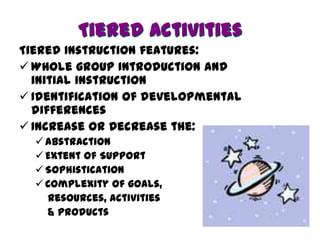
Tiered Activities
Tiered Instruction features:
 Whole group introduction and
  initial instruction
 Identification of developmental
  differences
 Increase or Decrease the:
   Abstraction
   Extent of Support
   Sophistication
   Complexity of goals,
    resources, activities
    & products
The “Equalizer”
1. Foundational Transformational                5. Smaller Leap   Greater Leap


2. Concrete          Abstract                   6. More Structured     More Open


3. Simple         Complex                       7. Clearly Defined Problems Fuzzy Problems


                                                8. Less Independence Greater Independence
4. Fewer Facets Multi-facets


                                                9. Slower         Quicker


     Based on the work of Carol Ann Tomlinson
Which tier isconcept?
        What is the which?
Pairs of students are   Pairs of students are   Pairs of students are
given a set of “real-   given a set of “real-   given a set of “real-
number” cards and       number” cards and a     number” cards and a
a blank number line.    blank Venn diagram      blank Venn diagram
                        which has three         which has three
Students must sort
                        overlapping circles     overlapping circles
their cards and         labeled as follows:     which are not labeled.
decide where to         numbers greater than    Students must sort
place each on the       1½, numbers less        their cards and decide
number line.            than 3.5, and numbers   on labels for each of
Students complete       between 0 and 15.       the circles. Then
the lesson by writing   Students write each     students write each
each number on the      number in the           number in the
                        appropriate circle.     appropriate circle.
number line.
Is this lesson tiered by content, process, or product?
Pairs of students are   Pairs of students are   Pairs of students are
given a set of “real-   given a set of “real-   given a set of “real-
number” cards and       number” cards and a     number” cards and a
a blank number line.    blank Venn diagram      blank Venn diagram
                        which has three         which has three
Students must sort
                        overlapping circles     overlapping circles
their cards and         labeled as follows:     which are not labeled.
decide where to         numbers greater than    Students must sort
place each on the       1½, numbers less        their cards and decide
number line.            than 3.5, and numbers   on labels for each of
Students complete       between 0 and 15.       the circles. Then
the lesson by writing   Students write each     students write each
each number on the      number in the           number in the
                        appropriate circle.     appropriate circle.
number line.
Is this lesson tiered by interest, learning
              style, or readiness?

Pairs of students are   Pairs of students are   Pairs of students are
given a set of “real-   given a set of “real-   given a set of “real-
number” cards and       number” cards and a     number” cards and a
a blank number line.    blank Venn diagram      blank Venn diagram
                        which has three         which has three
Students must sort
                        overlapping circles     overlapping circles
their cards and         labeled as follows:     which are not labeled.
decide where to         numbers greater than    Students must sort
place each on the       1½, numbers less        their cards and decide
number line.            than 3.5, and numbers   on labels for each of
Students complete       between 0 and 15.       the circles. Then
the lesson by writing   Students write each     students write each
each number on the      number in the           number in the
                        appropriate circle.     appropriate circle.
number line.
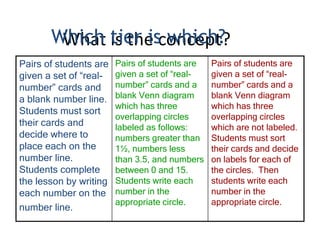
4th Grade Math
This lesson is tiered in product according to readiness.

Tier I: Basic Learners
• Pairs of students are given a set of “real-number” cards and a blank Venn
   diagram which has three overlapping circles labeled as follows: numbers
   greater then 1½, numbers less than 3.5, and numbers between 0 and 15.
   Students write each number in the appropriate circle.

Tier II: Grade Level Learners
• Pairs of students are given a set of “real-number” cards and a blank Venn
   diagram which has three overlapping circles which are not labeled.
   Students must sort their cards and decide on labels for each of the circles.
   Then students write each number in the appropriate circle.

Tier III: Advanced Learners
• Pairs of students are given a set of “real-number” cards and a blank number
   line. Students must sort their cards and decide where to place each on the
   number line. Students complete the lesson by writing each number on the
   number line.
                             http://ideanet.doe.state.in.us/exceptional/gt/tiered_curriculum/welcome.html
IDENTIFY OUTCOMES
WHAT SHOULD THE STUDENTS KNOW, UNDERSTAND, OR BE ABLE TO DO?


          THINK ABOUT YOUR STUDENTS
          PRE-ASSESS READINESS, INTEREST, OR LEARNING PROFILE


             INITIATING ACTIVITIES
             USE AS COMMON EXPERIENCE FOR WHOLE CLASS


GROUP 1                     GROUP 2                     GROUP 3
TASK                        TASK                        TASK
Video
• Cubing example
Cubing
Exploration Cube Example
  How is exploration          How should
from the past different     explorations be
   to more current        conducted in the 21st
     exploration?              century?

 What is Exploration?       What benefits are
                          there to exploration?
    What common
 characteristics do all   How has exploration
  explorers possess?      changed over time?
Talk &
                   Do
Listen        30 minutes
30 minutes


    Synthesiz
        e
      30 minutes
Primary Objectives / Topics / Skills


 Average
  Level


Advanced
  Level


Remedial
 Level
Talk &
                     Do
Listen         30 minutes
30 minutes


      Synthesiz
          e
        30 minutes
What Can Be Tiered?


•   Assignments        •   Experiments
•   Activities         •   Materials
•   Homework           •   Assessments
•   Learning Centers   •   Writing Prompts
Management Tips
 The number of tiers will depend on the range in the
  classroom.
 Form tiers based on assessment of your students’
  abilities to handle the material.
 Students are re-grouped the next time you use
  tiering as a strategy.
 Match the task's degree of difficulty and its pacing to
  student readiness.
Tiering by Interest
 Look at student characteristics other than
  ability level.
 Teachers give all students choices of content,
  process, or product that are at approximately
  the same ability level.
 These tiers are similar to those in a layer
  cake—all the same size.
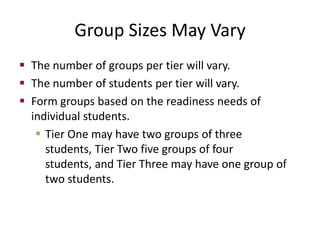
Group Sizes May Vary
 The number of groups per tier will vary.
 The number of students per tier will vary.
 Form groups based on the readiness needs of
  individual students.
    Tier One may have two groups of three
     students, Tier Two five groups of four
     students, and Tier Three may have one group of
     two students.
Managing Groups

Think about how to give directions to
different groups
Quick Tip for Forming Groups
• Color Swish = Readiness Level
              (Blue, Red, Green, Purple)
• Letter = Learning Style
              (A, B, C, D)
• Number = Random Assignment or
  Specific Tasks
  (1, 2, 3, 4)
                                    B 2
Modified for Specialists
Minimum Requirements


Build a complex machine which is made up of at least two simple machines
and can move a roll of pennies 3 feet.
All thinking begins
   with wonder.

             - Socrates
“Our job is not to make up
anybody’s mind, but to open minds
and to make the agony of decision-
 making so intense you can escape
        only by thinking.”


                      -Fred Friendly
                          Broadcaster
2012 classroom makeover day 4

2012 classroom makeover day 4

  • 1.
  • 3.
  • 4.
  • 5.
  • 6.
  • 7.
    Today’s Objective O Participants will be able to apply the cubing method to increase the degree of higher- order thinking used in their classrooms.
  • 8.
    Talk & Do Listen 30 minutes 30 minutes Synthesize 30 minutes
  • 9.
    From the Centerfor Media Literacy in New Mexico “If we are literate in our subject, we can: access (understand and find meaning in) analyze, evaluate and create the subject or medium.”
  • 10.
    Talk & Do Listen 30 minutes 30 minutes Synthesiz e 30 minutes
  • 11.
    Tiered Activities Tiered Instructionfeatures:  Whole group introduction and initial instruction  Identification of developmental differences  Increase or Decrease the:  Abstraction  Extent of Support  Sophistication  Complexity of goals, resources, activities & products
  • 12.
    The “Equalizer” 1. FoundationalTransformational 5. Smaller Leap Greater Leap 2. Concrete Abstract 6. More Structured More Open 3. Simple Complex 7. Clearly Defined Problems Fuzzy Problems 8. Less Independence Greater Independence 4. Fewer Facets Multi-facets 9. Slower Quicker Based on the work of Carol Ann Tomlinson
  • 13.
    Which tier isconcept? What is the which? Pairs of students are Pairs of students are Pairs of students are given a set of “real- given a set of “real- given a set of “real- number” cards and number” cards and a number” cards and a a blank number line. blank Venn diagram blank Venn diagram which has three which has three Students must sort overlapping circles overlapping circles their cards and labeled as follows: which are not labeled. decide where to numbers greater than Students must sort place each on the 1½, numbers less their cards and decide number line. than 3.5, and numbers on labels for each of Students complete between 0 and 15. the circles. Then the lesson by writing Students write each students write each each number on the number in the number in the appropriate circle. appropriate circle. number line.
  • 14.
    Is this lessontiered by content, process, or product? Pairs of students are Pairs of students are Pairs of students are given a set of “real- given a set of “real- given a set of “real- number” cards and number” cards and a number” cards and a a blank number line. blank Venn diagram blank Venn diagram which has three which has three Students must sort overlapping circles overlapping circles their cards and labeled as follows: which are not labeled. decide where to numbers greater than Students must sort place each on the 1½, numbers less their cards and decide number line. than 3.5, and numbers on labels for each of Students complete between 0 and 15. the circles. Then the lesson by writing Students write each students write each each number on the number in the number in the appropriate circle. appropriate circle. number line.
  • 15.
    Is this lessontiered by interest, learning style, or readiness? Pairs of students are Pairs of students are Pairs of students are given a set of “real- given a set of “real- given a set of “real- number” cards and number” cards and a number” cards and a a blank number line. blank Venn diagram blank Venn diagram which has three which has three Students must sort overlapping circles overlapping circles their cards and labeled as follows: which are not labeled. decide where to numbers greater than Students must sort place each on the 1½, numbers less their cards and decide number line. than 3.5, and numbers on labels for each of Students complete between 0 and 15. the circles. Then the lesson by writing Students write each students write each each number on the number in the number in the appropriate circle. appropriate circle. number line.
  • 16.
    4th Grade Math Thislesson is tiered in product according to readiness. Tier I: Basic Learners • Pairs of students are given a set of “real-number” cards and a blank Venn diagram which has three overlapping circles labeled as follows: numbers greater then 1½, numbers less than 3.5, and numbers between 0 and 15. Students write each number in the appropriate circle. Tier II: Grade Level Learners • Pairs of students are given a set of “real-number” cards and a blank Venn diagram which has three overlapping circles which are not labeled. Students must sort their cards and decide on labels for each of the circles. Then students write each number in the appropriate circle. Tier III: Advanced Learners • Pairs of students are given a set of “real-number” cards and a blank number line. Students must sort their cards and decide where to place each on the number line. Students complete the lesson by writing each number on the number line. http://ideanet.doe.state.in.us/exceptional/gt/tiered_curriculum/welcome.html
  • 17.
    IDENTIFY OUTCOMES WHAT SHOULDTHE STUDENTS KNOW, UNDERSTAND, OR BE ABLE TO DO? THINK ABOUT YOUR STUDENTS PRE-ASSESS READINESS, INTEREST, OR LEARNING PROFILE INITIATING ACTIVITIES USE AS COMMON EXPERIENCE FOR WHOLE CLASS GROUP 1 GROUP 2 GROUP 3 TASK TASK TASK
  • 18.
  • 19.
  • 20.
    Exploration Cube Example How is exploration How should from the past different explorations be to more current conducted in the 21st exploration? century? What is Exploration? What benefits are there to exploration? What common characteristics do all How has exploration explorers possess? changed over time?
  • 21.
    Talk & Do Listen 30 minutes 30 minutes Synthesiz e 30 minutes
  • 22.
    Primary Objectives /Topics / Skills Average Level Advanced Level Remedial Level
  • 23.
    Talk & Do Listen 30 minutes 30 minutes Synthesiz e 30 minutes
  • 24.
    What Can BeTiered? • Assignments • Experiments • Activities • Materials • Homework • Assessments • Learning Centers • Writing Prompts
  • 25.
    Management Tips  Thenumber of tiers will depend on the range in the classroom.  Form tiers based on assessment of your students’ abilities to handle the material.  Students are re-grouped the next time you use tiering as a strategy.  Match the task's degree of difficulty and its pacing to student readiness.
  • 26.
    Tiering by Interest Look at student characteristics other than ability level.  Teachers give all students choices of content, process, or product that are at approximately the same ability level.  These tiers are similar to those in a layer cake—all the same size.
  • 27.
    Group Sizes MayVary  The number of groups per tier will vary.  The number of students per tier will vary.  Form groups based on the readiness needs of individual students.  Tier One may have two groups of three students, Tier Two five groups of four students, and Tier Three may have one group of two students.
  • 28.
    Managing Groups Think abouthow to give directions to different groups
  • 29.
    Quick Tip forForming Groups • Color Swish = Readiness Level (Blue, Red, Green, Purple) • Letter = Learning Style (A, B, C, D) • Number = Random Assignment or Specific Tasks (1, 2, 3, 4) B 2 Modified for Specialists
  • 30.
    Minimum Requirements Build acomplex machine which is made up of at least two simple machines and can move a roll of pennies 3 feet.
  • 31.
    All thinking begins with wonder. - Socrates
  • 32.
    “Our job isnot to make up anybody’s mind, but to open minds and to make the agony of decision- making so intense you can escape only by thinking.” -Fred Friendly Broadcaster