time management
                   dr. m m bagali

        PhD (HRD & OB area) ; PhD (Management)
      Assistant Professor of Management & Human Resources,
         KLE Institute of Management Studies & Research,
Research Center Incharge, Centre for Advanced Studies in HR and OB,
         (A Center for Creating Future People work for you)
                      sanbag@rediffmail.com

                                                                1
t
abcdefghijk
lm nopqrs u
vwxyz    2
3can

     Can we manage time?
  Can we really manage time?
Can we really really manage time?


                                    3
we

We      all have time to either spend or
waste and it is our decision what to do
with it. But once passed, it is gone
forever

                                      4
we
What can be done at any time is never
done at all, because if you don't take care
of the minutes, for the hours will not take
care of themselves

If we take care of the minutes, the years will take care of
themselves, and your life


                                                       5
we
Time is the coin of your life. It is
the only coin you have, and only
you can determine how it will be
spent. Be careful lest you let
other people spend it for you

                                       6
we

The      secret of a person's
success is discovered in his
daily agenda,which says about
time and how one spends this
for rest of the life
                            7
Why we Waste TIME

Poor Attitude towards job
No Agenda
No Personal Plan of Growth
Lack of Clear cut Policies
No Prior Planning
Leaving work half done
No delegating attitude
Unnecessary Prolong Meeting
                              8
No organization of person, activity, functioning
Time waster
Worry on trivial matters
Too much work at a time
No priority
Disciplined approach
Unplanned activity
No focus / goals
Unplanned phones calls
No scheduling of assignments                 9
Clarity of urgent and not urgent work
Start work without planning
No Scheduling / time table
Bogged dawn with one work
Mix work- family work at same place
Handling tooo much duty
Interruptions - telephone
Interruptions - personal visitors
No diplomacy where needed
Ad-hoc interpretations / distractions   10
Tasks you should have delegated
Procrastination and indecision
Acting with incomplete information
Crisis management (more fire fighting)
Unclear communication
Inadequate technical knowledge
Unclear objectives and priorities
Lack of planning / planning / planning
                                         11
Value of TIME

       If you are a man of business,
        Come to a man of business
     Solely for the matter of business
      Quickly transact your business
      Then go back to your business
Leaving other to attend ones own business
        that’s b u s i n e s s
                                      12
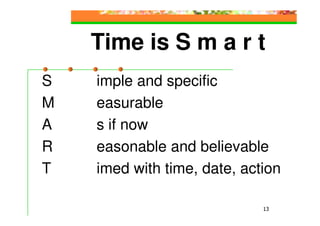
Time is S m a r t
S   imple and specific
M   easurable
A   s if now
R   easonable and believable
T   imed with time, date, action

                             13
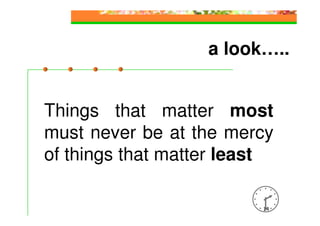
a look…..


Things that matter most
must never be at the mercy
of things that matter least

                         14
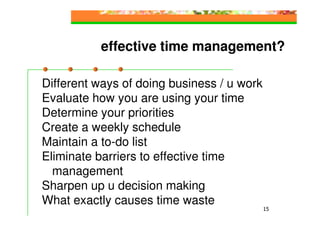
effective time management?

Different ways of doing business / u work
Evaluate how you are using your time
Determine your priorities
Create a weekly schedule
Maintain a to-do list
Eliminate barriers to effective time
  management
Sharpen up u decision making
What exactly causes time waste
                                            15
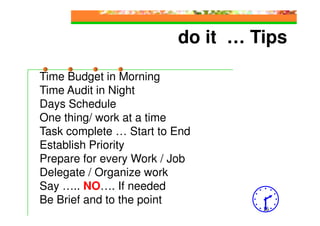
do it … Tips

Time Budget in Morning
Time Audit in Night
Days Schedule
One thing/ work at a time
Task complete … Start to End
Establish Priority
Prepare for every Work / Job
Delegate / Organize work
Say ….. NO…. If needed
Be Brief and to the point
                                  16
One thing at a time and that too done well
Form a habit of completing a given a task
Never leave a task unfinished
Cut meetings
If phone, don’t write / if email, don’t phone
A time for everything
Time slots for unplanned activity
Time slots for desperate emergencies

                                            17
15-30 minutes for concentration
15-30 for newspaper/journal / general reading
Take break / relax
Office problem not for the home / visa versa
Make lunch break a real break
Away from useless discussion
Schedule a call back period (after lunch is good)


                                             18
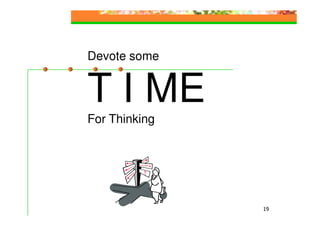
Devote some


T I ME
For Thinking


               19
?
      Commitment
             to
        Change
habit / routine / behavior
                         20
Evaluating your use of time

Make a list of the activities that you spend
      time on

Identify how much time the activities
        consume

Take note of activities you are keeping up
      with versus activities you are falling
      behind on
                                        21
P rio ritiz in g T a s k s
a n d A llo c a tin g T im e

  A n u rg e n cy /im p o rta n ce m a p o r m a trix
  h e lp s y o u to ca te g o rize , p rio ritize a n d
  th e re fo re a llo ca te tim e to ta sk s.
  T h e m a p o r m a trix ca te g o rize s ta sk s b y
  a sse ssin g :
     U rg e n cy (H o w so o n d o e s it n e e d to b e d o n e ?
     H o w q u ick ly m u st it b e a d d re sse d ?), a n d
     Im p o rta n ce (H o w im p o rta n t is th is issu e to
     o u r b u sin e ss? H o w ce n tra l is it to o u r
     su cce ss?)

                                                                22
Tips on evaluating your time
Be systematic: Start in the morning and go
 through the day when thinking of your activities

Don’t overlook activities like commuting, taking
 care of yourself, and relaxing. These activities
 may not be work or school related, but they
 consume time too

Be realistic. People often fail to allow enough
 time for activities.
                                              23
Priorities

The Task
The Work
The Activity
and The Priorities

and the   TIME
                          24
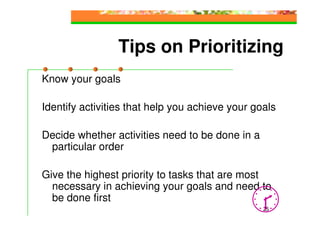
Tips on Prioritizing
Know your goals

Identify activities that help you achieve your goals

Decide whether activities need to be done in a
 particular order

Give the highest priority to tasks that are most
  necessary in achieving your goals and need to
  be done first
                                                 25
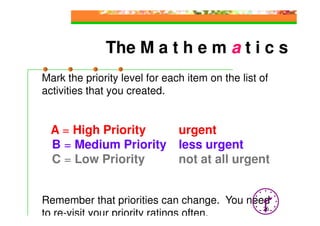
The M a t h e m a t i c s
Mark the priority level for each item on the list of
activities that you created.


  A = High Priority            urgent
  B = Medium Priority          less urgent
  C = Low Priority             not at all urgent


Remember that priorities can change. You need
                                            26
to re-visit your priority ratings often.
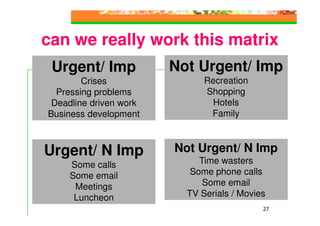
can we really work this matrix
 Urgent/ Imp            Not Urgent/ Imp
        Crises                Recreation
  Pressing problems           Shopping
 Deadline driven work           Hotels
Business development           Family


Urgent/ N Imp           Not Urgent/ N Imp
    Some calls               Time wasters
    Some email             Some phone calls
     Meetings                 Some email
     Luncheon             TV Serials / Movies
                                            27
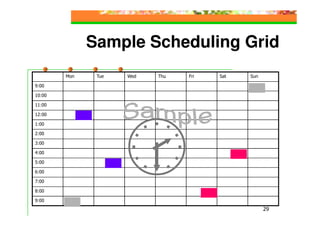
A Weekly Schedule Matrix


                           28
Sample Scheduling Grid
        Mon    Tue   Wed   Thu   Fri   Sat   Sun

9:00

10:00

11:00

12:00

1:00

2:00

3:00

4:00

5:00

6:00

7:00

8:00

9:00
                                                   29
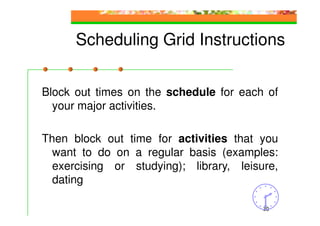
Scheduling Grid Instructions


Block out times on the schedule for each of
  your major activities.

Then block out time for activities that you
  want to do on a regular basis (examples:
  exercising or studying); library, leisure,
  dating

                                         30
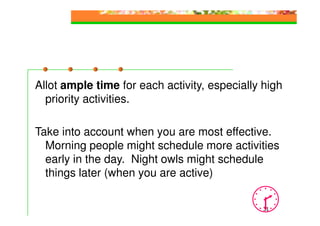
Allot ample time for each activity, especially high
  priority activities.

Take into account when you are most effective.
  Morning people might schedule more activities
  early in the day. Night owls might schedule
  things later (when you are active)


                                               31
32
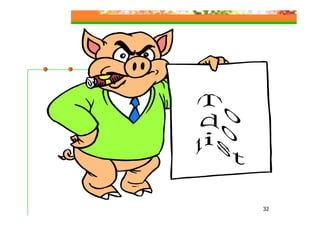
To-Do Lists

Personal
Professional
Home
Office
Market
Relatives

Any E m e r g e n c y ?
                            33
Make a written list of specific tasks or
  assignments that you need to do.
Plan ahead, taking into account the entire
  work.
Allot time for these tasks in your schedule.
  Keep in mind their due dates.
Assign priority ratings (A, B, or C) and
  revise as needed.
                                          34
Barriers to Effective
                 Time Management
Distractions

Disorganization

Perfectionism

Procrastination

Rigidity                         35
M a n a g in g T a s k s & T im e -
D e le g a t io n : W h a t is it ?

 D e le g a t io n in v o lv e s g iv in g s o m e o n e e ls e
 t h e r e s p o n s ib ilit y t o p e r f o r m a t a s k t h a t is
 a c t u a lly p a r t o f y o u r o w n jo b .
  R e a s o n s f o r d e le g a t io n :
     C a n h e lp t o c r e a t e t h e t im e n e e d e d f o r o t h e r
     v it a l f u n c t io n s .
     I t d e v e lo p s t h e s k ills o f e v e r y o n e in t h e t e a m .
     E v e r y o n e b e c o m e s m o r e in v o lv e d in h e lp in g
     t o a c h ie v e g o a ls .


                                                                          36
W h y n o t D e le g a t e ?

T h e r e a s o n s w e m ig h t g iv e f o r n o t d e le g a t in g
   in c lu d e :
       A s k in g f o r h e lp in d ic a t e s a la c k o f a b ilit y .
       N o b o d y e ls e c a n b e t r u s t e d t o d o t h e jo b p r o p e r ly .
       S o m e o n e e ls e w ill d o a b e t t e r jo b a n d t a k e t h e c r e d it .
       N o b o d y e ls e c a n a c t u a lly h e lp .
       F e e l g u ilt y a b o u t t h e a c t o f d e le g a t in g w o r k .
       R e lu c t a n t t o r e lin q u is h a n y p a r t o f t h e w o r k b e c a u s e
       y o u e n jo y d o in g it .


                                                                                      37
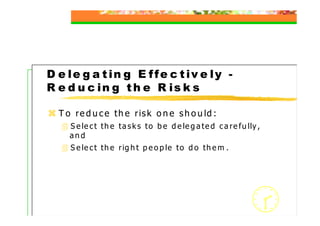
D e le g a t in g E ffe c t iv e ly -
R e d u c in g t h e R is k s

  T o r e d u c e t h e r is k o n e s h o u ld :
     S e le c t t h e t a s k s t o b e d e le g a t e d c a r e f u lly ,
     and
     S e le c t t h e r ig h t p e o p le t o d o t h e m .


                                                                             38
Distractions


Tell people when you are busy and cannot be
  disturbed

Work in areas where you are less likely to be
 disturbed

It is easier to get distracted when you are tired

…. It is up to u to welcome
                                                    39
Disorganization


Keep things that you need in a specific place.
Eliminate clutter
Before starting on a task, make sure that you have
all of the materials or information that you need
Follow your schedule
If u have decided to be disorganized, no one can
help u


                                                 40
Perfectionism


Examine whether your efforts to get the job done
perfectly are really improving things or preventing
you from getting the job done

Think about the cost-benefit ratio of the extra effort


Remember that nothing is perfect

                                                         41
Procrastination

It is easy to put off tasks if they are not due right
away. The trouble is, tasks pile up and you can
run into a time crunch later.

Remember to work ahead whenever possible.


If you can do it today, do it!


                                                        42
Rigidity


It is important to have some flexibility in
your schedule. Allow extra time and avoid
becoming too frustrated if things don’t
work out as planned… just re-evaluate
the plan and make adjustments.


                                         43
Remember quietly………


Don't say you don't have enough time.
You have exactly the same number of
hours per day that were given to
Michelangelo,      Mother     Teresa,
Leonardo da Vinci, Albert Einstein,
and Ratan TATA

                                  44
the how’s
How we spend our days is
how we spend our lives
How we spend our life is
how is spend our T I M E

                           45
r e m e m b e r


Don't put off for tomorrow what you
can do today because if you enjoy
it today, you can do it again
tomorrow

                               46
don’t wait
                     don’


         if you wait until
  wind and the weather are
just right, you will never plant
      anything, and never
        harvest anything

                               47
where do you go from here
                        48
thank you all


           49

Bagali MM Time Management Bagali [Compatibility Mode]

  • 1.
    time management dr. m m bagali PhD (HRD & OB area) ; PhD (Management) Assistant Professor of Management & Human Resources, KLE Institute of Management Studies & Research, Research Center Incharge, Centre for Advanced Studies in HR and OB, (A Center for Creating Future People work for you) sanbag@rediffmail.com 1
  • 2.
  • 3.
    3can Can we manage time? Can we really manage time? Can we really really manage time? 3
  • 4.
    we We all have time to either spend or waste and it is our decision what to do with it. But once passed, it is gone forever 4
  • 5.
    we What can bedone at any time is never done at all, because if you don't take care of the minutes, for the hours will not take care of themselves If we take care of the minutes, the years will take care of themselves, and your life 5
  • 6.
    we Time is thecoin of your life. It is the only coin you have, and only you can determine how it will be spent. Be careful lest you let other people spend it for you 6
  • 7.
    we The secret of a person's success is discovered in his daily agenda,which says about time and how one spends this for rest of the life 7
  • 8.
    Why we WasteTIME Poor Attitude towards job No Agenda No Personal Plan of Growth Lack of Clear cut Policies No Prior Planning Leaving work half done No delegating attitude Unnecessary Prolong Meeting 8
  • 9.
    No organization ofperson, activity, functioning Time waster Worry on trivial matters Too much work at a time No priority Disciplined approach Unplanned activity No focus / goals Unplanned phones calls No scheduling of assignments 9
  • 10.
    Clarity of urgentand not urgent work Start work without planning No Scheduling / time table Bogged dawn with one work Mix work- family work at same place Handling tooo much duty Interruptions - telephone Interruptions - personal visitors No diplomacy where needed Ad-hoc interpretations / distractions 10
  • 11.
    Tasks you shouldhave delegated Procrastination and indecision Acting with incomplete information Crisis management (more fire fighting) Unclear communication Inadequate technical knowledge Unclear objectives and priorities Lack of planning / planning / planning 11
  • 12.
    Value of TIME If you are a man of business, Come to a man of business Solely for the matter of business Quickly transact your business Then go back to your business Leaving other to attend ones own business that’s b u s i n e s s 12
  • 13.
    Time is Sm a r t S imple and specific M easurable A s if now R easonable and believable T imed with time, date, action 13
  • 14.
    a look….. Things thatmatter most must never be at the mercy of things that matter least 14
  • 15.
    effective time management? Differentways of doing business / u work Evaluate how you are using your time Determine your priorities Create a weekly schedule Maintain a to-do list Eliminate barriers to effective time management Sharpen up u decision making What exactly causes time waste 15
  • 16.
    do it …Tips Time Budget in Morning Time Audit in Night Days Schedule One thing/ work at a time Task complete … Start to End Establish Priority Prepare for every Work / Job Delegate / Organize work Say ….. NO…. If needed Be Brief and to the point 16
  • 17.
    One thing ata time and that too done well Form a habit of completing a given a task Never leave a task unfinished Cut meetings If phone, don’t write / if email, don’t phone A time for everything Time slots for unplanned activity Time slots for desperate emergencies 17
  • 18.
    15-30 minutes forconcentration 15-30 for newspaper/journal / general reading Take break / relax Office problem not for the home / visa versa Make lunch break a real break Away from useless discussion Schedule a call back period (after lunch is good) 18
  • 19.
    Devote some T IME For Thinking 19
  • 20.
    ? Commitment to Change habit / routine / behavior 20
  • 21.
    Evaluating your useof time Make a list of the activities that you spend time on Identify how much time the activities consume Take note of activities you are keeping up with versus activities you are falling behind on 21
  • 22.
    P rio ritizin g T a s k s a n d A llo c a tin g T im e A n u rg e n cy /im p o rta n ce m a p o r m a trix h e lp s y o u to ca te g o rize , p rio ritize a n d th e re fo re a llo ca te tim e to ta sk s. T h e m a p o r m a trix ca te g o rize s ta sk s b y a sse ssin g : U rg e n cy (H o w so o n d o e s it n e e d to b e d o n e ? H o w q u ick ly m u st it b e a d d re sse d ?), a n d Im p o rta n ce (H o w im p o rta n t is th is issu e to o u r b u sin e ss? H o w ce n tra l is it to o u r su cce ss?) 22
  • 23.
    Tips on evaluatingyour time Be systematic: Start in the morning and go through the day when thinking of your activities Don’t overlook activities like commuting, taking care of yourself, and relaxing. These activities may not be work or school related, but they consume time too Be realistic. People often fail to allow enough time for activities. 23
  • 24.
    Priorities The Task The Work TheActivity and The Priorities and the TIME 24
  • 25.
    Tips on Prioritizing Knowyour goals Identify activities that help you achieve your goals Decide whether activities need to be done in a particular order Give the highest priority to tasks that are most necessary in achieving your goals and need to be done first 25
  • 26.
    The M at h e m a t i c s Mark the priority level for each item on the list of activities that you created. A = High Priority urgent B = Medium Priority less urgent C = Low Priority not at all urgent Remember that priorities can change. You need 26 to re-visit your priority ratings often.
  • 27.
    can we reallywork this matrix Urgent/ Imp Not Urgent/ Imp Crises Recreation Pressing problems Shopping Deadline driven work Hotels Business development Family Urgent/ N Imp Not Urgent/ N Imp Some calls Time wasters Some email Some phone calls Meetings Some email Luncheon TV Serials / Movies 27
  • 28.
  • 29.
    Sample Scheduling Grid Mon Tue Wed Thu Fri Sat Sun 9:00 10:00 11:00 12:00 1:00 2:00 3:00 4:00 5:00 6:00 7:00 8:00 9:00 29
  • 30.
    Scheduling Grid Instructions Blockout times on the schedule for each of your major activities. Then block out time for activities that you want to do on a regular basis (examples: exercising or studying); library, leisure, dating 30
  • 31.
    Allot ample timefor each activity, especially high priority activities. Take into account when you are most effective. Morning people might schedule more activities early in the day. Night owls might schedule things later (when you are active) 31
  • 32.
  • 33.
  • 34.
    Make a writtenlist of specific tasks or assignments that you need to do. Plan ahead, taking into account the entire work. Allot time for these tasks in your schedule. Keep in mind their due dates. Assign priority ratings (A, B, or C) and revise as needed. 34
  • 35.
    Barriers to Effective Time Management Distractions Disorganization Perfectionism Procrastination Rigidity 35
  • 36.
    M a na g in g T a s k s & T im e - D e le g a t io n : W h a t is it ? D e le g a t io n in v o lv e s g iv in g s o m e o n e e ls e t h e r e s p o n s ib ilit y t o p e r f o r m a t a s k t h a t is a c t u a lly p a r t o f y o u r o w n jo b . R e a s o n s f o r d e le g a t io n : C a n h e lp t o c r e a t e t h e t im e n e e d e d f o r o t h e r v it a l f u n c t io n s . I t d e v e lo p s t h e s k ills o f e v e r y o n e in t h e t e a m . E v e r y o n e b e c o m e s m o r e in v o lv e d in h e lp in g t o a c h ie v e g o a ls . 36
  • 37.
    W h yn o t D e le g a t e ? T h e r e a s o n s w e m ig h t g iv e f o r n o t d e le g a t in g in c lu d e : A s k in g f o r h e lp in d ic a t e s a la c k o f a b ilit y . N o b o d y e ls e c a n b e t r u s t e d t o d o t h e jo b p r o p e r ly . S o m e o n e e ls e w ill d o a b e t t e r jo b a n d t a k e t h e c r e d it . N o b o d y e ls e c a n a c t u a lly h e lp . F e e l g u ilt y a b o u t t h e a c t o f d e le g a t in g w o r k . R e lu c t a n t t o r e lin q u is h a n y p a r t o f t h e w o r k b e c a u s e y o u e n jo y d o in g it . 37
  • 38.
    D e leg a t in g E ffe c t iv e ly - R e d u c in g t h e R is k s T o r e d u c e t h e r is k o n e s h o u ld : S e le c t t h e t a s k s t o b e d e le g a t e d c a r e f u lly , and S e le c t t h e r ig h t p e o p le t o d o t h e m . 38
  • 39.
    Distractions Tell people whenyou are busy and cannot be disturbed Work in areas where you are less likely to be disturbed It is easier to get distracted when you are tired …. It is up to u to welcome 39
  • 40.
    Disorganization Keep things thatyou need in a specific place. Eliminate clutter Before starting on a task, make sure that you have all of the materials or information that you need Follow your schedule If u have decided to be disorganized, no one can help u 40
  • 41.
    Perfectionism Examine whether yourefforts to get the job done perfectly are really improving things or preventing you from getting the job done Think about the cost-benefit ratio of the extra effort Remember that nothing is perfect 41
  • 42.
    Procrastination It is easyto put off tasks if they are not due right away. The trouble is, tasks pile up and you can run into a time crunch later. Remember to work ahead whenever possible. If you can do it today, do it! 42
  • 43.
    Rigidity It is importantto have some flexibility in your schedule. Allow extra time and avoid becoming too frustrated if things don’t work out as planned… just re-evaluate the plan and make adjustments. 43
  • 44.
    Remember quietly……… Don't sayyou don't have enough time. You have exactly the same number of hours per day that were given to Michelangelo, Mother Teresa, Leonardo da Vinci, Albert Einstein, and Ratan TATA 44
  • 45.
    the how’s How wespend our days is how we spend our lives How we spend our life is how is spend our T I M E 45
  • 46.
    r e me m b e r Don't put off for tomorrow what you can do today because if you enjoy it today, you can do it again tomorrow 46
  • 47.
    don’t wait don’ if you wait until wind and the weather are just right, you will never plant anything, and never harvest anything 47
  • 48.
    where do yougo from here 48
  • 49.