
Dr. N. Sivaranjani
Asst. Prof.
1
BY
VANA JAGAN MOHAN RAO M.S.Pharm, MED.CHEM
NIPER,KOLKATA
Asst. Professor, MIPER- KURNOOL
Email: jaganvana6@gmail.com
* Ammonia is produced in most tissues – less than 1% is TOXIC
especially to CNS
Readily ionizes to ammonium ion NH4
+
*It is immediately removed from the circulation and detoxified to
Urea in the LIVER.
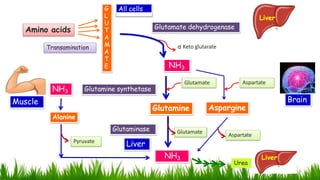
* Three transport forms of NH3 from peripheral tissues to LIVER:
1. Glutamate – ALL tissues
2. Glutamine – Brain
3. Alanine - Muscle
4NH +
pKa = 9.3
NH3 + H+
2
3NH +CH
COO-
COO-
CH2
CH2
Glutamate
NH3
+CH
CO--
CH2
CH2
Glutamine
3NH +CH
COO-
COO-
CH2
CH2
Glutamate
ATP ADP+Pi NH3
NH3
H2O
Glutamine synthetase
COO-
Glutaminase
Liver
Mitochondria
NH2
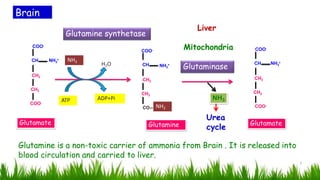
Glutamine is a non-toxic carrier of ammonia from Brain . It is released into
blood circulation and carried to liver.
Urea
cycle
Brain
3
Glucose-Alanine cycle
4
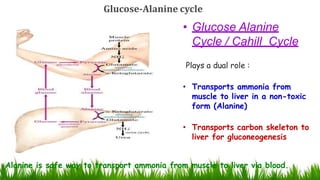
• Glucose Alanine
Cycle / Cahill Cycle
Plays a dual role :
• Transports ammonia from
muscle to liver in a non-toxic
form (Alanine)
• Transports carbon skeleton to
liver for gluconeogenesis
Alanine is safe way to transport ammonia from muscle to liver via blood.
Amino acids
G
L
U
T
A
M
A
T
E NH3
α Keto glutarate
Glutamate dehydrogenase
Transamination
Glutamine
Glutamate
Glutamate
NH3
Urea
Glutamine synthetase
Glutaminase
Alanine
Brain
Liver
Aspargine
Muscle
All cells
Pyruvate
NH3
Aspartate
Aspartate
Liver
Liver
5
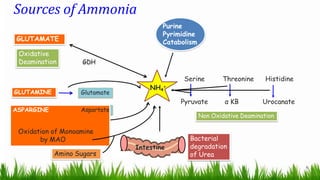
Sources of Ammonia
6
Intestine
GLUTAMINE Glutamate
Bacterial
degradation
of Urea
GDH
GLUTAMATE
Serine Threonine Histidine
Pyruvate α KB Urocanate
NH4
+
Purine
Pyrimidine
Catabolism
ASPARGINE Aspartate
Oxidation of Monoamine
by MAO
Amino Sugars
Non Oxidative Deamination
Oxidative
Deamination
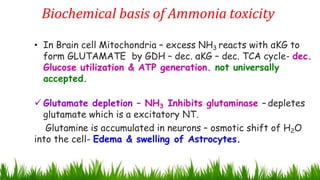
Biochemical basis of Ammonia toxicity
7
• In Brain cell Mitochondria – excess NH3 reacts with αKG to
form GLUTAMATE by GDH – dec. αKG – dec. TCA cycle- dec.
Glucose utilization & ATP generation. not universally
accepted.
 Glutamate depletion – NH3 Inhibits glutaminase – depletes
glutamate which is a excitatory NT.
Glutamine is accumulated in neurons – osmotic shift of H2O
into the cell- Edema & swelling of Astrocytes.
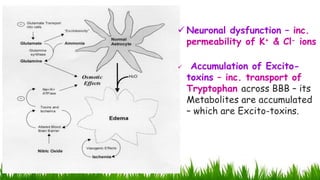
 Neuronal dysfunction – inc.
permeability of K+ & Cl- ions
 Accumulation of Excito-
toxins – inc. transport of
Tryptophan across BBB – its
Metabolites are accumulated
– which are Excito-toxins.
8
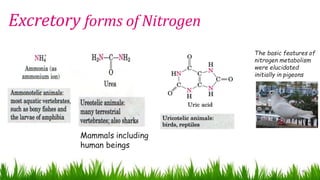
Excretory forms of Nitrogen
9
Mammals including
human beings
The basic features of
nitrogen metabolism
were elucidated
initially in pigeons
Urea cycle
10
Krebs–Henseleit urea cycle / Ornithine cycle
Site – LIVER
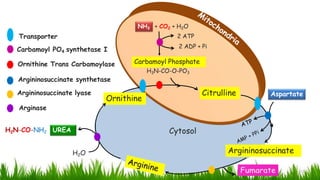
Subcellular organelle – Mitochondria , cytoplasm – 2 steps occur in
mitochondria, remaining in the cytosol.
Converts NH3 into harmless Urea
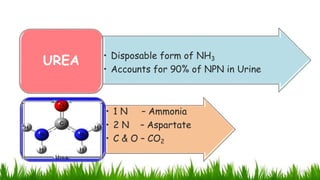
• Disposable form of NH3
• Accounts for 90% of NPN in Urine
UREA
• 1 N – Ammonia
• 2 N – Aspartate
• C & O – CO2
11
H3N-CO-O-PO3
NH3 + CO2 + H2O
2 ATP
2 ADP + Pi
Carbamoyl Phosphate
Citrulline
Argininosuccinate
Ornithine
Aspartate
UREA
H2O
Argininosuccinate lyase
Arginase
H2N-CO-NH2
Transporter
Carbamoyl PO4 synthetase I
Ornithine Trans Carbamoylase
Argininosuccinate synthetase
12
Cytosol
Significance Of Urea Cycle
13
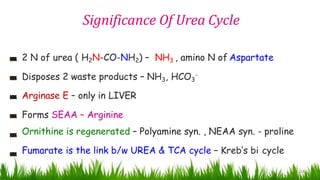
2 N of urea ( H2N-CO-NH2) – NH3 , amino N of Aspartate
Disposes 2 waste products – NH3, HCO3
-
Arginase E – only in LIVER
Forms SEAA – Arginine
Ornithine is regenerated – Polyamine syn. , NEAA syn. - proline
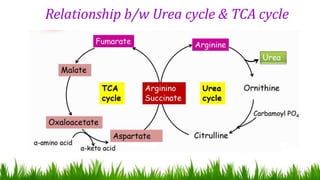
Fumarate is the link b/w UREA & TCA cycle – Kreb’s bi cycle
Relationship b/w Urea cycle & TCA cycle
16
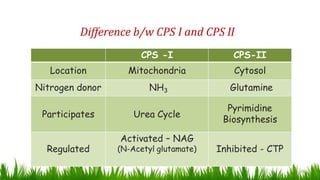
Difference b/w CPS I and CPS II
15
CPS -I CPS-II
Location Mitochondria Cytosol
Nitrogen donor NH3 Glutamine
Participates Urea Cycle
Pyrimidine
Biosynthesis
Regulated
Activated – NAG
(N-Acetyl glutamate) Inhibited - CTP
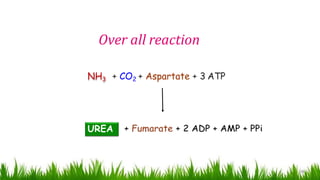
Over all reaction
16
NH3 + CO2 + Aspartate + 3 ATP
UREA
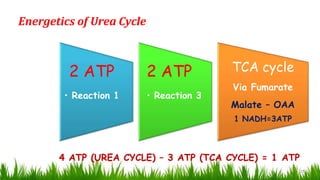
Energetics of Urea Cycle
2 ATP
• Reaction 1
2 ATP
• Reaction 3
TCA cycle
17
Via Fumarate
Malate – OAA
1 NADH=3ATP
4 ATP (UREA CYCLE) – 3 ATP (TCA CYCLE) = 1 ATP
Regulation
18
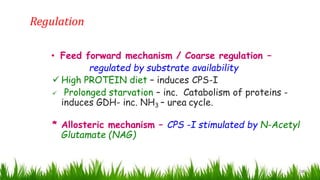
• Feed forward mechanism / Coarse regulation –
regulated by substrate availability
 High PROTEIN diet – induces CPS-I
 Prolonged starvation – inc. Catabolism of proteins -
induces GDH- inc. NH3 – urea cycle.
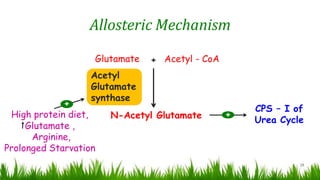
* Allosteric mechanism – CPS -I stimulated by N-Acetyl
Glutamate (NAG)
Allosteric Mechanism
19
Acetyl - CoA+
Arginine,
Prolonged Starvation
+
High protein diet,
Glutamate ,
Glutamate
Acetyl
Glutamate
synthase
N-Acetyl Glutamate
CPS – I of
Urea Cycle
+
20
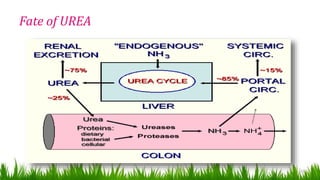
Fate of UREA
Disorders of UREA cycle
21
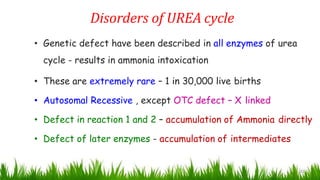
• Genetic defect have been described in all enzymes of urea
cycle - results in ammonia intoxication
• These are extremely rare – 1 in 30,000 live births
• Autosomal Recessive , except OTC defect – X linked
• Defect in reaction 1 and 2 – accumulation of Ammonia directly
• Defect of later enzymes - accumulation of intermediates
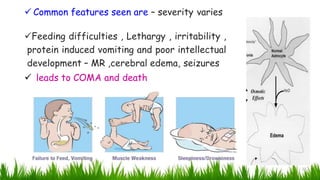
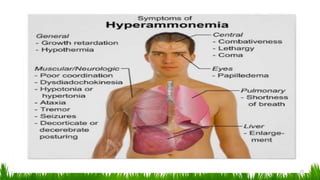
 Common features seen are – severity varies
Feeding difficulties , Lethargy , irritability ,
protein induced vomiting and poor intellectual
development – MR ,cerebral edema, seizures
 leads to COMA and death
22
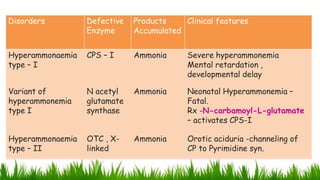
Disorders Defective
Enzyme
Products
Accumulated
Clinical features
23
Hyperammonaemia CPS – I Ammonia Severe hyperammonemia
type – I Mental retardation ,
developmental delay
Variant of N acetyl Ammonia Neonatal Hyperammonemia –
hyperammonemia glutamate Fatal.
type I synthase Rx -N-carbamoyl-L-glutamate
– activates CPS-I
Hyperammonaemia OTC , X- Ammonia Orotic aciduria -channeling of
type – II linked CP to Pyrimidine syn.
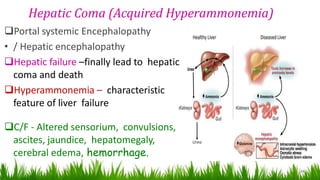
Hepatic Coma (Acquired Hyperammonemia)
Portal systemic Encephalopathy
• / Hepatic encephalopathy
Hepatic failure –finally lead to hepatic
coma and death
Hyperammonemia – characteristic
feature of liver failure
C/F - Altered sensorium, convulsions,
ascites, jaundice, hepatomegaly,
cerebral edema, hemorrhage.
24
Urea
25
26
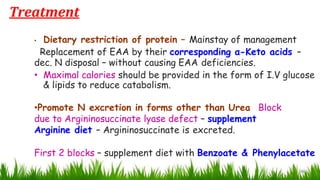
• Dietary restriction of protein – Mainstay of management
Replacement of EAA by their corresponding α-Keto acids –
dec. N disposal – without causing EAA deficiencies.
• Maximal calories should be provided in the form of I.V glucose
& lipids to reduce catabolism.
•Promote N excretion in forms other than Urea Block
due to Argininosuccinate lyase defect – supplement
Arginine diet – Argininosuccinate is excreted.
First 2 blocks – supplement diet with Benzoate & Phenylacetate
Treatment
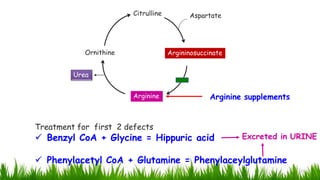
Treatment for first 2 defects
 Benzyl CoA + Glycine = Hippuric acid
 Phenylacetyl CoA + Glutamine = Phenylaceylglutamine
Arginine
Urea
Citrulline
Argininosuccinate
Aspartate
Ornithine
Arginine supplements
Excreted in URINE
27
Treatment
28
• Gene therapy is in experimental stage
• Neonatal Hyperammonaemia – Medical emergency
- requires rapid lowering of NH3
- Hemodilaysis ,
- Exchange Transfusion ,
- Peritoneal dialysis
• Hepatic Encepahalopathy
- sterilization of Gut – Lactulose laxative
- liver transplantation
- Treat the underlying cause.
Urea cycle

Urea cycle

  • 1.
    Dr. N. Sivaranjani Asst.Prof. 1 BY VANA JAGAN MOHAN RAO M.S.Pharm, MED.CHEM NIPER,KOLKATA Asst. Professor, MIPER- KURNOOL Email: jaganvana6@gmail.com
  • 2.
    * Ammonia isproduced in most tissues – less than 1% is TOXIC especially to CNS Readily ionizes to ammonium ion NH4 + *It is immediately removed from the circulation and detoxified to Urea in the LIVER. * Three transport forms of NH3 from peripheral tissues to LIVER: 1. Glutamate – ALL tissues 2. Glutamine – Brain 3. Alanine - Muscle 4NH + pKa = 9.3 NH3 + H+ 2
  • 3.
    3NH +CH COO- COO- CH2 CH2 Glutamate NH3 +CH CO-- CH2 CH2 Glutamine 3NH +CH COO- COO- CH2 CH2 Glutamate ATPADP+Pi NH3 NH3 H2O Glutamine synthetase COO- Glutaminase Liver Mitochondria NH2 Glutamine is a non-toxic carrier of ammonia from Brain . It is released into blood circulation and carried to liver. Urea cycle Brain 3
  • 4.
    Glucose-Alanine cycle 4 • GlucoseAlanine Cycle / Cahill Cycle Plays a dual role : • Transports ammonia from muscle to liver in a non-toxic form (Alanine) • Transports carbon skeleton to liver for gluconeogenesis Alanine is safe way to transport ammonia from muscle to liver via blood.
  • 5.
    Amino acids G L U T A M A T E NH3 αKeto glutarate Glutamate dehydrogenase Transamination Glutamine Glutamate Glutamate NH3 Urea Glutamine synthetase Glutaminase Alanine Brain Liver Aspargine Muscle All cells Pyruvate NH3 Aspartate Aspartate Liver Liver 5
  • 6.
    Sources of Ammonia 6 Intestine GLUTAMINEGlutamate Bacterial degradation of Urea GDH GLUTAMATE Serine Threonine Histidine Pyruvate α KB Urocanate NH4 + Purine Pyrimidine Catabolism ASPARGINE Aspartate Oxidation of Monoamine by MAO Amino Sugars Non Oxidative Deamination Oxidative Deamination
  • 7.
    Biochemical basis ofAmmonia toxicity 7 • In Brain cell Mitochondria – excess NH3 reacts with αKG to form GLUTAMATE by GDH – dec. αKG – dec. TCA cycle- dec. Glucose utilization & ATP generation. not universally accepted.  Glutamate depletion – NH3 Inhibits glutaminase – depletes glutamate which is a excitatory NT. Glutamine is accumulated in neurons – osmotic shift of H2O into the cell- Edema & swelling of Astrocytes.
  • 8.
     Neuronal dysfunction– inc. permeability of K+ & Cl- ions  Accumulation of Excito- toxins – inc. transport of Tryptophan across BBB – its Metabolites are accumulated – which are Excito-toxins. 8
  • 9.
    Excretory forms ofNitrogen 9 Mammals including human beings The basic features of nitrogen metabolism were elucidated initially in pigeons
  • 10.
    Urea cycle 10 Krebs–Henseleit ureacycle / Ornithine cycle Site – LIVER Subcellular organelle – Mitochondria , cytoplasm – 2 steps occur in mitochondria, remaining in the cytosol. Converts NH3 into harmless Urea
  • 11.
    • Disposable formof NH3 • Accounts for 90% of NPN in Urine UREA • 1 N – Ammonia • 2 N – Aspartate • C & O – CO2 11
  • 12.
    H3N-CO-O-PO3 NH3 + CO2+ H2O 2 ATP 2 ADP + Pi Carbamoyl Phosphate Citrulline Argininosuccinate Ornithine Aspartate UREA H2O Argininosuccinate lyase Arginase H2N-CO-NH2 Transporter Carbamoyl PO4 synthetase I Ornithine Trans Carbamoylase Argininosuccinate synthetase 12 Cytosol
  • 13.
    Significance Of UreaCycle 13 2 N of urea ( H2N-CO-NH2) – NH3 , amino N of Aspartate Disposes 2 waste products – NH3, HCO3 - Arginase E – only in LIVER Forms SEAA – Arginine Ornithine is regenerated – Polyamine syn. , NEAA syn. - proline Fumarate is the link b/w UREA & TCA cycle – Kreb’s bi cycle
  • 14.
    Relationship b/w Ureacycle & TCA cycle 16
  • 15.
    Difference b/w CPSI and CPS II 15 CPS -I CPS-II Location Mitochondria Cytosol Nitrogen donor NH3 Glutamine Participates Urea Cycle Pyrimidine Biosynthesis Regulated Activated – NAG (N-Acetyl glutamate) Inhibited - CTP
  • 16.
    Over all reaction 16 NH3+ CO2 + Aspartate + 3 ATP UREA
  • 17.
    Energetics of UreaCycle 2 ATP • Reaction 1 2 ATP • Reaction 3 TCA cycle 17 Via Fumarate Malate – OAA 1 NADH=3ATP 4 ATP (UREA CYCLE) – 3 ATP (TCA CYCLE) = 1 ATP
  • 18.
    Regulation 18 • Feed forwardmechanism / Coarse regulation – regulated by substrate availability  High PROTEIN diet – induces CPS-I  Prolonged starvation – inc. Catabolism of proteins - induces GDH- inc. NH3 – urea cycle. * Allosteric mechanism – CPS -I stimulated by N-Acetyl Glutamate (NAG)
  • 19.
    Allosteric Mechanism 19 Acetyl -CoA+ Arginine, Prolonged Starvation + High protein diet, Glutamate , Glutamate Acetyl Glutamate synthase N-Acetyl Glutamate CPS – I of Urea Cycle +
  • 20.
  • 21.
    Disorders of UREAcycle 21 • Genetic defect have been described in all enzymes of urea cycle - results in ammonia intoxication • These are extremely rare – 1 in 30,000 live births • Autosomal Recessive , except OTC defect – X linked • Defect in reaction 1 and 2 – accumulation of Ammonia directly • Defect of later enzymes - accumulation of intermediates
  • 22.
     Common featuresseen are – severity varies Feeding difficulties , Lethargy , irritability , protein induced vomiting and poor intellectual development – MR ,cerebral edema, seizures  leads to COMA and death 22
  • 23.
    Disorders Defective Enzyme Products Accumulated Clinical features 23 HyperammonaemiaCPS – I Ammonia Severe hyperammonemia type – I Mental retardation , developmental delay Variant of N acetyl Ammonia Neonatal Hyperammonemia – hyperammonemia glutamate Fatal. type I synthase Rx -N-carbamoyl-L-glutamate – activates CPS-I Hyperammonaemia OTC , X- Ammonia Orotic aciduria -channeling of type – II linked CP to Pyrimidine syn.
  • 24.
    Hepatic Coma (AcquiredHyperammonemia) Portal systemic Encephalopathy • / Hepatic encephalopathy Hepatic failure –finally lead to hepatic coma and death Hyperammonemia – characteristic feature of liver failure C/F - Altered sensorium, convulsions, ascites, jaundice, hepatomegaly, cerebral edema, hemorrhage. 24 Urea
  • 25.
  • 26.
    26 • Dietary restrictionof protein – Mainstay of management Replacement of EAA by their corresponding α-Keto acids – dec. N disposal – without causing EAA deficiencies. • Maximal calories should be provided in the form of I.V glucose & lipids to reduce catabolism. •Promote N excretion in forms other than Urea Block due to Argininosuccinate lyase defect – supplement Arginine diet – Argininosuccinate is excreted. First 2 blocks – supplement diet with Benzoate & Phenylacetate Treatment
  • 27.
    Treatment for first2 defects  Benzyl CoA + Glycine = Hippuric acid  Phenylacetyl CoA + Glutamine = Phenylaceylglutamine Arginine Urea Citrulline Argininosuccinate Aspartate Ornithine Arginine supplements Excreted in URINE 27
  • 28.
    Treatment 28 • Gene therapyis in experimental stage • Neonatal Hyperammonaemia – Medical emergency - requires rapid lowering of NH3 - Hemodilaysis , - Exchange Transfusion , - Peritoneal dialysis • Hepatic Encepahalopathy - sterilization of Gut – Lactulose laxative - liver transplantation - Treat the underlying cause.