
Urban soils as hotspots of anthropogenic carbon accumulation
•Download as PPT, PDF•
1 like•358 views

Urban soils store more carbon than natural soils. The study analyzed carbon stocks in 118 cities worldwide and found urban soil carbon stocks were typically 3-5 times higher than background natural soils. Larger and older cities tended to have lower average carbon levels in topsoils. However, substantial carbon and nitrogen were found stored deeper in urban subsoils and cultural layers, highlighting the importance of these "hidden" stocks. Urban soils accumulate carbon at a rate of about 20-30 kg of carbon per square meter per century as the soils grow upward by around 50 centimeters per century through inputs from surrounding areas, in-city redistribution, and transformations from activities like sealing and compaction.

Recommended
Recommended
More Related Content
What's hot
What's hot (19)
Similar to Urban soils as hotspots of anthropogenic carbon accumulation
Similar to Urban soils as hotspots of anthropogenic carbon accumulation (20)
More from ExternalEvents
More from ExternalEvents (20)
Recently uploaded
Recently uploaded (20)
Urban soils as hotspots of anthropogenic carbon accumulation
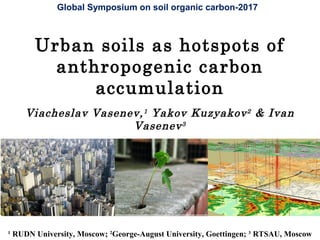
- 1. Urban soils as hotspots of anthropogenic carbon accumulation Viacheslav Vasenev,1 Yakov Kuzyakov2 & Ivan Vasenev3 1 RUDN University, Moscow; 2 George-August University, Goettingen; 3 RTSAU, Moscow Global Symposium on soil organic carbon-2017
- 2. Urbanization – global tendency World population will exceed 9 billion people by 2050 (FAO, 2013) More than 70% of world population will live in cities by then
- 3. Urbanization Traditionally urbanization was related to negative environmental impacts Recently the potential of urban areas to provide important soil functions and services is highlighted Natural and agricultural landscapes Green zonesBuild-up areas
- 4. Driving factors behind urban soil’s formation and transformation Slope terracing «Urban heat island» Plant species introduction Wastes and landfills Soil sealing Soil construction Indirect anthropogenic influence Direct anthropogenic influence
- 5. Why soil carbon? Soil functions Protection of humans and environment Biomass production General reservoir Physical basis of human activities Source of raw materials Geogenic and cultural heritage Blum, 2005 Water and nutrient cycling Ground water protection Basis for organisms’ life Land for settlements Land for agriculture Deposition of raw materials … BBodSchG, 1998 Nutrient cycling Water filtering and buffering Biodiversity and habitat Resistance and resilience Physical stability and support Andrews et al, 2004 !!! 30 to 50% of distinguished soil functions are directly or indirectly related to soil carbon
- 6. ESs’ categories (TEEB, 2010)ESs’ categories (TEEB, 2010) !!! 25 to 40% of distinguished ecosystem services are directly or indirectly related to soil carbon Food Water Raw materials Genetic resources Medical resources Ornamental resources Provisioning Air quality regulation Climate regulation Moderation of extreme events Regulation of water flows Water treatment Erosion prevention Maintenance of soil fertility Regulating •Aesthetic information •Opportunities for recreation and tourism •Inspiration of culture, art and design •Spiritual experience Cultural Habitat Maintenance of life cycles of migratory species Maintenance of genetic diversity Why soil carbon? Ecosystem services (ES)
- 7. Aim of the review study To analyze the global pattern of C stocks in urban soils as compared to their natural ones To analyze factors of intra- and inter- city variability of C stocks To compare profile distribution of C forms stored in urban soils, compared to natural ones To propose the main mechanisms of C accumulation in urban soils To estimate C accumulation time in urban soils
- 8. Materials and methods 118 cities 770 values SOC, SIC and BC stocks 5 depths
- 9. Global patterns of C stocks in urban soils Urban SOC stocks are usually greater than those of natural soils Urban soils in cold and temperate climate often store more SOC than those in tropical and arid climates
- 10. Inter-city variability in SOC stocks Generally, the larger is a city (in terms of extent and population) the less are average topsoil SOC stocks The largest urban SOC stocks are related to cultural layers of medieval cities
- 11. Intra-city variability in SOC stocksIntra-city variability in SOC stocks Public and residential areas usually stored more SOC than all the other functional zones with the maximal contribution from subsoils and cultural layers
- 12. ““Hidden” C and N stocks in urban subsoilsHidden” C and N stocks in urban subsoils Substantial amounts of SOC, SIC and N have been sequestered in the subsoils, cultural layers and sealed soils, underlining the importance of these ‘hidden’ stocks for C assessments.
- 13. Profile distribution of C and N stocksProfile distribution of C and N stocks
- 14. Mechanism of C accumulationMechanism of C accumulation 1) C inputs from suburban-areas (e.g. transfer of food, wood and raw materials); 2) C provisioning and redistribution inside the city (e.g. xenobiotics, soot and charcoal); 3) in situ transformations (e.g. sealing, over- compaction and water-logging)
- 15. C accumulation rate in urban soilsC accumulation rate in urban soils Urban soils growth rate ~ 50 cm/ century Carbon accumulatio n in urban soils ~ 20-30 kg C m-2 per century
- 16. Conclusions The estimated C stocks in the investigated urban soils generally were up to 3-5 times higher than in background natural soils SOC and BC stocks in the analyzed urban soils often positively correlated with city latitude City size and age were the main factors explaining inter-city variability of soil C stocks Intra-city variability of soil C stocks was dominated by their functional zoning Large stocks of SOC and SIC are located in subsoils (below 30 cm) and cultural layers (below 100 cm) of sealed soils Urban soils grow upward by about 50 cm per century, corresponding to C accumulation rate of 20-30 kg C m-2 per century
- 17. Thank you for attention !
- 18. On-line registration is open (www.suitma-russia.com)