Wetland Assimilation of Treated Municipal Effluent: Wetland Restoration & Improved Water Quality in Louisiana Dr. Rachael Hunter  1,2 , Dr. John W. Day 1,2 ,  Dr. Robert R. Lane 1,2 , Joel Lindsey 1 .   Montgomery Hunter 1  & Jason Day 1 1 Comite Resources, Inc., Zachary, LA 2 School of the Coast & Environment,  LSU, Baton Rouge, LA


Criteria for the use of Wetlands for  Municipal Effluent Assimilation   Effluent is treated, disinfected, and no toxic inputs. Sheet-flow hydrology (minimal channels and no short-circuits). Appropriately sized wetlands: low nitrogen and phosphorus loading rates. Monitoring ecosystem response in receiving wetlands, as well as non-impacted reference sites.


Monitoring Water level and hydrology. Water quality: NO x , NH x , TN, PO 4 , TP, TSS,  D.O., salinity, BOD, and fecal coliform. Vegetation species composition and productivity Stem growth (tree diameter)‏ Leaf fall (litter boxes)‏ Soils: bulk density and heavy metal concentrations Benthos is no longer monitored due to high seasonal and spatial variability, and lack of statistically significant trends in past monitoring and research. Assimilation wetlands have typical benthic species composition found throughout coastal Louisiana.


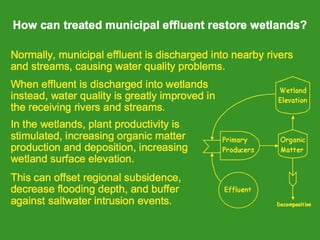
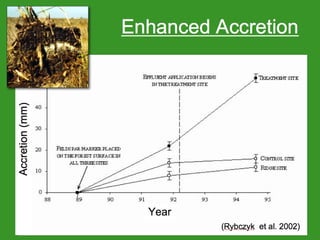
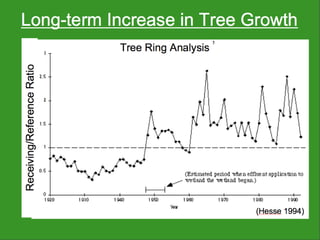
Conclusions Wetland assimilation of municipal effluent is a proven method of wetland restoration, as well as water quality improvement. Municipal effluent positively effects wetlands by: Increasing vegetative productivity Increasing organic matter deposition Increasing wetland surface elevation, counteracting high regional subsidence

Rachel Hunter

  • 1.
    Wetland Assimilation ofTreated Municipal Effluent: Wetland Restoration & Improved Water Quality in Louisiana Dr. Rachael Hunter 1,2 , Dr. John W. Day 1,2 , Dr. Robert R. Lane 1,2 , Joel Lindsey 1 . Montgomery Hunter 1 & Jason Day 1 1 Comite Resources, Inc., Zachary, LA 2 School of the Coast & Environment, LSU, Baton Rouge, LA
  • 2.
  • 3.
  • 4.
  • 5.
  • 6.
  • 7.
  • 8.
  • 9.
    Criteria for theuse of Wetlands for Municipal Effluent Assimilation Effluent is treated, disinfected, and no toxic inputs. Sheet-flow hydrology (minimal channels and no short-circuits). Appropriately sized wetlands: low nitrogen and phosphorus loading rates. Monitoring ecosystem response in receiving wetlands, as well as non-impacted reference sites.
  • 10.
  • 11.
  • 12.
  • 13.
    Monitoring Water leveland hydrology. Water quality: NO x , NH x , TN, PO 4 , TP, TSS, D.O., salinity, BOD, and fecal coliform. Vegetation species composition and productivity Stem growth (tree diameter)‏ Leaf fall (litter boxes)‏ Soils: bulk density and heavy metal concentrations Benthos is no longer monitored due to high seasonal and spatial variability, and lack of statistically significant trends in past monitoring and research. Assimilation wetlands have typical benthic species composition found throughout coastal Louisiana.
  • 14.
  • 15.
  • 16.
  • 17.
  • 18.
  • 19.
  • 20.
  • 21.
  • 22.
  • 23.
    Conclusions Wetland assimilationof municipal effluent is a proven method of wetland restoration, as well as water quality improvement. Municipal effluent positively effects wetlands by: Increasing vegetative productivity Increasing organic matter deposition Increasing wetland surface elevation, counteracting high regional subsidence