URBAN ENVIRONMENT &
DEVELOPMENT
JAYCEE SANTOS HIPOLITO, RN
SCOPE
• Definition
• Rural Vs. Urban Life
• Urban Environment
• Urbanization
• Urban Development
• Sustainable Development
• Role of LGU in Sustainable Development
• Economic Effect
• Environmental Effect
When we think of RURAL we
tend to imagine this:
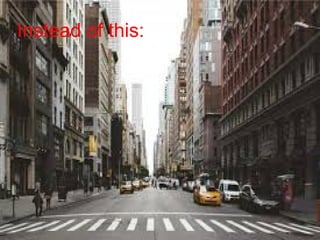
Instead of this:
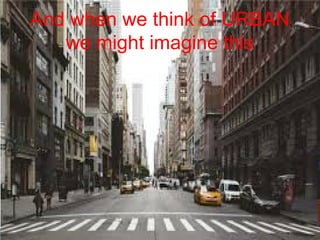
And when we think of URBAN
we might imagine this
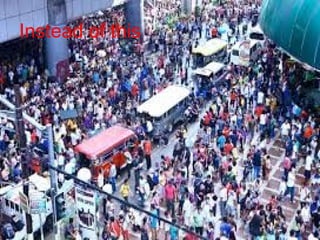
Instead of this
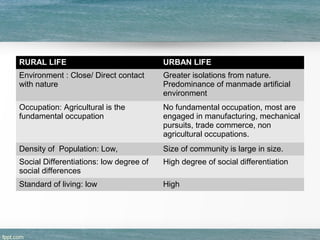
RURAL LIFE URBAN LIFE
Environment : Close/ Direct contact
with nature
Greater isolations from nature.
Predominance of manmade artificial
environment
Occupation: Agricultural is the
fundamental occupation
No fundamental occupation, most are
engaged in manufacturing, mechanical
pursuits, trade commerce, non
agricultural occupations.
Density of Population: Low, Size of community is large in size.
Social Differentiations: low degree of
social differences
High degree of social differentiation
Standard of living: low High
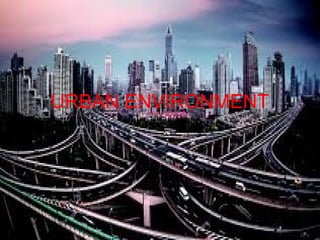
URBAN ENVIRONMENT
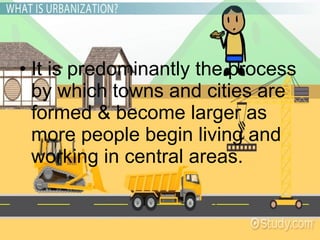
• It is predominantly the process
by which towns and cities are
formed & become larger as
more people begin living and
working in central areas.
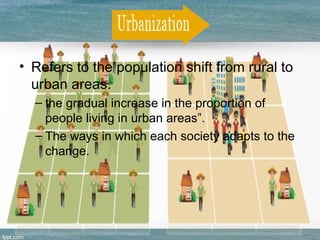
• Refers to the population shift from rural to
urban areas.
– the gradual increase in the proportion of
people living in urban areas”.
– The ways in which each society adapts to the
change.
3 Major Challenges in
Urbanization
• Density
– Pertaining to growing population which is not
matched by infrastructure investments
• Distance
– Connectivity issues and increase
transportation cost and impede labor mobility
• Division
– Limited access to basic services and
economic opportunities among informal
settlers
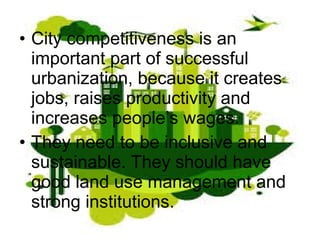
• City competitiveness is an
important part of successful
urbanization, because it creates
jobs, raises productivity and
increases people’s wages.
• They need to be inclusive and
sustainable. They should have
good land use management and
strong institutions.
• According to United Nations, projected
half of the worlds population would live in
urban areas at the end of 2017.
• By 2050 about 64% of the developing
world and 86% of the developed world will
be urbanized.
• Approximately 3 Billion urbanites by 2050
which is of Africa and Asia.
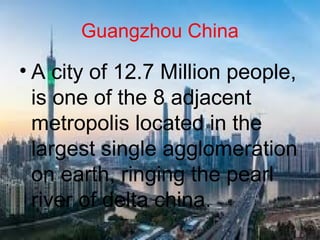
Guangzhou China
• A city of 12.7 Million people,
is one of the 8 adjacent
metropolis located in the
largest single agglomeration
on earth, ringing the pearl
river of delta china.
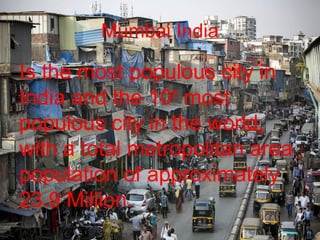
Mumbai India
Is the most populous city in
India and the 10th
most
populous city in the world,
with a total metropolitan area
population of approximately
23.9 Million.
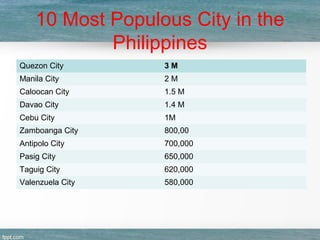
10 Most Populous City in the
Philippines
Quezon City 3 M
Manila City 2 M
Caloocan City 1.5 M
Davao City 1.4 M
Cebu City 1M
Zamboanga City 800,00
Antipolo City 700,000
Pasig City 650,000
Taguig City 620,000
Valenzuela City 580,000
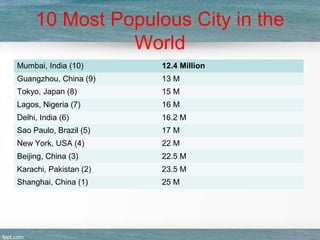
10 Most Populous City in the
World
Mumbai, India (10) 12.4 Million
Guangzhou, China (9) 13 M
Tokyo, Japan (8) 15 M
Lagos, Nigeria (7) 16 M
Delhi, India (6) 16.2 M
Sao Paulo, Brazil (5) 17 M
New York, USA (4) 22 M
Beijing, China (3) 22.5 M
Karachi, Pakistan (2) 23.5 M
Shanghai, China (1) 25 M
URBAN DEVELOPMENT
• Is a technical and political process
concerned with the use of land and
design of the urban environment,
including transportation networks, to
guide and ensure the orderly
development of settlement and
communities.
Sustainable Development
• It was introduced by IUCN in 1970’s
• WCED (World Commission on
Environment & Development) –
responsible for compiling reports
• “it is the development that meets the
needs of the generation without
jeopardizing the ability of future
generations to meet their own needs.
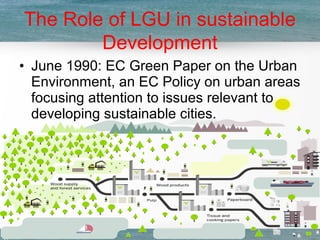
The Role of LGU in sustainable
Development
• June 1990: EC Green Paper on the Urban
Environment, an EC Policy on urban areas
focusing attention to issues relevant to
developing sustainable cities.
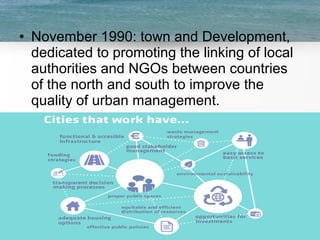
• November 1990: town and Development,
dedicated to promoting the linking of local
authorities and NGOs between countries
of the north and south to improve the
quality of urban management.
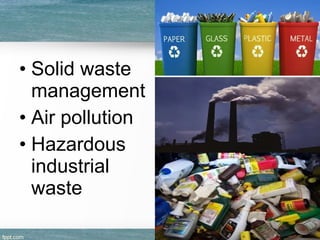
• Solid waste
management
• Air pollution
• Hazardous
industrial
waste
Economic Effect
• As cities developed, effects can include a
dramatic increase and change in costs,
labor and other necessities
• The drive for rapid urban growth and often
efficiency can lead to less equitable urban
development.
• Rapid increase of migrant employees bot
skilled and un-skilled.
POSITIVE EFFECT
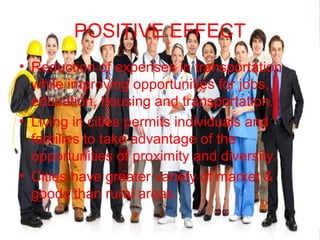
• Reduction of expenses in transportation
while improving opportunities for jobs,
education, housing and transportation.
• Living in cities permits individuals and
families to take advantage of the
opportunities of proximity and diversity.
• Cities have greater variety of market &
goods than rural areas.
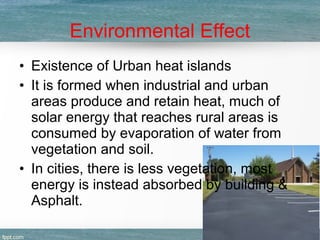
Environmental Effect
• Existence of Urban heat islands
• It is formed when industrial and urban
areas produce and retain heat, much of
solar energy that reaches rural areas is
consumed by evaporation of water from
vegetation and soil.
• In cities, there is less vegetation, most
energy is instead absorbed by building &
Asphalt.
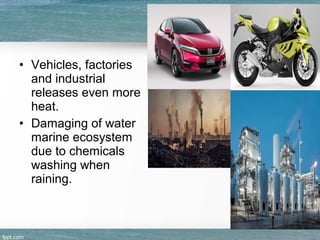
• Vehicles, factories
and industrial
releases even more
heat.
• Damaging of water
marine ecosystem
due to chemicals
washing when
raining.
Health & Social Effects
• Increase in
mortality from
non
communicable
diseases
associated with
lifestyle.
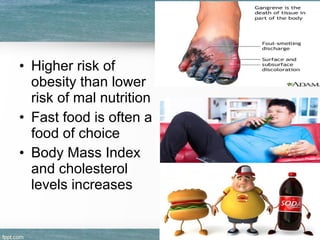
• Higher risk of
obesity than lower
risk of mal nutrition
• Fast food is often a
food of choice
• Body Mass Index
and cholesterol
levels increases
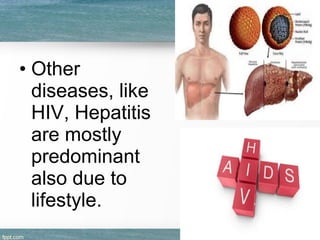
• Other
diseases, like
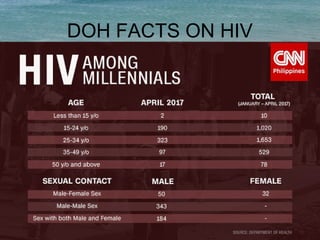
HIV, Hepatitis
are mostly
predominant
also due to
lifestyle.
DOH FACTS ON HIV
Changing Forms
• Most of the urban poor in developing
countries unable to find work, can spend
their lives in insecure, poorly paid jobs,
• :” the most important class conflict in the
poor countries of the world today is not
between labor and capital, it is between
foreign and national interest.”.
References
• Urbanization in 2013, demographic
partitions .
• Barney Cohen (2015) Urbanization, city
growth and the new United Nations
Development Agenda,
• Tadaro, Michael P. (2016) A model of
Labor Migration and Urban Development
in less Developed countries.
SALAMAT NG MARAMI

Urban development & environment

  • 1.
  • 2.
    SCOPE • Definition • RuralVs. Urban Life • Urban Environment • Urbanization • Urban Development • Sustainable Development • Role of LGU in Sustainable Development • Economic Effect • Environmental Effect
  • 3.
    When we thinkof RURAL we tend to imagine this:
  • 4.
  • 5.
    And when wethink of URBAN we might imagine this
  • 6.
  • 7.
    RURAL LIFE URBANLIFE Environment : Close/ Direct contact with nature Greater isolations from nature. Predominance of manmade artificial environment Occupation: Agricultural is the fundamental occupation No fundamental occupation, most are engaged in manufacturing, mechanical pursuits, trade commerce, non agricultural occupations. Density of Population: Low, Size of community is large in size. Social Differentiations: low degree of social differences High degree of social differentiation Standard of living: low High
  • 8.
  • 9.
    • It ispredominantly the process by which towns and cities are formed & become larger as more people begin living and working in central areas.
  • 10.
    • Refers tothe population shift from rural to urban areas. – the gradual increase in the proportion of people living in urban areas”. – The ways in which each society adapts to the change.
  • 11.
    3 Major Challengesin Urbanization • Density – Pertaining to growing population which is not matched by infrastructure investments • Distance – Connectivity issues and increase transportation cost and impede labor mobility • Division – Limited access to basic services and economic opportunities among informal settlers
  • 12.
    • City competitivenessis an important part of successful urbanization, because it creates jobs, raises productivity and increases people’s wages. • They need to be inclusive and sustainable. They should have good land use management and strong institutions.
  • 13.
    • According toUnited Nations, projected half of the worlds population would live in urban areas at the end of 2017. • By 2050 about 64% of the developing world and 86% of the developed world will be urbanized. • Approximately 3 Billion urbanites by 2050 which is of Africa and Asia.
  • 14.
    Guangzhou China • Acity of 12.7 Million people, is one of the 8 adjacent metropolis located in the largest single agglomeration on earth, ringing the pearl river of delta china.
  • 15.
    Mumbai India Is themost populous city in India and the 10th most populous city in the world, with a total metropolitan area population of approximately 23.9 Million.
  • 16.
    10 Most PopulousCity in the Philippines Quezon City 3 M Manila City 2 M Caloocan City 1.5 M Davao City 1.4 M Cebu City 1M Zamboanga City 800,00 Antipolo City 700,000 Pasig City 650,000 Taguig City 620,000 Valenzuela City 580,000
  • 17.
    10 Most PopulousCity in the World Mumbai, India (10) 12.4 Million Guangzhou, China (9) 13 M Tokyo, Japan (8) 15 M Lagos, Nigeria (7) 16 M Delhi, India (6) 16.2 M Sao Paulo, Brazil (5) 17 M New York, USA (4) 22 M Beijing, China (3) 22.5 M Karachi, Pakistan (2) 23.5 M Shanghai, China (1) 25 M
  • 18.
    URBAN DEVELOPMENT • Isa technical and political process concerned with the use of land and design of the urban environment, including transportation networks, to guide and ensure the orderly development of settlement and communities.
  • 19.
    Sustainable Development • Itwas introduced by IUCN in 1970’s • WCED (World Commission on Environment & Development) – responsible for compiling reports • “it is the development that meets the needs of the generation without jeopardizing the ability of future generations to meet their own needs.
  • 20.
    The Role ofLGU in sustainable Development • June 1990: EC Green Paper on the Urban Environment, an EC Policy on urban areas focusing attention to issues relevant to developing sustainable cities.
  • 21.
    • November 1990:town and Development, dedicated to promoting the linking of local authorities and NGOs between countries of the north and south to improve the quality of urban management.
  • 22.
    • Solid waste management •Air pollution • Hazardous industrial waste
  • 23.
    Economic Effect • Ascities developed, effects can include a dramatic increase and change in costs, labor and other necessities • The drive for rapid urban growth and often efficiency can lead to less equitable urban development. • Rapid increase of migrant employees bot skilled and un-skilled.
  • 24.
    POSITIVE EFFECT • Reductionof expenses in transportation while improving opportunities for jobs, education, housing and transportation. • Living in cities permits individuals and families to take advantage of the opportunities of proximity and diversity. • Cities have greater variety of market & goods than rural areas.
  • 25.
    Environmental Effect • Existenceof Urban heat islands • It is formed when industrial and urban areas produce and retain heat, much of solar energy that reaches rural areas is consumed by evaporation of water from vegetation and soil. • In cities, there is less vegetation, most energy is instead absorbed by building & Asphalt.
  • 26.
    • Vehicles, factories andindustrial releases even more heat. • Damaging of water marine ecosystem due to chemicals washing when raining.
  • 27.
    Health & SocialEffects • Increase in mortality from non communicable diseases associated with lifestyle.
  • 28.
    • Higher riskof obesity than lower risk of mal nutrition • Fast food is often a food of choice • Body Mass Index and cholesterol levels increases
  • 29.
    • Other diseases, like HIV,Hepatitis are mostly predominant also due to lifestyle.
  • 30.
  • 31.
    Changing Forms • Mostof the urban poor in developing countries unable to find work, can spend their lives in insecure, poorly paid jobs, • :” the most important class conflict in the poor countries of the world today is not between labor and capital, it is between foreign and national interest.”.
  • 32.
    References • Urbanization in2013, demographic partitions . • Barney Cohen (2015) Urbanization, city growth and the new United Nations Development Agenda, • Tadaro, Michael P. (2016) A model of Labor Migration and Urban Development in less Developed countries.
  • 33.