Seminar on
Amylase- Production and Application
Arun Kumar Gupta
Department of
Food Engineering and Technology
Introduction
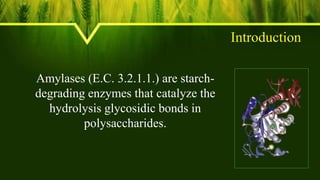
Amylases (E.C. 3.2.1.1.) are starch-
degrading enzymes that catalyze the
hydrolysis glycosidic bonds in
polysaccharides.
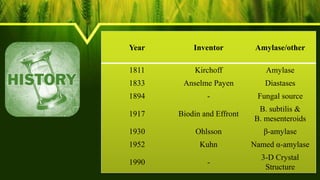
Year Inventor Amylase/other
1811 Kirchoff Amylase
1833 Anselme Payen Diastases
1894 - Fungal source
1917 Biodin and Effront
B. subtilis &
B. mesenteroids
1930 Ohlsson β-amylase
1952 Kuhn Named α-amylase
1990 -
3-D Crystal
Structure
Types of amylase
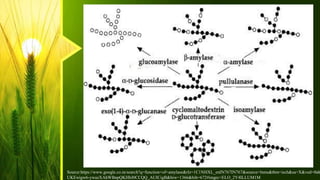
These enzymes are classified as per their
action on the glycosidic bond.
• α-amylase (E.C. 3.2.1.1)
• β-amylase (E.C. 3.2.1.2)
• γ-amylase (E.C. 3.2.1.3)
• α-Glucosidase (E.C. 3.2.1.20)
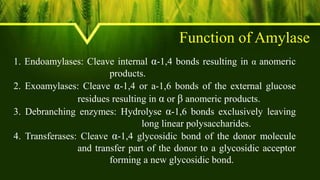
1. Endoamylases: Cleave internal α-1,4 bonds resulting in α anomeric
products.
2. Exoamylases: Cleave α-1,4 or a-1,6 bonds of the external glucose
residues resulting in α or β anomeric products.
3. Debranching enzymes: Hydrolyse α-1,6 bonds exclusively leaving
long linear polysaccharides.
4. Transferases: Cleave α-1,4 glycosidic bond of the donor molecule
and transfer part of the donor to a glycosidic acceptor
forming a new glycosidic bond.
Function of Amylase
Source:https://www.google.co.in/search?q=function+of+amylase&rlz=1C1NHXL_enIN767IN767&source=lnms&tbm=isch&sa=X&ved=0ah
UKEwigw6-ywazXAhWBnpQKHbJ0CCQQ_AUICigB&biw=1366&bih=672#imgrc=ELO_2Y4ILLUM1M
Source of Production
Plant
• Not considered a significant source for the commercial production of amylase.
• Agricultural wastes are used in the production.
Animal
• Ptyalin, a salivary α-amylase (40% total salivary protein )
• Calcium containing metalloenzyme, hydrolyzes α-1,4 linkages of starch.
Microbial
• Fungal (Aspergillus niger, Aspergillus oryzae, Penicillium, Thermomyces lanuginosus)
• Bacterial (Bacillus spp.)
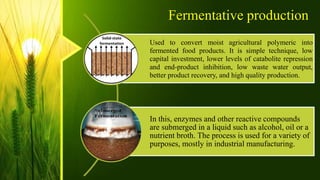
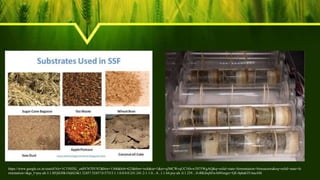
Fermentative production
Used to convert moist agricultural polymeric into
fermented food products. It is simple technique, low
capital investment, lower levels of catabolite repression
and end-product inhibition, low waste water output,
better product recovery, and high quality production.
In this, enzymes and other reactive compounds
are submerged in a liquid such as alcohol, oil or a
nutrient broth. The process is used for a variety of
purposes, mostly in industrial manufacturing.
https://www.google.co.in/search?rlz=1C1NHXL_enIN767IN767&biw=1366&bih=623&tbm=isch&sa=1&ei=qJMCWvqUC5i0vwT075WgAQ&q=solid+state+fermentation+bioreactors&oq=solid+state+fe
rmentation+&gs_l=psy-ab.3.1.0l5j0i30k1l4j0i24k1.52457.52457.0.57313.1.1.0.0.0.0.241.241.2-1.1.0....0...1.1.64.psy-ab..0.1.239....0.rRKibq9ZwA0#imgrc=QE-0phahTUmuAM:
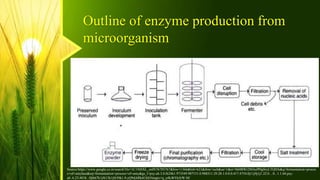
Outline of enzyme production from
microorganism
Source:https://www.google.co.in/search?rlz=1C1NHXL_enIN767IN767&biw=1366&bih=623&tbm=isch&sa=1&ei=S60BWr2MAsfP0gSryLTQDA&q=fermentation+proces
s+of+amylase&oq=fermentation+process+of+amy&gs_l=psy-ab.3.0.0i24k1.973549.987151.0.988311.29.28.1.0.0.0.417.4754.0j11j9j1j1.22.0....0...1.1.64.psy-
ab..6.23.4818...0j0i67k1j0i13k1j0i30k1.0.yQ9dARk6UhE#imgrc=q_crK4bYkfyW-M:
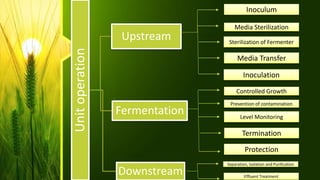
Unitoperation
Upstream
Fermentation
Downstream
Inoculum
Sterilization of Fermenter
Inoculation
Media Sterilization
Media Transfer
Controlled Growth
Level Monitoring
Prevention of contamination
Protection
Termination
Separation, Isolation and Purification
Effluent Treatment
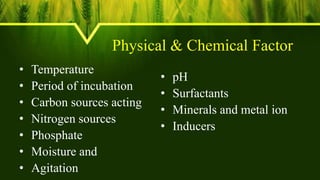
Physical & Chemical Factor
• Temperature
• Period of incubation
• Carbon sources acting
• Nitrogen sources
• Phosphate
• Moisture and
• Agitation
• pH
• Surfactants
• Minerals and metal ion
• Inducers
Temperature
• Growth of the organism
• Amylase production at optimum at 50–55 °C for the
thermophilic fungal cultures such as Talaromyces
emersonii, Thermomonospora fusca and Thermomyces
lanuginosus.
• At 37–60 °C, Mesophilic fungal culture such as Bacillus
amyloliquefaciens, B. subtilis, B. licheniformis and B.
stearothermophilus.
• Rhodothermus marinus, a marine thermophilic bacterium.
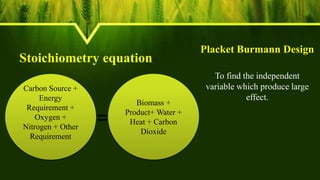
Stoichiometry equation
Placket Burmann Design
To find the independent
variable which produce large
effect.
Carbon Source +
Energy
Requirement +
Oxygen +
Nitrogen + Other
Requirement
Biomass +
Product+ Water +
Heat + Carbon
Dioxide
=
Carbon Sources
Carbon sources such as galactose, glycogen and inulin
suitable for B. licheniformis and Bacillus sp. maltose, a-
methyl -D-glucoside, resulted in 3-fold higher a-
amylase production.
Nitrogen media
• Soya bean meal - Bacillus sp. Strains of B.
stearothermophilus and B. amylolyticus secreted
maximum a-amylase in a medium supplemented with 1 %
peptone, 0.5 % yeast extract and 0.5 % maltose under
vigorous shaking conditions.
• Yeast extract also resulted in significant a-amylase yield.
• Addition of corn steep liquor and ammonium hydrogen
phosphate to SSF involving Amaranthus grains as
substrate by A. flavus gave high enzyme yield.
Moisture
• Most important parameters in SSF that influences the
growth of the organism and thereby enzyme
production.
• a-Amylase production by Bacillus licheniformis was
highest with 65 % initial moisture content in an SSF
system.
• High Moisture content = Decrease production
pH
• It determines the growth and morphology of microorganisms
as they are sensitive to the concentration of hydrogen ions
present in the medium.
• pH is known to affect the synthesis and secretion of a-amylase
just like its stability.
• pH=5.0–6.0 = A. oryzae, A. ficuum and A. niger = significant
yields
• pH=5.0 = Saccharomyces cerevisiae and S. kluyveri =
maximum enzyme production.
• pH=7.0 = Clostridium thermosulfurogenes = maximum yield
Surfactants
Increase the secretion of proteins by increasing cell
membrane permeability.
Increase the production of extracellular enzymes.
Ex: Tween 20, SDS
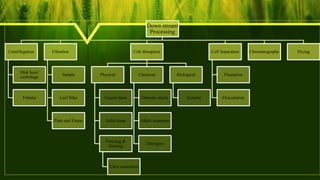
Down stream
Processing
Centrifugation
Disk bowl
centrifuge
Tubular
Filtration
Simple
Leaf filter
Plate and Frame
Cell disruption
Physical
Liquid shear
Solid shear
Freezing &
thawing
Ultra sonication
Chemical
Osmotic shock
Alkali treatment
Detergent
Biological
Enzyme
Cell Separation
Floatation
Flocculation
Chromatography Drying
Purification
Downstream processing for the production of pure
enzymes can generally constitute a major percentage of
overall production cost. Purification processes in
downstream processing after fermentation strongly
depend on the market, processing cost, final quality, and
available technology.
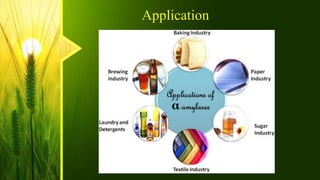
Application
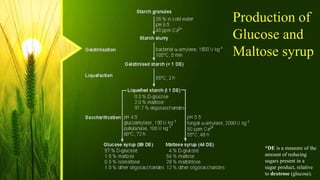
Production of
Glucose and
Maltose syrup
*DE is a measure of the
amount of reducing
sugars present in a
sugar product, relative
to dextrose (glucose).
References
Tiwari, S. P., Srivastava, R., Singh, C. S.,
Shukla, K., Singh, R. K., Singh, P., Singh, R.,
Singh, N. L. and Sharma, R. (2015).
Amylase: An Overview with special
references to alpha amylase. Journal of
Global Biosciences, Vol. 4, Spl. Issue 1.
Amylase (Production and application0

Amylase (Production and application0

  • 1.
    Seminar on Amylase- Productionand Application Arun Kumar Gupta Department of Food Engineering and Technology
  • 2.
    Introduction Amylases (E.C. 3.2.1.1.)are starch- degrading enzymes that catalyze the hydrolysis glycosidic bonds in polysaccharides.
  • 3.
    Year Inventor Amylase/other 1811Kirchoff Amylase 1833 Anselme Payen Diastases 1894 - Fungal source 1917 Biodin and Effront B. subtilis & B. mesenteroids 1930 Ohlsson β-amylase 1952 Kuhn Named α-amylase 1990 - 3-D Crystal Structure
  • 4.
    Types of amylase Theseenzymes are classified as per their action on the glycosidic bond. • α-amylase (E.C. 3.2.1.1) • β-amylase (E.C. 3.2.1.2) • γ-amylase (E.C. 3.2.1.3) • α-Glucosidase (E.C. 3.2.1.20)
  • 5.
    1. Endoamylases: Cleaveinternal α-1,4 bonds resulting in α anomeric products. 2. Exoamylases: Cleave α-1,4 or a-1,6 bonds of the external glucose residues resulting in α or β anomeric products. 3. Debranching enzymes: Hydrolyse α-1,6 bonds exclusively leaving long linear polysaccharides. 4. Transferases: Cleave α-1,4 glycosidic bond of the donor molecule and transfer part of the donor to a glycosidic acceptor forming a new glycosidic bond. Function of Amylase
  • 6.
  • 7.
    Source of Production Plant •Not considered a significant source for the commercial production of amylase. • Agricultural wastes are used in the production. Animal • Ptyalin, a salivary α-amylase (40% total salivary protein ) • Calcium containing metalloenzyme, hydrolyzes α-1,4 linkages of starch. Microbial • Fungal (Aspergillus niger, Aspergillus oryzae, Penicillium, Thermomyces lanuginosus) • Bacterial (Bacillus spp.)
  • 8.
    Fermentative production Used toconvert moist agricultural polymeric into fermented food products. It is simple technique, low capital investment, lower levels of catabolite repression and end-product inhibition, low waste water output, better product recovery, and high quality production. In this, enzymes and other reactive compounds are submerged in a liquid such as alcohol, oil or a nutrient broth. The process is used for a variety of purposes, mostly in industrial manufacturing.
  • 9.
  • 10.
    Outline of enzymeproduction from microorganism Source:https://www.google.co.in/search?rlz=1C1NHXL_enIN767IN767&biw=1366&bih=623&tbm=isch&sa=1&ei=S60BWr2MAsfP0gSryLTQDA&q=fermentation+proces s+of+amylase&oq=fermentation+process+of+amy&gs_l=psy-ab.3.0.0i24k1.973549.987151.0.988311.29.28.1.0.0.0.417.4754.0j11j9j1j1.22.0....0...1.1.64.psy- ab..6.23.4818...0j0i67k1j0i13k1j0i30k1.0.yQ9dARk6UhE#imgrc=q_crK4bYkfyW-M:
  • 11.
    Unitoperation Upstream Fermentation Downstream Inoculum Sterilization of Fermenter Inoculation MediaSterilization Media Transfer Controlled Growth Level Monitoring Prevention of contamination Protection Termination Separation, Isolation and Purification Effluent Treatment
  • 12.
    Physical & ChemicalFactor • Temperature • Period of incubation • Carbon sources acting • Nitrogen sources • Phosphate • Moisture and • Agitation • pH • Surfactants • Minerals and metal ion • Inducers
  • 13.
    Temperature • Growth ofthe organism • Amylase production at optimum at 50–55 °C for the thermophilic fungal cultures such as Talaromyces emersonii, Thermomonospora fusca and Thermomyces lanuginosus. • At 37–60 °C, Mesophilic fungal culture such as Bacillus amyloliquefaciens, B. subtilis, B. licheniformis and B. stearothermophilus. • Rhodothermus marinus, a marine thermophilic bacterium.
  • 14.
    Stoichiometry equation Placket BurmannDesign To find the independent variable which produce large effect. Carbon Source + Energy Requirement + Oxygen + Nitrogen + Other Requirement Biomass + Product+ Water + Heat + Carbon Dioxide =
  • 15.
    Carbon Sources Carbon sourcessuch as galactose, glycogen and inulin suitable for B. licheniformis and Bacillus sp. maltose, a- methyl -D-glucoside, resulted in 3-fold higher a- amylase production.
  • 16.
    Nitrogen media • Soyabean meal - Bacillus sp. Strains of B. stearothermophilus and B. amylolyticus secreted maximum a-amylase in a medium supplemented with 1 % peptone, 0.5 % yeast extract and 0.5 % maltose under vigorous shaking conditions. • Yeast extract also resulted in significant a-amylase yield. • Addition of corn steep liquor and ammonium hydrogen phosphate to SSF involving Amaranthus grains as substrate by A. flavus gave high enzyme yield.
  • 17.
    Moisture • Most importantparameters in SSF that influences the growth of the organism and thereby enzyme production. • a-Amylase production by Bacillus licheniformis was highest with 65 % initial moisture content in an SSF system. • High Moisture content = Decrease production
  • 18.
    pH • It determinesthe growth and morphology of microorganisms as they are sensitive to the concentration of hydrogen ions present in the medium. • pH is known to affect the synthesis and secretion of a-amylase just like its stability. • pH=5.0–6.0 = A. oryzae, A. ficuum and A. niger = significant yields • pH=5.0 = Saccharomyces cerevisiae and S. kluyveri = maximum enzyme production. • pH=7.0 = Clostridium thermosulfurogenes = maximum yield
  • 19.
    Surfactants Increase the secretionof proteins by increasing cell membrane permeability. Increase the production of extracellular enzymes. Ex: Tween 20, SDS
  • 20.
    Down stream Processing Centrifugation Disk bowl centrifuge Tubular Filtration Simple Leaffilter Plate and Frame Cell disruption Physical Liquid shear Solid shear Freezing & thawing Ultra sonication Chemical Osmotic shock Alkali treatment Detergent Biological Enzyme Cell Separation Floatation Flocculation Chromatography Drying
  • 21.
    Purification Downstream processing forthe production of pure enzymes can generally constitute a major percentage of overall production cost. Purification processes in downstream processing after fermentation strongly depend on the market, processing cost, final quality, and available technology.
  • 22.
  • 23.
    Production of Glucose and Maltosesyrup *DE is a measure of the amount of reducing sugars present in a sugar product, relative to dextrose (glucose).
  • 25.
    References Tiwari, S. P.,Srivastava, R., Singh, C. S., Shukla, K., Singh, R. K., Singh, P., Singh, R., Singh, N. L. and Sharma, R. (2015). Amylase: An Overview with special references to alpha amylase. Journal of Global Biosciences, Vol. 4, Spl. Issue 1.