Management of upper
respiratory infections
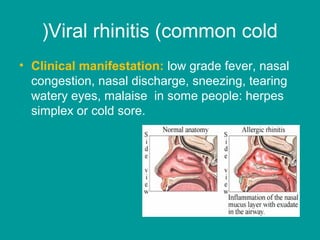
Viral rhinitis (common cold(
• Clinical manifestation: low grade fever, nasal
congestion, nasal discharge, sneezing, tearing
watery eyes, malaise in some people: herpes
simplex or cold sore.
Viral rhinitis (common cold(
• Medical management: increase fluid
intake, rest and use of expectorant if
cough, warm salt water gargling,
NSAIDs for pain, antihistamine for
sneezing, decongestant, steam
inhalation,,,,
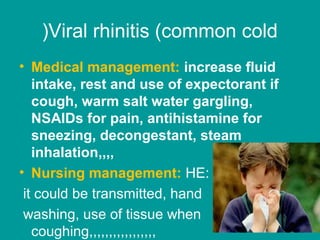
• Nursing management: HE:
it could be transmitted, hand
washing, use of tissue when
coughing,,,,,,,,,,,,,,,,,
pharyngitis
• Caused by viral infection as adenovirus,
influenza virus or herpes simplex virus.
• Clinical manifestation: red pharyngeal
membrane and tonsils, tender cervical lymph
nodes, no cough, fever (38.3c(, malaise and
sore throat
• Medical management: penciline,
analgesic, salt water gargling,
• Nutrition therapy: liquid or soft diet, warm
liquids, in severe cases IV fluids and
increase fluid intake.
pharyngitis
• Nursing management: if viral
symptomatic treatment, administer
antibiotics and encourage full course of it,
call physician if inability to fully open
mouth, dyspnea, drooling or inability to
swallow, bed rest, warm gargling, mouth
care is advised, teach preventive
measures ( not to share items as
tissues,,,,,,,,,,,,,,,,,,,,,(
Chronic pharyngitis
• Clinical manifestation: irritation and
fullness of throat, coughing and difficulty
swallowing,
• Medical management: avoid irritants as
dust, use nasal spray for irritation,
antihistamine decongestant medication to
be given, Aspirin and acetaminophen as
an anti-inflammatory and analgesic,
tonsillectomy a choice if
Chronic pharyngitis
• Nursing management: teach the patient:
avoid contact with other till fever subside,
avoid alcohol, tobacco, smoking, cold
environment, occupational pollutants, use
face mask, plenty of fluids, warm saline
gargling.
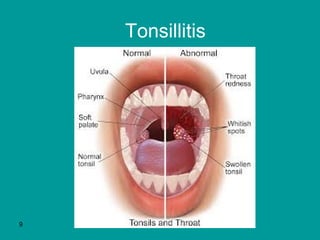
Tonsillitis
9
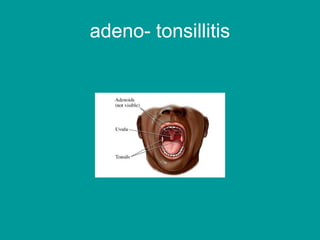
adeno- tonsillitis
Tonsillitis and adeno- tonsillitis
• Clinical manifestation: sore throat, fever,
snoring, difficulty in swallowing, enlarge
adenoids cause mouth breathing, earache,
draining ears, foul smelling breath, voice
impairment and noisy respiration.
• Medical management: increase fluid intake,
analgesics, salt water gargles, and rest penicillin
(antibiotics), tonsillectomy if it fits with criteria
( affecting breathing and eating and if it inflamed
more than 4 times per year)
Tonsillitis
• Nursing management: teach the patient post
operative care: prone position and head a side
for draining secretions, airway to be removed
once patient got gage reflex, apply ice collar,
good hydration, take soft diet, observe post
operative complication as : bleeding, infection,
avoid too much talking or coughing and continue
antibiotic in post operative period, avoid
vagarious gargling, avoid smoking and heavy
lifting for 10 days.
Peritonsillar abscess
• Is called quinsy is most common major
supportive complication of sore throat.
• The purulent is accumulated in the
tonsillar capsule and surrounding tissues.
Edema can cause airway obstruction.
• It can be life threatening condition
because it might cause intracranial
abscesses, empyemas from spread of
infection to lungs.
Peritonsillar abscess
• Clinical manifestation: Severe sore throat,
fever, trismus (inability to open the mouth),
drooling, difficulty in swallowing saliva, pain in
ear, enlarge cervical lymph node and pain in
lateral movement of head.
• Medical management: antibiotics,
corticosteroids, throat irrigation, hospitalization
and intubations if it is severe but rare. Surgery
(needle aspiration or I&D or tonsillectomy)
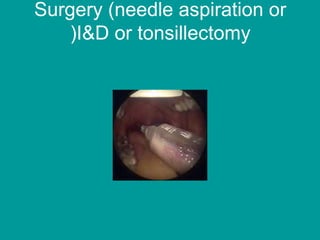
Surgery (needle aspiration or
I&D or tonsillectomy(
Peritonsillar abscess
• Nursing management: nurse assist with
procedures of tracheotomy, intubations,
needle aspiration, encourage gargling 1-
2hrs and mouthwash, increase fluid to
prevent dehydration and patient should
stop smoking.
2
Obstruction and
trauma of the upper
respiratory airway
Obstruction during sleep
• Due to reduced diameter of upper airway
leads to obstruction then apnea low O2
level.
• It might lead to HTN, STROCK, MI
• Clinical manifestation: loud snoring,
breathing cessation for 10 mins, gasping,
chocking, chart 22-4 p 534.
• Medical management: avoid alcohol,
ventilator, tonsillectomy, trachiostomy,
• Nursing management: nurse explains the
symptoms, treatment e.g: ventilator, O2,
Epistaxis (nose bleed(
• It is hemorrhage from nose
• Risk factor p 534 chart 22-5
• Medical management: identifying the site of
bleeding, pressure for 5-10mins after keeping
the patient setting and head tilted forward,
vasoconstrictor medications
• Nursing management: monitor V/S, control
bleeding, provide emesis basin and tissues,
assess airway, reassure the patent, might need
IV. Teach the patient avoid spicy food and
topacco as they cause vasodilatation.
Nasal Obstruction
• Obstruction because of deviation of nazal
septum, pressure from polyps, dryness of oral
mucosa because it is used for breathing,
swelling secondary to rhinosinusitis cause
obstruction as well
• Medical management: removal of obstruction,
treat allergy (rhinosinusitis(, corticosteroids,
antibiotics and surgical reduction of
hypertrophied tissues (rhinoplasty(.
Nasal obstruction
• Nursing management: nurse should
explain procedure, elevate the head of
bed to alleviate discomfort from edema,
frequent oral hygiene for dryness of
mouth, avoid blowing the nose during post
operative period,
Laryngeal obstruction
• It is because of edema, is fatal. It contains
a narrow space between the vocal cords
through which air must pass. If it swelling
the opening will be closed tightly causing
difficulty in breathing then hypoxia.
• Clinical manifestation: low O2, use of
accessory breathing muscles, patient
might need mechanical ventilation.
Medical management
• Used abdominal thrust maneuver to
remove the foreign body. If not
trachostomy should be performed to save
the patient.
• If it is because of edema give Epinephrine
and Corticosteroids, ice to the neck to
reduce edema, use pulse oxymetry to
assess O2 level.
Cancer of the Larynx
• Causes: tobacco, alcohol and
occupational exposure, voice straining,
chronic laryngitis, nutritional deficiencies
(Riboflavin), and family predisposing.
• Clinical manifestation: hoarseness for
more than 2 wks, persistent cough, sore
throat or burning in throat when citrus
fluids, dysphagia, dyspnea, foul breath,
cervical lymph adenopathy, wt loss.
• Medical management: surgery is the
option for effective swallowing, radiation
therapy, prognosis according to the stage
of cancer, age, dental examination to role
out oral disease, chemotherapy or
radiation will be used.
• New patient got admitted to the ward with
complaints of fever (38.5c), malaise, sore
throat.
1.Write one nursing diagnosis and tow
intervention each?
Upper respiratory infections

Upper respiratory infections

  • 1.
  • 2.
    Viral rhinitis (commoncold( • Clinical manifestation: low grade fever, nasal congestion, nasal discharge, sneezing, tearing watery eyes, malaise in some people: herpes simplex or cold sore.
  • 3.
    Viral rhinitis (commoncold( • Medical management: increase fluid intake, rest and use of expectorant if cough, warm salt water gargling, NSAIDs for pain, antihistamine for sneezing, decongestant, steam inhalation,,,, • Nursing management: HE: it could be transmitted, hand washing, use of tissue when coughing,,,,,,,,,,,,,,,,,
  • 4.
    pharyngitis • Caused byviral infection as adenovirus, influenza virus or herpes simplex virus. • Clinical manifestation: red pharyngeal membrane and tonsils, tender cervical lymph nodes, no cough, fever (38.3c(, malaise and sore throat
  • 5.
    • Medical management:penciline, analgesic, salt water gargling, • Nutrition therapy: liquid or soft diet, warm liquids, in severe cases IV fluids and increase fluid intake.
  • 6.
    pharyngitis • Nursing management:if viral symptomatic treatment, administer antibiotics and encourage full course of it, call physician if inability to fully open mouth, dyspnea, drooling or inability to swallow, bed rest, warm gargling, mouth care is advised, teach preventive measures ( not to share items as tissues,,,,,,,,,,,,,,,,,,,,,(
  • 7.
    Chronic pharyngitis • Clinicalmanifestation: irritation and fullness of throat, coughing and difficulty swallowing, • Medical management: avoid irritants as dust, use nasal spray for irritation, antihistamine decongestant medication to be given, Aspirin and acetaminophen as an anti-inflammatory and analgesic, tonsillectomy a choice if
  • 8.
    Chronic pharyngitis • Nursingmanagement: teach the patient: avoid contact with other till fever subside, avoid alcohol, tobacco, smoking, cold environment, occupational pollutants, use face mask, plenty of fluids, warm saline gargling.
  • 9.
  • 10.
  • 11.
    Tonsillitis and adeno-tonsillitis • Clinical manifestation: sore throat, fever, snoring, difficulty in swallowing, enlarge adenoids cause mouth breathing, earache, draining ears, foul smelling breath, voice impairment and noisy respiration. • Medical management: increase fluid intake, analgesics, salt water gargles, and rest penicillin (antibiotics), tonsillectomy if it fits with criteria ( affecting breathing and eating and if it inflamed more than 4 times per year)
  • 12.
    Tonsillitis • Nursing management:teach the patient post operative care: prone position and head a side for draining secretions, airway to be removed once patient got gage reflex, apply ice collar, good hydration, take soft diet, observe post operative complication as : bleeding, infection, avoid too much talking or coughing and continue antibiotic in post operative period, avoid vagarious gargling, avoid smoking and heavy lifting for 10 days.
  • 13.
    Peritonsillar abscess • Iscalled quinsy is most common major supportive complication of sore throat. • The purulent is accumulated in the tonsillar capsule and surrounding tissues. Edema can cause airway obstruction. • It can be life threatening condition because it might cause intracranial abscesses, empyemas from spread of infection to lungs.
  • 14.
    Peritonsillar abscess • Clinicalmanifestation: Severe sore throat, fever, trismus (inability to open the mouth), drooling, difficulty in swallowing saliva, pain in ear, enlarge cervical lymph node and pain in lateral movement of head. • Medical management: antibiotics, corticosteroids, throat irrigation, hospitalization and intubations if it is severe but rare. Surgery (needle aspiration or I&D or tonsillectomy)
  • 15.
    Surgery (needle aspirationor I&D or tonsillectomy(
  • 16.
    Peritonsillar abscess • Nursingmanagement: nurse assist with procedures of tracheotomy, intubations, needle aspiration, encourage gargling 1- 2hrs and mouthwash, increase fluid to prevent dehydration and patient should stop smoking.
  • 17.
    2 Obstruction and trauma ofthe upper respiratory airway
  • 18.
    Obstruction during sleep •Due to reduced diameter of upper airway leads to obstruction then apnea low O2 level. • It might lead to HTN, STROCK, MI • Clinical manifestation: loud snoring, breathing cessation for 10 mins, gasping, chocking, chart 22-4 p 534.
  • 19.
    • Medical management:avoid alcohol, ventilator, tonsillectomy, trachiostomy, • Nursing management: nurse explains the symptoms, treatment e.g: ventilator, O2,
  • 20.
    Epistaxis (nose bleed( •It is hemorrhage from nose • Risk factor p 534 chart 22-5 • Medical management: identifying the site of bleeding, pressure for 5-10mins after keeping the patient setting and head tilted forward, vasoconstrictor medications • Nursing management: monitor V/S, control bleeding, provide emesis basin and tissues, assess airway, reassure the patent, might need IV. Teach the patient avoid spicy food and topacco as they cause vasodilatation.
  • 21.
    Nasal Obstruction • Obstructionbecause of deviation of nazal septum, pressure from polyps, dryness of oral mucosa because it is used for breathing, swelling secondary to rhinosinusitis cause obstruction as well • Medical management: removal of obstruction, treat allergy (rhinosinusitis(, corticosteroids, antibiotics and surgical reduction of hypertrophied tissues (rhinoplasty(.
  • 22.
    Nasal obstruction • Nursingmanagement: nurse should explain procedure, elevate the head of bed to alleviate discomfort from edema, frequent oral hygiene for dryness of mouth, avoid blowing the nose during post operative period,
  • 23.
    Laryngeal obstruction • Itis because of edema, is fatal. It contains a narrow space between the vocal cords through which air must pass. If it swelling the opening will be closed tightly causing difficulty in breathing then hypoxia. • Clinical manifestation: low O2, use of accessory breathing muscles, patient might need mechanical ventilation.
  • 24.
    Medical management • Usedabdominal thrust maneuver to remove the foreign body. If not trachostomy should be performed to save the patient. • If it is because of edema give Epinephrine and Corticosteroids, ice to the neck to reduce edema, use pulse oxymetry to assess O2 level.
  • 25.
    Cancer of theLarynx • Causes: tobacco, alcohol and occupational exposure, voice straining, chronic laryngitis, nutritional deficiencies (Riboflavin), and family predisposing. • Clinical manifestation: hoarseness for more than 2 wks, persistent cough, sore throat or burning in throat when citrus fluids, dysphagia, dyspnea, foul breath, cervical lymph adenopathy, wt loss.
  • 26.
    • Medical management:surgery is the option for effective swallowing, radiation therapy, prognosis according to the stage of cancer, age, dental examination to role out oral disease, chemotherapy or radiation will be used.
  • 27.
    • New patientgot admitted to the ward with complaints of fever (38.5c), malaise, sore throat. 1.Write one nursing diagnosis and tow intervention each?