Holistic model for gerentological
nursing
• Holistic means intervention of physiological,
psychological and social and spiritual
dimensions of individual
• The whole person is the goal of nursing care
• It concerned with: facilitating growth toward
wholeness, prompting recover and learning
from illness, and providing peace, comfort and
dignity as death approach.
• Age related changes affects easily the well
being of body, mind and spirit therefore
nursing is to reduce such threats
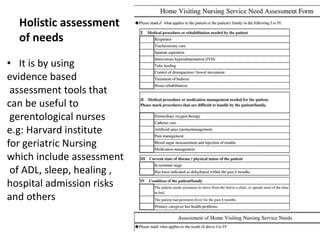
Holistic assessment
of needs
• It is by using
evidence based
assessment tools that
can be useful to
gerentological nurses
e.g: Harvard institute
for geriatric Nursing
which include assessment
of ADL, sleep, healing ,
hospital admission risks
and others
Health promotion related needs
• Absence of disease is not enough to identify the
person to health as he might feel uncomfortable
• Other factors should be considered as connection
with higher power and others help to promote
well being of body, mind and spirit
• Holistic model demonstrates that optimal health
include those activities that not only enable us to
exist but also help us to realize effective enriched
lives fig 7-1 p 89
Definition of health
• It is a state of wholeness , and integration of
body, mind and sprite to achieve the highest
possible quality of life each day.
• this could be exercising at the gym, engaging
in changing work and having person
relationship with God or for others propping
oneself in wheelchair and enjoying the beauty
of nature
• There is the risk that the busy clinical setting ,
the les tangible needs of gratification of
connection can be overlooked
• As a role of advocate for older adults,
gerentological nurse must assure that
comprehensive care is provided by not
omitting the important needs
Explain the following Health
challenges related needs in page 91
1. Education:
2. Counseling:
3. Coaching:
4. Monitoring:
5. Coordinating:
6. Therapies:
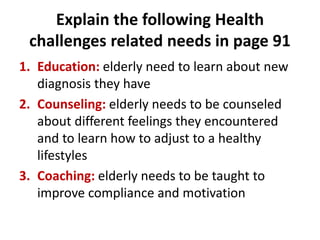
Explain the following Health
challenges related needs in page 91
1. Education: elderly need to learn about new
diagnosis they have
2. Counseling: elderly needs to be counseled
about different feelings they encountered
and to learn how to adjust to a healthy
lifestyles
3. Coaching: elderly needs to be taught to
improve compliance and motivation
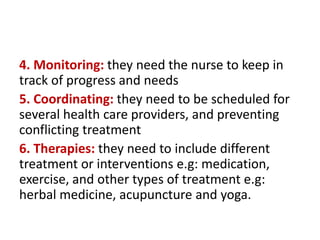
4. Monitoring: they need the nurse to keep in
track of progress and needs
5. Coordinating: they need to be scheduled for
several health care providers, and preventing
conflicting treatment
6. Therapies: they need to include different
treatment or interventions e.g: medication,
exercise, and other types of treatment e.g:
herbal medicine, acupuncture and yoga.
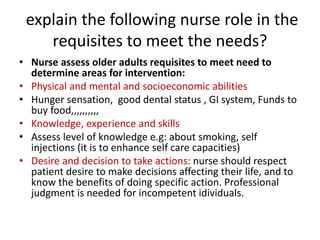
explain the following nurse role in the
requisites to meet the needs?
• Nurse assess older adults requisites to meet need to
determine areas for intervention:
• Physical and mental and socioeconomic abilities
• Hunger sensation, good dental status , GI system, Funds to
buy food,,,,,,,,,,
• Knowledge, experience and skills
• Assess level of knowledge e.g: about smoking, self
injections (it is to enhance self care capacities)
• Desire and decision to take actions: nurse should respect
patient desire to make decisions affecting their life, and to
know the benefits of doing specific action. Professional
judgment is needed for incompetent idividuals.
Gerentological nursing process
• Nursing process considers patients effectiveness
in meeting needs related to health promotion
and health challenges
• If person is able to fulfill them there will be no
need for nursing interventions
• Nursing intervention is directed to: strengthening
self care capacities, minimizing self care limitation
ad providing direct services by doing or assisting
the individual when needed
Applying holistic model in nursing
• Self reading of the case of Mrs. D, 78 years old
lady who is living alone and fallen down and
found to be having fracture see NCP for this
lady in page 93-98
Legal aspect of gerentological
Nursing
Lows governing gerentological
Nursing practice
• The nursing should be familiar with lows in
her place of work
• In some countries there is both public laws
and private laws
• Public law governs relationships between
private parties and the government as :
criminal law and its example is listening of a
nurses to be a home health agency
• Private law is concern with relationship
between the individual and organization and
include contracts
• Scope and standard of gerentological nursing
providing guidelines for gerentological nurse
that offer description of what is considered
safe and effective care
Legal risks in gerentological nursing
1. The following puts the nurse under liability:
• Working without sufficient resources, not
checking agency polity or procedure, taking
shortcuts, or trying to work with emotionally
or physical exhausted
• it could happened once or repeated by the
nurse, thus leads to legal problems
• Box 8-1 are example of situation which make
the nurse to be liable to violation of laws
1. Malpractice
• Nurse is expected to given competent and up
to the standard care
• If performance deviated from the stranded it
make the nurse to be liable e.g: administering
incorrect dose of medication , not informing
about respiratory distress in the client, leaving
irrigating solution near the patient and he
drink it, not turning the client in the shift, or
having patient fall,,,,,,,,,,,,,,,,,,,,,
• What is meant by the following terms Duty,
Negligence, Injury.
• Nurse should work to prevent malpractice
which is mention in box 8-2 p 104
Confidentiality
• It is protecting and proper methods of
communicating client’s information
• Penalties is made to control variation in the
procedure
Patient consent
• Nurse should be careful not to overlook or
improperly obtain consent
• Failure to follow the correct procedure of
getting the informed consent leads to legal
liability
• Consent should be obtained before any
procedure and it should be informed and
should understand the risks of refusing it
Patient competency
• The person should take his decision by
him/herself unless judged to be incompetent
• Nurse should get his consent from the next of
kin and It is called durable power of attorney.
Staff supervision
• Nurse should supervisor his or her actions as
well as other’s staff actions
• This comes under “respondeat superior”
which is “ let the master user”
• To prevent liability of staff she or he should:
no to permit unqualified staff to give care,
failure to follow undeleted task, assigning
unqualified staff, allow staff to work with
improperly working equipment.
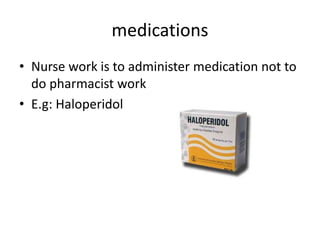
medications
• Nurse work is to administer medication not to
do pharmacist work
• E.g: Haloperidol
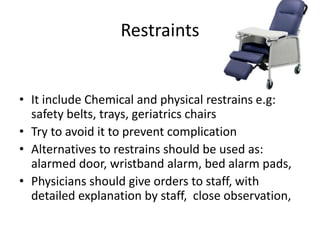
Restraints
• It include Chemical and physical restrains e.g:
safety belts, trays, geriatrics chairs
• Try to avoid it to prevent complication
• Alternatives to restrains should be used as:
alarmed door, wristband alarm, bed alarm pads,
• Physicians should give orders to staff, with
detailed explanation by staff, close observation,
Telephone orders
• Accepting telephone orders makes the staff at
risk
• However, nurse should follow the following
precautions: p107
DNR
• Unless it agreed upon, noting doing CPR, is
considered as negligence
• It should be written and discussed between
the physician and relatives
• A sign to be written near client’s bed
• Every agency should develop DNR policy
Advance directives or living will
• It is related to terminal care and life sustaining
measures
• The client response to be documented
• Nurse should inform other team about the
decision was made
• The person should be at proper age, has
sound mind and not forced to chose any
treatemtn
• If client not able to decides: involve family
members, legal aid agency, local school of
law,,,,,,
• Physician are responsible to announcing the
death not the nurse
• Consent for autopsy should be taked if death
is suspected because of abuse,,,,,,
Elder abuse
• It could occur from any one
• Especially in long-term care settings
• It is a sign of “burn out”
• Types of abuse: physical, emotional, sexual,
neglect, abandonment (rejection),
exploitation (take the advatages that they
have e.g: money)
Sings of Elder abuse
• P 109
Legal safeguard for nurse
• P 110
Ethics in nursing
Sources of ethics in nrusin g
• It is from ANA code of ethics or from American
Holistic Nurses’s association www.ahna.org
• Ethics standards from outside the profession
e.g: federal state, local standard, individual
agencies,,,,,,,,,,,,,,,,,
Principles of ethics
1. Beneficience
2. Non-maleficence
3. Justics
4. Autonomy
5. Confidentiality
6. ,,,,,,,,,,,,,,,,,,,,,,,,,
Ethical dilemma in nursing
1. Expanded role of nurses:
2. Medical technology
3. New fiscal constraints
4. Conflict or interest
5. Greater numbers of older adults
6. Assisted suicide
Changes increasing Ethical dilemma in
nursing
1. Expanded role of nurses: it more than
follwing physicians orders, it is assessment,
diagnosiing, nursing problems, making
independent judjment all this has increased
nurse responnsibity
2. Medical technology: new treatment
modlities e.g: USG, artificial organs,,,,, creat
new problems of who and when this
technology should be used.
3. New fiscal constraints: patient needs are
weighht accoridn to econolic, survival which
result in dificult dicision. This rise the question
whether to give good quality care to patient
or justto give the basic care
4. Conflict of interest: it is confliect form client,
family, employer, insurance companies, this all
leads to ethical dilema
5. Greater numbers of older adults: because
they are dependant to the care which is given,
they increase the burden to health care
setting and they need the society support
6. Asssisted suicide: ANA ojbected it, as the
nurse should provide competent care, not
unethical actions as assisted suicide, ethical
dilema occurs between professioanl standared
of reporting the attempt and self
determination act.
Measured to help the nurse make ethical
decsions
1. Encourage patients to express their desires
2. Identify significant other who are impacted
or impact others
3. Know yourself
4. Read literature to see similar decisions in
similar situation
5. Discuss issues with members of ethicists
6. Form an ethics committee: to develop policies
and discuss the ethical dilemma
7. consult: it clinical ethics consultation to
provide education, relieve moral conflict and
advocate for patients.
Holistic model for gerentological nursing

Holistic model for gerentological nursing

  • 1.
    Holistic model forgerentological nursing
  • 2.
    • Holistic meansintervention of physiological, psychological and social and spiritual dimensions of individual • The whole person is the goal of nursing care • It concerned with: facilitating growth toward wholeness, prompting recover and learning from illness, and providing peace, comfort and dignity as death approach.
  • 3.
    • Age relatedchanges affects easily the well being of body, mind and spirit therefore nursing is to reduce such threats
  • 4.
    Holistic assessment of needs •It is by using evidence based assessment tools that can be useful to gerentological nurses e.g: Harvard institute for geriatric Nursing which include assessment of ADL, sleep, healing , hospital admission risks and others
  • 5.
    Health promotion relatedneeds • Absence of disease is not enough to identify the person to health as he might feel uncomfortable • Other factors should be considered as connection with higher power and others help to promote well being of body, mind and spirit • Holistic model demonstrates that optimal health include those activities that not only enable us to exist but also help us to realize effective enriched lives fig 7-1 p 89
  • 6.
    Definition of health •It is a state of wholeness , and integration of body, mind and sprite to achieve the highest possible quality of life each day. • this could be exercising at the gym, engaging in changing work and having person relationship with God or for others propping oneself in wheelchair and enjoying the beauty of nature
  • 7.
    • There isthe risk that the busy clinical setting , the les tangible needs of gratification of connection can be overlooked • As a role of advocate for older adults, gerentological nurse must assure that comprehensive care is provided by not omitting the important needs
  • 8.
    Explain the followingHealth challenges related needs in page 91 1. Education: 2. Counseling: 3. Coaching: 4. Monitoring: 5. Coordinating: 6. Therapies:
  • 9.
    Explain the followingHealth challenges related needs in page 91 1. Education: elderly need to learn about new diagnosis they have 2. Counseling: elderly needs to be counseled about different feelings they encountered and to learn how to adjust to a healthy lifestyles 3. Coaching: elderly needs to be taught to improve compliance and motivation
  • 10.
    4. Monitoring: theyneed the nurse to keep in track of progress and needs 5. Coordinating: they need to be scheduled for several health care providers, and preventing conflicting treatment 6. Therapies: they need to include different treatment or interventions e.g: medication, exercise, and other types of treatment e.g: herbal medicine, acupuncture and yoga.
  • 11.
    explain the followingnurse role in the requisites to meet the needs? • Nurse assess older adults requisites to meet need to determine areas for intervention: • Physical and mental and socioeconomic abilities • Hunger sensation, good dental status , GI system, Funds to buy food,,,,,,,,,, • Knowledge, experience and skills • Assess level of knowledge e.g: about smoking, self injections (it is to enhance self care capacities) • Desire and decision to take actions: nurse should respect patient desire to make decisions affecting their life, and to know the benefits of doing specific action. Professional judgment is needed for incompetent idividuals.
  • 12.
    Gerentological nursing process •Nursing process considers patients effectiveness in meeting needs related to health promotion and health challenges • If person is able to fulfill them there will be no need for nursing interventions • Nursing intervention is directed to: strengthening self care capacities, minimizing self care limitation ad providing direct services by doing or assisting the individual when needed
  • 13.
    Applying holistic modelin nursing • Self reading of the case of Mrs. D, 78 years old lady who is living alone and fallen down and found to be having fracture see NCP for this lady in page 93-98
  • 14.
    Legal aspect ofgerentological Nursing
  • 15.
    Lows governing gerentological Nursingpractice • The nursing should be familiar with lows in her place of work • In some countries there is both public laws and private laws • Public law governs relationships between private parties and the government as : criminal law and its example is listening of a nurses to be a home health agency
  • 16.
    • Private lawis concern with relationship between the individual and organization and include contracts • Scope and standard of gerentological nursing providing guidelines for gerentological nurse that offer description of what is considered safe and effective care
  • 17.
    Legal risks ingerentological nursing 1. The following puts the nurse under liability: • Working without sufficient resources, not checking agency polity or procedure, taking shortcuts, or trying to work with emotionally or physical exhausted • it could happened once or repeated by the nurse, thus leads to legal problems • Box 8-1 are example of situation which make the nurse to be liable to violation of laws
  • 18.
    1. Malpractice • Nurseis expected to given competent and up to the standard care • If performance deviated from the stranded it make the nurse to be liable e.g: administering incorrect dose of medication , not informing about respiratory distress in the client, leaving irrigating solution near the patient and he drink it, not turning the client in the shift, or having patient fall,,,,,,,,,,,,,,,,,,,,,
  • 19.
    • What ismeant by the following terms Duty, Negligence, Injury. • Nurse should work to prevent malpractice which is mention in box 8-2 p 104
  • 20.
    Confidentiality • It isprotecting and proper methods of communicating client’s information • Penalties is made to control variation in the procedure
  • 21.
    Patient consent • Nurseshould be careful not to overlook or improperly obtain consent • Failure to follow the correct procedure of getting the informed consent leads to legal liability • Consent should be obtained before any procedure and it should be informed and should understand the risks of refusing it
  • 22.
    Patient competency • Theperson should take his decision by him/herself unless judged to be incompetent • Nurse should get his consent from the next of kin and It is called durable power of attorney.
  • 23.
    Staff supervision • Nurseshould supervisor his or her actions as well as other’s staff actions • This comes under “respondeat superior” which is “ let the master user” • To prevent liability of staff she or he should: no to permit unqualified staff to give care, failure to follow undeleted task, assigning unqualified staff, allow staff to work with improperly working equipment.
  • 24.
    medications • Nurse workis to administer medication not to do pharmacist work • E.g: Haloperidol
  • 25.
    Restraints • It includeChemical and physical restrains e.g: safety belts, trays, geriatrics chairs • Try to avoid it to prevent complication • Alternatives to restrains should be used as: alarmed door, wristband alarm, bed alarm pads, • Physicians should give orders to staff, with detailed explanation by staff, close observation,
  • 26.
    Telephone orders • Acceptingtelephone orders makes the staff at risk • However, nurse should follow the following precautions: p107
  • 27.
    DNR • Unless itagreed upon, noting doing CPR, is considered as negligence • It should be written and discussed between the physician and relatives • A sign to be written near client’s bed • Every agency should develop DNR policy
  • 28.
    Advance directives orliving will • It is related to terminal care and life sustaining measures • The client response to be documented • Nurse should inform other team about the decision was made • The person should be at proper age, has sound mind and not forced to chose any treatemtn
  • 29.
    • If clientnot able to decides: involve family members, legal aid agency, local school of law,,,,,, • Physician are responsible to announcing the death not the nurse • Consent for autopsy should be taked if death is suspected because of abuse,,,,,,
  • 30.
    Elder abuse • Itcould occur from any one • Especially in long-term care settings • It is a sign of “burn out” • Types of abuse: physical, emotional, sexual, neglect, abandonment (rejection), exploitation (take the advatages that they have e.g: money)
  • 31.
    Sings of Elderabuse • P 109
  • 32.
    Legal safeguard fornurse • P 110
  • 33.
  • 34.
    Sources of ethicsin nrusin g • It is from ANA code of ethics or from American Holistic Nurses’s association www.ahna.org • Ethics standards from outside the profession e.g: federal state, local standard, individual agencies,,,,,,,,,,,,,,,,,
  • 35.
    Principles of ethics 1.Beneficience 2. Non-maleficence 3. Justics 4. Autonomy 5. Confidentiality 6. ,,,,,,,,,,,,,,,,,,,,,,,,,
  • 36.
    Ethical dilemma innursing 1. Expanded role of nurses: 2. Medical technology 3. New fiscal constraints 4. Conflict or interest 5. Greater numbers of older adults 6. Assisted suicide
  • 37.
    Changes increasing Ethicaldilemma in nursing 1. Expanded role of nurses: it more than follwing physicians orders, it is assessment, diagnosiing, nursing problems, making independent judjment all this has increased nurse responnsibity 2. Medical technology: new treatment modlities e.g: USG, artificial organs,,,,, creat new problems of who and when this technology should be used.
  • 38.
    3. New fiscalconstraints: patient needs are weighht accoridn to econolic, survival which result in dificult dicision. This rise the question whether to give good quality care to patient or justto give the basic care 4. Conflict of interest: it is confliect form client, family, employer, insurance companies, this all leads to ethical dilema
  • 39.
    5. Greater numbersof older adults: because they are dependant to the care which is given, they increase the burden to health care setting and they need the society support 6. Asssisted suicide: ANA ojbected it, as the nurse should provide competent care, not unethical actions as assisted suicide, ethical dilema occurs between professioanl standared of reporting the attempt and self determination act.
  • 40.
    Measured to helpthe nurse make ethical decsions 1. Encourage patients to express their desires 2. Identify significant other who are impacted or impact others 3. Know yourself 4. Read literature to see similar decisions in similar situation 5. Discuss issues with members of ethicists
  • 41.
    6. Form anethics committee: to develop policies and discuss the ethical dilemma 7. consult: it clinical ethics consultation to provide education, relieve moral conflict and advocate for patients.