
Universal Architectural Design
Nishita Mohta
Rishi Thirth
Jithin K. Shamsu
What is Universal Design?
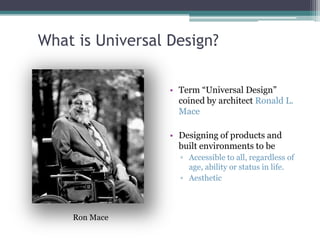
• Term “Universal Design”
coined by architect Ronald L.
Mace
• Designing of products and
built environments to be
▫ Accessible to all, regardless of
age, ability or status in life.
▫ Aesthetic
Ron Mace
Why do we need Universal Design?
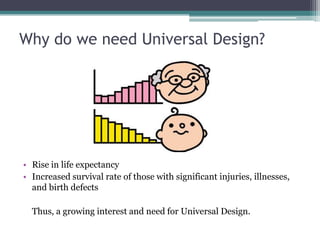
• Rise in life expectancy
• Increased survival rate of those with significant injuries, illnesses,
and birth defects
Thus, a growing interest and need for Universal Design.
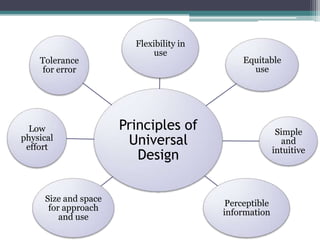
Principles of
Universal
Design
Flexibility in
use
Equitable
use
Simple
and
intuitive
Perceptible
information
Size and space
for approach
and use
Low
physical
effort
Tolerance
for error
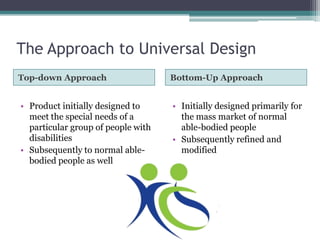
The Approach to Universal Design
Top-down Approach Bottom-Up Approach
• Product initially designed to
meet the special needs of a
particular group of people with
disabilities
• Subsequently to normal able-
bodied people as well
• Initially designed primarily for
the mass market of normal
able-bodied people
• Subsequently refined and
modified
The Approach to Universal Design
In support of the Bottom-up Approach
• Good design for everyone = Good for disabled people
• Building users, including those with disabilities, are all treated as
normal people.
• People with disabilities ≠ abnormal, peculiar, different
▫ To make buildings accessible to them, they need not be packaged
together
▫ Requirements need not be presented as add-ons to unspecified normal
provision
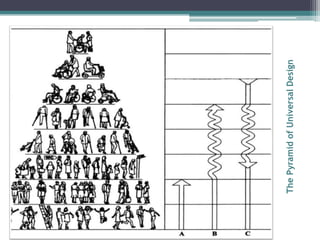
ThePyramidofUniversalDesign
The Pyramid of Universal Design
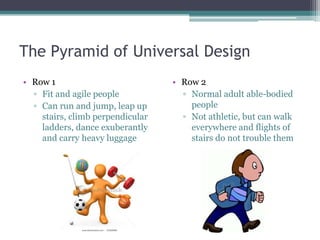
• Row 1
▫ Fit and agile people
▫ Can run and jump, leap up
stairs, climb perpendicular
ladders, dance exuberantly
and carry heavy luggage
• Row 2
▫ Normal adult able-bodied
people
▫ Not athletic, but can walk
everywhere and flights of
stairs do not trouble them
The Pyramid of Universal Design
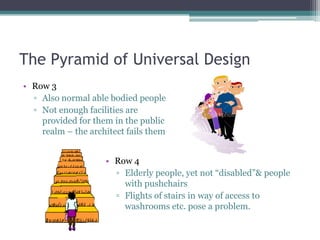
• Row 3
▫ Also normal able bodied people
▫ Not enough facilities are
provided for them in the public
realm – the architect fails them
• Row 4
▫ Elderly people, yet not “disabled”& people
with pushchairs
▫ Flights of stairs in way of access to
washrooms etc. pose a problem.
The Pyramid of Universal Design
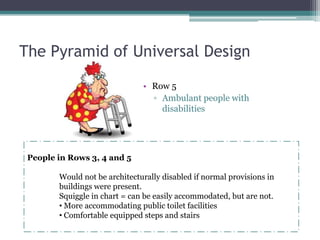
• Row 5
▫ Ambulant people with
disabilities
People in Rows 3, 4 and 5
Would not be architecturally disabled if normal provisions in
buildings were present.
Squiggle in chart = can be easily accommodated, but are not.
• More accommodating public toilet facilities
• Comfortable equipped steps and stairs
The Pyramid of Universal Design
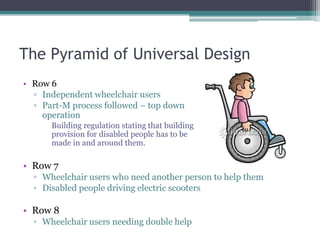
• Row 6
▫ Independent wheelchair users
▫ Part-M process followed – top down
operation
Building regulation stating that building
provision for disabled people has to be
made in and around them.
• Row 7
▫ Wheelchair users who need another person to help them
▫ Disabled people driving electric scooters
• Row 8
▫ Wheelchair users needing double help
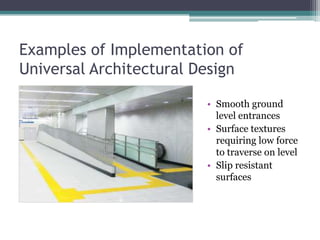
Examples of Implementation of
Universal Architectural Design
• Smooth ground
level entrances
• Surface textures
requiring low force
to traverse on level
• Slip resistant
surfaces
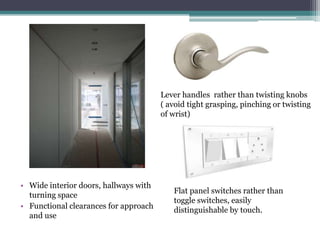
• Wide interior doors, hallways with
turning space
• Functional clearances for approach
and use
Lever handles rather than twisting knobs
( avoid tight grasping, pinching or twisting
of wrist)
Flat panel switches rather than
toggle switches, easily
distinguishable by touch.
• Auditory output redundant with information on visual displays and vice-
versa
• Contrast controls on visual output
• Volume, speed and language controls on auditory output
A Tale of Two Cities in
One:
Indraprastha Project
and Delhi Metro
• Comparison of outcome of two infrastructural in Delhi
• Institutional coordination challenges facing accessibility
for PWD
The Indraprastha Project
• A square kilometre of New Delhi (the Indraprastha Institutional
Area) chosen as a pilot for implementing an accessible built
environment for people with disabilities
• Nodal agency for the project - the Union Ministry of Urban Affairs
and Employment.
• However, the infrastructure in the area fell under several different
agencies:
▫ Roads were under the Municipal Corporation of Delhi
▫ Bus stops under the Delhi Development Authority
▫ Institutional buildings under the Central Public Works Department
▫ Traffic signals and crossings under the Commissioner of Police.
The Indraprastha Project
• THE RESULT:
▫ financing for the initiative remained fragmented across agencies
▫ The project was implemented with limited input from people with
disabilities in the process
▫ The area has reverted to its original level of inaccessibility -
largely due to lack of concerted ownership among the several
agencies involved.
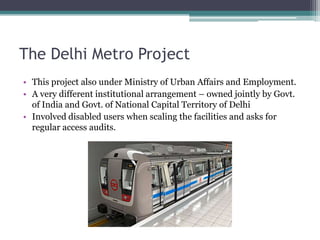
The Delhi Metro Project
• This project also under Ministry of Urban Affairs and Employment.
• A very different institutional arrangement – owned jointly by Govt.
of India and Govt. of National Capital Territory of Delhi
• Involved disabled users when scaling the facilities and asks for
regular access audits.
The Delhi Metro Project
• THE RESULT: People with disabilities are viewed as customers, and
thus the Delhi metro is designed to be easily accessible for them.
▫ Escalators and accessible elevators available at all stations
▫ Accessible seating on trains
▫ Audible warnings and announcing devices wherever possible
▫ Ticket gate exclusively for disabled passengers
▫ Tactile tiles on all common passages with tactile warnings for
abrupt change in height or near hazardous areas
▫ Signs printed in braille in the lifts to indicate floors
▫ Elevator control buttons positioned at heights that are accessible
to wheelchair users
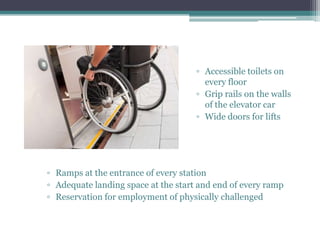
▫ Accessible toilets on
every floor
▫ Grip rails on the walls
of the elevator car
▫ Wide doors for lifts
▫ Ramps at the entrance of every station
▫ Adequate landing space at the start and end of every ramp
▫ Reservation for employment of physically challenged
Inference
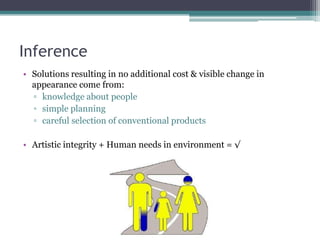
• Solutions resulting in no additional cost & visible change in
appearance come from:
▫ knowledge about people
▫ simple planning
▫ careful selection of conventional products
• Artistic integrity + Human needs in environment = √
Bibliography
• “Universal Design”, by Selwyn Goldsmith
• Ronald L. Mace on NC State University, College of Design
▫ http://design.ncsu.edu
• Disability Act 2005 (Part 3- Access to Buildings and Services and
Sectoral Plans)
▫ http://www.irishstatutebook.ie
• Access for People with Disabilities
▫ http://siteresources.worldbank.org/INDIAEXTN/Resources/295583-
1171456325808/Chapter08.pdf
Universal architectural design

Universal architectural design

  • 1.
    Universal Architectural Design NishitaMohta Rishi Thirth Jithin K. Shamsu
  • 2.
    What is UniversalDesign? • Term “Universal Design” coined by architect Ronald L. Mace • Designing of products and built environments to be ▫ Accessible to all, regardless of age, ability or status in life. ▫ Aesthetic Ron Mace
  • 3.
    Why do weneed Universal Design? • Rise in life expectancy • Increased survival rate of those with significant injuries, illnesses, and birth defects Thus, a growing interest and need for Universal Design.
  • 4.
  • 5.
    The Approach toUniversal Design Top-down Approach Bottom-Up Approach • Product initially designed to meet the special needs of a particular group of people with disabilities • Subsequently to normal able- bodied people as well • Initially designed primarily for the mass market of normal able-bodied people • Subsequently refined and modified
  • 6.
    The Approach toUniversal Design In support of the Bottom-up Approach • Good design for everyone = Good for disabled people • Building users, including those with disabilities, are all treated as normal people. • People with disabilities ≠ abnormal, peculiar, different ▫ To make buildings accessible to them, they need not be packaged together ▫ Requirements need not be presented as add-ons to unspecified normal provision
  • 7.
  • 8.
    The Pyramid ofUniversal Design • Row 1 ▫ Fit and agile people ▫ Can run and jump, leap up stairs, climb perpendicular ladders, dance exuberantly and carry heavy luggage • Row 2 ▫ Normal adult able-bodied people ▫ Not athletic, but can walk everywhere and flights of stairs do not trouble them
  • 9.
    The Pyramid ofUniversal Design • Row 3 ▫ Also normal able bodied people ▫ Not enough facilities are provided for them in the public realm – the architect fails them • Row 4 ▫ Elderly people, yet not “disabled”& people with pushchairs ▫ Flights of stairs in way of access to washrooms etc. pose a problem.
  • 10.
    The Pyramid ofUniversal Design • Row 5 ▫ Ambulant people with disabilities People in Rows 3, 4 and 5 Would not be architecturally disabled if normal provisions in buildings were present. Squiggle in chart = can be easily accommodated, but are not. • More accommodating public toilet facilities • Comfortable equipped steps and stairs
  • 11.
    The Pyramid ofUniversal Design • Row 6 ▫ Independent wheelchair users ▫ Part-M process followed – top down operation Building regulation stating that building provision for disabled people has to be made in and around them. • Row 7 ▫ Wheelchair users who need another person to help them ▫ Disabled people driving electric scooters • Row 8 ▫ Wheelchair users needing double help
  • 12.
    Examples of Implementationof Universal Architectural Design • Smooth ground level entrances • Surface textures requiring low force to traverse on level • Slip resistant surfaces
  • 13.
    • Wide interiordoors, hallways with turning space • Functional clearances for approach and use Lever handles rather than twisting knobs ( avoid tight grasping, pinching or twisting of wrist) Flat panel switches rather than toggle switches, easily distinguishable by touch.
  • 14.
    • Auditory outputredundant with information on visual displays and vice- versa • Contrast controls on visual output • Volume, speed and language controls on auditory output
  • 15.
    A Tale ofTwo Cities in One: Indraprastha Project and Delhi Metro • Comparison of outcome of two infrastructural in Delhi • Institutional coordination challenges facing accessibility for PWD
  • 16.
    The Indraprastha Project •A square kilometre of New Delhi (the Indraprastha Institutional Area) chosen as a pilot for implementing an accessible built environment for people with disabilities • Nodal agency for the project - the Union Ministry of Urban Affairs and Employment. • However, the infrastructure in the area fell under several different agencies: ▫ Roads were under the Municipal Corporation of Delhi ▫ Bus stops under the Delhi Development Authority ▫ Institutional buildings under the Central Public Works Department ▫ Traffic signals and crossings under the Commissioner of Police.
  • 17.
    The Indraprastha Project •THE RESULT: ▫ financing for the initiative remained fragmented across agencies ▫ The project was implemented with limited input from people with disabilities in the process ▫ The area has reverted to its original level of inaccessibility - largely due to lack of concerted ownership among the several agencies involved.
  • 18.
    The Delhi MetroProject • This project also under Ministry of Urban Affairs and Employment. • A very different institutional arrangement – owned jointly by Govt. of India and Govt. of National Capital Territory of Delhi • Involved disabled users when scaling the facilities and asks for regular access audits.
  • 19.
    The Delhi MetroProject • THE RESULT: People with disabilities are viewed as customers, and thus the Delhi metro is designed to be easily accessible for them. ▫ Escalators and accessible elevators available at all stations ▫ Accessible seating on trains ▫ Audible warnings and announcing devices wherever possible ▫ Ticket gate exclusively for disabled passengers ▫ Tactile tiles on all common passages with tactile warnings for abrupt change in height or near hazardous areas ▫ Signs printed in braille in the lifts to indicate floors ▫ Elevator control buttons positioned at heights that are accessible to wheelchair users
  • 20.
    ▫ Accessible toiletson every floor ▫ Grip rails on the walls of the elevator car ▫ Wide doors for lifts ▫ Ramps at the entrance of every station ▫ Adequate landing space at the start and end of every ramp ▫ Reservation for employment of physically challenged
  • 21.
    Inference • Solutions resultingin no additional cost & visible change in appearance come from: ▫ knowledge about people ▫ simple planning ▫ careful selection of conventional products • Artistic integrity + Human needs in environment = √
  • 22.
    Bibliography • “Universal Design”,by Selwyn Goldsmith • Ronald L. Mace on NC State University, College of Design ▫ http://design.ncsu.edu • Disability Act 2005 (Part 3- Access to Buildings and Services and Sectoral Plans) ▫ http://www.irishstatutebook.ie • Access for People with Disabilities ▫ http://siteresources.worldbank.org/INDIAEXTN/Resources/295583- 1171456325808/Chapter08.pdf