UDL
UNIVERSAL DESIGN FOR
LEARNING
Ryan A. Maxwell
Walden University
Jacqueline Derby
Reaching and Engaging All Learners through
Technology EDUC 6714
July 27th, 2014
What is UDL?
-UDL is a framework
for making curriculum
more inclusive for all
learners.
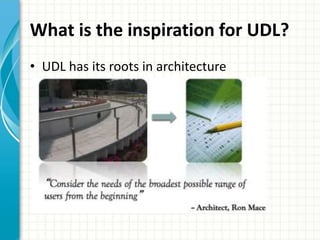
What is the inspiration for UDL?
• UDL has its roots in architecture
More UDL in architecture
Power doors
Curb cuts
Accessibility ramps
There are 3 principles of UDL
Principle #1
Provide multiple means of representation
Principle #2
Provide multiple means of action and expression
Principle #3
Provide multiple means of engagement
-In order for learners to acquire new knowledge, they must be able to connect
with the content. (Brain research tells us that those of us that are strategic
network learners rely on content being presented in many ways!)
-Everyone has their own unique way of making this connection.
- Providing multiple means of expression means that the teacher is laying
down a variety of options for perception, language, math expression, symbols,
and comprehension.
There are a variety of technology tools to support this task.
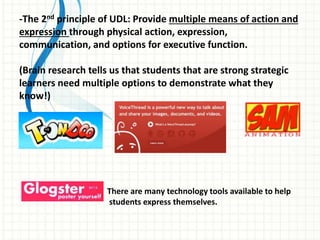
-The 2nd principle of UDL: Provide multiple means of action and
expression through physical action, expression,
communication, and options for executive function.
(Brain research tells us that students that are strong strategic
learners need multiple options to demonstrate what they
know!)
There are many technology tools available to help
students express themselves.
The 3rd principle of UDL: Provide multiple means of engagement means
presenting lessons and information in a fun and exciting way that keeps
students interested and challenged. This process entails recruiting interest,
sustaining effort and persistence, and providing options for self-regulation.
(Brain research tells us that students that are affective learners need their
interest stimulated, and they need to remain motivated for learning to
occur.)
These technology tools give students the opportunity to become more self-
directed learners.
What is the central role of technology
in the principles identified?
• Technology
provides:
• Availability
• Flexibility
• Adaptability
WHAT IS THE POTENTIAL IMPACT OF UDL ON MY SCHOOL?
“CAST defines Universal Design for Learning
(UDL) as a blueprint for creating flexible
goals, methods, materials, and assessments
that accommodate learners’ differences”
(CAST, 1998)
Brain Research Has Taught Us About 3
Learning Networks:
The recognition
network
The strategic
network
The affective
network
The "what" of learning
How we gather facts
and categorize what
we see, hear, and read.
The "how" of learning.
Planning and performing
tasks.
The "why" of learning.
How learners get
engaged and stay
motivated.
(Cast.org, 2013)
What are the implications?
• Each student varies in which network of the
brain he or she prefers to learn with.
• This means teachers must create lessons that
appeal to ALL 3 networks of the brain!
• Using UDL approaches to teaching ensures
this will happen.
What about diversity?
Universal Design for Learning (UDL) was created
to meet the needs of all students and give all
students the opportunity to be successful.
Diversity is commonly found in schools today.
“Universal Design for Learning helps meet the
challenge of diversity by suggesting flexible
instructional materials, techniques, and
strategies that empower educators to meet
these varied needs” (CAST, 2009)
CAST Online Tools
• Internet Inquiry Tool Kit
• This tool provides grades 5-10 a
resource in finding information on
the Internet from a UDL perspective.
• PAL Tool Kit
• This resource gives teachers a tool
to help design lesson plans that
make the curriculum accessible to
all learners.
• The SSEC Tool Kit
• This tool provides high school
teachers with strategies and
activities in vocabulary and reading
comprehension instruction.
Resources
• Retrieved from http://marylandlearninglinks.org/data/ck/sites/121/images/
curb2.jpg
• Alltech - ABSalltech.com | exterior property maintenance. (n.d.). Retrieved from
http://www.alltechbuildingsystems.com
• CAST: About CAST. (n.d.). Retrieved from http://www.cast.org/about/index.html
• Historical Foundations | Universal Design for Learning in HCPSS. (n.d.). Retrieved
from http://udlhcpss.wordpress.com/historical-foundations
• Home | National Center On Universal Design for Learning. (n.d.). Retrieved from
http://www.udlcenter.org
• UDL and The Flipped Classroom: The Full Picture | User Generated Education.
(n.d.). Retrieved from http://usergeneratededucation.wordpress.com/
2012/05/29/udl-and-the-flipped-classroom-the-full-picture/
• Universal Design: Architecture - UDL-VT-TTAC. (n.d.). Retrieved from http://udl-
vt-ttac.wikidot.com/universal-design:architecture

WK4AssgnMaxwellR UDL Presentation6714

  • 1.
    UDL UNIVERSAL DESIGN FOR LEARNING RyanA. Maxwell Walden University Jacqueline Derby Reaching and Engaging All Learners through Technology EDUC 6714 July 27th, 2014
  • 2.
    What is UDL? -UDLis a framework for making curriculum more inclusive for all learners.
  • 3.
    What is theinspiration for UDL? • UDL has its roots in architecture
  • 4.
    More UDL inarchitecture Power doors Curb cuts Accessibility ramps
  • 5.
    There are 3principles of UDL Principle #1 Provide multiple means of representation Principle #2 Provide multiple means of action and expression Principle #3 Provide multiple means of engagement
  • 6.
    -In order forlearners to acquire new knowledge, they must be able to connect with the content. (Brain research tells us that those of us that are strategic network learners rely on content being presented in many ways!) -Everyone has their own unique way of making this connection. - Providing multiple means of expression means that the teacher is laying down a variety of options for perception, language, math expression, symbols, and comprehension. There are a variety of technology tools to support this task.
  • 7.
    -The 2nd principleof UDL: Provide multiple means of action and expression through physical action, expression, communication, and options for executive function. (Brain research tells us that students that are strong strategic learners need multiple options to demonstrate what they know!) There are many technology tools available to help students express themselves.
  • 8.
    The 3rd principleof UDL: Provide multiple means of engagement means presenting lessons and information in a fun and exciting way that keeps students interested and challenged. This process entails recruiting interest, sustaining effort and persistence, and providing options for self-regulation. (Brain research tells us that students that are affective learners need their interest stimulated, and they need to remain motivated for learning to occur.) These technology tools give students the opportunity to become more self- directed learners.
  • 9.
    What is thecentral role of technology in the principles identified? • Technology provides: • Availability • Flexibility • Adaptability
  • 10.
    WHAT IS THEPOTENTIAL IMPACT OF UDL ON MY SCHOOL? “CAST defines Universal Design for Learning (UDL) as a blueprint for creating flexible goals, methods, materials, and assessments that accommodate learners’ differences” (CAST, 1998)
  • 11.
    Brain Research HasTaught Us About 3 Learning Networks: The recognition network The strategic network The affective network The "what" of learning How we gather facts and categorize what we see, hear, and read. The "how" of learning. Planning and performing tasks. The "why" of learning. How learners get engaged and stay motivated. (Cast.org, 2013)
  • 12.
    What are theimplications? • Each student varies in which network of the brain he or she prefers to learn with. • This means teachers must create lessons that appeal to ALL 3 networks of the brain! • Using UDL approaches to teaching ensures this will happen.
  • 13.
    What about diversity? UniversalDesign for Learning (UDL) was created to meet the needs of all students and give all students the opportunity to be successful. Diversity is commonly found in schools today. “Universal Design for Learning helps meet the challenge of diversity by suggesting flexible instructional materials, techniques, and strategies that empower educators to meet these varied needs” (CAST, 2009)
  • 14.
    CAST Online Tools •Internet Inquiry Tool Kit • This tool provides grades 5-10 a resource in finding information on the Internet from a UDL perspective. • PAL Tool Kit • This resource gives teachers a tool to help design lesson plans that make the curriculum accessible to all learners. • The SSEC Tool Kit • This tool provides high school teachers with strategies and activities in vocabulary and reading comprehension instruction.
  • 15.
    Resources • Retrieved fromhttp://marylandlearninglinks.org/data/ck/sites/121/images/ curb2.jpg • Alltech - ABSalltech.com | exterior property maintenance. (n.d.). Retrieved from http://www.alltechbuildingsystems.com • CAST: About CAST. (n.d.). Retrieved from http://www.cast.org/about/index.html • Historical Foundations | Universal Design for Learning in HCPSS. (n.d.). Retrieved from http://udlhcpss.wordpress.com/historical-foundations • Home | National Center On Universal Design for Learning. (n.d.). Retrieved from http://www.udlcenter.org • UDL and The Flipped Classroom: The Full Picture | User Generated Education. (n.d.). Retrieved from http://usergeneratededucation.wordpress.com/ 2012/05/29/udl-and-the-flipped-classroom-the-full-picture/ • Universal Design: Architecture - UDL-VT-TTAC. (n.d.). Retrieved from http://udl- vt-ttac.wikidot.com/universal-design:architecture