FLUID DYNAMICS J3008/4/1
FLUID DYNAMICS
OBJECTIVES
General Objective : To know, understand and apply the mechanism of flow to simple
pipes.
Specific Objectives : At the end of the unit you should be able to :
 define types of flow
 define discharge, continuity equation and mass flowrate in pipes
 solve problems related to the use of continuity equation
UNIT 4
FLUID DYNAMICS J3008/4/2
4.1 TYPES OF FLOW
4.1.1 Steady flow
The cross-sectional area and velocity of the stream may vary from cross-
section, but for each cross-section they do not change with time. Example: a
wave travelling along a channel.
4.1.2 Uniform flow
The cross-sectional area and velocity of the stream of fluid are the same at
each successive cross-section. Example: flow through a pipe of uniform bore
running completely full.
4.1.3 Laminar flow
Also known as streamline or viscous flow, in which the particles of the fluid
move in an orderly manner and retain the same relative positions in
successive cross-sections.
4.1.4 Turbulent flow
Turbulent flow is a non steady flow in which the particles of fluid move in a
disorderly manner, occupying different relative positions in successive cross-
sections.
4.2 Discharge and Mass Flowrate
4.2.1 Discharge
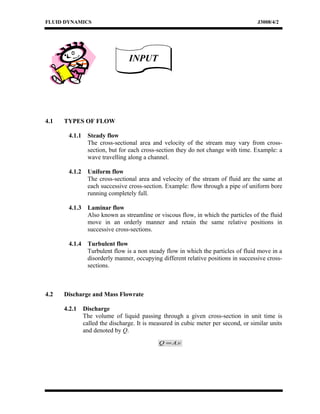
The volume of liquid passing through a given cross-section in unit time is
called the discharge. It is measured in cubic meter per second, or similar units
and denoted by Q.
vAQ .=
INPUTINPUT
FLUID DYNAMICS J3008/4/3
Example 4.1
If the diameter d = 15 cm and the mean velocity, v = 3 m/s, calculate the actual
discharge in the pipe.
Solution to Example 4.1
AvQ =
v
d
×=
4
2
π
( ) 3
4
15.0
2
×=
π
sm /053.0 3
=
4.2.2 Mass Flowrate
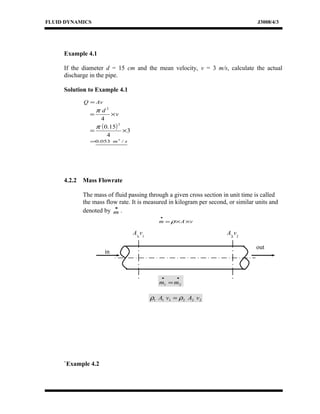
The mass of fluid passing through a given cross section in unit time is called
the mass flow rate. It is measured in kilogram per second, or similar units and
denoted by
•
m .
vAm ××=
•
ρ
••
= 21 mm
222111 vAvA ρρ =
`Example 4.2
A1
v1
A2
v2
in
out
FLUID DYNAMICS J3008/4/4
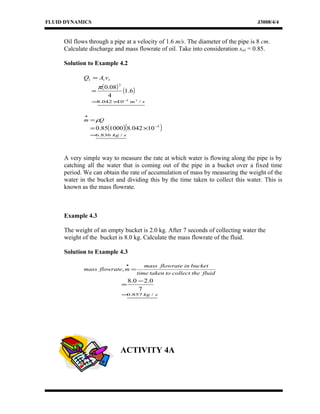
Oil flows through a pipe at a velocity of 1.6 m/s. The diameter of the pipe is 8 cm.
Calculate discharge and mass flowrate of oil. Take into consideration soil = 0.85.
Solution to Example 4.2
111 vAQ =
( ) ( )6.1
4
08.0
2
π
=
sm /10042.8 33−
×=
Qm ρ=
•
( )( )3
10042.8100085.0 −
×=
skg /836.6=
A very simple way to measure the rate at which water is flowing along the pipe is by
catching all the water that is coming out of the pipe in a bucket over a fixed time
period. We can obtain the rate of accumulation of mass by measuring the weight of the
water in the bucket and dividing this by the time taken to collect this water. This is
known as the mass flowrate.
Example 4.3
The weight of an empty bucket is 2.0 kg. After 7 seconds of collecting water the
weight of the bucket is 8.0 kg. Calculate the mass flowrate of the fluid.
Solution to Example 4.3
fluidthecollecttotakentime
bucketinflowratemass
mflowratemass =
•
,
7
0.20.8 −
=
skg /857.0=
ACTIVITY 4A
FLUID DYNAMICS J3008/4/5
TEST YOUR UNDERSTANDING BEFORE YOU CONTINUE WITH THE NEXT
INPUT…!
4.1 List down four types of flow. Define any three types of flow that you have
listed.
FEEDBACK ON ACTIVITY 4A
FLUID DYNAMICS J3008/4/6
4.1
1. Steady flow
The cross-sectional area and velocity of the stream may vary from cross-
section, but for each cross-section they do not change with time. Example: a
wave travelling along a channel.
2. Uniform flow
The cross-sectional area and velocity of the stream of fluid are the same at
each successive cross-section. Example: flow through a pipe of uniform bore
running completely full.
3. Laminar flow
Also known as streamline or viscous flow, in which the particles of the fluid
move in an orderly manner and retain the same relative positions in successive
cross-sections.
4. Turbulent flow
Turbulent flow is a non steady flow in which the particles of fluid move in a
disorderly manner, occupying different relative positions in successive cross-
sections.
INPUTINPUT
FLUID DYNAMICS J3008/4/7
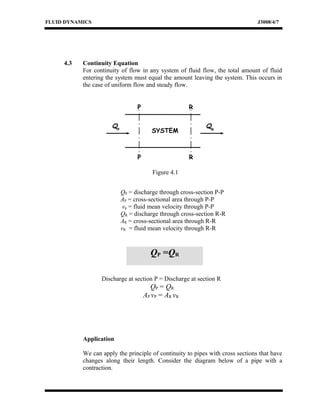
4.3 Continuity Equation
For continuity of flow in any system of fluid flow, the total amount of fluid
entering the system must equal the amount leaving the system. This occurs in
the case of uniform flow and steady flow.
QP = discharge through cross-section P-P
AP = cross-sectional area through P-P
vp = fluid mean velocity through P-P
QR = discharge through cross-section R-R
AR = cross-sectional area through R-R
vR = fluid mean velocity through R-R
Discharge at section P = Discharge at section R
QP = QR
AP vP = AR vR
Application
We can apply the principle of continuity to pipes with cross sections that have
changes along their length. Consider the diagram below of a pipe with a
contraction.
RP
SYSTEM
P R
QR
QP
QP =QR
Figure 4.1
FLUID DYNAMICS J3008/4/8
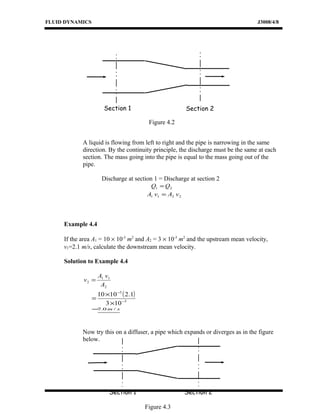
A liquid is flowing from left to right and the pipe is narrowing in the same
direction. By the continuity principle, the discharge must be the same at each
section. The mass going into the pipe is equal to the mass going out of the
pipe.
Discharge at section 1 = Discharge at section 2
21 QQ =
2211 vAvA =
Example 4.4
If the area A1 = 10 × 10-3
m2
and A2 = 3 × 10⁻³
m2
and the upstream mean velocity,
v1=2.1 m/s, calculate the downstream mean velocity.
Solution to Example 4.4
2
11
2
A
vA
v =
( )
3
3
103
1.21010
−
−
×
×
=
sm /0.7=
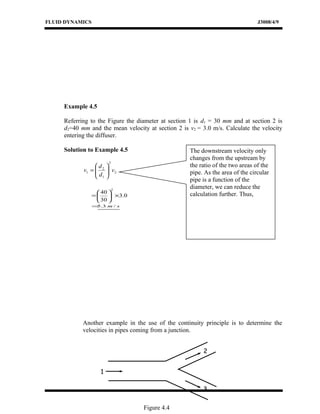
Now try this on a diffuser, a pipe which expands or diverges as in the figure
below.
Section 1 Section 2
Figure 4.2
Section 1 Section 2
Figure 4.3
FLUID DYNAMICS J3008/4/9
Example 4.5
Referring to the Figure the diameter at section 1 is d1 = 30 mm and at section 2 is
d2=40 mm and the mean velocity at section 2 is v2 = 3.0 m/s. Calculate the velocity
entering the diffuser.
Solution to Example 4.5
2
2
1
2
1 v
d
d
v 





=
0.3
30
40
2
×





=
sm /3.5=
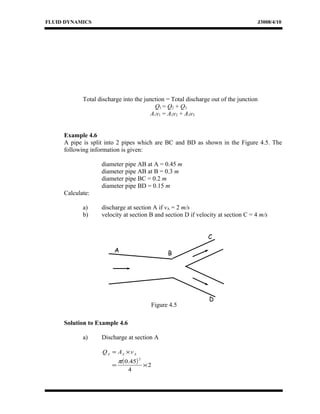
Another example in the use of the continuity principle is to determine the
velocities in pipes coming from a junction.
The downstream velocity only
changes from the upstream by
the ratio of the two areas of the
pipe. As the area of the circular
pipe is a function of the
diameter, we can reduce the
calculation further. Thus,
1
3
2
Figure 4.4
FLUID DYNAMICS J3008/4/10
Total discharge into the junction = Total discharge out of the junction
Q1 = Q2 + Q3
A1v1 = A2v2 + A3v3
Example 4.6
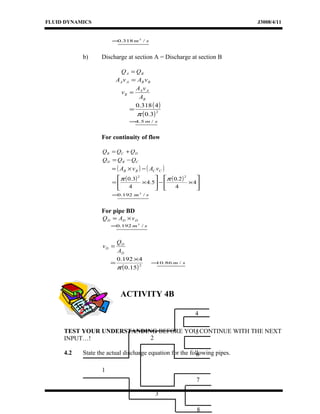
A pipe is split into 2 pipes which are BC and BD as shown in the Figure 4.5. The
following information is given:
diameter pipe AB at A = 0.45 m
diameter pipe AB at B = 0.3 m
diameter pipe BC = 0.2 m
diameter pipe BD = 0.15 m
Calculate:
a) discharge at section A if vA = 2 m/s
b) velocity at section B and section D if velocity at section C = 4 m/s
Solution to Example 4.6
a) Discharge at section A
AAA vAQ ×=
( ) 2
4
45.0
2
×=
π
A
D
C
Figure 4.5
B
FLUID DYNAMICS J3008/4/11
sm /318.0 3
=
b) Discharge at section A = Discharge at section B
BA QQ =
BBAA vAvA =
B
AA
B
A
vA
v =
( )
( )2
3.0
4318.0
π
=
sm /5.4=
For continuity of flow
DCB QQQ +=
CBD QQQ −=
( ) ( )CCBB vAvA −×=
( ) ( )






×−





×= 4
4
2.0
5.4
4
3.0
22
ππ
sm /192.0 3
=
For pipe BD
DDD vAQ ×=
sm /192.0 3
=
D
D
D
A
Q
v =
( )2
15.0
4192.0
π
×
= sm /86.10=
ACTIVITY 4B
TEST YOUR UNDERSTANDING BEFORE YOU CONTINUE WITH THE NEXT
INPUT…!
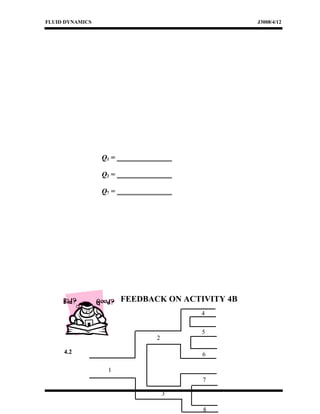
4.2 State the actual discharge equation for the following pipes.6
5
4
3
2
7
8
1
FLUID DYNAMICS J3008/4/12
Q1 = _______________
Q2 = _______________
Q7 = _______________
FEEDBACK ON ACTIVITY 4B
4.2 6
5
4
3
2
7
8
1
FLUID DYNAMICS J3008/4/13
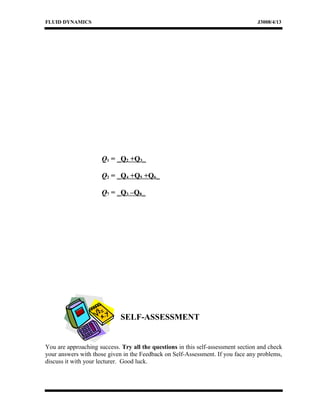
Q1 = _Q2 +Q3_
Q2 = _Q4 +Q5 +Q6_
Q7 = _Q3 –Q8_
SELF-ASSESSMENT
You are approaching success. Try all the questions in this self-assessment section and check
your answers with those given in the Feedback on Self-Assessment. If you face any problems,
discuss it with your lecturer. Good luck.
FLUID DYNAMICS J3008/4/14
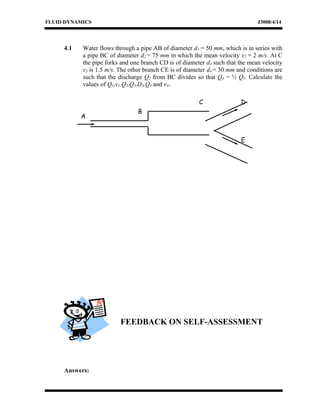
4.1 Water flows through a pipe AB of diameter d1 = 50 mm, which is in series with
a pipe BC of diameter d2 = 75 mm in which the mean velocity v2 = 2 m/s. At C
the pipe forks and one branch CD is of diameter d3 such that the mean velocity
v3 is 1.5 m/s. The other branch CE is of diameter d4 = 30 mm and conditions are
such that the discharge Q2 from BC divides so that Q4 = ½ Q3. Calculate the
values of Q1,v1,Q2,Q3,D3,Q4 and v4..
FEEDBACK ON SELF-ASSESSMENT
Answers:
B
E
DC
A
FLUID DYNAMICS J3008/4/15
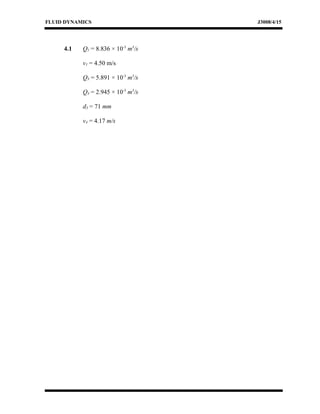
4.1 Q1 = 8.836 × 10⁻³
m3
/s
v1 = 4.50 m/s
Q3 = 5.891 × 10⁻³
m3
/s
Q4 = 2.945 × 10⁻³
m3
/s
d3 = 71 mm
v4 = 4.17 m/s

Unit4 fluid dynamics

  • 1.
    FLUID DYNAMICS J3008/4/1 FLUIDDYNAMICS OBJECTIVES General Objective : To know, understand and apply the mechanism of flow to simple pipes. Specific Objectives : At the end of the unit you should be able to :  define types of flow  define discharge, continuity equation and mass flowrate in pipes  solve problems related to the use of continuity equation UNIT 4
  • 2.
    FLUID DYNAMICS J3008/4/2 4.1TYPES OF FLOW 4.1.1 Steady flow The cross-sectional area and velocity of the stream may vary from cross- section, but for each cross-section they do not change with time. Example: a wave travelling along a channel. 4.1.2 Uniform flow The cross-sectional area and velocity of the stream of fluid are the same at each successive cross-section. Example: flow through a pipe of uniform bore running completely full. 4.1.3 Laminar flow Also known as streamline or viscous flow, in which the particles of the fluid move in an orderly manner and retain the same relative positions in successive cross-sections. 4.1.4 Turbulent flow Turbulent flow is a non steady flow in which the particles of fluid move in a disorderly manner, occupying different relative positions in successive cross- sections. 4.2 Discharge and Mass Flowrate 4.2.1 Discharge The volume of liquid passing through a given cross-section in unit time is called the discharge. It is measured in cubic meter per second, or similar units and denoted by Q. vAQ .= INPUTINPUT
  • 3.
    FLUID DYNAMICS J3008/4/3 Example4.1 If the diameter d = 15 cm and the mean velocity, v = 3 m/s, calculate the actual discharge in the pipe. Solution to Example 4.1 AvQ = v d ×= 4 2 π ( ) 3 4 15.0 2 ×= π sm /053.0 3 = 4.2.2 Mass Flowrate The mass of fluid passing through a given cross section in unit time is called the mass flow rate. It is measured in kilogram per second, or similar units and denoted by • m . vAm ××= • ρ •• = 21 mm 222111 vAvA ρρ = `Example 4.2 A1 v1 A2 v2 in out
  • 4.
    FLUID DYNAMICS J3008/4/4 Oilflows through a pipe at a velocity of 1.6 m/s. The diameter of the pipe is 8 cm. Calculate discharge and mass flowrate of oil. Take into consideration soil = 0.85. Solution to Example 4.2 111 vAQ = ( ) ( )6.1 4 08.0 2 π = sm /10042.8 33− ×= Qm ρ= • ( )( )3 10042.8100085.0 − ×= skg /836.6= A very simple way to measure the rate at which water is flowing along the pipe is by catching all the water that is coming out of the pipe in a bucket over a fixed time period. We can obtain the rate of accumulation of mass by measuring the weight of the water in the bucket and dividing this by the time taken to collect this water. This is known as the mass flowrate. Example 4.3 The weight of an empty bucket is 2.0 kg. After 7 seconds of collecting water the weight of the bucket is 8.0 kg. Calculate the mass flowrate of the fluid. Solution to Example 4.3 fluidthecollecttotakentime bucketinflowratemass mflowratemass = • , 7 0.20.8 − = skg /857.0= ACTIVITY 4A
  • 5.
    FLUID DYNAMICS J3008/4/5 TESTYOUR UNDERSTANDING BEFORE YOU CONTINUE WITH THE NEXT INPUT…! 4.1 List down four types of flow. Define any three types of flow that you have listed. FEEDBACK ON ACTIVITY 4A
  • 6.
    FLUID DYNAMICS J3008/4/6 4.1 1.Steady flow The cross-sectional area and velocity of the stream may vary from cross- section, but for each cross-section they do not change with time. Example: a wave travelling along a channel. 2. Uniform flow The cross-sectional area and velocity of the stream of fluid are the same at each successive cross-section. Example: flow through a pipe of uniform bore running completely full. 3. Laminar flow Also known as streamline or viscous flow, in which the particles of the fluid move in an orderly manner and retain the same relative positions in successive cross-sections. 4. Turbulent flow Turbulent flow is a non steady flow in which the particles of fluid move in a disorderly manner, occupying different relative positions in successive cross- sections. INPUTINPUT
  • 7.
    FLUID DYNAMICS J3008/4/7 4.3Continuity Equation For continuity of flow in any system of fluid flow, the total amount of fluid entering the system must equal the amount leaving the system. This occurs in the case of uniform flow and steady flow. QP = discharge through cross-section P-P AP = cross-sectional area through P-P vp = fluid mean velocity through P-P QR = discharge through cross-section R-R AR = cross-sectional area through R-R vR = fluid mean velocity through R-R Discharge at section P = Discharge at section R QP = QR AP vP = AR vR Application We can apply the principle of continuity to pipes with cross sections that have changes along their length. Consider the diagram below of a pipe with a contraction. RP SYSTEM P R QR QP QP =QR Figure 4.1
  • 8.
    FLUID DYNAMICS J3008/4/8 Aliquid is flowing from left to right and the pipe is narrowing in the same direction. By the continuity principle, the discharge must be the same at each section. The mass going into the pipe is equal to the mass going out of the pipe. Discharge at section 1 = Discharge at section 2 21 QQ = 2211 vAvA = Example 4.4 If the area A1 = 10 × 10-3 m2 and A2 = 3 × 10⁻³ m2 and the upstream mean velocity, v1=2.1 m/s, calculate the downstream mean velocity. Solution to Example 4.4 2 11 2 A vA v = ( ) 3 3 103 1.21010 − − × × = sm /0.7= Now try this on a diffuser, a pipe which expands or diverges as in the figure below. Section 1 Section 2 Figure 4.2 Section 1 Section 2 Figure 4.3
  • 9.
    FLUID DYNAMICS J3008/4/9 Example4.5 Referring to the Figure the diameter at section 1 is d1 = 30 mm and at section 2 is d2=40 mm and the mean velocity at section 2 is v2 = 3.0 m/s. Calculate the velocity entering the diffuser. Solution to Example 4.5 2 2 1 2 1 v d d v       = 0.3 30 40 2 ×      = sm /3.5= Another example in the use of the continuity principle is to determine the velocities in pipes coming from a junction. The downstream velocity only changes from the upstream by the ratio of the two areas of the pipe. As the area of the circular pipe is a function of the diameter, we can reduce the calculation further. Thus, 1 3 2 Figure 4.4
  • 10.
    FLUID DYNAMICS J3008/4/10 Totaldischarge into the junction = Total discharge out of the junction Q1 = Q2 + Q3 A1v1 = A2v2 + A3v3 Example 4.6 A pipe is split into 2 pipes which are BC and BD as shown in the Figure 4.5. The following information is given: diameter pipe AB at A = 0.45 m diameter pipe AB at B = 0.3 m diameter pipe BC = 0.2 m diameter pipe BD = 0.15 m Calculate: a) discharge at section A if vA = 2 m/s b) velocity at section B and section D if velocity at section C = 4 m/s Solution to Example 4.6 a) Discharge at section A AAA vAQ ×= ( ) 2 4 45.0 2 ×= π A D C Figure 4.5 B
  • 11.
    FLUID DYNAMICS J3008/4/11 sm/318.0 3 = b) Discharge at section A = Discharge at section B BA QQ = BBAA vAvA = B AA B A vA v = ( ) ( )2 3.0 4318.0 π = sm /5.4= For continuity of flow DCB QQQ += CBD QQQ −= ( ) ( )CCBB vAvA −×= ( ) ( )       ×−      ×= 4 4 2.0 5.4 4 3.0 22 ππ sm /192.0 3 = For pipe BD DDD vAQ ×= sm /192.0 3 = D D D A Q v = ( )2 15.0 4192.0 π × = sm /86.10= ACTIVITY 4B TEST YOUR UNDERSTANDING BEFORE YOU CONTINUE WITH THE NEXT INPUT…! 4.2 State the actual discharge equation for the following pipes.6 5 4 3 2 7 8 1
  • 12.
    FLUID DYNAMICS J3008/4/12 Q1= _______________ Q2 = _______________ Q7 = _______________ FEEDBACK ON ACTIVITY 4B 4.2 6 5 4 3 2 7 8 1
  • 13.
    FLUID DYNAMICS J3008/4/13 Q1= _Q2 +Q3_ Q2 = _Q4 +Q5 +Q6_ Q7 = _Q3 –Q8_ SELF-ASSESSMENT You are approaching success. Try all the questions in this self-assessment section and check your answers with those given in the Feedback on Self-Assessment. If you face any problems, discuss it with your lecturer. Good luck.
  • 14.
    FLUID DYNAMICS J3008/4/14 4.1Water flows through a pipe AB of diameter d1 = 50 mm, which is in series with a pipe BC of diameter d2 = 75 mm in which the mean velocity v2 = 2 m/s. At C the pipe forks and one branch CD is of diameter d3 such that the mean velocity v3 is 1.5 m/s. The other branch CE is of diameter d4 = 30 mm and conditions are such that the discharge Q2 from BC divides so that Q4 = ½ Q3. Calculate the values of Q1,v1,Q2,Q3,D3,Q4 and v4.. FEEDBACK ON SELF-ASSESSMENT Answers: B E DC A
  • 15.
    FLUID DYNAMICS J3008/4/15 4.1Q1 = 8.836 × 10⁻³ m3 /s v1 = 4.50 m/s Q3 = 5.891 × 10⁻³ m3 /s Q4 = 2.945 × 10⁻³ m3 /s d3 = 71 mm v4 = 4.17 m/s