Computer organization
Organization of control units
Basic concepts   To execute a program, the will fetch the contents of memory location pointed to by the PC and they are loaded to IR Instructions are fetched from successive memory locations until a branch or a jump instruction is encountered After loading instruction to IR, PC is incremented. Carry out actions specified by instruction in IR The above phases can be considered as fetch phase and execution phase
Basic concepts   An instruction can be executed by performing one or more of the following operations Transfer a word of data from one processor register to another or to the ALU Perform an arithmetic or a logic operation  and store the result in a processor register Fetch the contents of a given memory location and load them into a processor register Store a word of data from a processor register into a given memory location
Basic concepts   The registers, the ALU and interconnecting bus are collectively referred to as the datapath There are certain registers which are used by the processor for temporary storage during execution for some instructions
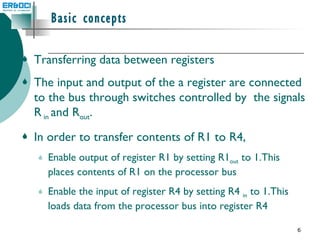
Basic concepts   Transferring data between registers The input and output of the a register are connected to the bus through switches controlled by  the signals R  in  and R out . In order to transfer contents of R1 to R4, Enable output of register R1 by setting R1 out  to 1.This places contents of R1 on the processor bus Enable the input of register R4 by setting R4  in  to 1.This loads data from the processor bus into register R4
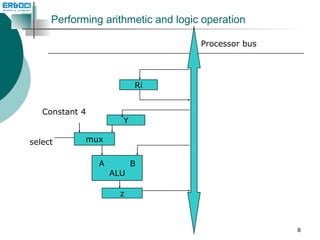
Basic concepts   Performing arithmetic instruction E.g. add contents of register R1 to those of register R2 and store the result to R3 R1 out  ,Y  in R2 out ,SelectY,Add,Z in Z out ,R3 in
Performing arithmetic and logic operation Ri Y mux A  B ALU z Processor bus select Constant 4
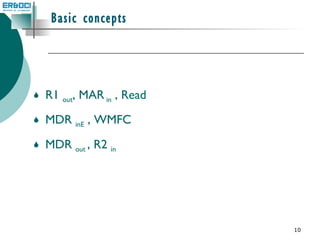
Basic concepts   Fetching a word from memory  ; move (R1),R2 MAR   [ R1] Start a read operation on the memory bus Wait for MFC response from the memory Load MDR from the memory bus R2    [MDR ] To accommodate the variability in response time, the processor waits until it receives an indication that the requested read operation is completed ,such a signal is the MFC signal
Basic concepts   R1  out , MAR  in  , Read MDR  inE  , WMFC MDR  out  , R2  in
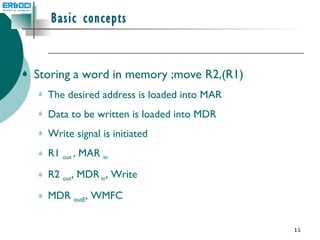
Basic concepts   Storing a word in memory ;move R2,(R1) The desired address is loaded into MAR Data to be written is loaded into MDR Write signal is initiated R1  out  , MAR  in R2  out , MDR  in , Write MDR  outE , WMFC
Execution of a complete instruction   Various steps are involved in executing a complete instruction (e.g. Add  (R3),R1 Fetch the instruction Fetch the first operand Perform the action Load the result
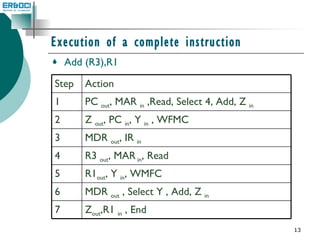
Execution of a complete instruction   Add (R3),R1 Z out ,R1  in  , End 7 MDR  out  , Select Y , Add, Z  in 6 R1 out , Y  in , WMFC 5 R3  out , MAR  in , Read 4  MDR  out , IR  in 3 Z  out , PC  in , Y  in  , WFMC 2 PC  out , MAR  in  ,Read, Select 4, Add, Z  in 1 Action Step
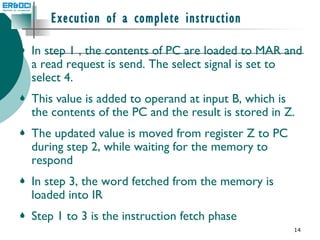
Execution of a complete instruction   In step 1 , the contents of PC are loaded to MAR and a read request is send. The select signal is set to select 4.  This value is added to operand at input B, which is the contents of the PC and the result is stored in Z. The updated value is moved from register Z to PC during step 2, while waiting for the memory to respond In step 3, the word fetched from the memory is loaded into IR Step 1 to 3 is the instruction fetch phase
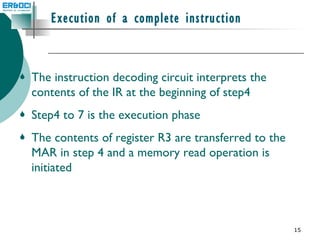
Execution of a complete instruction   The instruction decoding circuit interprets the contents of the IR at the beginning of step4 Step4 to 7 is the execution phase The contents of register R3 are transferred to the MAR in step 4 and a memory read operation is initiated
Execution of a complete instruction   The contents of R1 are transferred to register Y in step 5,when read operation is completed, the memory operand is available in register MDR The addition is performed in step 6 The result is stored in step 7
Execution of a complete instruction   The end signal causes a new instruction fetch cycle to begin by returning to step1 In step 2 , it is not necessary to transfer contents of PC to register Y But if any branching occurs, the updated value of PC is required to calculate the  branch target address
Execution of a complete instruction   Branch instructions Branch instruction replaces the contents of the PC with target address This address is usually obtained by adding an offset X, which is given in the branch instruction to the updated value of PC If the branch instruction is at location 2000 ,if the branch target address is 2050 offset must be 46  If it is a conditional branch , the status must be checked before branching
Execution of a complete instruction   branching Z out ,PC  in  , End 5 Offset of IR  out , Add, Z  in 4  MDR  out , IR  in 3 Z  out , PC  in , Y  in  , WMFC 2 PC  out , MAR  in  ,Read, Select 4, Add, Z  in 1 Action Step
Control Two main approaches used for implementing the control unit of a processor are  Hardwired control  and  Micro programmed control
Hardwired control Each step in a sequence of control signal is completed in one clock period A counter may be used to keep track of the control steps Each state or count of this counter corresponds to one control step
Hardwired control Each state or count of this counter correspond to one control step The required control signals are determined by Contents of the control step counter Contents of the Instruction register Contents of the condition code flags External input signals, such as MFC and interrupt requests
Hardwired control Control step  counter Step counter External  inputs Condition  codes Encoder Instruction decoder IR clock End Run INS1 INS n T1
Hardwired control The step decoder provides a separate signal line for each step or time slot, in the control sequence The output of the instruction decoder consists of a separate line for each machine instruction For any instruction loaded in IR, one of the output lines INS1 is set to 1and all other lines are set to 0 The input signals to the encoder block are combined to generate the individual control signals
Hardwired control E.g. Z in = T1+T6.Add+T4.Br+……… The end signal starts a new instruction fetch cycle by resetting the control step counter to its starting values When Run signal is set to 1 the counter is incremented at the end of every clock cycle
Hardwired control The sequence of operations carried out by the wiring of the logic elements ,hence the name hardwired A controller that uses this approach can operate at high speed It has limited flexibility and complexity of the instruction set it can implement is limited
Micro programmed control Here the control signals are generated using program similar to machine language programs A control word is a word whose individual bits represent various control signals Each of the control steps in the control sequence of an instruction defines a unique combination of 1’s and 0 s.
Micro programmed control A sequence of CW s corresponding to the control sequence of a machine constitutes the micro routine  or micro program for the instruction The individual control words in the micro routine are referred to as microinstructions
Micro programmed control The micro routines for all instructions in the instruction set of a computer are stored in a special memory called the control store The control unit can generate the control signals for any instruction by sequentially reading the CW’s of the corresponding microroutine from the control store
Microprogrammed control   3. 1. PC out, MAR in, Read,Select,Add,Zin 2. 0 0 0 0 0 0 1 1 1 0 0 0 1 1 1 0 1. E nd WMFC R3 out R1 in R1 out Z out Z in Add select Y  in IR in MDR out Read MAR  in PC out PC in Micro instruction
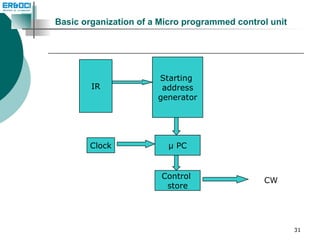
Basic organization of a Micro programmed control unit Starting  address generator IR μ  PC Control  store Clock CW
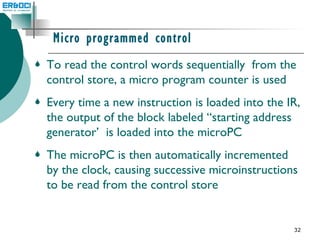
Micro programmed control To read the control words sequentially  from the control store, a micro program counter is used Every time a new instruction is loaded into the IR, the output of the block labeled “starting address generator’  is loaded into the microPC The microPC is then automatically incremented by the clock, causing successive microinstructions to be read from the control store
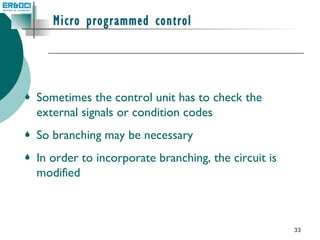
Micro programmed control Sometimes the control unit has to check the external signals or condition codes So branching may be necessary In order to incorporate branching, the circuit is modified
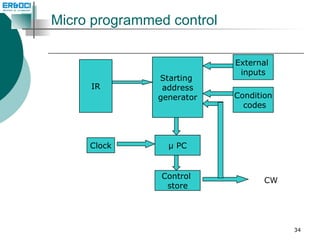
Micro programmed control Starting  address generator IR μ  PC Control  store Clock CW External  inputs Condition codes
Micro programmed control When a new instruction is loaded into the IR , the micro PC is loaded with the starting address of the micro routine for that instruction When a branch micro instruction is encountered , and the branch condition is satisfied, the micro PC is loaded with the branch address
Micro programmed control When an End microinstruction is encountered, the micro PC is loaded with the address of the first CW in the micro routine for the instruction fetch cycle
Micro programmed control – address sequencing –micro instruction sequencing Incrementing of the control address register Unconditional branch or conditional branch , depending on status bit conditions A mapping process from the bits of the instruction to an address of the control memory A facility for sub routine and return
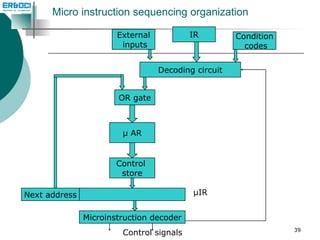
Microinstructions with next address field The increase in branch instruction may create problems if we are using incrementable  μ PC An alternative is to use an additional address field which indicate the address of next instruction to be fetched So separate branch instruction is not necessary So there is no need to use a counter for sequencing
Micro instruction sequencing organization μ  AR Control  store Next address OR gate μ IR Microinstruction decoder Decoding circuit IR Condition codes External inputs Control signals
Microinstructions with next address field So  μ PC is replaced with micro instruction address register  μ AR  The next address bits are fed through the OR gates to the  μ AR  Any modification required for the address can be done on the basis of data in the IR , external inputs and condition codes The decoding circuits generate the starting address on the basis of the output code in IR

Unit2 control unit

  • 1.
  • 2.
  • 3.
    Basic concepts To execute a program, the will fetch the contents of memory location pointed to by the PC and they are loaded to IR Instructions are fetched from successive memory locations until a branch or a jump instruction is encountered After loading instruction to IR, PC is incremented. Carry out actions specified by instruction in IR The above phases can be considered as fetch phase and execution phase
  • 4.
    Basic concepts An instruction can be executed by performing one or more of the following operations Transfer a word of data from one processor register to another or to the ALU Perform an arithmetic or a logic operation and store the result in a processor register Fetch the contents of a given memory location and load them into a processor register Store a word of data from a processor register into a given memory location
  • 5.
    Basic concepts The registers, the ALU and interconnecting bus are collectively referred to as the datapath There are certain registers which are used by the processor for temporary storage during execution for some instructions
  • 6.
    Basic concepts Transferring data between registers The input and output of the a register are connected to the bus through switches controlled by the signals R in and R out . In order to transfer contents of R1 to R4, Enable output of register R1 by setting R1 out to 1.This places contents of R1 on the processor bus Enable the input of register R4 by setting R4 in to 1.This loads data from the processor bus into register R4
  • 7.
    Basic concepts Performing arithmetic instruction E.g. add contents of register R1 to those of register R2 and store the result to R3 R1 out ,Y in R2 out ,SelectY,Add,Z in Z out ,R3 in
  • 8.
    Performing arithmetic andlogic operation Ri Y mux A B ALU z Processor bus select Constant 4
  • 9.
    Basic concepts Fetching a word from memory ; move (R1),R2 MAR  [ R1] Start a read operation on the memory bus Wait for MFC response from the memory Load MDR from the memory bus R2  [MDR ] To accommodate the variability in response time, the processor waits until it receives an indication that the requested read operation is completed ,such a signal is the MFC signal
  • 10.
    Basic concepts R1 out , MAR in , Read MDR inE , WMFC MDR out , R2 in
  • 11.
    Basic concepts Storing a word in memory ;move R2,(R1) The desired address is loaded into MAR Data to be written is loaded into MDR Write signal is initiated R1 out , MAR in R2 out , MDR in , Write MDR outE , WMFC
  • 12.
    Execution of acomplete instruction Various steps are involved in executing a complete instruction (e.g. Add (R3),R1 Fetch the instruction Fetch the first operand Perform the action Load the result
  • 13.
    Execution of acomplete instruction Add (R3),R1 Z out ,R1 in , End 7 MDR out , Select Y , Add, Z in 6 R1 out , Y in , WMFC 5 R3 out , MAR in , Read 4 MDR out , IR in 3 Z out , PC in , Y in , WFMC 2 PC out , MAR in ,Read, Select 4, Add, Z in 1 Action Step
  • 14.
    Execution of acomplete instruction In step 1 , the contents of PC are loaded to MAR and a read request is send. The select signal is set to select 4. This value is added to operand at input B, which is the contents of the PC and the result is stored in Z. The updated value is moved from register Z to PC during step 2, while waiting for the memory to respond In step 3, the word fetched from the memory is loaded into IR Step 1 to 3 is the instruction fetch phase
  • 15.
    Execution of acomplete instruction The instruction decoding circuit interprets the contents of the IR at the beginning of step4 Step4 to 7 is the execution phase The contents of register R3 are transferred to the MAR in step 4 and a memory read operation is initiated
  • 16.
    Execution of acomplete instruction The contents of R1 are transferred to register Y in step 5,when read operation is completed, the memory operand is available in register MDR The addition is performed in step 6 The result is stored in step 7
  • 17.
    Execution of acomplete instruction The end signal causes a new instruction fetch cycle to begin by returning to step1 In step 2 , it is not necessary to transfer contents of PC to register Y But if any branching occurs, the updated value of PC is required to calculate the branch target address
  • 18.
    Execution of acomplete instruction Branch instructions Branch instruction replaces the contents of the PC with target address This address is usually obtained by adding an offset X, which is given in the branch instruction to the updated value of PC If the branch instruction is at location 2000 ,if the branch target address is 2050 offset must be 46 If it is a conditional branch , the status must be checked before branching
  • 19.
    Execution of acomplete instruction branching Z out ,PC in , End 5 Offset of IR out , Add, Z in 4 MDR out , IR in 3 Z out , PC in , Y in , WMFC 2 PC out , MAR in ,Read, Select 4, Add, Z in 1 Action Step
  • 20.
    Control Two mainapproaches used for implementing the control unit of a processor are Hardwired control and Micro programmed control
  • 21.
    Hardwired control Eachstep in a sequence of control signal is completed in one clock period A counter may be used to keep track of the control steps Each state or count of this counter corresponds to one control step
  • 22.
    Hardwired control Eachstate or count of this counter correspond to one control step The required control signals are determined by Contents of the control step counter Contents of the Instruction register Contents of the condition code flags External input signals, such as MFC and interrupt requests
  • 23.
    Hardwired control Controlstep counter Step counter External inputs Condition codes Encoder Instruction decoder IR clock End Run INS1 INS n T1
  • 24.
    Hardwired control Thestep decoder provides a separate signal line for each step or time slot, in the control sequence The output of the instruction decoder consists of a separate line for each machine instruction For any instruction loaded in IR, one of the output lines INS1 is set to 1and all other lines are set to 0 The input signals to the encoder block are combined to generate the individual control signals
  • 25.
    Hardwired control E.g.Z in = T1+T6.Add+T4.Br+……… The end signal starts a new instruction fetch cycle by resetting the control step counter to its starting values When Run signal is set to 1 the counter is incremented at the end of every clock cycle
  • 26.
    Hardwired control Thesequence of operations carried out by the wiring of the logic elements ,hence the name hardwired A controller that uses this approach can operate at high speed It has limited flexibility and complexity of the instruction set it can implement is limited
  • 27.
    Micro programmed controlHere the control signals are generated using program similar to machine language programs A control word is a word whose individual bits represent various control signals Each of the control steps in the control sequence of an instruction defines a unique combination of 1’s and 0 s.
  • 28.
    Micro programmed controlA sequence of CW s corresponding to the control sequence of a machine constitutes the micro routine or micro program for the instruction The individual control words in the micro routine are referred to as microinstructions
  • 29.
    Micro programmed controlThe micro routines for all instructions in the instruction set of a computer are stored in a special memory called the control store The control unit can generate the control signals for any instruction by sequentially reading the CW’s of the corresponding microroutine from the control store
  • 30.
    Microprogrammed control 3. 1. PC out, MAR in, Read,Select,Add,Zin 2. 0 0 0 0 0 0 1 1 1 0 0 0 1 1 1 0 1. E nd WMFC R3 out R1 in R1 out Z out Z in Add select Y in IR in MDR out Read MAR in PC out PC in Micro instruction
  • 31.
    Basic organization ofa Micro programmed control unit Starting address generator IR μ PC Control store Clock CW
  • 32.
    Micro programmed controlTo read the control words sequentially from the control store, a micro program counter is used Every time a new instruction is loaded into the IR, the output of the block labeled “starting address generator’ is loaded into the microPC The microPC is then automatically incremented by the clock, causing successive microinstructions to be read from the control store
  • 33.
    Micro programmed controlSometimes the control unit has to check the external signals or condition codes So branching may be necessary In order to incorporate branching, the circuit is modified
  • 34.
    Micro programmed controlStarting address generator IR μ PC Control store Clock CW External inputs Condition codes
  • 35.
    Micro programmed controlWhen a new instruction is loaded into the IR , the micro PC is loaded with the starting address of the micro routine for that instruction When a branch micro instruction is encountered , and the branch condition is satisfied, the micro PC is loaded with the branch address
  • 36.
    Micro programmed controlWhen an End microinstruction is encountered, the micro PC is loaded with the address of the first CW in the micro routine for the instruction fetch cycle
  • 37.
    Micro programmed control– address sequencing –micro instruction sequencing Incrementing of the control address register Unconditional branch or conditional branch , depending on status bit conditions A mapping process from the bits of the instruction to an address of the control memory A facility for sub routine and return
  • 38.
    Microinstructions with nextaddress field The increase in branch instruction may create problems if we are using incrementable μ PC An alternative is to use an additional address field which indicate the address of next instruction to be fetched So separate branch instruction is not necessary So there is no need to use a counter for sequencing
  • 39.
    Micro instruction sequencingorganization μ AR Control store Next address OR gate μ IR Microinstruction decoder Decoding circuit IR Condition codes External inputs Control signals
  • 40.
    Microinstructions with nextaddress field So μ PC is replaced with micro instruction address register μ AR The next address bits are fed through the OR gates to the μ AR Any modification required for the address can be done on the basis of data in the IR , external inputs and condition codes The decoding circuits generate the starting address on the basis of the output code in IR