GRAMMAR BOOK
  By: Erica Tibbs
TABLE OF CONTENTS


1.Nationalidades
2.Stem Changers
3. Para
4.Indirect Object Pronouns
5. Pronoun Placement
6.Gustar
7.Affirmative & Negative Words
8. Superlatives
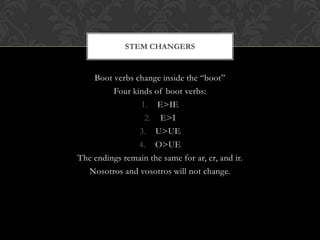
STEM CHANGERS


    Boot verbs change inside the “boot”
         Four kinds of boot verbs:
                1. E>IE
                 2. E>I
                3. U>UE
                4. O>UE
The endings remain the same for ar, er, and ir.
  Nosotros and vosotros will not change.
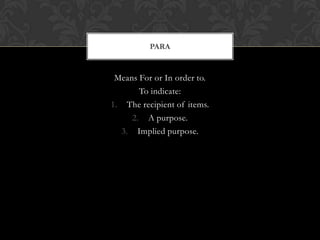
PARA


 Means For or In order to.
       To indicate:
1. The recipient of items.
     2. A purpose.
  3. Implied purpose.
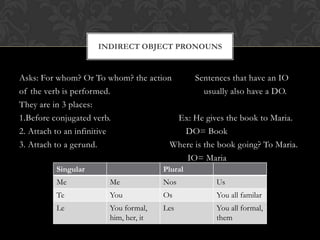
INDIRECT OBJECT PRONOUNS


Asks: For whom? Or To whom? the action      Sentences that have an IO
of the verb is performed.                      usually also have a DO.
They are in 3 places:
1.Before conjugated verb.              Ex: He gives the book to Maria.
2. Attach to an infinitive               DO= Book
3. Attach to a gerund.                Where is the book going? To Maria.
                                         IO= Maria
         Singular                     Plural
         Me            Me             Nos          Us
         Te            You            Os           You all familar
         Le            You formal,    Les          You all formal,
                       him, her, it                them
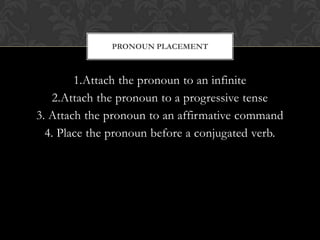
PRONOUN PLACEMENT


        1.Attach the pronoun to an infinite
   2.Attach the pronoun to a progressive tense
3. Attach the pronoun to an affirmative command
  4. Place the pronoun before a conjugated verb.
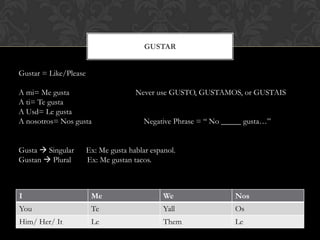
GUSTAR


Gustar = Like/Please

A mi= Me gusta                        Never use GUSTO, GUSTAMOS, or GUSTAIS
A ti= Te gusta
A Usd= Le gusta
A nosotros= Nos gusta                    Negative Phrase = “ No _____ gusta…”


Gusta  Singular       Ex: Me gusta hablar espanol.
Gustan  Plural        Ex: Me gustan tacos.


I                       Me                     We                 Nos
You                     Te                     Yall               Os
Him/ Her/ It            Le                     Them               Le
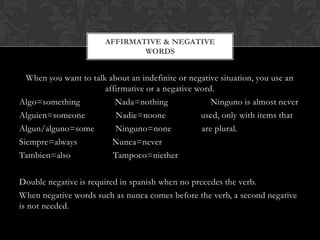
AFFIRMATIVE & NEGATIVE
                               WORDS


  When you want to talk about an indefinite or negative situation, you use an
                       affirmative or a negative word.
Algo=something            Nada=nothing               Ninguno is almost never
Alguien=someone           Nadie=noone             used, only with items that
Algun/alguno=some         Ninguno=none            are plural.
Siempre=always           Nunca=never
Tambien=also             Tampoco=niether

Double negative is required in spanish when no precedes the verb.
When negative words such as nunca comes before the verb, a second negative
is not needed.
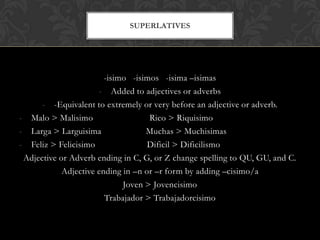
SUPERLATIVES


                        -isimo -isimos -isima –isimas
                      - Added to adjectives or adverbs
      - -Equivalent to extremely or very before an adjective or adverb.
- Malo > Malisimo                   Rico > Riquisimo
- Larga > Larguisima               Muchas > Muchisimas
- Feliz > Felicisimo                Dificil > Dificilismo
 Adjective or Adverb ending in C, G, or Z change spelling to QU, GU, and C.
            Adjective ending in –n or –r form by adding –cisimo/a
                             Joven > Jovencisimo
                        Trabajador > Trabajadorcisimo

Grammar book sp2h erica

  • 1.
    GRAMMAR BOOK By: Erica Tibbs
  • 2.
    TABLE OF CONTENTS 1.Nationalidades 2.StemChangers 3. Para 4.Indirect Object Pronouns 5. Pronoun Placement 6.Gustar 7.Affirmative & Negative Words 8. Superlatives
  • 4.
    STEM CHANGERS Boot verbs change inside the “boot” Four kinds of boot verbs: 1. E>IE 2. E>I 3. U>UE 4. O>UE The endings remain the same for ar, er, and ir. Nosotros and vosotros will not change.
  • 5.
    PARA Means Foror In order to. To indicate: 1. The recipient of items. 2. A purpose. 3. Implied purpose.
  • 6.
    INDIRECT OBJECT PRONOUNS Asks:For whom? Or To whom? the action Sentences that have an IO of the verb is performed. usually also have a DO. They are in 3 places: 1.Before conjugated verb. Ex: He gives the book to Maria. 2. Attach to an infinitive DO= Book 3. Attach to a gerund. Where is the book going? To Maria. IO= Maria Singular Plural Me Me Nos Us Te You Os You all familar Le You formal, Les You all formal, him, her, it them
  • 7.
    PRONOUN PLACEMENT 1.Attach the pronoun to an infinite 2.Attach the pronoun to a progressive tense 3. Attach the pronoun to an affirmative command 4. Place the pronoun before a conjugated verb.
  • 8.
    GUSTAR Gustar = Like/Please Ami= Me gusta Never use GUSTO, GUSTAMOS, or GUSTAIS A ti= Te gusta A Usd= Le gusta A nosotros= Nos gusta Negative Phrase = “ No _____ gusta…” Gusta  Singular Ex: Me gusta hablar espanol. Gustan  Plural Ex: Me gustan tacos. I Me We Nos You Te Yall Os Him/ Her/ It Le Them Le
  • 9.
    AFFIRMATIVE & NEGATIVE WORDS When you want to talk about an indefinite or negative situation, you use an affirmative or a negative word. Algo=something Nada=nothing Ninguno is almost never Alguien=someone Nadie=noone used, only with items that Algun/alguno=some Ninguno=none are plural. Siempre=always Nunca=never Tambien=also Tampoco=niether Double negative is required in spanish when no precedes the verb. When negative words such as nunca comes before the verb, a second negative is not needed.
  • 10.
    SUPERLATIVES -isimo -isimos -isima –isimas - Added to adjectives or adverbs - -Equivalent to extremely or very before an adjective or adverb. - Malo > Malisimo Rico > Riquisimo - Larga > Larguisima Muchas > Muchisimas - Feliz > Felicisimo Dificil > Dificilismo Adjective or Adverb ending in C, G, or Z change spelling to QU, GU, and C. Adjective ending in –n or –r form by adding –cisimo/a Joven > Jovencisimo Trabajador > Trabajadorcisimo