 A phrasal verb is a verb followed by a
preposition or an adverb; the combination
creates a meaning different from the original
verb alone.
 Phrasal verbs are part of a large group of
verbs called “multi-part” or "multi-
word” verbs.
 The preposition or adverb that follows
the verb is sometimes called a particle.
 Phrasal verbs and other multi-word
verbs are an important part of the
English language.
 However, they are mainly used in
spoken English and informal texts.
 They should be avoided in academic
writing where it is preferable to use a
formal verb such as “to postpone” rather
than “to put off”.
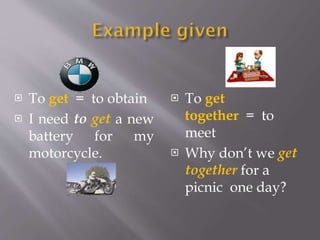
 To get = to obtain
 I need to get a new
battery for my
motorcycle.
 To get
together = to
meet
 Why don’t we get
together for a
picnic one day?
 Phrasal verbs can be either transitive or
intransitive.
 These phrasal verbs need an object in
order to be used.
 E.g. I made up an excuse about the
computer. ('Excuse' is the object of the
verb.)
 You can separate some of the transitive
phrasal verbs, it means, you can place the
object between the verb and the particle.
 E.g. I looked the word up in the dictionary.
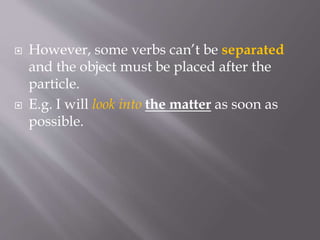
 However, some verbs can’t be separated
and the object must be placed after the
particle.
 E.g. I will look into the matter as soon as
possible.
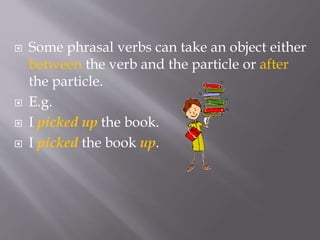
 Some phrasal verbs can take an object either
between the verb and the particle or after
the particle.
 E.g.
 I picked up the book.
 I picked the book up.
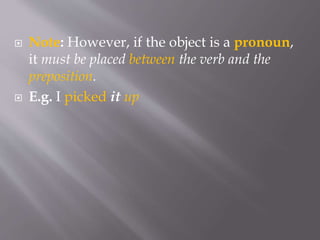
 Note: However, if the object is a pronoun,
it must be placed between the verb and the
preposition.
 E.g. I picked it up
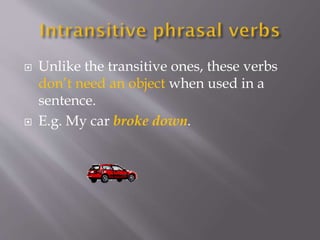
 Unlike the transitive ones, these verbs
don’t need an object when used in a
sentence.
 E.g. My car broke down.

Phrasal verbs presentation

  • 2.
     A phrasalverb is a verb followed by a preposition or an adverb; the combination creates a meaning different from the original verb alone.
  • 3.
     Phrasal verbsare part of a large group of verbs called “multi-part” or "multi- word” verbs.  The preposition or adverb that follows the verb is sometimes called a particle.
  • 4.
     Phrasal verbsand other multi-word verbs are an important part of the English language.  However, they are mainly used in spoken English and informal texts.
  • 5.
     They shouldbe avoided in academic writing where it is preferable to use a formal verb such as “to postpone” rather than “to put off”.
  • 6.
     To get= to obtain  I need to get a new battery for my motorcycle.  To get together = to meet  Why don’t we get together for a picnic one day?
  • 7.
     Phrasal verbscan be either transitive or intransitive.
  • 8.
     These phrasalverbs need an object in order to be used.  E.g. I made up an excuse about the computer. ('Excuse' is the object of the verb.)
  • 9.
     You canseparate some of the transitive phrasal verbs, it means, you can place the object between the verb and the particle.  E.g. I looked the word up in the dictionary.
  • 10.
     However, someverbs can’t be separated and the object must be placed after the particle.  E.g. I will look into the matter as soon as possible.
  • 11.
     Some phrasalverbs can take an object either between the verb and the particle or after the particle.  E.g.  I picked up the book.  I picked the book up.
  • 12.
     Note: However,if the object is a pronoun, it must be placed between the verb and the preposition.  E.g. I picked it up
  • 13.
     Unlike thetransitive ones, these verbs don’t need an object when used in a sentence.  E.g. My car broke down.