Chapter 37 grammar
Ablative Absolutes
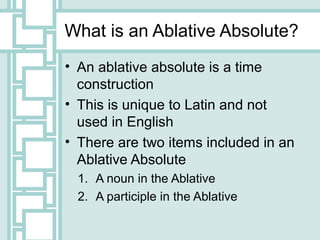
What is an Ablative Absolute?
• An ablative absolute is a time
construction
• This is unique to Latin and not
used in English
• There are two items included in an
Ablative Absolute
1. A noun in the Ablative
2. A participle in the Ablative
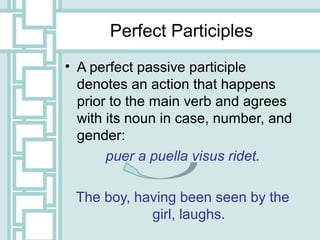
Perfect Participles
• A perfect passive participle
denotes an action that happens
prior to the main verb and agrees
with its noun in case, number, and
gender:
puer a puella visus ridet.
The boy, having been seen by the
girl, laughs.
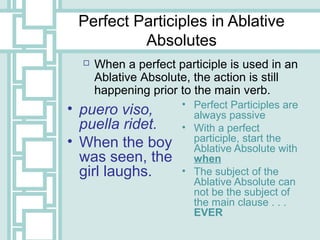
Perfect Participles in Ablative
Absolutes
• puero viso,
puella ridet.
• When the boy
was seen, the
girl laughs.
• Perfect Participles are
always passive
• With a perfect
participle, start the
Ablative Absolute with
when
• The subject of the
Ablative Absolute can
not be the subject of
the main clause . . .
EVER
 When a perfect participle is used in an
Ablative Absolute, the action is still
happening prior to the main verb.
Present Participles
• A present active participle denotes
an action that happens at the same
time as the main verb and agrees
with its noun in case, number, and
gender:
puer puellam spectans ridet.
The boy, watching the girl, laughs.
Present Participles in Ablative
Absolutes
• puero
spectante,
puella ridet.
• While the boy
watches, the
girl laughs.
• Present Participles are
always active
• With a present
participle, start the
Ablative Absolute with
while
• The subject of the
Ablative Absolute can
not be the subject of the
main clause . . . EVER
 When a present participle is used in an Ablative
Absolute, the action is still happening at the
same time as the main verb.
Present Participles in Ablative
Absolutes
• puero
spectante,
puella ridet.
• While the boy
watches, the
girl laughs.
• Present Participles are
always active
• With a present
participle, start the
Ablative Absolute with
while
• The subject of the
Ablative Absolute can
not be the subject of the
main clause . . . EVER
 When a present participle is used in an Ablative
Absolute, the action is still happening at the
same time as the main verb.

Unit Seven - Ablative absolute

  • 1.
  • 2.
    What is anAblative Absolute? • An ablative absolute is a time construction • This is unique to Latin and not used in English • There are two items included in an Ablative Absolute 1. A noun in the Ablative 2. A participle in the Ablative
  • 3.
    Perfect Participles • Aperfect passive participle denotes an action that happens prior to the main verb and agrees with its noun in case, number, and gender: puer a puella visus ridet. The boy, having been seen by the girl, laughs.
  • 4.
    Perfect Participles inAblative Absolutes • puero viso, puella ridet. • When the boy was seen, the girl laughs. • Perfect Participles are always passive • With a perfect participle, start the Ablative Absolute with when • The subject of the Ablative Absolute can not be the subject of the main clause . . . EVER  When a perfect participle is used in an Ablative Absolute, the action is still happening prior to the main verb.
  • 5.
    Present Participles • Apresent active participle denotes an action that happens at the same time as the main verb and agrees with its noun in case, number, and gender: puer puellam spectans ridet. The boy, watching the girl, laughs.
  • 6.
    Present Participles inAblative Absolutes • puero spectante, puella ridet. • While the boy watches, the girl laughs. • Present Participles are always active • With a present participle, start the Ablative Absolute with while • The subject of the Ablative Absolute can not be the subject of the main clause . . . EVER  When a present participle is used in an Ablative Absolute, the action is still happening at the same time as the main verb.
  • 7.
    Present Participles inAblative Absolutes • puero spectante, puella ridet. • While the boy watches, the girl laughs. • Present Participles are always active • With a present participle, start the Ablative Absolute with while • The subject of the Ablative Absolute can not be the subject of the main clause . . . EVER  When a present participle is used in an Ablative Absolute, the action is still happening at the same time as the main verb.