ADVERB
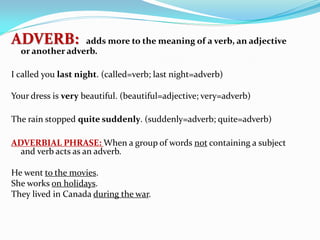
ADVERB: adds more to the meaning of a verb, an adjective
or another adverb.
I called you last night. (called=verb; last night=adverb)
Your dress is very beautiful. (beautiful=adjective; very=adverb)
The rain stopped quite suddenly. (suddenly=adverb; quite=adverb)
ADVERBIAL PHRASE: When a group of words not containing a subject
and verb acts as an adverb.
He went to the movies.
She works on holidays.
They lived in Canada during the war.
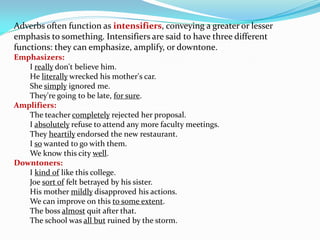
Adverbs often function as intensifiers, conveying a greater or lesser
emphasis to something. Intensifiers are said to have three different
functions: they can emphasize, amplify, or downtone.
Emphasizers:
I really don't believe him.
He literally wrecked his mother's car.
She simply ignored me.
They're going to be late, for sure.
Amplifiers:
The teacher completely rejected her proposal.
I absolutely refuse to attend any more faculty meetings.
They heartily endorsed the new restaurant.
I so wanted to go with them.
We know this city well.
Downtoners:
I kind of like this college.
Joe sort of felt betrayed by his sister.
His mother mildly disapproved his actions.
We can improve on this to some extent.
The boss almost quit after that.
The school was all but ruined by the storm.
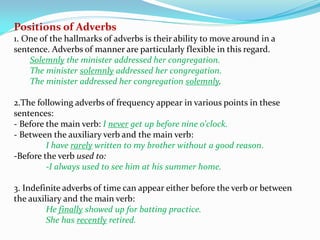
Positions of Adverbs
1. One of the hallmarks of adverbs is their ability to move around in a
sentence. Adverbs of manner are particularly flexible in this regard.
Solemnly the minister addressed her congregation.
The minister solemnly addressed her congregation.
The minister addressed her congregation solemnly.
2.The following adverbs of frequency appear in various points in these
sentences:
- Before the main verb: I never get up before nine o'clock.
- Between the auxiliary verb and the main verb:
I have rarely written to my brother without a good reason.
-Before the verb used to:
-I always used to see him at his summer home.
3. Indefinite adverbs of time can appear either before the verb or between
the auxiliary and the main verb:
He finally showed up for batting practice.
She has recently retired.
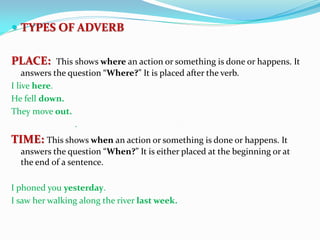
 TYPES OF ADVERB
PLACE: This shows where an action or something is done or happens. It
answers the question “Where?” It is placed after the verb.
I live here.
He fell down.
They move out.
.
TIME: This shows when an action or something is done or happens. It
answers the question “When?” It is either placed at the beginning or at
the end of a sentence.
I phoned you yesterday.
I saw her walking along the river last week.
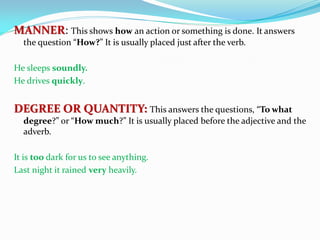
MANNER: This shows how an action or something is done. It answers
the question “How?” It is usually placed just after the verb.
He sleeps soundly.
He drives quickly.
DEGREE OR QUANTITY: This answers the questions, “To what
degree?” or “How much?” It is usually placed before the adjective and the
adverb.
It is too dark for us to see anything.
Last night it rained very heavily.
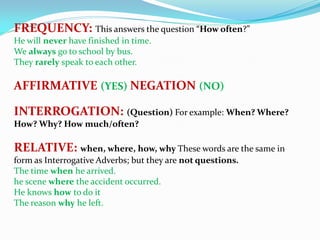
FREQUENCY: This answers the question “How often?”
He will never have finished in time.
We always go to school by bus.
They rarely speak to each other.
AFFIRMATIVE (YES) NEGATION (NO)
INTERROGATION: (Question) For example: When? Where?
How? Why? How much/often?
RELATIVE: when, where, how, why These words are the same in
form as Interrogative Adverbs; but they are not questions.
The time when he arrived.
he scene where the accident occurred.
He knows how to do it
The reason why he left.
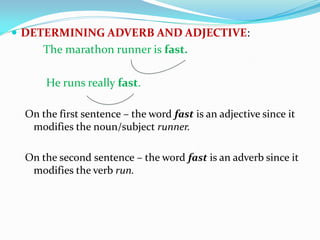
 DETERMINING ADVERB AND ADJECTIVE:
The marathon runner is fast.
He runs really fast.
On the first sentence – the word fast is an adjective since it
modifies the noun/subject runner.
On the second sentence – the word fast is an adverb since it
modifies the verb run.

Adverbs

  • 1.
  • 2.
    ADVERB: adds moreto the meaning of a verb, an adjective or another adverb. I called you last night. (called=verb; last night=adverb) Your dress is very beautiful. (beautiful=adjective; very=adverb) The rain stopped quite suddenly. (suddenly=adverb; quite=adverb) ADVERBIAL PHRASE: When a group of words not containing a subject and verb acts as an adverb. He went to the movies. She works on holidays. They lived in Canada during the war.
  • 3.
    Adverbs often functionas intensifiers, conveying a greater or lesser emphasis to something. Intensifiers are said to have three different functions: they can emphasize, amplify, or downtone. Emphasizers: I really don't believe him. He literally wrecked his mother's car. She simply ignored me. They're going to be late, for sure. Amplifiers: The teacher completely rejected her proposal. I absolutely refuse to attend any more faculty meetings. They heartily endorsed the new restaurant. I so wanted to go with them. We know this city well. Downtoners: I kind of like this college. Joe sort of felt betrayed by his sister. His mother mildly disapproved his actions. We can improve on this to some extent. The boss almost quit after that. The school was all but ruined by the storm.
  • 4.
    Positions of Adverbs 1.One of the hallmarks of adverbs is their ability to move around in a sentence. Adverbs of manner are particularly flexible in this regard. Solemnly the minister addressed her congregation. The minister solemnly addressed her congregation. The minister addressed her congregation solemnly. 2.The following adverbs of frequency appear in various points in these sentences: - Before the main verb: I never get up before nine o'clock. - Between the auxiliary verb and the main verb: I have rarely written to my brother without a good reason. -Before the verb used to: -I always used to see him at his summer home. 3. Indefinite adverbs of time can appear either before the verb or between the auxiliary and the main verb: He finally showed up for batting practice. She has recently retired.
  • 5.
     TYPES OFADVERB PLACE: This shows where an action or something is done or happens. It answers the question “Where?” It is placed after the verb. I live here. He fell down. They move out. . TIME: This shows when an action or something is done or happens. It answers the question “When?” It is either placed at the beginning or at the end of a sentence. I phoned you yesterday. I saw her walking along the river last week.
  • 6.
    MANNER: This showshow an action or something is done. It answers the question “How?” It is usually placed just after the verb. He sleeps soundly. He drives quickly. DEGREE OR QUANTITY: This answers the questions, “To what degree?” or “How much?” It is usually placed before the adjective and the adverb. It is too dark for us to see anything. Last night it rained very heavily.
  • 7.
    FREQUENCY: This answersthe question “How often?” He will never have finished in time. We always go to school by bus. They rarely speak to each other. AFFIRMATIVE (YES) NEGATION (NO) INTERROGATION: (Question) For example: When? Where? How? Why? How much/often? RELATIVE: when, where, how, why These words are the same in form as Interrogative Adverbs; but they are not questions. The time when he arrived. he scene where the accident occurred. He knows how to do it The reason why he left.
  • 8.
     DETERMINING ADVERBAND ADJECTIVE: The marathon runner is fast. He runs really fast. On the first sentence – the word fast is an adjective since it modifies the noun/subject runner. On the second sentence – the word fast is an adverb since it modifies the verb run.