LATIN II
Subjunctive Mood I
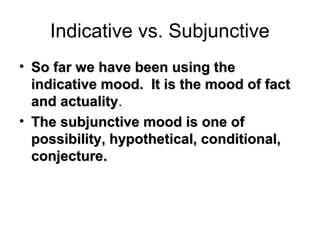
Indicative vs. Subjunctive
• So far we have been using theSo far we have been using the
indicative mood. It is the mood of factindicative mood. It is the mood of fact
and actualityand actuality.
• The subjunctive mood is one ofThe subjunctive mood is one of
possibility, hypothetical, conditional,possibility, hypothetical, conditional,
conjecture.conjecture.
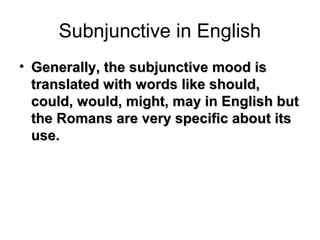
Subnjunctive in English
• Generally, the subjunctive mood isGenerally, the subjunctive mood is
translated with words like should,translated with words like should,
could, would, might, may in English butcould, would, might, may in English but
the Romans are very specific about itsthe Romans are very specific about its
use.use.
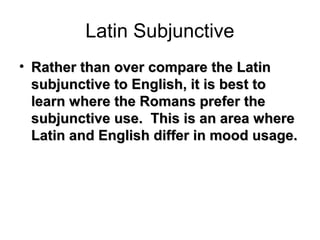
Latin Subjunctive
• Rather than over compare the LatinRather than over compare the Latin
subjunctive to English, it is best tosubjunctive to English, it is best to
learn where the Romans prefer thelearn where the Romans prefer the
subjunctive use. This is an area wheresubjunctive use. This is an area where
Latin and English differ in mood usage.Latin and English differ in mood usage.
Latin Subjunctive: tenses
• The subjunctive mood has 4 tenses inThe subjunctive mood has 4 tenses in
the active and passive voices:the active and passive voices:
– PresentPresent
– ImperfectImperfect
– PerfectPerfect
– PluperfectPluperfect
Latin Subjunctive: tenses
• There is no future or future perfectThere is no future or future perfect
subjunctive since the mood itself issubjunctive since the mood itself is
futuristic.futuristic.
Imperfect Subjunctive
• The imperfect subjunctive is formed byThe imperfect subjunctive is formed by
adding the personal endings onto theadding the personal endings onto the
end of the present infinitive of the verbend of the present infinitive of the verb
(2nd principal part). This even works(2nd principal part). This even works
forfor esseesse (the verb “to be”).(the verb “to be”).
Imperfect Subjunctive - sum
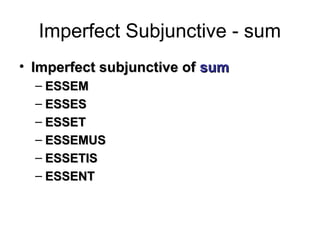
• Imperfect subjunctive ofImperfect subjunctive of sumsum
– ESSEMESSEM
– ESSESESSES
– ESSETESSET
– ESSEMUSESSEMUS
– ESSETISESSETIS
– ESSENTESSENT
Imperfect Subjunctive - formula
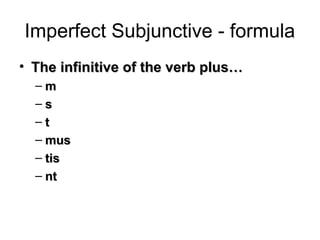
• The infinitive of the verb plus…The infinitive of the verb plus…
– mm
– ss
– tt
– musmus
– tistis
– ntnt
Imperfect Subjunctive – amo
• amo, amareamo, amare
– amaremamarem
– amaresamares
– amaretamaret
– amaremusamaremus
– amaretisamaretis
– amarentamarent
Imperfect Subjunctive - moneo
• moneo, monere
– moneremmonerem
– moneresmoneres
– moneretmoneret
– moneremusmoneremus
– moneretismoneretis
– monerentmonerent
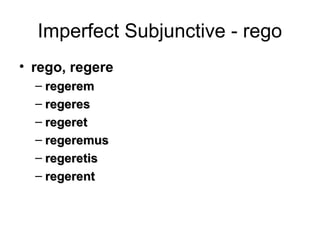
Imperfect Subjunctive - rego
• rego, regere
– regeremregerem
– regeresregeres
– regeretregeret
– regeremusregeremus
– regeretisregeretis
– regerentregerent
Imperfect subjunctive - audio
• audio, audire
– audiremaudirem
– audiresaudires
– audiretaudiret
– audiremusaudiremus
– audiretisaudiretis
– audirentaudirent
Imperfect Subjunctive Passive–
amo
• amo, amareamo, amare
– amareramarer
– amarerisamareris
– amareturamaretur
– amaremuramaremur
– amareminiamaremini
– amarenturamarentur
To form the imperfect passive just use the
passive endings instead of the active.
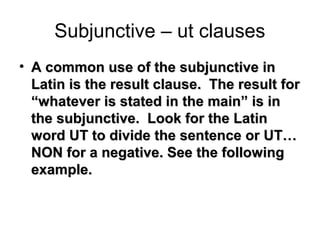
Subjunctive – ut clauses
• A common use of the subjunctive inA common use of the subjunctive in
Latin is the result clause. The result forLatin is the result clause. The result for
“whatever is stated in the main” is in“whatever is stated in the main” is in
the subjunctive. Look for the Latinthe subjunctive. Look for the Latin
word UT to divide the sentence or UT…word UT to divide the sentence or UT…
NON for a negative. See the followingNON for a negative. See the following
example.example.
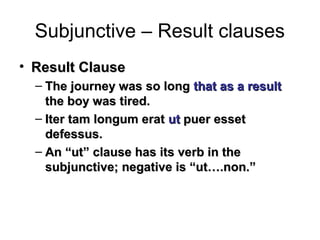
Subjunctive – Result clauses
• Result ClauseResult Clause
– The journey was so longThe journey was so long that as a resultthat as a result
the boy was tired.the boy was tired.
– Iter tam longum eratIter tam longum erat utut puer essetpuer esset
defessus.defessus.
– An “ut” clause has its verb in theAn “ut” clause has its verb in the
subjunctive; negative is “ut….non.”subjunctive; negative is “ut….non.”

Unit Twelve - Imperfect subjunctive

  • 1.
  • 2.
    Indicative vs. Subjunctive •So far we have been using theSo far we have been using the indicative mood. It is the mood of factindicative mood. It is the mood of fact and actualityand actuality. • The subjunctive mood is one ofThe subjunctive mood is one of possibility, hypothetical, conditional,possibility, hypothetical, conditional, conjecture.conjecture.
  • 3.
    Subnjunctive in English •Generally, the subjunctive mood isGenerally, the subjunctive mood is translated with words like should,translated with words like should, could, would, might, may in English butcould, would, might, may in English but the Romans are very specific about itsthe Romans are very specific about its use.use.
  • 4.
    Latin Subjunctive • Ratherthan over compare the LatinRather than over compare the Latin subjunctive to English, it is best tosubjunctive to English, it is best to learn where the Romans prefer thelearn where the Romans prefer the subjunctive use. This is an area wheresubjunctive use. This is an area where Latin and English differ in mood usage.Latin and English differ in mood usage.
  • 5.
    Latin Subjunctive: tenses •The subjunctive mood has 4 tenses inThe subjunctive mood has 4 tenses in the active and passive voices:the active and passive voices: – PresentPresent – ImperfectImperfect – PerfectPerfect – PluperfectPluperfect
  • 6.
    Latin Subjunctive: tenses •There is no future or future perfectThere is no future or future perfect subjunctive since the mood itself issubjunctive since the mood itself is futuristic.futuristic.
  • 7.
    Imperfect Subjunctive • Theimperfect subjunctive is formed byThe imperfect subjunctive is formed by adding the personal endings onto theadding the personal endings onto the end of the present infinitive of the verbend of the present infinitive of the verb (2nd principal part). This even works(2nd principal part). This even works forfor esseesse (the verb “to be”).(the verb “to be”).
  • 8.
    Imperfect Subjunctive -sum • Imperfect subjunctive ofImperfect subjunctive of sumsum – ESSEMESSEM – ESSESESSES – ESSETESSET – ESSEMUSESSEMUS – ESSETISESSETIS – ESSENTESSENT
  • 9.
    Imperfect Subjunctive -formula • The infinitive of the verb plus…The infinitive of the verb plus… – mm – ss – tt – musmus – tistis – ntnt
  • 10.
    Imperfect Subjunctive –amo • amo, amareamo, amare – amaremamarem – amaresamares – amaretamaret – amaremusamaremus – amaretisamaretis – amarentamarent
  • 11.
    Imperfect Subjunctive -moneo • moneo, monere – moneremmonerem – moneresmoneres – moneretmoneret – moneremusmoneremus – moneretismoneretis – monerentmonerent
  • 12.
    Imperfect Subjunctive -rego • rego, regere – regeremregerem – regeresregeres – regeretregeret – regeremusregeremus – regeretisregeretis – regerentregerent
  • 13.
    Imperfect subjunctive -audio • audio, audire – audiremaudirem – audiresaudires – audiretaudiret – audiremusaudiremus – audiretisaudiretis – audirentaudirent
  • 14.
    Imperfect Subjunctive Passive– amo •amo, amareamo, amare – amareramarer – amarerisamareris – amareturamaretur – amaremuramaremur – amareminiamaremini – amarenturamarentur To form the imperfect passive just use the passive endings instead of the active.
  • 15.
    Subjunctive – utclauses • A common use of the subjunctive inA common use of the subjunctive in Latin is the result clause. The result forLatin is the result clause. The result for “whatever is stated in the main” is in“whatever is stated in the main” is in the subjunctive. Look for the Latinthe subjunctive. Look for the Latin word UT to divide the sentence or UT…word UT to divide the sentence or UT… NON for a negative. See the followingNON for a negative. See the following example.example.
  • 16.
    Subjunctive – Resultclauses • Result ClauseResult Clause – The journey was so longThe journey was so long that as a resultthat as a result the boy was tired.the boy was tired. – Iter tam longum eratIter tam longum erat utut puer essetpuer esset defessus.defessus. – An “ut” clause has its verb in theAn “ut” clause has its verb in the subjunctive; negative is “ut….non.”subjunctive; negative is “ut….non.”