Chapter 5 Grammar
Part One:
Present Tense Verbs
What makes up a verb?
– Tense: the tense of the verb tells us when
something happens
– Person: the person of the verb tells us who is
doing the action
– Number: the number of the verb tells us how
many are doing the action
There are three things that make up a verb:
What is the Present Tense?
• The Present Tense happens now.
Horatia in casam festinat.
Horatia is hurrying into the house.
• It is at this moment in time that Horatia is hurrying. It has not already happened, nor is it about to happen . . . that is the present tense.
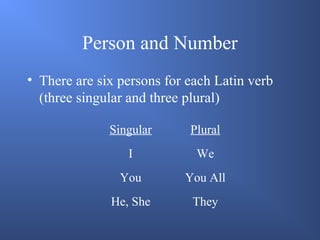
Person and Number
• There are six persons for each Latin verb
(three singular and three plural)
Singular Plural
I We
You You All
He, She They
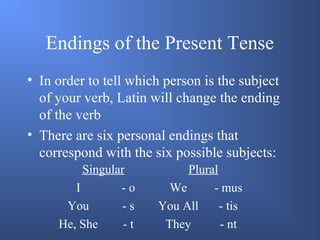
Endings of the Present Tense
• In order to tell which person is the subject
of your verb, Latin will change the ending
of the verb
• There are six personal endings that
correspond with the six possible subjects:
Singular Plural
I - o We - mus
You - s You All - tis
He, She - t They - nt
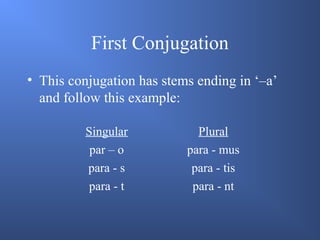
First Conjugation
• This conjugation has stems ending in ‘–a’
and follow this example:
Singular Plural
par – o para - mus
para - s para - tis
para - t para - nt
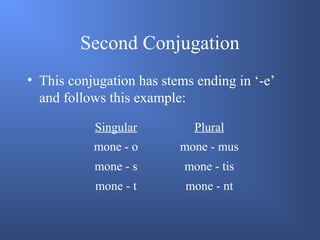
Second Conjugation
• This conjugation has stems ending in ‘-e’
and follows this example:
Singular Plural
mone - o mone - mus
mone - s mone - tis
mone - t mone - nt
Third Conjugation
• This conjugation has stems ending in a
consonant and follow this example:
Singular Plural
reg - o reg - imus
reg - is reg - it
reg - it reg - unt
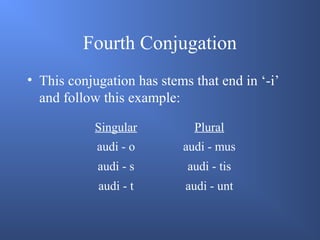
Fourth Conjugation
• This conjugation has stems that end in ‘-i’
and follow this example:
Singular Plural
audi - o audi - mus
audi - s audi - tis
audi - t audi - unt
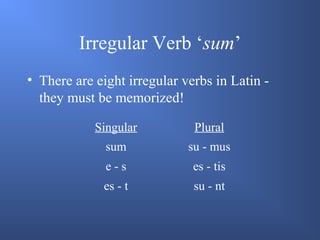
Irregular Verb ‘sum’
• There are eight irregular verbs in Latin -
they must be memorized!
Singular Plural
sum su - mus
e - s es - tis
es - t su - nt
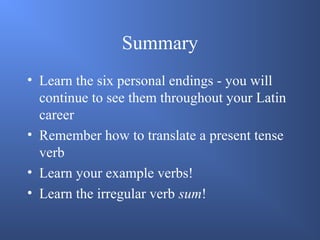
Summary
• Learn the six personal endings - you will
continue to see them throughout your Latin
career
• Remember how to translate a present tense
verb
• Learn your example verbs!
• Learn the irregular verb sum!

Unit One Present Tense Grammar

  • 1.
    Chapter 5 Grammar PartOne: Present Tense Verbs
  • 2.
    What makes upa verb? – Tense: the tense of the verb tells us when something happens – Person: the person of the verb tells us who is doing the action – Number: the number of the verb tells us how many are doing the action There are three things that make up a verb:
  • 3.
    What is thePresent Tense? • The Present Tense happens now. Horatia in casam festinat. Horatia is hurrying into the house. • It is at this moment in time that Horatia is hurrying. It has not already happened, nor is it about to happen . . . that is the present tense.
  • 4.
    Person and Number •There are six persons for each Latin verb (three singular and three plural) Singular Plural I We You You All He, She They
  • 5.
    Endings of thePresent Tense • In order to tell which person is the subject of your verb, Latin will change the ending of the verb • There are six personal endings that correspond with the six possible subjects: Singular Plural I - o We - mus You - s You All - tis He, She - t They - nt
  • 6.
    First Conjugation • Thisconjugation has stems ending in ‘–a’ and follow this example: Singular Plural par – o para - mus para - s para - tis para - t para - nt
  • 7.
    Second Conjugation • Thisconjugation has stems ending in ‘-e’ and follows this example: Singular Plural mone - o mone - mus mone - s mone - tis mone - t mone - nt
  • 8.
    Third Conjugation • Thisconjugation has stems ending in a consonant and follow this example: Singular Plural reg - o reg - imus reg - is reg - it reg - it reg - unt
  • 9.
    Fourth Conjugation • Thisconjugation has stems that end in ‘-i’ and follow this example: Singular Plural audi - o audi - mus audi - s audi - tis audi - t audi - unt
  • 10.
    Irregular Verb ‘sum’ •There are eight irregular verbs in Latin - they must be memorized! Singular Plural sum su - mus e - s es - tis es - t su - nt
  • 11.
    Summary • Learn thesix personal endings - you will continue to see them throughout your Latin career • Remember how to translate a present tense verb • Learn your example verbs! • Learn the irregular verb sum!