VerbsChapter 2
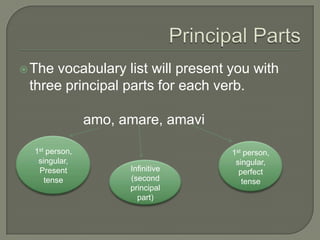
Principal PartsThe vocabulary list will present you with three principal parts for each verb.amo, amare, amavi1st person, singular,Present tense1st person, singular, perfect tenseInfinitive(second principal part)
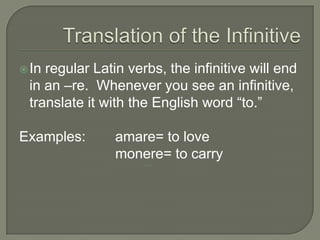
Translation of the InfinitiveIn regular Latin verbs, the infinitive will end in an –re.  Whenever you see an infinitive, translate it with the English word “to.”Examples:  	amare= to lovemonere= to carry
The InfinitiveThe infinitive of a verb helps you in two very important ways.It tells you what conjugation a verb is in.It gives you the present stem of a verb.
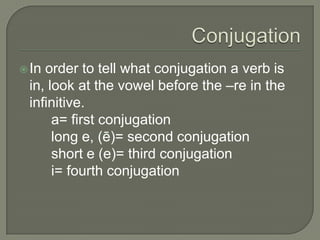
ConjugationIn order to tell what conjugation a verb is in, look at the vowel before the –re in the infinitive.	a= first conjugation	long e, (ē)= second conjugation	short e (e)= third conjugationi= fourth conjugation
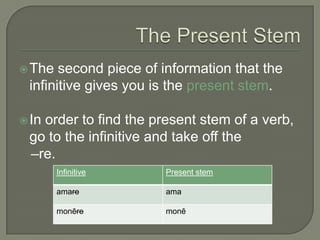
The Present StemThe second piece of information that the infinitive gives you is the present stem.In order to find the present stem of a verb, go to the infinitive and take off the   –re.
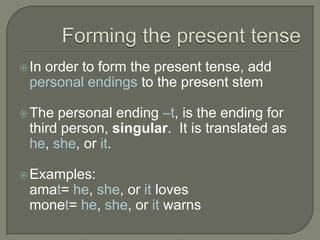
Forming the present tenseIn order to form the present tense, add personal endings to the present stemThe personal ending –t, is the ending for third person, singular.  It is translated as he, she, or it.Examples:amat= he, she, or it lovesmonet= he, she, or it warns
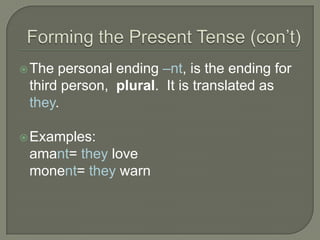
Forming the Present Tense (con’t)The personal ending –nt, is the ending for third person, plural.  It is translated as they.Examples:amant= they lovemonent= they warn
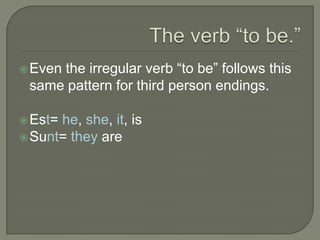
The verb “to be.”Even the irregular verb “to be” follows this same pattern for third person endings.Est= he, she, it, isSunt= they are
Subject/Verb AgreementAlways remember that the subject and the verb in a sentence MUST agree in number.In other words, if your subject is singular, the verb MUST also have a singular ending.  If the subject is plural, the verb MUST also be plural.
Subject/Verb Agreement (con’t)Patercanemamat.  Father loves the dog.“Father” (Pater) is a singular subject, so “loves” (amat) also has a singular ending.Pater et mater canemamant.  The father and mother love the dog.Because “father and mother” are a plural subject, amant also has a plural ending.

Verbs Chapter 2

  • 1.
  • 2.
    Principal PartsThe vocabularylist will present you with three principal parts for each verb.amo, amare, amavi1st person, singular,Present tense1st person, singular, perfect tenseInfinitive(second principal part)
  • 3.
    Translation of theInfinitiveIn regular Latin verbs, the infinitive will end in an –re. Whenever you see an infinitive, translate it with the English word “to.”Examples: amare= to lovemonere= to carry
  • 4.
    The InfinitiveThe infinitiveof a verb helps you in two very important ways.It tells you what conjugation a verb is in.It gives you the present stem of a verb.
  • 5.
    ConjugationIn order totell what conjugation a verb is in, look at the vowel before the –re in the infinitive. a= first conjugation long e, (ē)= second conjugation short e (e)= third conjugationi= fourth conjugation
  • 6.
    The Present StemThesecond piece of information that the infinitive gives you is the present stem.In order to find the present stem of a verb, go to the infinitive and take off the –re.
  • 7.
    Forming the presenttenseIn order to form the present tense, add personal endings to the present stemThe personal ending –t, is the ending for third person, singular. It is translated as he, she, or it.Examples:amat= he, she, or it lovesmonet= he, she, or it warns
  • 8.
    Forming the PresentTense (con’t)The personal ending –nt, is the ending for third person, plural. It is translated as they.Examples:amant= they lovemonent= they warn
  • 9.
    The verb “tobe.”Even the irregular verb “to be” follows this same pattern for third person endings.Est= he, she, it, isSunt= they are
  • 10.
    Subject/Verb AgreementAlways rememberthat the subject and the verb in a sentence MUST agree in number.In other words, if your subject is singular, the verb MUST also have a singular ending. If the subject is plural, the verb MUST also be plural.
  • 11.
    Subject/Verb Agreement (con’t)Patercanemamat. Father loves the dog.“Father” (Pater) is a singular subject, so “loves” (amat) also has a singular ending.Pater et mater canemamant. The father and mother love the dog.Because “father and mother” are a plural subject, amant also has a plural ending.