A small group of words standing 
together as a conceptual unit, typically 
forming a component of a clause. 
Different phrases make a clause or a 
sentence.
A clause is a collection of words that has a 
subject that is actively doing a verb. 
Examples of clause 
because she smiled at him 
when the saints go marching in
 NOUN PHRASES 
 ADJECTIVE PHRASE 
 VERB PHRASE 
 ADVERB PHRASE 
 PREPOSITIONAL PHRASE
A word (other than a pronoun) used to identify 
any of a class of people, places, or 
things common noun, or to name a particular 
one of these proper noun.
An adjective is a kind of word (a part of 
speech) that modifies (describes) a noun.
The part of speech (orword class) that describes 
an action or occurrence or indicates a state of 
being.
a word or phrase that modifies the meaning of 
an adjective, verb, or other adverb, expressing 
manner, place, time, or degree 
(e.g. gently, here, now, very ).
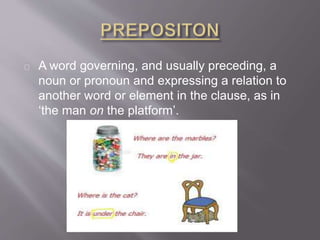
A word governing, and usually preceding, a 
noun or pronoun and expressing a relation to 
another word or element in the clause, as in 
‘the man on the platform’.
A modifying word that determines the kind of 
reference a noun or noun group has, for 
example a, the, every.
 NOUN PHRASES 
 ADJECTIVE PHRASE 
 VERB PHRASE 
 ADVERB PHRASE 
 PREPOSITIONAL PHRASE
OUR .UNCLE WILL COME NEXT WEEK. 
OUR UNCLE WILL COME NEXT WEEK 
NOUN PHRASE VERB PHRASE ADVERB PHRASE
A noun phrase has a noun, usually 
proceeded by a determiner or an 
adjective. A pronoun also is a noun 
phrase.
WE SAW AN OLD MAN. 
WE SAW AN OLD MAN 
PRONOUN DETERMINER ADJECTIVE NOUN
It contains an adjective, some times with an 
adverb of degree in front of it.
she is very beautiful. 
she is very beautiful 
(Adverb of degree) adjective
It may be a single main verb or it may have 
auxiliaries too.
he came late 
Main verb 
He was playing. He was playing 
Auxiliary verb main 
verb
It has an adverb some times with an adverb of 
degree in front of it.
GRANDFATHER VISITS US QUITE OFTEN. 
GRANDFATHER VISITS US QUITE OFTEN 
Adverb of degree Adverb
a prepositional phrase is the combination of a 
preposition and a noun phrase.
WE MET AT THE BUS STOP. 
WE MET AT THE BUS STOP 
PREPOSITION NOUN PHRASE
Phrases in english

Phrases in english

  • 1.
    A small groupof words standing together as a conceptual unit, typically forming a component of a clause. Different phrases make a clause or a sentence.
  • 2.
    A clause isa collection of words that has a subject that is actively doing a verb. Examples of clause because she smiled at him when the saints go marching in
  • 3.
     NOUN PHRASES  ADJECTIVE PHRASE  VERB PHRASE  ADVERB PHRASE  PREPOSITIONAL PHRASE
  • 4.
    A word (otherthan a pronoun) used to identify any of a class of people, places, or things common noun, or to name a particular one of these proper noun.
  • 6.
    An adjective isa kind of word (a part of speech) that modifies (describes) a noun.
  • 7.
    The part ofspeech (orword class) that describes an action or occurrence or indicates a state of being.
  • 8.
    a word orphrase that modifies the meaning of an adjective, verb, or other adverb, expressing manner, place, time, or degree (e.g. gently, here, now, very ).
  • 9.
    A word governing,and usually preceding, a noun or pronoun and expressing a relation to another word or element in the clause, as in ‘the man on the platform’.
  • 10.
    A modifying wordthat determines the kind of reference a noun or noun group has, for example a, the, every.
  • 11.
     NOUN PHRASES  ADJECTIVE PHRASE  VERB PHRASE  ADVERB PHRASE  PREPOSITIONAL PHRASE
  • 12.
    OUR .UNCLE WILLCOME NEXT WEEK. OUR UNCLE WILL COME NEXT WEEK NOUN PHRASE VERB PHRASE ADVERB PHRASE
  • 13.
    A noun phrasehas a noun, usually proceeded by a determiner or an adjective. A pronoun also is a noun phrase.
  • 15.
    WE SAW ANOLD MAN. WE SAW AN OLD MAN PRONOUN DETERMINER ADJECTIVE NOUN
  • 16.
    It contains anadjective, some times with an adverb of degree in front of it.
  • 17.
    she is verybeautiful. she is very beautiful (Adverb of degree) adjective
  • 18.
    It may bea single main verb or it may have auxiliaries too.
  • 19.
    he came late Main verb He was playing. He was playing Auxiliary verb main verb
  • 20.
    It has anadverb some times with an adverb of degree in front of it.
  • 21.
    GRANDFATHER VISITS USQUITE OFTEN. GRANDFATHER VISITS US QUITE OFTEN Adverb of degree Adverb
  • 22.
    a prepositional phraseis the combination of a preposition and a noun phrase.
  • 23.
    WE MET ATTHE BUS STOP. WE MET AT THE BUS STOP PREPOSITION NOUN PHRASE