In Latin, Verbs have endings just like nouns. They are called personal endings and each ending actually means something . . . . Chapter 3 - Verbs
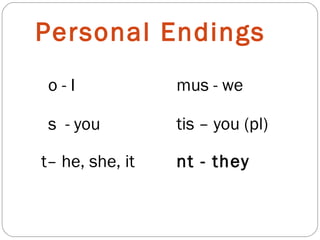
Personal Endings nt - they o - I s  - you t– he, she, it mus - we tis – you (pl)
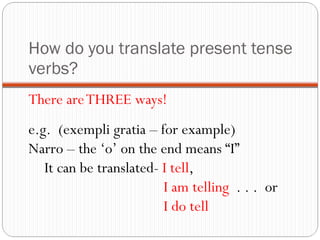
How do you translate present tense verbs? There are THREE ways! e.g.  (exempli gratia – for example) Narro – the ‘o’ on the end means “I” It can be translated-  I tell ,   I am telling  . . .  or    I do tell
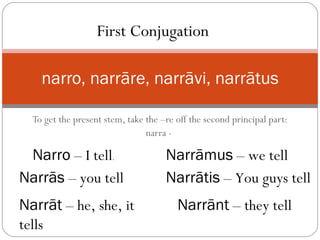
To get the present stem, take the –re off the second principal part: narra -  narro, narrāre, narrāvi, narrātus Narro  – I tell . Narrās  – you tell Narrāt  – he, she, it tells First Conjugation Narrāmus  – we tell Narrātis  – You guys tell  Narrānt  – they tell
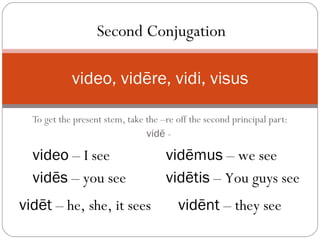
To get the present stem, take the –re off the second principal part: vidē  -  video, vidēre, vidi, visus video  – I see vidēs  – you see vidēt  – he, she, it sees Second Conjugation vidēmus  – we see vidētis  – You guys see  vidēnt  – they see
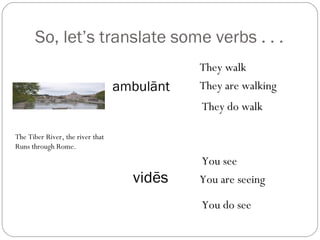
So, let’s translate some verbs . . . ambulānt They walk They are walking They do walk vidēs You see You are seeing You do see The Tiber River, the river that Runs through Rome.
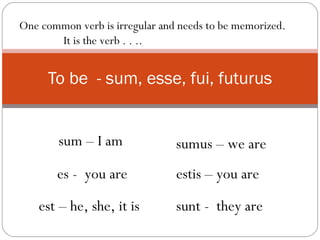
To be  - sum, esse, fui, futurus sum – I am One common verb is irregular and needs to be memorized.  It is the verb . . ..  sumus – we are estis – you are es -  you are sunt -  they are  est – he, she, it is

Chapter 3 Present Tense Verbs

  • 1.
    In Latin, Verbshave endings just like nouns. They are called personal endings and each ending actually means something . . . . Chapter 3 - Verbs
  • 2.
    Personal Endings nt- they o - I s - you t– he, she, it mus - we tis – you (pl)
  • 3.
    How do youtranslate present tense verbs? There are THREE ways! e.g. (exempli gratia – for example) Narro – the ‘o’ on the end means “I” It can be translated- I tell , I am telling . . . or I do tell
  • 4.
    To get thepresent stem, take the –re off the second principal part: narra - narro, narrāre, narrāvi, narrātus Narro – I tell . Narrās – you tell Narrāt – he, she, it tells First Conjugation Narrāmus – we tell Narrātis – You guys tell Narrānt – they tell
  • 5.
    To get thepresent stem, take the –re off the second principal part: vidē - video, vidēre, vidi, visus video – I see vidēs – you see vidēt – he, she, it sees Second Conjugation vidēmus – we see vidētis – You guys see vidēnt – they see
  • 6.
    So, let’s translatesome verbs . . . ambulānt They walk They are walking They do walk vidēs You see You are seeing You do see The Tiber River, the river that Runs through Rome.
  • 7.
    To be - sum, esse, fui, futurus sum – I am One common verb is irregular and needs to be memorized. It is the verb . . .. sumus – we are estis – you are es - you are sunt - they are est – he, she, it is