Verb: The part of speech that expresses action, or state of being. 
Subject: The part which names the person or thing we are speaking about in a 
sentence. 
EasyShiksha.Com - A Way of Simple Learning 
Subjects and Verbs
Subject and Verb Agreement 
The Verb agrees with the Subject in Number and 
Person 
E.g. Sam and Harry are friends. 
EasyShiksha.Com - A Way of Simple Learning 
Subjects and Verbs
Subjects and Verbs 
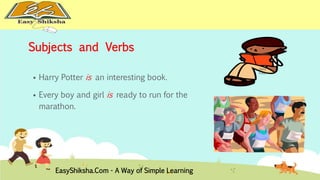
 Harry Potter is an interesting book. 
 Every boy and girl is ready to run for the 
marathon. 
Harry 
Potter 
EasyShiksha.Com - A Way of Simple Learning
Objective 
 Identify the mechanisms to use articles appropriately. 
EasyShiksha.Com - A Way of Simple Learning 
Articles
 Articles: are Determiners. 
 Types Of Articles 
Indefinite – A / AN 
Definite – THE 
EasyShiksha.Com - A Way of Simple Learning 
Articles
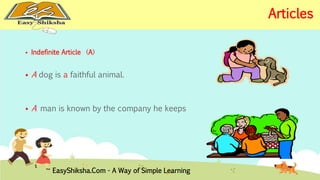
 Indefinite Article (A) 
 A dog is a faithful animal. 
 A man is known by the company he keeps 
EasyShiksha.Com - A Way of Simple Learning 
Articles
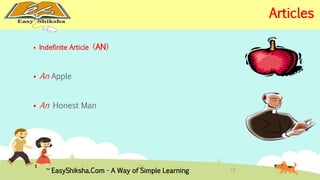
 Indefinite Article (AN) 
 An Apple 
 An Honest Man 
EasyShiksha.Com - A Way of Simple Learning 
Articles
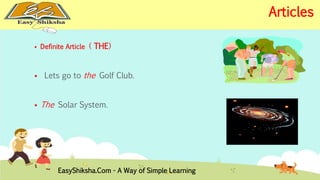
 Definite Article ( THE) 
 Lets go to the Golf Club. 
 The Solar System. 
EasyShiksha.Com - A Way of Simple Learning 
Articles
Lets have fun 
Identify articles in the songs 
(Clips to be added) 
EasyShiksha.Com - A Way of Simple Learning 
Articles
Objective 
 Identify the correct usage of Tense in a sentence 
 Identify the correct usage of Tense while speaking in English 
EasyShiksha.Com - A Way of Simple Learning 
Tenses
 The Tense of a verb shows the time of action or event. 
 Verb tenses are tools that English speakers use to express time in language. 
EasyShiksha.Com - A Way of Simple Learning 
Tenses
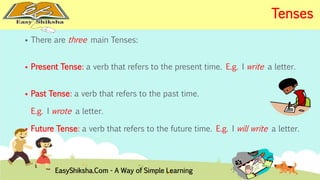
 There are three main Tenses: 
 Present Tense: a verb that refers to the present time. E.g. I write a letter. 
 Past Tense: a verb that refers to the past time. 
E.g. I wrote a letter. 
 Future Tense: a verb that refers to the future time. E.g. I will write a letter. 
EasyShiksha.Com - A Way of Simple Learning 
Tenses
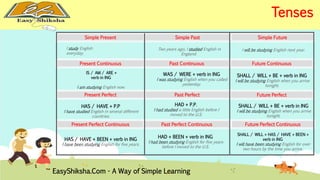
Simple Present Simple Past 
Simple Future 
I study English 
everyday. 
Present Continuous Past Continuous Future Continuous 
IS / AM / ARE + 
verb in ING 
I am studying English now. 
WAS / WERE + verb in ING 
I was studying English when you called 
yesterday. 
Present Perfect Past Perfect Future Perfect 
HAS / HAVE + P.P 
I have studied English in several different 
countries. 
Present Perfect Continuous Past Perfect Continuous Future Perfect Continuous 
HAS / HAVE + BEEN + verb in ING 
I have been studying English for five years. 
Two years ago, I studied English in 
England. 
HAD + P.P. 
I had studied a little English before I 
moved to the U.S. 
HAD + BEEN + verb in ING 
I had been studying English for five years 
before I moved to the U.S. 
I will be studying English next year. 
SHALL / WILL + BE + verb in ING 
I will be studying English when you arrive 
tonight. 
SHALL / WILL + BE + verb in ING 
I will be studying English when you arrive 
tonight. 
SHALL / WILL + HAS / HAVE + BEEN + 
verb in ING 
I will have been studying English for over 
two hours by the time you arrive. 
EasyShiksha.Com - A Way of Simple Learning 
Tenses
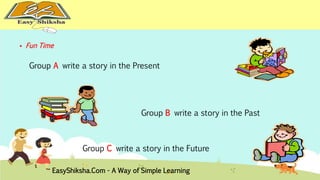
 Fun Time 
Group A write a story in the Present 
Group B write a story in the Past 
Group C write a story in the Future 
EasyShiksha.Com - A Way of Simple Learning
Objective 
 To aid formulating appropriate questions. 
 To learn to convert ideas or sentences into questions. 
EasyShiksha.Com - A Way of Simple Learning 
Question Tags
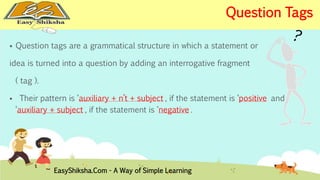
 Question tags are a grammatical structure in which a statement or 
idea is turned into a question by adding an interrogative fragment 
( tag ). 
 Their pattern is ‘auxiliary + n’t + subject’, if the statement is ‘positive’ and 
‘auxiliary + subject’, if the statement is ‘negative’. 
EasyShiksha.Com - A Way of Simple Learning 
Question Tags
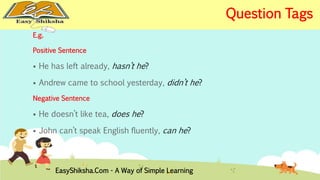
E.g. 
Positive Sentence 
 He has left already, hasn’t he? 
 Andrew came to school yesterday, didn’t he? 
Negative Sentence 
 He doesn’t like tea, does he? 
 John can’t speak English fluently, can he? 
EasyShiksha.Com - A Way of Simple Learning 
Question Tags
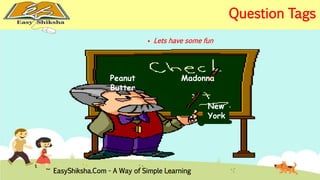
 Lets have some fun 
Peanut 
Butter 
Madonna 
New 
York 
EasyShiksha.Com - A Way of Simple Learning 
Question Tags
Direct And Indirect Speech 
Objective 
 To understand the two ways of relating and quoting what someone has 
said. 
EasyShiksha.Com - A Way of Simple Learning
Direct And Indirect Speech 
 In Direct Speech the original speaker’s exact words are given and indicated 
by quotation marks (“ ”) 
 E.g. “I don’t know what to do,” said Dean. 
 In Indirect Speech the exact meaning of the speaker’s words are given, but 
the exact words are not directly quoted. 
 E.g. Dean said that he didn’t know what to do. 
EasyShiksha.Com - A Way of Simple Learning
Direct And Indirect Speech 
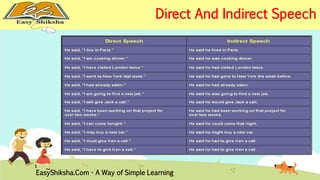
Some pointers to convert Direct Speech into Indirect 
Speech and vice – versa. 
 If the main verb is in the past tense, the present tense verbs in that sentence 
must be changed to past tense. 
 First and second person pronouns must be changed to third person 
pronouns. 
EasyShiksha.Com - A Way of Simple Learning
Direct And Indirect Speech 
EasyShiksha.Com - A Way of Simple Learning
 Objective 
To create awareness that using the Passive Voice 
sounds more objective. 
EasyShiksha.Com - A Way of Simple Learning 
Voice
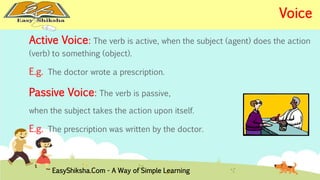
Active Voice: The verb is active, when the subject (agent) does the action 
(verb) to something (object). 
E.g. The doctor wrote a prescription. 
Passive Voice: The verb is passive, 
when the subject takes the action upon itself. 
E.g. The prescription was written by the doctor. 
EasyShiksha.Com - A Way of Simple Learning 
Voice
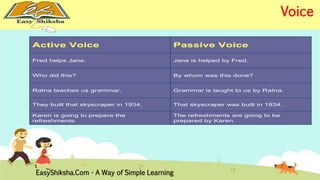
Passive Voice 
Jane is helped by Fred. 
By whom was this done? 
Grammar is taught to us by Ratna. 
That skyscraper was built in 1934. 
The refreshments are going to be 
prepared by Karen. 
Active Voice 
Fred helps Jane. 
Who did this? 
Ratna teaches us grammar. 
They built that skyscraper in 1934. 
Karen is going to prepare the 
refreshments. 
EasyShiksha.Com - A Way of Simple Learning 
Voice

English Grammar Part 1

  • 1.
    Verb: The partof speech that expresses action, or state of being. Subject: The part which names the person or thing we are speaking about in a sentence. EasyShiksha.Com - A Way of Simple Learning Subjects and Verbs
  • 2.
    Subject and VerbAgreement The Verb agrees with the Subject in Number and Person E.g. Sam and Harry are friends. EasyShiksha.Com - A Way of Simple Learning Subjects and Verbs
  • 3.
    Subjects and Verbs  Harry Potter is an interesting book.  Every boy and girl is ready to run for the marathon. Harry Potter EasyShiksha.Com - A Way of Simple Learning
  • 4.
    Objective  Identifythe mechanisms to use articles appropriately. EasyShiksha.Com - A Way of Simple Learning Articles
  • 5.
     Articles: areDeterminers.  Types Of Articles Indefinite – A / AN Definite – THE EasyShiksha.Com - A Way of Simple Learning Articles
  • 6.
     Indefinite Article(A)  A dog is a faithful animal.  A man is known by the company he keeps EasyShiksha.Com - A Way of Simple Learning Articles
  • 7.
     Indefinite Article(AN)  An Apple  An Honest Man EasyShiksha.Com - A Way of Simple Learning Articles
  • 8.
     Definite Article( THE)  Lets go to the Golf Club.  The Solar System. EasyShiksha.Com - A Way of Simple Learning Articles
  • 9.
    Lets have fun Identify articles in the songs (Clips to be added) EasyShiksha.Com - A Way of Simple Learning Articles
  • 10.
    Objective  Identifythe correct usage of Tense in a sentence  Identify the correct usage of Tense while speaking in English EasyShiksha.Com - A Way of Simple Learning Tenses
  • 11.
     The Tenseof a verb shows the time of action or event.  Verb tenses are tools that English speakers use to express time in language. EasyShiksha.Com - A Way of Simple Learning Tenses
  • 12.
     There arethree main Tenses:  Present Tense: a verb that refers to the present time. E.g. I write a letter.  Past Tense: a verb that refers to the past time. E.g. I wrote a letter.  Future Tense: a verb that refers to the future time. E.g. I will write a letter. EasyShiksha.Com - A Way of Simple Learning Tenses
  • 13.
    Simple Present SimplePast Simple Future I study English everyday. Present Continuous Past Continuous Future Continuous IS / AM / ARE + verb in ING I am studying English now. WAS / WERE + verb in ING I was studying English when you called yesterday. Present Perfect Past Perfect Future Perfect HAS / HAVE + P.P I have studied English in several different countries. Present Perfect Continuous Past Perfect Continuous Future Perfect Continuous HAS / HAVE + BEEN + verb in ING I have been studying English for five years. Two years ago, I studied English in England. HAD + P.P. I had studied a little English before I moved to the U.S. HAD + BEEN + verb in ING I had been studying English for five years before I moved to the U.S. I will be studying English next year. SHALL / WILL + BE + verb in ING I will be studying English when you arrive tonight. SHALL / WILL + BE + verb in ING I will be studying English when you arrive tonight. SHALL / WILL + HAS / HAVE + BEEN + verb in ING I will have been studying English for over two hours by the time you arrive. EasyShiksha.Com - A Way of Simple Learning Tenses
  • 14.
     Fun Time Group A write a story in the Present Group B write a story in the Past Group C write a story in the Future EasyShiksha.Com - A Way of Simple Learning
  • 15.
    Objective  Toaid formulating appropriate questions.  To learn to convert ideas or sentences into questions. EasyShiksha.Com - A Way of Simple Learning Question Tags
  • 16.
     Question tagsare a grammatical structure in which a statement or idea is turned into a question by adding an interrogative fragment ( tag ).  Their pattern is ‘auxiliary + n’t + subject’, if the statement is ‘positive’ and ‘auxiliary + subject’, if the statement is ‘negative’. EasyShiksha.Com - A Way of Simple Learning Question Tags
  • 17.
    E.g. Positive Sentence  He has left already, hasn’t he?  Andrew came to school yesterday, didn’t he? Negative Sentence  He doesn’t like tea, does he?  John can’t speak English fluently, can he? EasyShiksha.Com - A Way of Simple Learning Question Tags
  • 18.
     Lets havesome fun Peanut Butter Madonna New York EasyShiksha.Com - A Way of Simple Learning Question Tags
  • 19.
    Direct And IndirectSpeech Objective  To understand the two ways of relating and quoting what someone has said. EasyShiksha.Com - A Way of Simple Learning
  • 20.
    Direct And IndirectSpeech  In Direct Speech the original speaker’s exact words are given and indicated by quotation marks (“ ”)  E.g. “I don’t know what to do,” said Dean.  In Indirect Speech the exact meaning of the speaker’s words are given, but the exact words are not directly quoted.  E.g. Dean said that he didn’t know what to do. EasyShiksha.Com - A Way of Simple Learning
  • 21.
    Direct And IndirectSpeech Some pointers to convert Direct Speech into Indirect Speech and vice – versa.  If the main verb is in the past tense, the present tense verbs in that sentence must be changed to past tense.  First and second person pronouns must be changed to third person pronouns. EasyShiksha.Com - A Way of Simple Learning
  • 22.
    Direct And IndirectSpeech EasyShiksha.Com - A Way of Simple Learning
  • 23.
     Objective Tocreate awareness that using the Passive Voice sounds more objective. EasyShiksha.Com - A Way of Simple Learning Voice
  • 24.
    Active Voice: Theverb is active, when the subject (agent) does the action (verb) to something (object). E.g. The doctor wrote a prescription. Passive Voice: The verb is passive, when the subject takes the action upon itself. E.g. The prescription was written by the doctor. EasyShiksha.Com - A Way of Simple Learning Voice
  • 25.
    Passive Voice Janeis helped by Fred. By whom was this done? Grammar is taught to us by Ratna. That skyscraper was built in 1934. The refreshments are going to be prepared by Karen. Active Voice Fred helps Jane. Who did this? Ratna teaches us grammar. They built that skyscraper in 1934. Karen is going to prepare the refreshments. EasyShiksha.Com - A Way of Simple Learning Voice