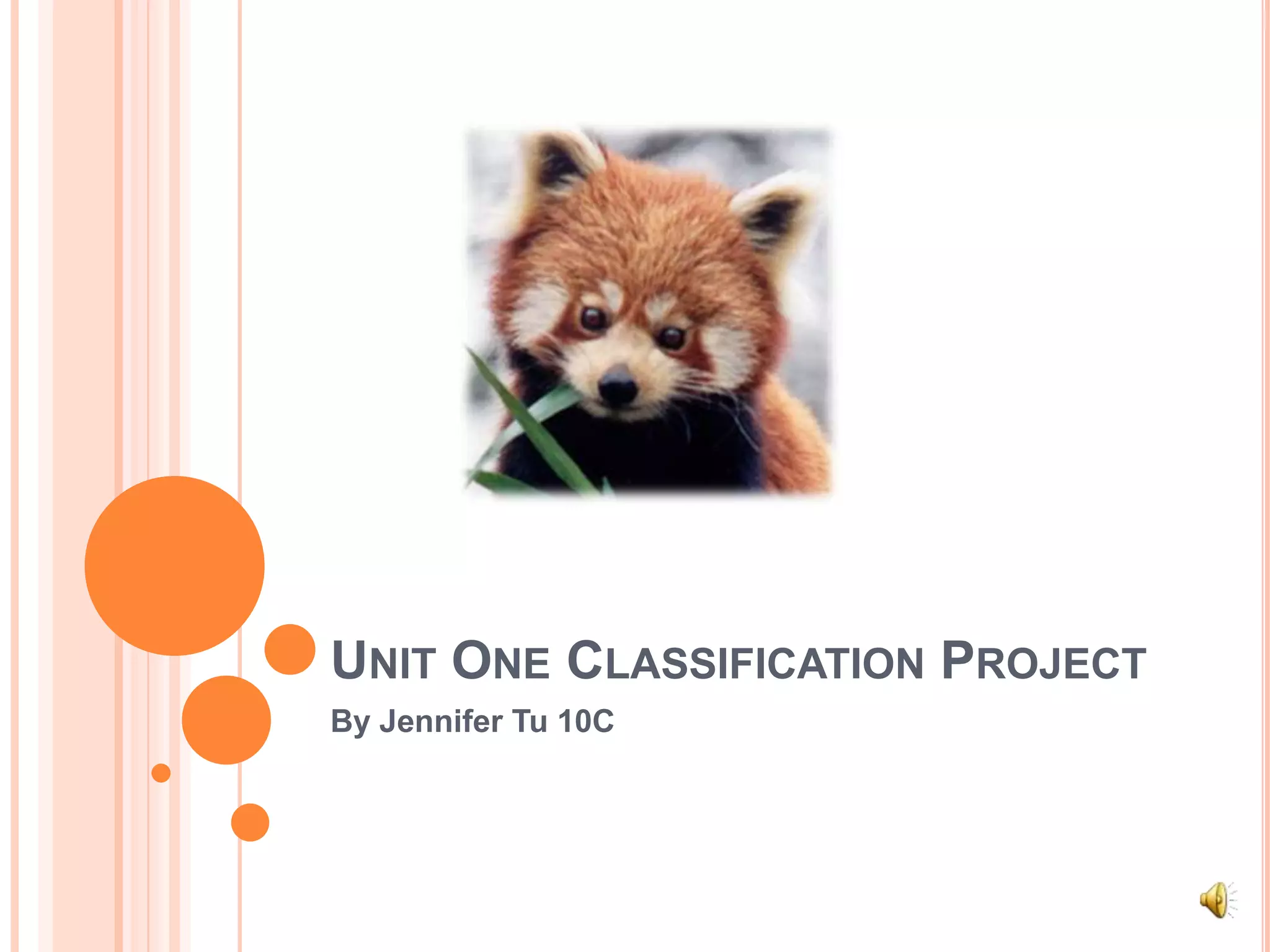
Unit One Classification ProjectBy Jennifer Tu 10C
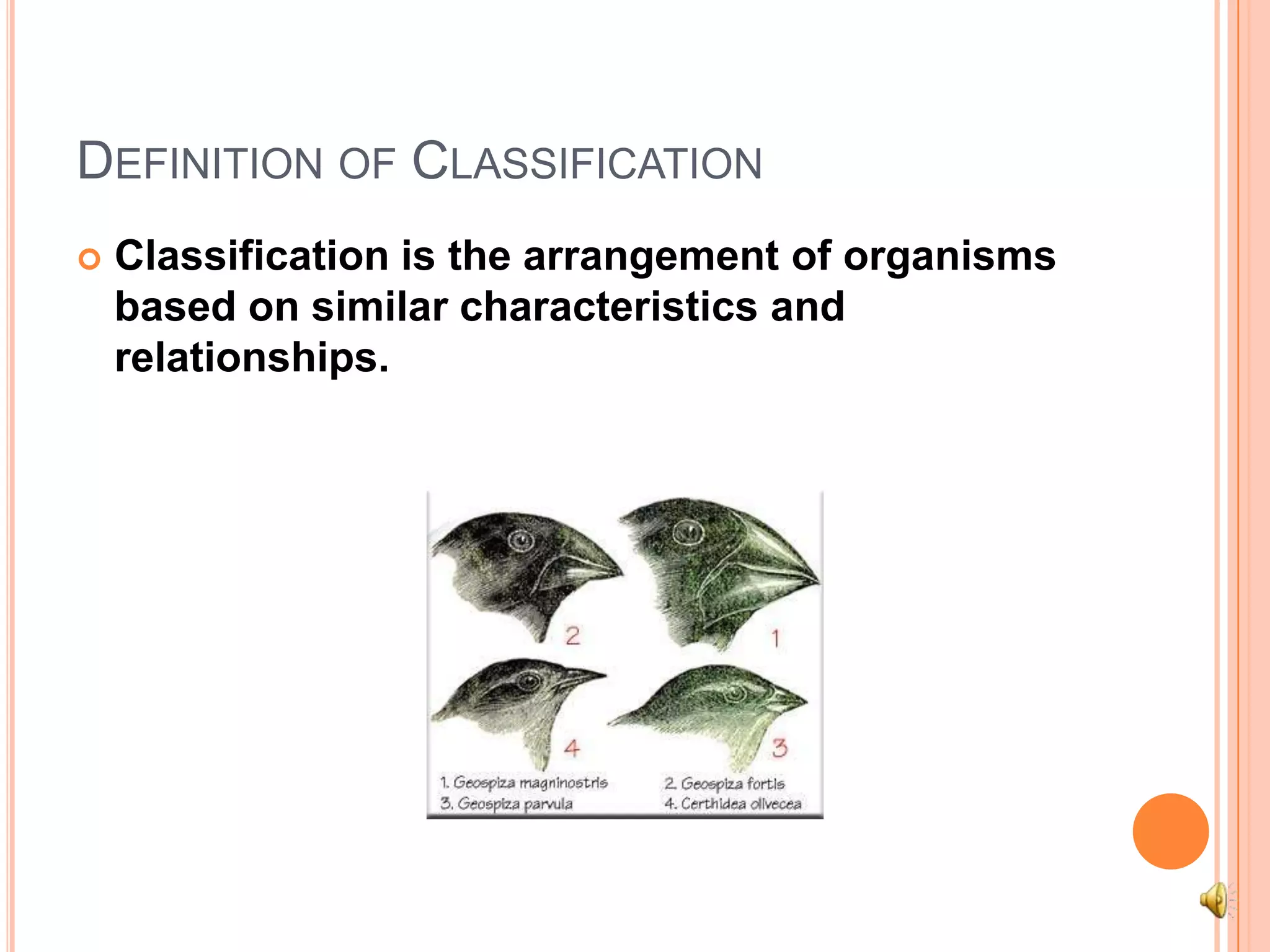
Definition of ClassificationClassification is the arrangement of organisms based on similar characteristics and relationships.
Why We Need Classification?Personal safetyQuarantineForensicsAgriculture and HorticultureMedicineConservation and Protection
What are scientific names?Scientific names are the names that taxonomists use to categorise and classify organisms. Ailurusfulgens= Red PandaScientific Name Common Name
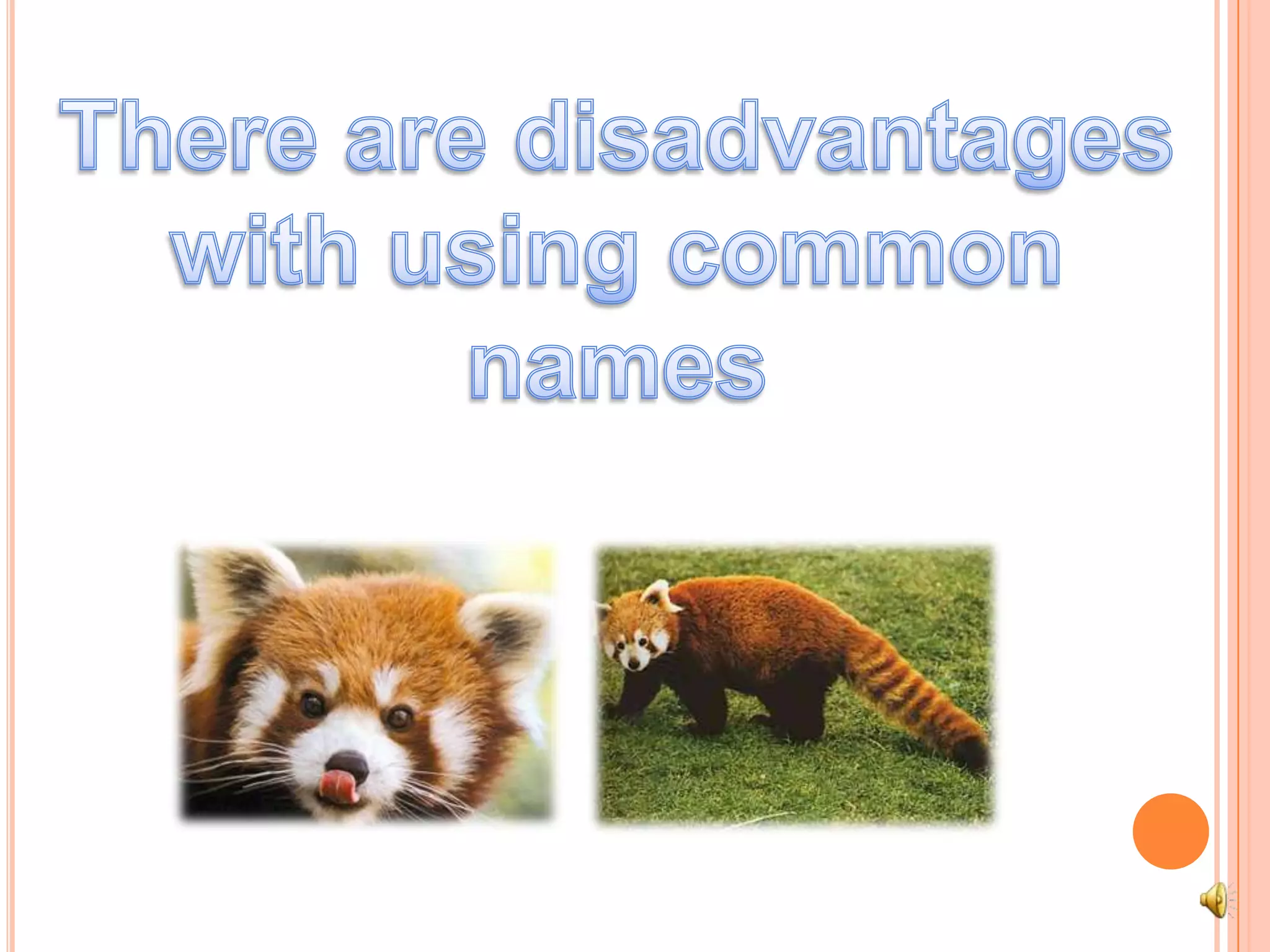
There are disadvantageswith using common names
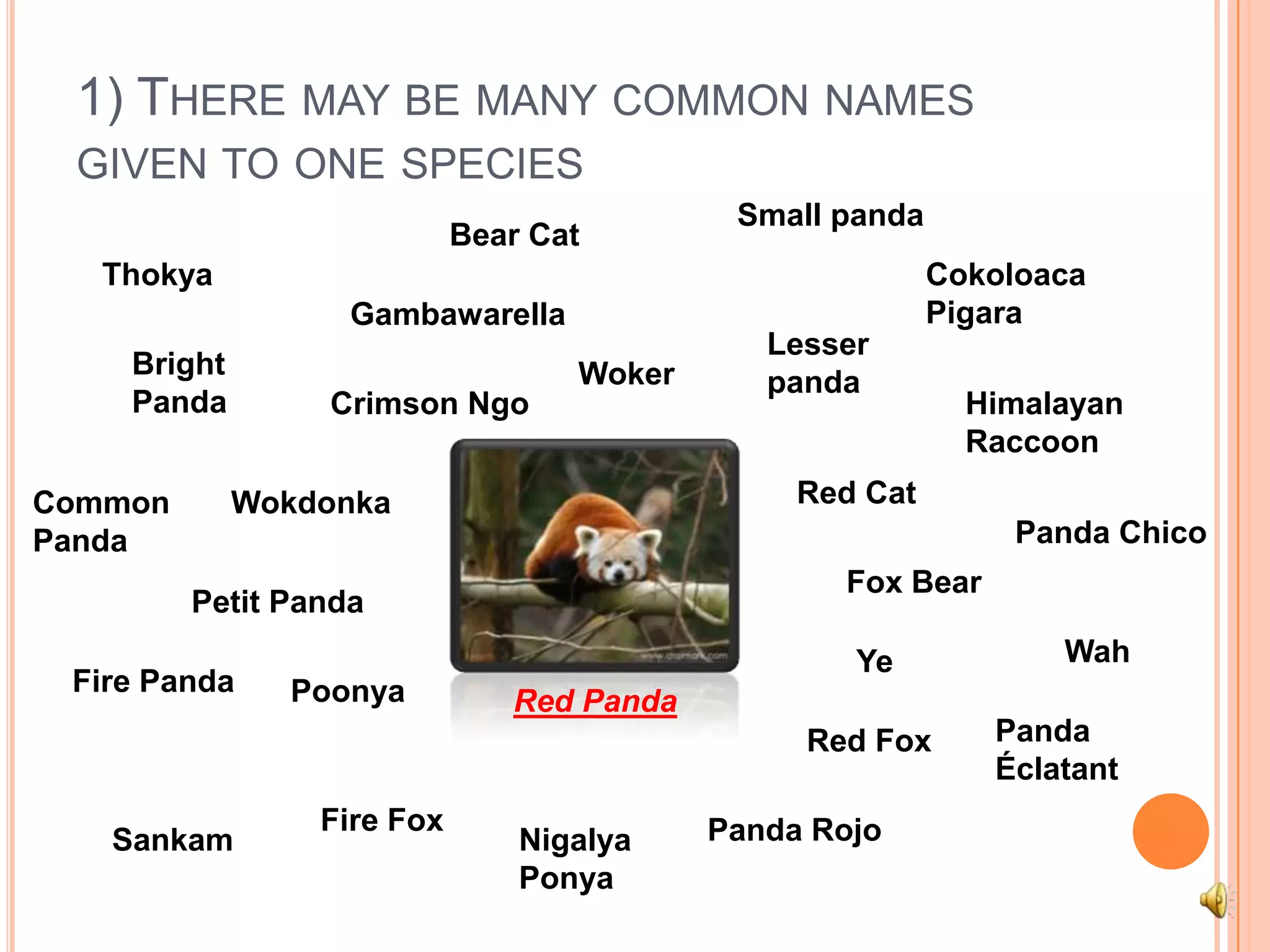
1) There may be many common names given to one speciesSmall pandaBear CatCokoloacaPigaraThokyaGambawarellaLesser pandaBright PandaWokerHimalayan RaccoonCrimson NgoRed CatCommon PandaWokdonkaPanda ChicoFox BearPetit PandaWahYeFire PandaPoonyaRed PandaPanda ÉclatantRed FoxFire FoxPanda RojoNigalyaPonyaSankam
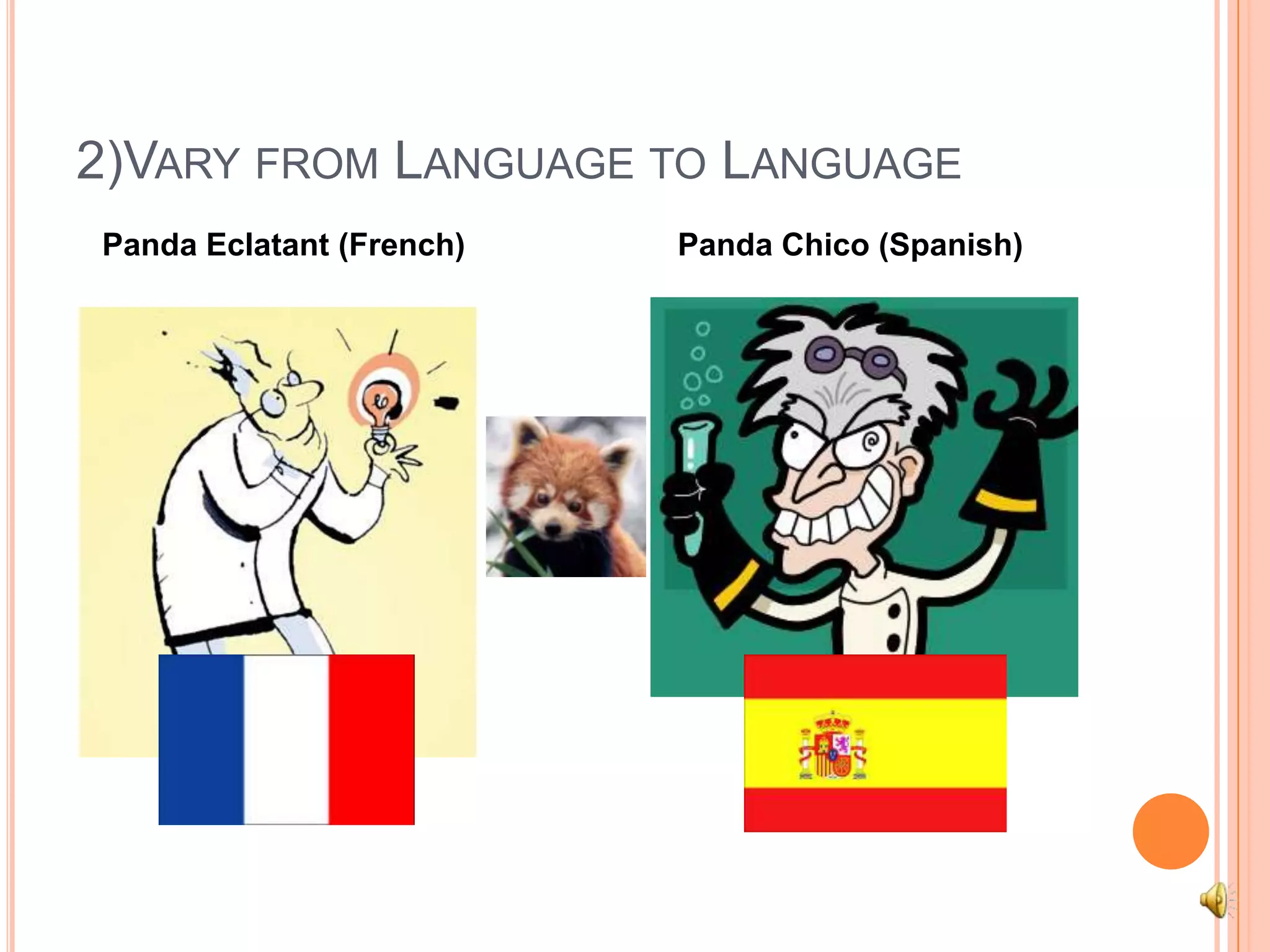
2)Vary from Language to LanguagePanda Eclatant (French)Panda Chico (Spanish)
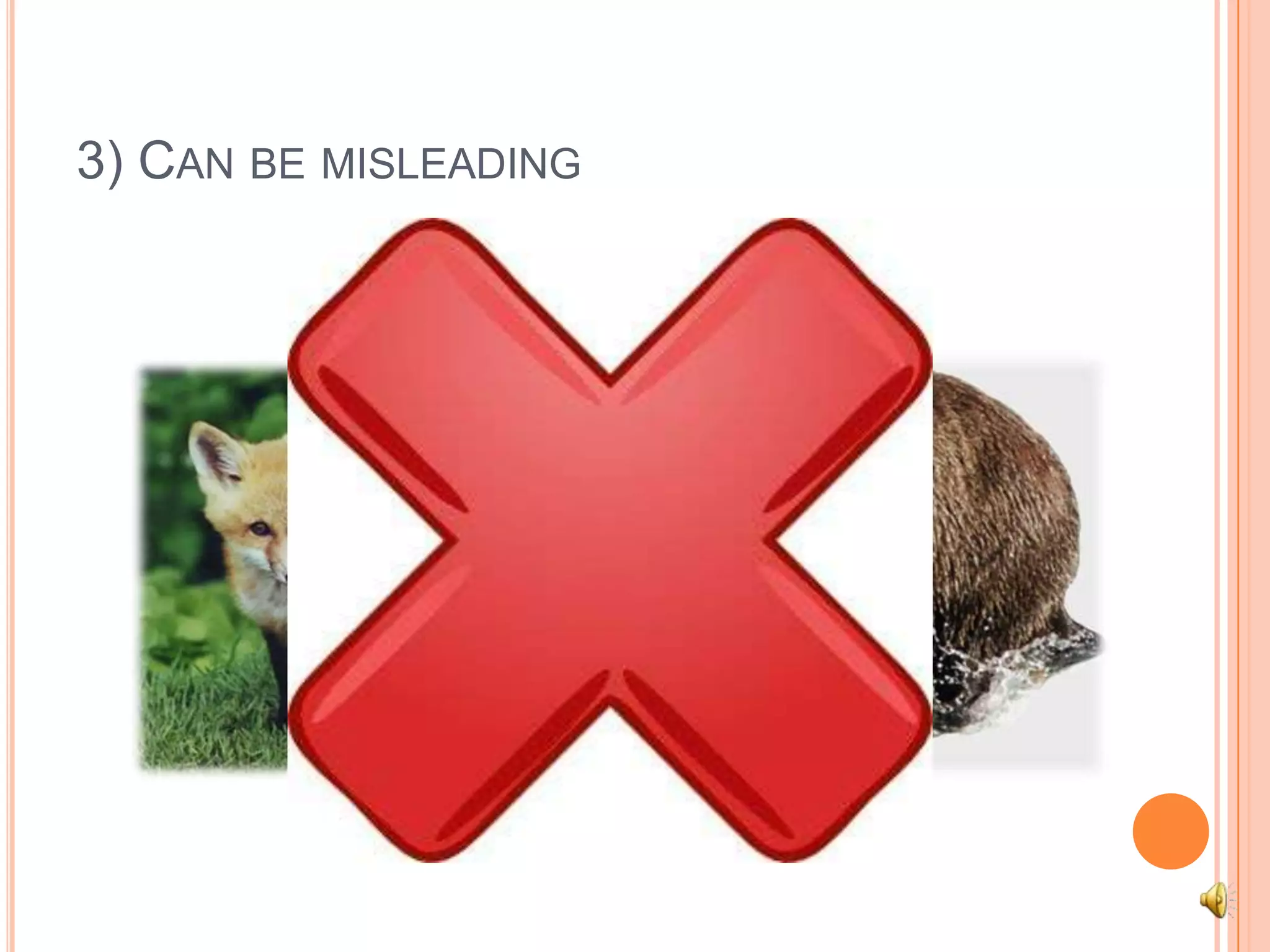
3) Can be misleadingFoxBear
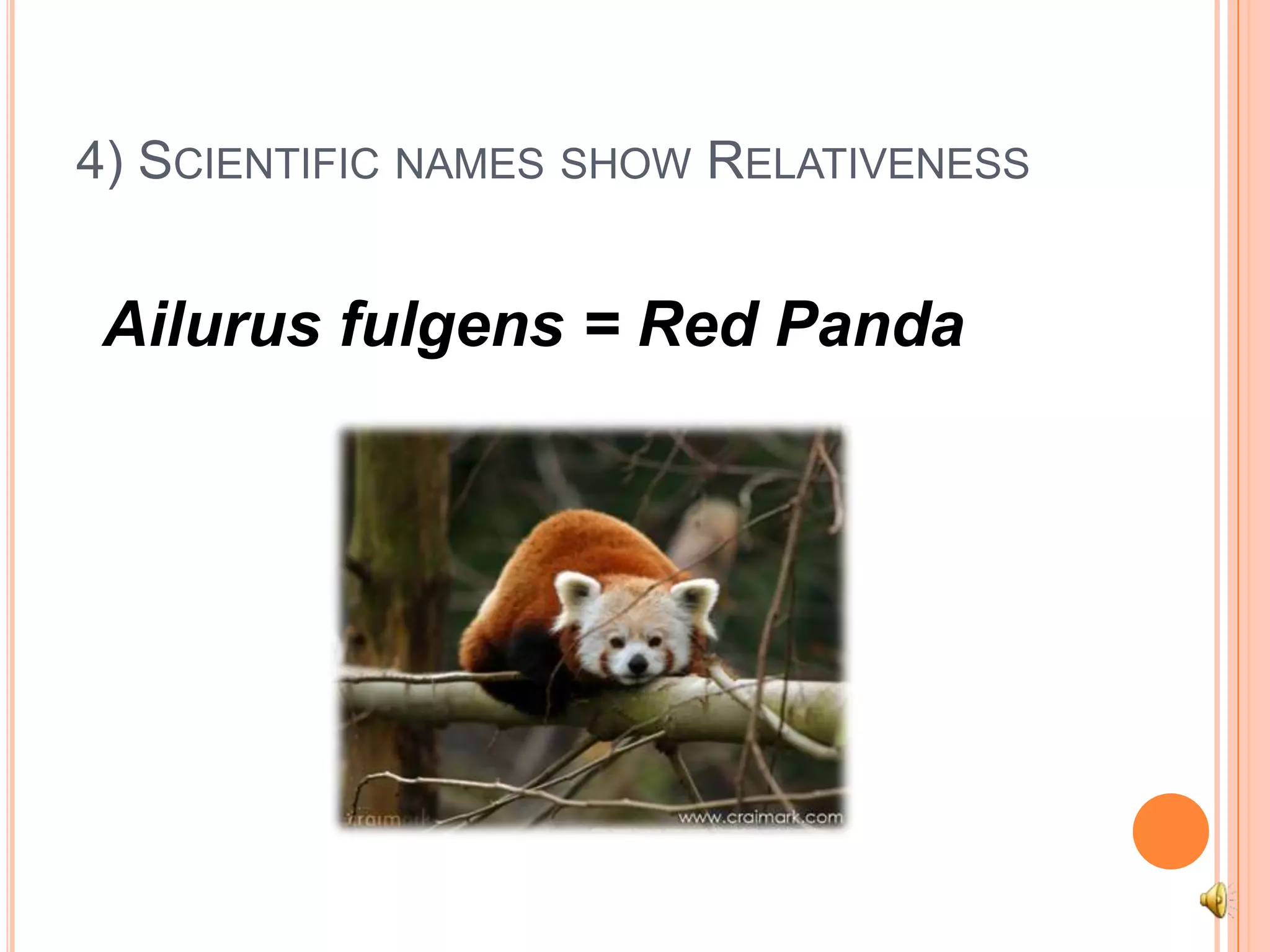
4) Scientific names show RelativenessAilurusfulgens= Red Panda
5) Scientific Names are recognised Universally by all biologists
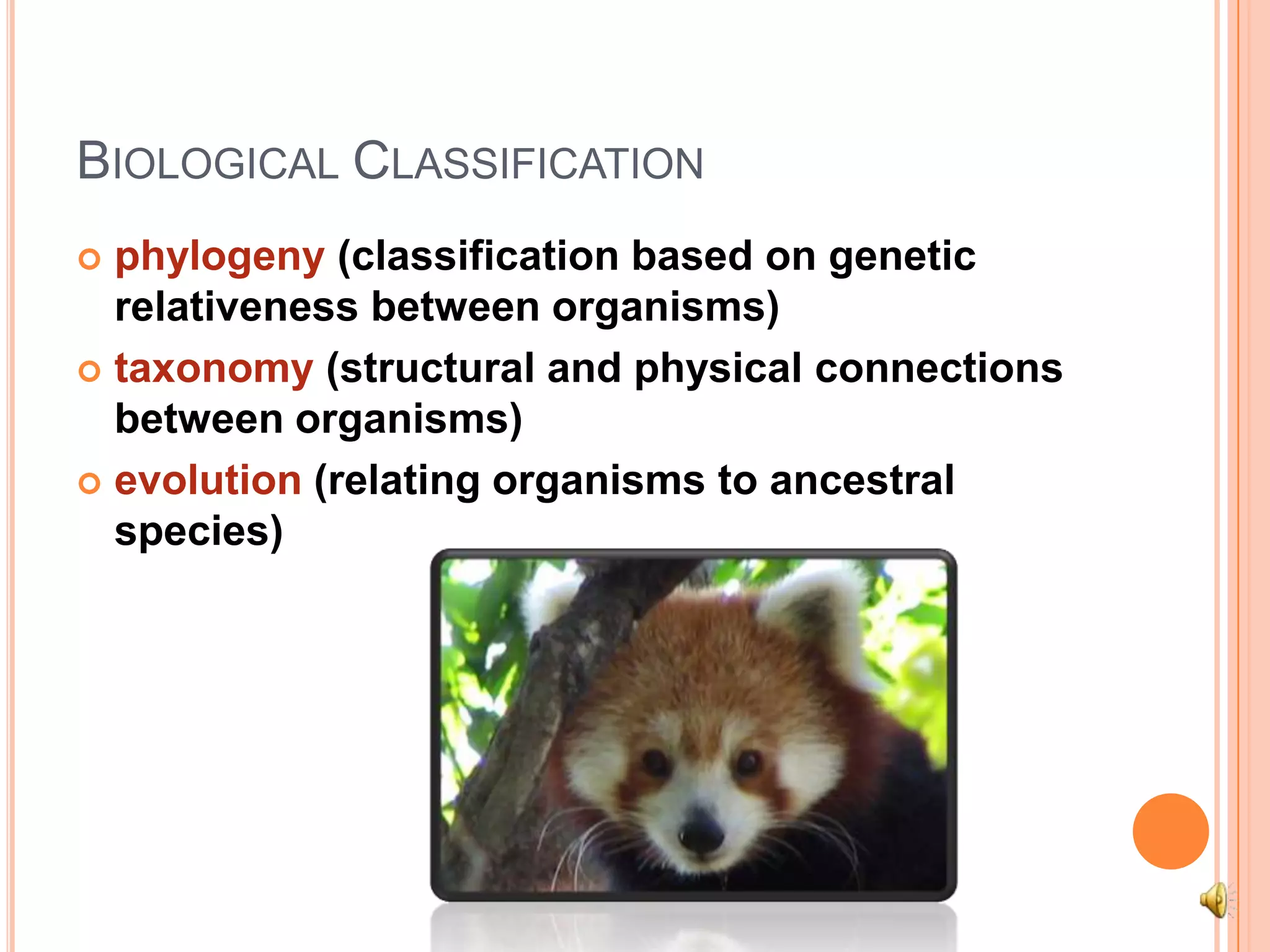
Biological Classificationphylogeny (classification based on genetic relativeness between organisms)taxonomy (structural and physical connections between organisms)evolution (relating organisms to ancestral species)
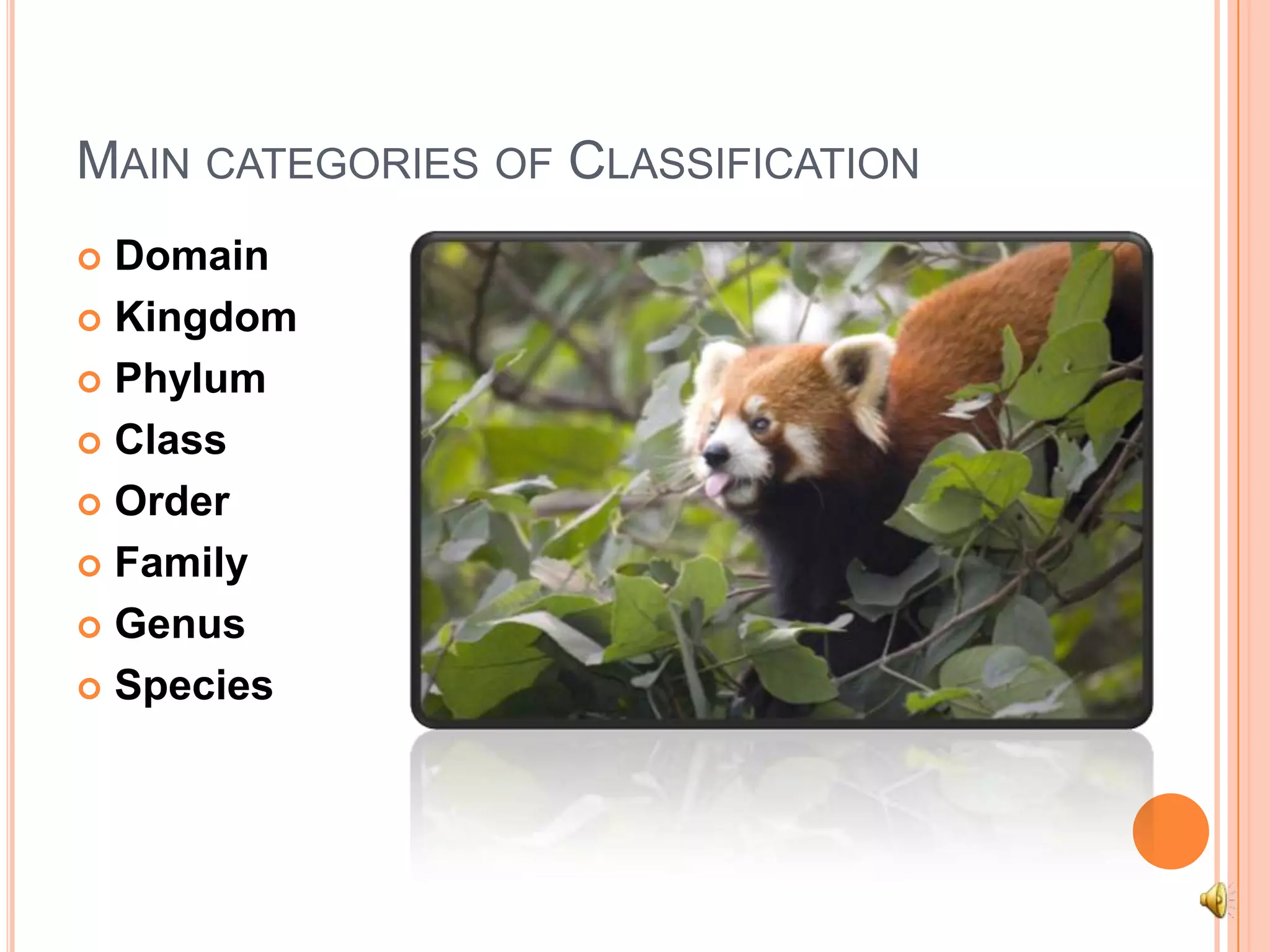
Main categories of ClassificationDomainKingdomPhylumClassOrderFamilyGenusSpecies
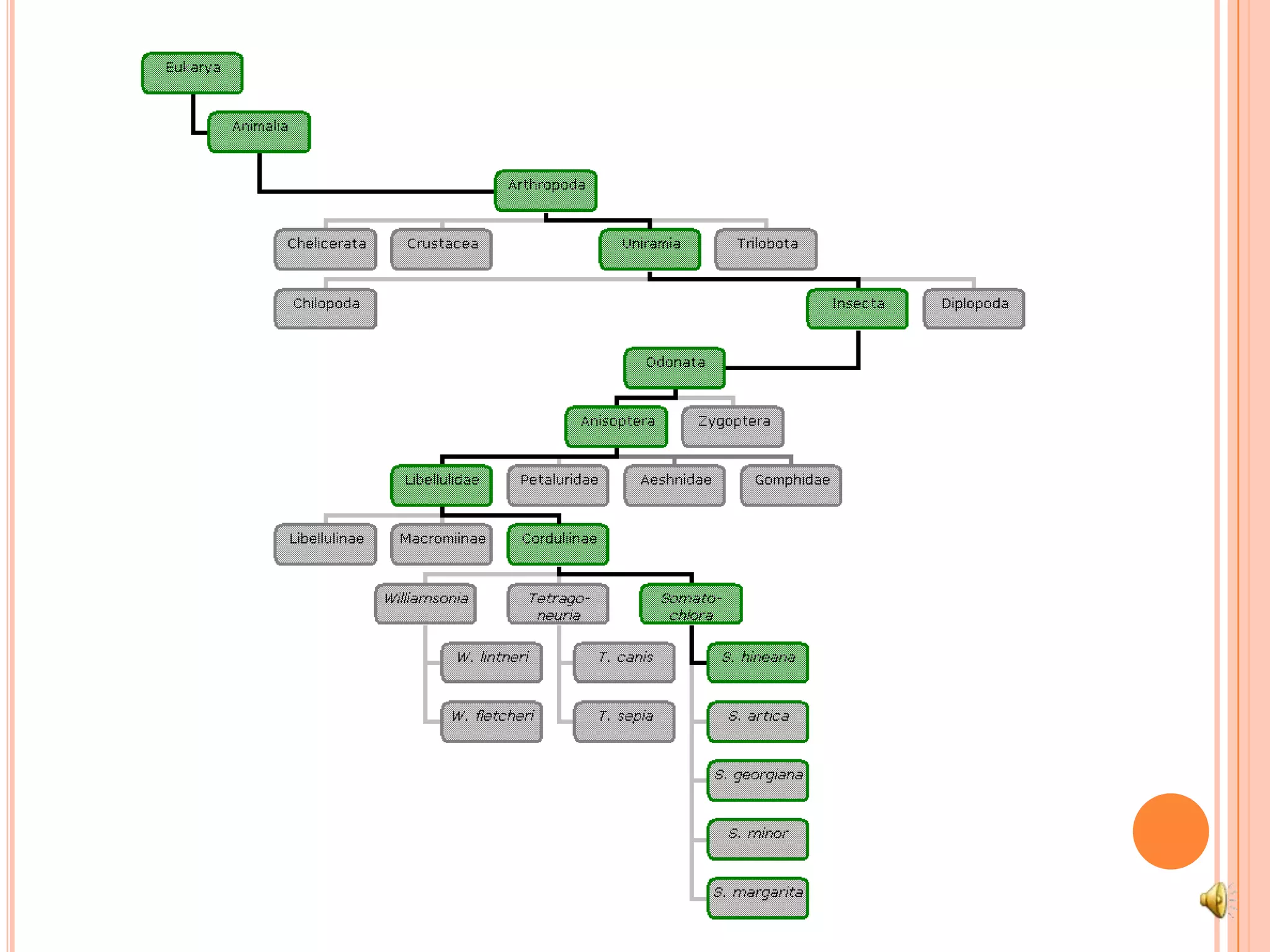
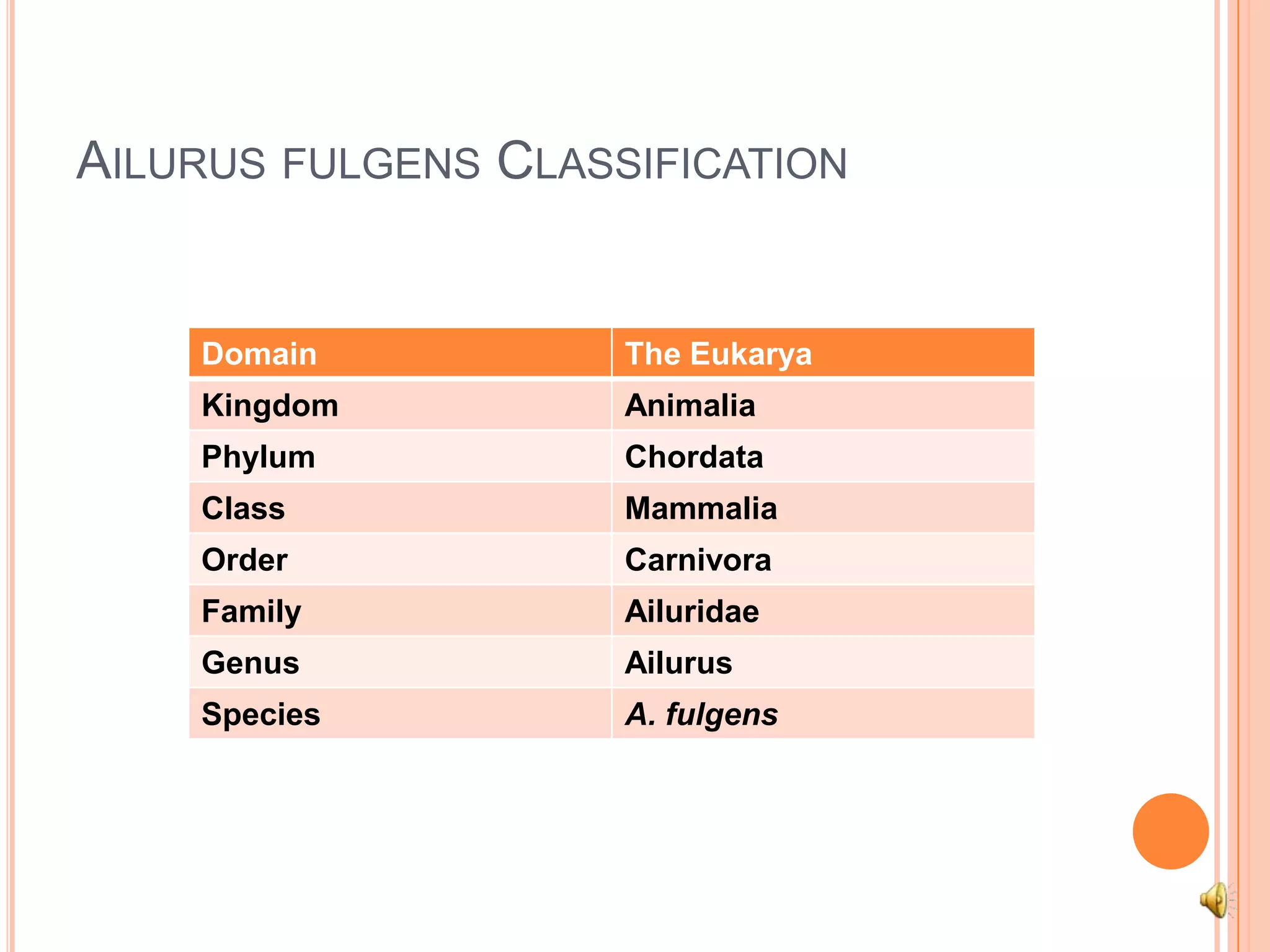
Ailurusfulgens Classification
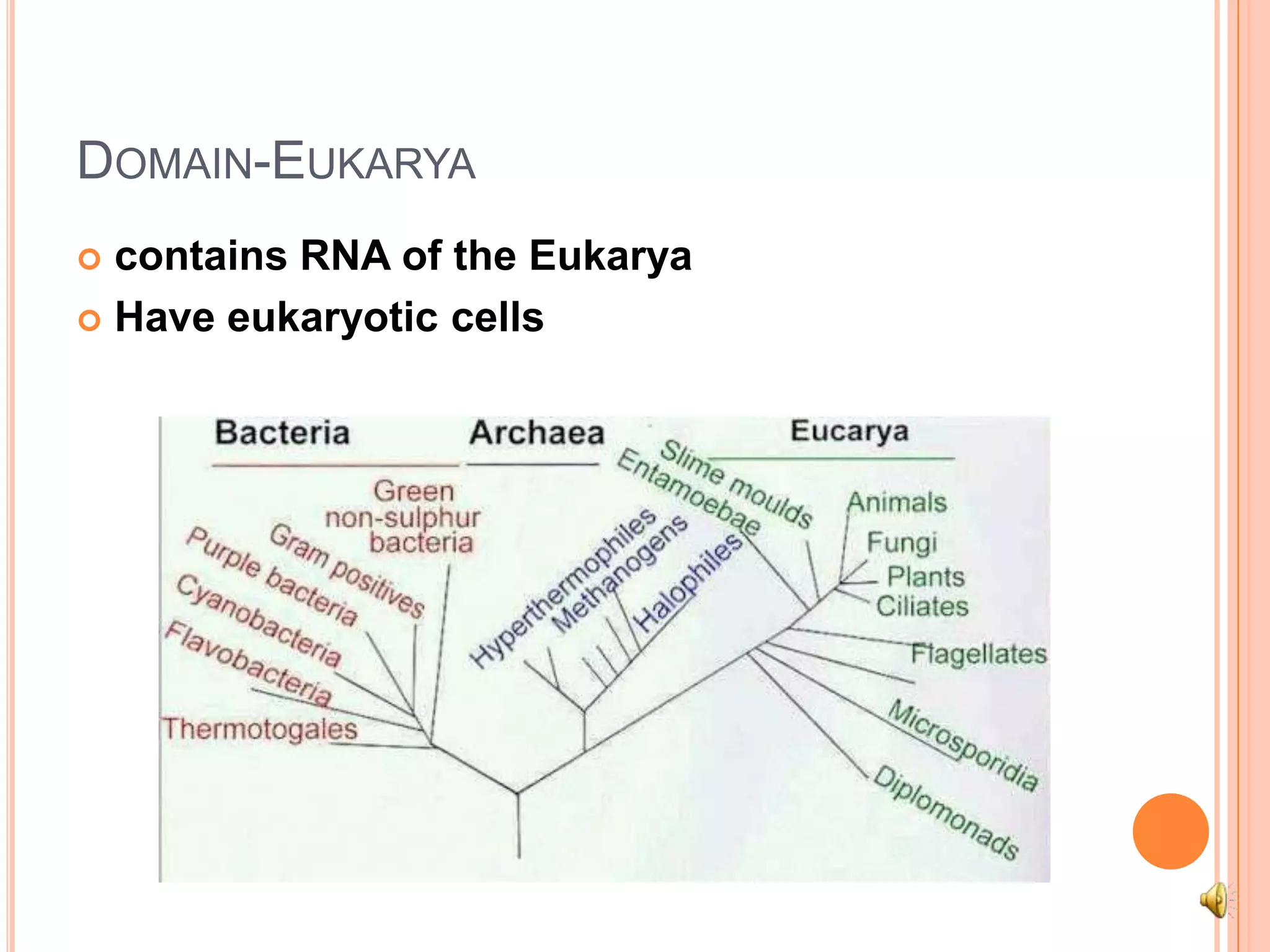
Domain-Eukaryacontains RNA of the EukaryaHave eukaryotic cells
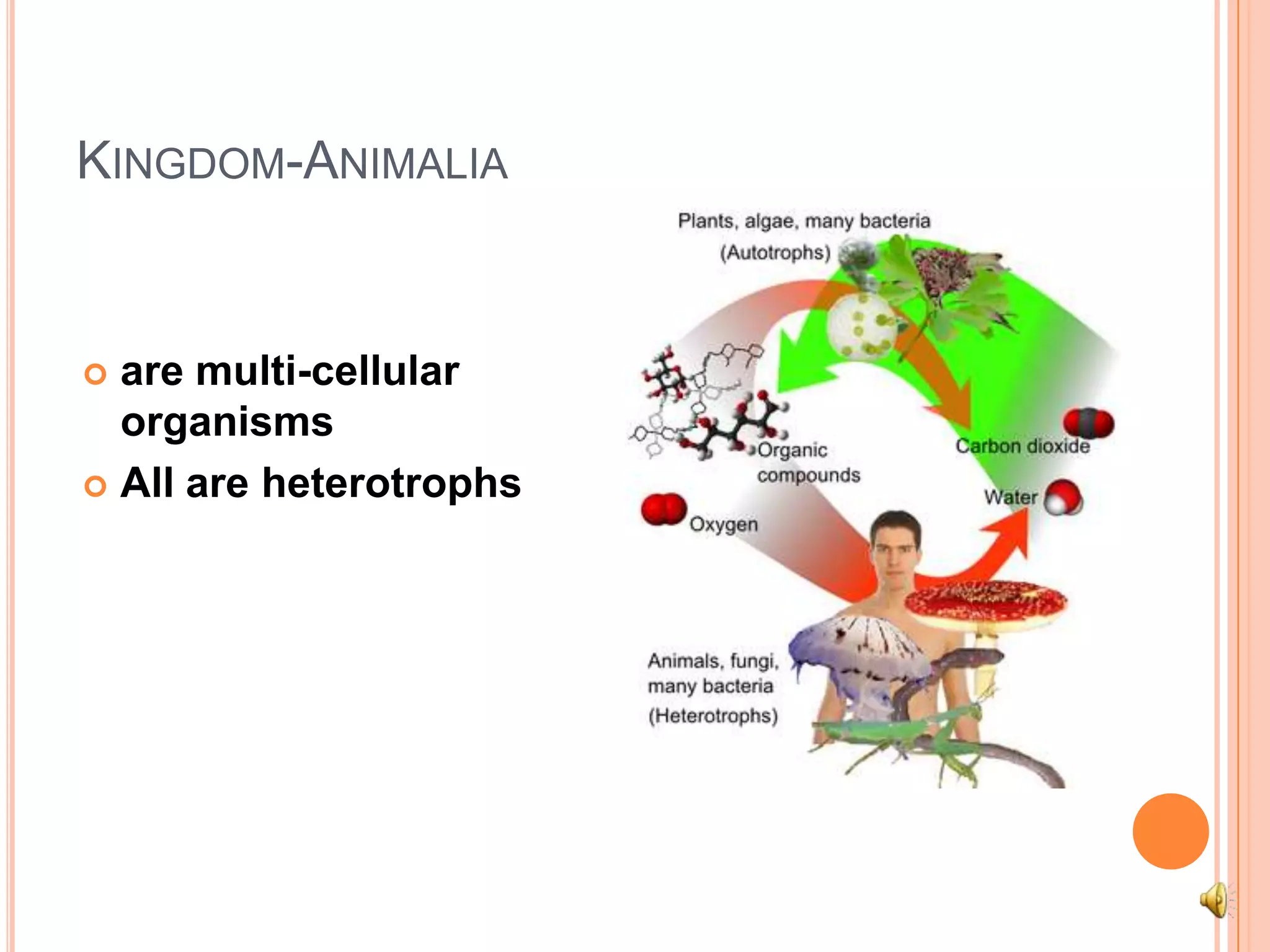
Kingdom-Animaliaare multi-cellular organismsAll are heterotrophs
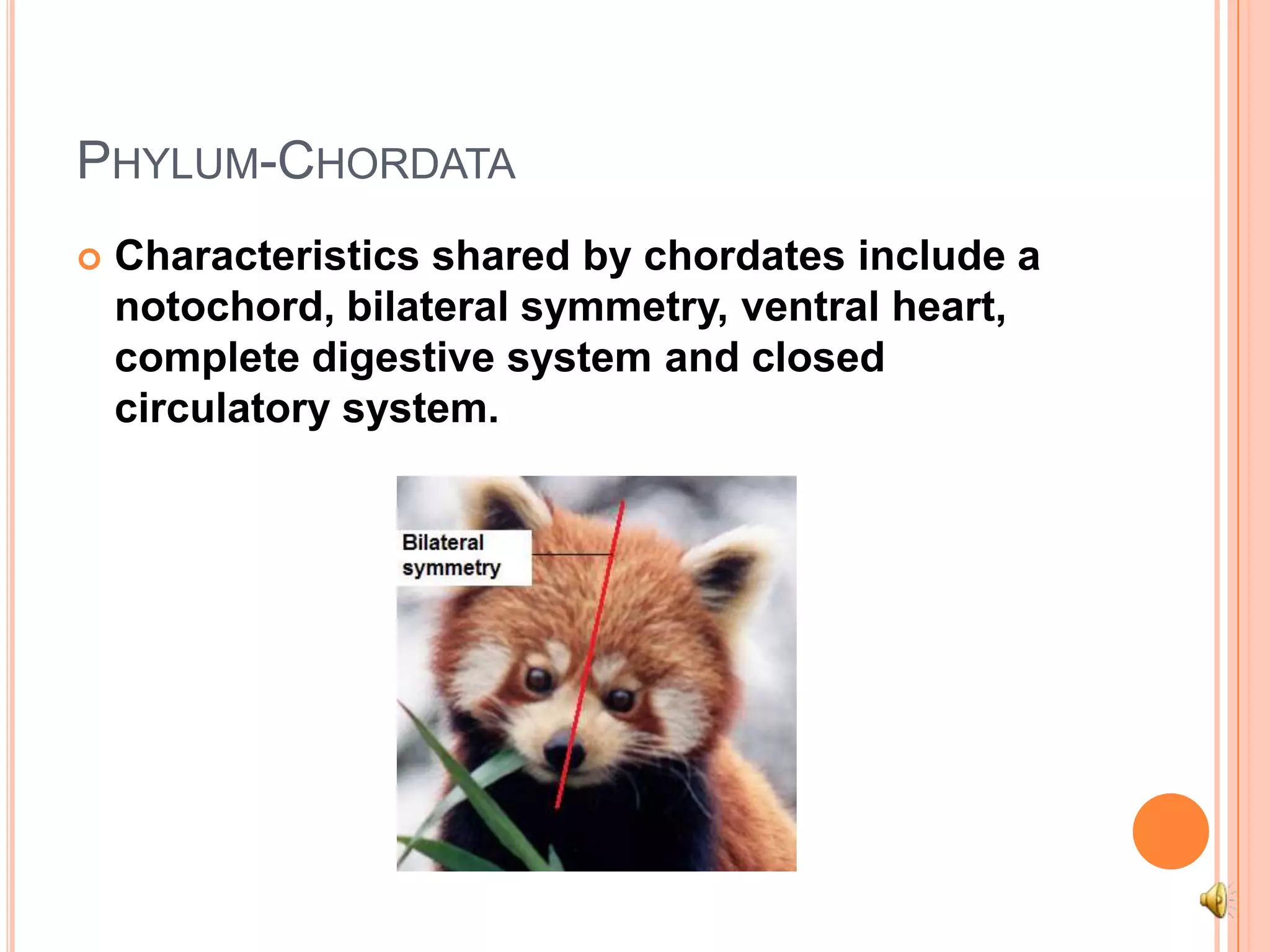
Phylum-ChordataCharacteristics shared by chordates include a notochord, bilateral symmetry, ventral heart, complete digestive system and closed circulatory system.
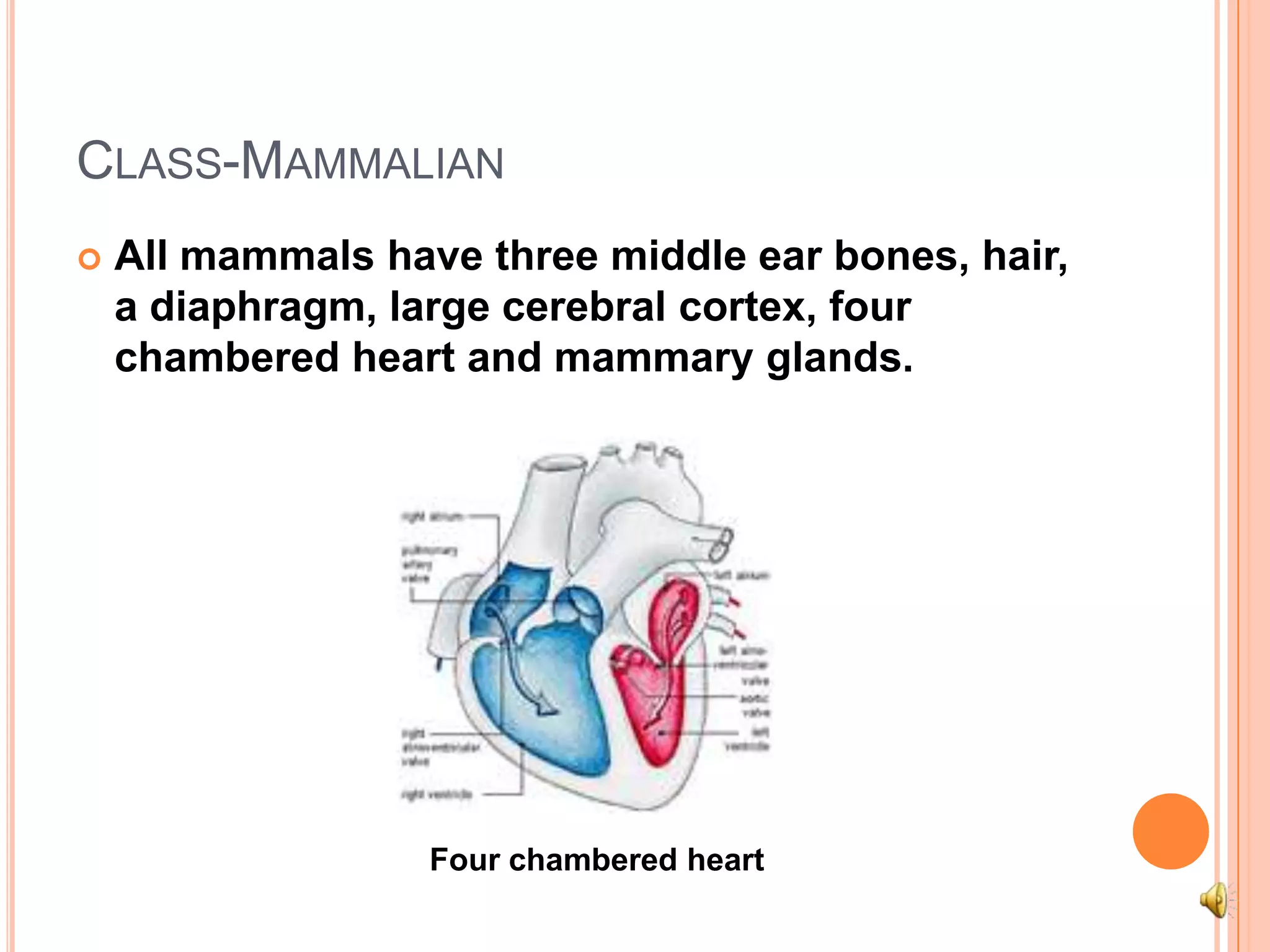
Class-MammalianAll mammals have three middle ear bones, hair, a diaphragm, large cerebral cortex, four chambered heart and mammary glands.Four chambered heart
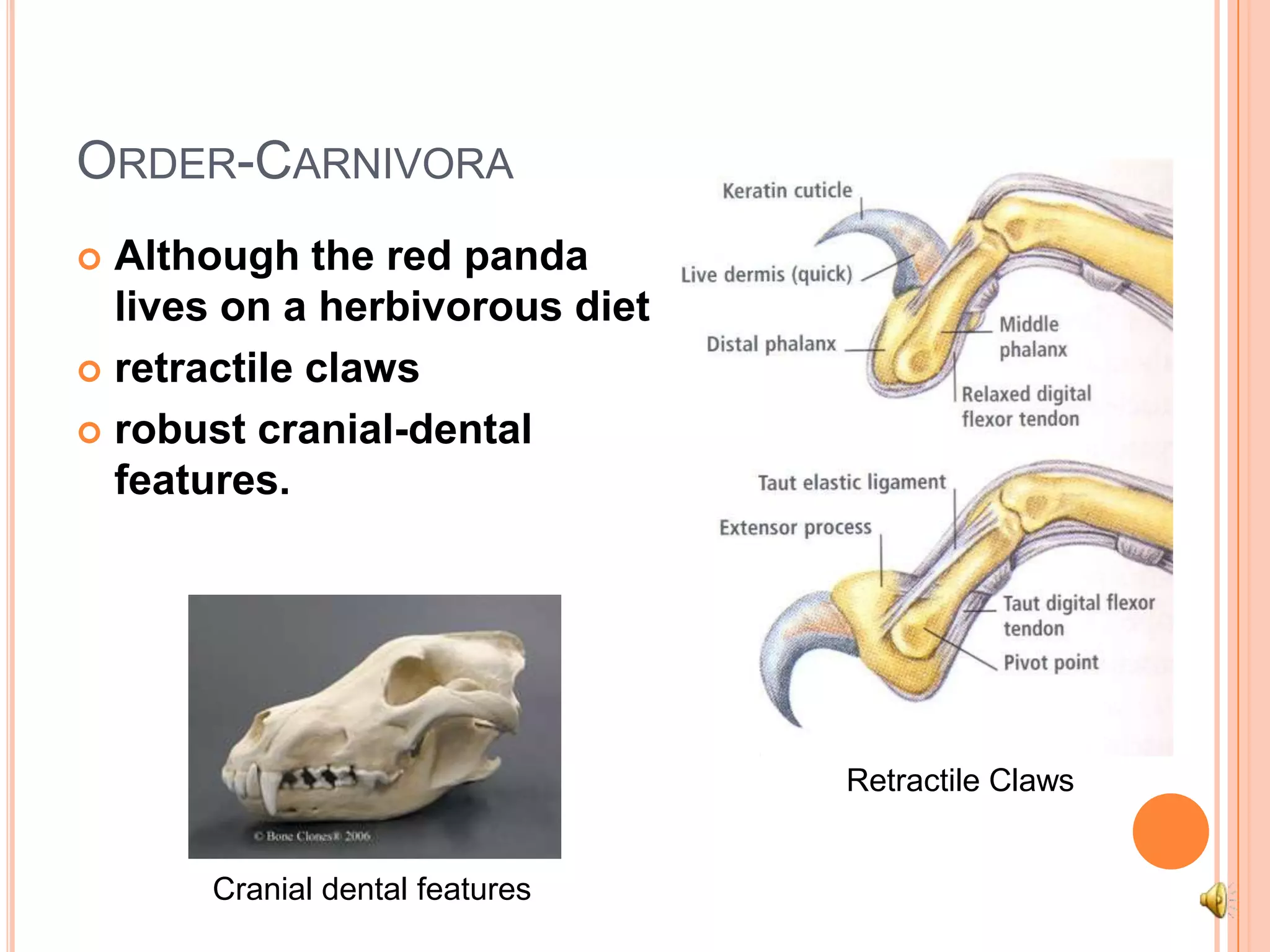
Order-CarnivoraAlthough the red panda lives on a herbivorous dietretractile clawsrobust cranial-dental features.Retractile ClawsCranial dental features
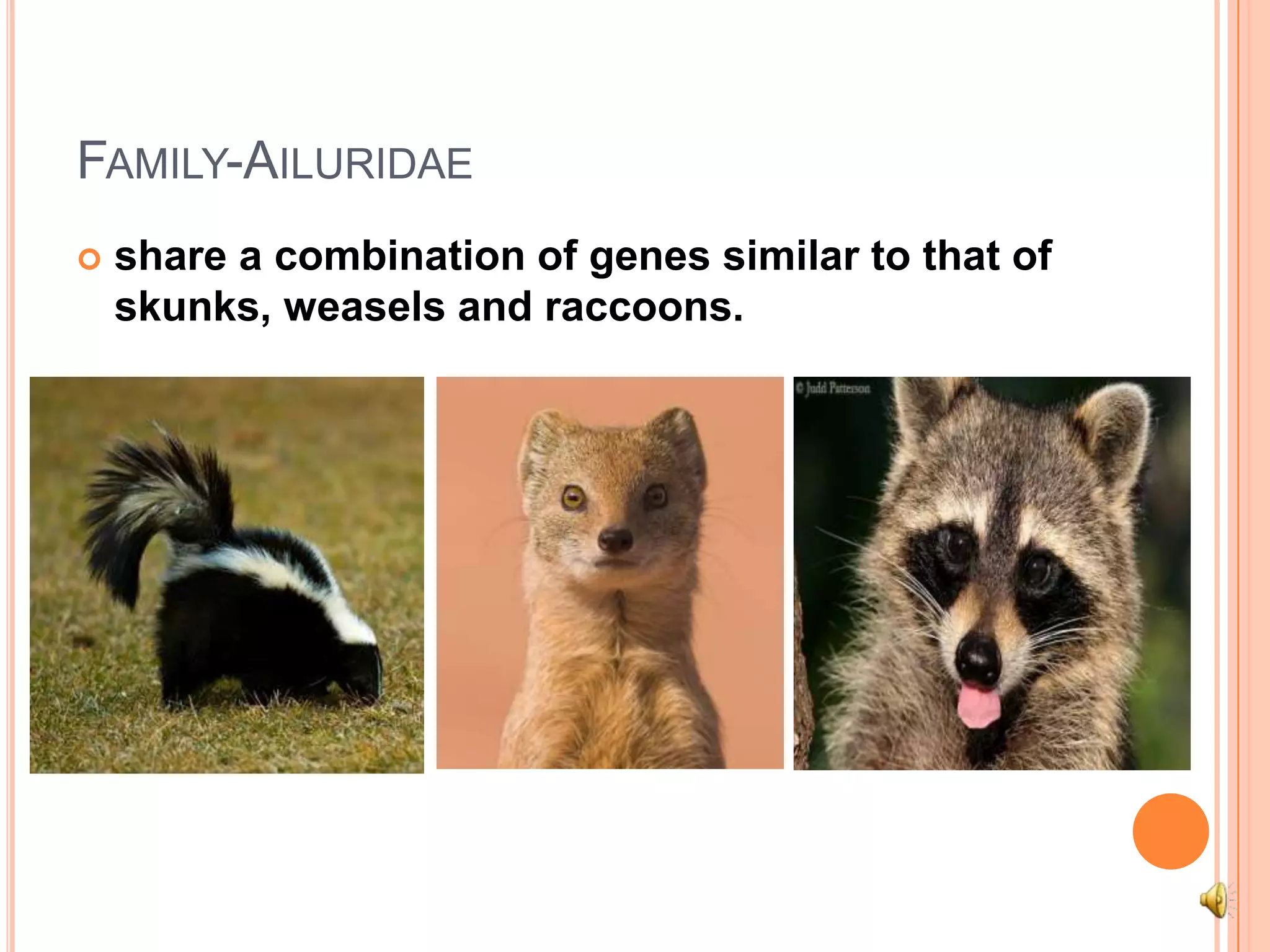
Family-Ailuridaeshare a combination of genes similar to that of skunks, weasels and raccoons.
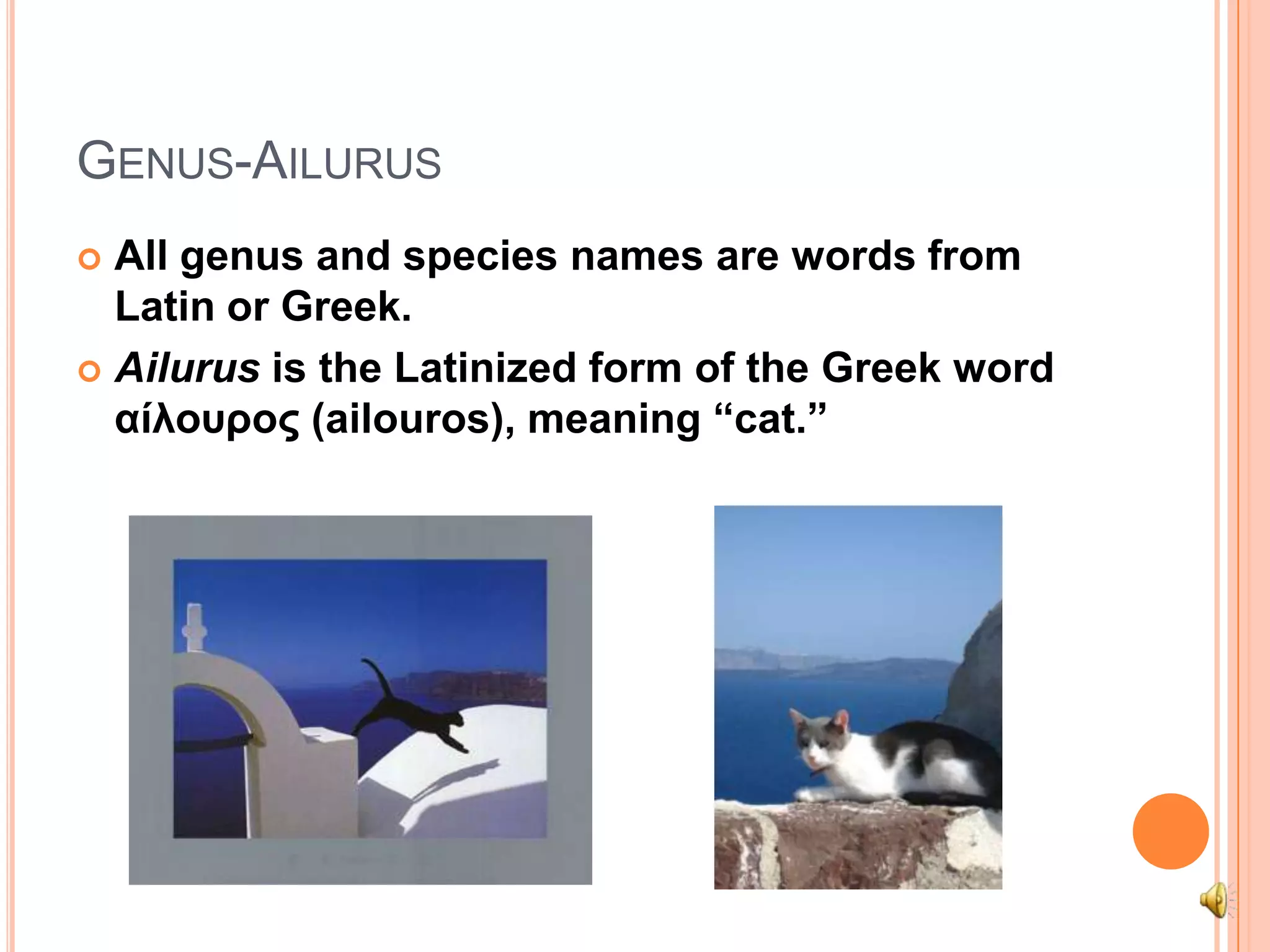
Genus-AilurusAll genus and species names are words from Latin or Greek. Ailurus is the Latinized form of the Greek word αίλουρος (ailouros), meaning “cat.”
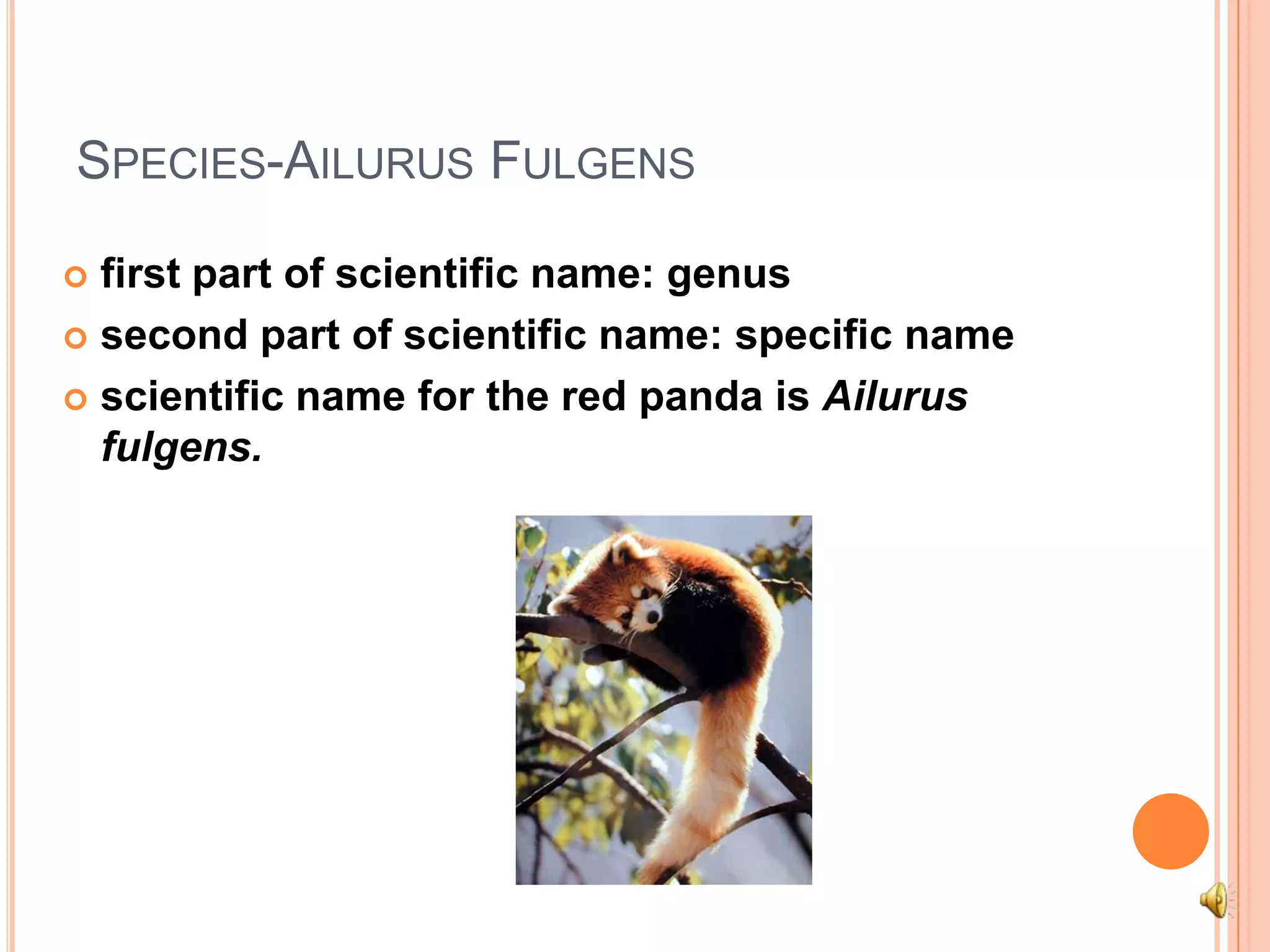
Species-AilurusFulgensfirst part of scientific name: genussecond part of scientific name: specific name scientific name for the red panda is Ailurusfulgens.
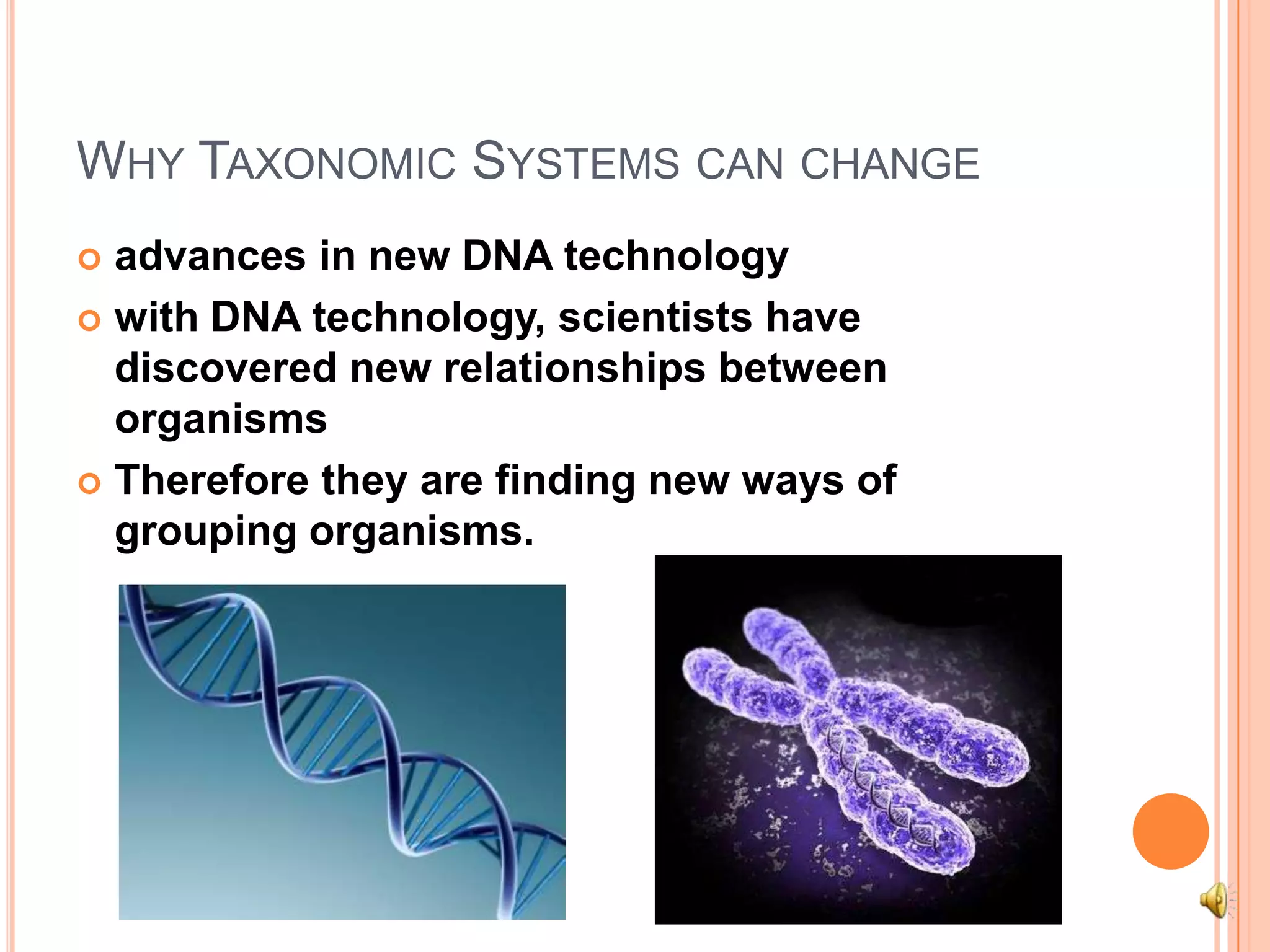
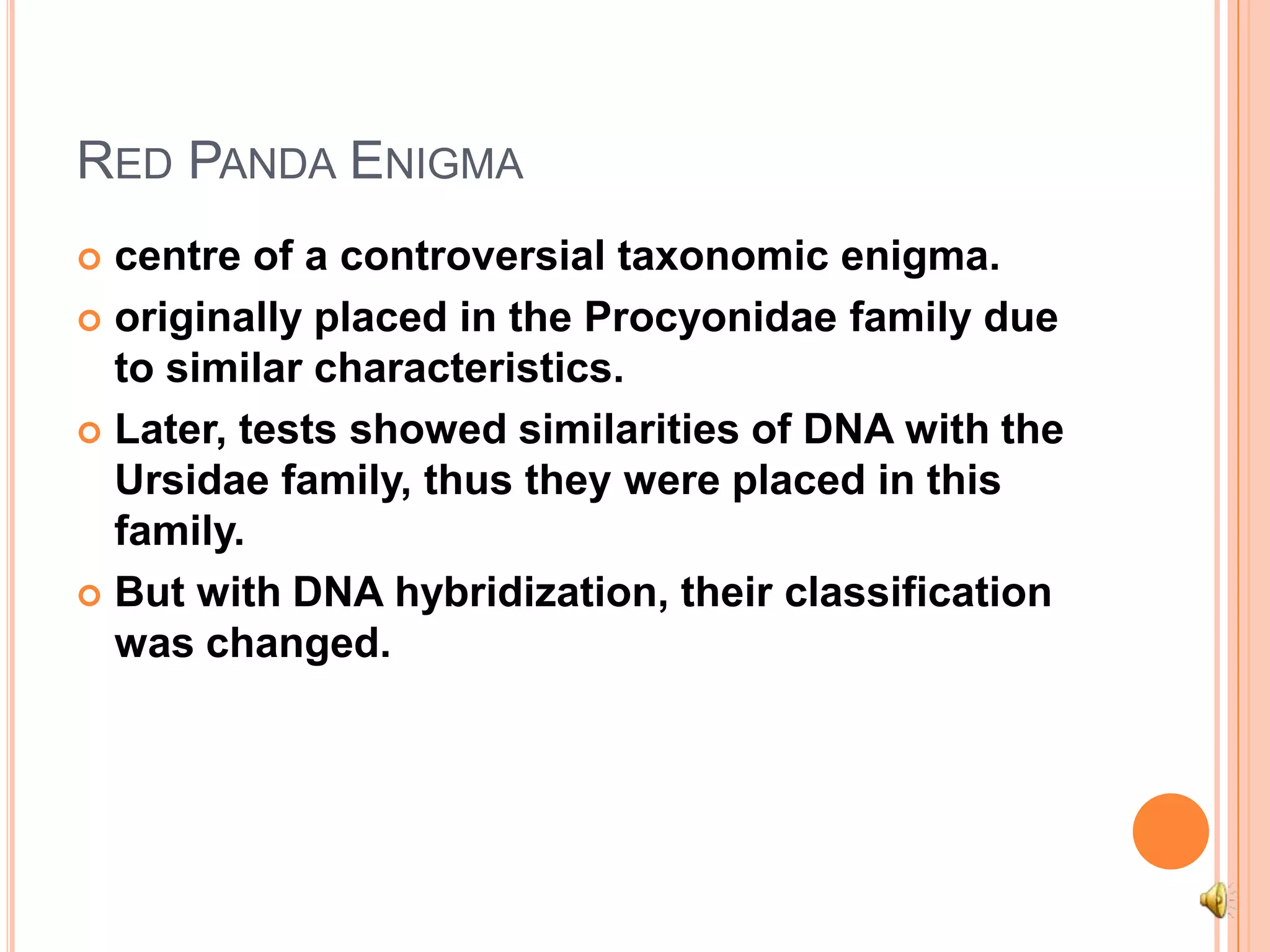
Why Taxonomic Systems can changeadvances in new DNA technologywith DNA technology, scientists have discovered new relationships between organismsTherefore they are finding new ways of grouping organisms.
Red Panda Enigmacentre of a controversial taxonomic enigma.originally placed in the Procyonidae family due to similar characteristics. Later, tests showed similarities of DNA with the Ursidae family, thus they were placed in this family. But with DNA hybridization, their classification was changed.
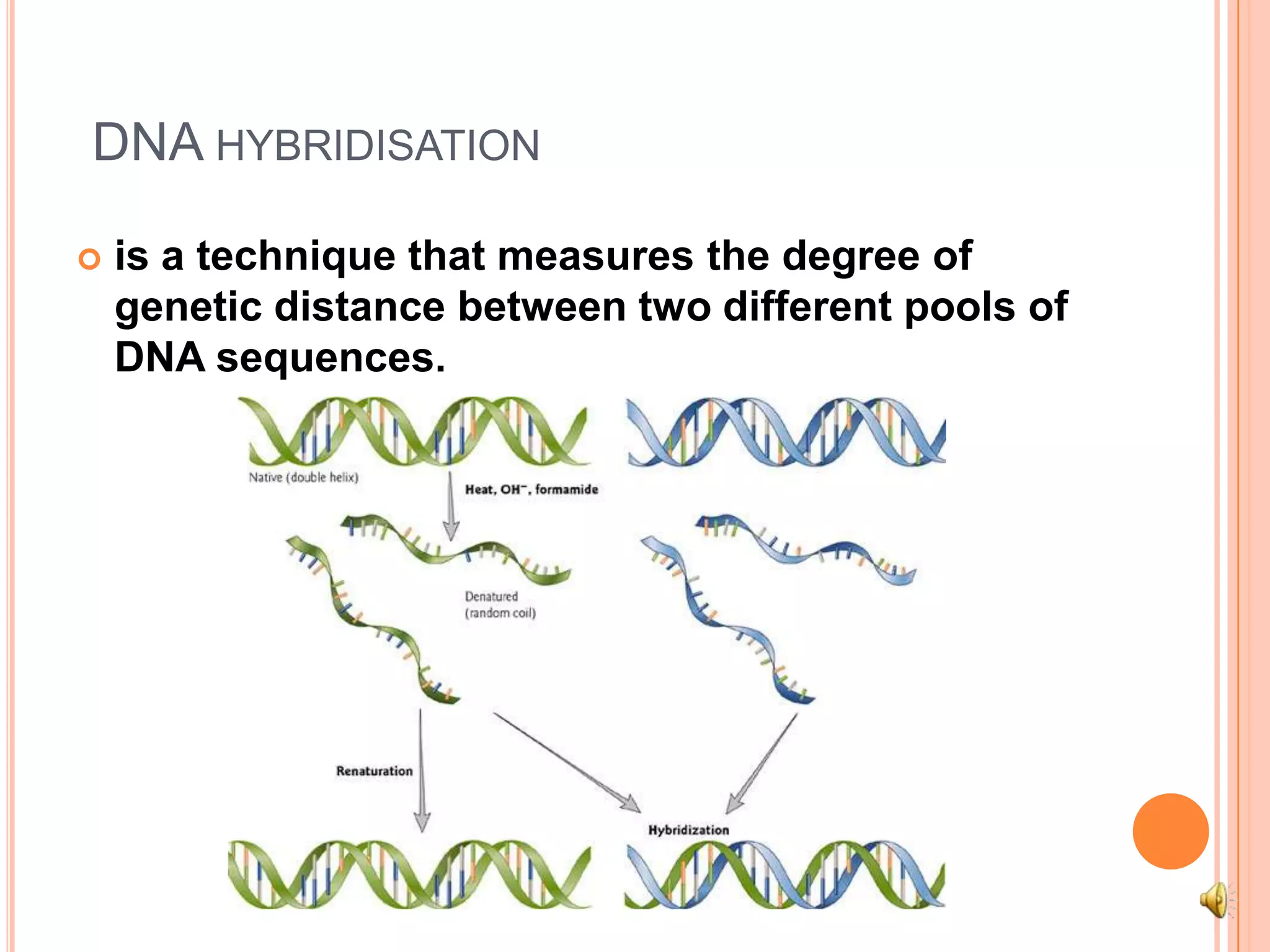
DNA hybridisationis a technique that measures the degree of genetic distance between two different pools of DNA sequences.
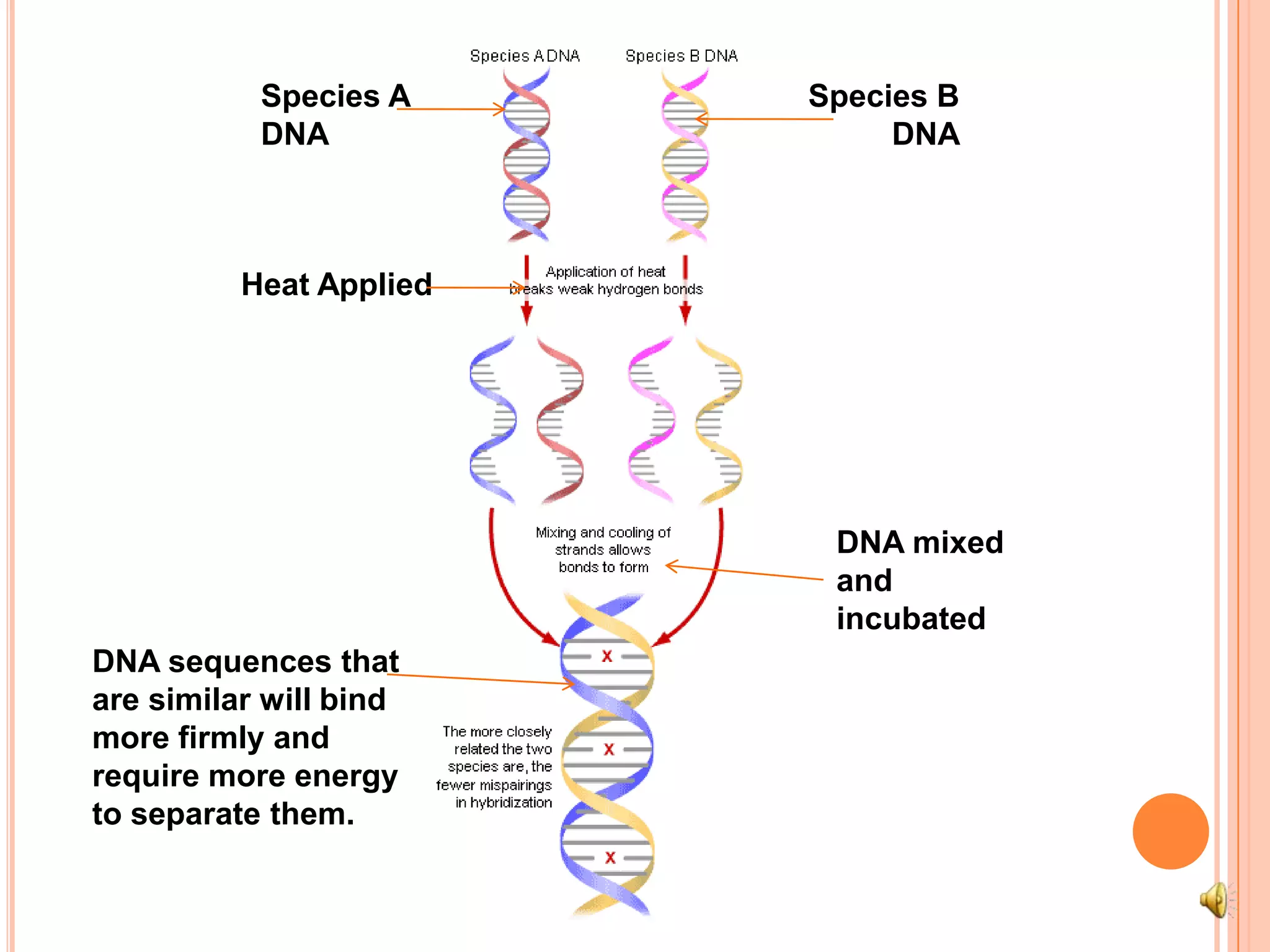
Species A DNASpecies B DNAHeat AppliedDNA mixed and incubatedDNA sequences that are similar will bind more firmly and require more energy to separate them.
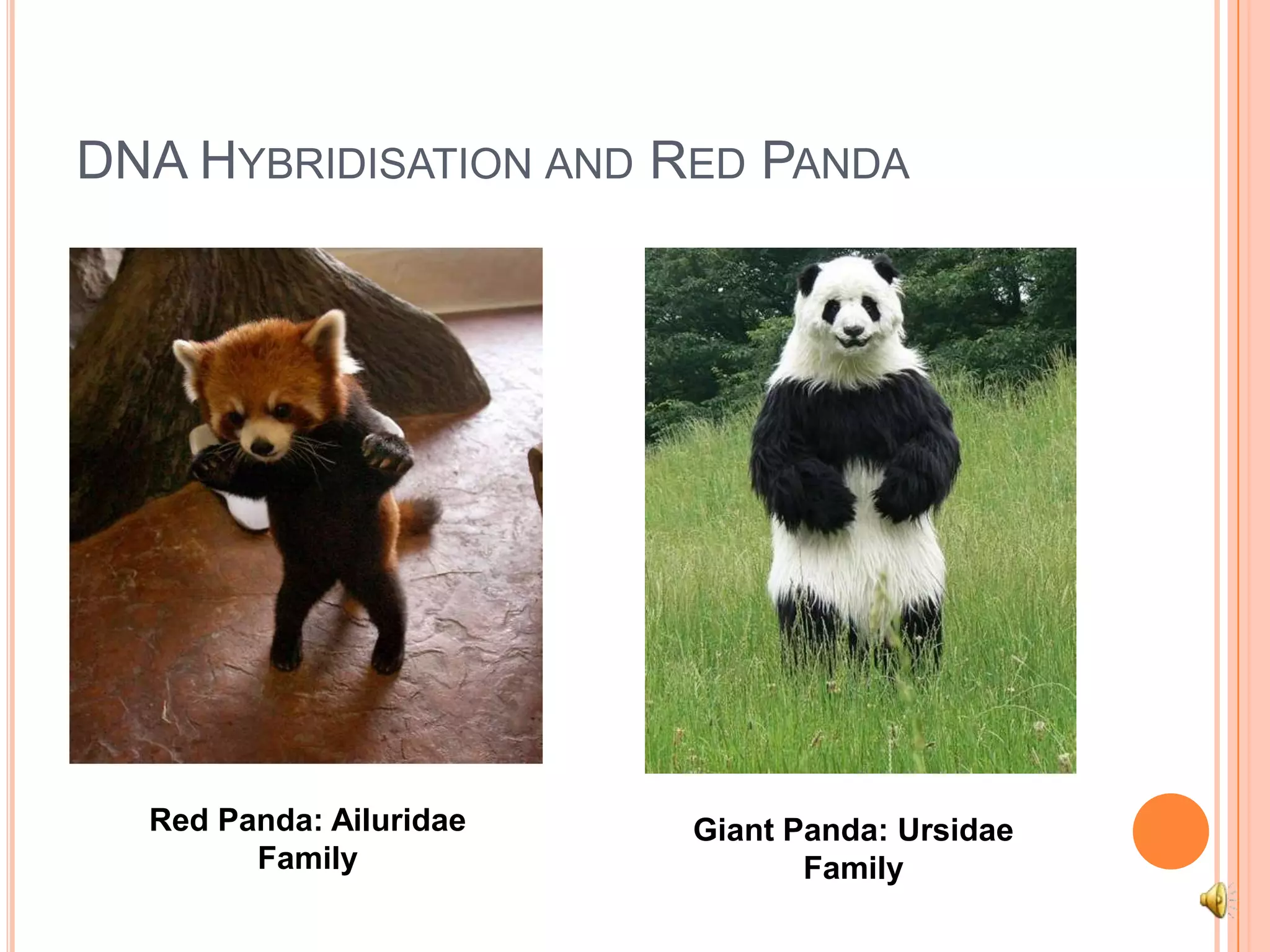
DNA Hybridisation and Red PandaRed Panda: Ailuridae FamilyGiant Panda: Ursidae Family
BibliographyBiology-online.org 2009, ‘Classification’, Biology-online.org, http://www.biology-online.org/dictionary/Classification (23 September 2009)Heath, T. & Platnick J. 2008, "Ailurusfulgens" (On-line), Animal Diversity Web http://animaldiversity.ummz.umich.edu/site/accounts/information/Ailurus_fulgens.html. (September 19, 2009)Wikipedia-the free encyclopaedia 2009, ‘Red Panda’, Wikipedia-the free encyclopaedia, 23 September http://en.wikipedia.org/wiki/Red_Panda (22 September 2009)Lioncrusher ‘s Domain- Carnivora Species Information 2009, ‘The Ailuridae Family’, http://www.lioncrusher.com/family.asp?family=Ailuridae (23 September 2009)Wang, X., Choudhry, A., Yonzon, P., Wozencraft, C. & Than Zaw 2008, ‘AilurusFugens’, The IUCN Red List of Endangered Species http://www.iucnredlist.org/details/714/0/full (23 September 2009)
Bibliography (Continued)Kinnear, J. & Martin, M. 2006, Nature of Biology Book 1 Third Edition, John Wiley & Sons Australia, MiltonSemple, A., Borger P., Cleeland, C., Jackel, S. & Pappas X. 2006, ‘Nelson Biology VCE Units 1&2’, Nelson Australia, South MelbourneEvans, D., Ladiges, P., Mckenzie, J. & Sanders, Y. 2005, ‘Heinemann Biology 1, 4th edition VCE Units 1 & 2’, Heinemann Harcourt Education, Port MelbourneKaiser, G.E. 2007, ‘I.Introduction,’ Doc Kaiser’s Microbiology, 27 February http://student.ccbcmd.edu/courses/bio141/lecguide/unit1/3domain/3domain.html (23 September 2009)Pidwirny, M., 2006, "Biological Classification of Organisms", Fundamentals of Physical Geography, 2nd Edition. http://www.physicalgeography.net/fundamentals/9b.html (23 September 2009)
Bibliography (Continued)Myers, P. 2001, "Chordata", Animal Diversity Web, http://animaldiversity.ummz.umich.edu/site/accounts/information/Chordata.html. (23 September 2009)Myers, P. & Poor, A. 2007, "Carnivora", Animal Diversity Web, http://animaldiversity.ummz.umich.edu/site/accounts/information/Carnivora.html (23 September 2009)Wund, M. & Myers, P.2005, "Mammalia", Animal Diversity Web, http://animaldiversity.ummz.umich.edu/site/accounts/information/Mammalia.html. (accessed 23 September 2009)Heath, T. & Platnic,k J. 2008, "Phylum Chordata" (On-line), Animal Diversity Web http://animaldiversity.ummz.umich.edu/site/accounts/information/Chordata.html. (19 September 2009)Microsoft Encarta Online Encyclopaedia 2009, ‘Classifcation,’ Microsoft Encarta Online Encyclopaedia, http://encarta.msn.com/encyclopedia_761576239/classification.html (20 September 2009)
Bibliography (Continued)Trek Nature 2009, ‘Red Panda,’ Trek Nature, http://www.treknature.com/gallery/photo136997.htm (20 September 2009)Microsoft Encarta 2009, ‘All About Animals,’ http://microsoftencarta-in-english.blogspot.com/2009/01/all-about-animals.html (20 September 2009)Wikipedia-the free encyclopaedia 2009, ‘DNA hybridization, 13 September http://en.wikipedia.org/wiki/DNA-DNA_hybridization  (20 September 2009)
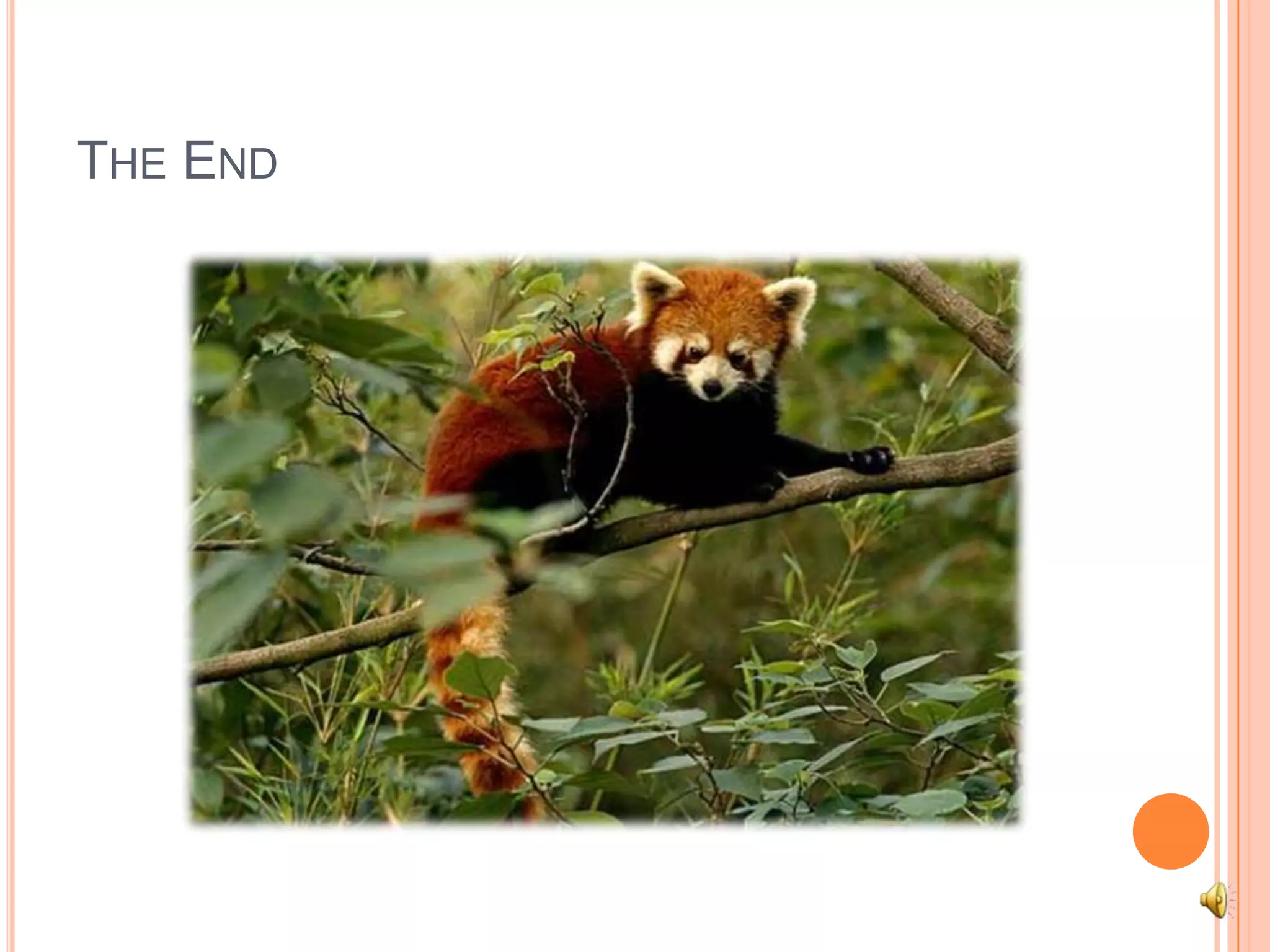
The End

Unit One Classification Project (Simplified 3 Minute Version)

  • 1.
    Unit One ClassificationProjectBy Jennifer Tu 10C
  • 2.
    Definition of ClassificationClassificationis the arrangement of organisms based on similar characteristics and relationships.
  • 4.
    Why We NeedClassification?Personal safetyQuarantineForensicsAgriculture and HorticultureMedicineConservation and Protection
  • 5.
    What are scientificnames?Scientific names are the names that taxonomists use to categorise and classify organisms. Ailurusfulgens= Red PandaScientific Name Common Name
  • 6.
    There are disadvantageswithusing common names
  • 7.
    1) There maybe many common names given to one speciesSmall pandaBear CatCokoloacaPigaraThokyaGambawarellaLesser pandaBright PandaWokerHimalayan RaccoonCrimson NgoRed CatCommon PandaWokdonkaPanda ChicoFox BearPetit PandaWahYeFire PandaPoonyaRed PandaPanda ÉclatantRed FoxFire FoxPanda RojoNigalyaPonyaSankam
  • 8.
    2)Vary from Languageto LanguagePanda Eclatant (French)Panda Chico (Spanish)
  • 9.
    3) Can bemisleadingFoxBear
  • 10.
    4) Scientific namesshow RelativenessAilurusfulgens= Red Panda
  • 11.
    5) Scientific Namesare recognised Universally by all biologists
  • 12.
    Biological Classificationphylogeny (classificationbased on genetic relativeness between organisms)taxonomy (structural and physical connections between organisms)evolution (relating organisms to ancestral species)
  • 13.
    Main categories ofClassificationDomainKingdomPhylumClassOrderFamilyGenusSpecies
  • 14.
  • 15.
    Domain-Eukaryacontains RNA ofthe EukaryaHave eukaryotic cells
  • 16.
  • 17.
    Phylum-ChordataCharacteristics shared bychordates include a notochord, bilateral symmetry, ventral heart, complete digestive system and closed circulatory system.
  • 18.
    Class-MammalianAll mammals havethree middle ear bones, hair, a diaphragm, large cerebral cortex, four chambered heart and mammary glands.Four chambered heart
  • 19.
    Order-CarnivoraAlthough the redpanda lives on a herbivorous dietretractile clawsrobust cranial-dental features.Retractile ClawsCranial dental features
  • 20.
    Family-Ailuridaeshare a combinationof genes similar to that of skunks, weasels and raccoons.
  • 21.
    Genus-AilurusAll genus andspecies names are words from Latin or Greek. Ailurus is the Latinized form of the Greek word αίλουρος (ailouros), meaning “cat.”
  • 22.
    Species-AilurusFulgensfirst part ofscientific name: genussecond part of scientific name: specific name scientific name for the red panda is Ailurusfulgens.
  • 23.
    Why Taxonomic Systemscan changeadvances in new DNA technologywith DNA technology, scientists have discovered new relationships between organismsTherefore they are finding new ways of grouping organisms.
  • 24.
    Red Panda Enigmacentreof a controversial taxonomic enigma.originally placed in the Procyonidae family due to similar characteristics. Later, tests showed similarities of DNA with the Ursidae family, thus they were placed in this family. But with DNA hybridization, their classification was changed.
  • 25.
    DNA hybridisationis atechnique that measures the degree of genetic distance between two different pools of DNA sequences.
  • 26.
    Species A DNASpeciesB DNAHeat AppliedDNA mixed and incubatedDNA sequences that are similar will bind more firmly and require more energy to separate them.
  • 27.
    DNA Hybridisation andRed PandaRed Panda: Ailuridae FamilyGiant Panda: Ursidae Family
  • 28.
    BibliographyBiology-online.org 2009, ‘Classification’,Biology-online.org, http://www.biology-online.org/dictionary/Classification (23 September 2009)Heath, T. & Platnick J. 2008, "Ailurusfulgens" (On-line), Animal Diversity Web http://animaldiversity.ummz.umich.edu/site/accounts/information/Ailurus_fulgens.html. (September 19, 2009)Wikipedia-the free encyclopaedia 2009, ‘Red Panda’, Wikipedia-the free encyclopaedia, 23 September http://en.wikipedia.org/wiki/Red_Panda (22 September 2009)Lioncrusher ‘s Domain- Carnivora Species Information 2009, ‘The Ailuridae Family’, http://www.lioncrusher.com/family.asp?family=Ailuridae (23 September 2009)Wang, X., Choudhry, A., Yonzon, P., Wozencraft, C. & Than Zaw 2008, ‘AilurusFugens’, The IUCN Red List of Endangered Species http://www.iucnredlist.org/details/714/0/full (23 September 2009)
  • 29.
    Bibliography (Continued)Kinnear, J.& Martin, M. 2006, Nature of Biology Book 1 Third Edition, John Wiley & Sons Australia, MiltonSemple, A., Borger P., Cleeland, C., Jackel, S. & Pappas X. 2006, ‘Nelson Biology VCE Units 1&2’, Nelson Australia, South MelbourneEvans, D., Ladiges, P., Mckenzie, J. & Sanders, Y. 2005, ‘Heinemann Biology 1, 4th edition VCE Units 1 & 2’, Heinemann Harcourt Education, Port MelbourneKaiser, G.E. 2007, ‘I.Introduction,’ Doc Kaiser’s Microbiology, 27 February http://student.ccbcmd.edu/courses/bio141/lecguide/unit1/3domain/3domain.html (23 September 2009)Pidwirny, M., 2006, "Biological Classification of Organisms", Fundamentals of Physical Geography, 2nd Edition. http://www.physicalgeography.net/fundamentals/9b.html (23 September 2009)
  • 30.
    Bibliography (Continued)Myers, P.2001, "Chordata", Animal Diversity Web, http://animaldiversity.ummz.umich.edu/site/accounts/information/Chordata.html. (23 September 2009)Myers, P. & Poor, A. 2007, "Carnivora", Animal Diversity Web, http://animaldiversity.ummz.umich.edu/site/accounts/information/Carnivora.html (23 September 2009)Wund, M. & Myers, P.2005, "Mammalia", Animal Diversity Web, http://animaldiversity.ummz.umich.edu/site/accounts/information/Mammalia.html. (accessed 23 September 2009)Heath, T. & Platnic,k J. 2008, "Phylum Chordata" (On-line), Animal Diversity Web http://animaldiversity.ummz.umich.edu/site/accounts/information/Chordata.html. (19 September 2009)Microsoft Encarta Online Encyclopaedia 2009, ‘Classifcation,’ Microsoft Encarta Online Encyclopaedia, http://encarta.msn.com/encyclopedia_761576239/classification.html (20 September 2009)
  • 31.
    Bibliography (Continued)Trek Nature2009, ‘Red Panda,’ Trek Nature, http://www.treknature.com/gallery/photo136997.htm (20 September 2009)Microsoft Encarta 2009, ‘All About Animals,’ http://microsoftencarta-in-english.blogspot.com/2009/01/all-about-animals.html (20 September 2009)Wikipedia-the free encyclopaedia 2009, ‘DNA hybridization, 13 September http://en.wikipedia.org/wiki/DNA-DNA_hybridization (20 September 2009)
  • 32.