

FOX
BY-
SWAYAM PRAKASH NAYAK
TAXONOMICAL CLASSIFICATION
Class-mammalia
Order-carnivora
Family-canidae
Sc. name-vulpes vulpes(common fox)
Conservation status-threatened
Other features-
Body length-40-83 c.m
Weight-11 lbs-24lbs
Top speed-48km/hr
Life span- 3 to 11 yrs
Life style-solitary
Skin type-fur
Fav. Food-rabbit
Habitat-woodland areas,urban parks
Avg litter size-5
Main prey-rabbits,birds & lizards
Predators-human,bears,eagles
Physiological parameters
Rectal temp-102.2 to 104 degree F
Respiratory rate-12 to 60 breaths/min
Heart rate-118 beats/min
Venipuncture-
Jugular vein, cephalic vein, lateral saphenous
vein
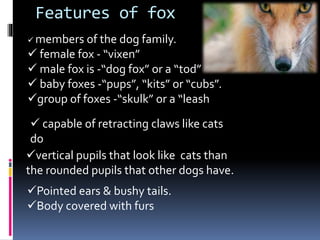
Features of fox
 members of the dog family.
 female fox - “vixen”
 male fox is -“dog fox” or a “tod”
 baby foxes -“pups”, “kits” or “cubs”.
group of foxes -“skulk” or a “leash
 capable of retracting claws like cats
do
vertical pupils that look like cats than
the rounded pupils that other dogs have.
Pointed ears & bushy tails.
Body covered with furs
Foxes can be a pest in the cities
 can identify each other's voices, just like humans.
The red fox has 28 different sounds use to
communicate.
vocalizations include yips, growls and howls
excellent hearing.
 can hear low-frequency sounds and rodents digging
underground.
In folklore- characterized as cunning creatures
sometimes having magical powers
Grey foxes Of in North America -only type climbe trees
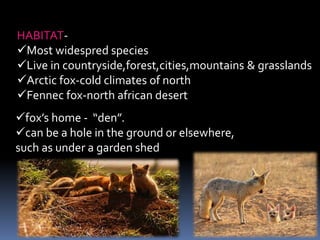
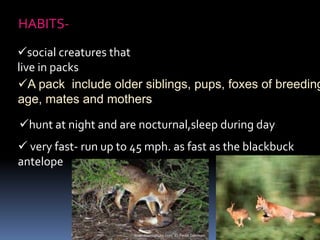
HABITAT-
Most widespred species
Live in countryside,forest,cities,mountains & grasslands
Arctic fox-cold climates of north
Fennec fox-north african desert
fox’s home - “den”.
can be a hole in the ground or elsewhere,
such as under a garden shed
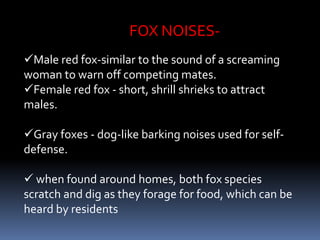
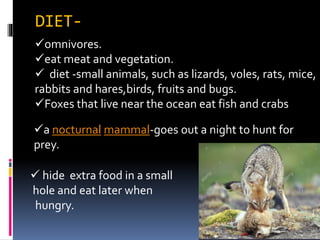
HABITS-
social creatures that
live in packs
A pack include older siblings, pups, foxes of breeding
age, mates and mothers.
hunt at night and are nocturnal,sleep during day
 very fast- run up to 45 mph. as fast as the blackbuck
antelope
FOX NOISES-
Male red fox-similar to the sound of a screaming
woman to warn off competing mates.
Female red fox - short, shrill shrieks to attract
males.
Gray foxes - dog-like barking noises used for self-
defense.
 when found around homes, both fox species
scratch and dig as they forage for food, which can be
heard by residents
omnivores.
eat meat and vegetation.
 diet -small animals, such as lizards, voles, rats, mice,
rabbits and hares,birds, fruits and bugs.
Foxes that live near the ocean eat fish and crabs
DIET-
a nocturnal mammal-goes out a night to hunt for
prey.
 hide extra food in a small
hole and eat later when
hungry.
Haematological parametres
•RBC- 8-9X10⁶uL
•Hb- 15.5gdl
•PCV- 48%
•WBC- 8-10X 103uL
•NEUTROPHILLS-60%
•EOSINOPHILLS-11%
•BASOPHILLS- 0
•LYMPHOCYTES-20%
•MONOCYTES-9%
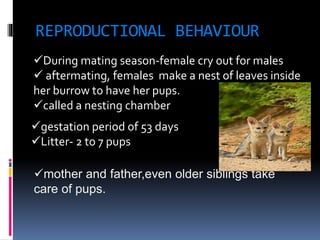
REPRODUCTIONAL BEHAVIOUR
During mating season-female cry out for males
 aftermating, females make a nest of leaves inside
her burrow to have her pups.
called a nesting chamber
gestation period of 53 days
Litter- 2 to 7 pups
mother and father,even older siblings take
care of pups.
TYPES OF FOXES-
7 of the most beautiful fox species found around the
world
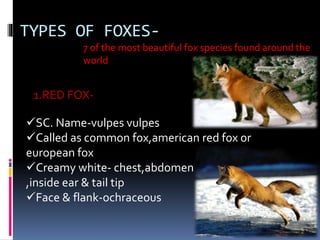
1.RED FOX-
SC. Name-vulpes vulpes
Called as common fox,american red fox or
european fox
Creamy white- chest,abdomen
,inside ear & tail tip
Face & flank-ochraceous
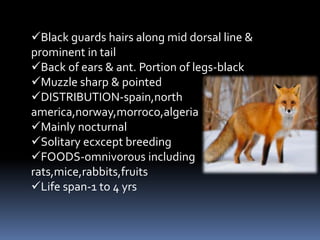
Black guards hairs along mid dorsal line &
prominent in tail
Back of ears & ant. Portion of legs-black
Muzzle sharp & pointed
DISTRIBUTION-spain,north
america,norway,morroco,algeria
Mainly nocturnal
Solitary ecxcept breeding
FOODS-omnivorous including
rats,mice,rabbits,fruits
Life span-1 to 4 yrs
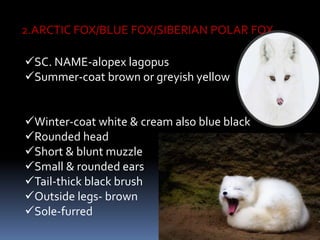
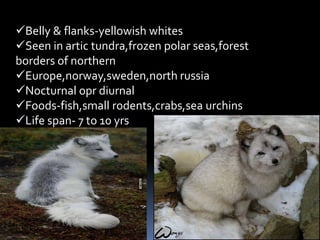
2.ARCTIC FOX/BLUE FOX/SIBERIAN POLAR FOX-
SC. NAME-alopex lagopus
Summer-coat brown or greyish yellow
Winter-coat white & cream also blue black
Rounded head
Short & blunt muzzle
Small & rounded ears
Tail-thick black brush
Outside legs- brown
Sole-furred
Belly & flanks-yellowish whites
Seen in artic tundra,frozen polar seas,forest
borders of northern
Europe,norway,sweden,north russia
Nocturnal opr diurnal
Foods-fish,small rodents,crabs,sea urchins
Life span- 7 to 10 yrs
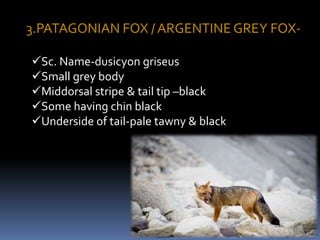
3.PATAGONIAN FOX / ARGENTINE GREY FOX-
Sc. Name-dusicyon griseus
Small grey body
Middorsal stripe & tail tip –black
Some having chin black
Underside of tail-pale tawny & black
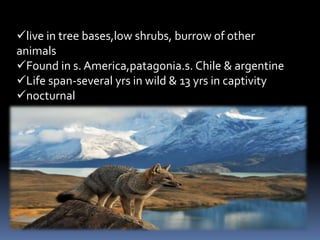
live in tree bases,low shrubs, burrow of other
animals
Found in s. America,patagonia.s. Chile & argentine
Life span-several yrs in wild & 13 yrs in captivity
nocturnal
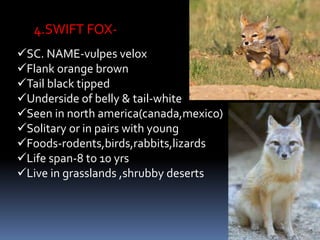
4.SWIFT FOX-
SC. NAME-vulpes velox
Flank orange brown
Tail black tipped
Underside of belly & tail-white
Seen in north america(canada,mexico)
Solitary or in pairs with young
Foods-rodents,birds,rabbits,lizards
Life span-8 to 10 yrs
Live in grasslands ,shrubby deserts
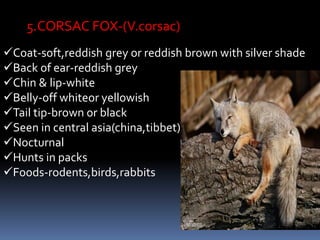
5.CORSAC FOX-(V.corsac)
Coat-soft,reddish grey or reddish brown with silver shade
Back of ear-reddish grey
Chin & lip-white
Belly-off whiteor yellowish
Tail tip-brown or black
Seen in central asia(china,tibbet)
Nocturnal
Hunts in packs
Foods-rodents,birds,rabbits
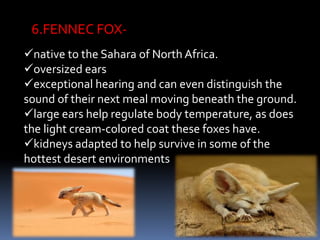
6.FENNEC FOX-
native to the Sahara of North Africa.
oversized ears
exceptional hearing and can even distinguish the
sound of their next meal moving beneath the ground.
large ears help regulate body temperature, as does
the light cream-colored coat these foxes have.
kidneys adapted to help survive in some of the
hottest desert environments
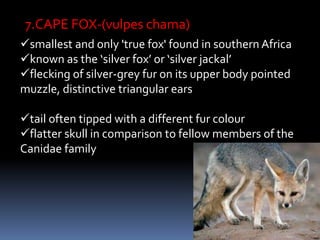
7.CAPE FOX-(vulpes chama)
smallest and only 'true fox' found in southern Africa
known as the ‘silver fox’ or ‘silver jackal’
flecking of silver-grey fur on its upper body pointed
muzzle, distinctive triangular ears
tail often tipped with a different fur colour
flatter skull in comparison to fellow members of the
Canidae family
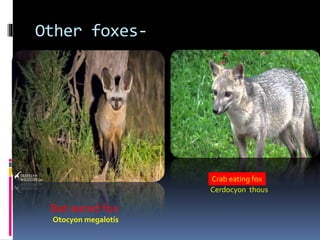
Other foxes-
Bat eared fox
Otocyon megalotis
Crab eating fox
Cerdocyon thous
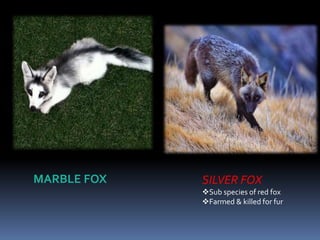
MARBLE FOX SILVER FOX
Sub species of red fox
Farmed & killed for fur
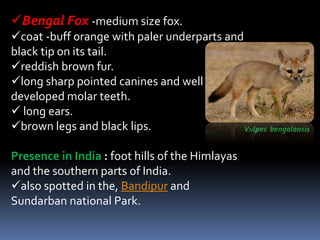
Bengal Fox -medium size fox.
coat -buff orange with paler underparts and
black tip on its tail.
reddish brown fur.
long sharp pointed canines and well
developed molar teeth.
 long ears.
brown legs and black lips.
Presence in India : foot hills of the Himlayas
and the southern parts of India.
also spotted in the, Bandipur and
Sundarban national Park.
Vulpes bengalensis
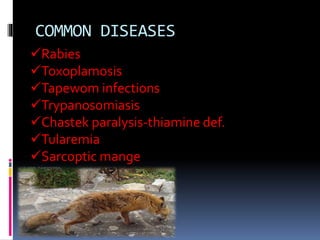
COMMON DISEASES
Rabies
Toxoplamosis
Tapewom infections
Trypanosomiasis
Chastek paralysis-thiamine def.
Tularemia
Sarcoptic mange
Fox

Fox

  • 1.
  • 2.
  • 3.
    Other features- Body length-40-83c.m Weight-11 lbs-24lbs Top speed-48km/hr Life span- 3 to 11 yrs Life style-solitary Skin type-fur Fav. Food-rabbit Habitat-woodland areas,urban parks Avg litter size-5 Main prey-rabbits,birds & lizards Predators-human,bears,eagles
  • 4.
    Physiological parameters Rectal temp-102.2to 104 degree F Respiratory rate-12 to 60 breaths/min Heart rate-118 beats/min Venipuncture- Jugular vein, cephalic vein, lateral saphenous vein
  • 5.
    Features of fox members of the dog family.  female fox - “vixen”  male fox is -“dog fox” or a “tod”  baby foxes -“pups”, “kits” or “cubs”. group of foxes -“skulk” or a “leash  capable of retracting claws like cats do vertical pupils that look like cats than the rounded pupils that other dogs have. Pointed ears & bushy tails. Body covered with furs
  • 6.
    Foxes can bea pest in the cities  can identify each other's voices, just like humans. The red fox has 28 different sounds use to communicate. vocalizations include yips, growls and howls excellent hearing.  can hear low-frequency sounds and rodents digging underground. In folklore- characterized as cunning creatures sometimes having magical powers Grey foxes Of in North America -only type climbe trees
  • 7.
    HABITAT- Most widespred species Livein countryside,forest,cities,mountains & grasslands Arctic fox-cold climates of north Fennec fox-north african desert fox’s home - “den”. can be a hole in the ground or elsewhere, such as under a garden shed
  • 8.
    HABITS- social creatures that livein packs A pack include older siblings, pups, foxes of breeding age, mates and mothers. hunt at night and are nocturnal,sleep during day  very fast- run up to 45 mph. as fast as the blackbuck antelope
  • 9.
    FOX NOISES- Male redfox-similar to the sound of a screaming woman to warn off competing mates. Female red fox - short, shrill shrieks to attract males. Gray foxes - dog-like barking noises used for self- defense.  when found around homes, both fox species scratch and dig as they forage for food, which can be heard by residents
  • 10.
    omnivores. eat meat andvegetation.  diet -small animals, such as lizards, voles, rats, mice, rabbits and hares,birds, fruits and bugs. Foxes that live near the ocean eat fish and crabs DIET- a nocturnal mammal-goes out a night to hunt for prey.  hide extra food in a small hole and eat later when hungry.
  • 11.
    Haematological parametres •RBC- 8-9X10⁶uL •Hb-15.5gdl •PCV- 48% •WBC- 8-10X 103uL •NEUTROPHILLS-60% •EOSINOPHILLS-11% •BASOPHILLS- 0 •LYMPHOCYTES-20% •MONOCYTES-9%
  • 12.
    REPRODUCTIONAL BEHAVIOUR During matingseason-female cry out for males  aftermating, females make a nest of leaves inside her burrow to have her pups. called a nesting chamber gestation period of 53 days Litter- 2 to 7 pups mother and father,even older siblings take care of pups.
  • 13.
    TYPES OF FOXES- 7of the most beautiful fox species found around the world 1.RED FOX- SC. Name-vulpes vulpes Called as common fox,american red fox or european fox Creamy white- chest,abdomen ,inside ear & tail tip Face & flank-ochraceous
  • 14.
    Black guards hairsalong mid dorsal line & prominent in tail Back of ears & ant. Portion of legs-black Muzzle sharp & pointed DISTRIBUTION-spain,north america,norway,morroco,algeria Mainly nocturnal Solitary ecxcept breeding FOODS-omnivorous including rats,mice,rabbits,fruits Life span-1 to 4 yrs
  • 15.
    2.ARCTIC FOX/BLUE FOX/SIBERIANPOLAR FOX- SC. NAME-alopex lagopus Summer-coat brown or greyish yellow Winter-coat white & cream also blue black Rounded head Short & blunt muzzle Small & rounded ears Tail-thick black brush Outside legs- brown Sole-furred
  • 16.
    Belly & flanks-yellowishwhites Seen in artic tundra,frozen polar seas,forest borders of northern Europe,norway,sweden,north russia Nocturnal opr diurnal Foods-fish,small rodents,crabs,sea urchins Life span- 7 to 10 yrs
  • 17.
    3.PATAGONIAN FOX /ARGENTINE GREY FOX- Sc. Name-dusicyon griseus Small grey body Middorsal stripe & tail tip –black Some having chin black Underside of tail-pale tawny & black
  • 18.
    live in treebases,low shrubs, burrow of other animals Found in s. America,patagonia.s. Chile & argentine Life span-several yrs in wild & 13 yrs in captivity nocturnal
  • 19.
    4.SWIFT FOX- SC. NAME-vulpesvelox Flank orange brown Tail black tipped Underside of belly & tail-white Seen in north america(canada,mexico) Solitary or in pairs with young Foods-rodents,birds,rabbits,lizards Life span-8 to 10 yrs Live in grasslands ,shrubby deserts
  • 20.
    5.CORSAC FOX-(V.corsac) Coat-soft,reddish greyor reddish brown with silver shade Back of ear-reddish grey Chin & lip-white Belly-off whiteor yellowish Tail tip-brown or black Seen in central asia(china,tibbet) Nocturnal Hunts in packs Foods-rodents,birds,rabbits
  • 21.
    6.FENNEC FOX- native tothe Sahara of North Africa. oversized ears exceptional hearing and can even distinguish the sound of their next meal moving beneath the ground. large ears help regulate body temperature, as does the light cream-colored coat these foxes have. kidneys adapted to help survive in some of the hottest desert environments
  • 22.
    7.CAPE FOX-(vulpes chama) smallestand only 'true fox' found in southern Africa known as the ‘silver fox’ or ‘silver jackal’ flecking of silver-grey fur on its upper body pointed muzzle, distinctive triangular ears tail often tipped with a different fur colour flatter skull in comparison to fellow members of the Canidae family
  • 23.
    Other foxes- Bat earedfox Otocyon megalotis Crab eating fox Cerdocyon thous
  • 24.
    MARBLE FOX SILVERFOX Sub species of red fox Farmed & killed for fur
  • 25.
    Bengal Fox -mediumsize fox. coat -buff orange with paler underparts and black tip on its tail. reddish brown fur. long sharp pointed canines and well developed molar teeth.  long ears. brown legs and black lips. Presence in India : foot hills of the Himlayas and the southern parts of India. also spotted in the, Bandipur and Sundarban national Park. Vulpes bengalensis
  • 26.