IB Biology Chapter 5 Notes: Classification (5.3) NAME:
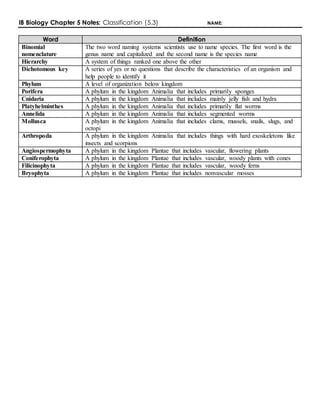
Word Definition
Binomial
nomenclature
The two word naming systems scientists use to name species. The first word is the
genus name and capitalized and the second name is the species name
Hierarchy A system of things ranked one above the other
Dichotomous key A series of yes or no questions that describe the characteristics of an organism and
help people to identify it
Phylum A level of organization below kingdom
Porifera A phylum in the kingdom Animalia that includes primarily sponges
Cnidaria A phylum in the kingdom Animalia that includes mainly jelly fish and hydra
Platyhelminthes A phylum in the kingdom Animalia that includes primarily flat worms
Annelida A phylum in the kingdom Animalia that includes segmented worms
Mollusca A phylum in the kingdom Animalia that includes clams, mussels, snails, slugs, and
octopi
Arthropoda A phylum in the kingdom Animalia that includes things with hard exoskeletons like
insects and scorpions
Angiospermophyta A phylum in the kingdom Plantae that includes vascular, flowering plants
Coniferophyta A phylum in the kingdom Plantae that includes vascular, woody plants with cones
Filicinophyta A phylum in the kingdom Plantae that includes vascular, woody ferns
Bryophyta A phylum in the kingdom Plantae that includes nonvascular mosses
5.3.1 The binomial system
of names for species is
universal among biologists
and has been agreed and
developed at a series of
congresses.
5.3.2 When species are
discovered they are given
scientific names using the
binomial system.
5.3.3 Taxonomists classify
species using a hierarchy of
taxa.
5.3.4 All organisms are
classified into three
domains.
5.3.5 The principal taxa for
classifying eukaryotes are
kingdom, phylum, class,
order, family, genus,and
species.
5.3.9 Classification of one
plant and one animal
species from domain to
species level.
5.3.6 In natural
classification the genus and
accompanying higher taxa
consist of all the species
that have evolved from one
common ancestral species.
5.3.7 Taxonomists
sometimes reclassify
groups of species when
new evidence shows that a
previous taxon contains
species that have evolved
from different ancestral
species.
Who first introduced the biological classification systemwith two-part names?
Explain why it is important for biologists to agree on a common naming system:
Outline how a species is named using binomial nomenclature:
State the three domains:
Describe members of the Archaea domain:
Are viruses classified? Why or why not?
List the primary taxa, in order:
State the four eukaryotic kingdoms (prokaryotes are in kingdom Monera):
Taxon Grey Wolf Date palm
Kingdom State the scientific name
Phylum for the Grey Wolf:
Class
Order
Family State the scientific name
Genus for the Date Palm:
Species
Differentiate between “natural” and “unnatural” classification:
5.3.8 Classifications help in
identification of species and
allow the prediction of
characteristics shared by
species within a group.
5.3.13 Construct
dichotomous keys for use
in identifying specimens.
5.3.10 External recognition
features of bryophytes,
filicinophytes,
coniferophytes,and
angiospermophytes.
5.3.11 Recognition of
features of porifera,
cnidaria, platyhelminthes,
annelida, mollusca,
arthropoda,and chordata.
5.3.12 Recognition of
features of birds, mammals,
amphibians, reptiles, and
fish.
Outline the advantages ofnatural classification:
Describe a dichotomous key and its function:
Bryophytes:
Filicinophytes:
Coniferophytes:
Angiospermophytes:
Porifera:
Cnidaria:
Platyhelminthes:
Mollusca:
Annelida:
Arthropoda:
Fish:
Amphibians:
Reptiles:
Birds:
Mammals:

5.3 Notes

  • 1.
    IB Biology Chapter5 Notes: Classification (5.3) NAME: Word Definition Binomial nomenclature The two word naming systems scientists use to name species. The first word is the genus name and capitalized and the second name is the species name Hierarchy A system of things ranked one above the other Dichotomous key A series of yes or no questions that describe the characteristics of an organism and help people to identify it Phylum A level of organization below kingdom Porifera A phylum in the kingdom Animalia that includes primarily sponges Cnidaria A phylum in the kingdom Animalia that includes mainly jelly fish and hydra Platyhelminthes A phylum in the kingdom Animalia that includes primarily flat worms Annelida A phylum in the kingdom Animalia that includes segmented worms Mollusca A phylum in the kingdom Animalia that includes clams, mussels, snails, slugs, and octopi Arthropoda A phylum in the kingdom Animalia that includes things with hard exoskeletons like insects and scorpions Angiospermophyta A phylum in the kingdom Plantae that includes vascular, flowering plants Coniferophyta A phylum in the kingdom Plantae that includes vascular, woody plants with cones Filicinophyta A phylum in the kingdom Plantae that includes vascular, woody ferns Bryophyta A phylum in the kingdom Plantae that includes nonvascular mosses
  • 2.
    5.3.1 The binomialsystem of names for species is universal among biologists and has been agreed and developed at a series of congresses. 5.3.2 When species are discovered they are given scientific names using the binomial system. 5.3.3 Taxonomists classify species using a hierarchy of taxa. 5.3.4 All organisms are classified into three domains. 5.3.5 The principal taxa for classifying eukaryotes are kingdom, phylum, class, order, family, genus,and species. 5.3.9 Classification of one plant and one animal species from domain to species level. 5.3.6 In natural classification the genus and accompanying higher taxa consist of all the species that have evolved from one common ancestral species. 5.3.7 Taxonomists sometimes reclassify groups of species when new evidence shows that a previous taxon contains species that have evolved from different ancestral species. Who first introduced the biological classification systemwith two-part names? Explain why it is important for biologists to agree on a common naming system: Outline how a species is named using binomial nomenclature: State the three domains: Describe members of the Archaea domain: Are viruses classified? Why or why not? List the primary taxa, in order: State the four eukaryotic kingdoms (prokaryotes are in kingdom Monera): Taxon Grey Wolf Date palm Kingdom State the scientific name Phylum for the Grey Wolf: Class Order Family State the scientific name Genus for the Date Palm: Species Differentiate between “natural” and “unnatural” classification:
  • 3.
    5.3.8 Classifications helpin identification of species and allow the prediction of characteristics shared by species within a group. 5.3.13 Construct dichotomous keys for use in identifying specimens. 5.3.10 External recognition features of bryophytes, filicinophytes, coniferophytes,and angiospermophytes. 5.3.11 Recognition of features of porifera, cnidaria, platyhelminthes, annelida, mollusca, arthropoda,and chordata. 5.3.12 Recognition of features of birds, mammals, amphibians, reptiles, and fish. Outline the advantages ofnatural classification: Describe a dichotomous key and its function: Bryophytes: Filicinophytes: Coniferophytes: Angiospermophytes: Porifera: Cnidaria: Platyhelminthes: Mollusca: Annelida: Arthropoda: Fish: Amphibians: Reptiles: Birds: Mammals: