Unit C
Heat & Temperature
What is Heat?
After experimentation in the 1600's, a caloric theory was
developed
Caloric: a self-repellent fluid that flows from hotter
bodies to colder bodies
What is the problem?
Heat does not change the mass of an object
What is Heat?
Heat is not a substance
Heat: a form of energy that flows from hot (more
energy) to cold (less energy)
Kinetic & Thermal Energy
Kinetic Energy: energy of movement (specifically
movement of particles)
Kinetic & Thermal Energy
Thermal Energy: total kinetic energy of the particles in a
substance (Total Kinetic energy)
The soup in the bowl and the soup in the spoon have the
same temperature (same average KE.) BUT the bowl has more
thermal energy
What is Temperature?
Temperature: The measurement of how hot or cold
something is. (The average kinetic energy of the
particles)
What is Temperature?
Handy Thermometer
What is Temperature?
Answer these on your lined paper
1. What do you think the temperature of each
bucket is?
2. What happened when you switched your hands
from the ice one and hot one?
What is Temperature?
What makes a good thermometer?
• Reliable
• Consistent
• Accurate
• Readable
• Etc.
Thermometer: An instrument for measuring
temperature (Accurately)
Heating Technology
Heating Technology
Furnaces and Air conditioners are examples
of technologies we use.
Heating Technology Timeline
7000 BC or earlier:
Humans Created Fire
100 BC: Romans
developed central heating
(heat travels from 1
source to different areas
in a building)
Heating Technology Timeline
1200: Chimneys first
appear in Europe
1300: Fireplaces with
chimneys are built into
the walls of buildings
Heating Technology Timeline
1700s: Cast-iron stoves
are used to heat rooms
Late 1700s: Central
Heating reappears using
coal
Heating Technology Timeline
1800s: forced-air heating
1906: Electric heaters
Needs vs Wants
Needs: are things we must have to stay alive (food, water, air)
Wants: are things we would like to have (I-pods, cell phones,
TV’s)
In Canada we have some heat technology NEEDS.
Needs vs Wants
Standard of Living: A measure of how well
we live, including the level of technology that
we use in our daily lives
Heating Technology Timeline
Think about
microwaves!
What others can you
think of?
Controlling Heat
Why do we need to control heat?
Example: A furnace and a thermostat.
A furnace generates and transfers the heat from one area to
another.
A thermostat allows us to control and monitor that heat. If
it is too hot, we turn the thermostat down. If it is too cold,
we turn the thermostat up.
Sustainable
vs
Non-Sustainable
Sustainable
Sustainable: means something can be maintained or
used again and again
Examples of Sustainable Resources:
• Wind
• Water
• Wood
Non-Sustainable
Non-Sustainable: means something can NOT be
maintained or used again and again
Examples of Non-Sustainable Resources:
• Coal
• Oil
• Gas
Sustainable or Non-Sustainable
What about the sun?
Particle Model of
Matter (PMOM)
What is matter?
• Matter: The stuff that makes up the universe that is
not energy
• Matter:
1. Has mass
2. Takes up space
States of Matter
States of Matter: distinct forms in which matter can
exist.
Bose-Einstein
Condensate
5
States of Matter
To move between states the matter must gain or lose
heat energy
Bose-Einstein
Condensate
5
The Particle Model of Matter (PMOM)
1. All matter is made of tiny particles
2. Particles are in constant motion
3. Adding heat to matter makes the particles move faster
4. There are attractive & repulsive forces between particles
5. There are spaces between the particles
6. (Different matter is made of different particles)
Solid
Solid:
• Particles are very close together
• Definite shape and volume
(Volume: the amount of space the matter occupies)
Liquid
Liquid:
• Particles are loosely attached to each other
• Take the shape of its container
• Has definite volume
Gas
Gas:
• Particles are not connected
• Has no definite shape
• Has no definite volume
Solid Liquid Gas
Motion of
Particles
Space between
particles
Behaviour in a
container
LOW Medium HIGH
Not affected
by the
container
Takes shape
of the
container
Fills the
container
Changing Between
States of Matter
The Effect of Heat
Heating particles adds energy to them. This energy is
in the form of movement. We call this kinetic energy.
Therefore, to change the state of matter, you
must change its kinetic energy.
When particles gain kinetic energy (heat) they
move faster. Because of this, they take up more space.
The Effect of Heat
Phase Change: When matter goes from one state (solid,
liquid, gas) to another.
Melting: Going from a solid to a liquid when heat is added
Boiling: Going from a liquid to a gas when heat is added
Condensation: Going from a gas to a liquid when heat is
removed
Freezing: Going from a liquid to a solid when heat is removed
Sublimation: Going from a solid to a gas when heat is added
Deposition: Going from a gas to a solid when heat is removed
Changes Between States of Matter
Melting: Going from a solid to a liquid when heat is added
Boiling: Going from a liquid to a gas when heat is added
Condensation: Going from a gas to a liquid when heat is
removed
Freezing: Going from a liquid to a solid when heat is removed
Sublimation: Going from a solid to a gas when heat is added
Deposition: Going from a gas to a solid when heat is removed
How Heat Affects
Volume
How Heat Affects Volume
• Volume: How much space something takes up
• The volume of matter can be changed with heat energy.
• Adding energy -> particles move faster -> have more collisions -> take up
more space.
• Losing energy -> particles slow down -> have less collisions -> take up less
space.
How Heat Affects Volume
• Therefore: the more collisions, the more space that is required!
How does that explain how a hot air balloon works?
Expansion vs Contraction
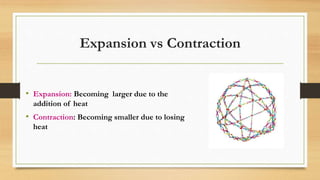
• Expansion: Becoming larger due to the
addition of heat
• Contraction: Becoming smaller due to losing
heat
Expansion vs Contraction
• Adding thermal energy to a solid
will increase its volume.
• So...
• When a solid heats up it expands.
(exits away)
• When a solid cools down it
contracts. (comes together)
Expansion vs Contraction
• Liquids: Look at a thermometer. The
liquid expands when it gets warm and
contracts when it gets cold.
• Gases: Think of a helium balloon, once
it cools down, it begins to fall closer to
the group and the balloon looks
smaller.
Expansion vs Contraction
• There is an Exception!
• Can you think of one substance that expands as it get colder?
Expansion vs Contraction
• H2O or water is one of the only
substances that the solid form
has a greater volume than
the liquid form.
• This is why Ice floats and we get
potholes!
Conduction
What is better for cooking?
• Metal or Wood?
• The wood spoon would be better, because the metal spoon could get hot and burn
you!
• This means that metal conducts heat better than wood.
Heat Heat
Conduction
• Conduction: the transfer of heat energy between
substances that are in contact
Conduction
• This happens like a chain reaction. The heat travels from particle to
particle, through the substance. Even a solid
Conduction
• Conductors: Materials that allow for
easy transfer of heat
• Insulators: Materials that do not
transfer heat easily
Insulators are essential when dealing
with large amounts of heat
Conduction
Name some insulators you see every day!
• Wood,
• Rubber (Cooking tools, hot water bottle)
• House
• Clothing
• Plastic
• Thermos
Convection
Convection
• Convection: Heat travelling through gases and liquids since they flow.
Heat is transported by the motion of particles.
• Hot particles rise up through the substance, and cooler particles move
in to take their place near their bottom.
Convection
Convection
• Convection Current: The
circular pattern caused by the
moving particles during
convection.
• The heat moves from high-
energy to low-energy
Radiation
Radiation
• Radiation: Transfers heat through infrared
waves (same as light waves)
• Radiation is the only energy transfer that does
not rely on particle movement
• Radiant Energy: Energy carried through
radiation
Radiation
• What is our greatest source of radiant energy?
• THE SUN
• Heat from the sun cannot reach us by conduction or convection
Radiation
• The texture and color of objects can
affect how well they absorb radiation
• Dark materials absorb radiation better
than light materials
• Rough/dull textures absorb radiation
better than smooth or shiny materials
• Think of Foil!
All 3 Types of Heat Transfer
Natural Ways to
Produce
Thermal Energy
Natural Ways to Produce Thermal Energy
• Sun
• Radiant energy heats the surface
of the earth
• Geothermal Energy
• It’s very hot deep inside of the Earth and it’s
possible to obtain some of this energy
Natural Ways to Produce Thermal Energy
• Fire
• Fire Convert chemical energy into
thermal energy
• Decay
• When organic material decays, it lets off heat
Natural Ways to Produce Thermal Energy
• Solar energy is the most simple
natural resources to harvest. Many
homes are now being built with
active or passive solar heating.
• But experts disagree as to whether
or not solar energy is enough to fuel
our demands.
Passive vs Active
Heating
Passive Solar Heating
• "Reduce heat loss and increase heat gain from
the sun."
• Uses materials in the structure to absorb, store,
and release solar energy. Examples: insulating as
much as possible, having large south-facing
windows, putting deciduous trees in front of
windows to reduce heat gain in the summer but
allow heat gain in the winter.
Active Solar Heating
• Uses mechanical devices to
distribute stored thermal energy.
Has three components: a
collector, a heat storage unit, and
a heat distribution system.
Solar Energy
• https://www.youtube.com/watch?v
=4uPVZUTLAvA
Heating Systems
Thermostats
• "Thermo" = heat "stat" = maintain or keep the
same
• In order to control or regulate the temperature of
a room or house, we need a thermostat.
Thermostats
• When heated, one metal expands
faster than the other, causing it to
bend.
• The bending is used to measure
temperature change.
• When the strip bends/unbends,
it opens/closes an electric circuit
that controls the device.
Bimetallic Strip
Local vs Central Heating Systems
• Thermostats can control two different heating systems:
• Local Heating System Central Heating System
Local Heating Systems
• -Provide heat for one room or
small area.
• -Relies on convection to
transport the heat.
• -Ex. Fireplaces, wood-
burning stoves, space heaters,
etc
Central Heating Systems
• -Heat is gathered in one area, then
transported throughout the
building/system.
• -Transfer is through vents, pipes,
ducts, etc.
• - Two kinds of central heating
systems are through forced-air
heating or hot-water heating.
Forced Air Heating
• Air is heated in a furnace.
• Air travels through ducts and into
other rooms.
• Convection transports heat once
it exits ducts
Hot Water Heating
• Water is heated in a furnace/boiler.
• Pumps push water through radiators
in the house.
• Hot air travels from the radiator
through convection.
• Cold water returns to the boiler.
Heating Efficiency
Insulation
• Controlling indoor temperature is very
important in Alberta. In the winter, it's
important to keep the hot air inside.
During the summer, you would like to
keep the warm air outside. This is
achieved with insulation!
• Insulators Reduce Heat Transfer
Insulation
• Some objects are better insulators
than others.
• The insulating property of an object
is called the thermal conductivity,
and this is recorded as the R-Value.
The higher the R-Value, the better
the insulation.
Insulation
• Brick walls, styrofoam and fiberglass are examples of good insulators.
• Doors and windows can be designed to be good insulators.
Where is most heat lost in a home?
Efficiency
• Efficiency: How well a device uses the energy that goes into it. If energy is
made that isn't useful for the desired job then it is inefficient
Efficiency
Sources of Heat
Renewable vs. Non-renewable
• Renewable: Natural
resources that can be
replaced.
• Non-renewable:
Resources that cannot
be replaced.
Fossil Fuels
• Fossil Fuels:
• Non-renewable
• Source of almost all of the world's
heating/electricity.
• Made from remains of plants and animals
that died millions of years ago.
Fossil Fuels
• Economic Cost: Cost to obtain fuel. Cost
increases as supplies decrease.
• Environmental Cost: Effect on environment.
Main effect is air pollution.
• Societal Cost: Effect on people. Air pollution
leads to health risks, increases medical costs...
Alternatives to Fossil Fuels
• Wind Energy:
• -Captured by windmills
• -Inexpensive and simple
• -Only works in windy regions
Alternatives to Fossil Fuels
• Nuclear Energy:
• -Uses uranium to make heat
• -Takes only a small amount of fuel
• -Non-renewable
• -Waste is very harmful (radioactive waste
takes 100's or 1000's of years to disappear)
Alternatives to Fossil Fuels
• Hydro-Electric:
• -Captured energy of falling water
• -Clean and renewable
• -Expensive to build
Alternatives to Fossil Fuels
• Cogeneration:
• -Waste heat energy is recycled to
produce steam.
• - Expensive

Unit c heattemperaturenotes

  • 1.
    Unit C Heat &Temperature
  • 2.
    What is Heat? Afterexperimentation in the 1600's, a caloric theory was developed Caloric: a self-repellent fluid that flows from hotter bodies to colder bodies What is the problem? Heat does not change the mass of an object
  • 3.
    What is Heat? Heatis not a substance Heat: a form of energy that flows from hot (more energy) to cold (less energy)
  • 4.
    Kinetic & ThermalEnergy Kinetic Energy: energy of movement (specifically movement of particles)
  • 5.
    Kinetic & ThermalEnergy Thermal Energy: total kinetic energy of the particles in a substance (Total Kinetic energy) The soup in the bowl and the soup in the spoon have the same temperature (same average KE.) BUT the bowl has more thermal energy
  • 6.
    What is Temperature? Temperature:The measurement of how hot or cold something is. (The average kinetic energy of the particles)
  • 7.
  • 8.
    What is Temperature? Answerthese on your lined paper 1. What do you think the temperature of each bucket is? 2. What happened when you switched your hands from the ice one and hot one?
  • 9.
    What is Temperature? Whatmakes a good thermometer? • Reliable • Consistent • Accurate • Readable • Etc. Thermometer: An instrument for measuring temperature (Accurately)
  • 10.
  • 11.
    Heating Technology Furnaces andAir conditioners are examples of technologies we use.
  • 12.
    Heating Technology Timeline 7000BC or earlier: Humans Created Fire 100 BC: Romans developed central heating (heat travels from 1 source to different areas in a building)
  • 13.
    Heating Technology Timeline 1200:Chimneys first appear in Europe 1300: Fireplaces with chimneys are built into the walls of buildings
  • 14.
    Heating Technology Timeline 1700s:Cast-iron stoves are used to heat rooms Late 1700s: Central Heating reappears using coal
  • 15.
    Heating Technology Timeline 1800s:forced-air heating 1906: Electric heaters
  • 16.
    Needs vs Wants Needs:are things we must have to stay alive (food, water, air) Wants: are things we would like to have (I-pods, cell phones, TV’s) In Canada we have some heat technology NEEDS.
  • 17.
    Needs vs Wants Standardof Living: A measure of how well we live, including the level of technology that we use in our daily lives
  • 18.
    Heating Technology Timeline Thinkabout microwaves! What others can you think of?
  • 19.
    Controlling Heat Why dowe need to control heat? Example: A furnace and a thermostat. A furnace generates and transfers the heat from one area to another. A thermostat allows us to control and monitor that heat. If it is too hot, we turn the thermostat down. If it is too cold, we turn the thermostat up.
  • 20.
  • 21.
    Sustainable Sustainable: means somethingcan be maintained or used again and again Examples of Sustainable Resources: • Wind • Water • Wood
  • 22.
    Non-Sustainable Non-Sustainable: means somethingcan NOT be maintained or used again and again Examples of Non-Sustainable Resources: • Coal • Oil • Gas
  • 23.
  • 24.
  • 25.
    What is matter? •Matter: The stuff that makes up the universe that is not energy • Matter: 1. Has mass 2. Takes up space
  • 26.
    States of Matter Statesof Matter: distinct forms in which matter can exist. Bose-Einstein Condensate 5
  • 27.
    States of Matter Tomove between states the matter must gain or lose heat energy Bose-Einstein Condensate 5
  • 28.
    The Particle Modelof Matter (PMOM) 1. All matter is made of tiny particles 2. Particles are in constant motion 3. Adding heat to matter makes the particles move faster 4. There are attractive & repulsive forces between particles 5. There are spaces between the particles 6. (Different matter is made of different particles)
  • 30.
    Solid Solid: • Particles arevery close together • Definite shape and volume (Volume: the amount of space the matter occupies)
  • 31.
    Liquid Liquid: • Particles areloosely attached to each other • Take the shape of its container • Has definite volume
  • 32.
    Gas Gas: • Particles arenot connected • Has no definite shape • Has no definite volume
  • 33.
    Solid Liquid Gas Motionof Particles Space between particles Behaviour in a container LOW Medium HIGH Not affected by the container Takes shape of the container Fills the container
  • 35.
  • 36.
    The Effect ofHeat Heating particles adds energy to them. This energy is in the form of movement. We call this kinetic energy. Therefore, to change the state of matter, you must change its kinetic energy. When particles gain kinetic energy (heat) they move faster. Because of this, they take up more space.
  • 37.
    The Effect ofHeat Phase Change: When matter goes from one state (solid, liquid, gas) to another.
  • 39.
    Melting: Going froma solid to a liquid when heat is added
  • 40.
    Boiling: Going froma liquid to a gas when heat is added
  • 41.
    Condensation: Going froma gas to a liquid when heat is removed
  • 42.
    Freezing: Going froma liquid to a solid when heat is removed
  • 43.
    Sublimation: Going froma solid to a gas when heat is added
  • 44.
    Deposition: Going froma gas to a solid when heat is removed
  • 45.
    Changes Between Statesof Matter Melting: Going from a solid to a liquid when heat is added Boiling: Going from a liquid to a gas when heat is added Condensation: Going from a gas to a liquid when heat is removed Freezing: Going from a liquid to a solid when heat is removed Sublimation: Going from a solid to a gas when heat is added Deposition: Going from a gas to a solid when heat is removed
  • 46.
  • 47.
    How Heat AffectsVolume • Volume: How much space something takes up • The volume of matter can be changed with heat energy. • Adding energy -> particles move faster -> have more collisions -> take up more space. • Losing energy -> particles slow down -> have less collisions -> take up less space.
  • 48.
    How Heat AffectsVolume • Therefore: the more collisions, the more space that is required!
  • 49.
    How does thatexplain how a hot air balloon works?
  • 50.
    Expansion vs Contraction •Expansion: Becoming larger due to the addition of heat • Contraction: Becoming smaller due to losing heat
  • 51.
    Expansion vs Contraction •Adding thermal energy to a solid will increase its volume. • So... • When a solid heats up it expands. (exits away) • When a solid cools down it contracts. (comes together)
  • 52.
    Expansion vs Contraction •Liquids: Look at a thermometer. The liquid expands when it gets warm and contracts when it gets cold. • Gases: Think of a helium balloon, once it cools down, it begins to fall closer to the group and the balloon looks smaller.
  • 53.
    Expansion vs Contraction •There is an Exception! • Can you think of one substance that expands as it get colder?
  • 54.
    Expansion vs Contraction •H2O or water is one of the only substances that the solid form has a greater volume than the liquid form. • This is why Ice floats and we get potholes!
  • 55.
  • 56.
    What is betterfor cooking? • Metal or Wood? • The wood spoon would be better, because the metal spoon could get hot and burn you! • This means that metal conducts heat better than wood. Heat Heat
  • 57.
    Conduction • Conduction: thetransfer of heat energy between substances that are in contact
  • 58.
    Conduction • This happenslike a chain reaction. The heat travels from particle to particle, through the substance. Even a solid
  • 59.
    Conduction • Conductors: Materialsthat allow for easy transfer of heat • Insulators: Materials that do not transfer heat easily Insulators are essential when dealing with large amounts of heat
  • 60.
    Conduction Name some insulatorsyou see every day! • Wood, • Rubber (Cooking tools, hot water bottle) • House • Clothing • Plastic • Thermos
  • 61.
  • 62.
    Convection • Convection: Heattravelling through gases and liquids since they flow. Heat is transported by the motion of particles. • Hot particles rise up through the substance, and cooler particles move in to take their place near their bottom.
  • 63.
  • 64.
    Convection • Convection Current:The circular pattern caused by the moving particles during convection. • The heat moves from high- energy to low-energy
  • 65.
  • 66.
    Radiation • Radiation: Transfersheat through infrared waves (same as light waves) • Radiation is the only energy transfer that does not rely on particle movement • Radiant Energy: Energy carried through radiation
  • 67.
    Radiation • What isour greatest source of radiant energy? • THE SUN • Heat from the sun cannot reach us by conduction or convection
  • 68.
    Radiation • The textureand color of objects can affect how well they absorb radiation • Dark materials absorb radiation better than light materials • Rough/dull textures absorb radiation better than smooth or shiny materials • Think of Foil!
  • 69.
    All 3 Typesof Heat Transfer
  • 70.
  • 71.
    Natural Ways toProduce Thermal Energy • Sun • Radiant energy heats the surface of the earth • Geothermal Energy • It’s very hot deep inside of the Earth and it’s possible to obtain some of this energy
  • 72.
    Natural Ways toProduce Thermal Energy • Fire • Fire Convert chemical energy into thermal energy • Decay • When organic material decays, it lets off heat
  • 73.
    Natural Ways toProduce Thermal Energy • Solar energy is the most simple natural resources to harvest. Many homes are now being built with active or passive solar heating. • But experts disagree as to whether or not solar energy is enough to fuel our demands.
  • 74.
  • 75.
    Passive Solar Heating •"Reduce heat loss and increase heat gain from the sun." • Uses materials in the structure to absorb, store, and release solar energy. Examples: insulating as much as possible, having large south-facing windows, putting deciduous trees in front of windows to reduce heat gain in the summer but allow heat gain in the winter.
  • 76.
    Active Solar Heating •Uses mechanical devices to distribute stored thermal energy. Has three components: a collector, a heat storage unit, and a heat distribution system.
  • 77.
  • 78.
  • 79.
    Thermostats • "Thermo" =heat "stat" = maintain or keep the same • In order to control or regulate the temperature of a room or house, we need a thermostat.
  • 80.
    Thermostats • When heated,one metal expands faster than the other, causing it to bend. • The bending is used to measure temperature change. • When the strip bends/unbends, it opens/closes an electric circuit that controls the device.
  • 81.
  • 82.
    Local vs CentralHeating Systems • Thermostats can control two different heating systems: • Local Heating System Central Heating System
  • 83.
    Local Heating Systems •-Provide heat for one room or small area. • -Relies on convection to transport the heat. • -Ex. Fireplaces, wood- burning stoves, space heaters, etc
  • 84.
    Central Heating Systems •-Heat is gathered in one area, then transported throughout the building/system. • -Transfer is through vents, pipes, ducts, etc. • - Two kinds of central heating systems are through forced-air heating or hot-water heating.
  • 85.
    Forced Air Heating •Air is heated in a furnace. • Air travels through ducts and into other rooms. • Convection transports heat once it exits ducts
  • 86.
    Hot Water Heating •Water is heated in a furnace/boiler. • Pumps push water through radiators in the house. • Hot air travels from the radiator through convection. • Cold water returns to the boiler.
  • 87.
  • 88.
    Insulation • Controlling indoortemperature is very important in Alberta. In the winter, it's important to keep the hot air inside. During the summer, you would like to keep the warm air outside. This is achieved with insulation! • Insulators Reduce Heat Transfer
  • 89.
    Insulation • Some objectsare better insulators than others. • The insulating property of an object is called the thermal conductivity, and this is recorded as the R-Value. The higher the R-Value, the better the insulation.
  • 90.
    Insulation • Brick walls,styrofoam and fiberglass are examples of good insulators. • Doors and windows can be designed to be good insulators.
  • 91.
    Where is mostheat lost in a home?
  • 92.
    Efficiency • Efficiency: Howwell a device uses the energy that goes into it. If energy is made that isn't useful for the desired job then it is inefficient
  • 93.
  • 94.
  • 95.
    Renewable vs. Non-renewable •Renewable: Natural resources that can be replaced. • Non-renewable: Resources that cannot be replaced.
  • 96.
    Fossil Fuels • FossilFuels: • Non-renewable • Source of almost all of the world's heating/electricity. • Made from remains of plants and animals that died millions of years ago.
  • 97.
    Fossil Fuels • EconomicCost: Cost to obtain fuel. Cost increases as supplies decrease. • Environmental Cost: Effect on environment. Main effect is air pollution. • Societal Cost: Effect on people. Air pollution leads to health risks, increases medical costs...
  • 98.
    Alternatives to FossilFuels • Wind Energy: • -Captured by windmills • -Inexpensive and simple • -Only works in windy regions
  • 99.
    Alternatives to FossilFuels • Nuclear Energy: • -Uses uranium to make heat • -Takes only a small amount of fuel • -Non-renewable • -Waste is very harmful (radioactive waste takes 100's or 1000's of years to disappear)
  • 100.
    Alternatives to FossilFuels • Hydro-Electric: • -Captured energy of falling water • -Clean and renewable • -Expensive to build
  • 101.
    Alternatives to FossilFuels • Cogeneration: • -Waste heat energy is recycled to produce steam. • - Expensive