Transcription in
prokaryotes
G.KRANTHI KUMAR
3
rd
Pharm D
INTRODUCTION
 Synthesis of RNA by copying DNA template is known
as transcription.
 Only selected portion of the genome (exons)is
transcribed .
 RNA polymerase requires no primers it is a DNA
dependent RNA polymerase
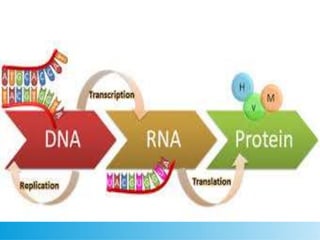
Central dogma of biology
REPLICATION
DNA DNA
TRANSCRIPTION POST
TRANSCRIPTIONAL
MODIFICATION
RNA
The process of transcription takes place in three major
steps. They are :
1. Initiation.
2.Elongation.
3.Termination.
N
 Transcription is initiated by RNA Polymerase
holoenzyme from a specific region called promotor
sequence in DNA .
 Principle enzyme – Bacterial RNA Polymerase
 RNA Polymerase alone is called core Polymerase .
 Core polymerase consists of α,β,β’and ω sub units.
 Closed complex formation :
Binding of RNA polymerase holoenzyme
to promotor sequence.
 Open complex formation :
1. RNA polymerase holoenzyme separates
10-14 DNA basepairs extending from
-11 to +3 and this is called melting.
2. It leads to the formation of open
complex.
3. closed complex to open complex
isomerization
Teritiary complex formation :
1. If the enzyme synthesizes RNA <10
basepairs ,it does not elongate it
abortive initiation.
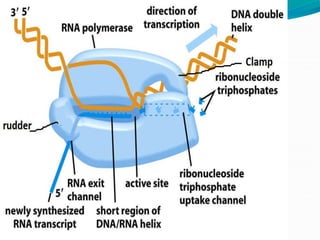
2. Because σ factor acts as a mimic of RNA
and blocks the RNA exit channel in open
complex.
3. When RNA polymerase synthesizes RNA >
10 base pairs , it ejects σ factor and RNA
elongates further and moves out through exit
channel. This is known as the teritiary complex
ELONGATION
 After the formation of teritiary complex the RNA
elongates further by the addition of dNTPs .
 The synthesized is proof read by hydrolytic editing.
Gre factor enhances the proof reading activity.
Pyrophospholytic editing is another proof reading
mechanism.
TERMINATION
 The process of termination can happen in two
different mechanisms. They are :
1. Rho – independent termination.
2. Rho – dependent termination.
termination
In this mechanism, transcription is terminated by
termination sequence in DNA.
Terminator sequence contains invert repeat causing
complementary pairing as transcript RNA form
hairpin structure.
Invert repeat is followed by a large number of T (~8
basepairs), in RNA “U” appears.
The load of hairpin structure isn’t tolerated by A=U
bps so RNA gets separated from RNA –DNA
heteroduplex.
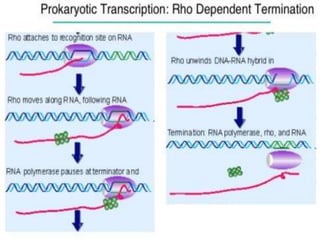
Rho – dependent
termination
In this mechanism,transcription is terminated by rho
protein (ρ).
Rho protein is a single strand ATPase protein.
Rho protein binds to the single stranded RNA after
termination.
In bacteria, transcription and translation occurs
simultaneously so Rho protein binds to the mRNA
after translation i.e.,when translation is completed but
transcription is “ON”.
Transcripti                           on.pptx

Transcripti on.pptx

  • 1.
  • 2.
    INTRODUCTION  Synthesis ofRNA by copying DNA template is known as transcription.  Only selected portion of the genome (exons)is transcribed .  RNA polymerase requires no primers it is a DNA dependent RNA polymerase
  • 3.
    Central dogma ofbiology REPLICATION DNA DNA TRANSCRIPTION POST TRANSCRIPTIONAL MODIFICATION RNA
  • 6.
    The process oftranscription takes place in three major steps. They are : 1. Initiation. 2.Elongation. 3.Termination.
  • 7.
    N  Transcription isinitiated by RNA Polymerase holoenzyme from a specific region called promotor sequence in DNA .  Principle enzyme – Bacterial RNA Polymerase  RNA Polymerase alone is called core Polymerase .  Core polymerase consists of α,β,β’and ω sub units.
  • 8.
     Closed complexformation : Binding of RNA polymerase holoenzyme to promotor sequence.  Open complex formation : 1. RNA polymerase holoenzyme separates 10-14 DNA basepairs extending from -11 to +3 and this is called melting. 2. It leads to the formation of open complex. 3. closed complex to open complex isomerization
  • 9.
    Teritiary complex formation: 1. If the enzyme synthesizes RNA <10 basepairs ,it does not elongate it abortive initiation. 2. Because σ factor acts as a mimic of RNA and blocks the RNA exit channel in open complex. 3. When RNA polymerase synthesizes RNA > 10 base pairs , it ejects σ factor and RNA elongates further and moves out through exit channel. This is known as the teritiary complex
  • 12.
    ELONGATION  After theformation of teritiary complex the RNA elongates further by the addition of dNTPs .  The synthesized is proof read by hydrolytic editing. Gre factor enhances the proof reading activity. Pyrophospholytic editing is another proof reading mechanism.
  • 14.
    TERMINATION  The processof termination can happen in two different mechanisms. They are : 1. Rho – independent termination. 2. Rho – dependent termination.
  • 15.
    termination In this mechanism,transcription is terminated by termination sequence in DNA. Terminator sequence contains invert repeat causing complementary pairing as transcript RNA form hairpin structure. Invert repeat is followed by a large number of T (~8 basepairs), in RNA “U” appears. The load of hairpin structure isn’t tolerated by A=U bps so RNA gets separated from RNA –DNA heteroduplex.
  • 16.
    Rho – dependent termination Inthis mechanism,transcription is terminated by rho protein (ρ). Rho protein is a single strand ATPase protein. Rho protein binds to the single stranded RNA after termination. In bacteria, transcription and translation occurs simultaneously so Rho protein binds to the mRNA after translation i.e.,when translation is completed but transcription is “ON”.