Learning Objectives
After studyingthis chapter, you should be able to:
❑ Summarize the types of parallel processor organizations.
❑ Present an overview of design features of symmetric multiprocessors.
❑ Understand the issue of cache coherence in a multiple processor
system.
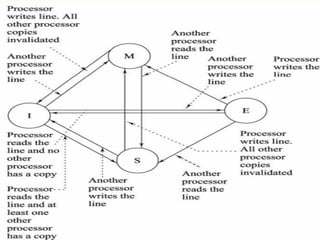
❑ Explain the key features of the MESI protocol.
❑ Explain the difference between implicit and explicit multithreading.
❑ Summarize key design issues for clusters.
❑ Explain the concept of nonuniform memory access.
❑ Present an overview of cloud computing concepts
4.
Introduction
❑ Traditionally Computerviewed as sequential machine
❑ Programmers had to specify algorithm in sequence manner
❑ Each instruction is executed in sequence of operation i.e. fetch
instruction, fetch operands, perform operation, store results
❑ But, in reality the above claim has never been entirely true
❑ Think at micro-operations level whereby; multiple control signals are
generated, instruction pipelining, overlapping fetching, execution
operations
❑ Both of these indicate that computers has been performing functions in
parallel
5.
+
Multiple Processor Organization
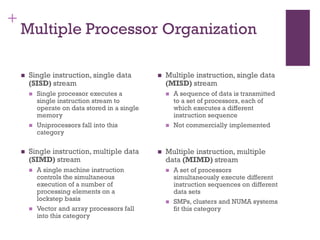
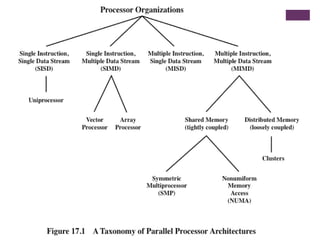
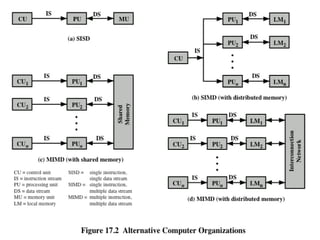
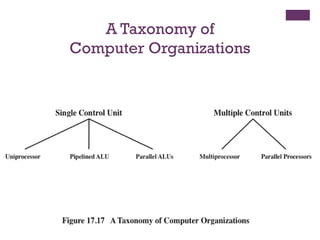
◼Single instruction, single data
(SISD) stream
◼ Single processor executes a
single instruction stream to
operate on data stored in a single
memory
◼ Uniprocessors fall into this
category
◼ Single instruction, multiple data
(SIMD) stream
◼ A single machine instruction
controls the simultaneous
execution of a number of
processing elements on a
lockstep basis
◼ Vector and array processors fall
into this category
◼ Multiple instruction, single data
(MISD) stream
◼ A sequence of data is transmitted
to a set of processors, each of
which executes a different
instruction sequence
◼ Not commercially implemented
◼ Multiple instruction, multiple
data (MIMD) stream
◼ A set of processors
simultaneously execute different
instruction sequences on different
data sets
◼ SMPs, clusters and NUMA systems
fit this category
8.
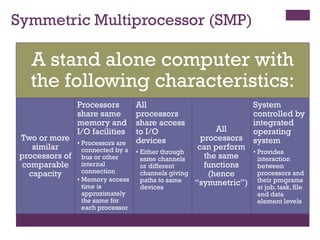
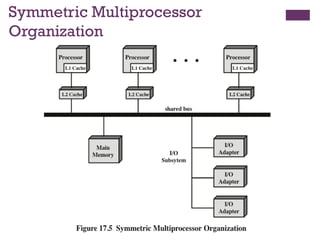
Symmetric Multiprocessor (SMP)
Astand alone computer with
the following characteristics:
A stand alone computer with
the following characteristics:
Two or more
similar
processors of
comparable
capacity
Two or more
similar
processors of
comparable
capacity
Processors
share same
memory and
I/O facilities
• Processors are
connected by a
bus or other
internal
connection
• Memory access
time is
approximately
the same for
each processor
Processors
share same
memory and
I/O facilities
• Processors are
connected by a
bus or other
internal
connection
• Memory access
time is
approximately
the same for
each processor
All
processors
share access
to I/O
devices
• Either through
same channels
or different
channels giving
paths to same
devices
All
processors
share access
to I/O
devices
• Either through
same channels
or different
channels giving
paths to same
devices
All
processors
can perform
the same
functions
(hence
“symmetric”)
All
processors
can perform
the same
functions
(hence
“symmetric”)
System
controlled by
integrated
operating
system
• Provides
interaction
between
processors and
their programs
at job, task, file
and data
element levels
System
controlled by
integrated
operating
system
• Provides
interaction
between
processors and
their programs
at job, task, file
and data
element levels
+
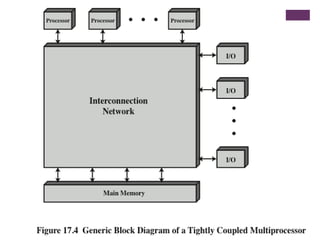
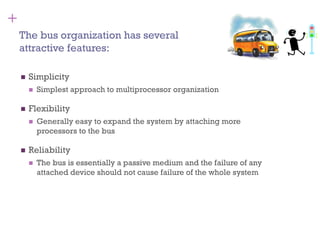
◼ Simplicity
◼ Simplestapproach to multiprocessor organization
◼ Flexibility
◼ Generally easy to expand the system by attaching more
processors to the bus
◼ Reliability
◼ The bus is essentially a passive medium and the failure of any
attached device should not cause failure of the whole system
The bus organization has several
attractive features:
13.
+
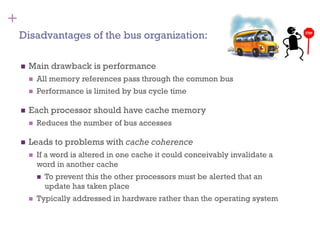
◼ Main drawbackis performance
◼ All memory references pass through the common bus
◼ Performance is limited by bus cycle time
◼ Each processor should have cache memory
◼ Reduces the number of bus accesses
◼ Leads to problems with cache coherence
◼ If a word is altered in one cache it could conceivably invalidate a
word in another cache
◼ To prevent this the other processors must be alerted that an
update has taken place
◼ Typically addressed in hardware rather than the operating system
Disadvantages of the bus organization:
14.
+
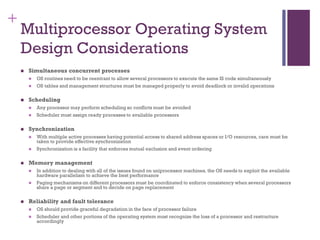
Multiprocessor Operating System
DesignConsiderations
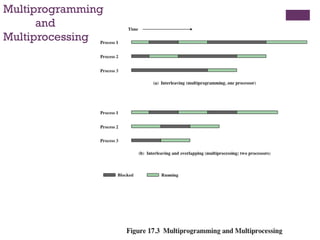
◼ Simultaneous concurrent processes
◼ OS routines need to be reentrant to allow several processors to execute the same IS code simultaneously
◼ OS tables and management structures must be managed properly to avoid deadlock or invalid operations
◼ Scheduling
◼ Any processor may perform scheduling so conflicts must be avoided
◼ Scheduler must assign ready processes to available processors
◼ Synchronization
◼ With multiple active processes having potential access to shared address spaces or I/O resources, care must be
taken to provide effective synchronization
◼ Synchronization is a facility that enforces mutual exclusion and event ordering
◼ Memory management
◼ In addition to dealing with all of the issues found on uniprocessor machines, the OS needs to exploit the available
hardware parallelism to achieve the best performance
◼ Paging mechanisms on different processors must be coordinated to enforce consistency when several processors
share a page or segment and to decide on page replacement
◼ Reliability and fault tolerance
◼ OS should provide graceful degradation in the face of processor failure
◼ Scheduler and other portions of the operating system must recognize the loss of a processor and restructure
accordingly
15.
+
Cache Coherence
◼ Attemptto avoid the need for additional hardware circuitry
and logic by relying on the compiler and operating system to
deal with the problem
◼ Attractive because the overhead of detecting potential
problems is transferred from run time to compile time, and
the design complexity is transferred from hardware to
software
◼ However, compile-time software approaches generally must make
conservative decisions, leading to inefficient cache utilization
Software Solutions
16.
+
Cache Coherence
◼ Generallyreferred to as cache coherence protocols
◼ These solutions provide dynamic recognition at run time of
potential inconsistency conditions
◼ Because the problem is only dealt with when it actually arises
there is more effective use of caches, leading to improved
performance over a software approach
◼ Approaches are transparent to the programmer and the
compiler, reducing the software development burden
◼ Can be divided into two categories:
◼ Directory protocols
◼ Snoopy protocols
Hardware-Based Solutions
17.
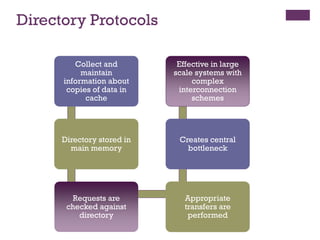
Directory Protocols
Collect and
maintain
informationabout
copies of data in
cache
Collect and
maintain
information about
copies of data in
cache
Directory stored in
main memory
Directory stored in
main memory
Requests are
checked against
directory
Requests are
checked against
directory
Appropriate
transfers are
performed
Appropriate
transfers are
performed
Creates central
bottleneck
Creates central
bottleneck
Effective in large
scale systems with
complex
interconnection
schemes
Effective in large
scale systems with
complex
interconnection
schemes
18.
Snoopy Protocols
◼ Distributethe responsibility for maintaining cache coherence
among all of the cache controllers in a multiprocessor
◼ A cache must recognize when a line that it holds is shared with other
caches
◼ When updates are performed on a shared cache line, it must be
announced to other caches by a broadcast mechanism
◼ Each cache controller is able to “snoop” on the network to observe
these broadcast notifications and react accordingly
◼ Suited to bus-based multiprocessor because the shared bus
provides a simple means for broadcasting and snooping
◼ Care must be taken that the increased bus traffic required for
broadcasting and snooping does not cancel out the gains from the
use of local caches
◼ Two basic approaches have been explored:
◼ Write invalidate
◼ Write update (or write broadcast)
19.
+
Write Invalidate
◼ Multiplereaders, but only one writer at a time
◼ When a write is required, all other caches of the line are
invalidated
◼ Writing processor then has exclusive (cheap) access until
line is required by another processor
◼ Most widely used in commercial multiprocessor systems
such as the Pentium 4 and PowerPC
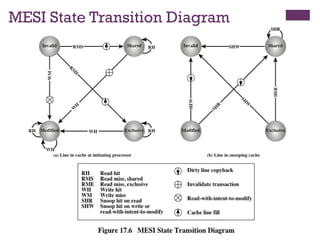
◼ State of every line is marked as modified, exclusive, shared
or invalid
◼ For this reason the write-invalidate protocol is called MESI
20.
+
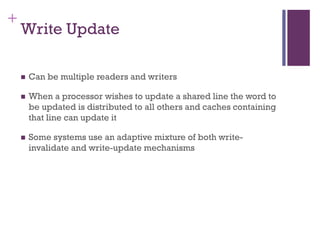
Write Update
◼ Canbe multiple readers and writers
◼ When a processor wishes to update a shared line the word to
be updated is distributed to all others and caches containing
that line can update it
◼ Some systems use an adaptive mixture of both write-
invalidate and write-update mechanisms
21.
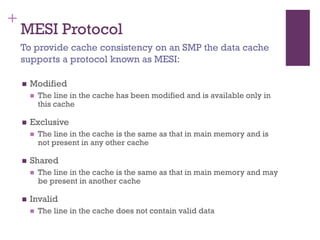
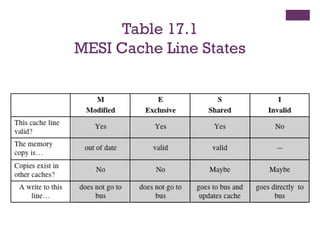
+
MESI Protocol
◼ Modified
◼The line in the cache has been modified and is available only in
this cache
◼ Exclusive
◼ The line in the cache is the same as that in main memory and is
not present in any other cache
◼ Shared
◼ The line in the cache is the same as that in main memory and may
be present in another cache
◼ Invalid
◼ The line in the cache does not contain valid data
To provide cache consistency on an SMP the data cache
supports a protocol known as MESI:
+
Multithreading and Chip
Multiprocessors
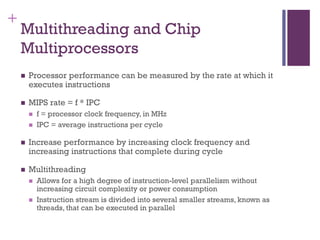
◼Processor performance can be measured by the rate at which it
executes instructions
◼ MIPS rate = f * IPC
◼ f = processor clock frequency, in MHz
◼ IPC = average instructions per cycle
◼ Increase performance by increasing clock frequency and
increasing instructions that complete during cycle
◼ Multithreading
◼ Allows for a high degree of instruction-level parallelism without
increasing circuit complexity or power consumption
◼ Instruction stream is divided into several smaller streams, known as
threads, that can be executed in parallel
26.
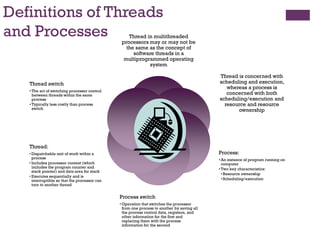
Definitions of Threads
andProcesses Thread in multithreaded
processors may or may not be
the same as the concept of
software threads in a
multiprogrammed operating
system
Thread is concerned with
scheduling and execution,
whereas a process is
concerned with both
scheduling/execution and
resource and resource
ownership
Process:
• An instance of program running on
computer
• Two key characteristics:
•Resource ownership
•Scheduling/execution
Process switch
• Operation that switches the processor
from one process to another by saving all
the process control data, registers, and
other information for the first and
replacing them with the process
information for the second
Thread:
• Dispatchable unit of work within a
process
• Includes processor context (which
includes the program counter and
stack pointer) and data area for stack
• Executes sequentially and is
interruptible so that the processor can
turn to another thread
Thread switch
• The act of switching processor control
between threads within the same
process
• Typically less costly than process
switch
27.
+
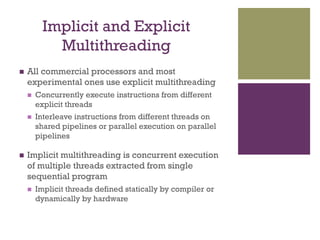
Implicit and Explicit
Multithreading
◼All commercial processors and most
experimental ones use explicit multithreading
◼ Concurrently execute instructions from different
explicit threads
◼ Interleave instructions from different threads on
shared pipelines or parallel execution on parallel
pipelines
◼ Implicit multithreading is concurrent execution
of multiple threads extracted from single
sequential program
◼ Implicit threads defined statically by compiler or
dynamically by hardware
28.
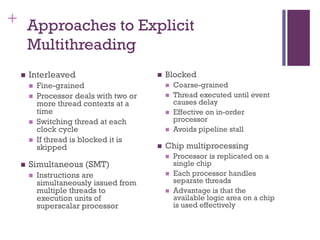
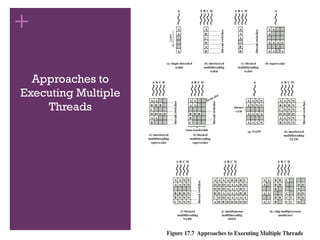
+ Approaches toExplicit
Multithreading
◼ Interleaved
◼ Fine-grained
◼ Processor deals with two or
more thread contexts at a
time
◼ Switching thread at each
clock cycle
◼ If thread is blocked it is
skipped
◼ Simultaneous (SMT)
◼ Instructions are
simultaneously issued from
multiple threads to
execution units of
superscalar processor
◼ Blocked
◼ Coarse-grained
◼ Thread executed until event
causes delay
◼ Effective on in-order
processor
◼ Avoids pipeline stall
◼ Chip multiprocessing
◼ Processor is replicated on a
single chip
◼ Each processor handles
separate threads
◼ Advantage is that the
available logic area on a chip
is used effectively
+
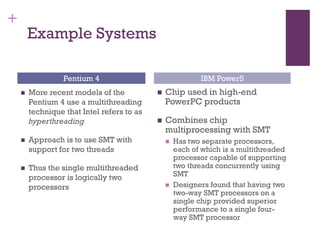
Example Systems
◼ Morerecent models of the
Pentium 4 use a multithreading
technique that Intel refers to as
hyperthreading
◼ Approach is to use SMT with
support for two threads
◼ Thus the single multithreaded
processor is logically two
processors
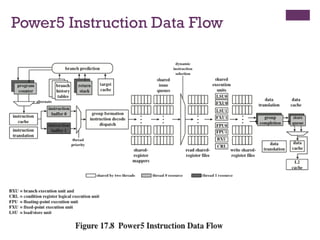
◼ Chip used in high-end
PowerPC products
◼ Combines chip
multiprocessing with SMT
◼ Has two separate processors,
each of which is a multithreaded
processor capable of supporting
two threads concurrently using
SMT
◼ Designers found that having two
two-way SMT processors on a
single chip provided superior
performance to a single four-
way SMT processor
Pentium 4 IBM Power5
+
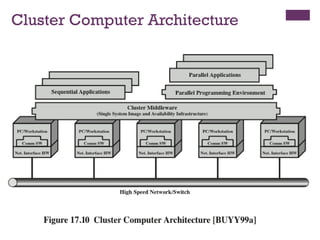
Clusters
◼ Alternative toSMP as an approach to providing
high performance and high availability
◼ Particularly attractive for server applications
◼ Defined as:
◼ A group of interconnected whole computers working
together as a unified computing resource that can
create the illusion of being one machine
◼ (The term whole computer means a system that can run
on its own, apart from the cluster)
◼ Each computer in a cluster is called a node
◼ Benefits:
◼ Absolute scalability
◼ Incremental scalability
◼ High availability
◼ Superior price/performance
+
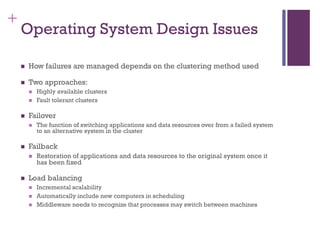
Operating System DesignIssues
◼ How failures are managed depends on the clustering method used
◼ Two approaches:
◼ Highly available clusters
◼ Fault tolerant clusters
◼ Failover
◼ The function of switching applications and data resources over from a failed system
to an alternative system in the cluster
◼ Failback
◼ Restoration of applications and data resources to the original system once it
has been fixed
◼ Load balancing
◼ Incremental scalability
◼ Automatically include new computers in scheduling
◼ Middleware needs to recognize that processes may switch between machines
36.
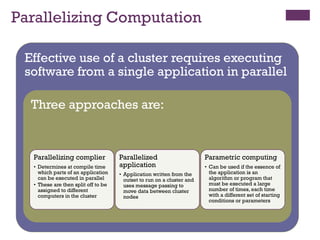
Parallelizing Computation
Effective useof a cluster requires executing
software from a single application in parallel
Effective use of a cluster requires executing
software from a single application in parallel
Three approaches are:
Three approaches are:
Parallelizing complier
• Determines at compile time
which parts of an application
can be executed in parallel
• These are then split off to be
assigned to different
computers in the cluster
Parallelized
application
• Application written from the
outset to run on a cluster and
uses message passing to
move data between cluster
nodes
Parametric computing
• Can be used if the essence of
the application is an
algorithm or program that
must be executed a large
number of times, each time
with a different set of starting
conditions or parameters
+
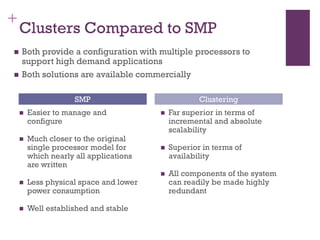
Clusters Compared toSMP
◼ Easier to manage and
configure
◼ Much closer to the original
single processor model for
which nearly all applications
are written
◼ Less physical space and lower
power consumption
◼ Well established and stable
◼ Far superior in terms of
incremental and absolute
scalability
◼ Superior in terms of
availability
◼ All components of the system
can readily be made highly
redundant
SMP Clustering
◼ Both provide a configuration with multiple processors to
support high demand applications
◼ Both solutions are available commercially
40.
+
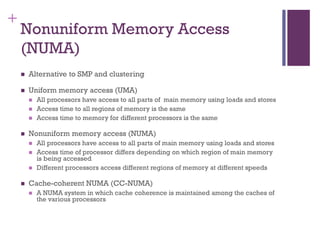
Nonuniform Memory Access
(NUMA)
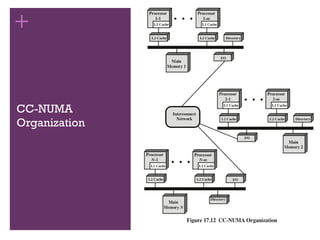
◼Alternative to SMP and clustering
◼ Uniform memory access (UMA)
◼ All processors have access to all parts of main memory using loads and stores
◼ Access time to all regions of memory is the same
◼ Access time to memory for different processors is the same
◼ Nonuniform memory access (NUMA)
◼ All processors have access to all parts of main memory using loads and stores
◼ Access time of processor differs depending on which region of main memory
is being accessed
◼ Different processors access different regions of memory at different speeds
◼ Cache-coherent NUMA (CC-NUMA)
◼ A NUMA system in which cache coherence is maintained among the caches of
the various processors
41.
Motivation
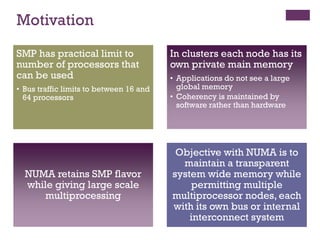
SMP has practicallimit to
number of processors that
can be used
• Bus traffic limits to between 16 and
64 processors
SMP has practical limit to
number of processors that
can be used
• Bus traffic limits to between 16 and
64 processors
In clusters each node has its
own private main memory
• Applications do not see a large
global memory
• Coherency is maintained by
software rather than hardware
In clusters each node has its
own private main memory
• Applications do not see a large
global memory
• Coherency is maintained by
software rather than hardware
NUMA retains SMP flavor
while giving large scale
multiprocessing
NUMA retains SMP flavor
while giving large scale
multiprocessing
Objective with NUMA is to
maintain a transparent
system wide memory while
permitting multiple
multiprocessor nodes, each
with its own bus or internal
interconnect system
Objective with NUMA is to
maintain a transparent
system wide memory while
permitting multiple
multiprocessor nodes, each
with its own bus or internal
interconnect system
+
NUMA Pros andCons
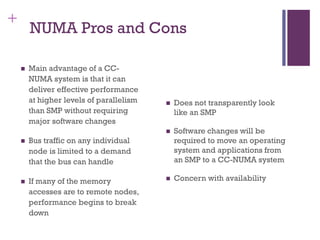
◼ Main advantage of a CC-
NUMA system is that it can
deliver effective performance
at higher levels of parallelism
than SMP without requiring
major software changes
◼ Bus traffic on any individual
node is limited to a demand
that the bus can handle
◼ If many of the memory
accesses are to remote nodes,
performance begins to break
down
◼ Does not transparently look
like an SMP
◼ Software changes will be
required to move an operating
system and applications from
an SMP to a CC-NUMA system
◼ Concern with availability
44.
+
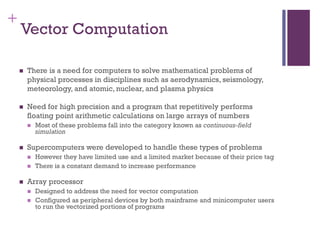
Vector Computation
◼ Thereis a need for computers to solve mathematical problems of
physical processes in disciplines such as aerodynamics, seismology,
meteorology, and atomic, nuclear, and plasma physics
◼ Need for high precision and a program that repetitively performs
floating point arithmetic calculations on large arrays of numbers
◼ Most of these problems fall into the category known as continuous-field
simulation
◼ Supercomputers were developed to handle these types of problems
◼ However they have limited use and a limited market because of their price tag
◼ There is a constant demand to increase performance
◼ Array processor
◼ Designed to address the need for vector computation
◼ Configured as peripheral devices by both mainframe and minicomputer users
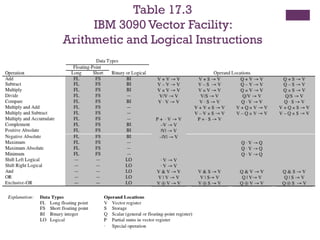
to run the vectorized portions of programs