1
Data Logic and Design
Syed Ammar Ali
Aqdas Hassan
Static and Dynamic memories
Random Access Memory (RAM)
• Random-access memory (RAM) is a type
of computer data storage. A RAM device
makes it possible to access data in random
order, which makes it very fast to find a
specific piece of information.
– These are volatile, switch the machine off and the
contents in this form of memory are lost
• There are two main types of RAM
– Dynamic RAM (DRAM)
– Static RAM (SRAM)
2
Random Access Memory (RAM)
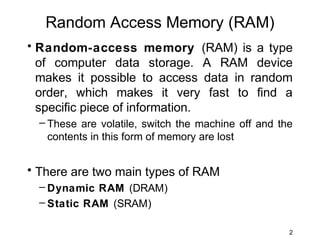
• Static RAM (SRAM)
– Memory behaves like Latches or Flip-Flops
– Data remains stored as long as power applied
3
Random Access Memory (RAM)
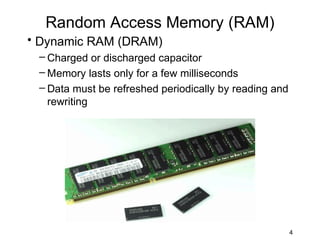
• Dynamic RAM (DRAM)
– Charged or discharged capacitor
– Memory lasts only for a few milliseconds
– Data must be refreshed periodically by reading and
rewriting
4
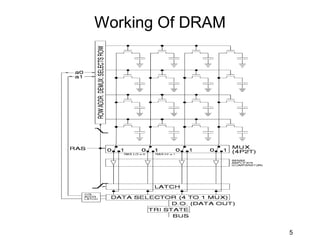
Working Of DRAM
5
Working of DRAM
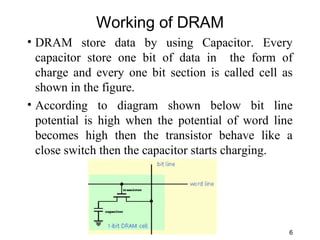
• DRAM store data by using Capacitor. Every
capacitor store one bit of data in the form of
charge and every one bit section is called cell as
shown in the figure.
• According to diagram shown below bit line
potential is high when the potential of word line
becomes high then the transistor behave like a
close switch then the capacitor starts charging.
6
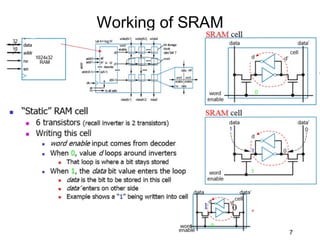
Working of SRAM
7
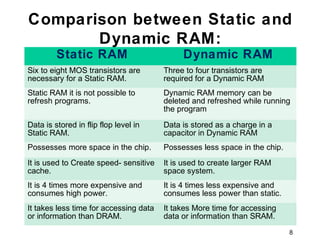
Comparison between Static and
Dynamic RAM:
8
Static RAM Dynamic RAM
Six to eight MOS transistors are
necessary for a Static RAM.
Three to four transistors are
required for a Dynamic RAM
Static RAM it is not possible to
refresh programs.
Dynamic RAM memory can be
deleted and refreshed while running
the program
Data is stored in flip flop level in
Static RAM.
Data is stored as a charge in a
capacitor in Dynamic RAM
Possesses more space in the chip. Possesses less space in the chip.
It is used to Create speed- sensitive
cache.
It is used to create larger RAM
space system.
It is 4 times more expensive and
consumes high power.
It is 4 times less expensive and
consumes less power than static.
It takes less time for accessing data
or information than DRAM.
It takes More time for accessing
data or information than SRAM.
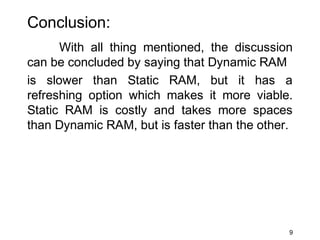
Conclusion:
With all thing mentioned, the discussion
can be concluded by saying that Dynamic RAM
is slower than Static RAM, but it has a
refreshing option which makes it more viable.
Static RAM is costly and takes more spaces
than Dynamic RAM, but is faster than the other.
9
Thank
You
10

Static and dynamic memories

  • 1.
    1 Data Logic andDesign Syed Ammar Ali Aqdas Hassan Static and Dynamic memories
  • 2.
    Random Access Memory(RAM) • Random-access memory (RAM) is a type of computer data storage. A RAM device makes it possible to access data in random order, which makes it very fast to find a specific piece of information. – These are volatile, switch the machine off and the contents in this form of memory are lost • There are two main types of RAM – Dynamic RAM (DRAM) – Static RAM (SRAM) 2
  • 3.
    Random Access Memory(RAM) • Static RAM (SRAM) – Memory behaves like Latches or Flip-Flops – Data remains stored as long as power applied 3
  • 4.
    Random Access Memory(RAM) • Dynamic RAM (DRAM) – Charged or discharged capacitor – Memory lasts only for a few milliseconds – Data must be refreshed periodically by reading and rewriting 4
  • 5.
  • 6.
    Working of DRAM •DRAM store data by using Capacitor. Every capacitor store one bit of data in the form of charge and every one bit section is called cell as shown in the figure. • According to diagram shown below bit line potential is high when the potential of word line becomes high then the transistor behave like a close switch then the capacitor starts charging. 6
  • 7.
  • 8.
    Comparison between Staticand Dynamic RAM: 8 Static RAM Dynamic RAM Six to eight MOS transistors are necessary for a Static RAM. Three to four transistors are required for a Dynamic RAM Static RAM it is not possible to refresh programs. Dynamic RAM memory can be deleted and refreshed while running the program Data is stored in flip flop level in Static RAM. Data is stored as a charge in a capacitor in Dynamic RAM Possesses more space in the chip. Possesses less space in the chip. It is used to Create speed- sensitive cache. It is used to create larger RAM space system. It is 4 times more expensive and consumes high power. It is 4 times less expensive and consumes less power than static. It takes less time for accessing data or information than DRAM. It takes More time for accessing data or information than SRAM.
  • 9.
    Conclusion: With all thingmentioned, the discussion can be concluded by saying that Dynamic RAM is slower than Static RAM, but it has a refreshing option which makes it more viable. Static RAM is costly and takes more spaces than Dynamic RAM, but is faster than the other. 9
  • 10.