Objectives unit 6Introduce the concept of culture Relate the concept of identity to cultureIntroduce the concept of cultural variability and operationalize this in different cultural dimensions (Hofstede)Present the concept of acculturation, how this relates to cultural identity and multicultural societiesApply abovementioned concepts/theories  (point 1-4) to Aruba’s context
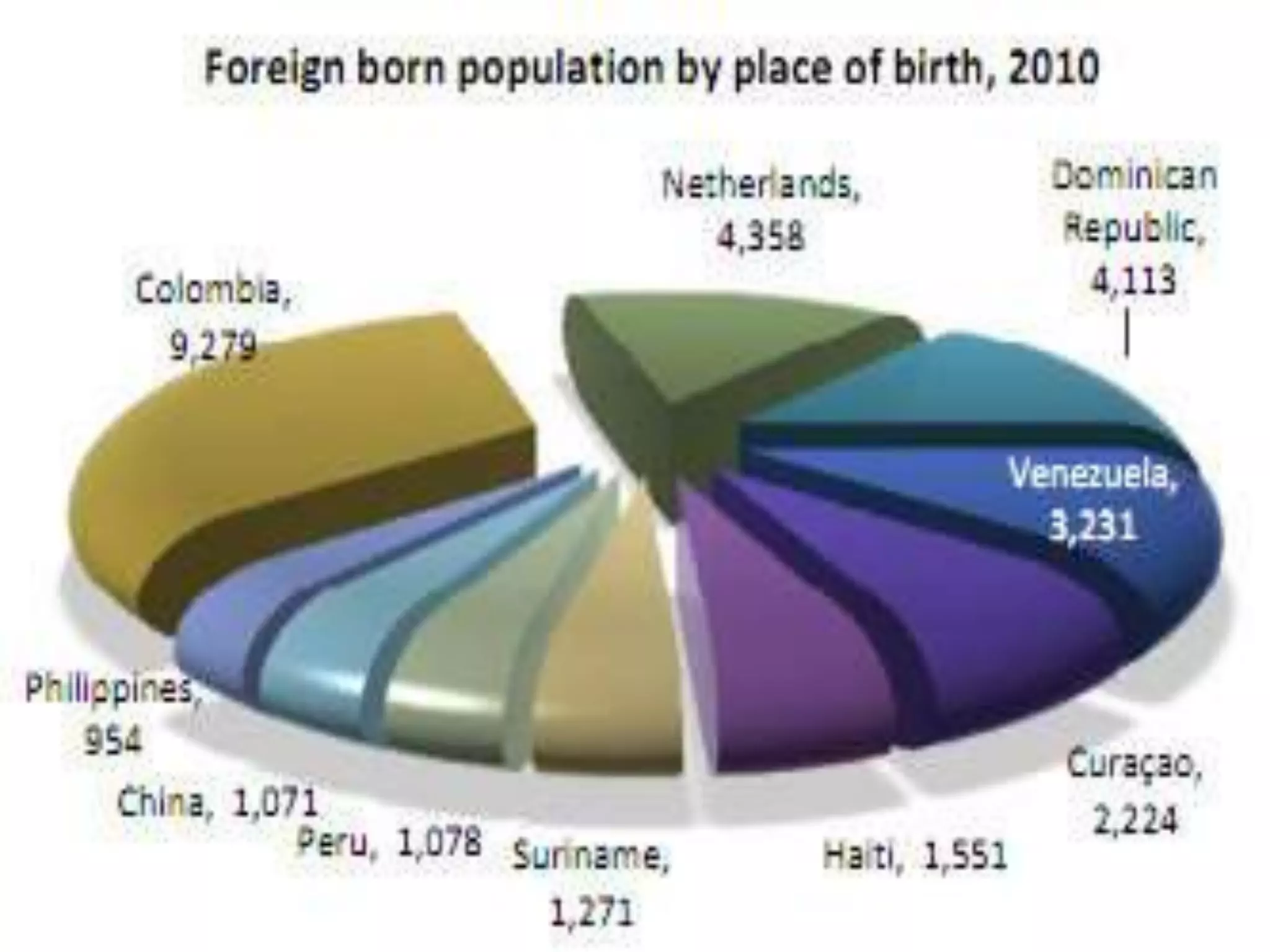
Census Aruba 2010: Aruba is multicultural and has always been“Aruba tin 96 diferentenacionalidad di 133 diferentepais”Aruba has 96 different nationalities from 133 different countries
Activity 1:In your own words, what does culture mean to you and what associations do you get when thinking about culture?
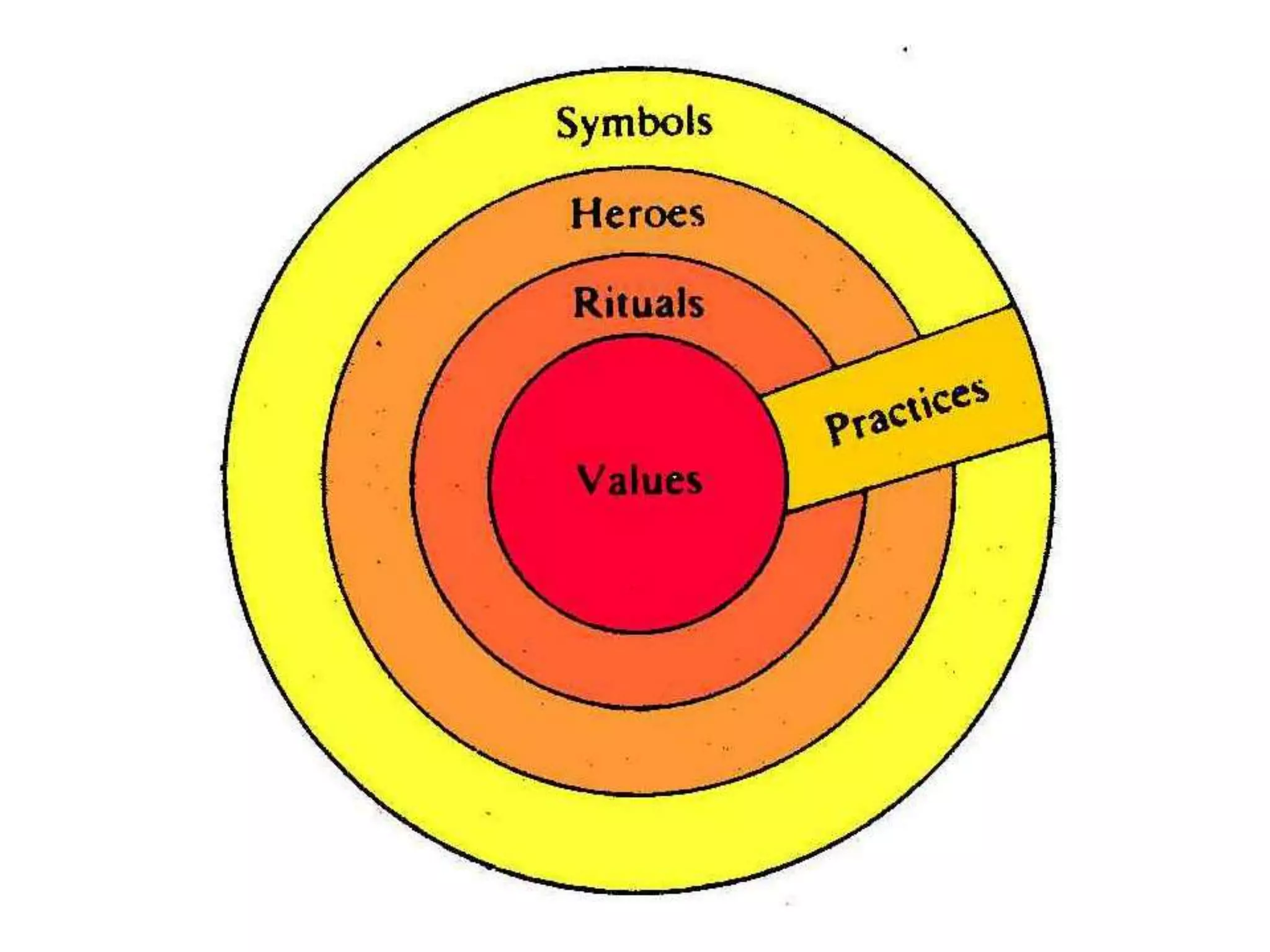
“A way of life”The full range of learned human behavior patternsEverything that people create or develop:Values, norms, goals, and culture in general develop as people interact with each other over time;It includes beliefs, values, behaviors and physical objects that create a people’s way of lifePeople create their culture, and this culture in turn shapes their behavior
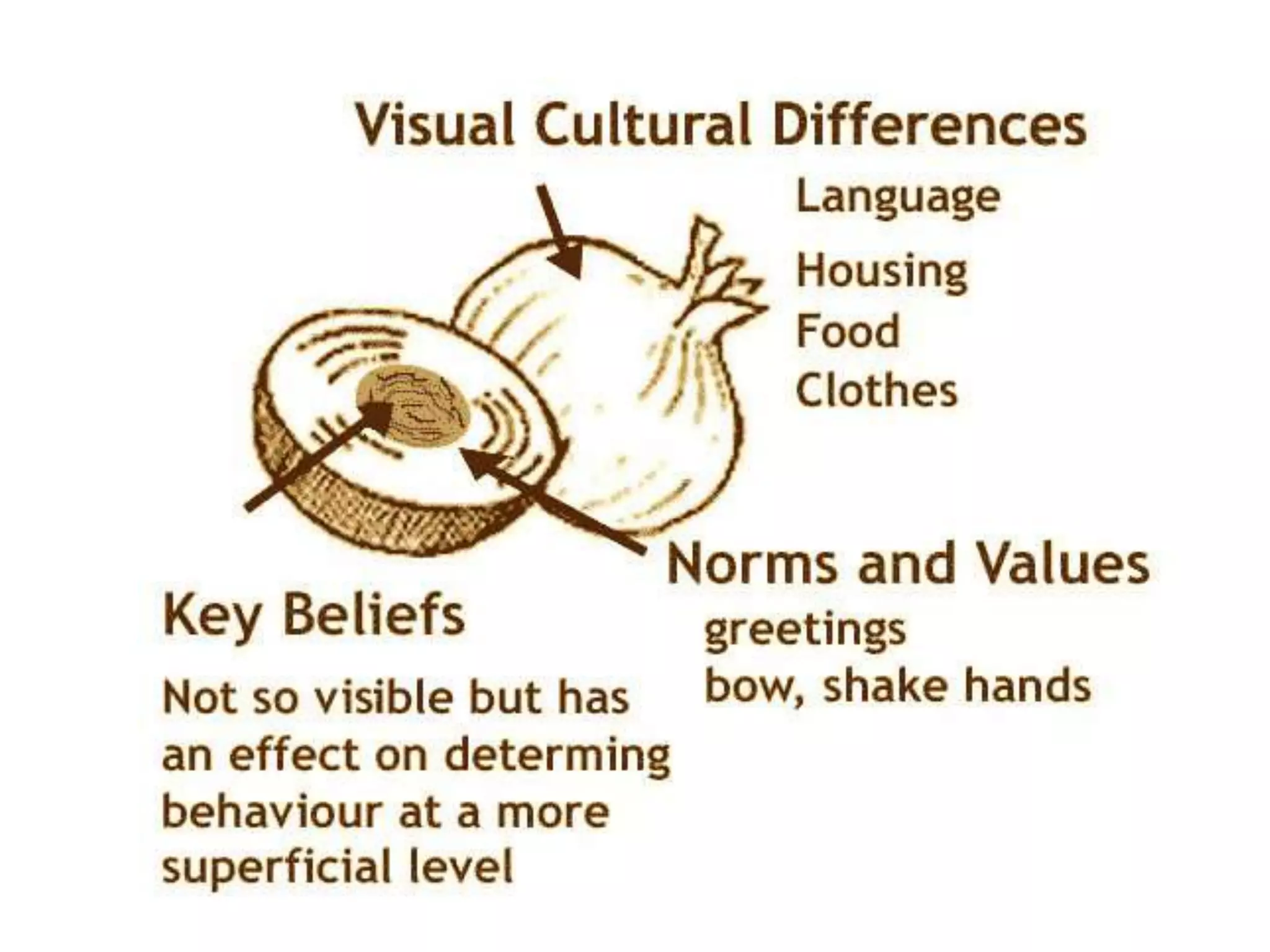
The concept of cultureDefinition of culture as a concept has implications for our categorization processes, the way we describe, evaluate, understand and communicate about cultures (ours and theirs) Difference between static and dynamic approaches of the concept cultureA statically entity, block, unchanging, monolithicA dynamic entity, changeable, contextual and with internal variations Stereotypes are often related with statically views of culture (unchanging, generalizations, “they all are the same”)
Defining Culture:Cultureas “ processes of continuing shifting and changingsystems of meaning” *. There are “shared systems of values, norms, ideas, attitudes, behaviours, means of communication and the products of these” ** that are continuingly created in the interaction with their particular environment. [Systems of meaning] that play an important role in shaping the behaviour of the individual.*** *Bartels en Brouwer, 1999:16**Van Oudenhoven, 2002: 14*** Berry, 1997
A more practical definition of cultureThe full range of learned human behaviour patterns. It refers to everything that people create or develop. Values, norms, goals and culture in general develop as people interact with one another over time. It includes beliefs, values, behaviours and physical objects that create a people’s way of lifePeople create their culture and this culture in turn shapes their behaviour
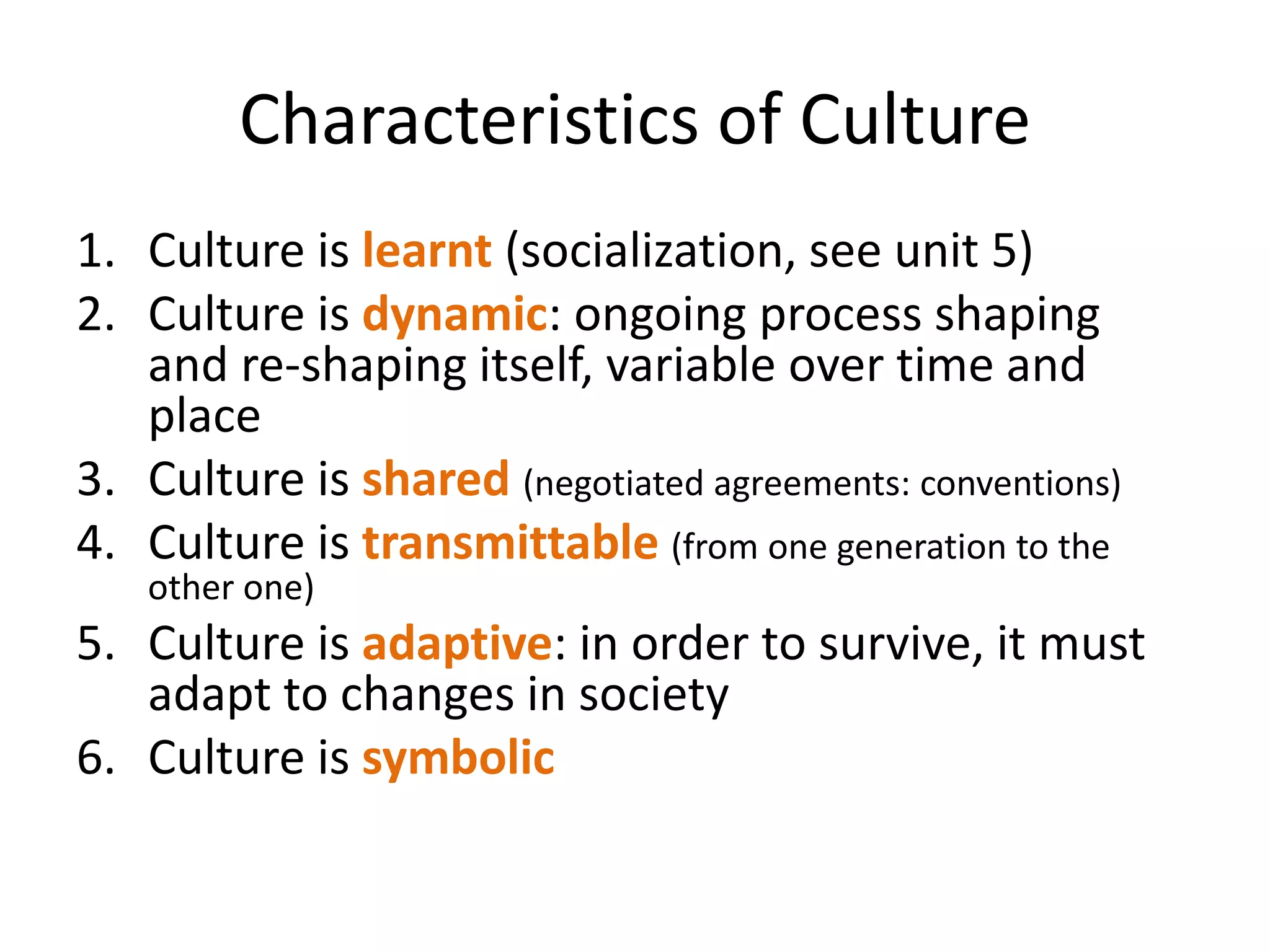
Characteristics of CultureCulture is learnt (socialization, see unit 5)Culture is dynamic: ongoing process shaping and re-shaping itself, variable over time and placeCulture is shared(negotiated agreements: conventions)Culture is transmittable(from one generation to the other one)Culture is adaptive: in order to survive, it must adapt to changes in societyCulture is symbolic
Activity 2:Compare the culture of your grandparents with yours:Culture is variable over time and place!
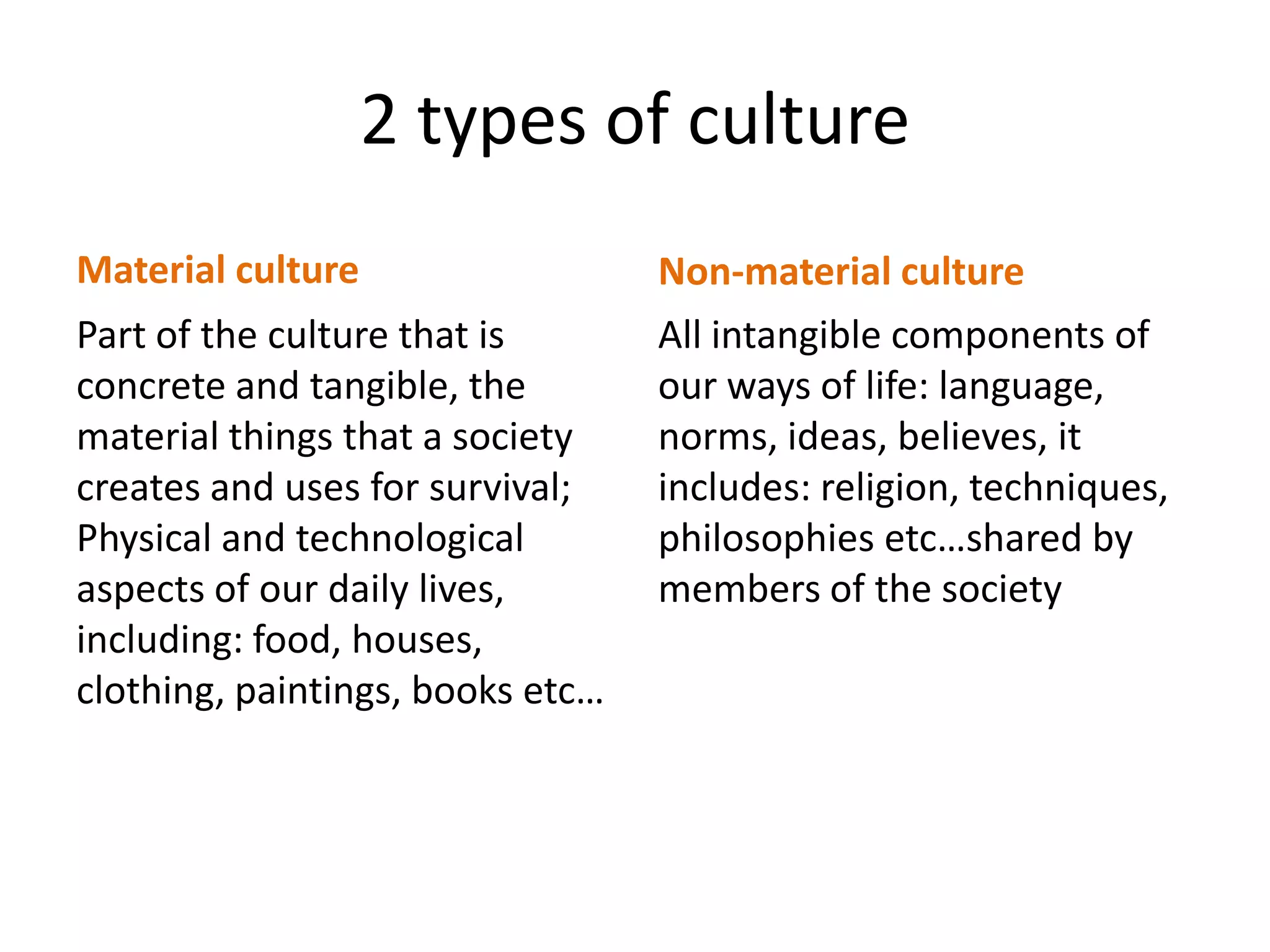
2 types of cultureMaterial culturePart of the culture that is concrete and tangible, the material things that a society creates and uses for survival; Physical and technological aspects of our daily lives, including: food, houses, clothing, paintings, books etc…Non-material cultureAll intangible components of our ways of life: language, norms, ideas, believes, it includes: religion, techniques, philosophies etc…shared by members of the society
Activity 3:	State whether the examples below represent material or non-material culture:FoodNormsMonumentsValuesReligious beliefsClothingIdeasChurch buildingsBeliefsArt
Activity 4: Arubansare/or my specific cultural group, is...Imagine you are living abroad, and you have to explain to your new friends what it means to be ‘Aruban’ or your specific cultural group?How would you describe the Arubanculture or yourspecificculturalgrouptoyour new friends?
StereotypingTo stereotype someone is to attribute to that person some characteristics which are seen to be shared by all or most of his or her fellow group members (Brown, 1995)Stereotypes canleadtoprejudice
StereotypesPrejudicePrejudice: the holding of derogatory social attitudes or cognitive beliefs, the expression of negative affect or display of hostile or discriminatory behaviour towards members of a group on account of their membership of that group (Brown, 1995)
Cultural variability: dimensions
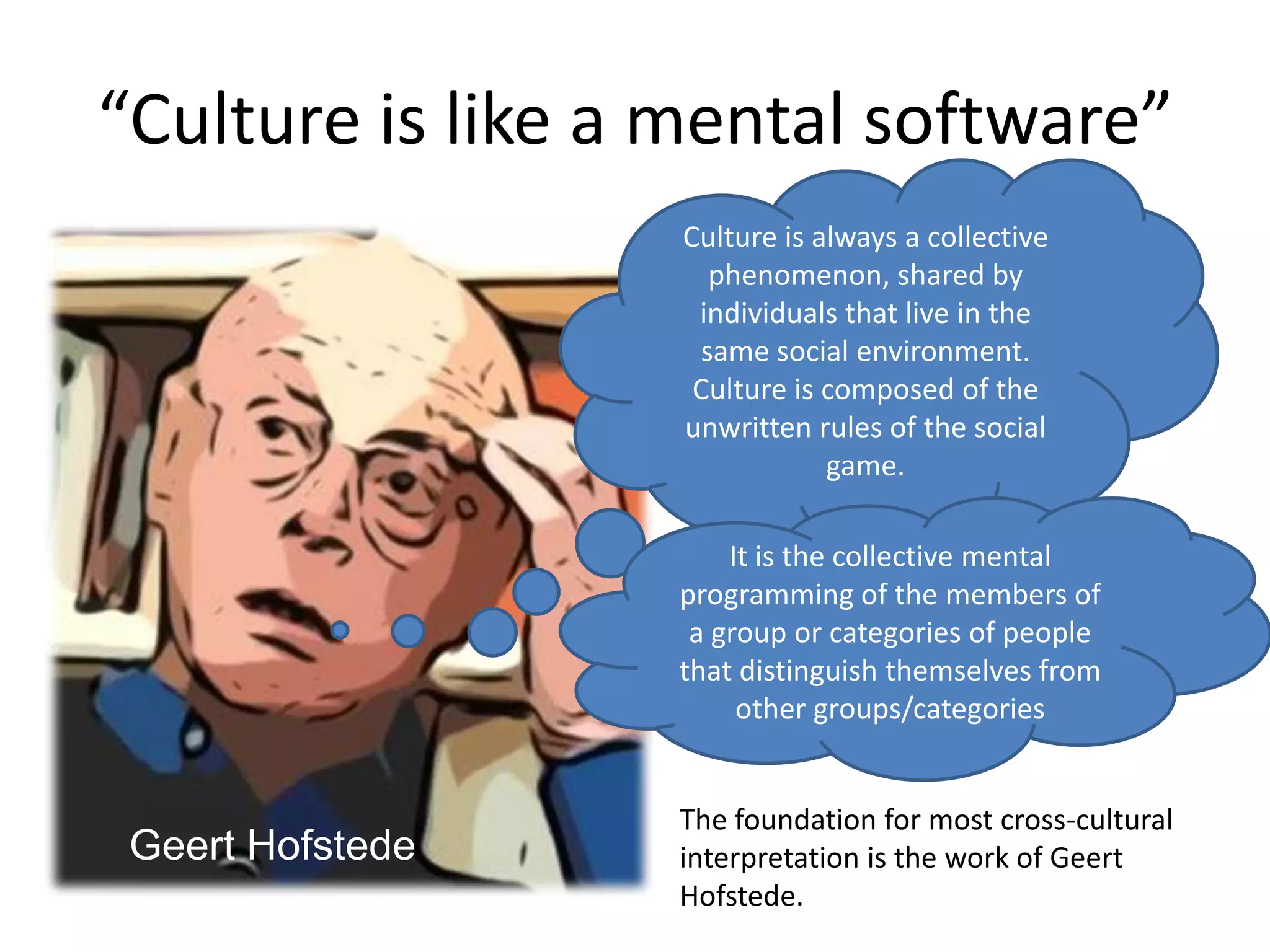
“Culture is like a mental software”Culture is always a collective phenomenon, shared by individuals that live in the same social environment. Culture is composed of the unwritten rules of the social game. It is the collective mental programming of the members of a group or categories of people that distinguish themselves from other groups/categoriesThe foundation for most cross-cultural interpretation is the work of Geert Hofstede. Geert Hofstede
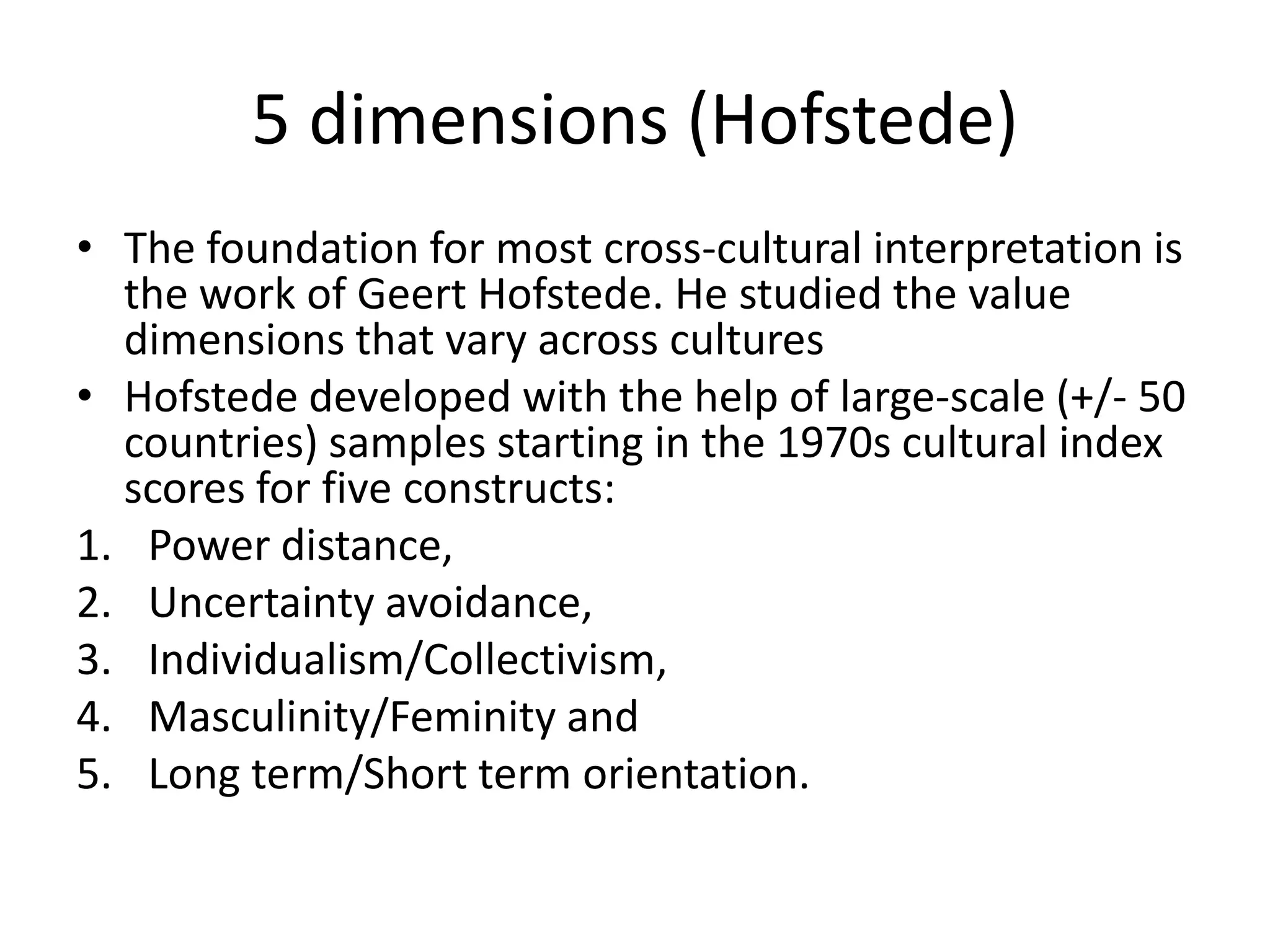
5 dimensions (Hofstede)The foundation for most cross-cultural interpretation is the work of Geert Hofstede. He studied the value dimensions that vary across culturesHofstede developed with the help of large-scale (+/- 50 countries) samples starting in the 1970s cultural index scores for five constructs:Power distance,Uncertainty avoidance,Individualism/Collectivism,Masculinity/Feminity andLong term/Short term orientation.
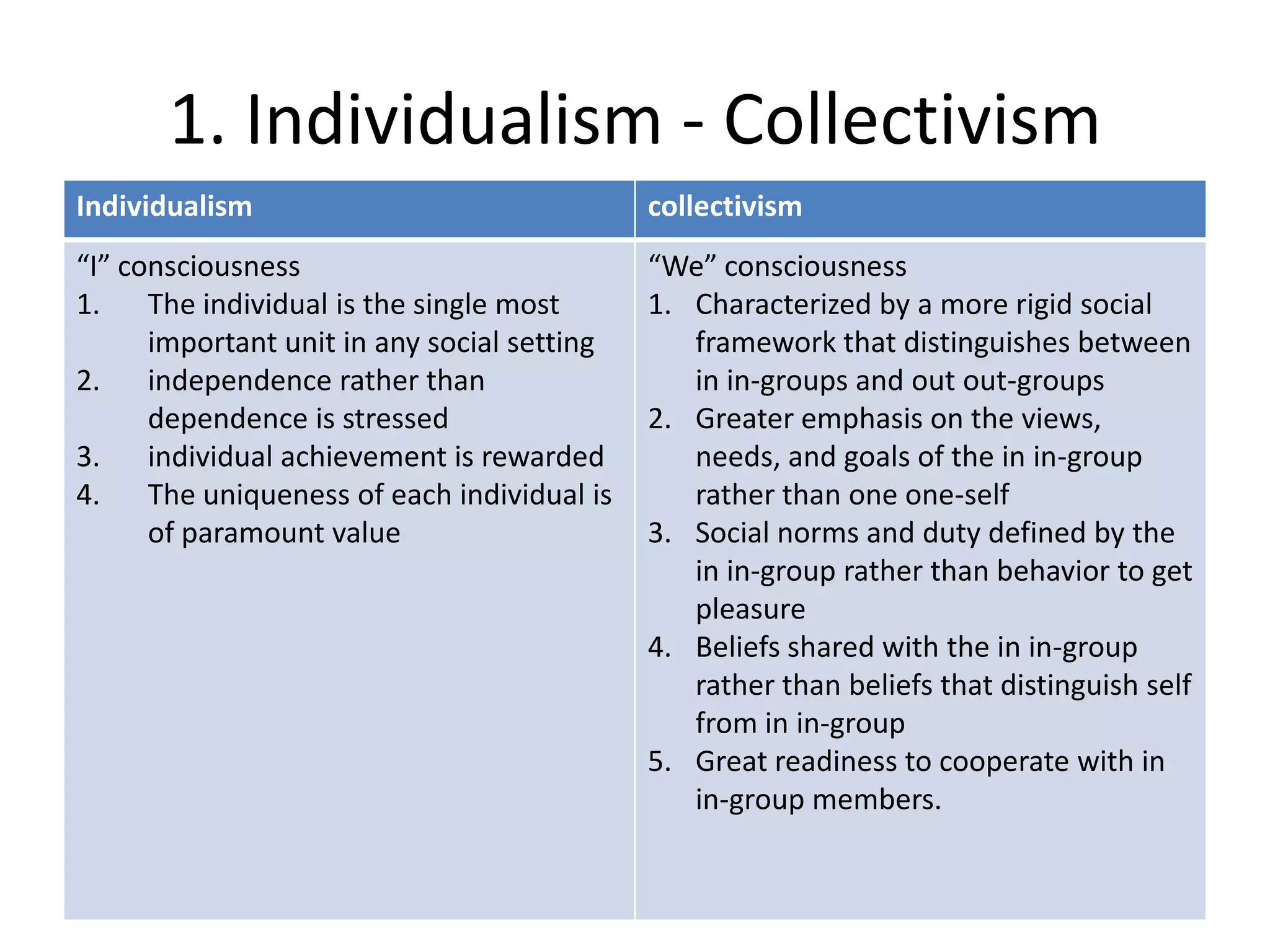
Individualism - CollectivismThe degree to which individuals are supposed to look after themselves (individualism) or remain integrated into groups (collectivism).All cultures have both individual and collective dispositions
1. Individualism - Collectivism
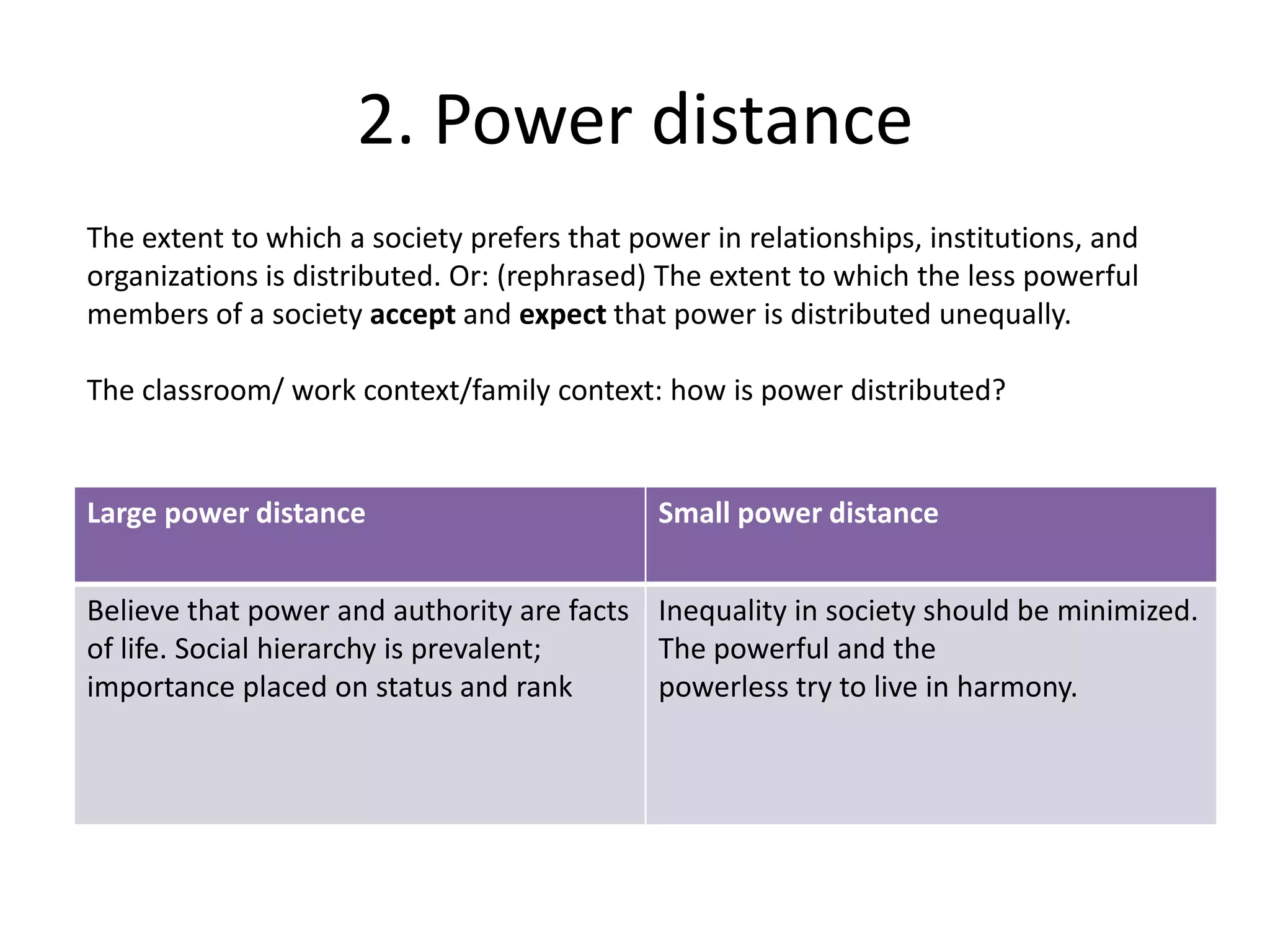
2. Power distanceThe extent to which a society prefers that power in relationships, institutions, and organizations is distributed. Or: (rephrased) The extent to which the less powerful members of a society accept and expect that power is distributed unequally.The classroom/ work context/family context: how is power distributed?
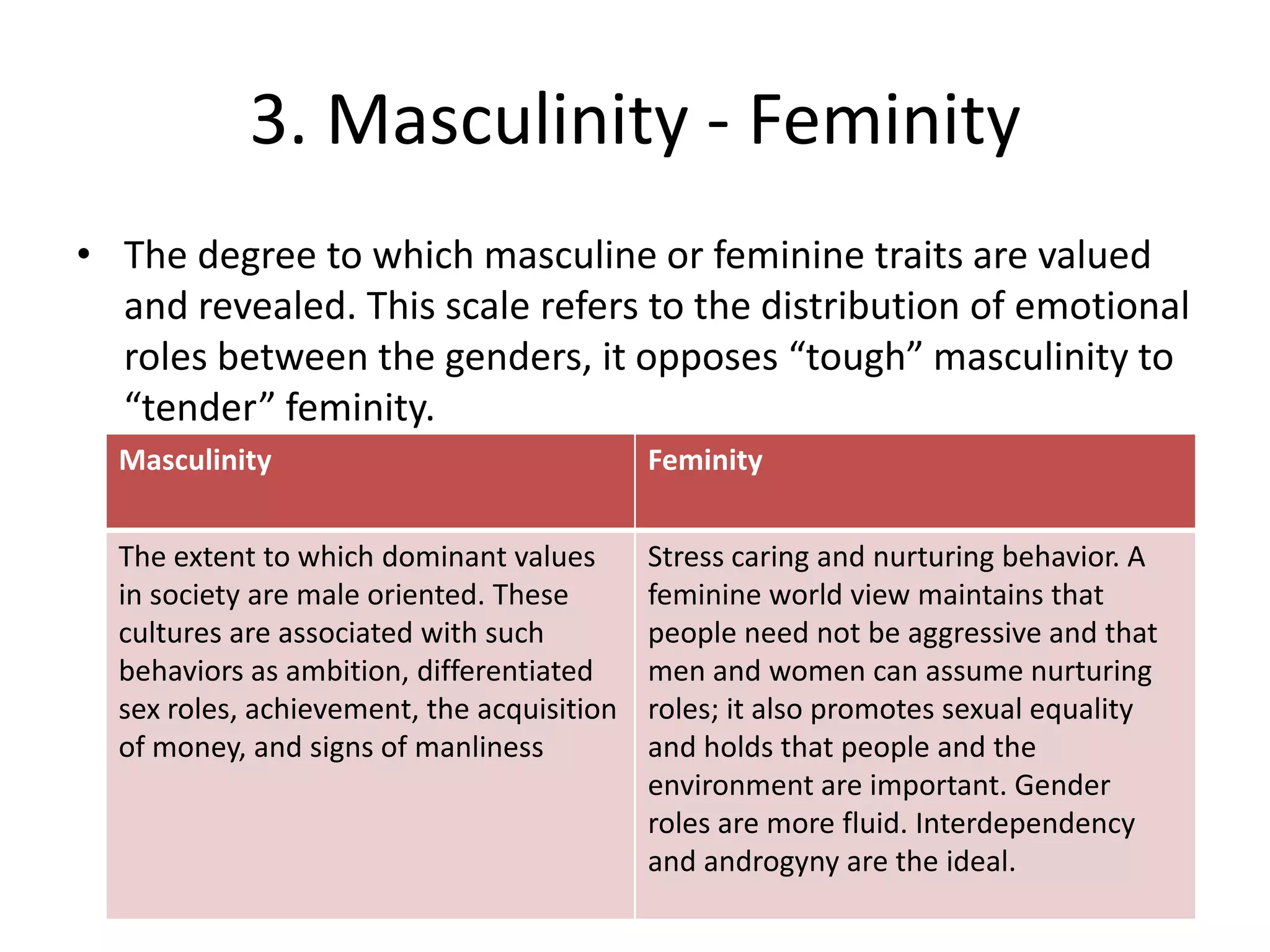
3. Masculinity - FeminityThe degree to which masculine or feminine traits are valued and revealed. This scale refers to the distribution of emotional roles between the genders, it opposes “tough” masculinity to “tender” feminity.
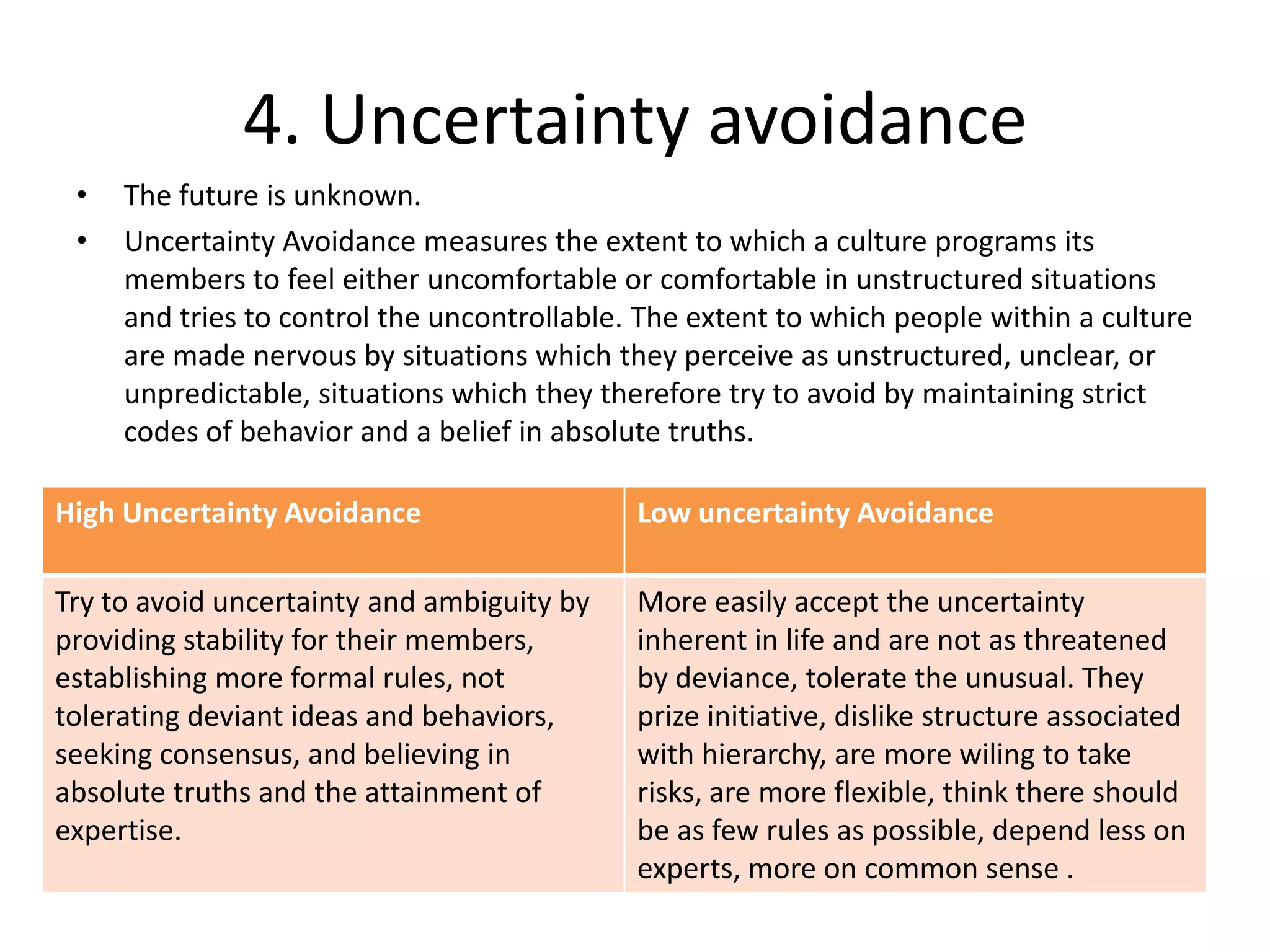
4. Uncertainty avoidanceThe future is unknown. Uncertainty Avoidance measures the extent to which a culture programs its members to feel either uncomfortable or comfortable in unstructured situations and tries to control the uncontrollable. The extent to which people within a culture are made nervous by situations which they perceive as unstructured, unclear, or unpredictable, situations which they therefore try to avoid by maintaining strict codes of behavior and a belief in absolute truths.
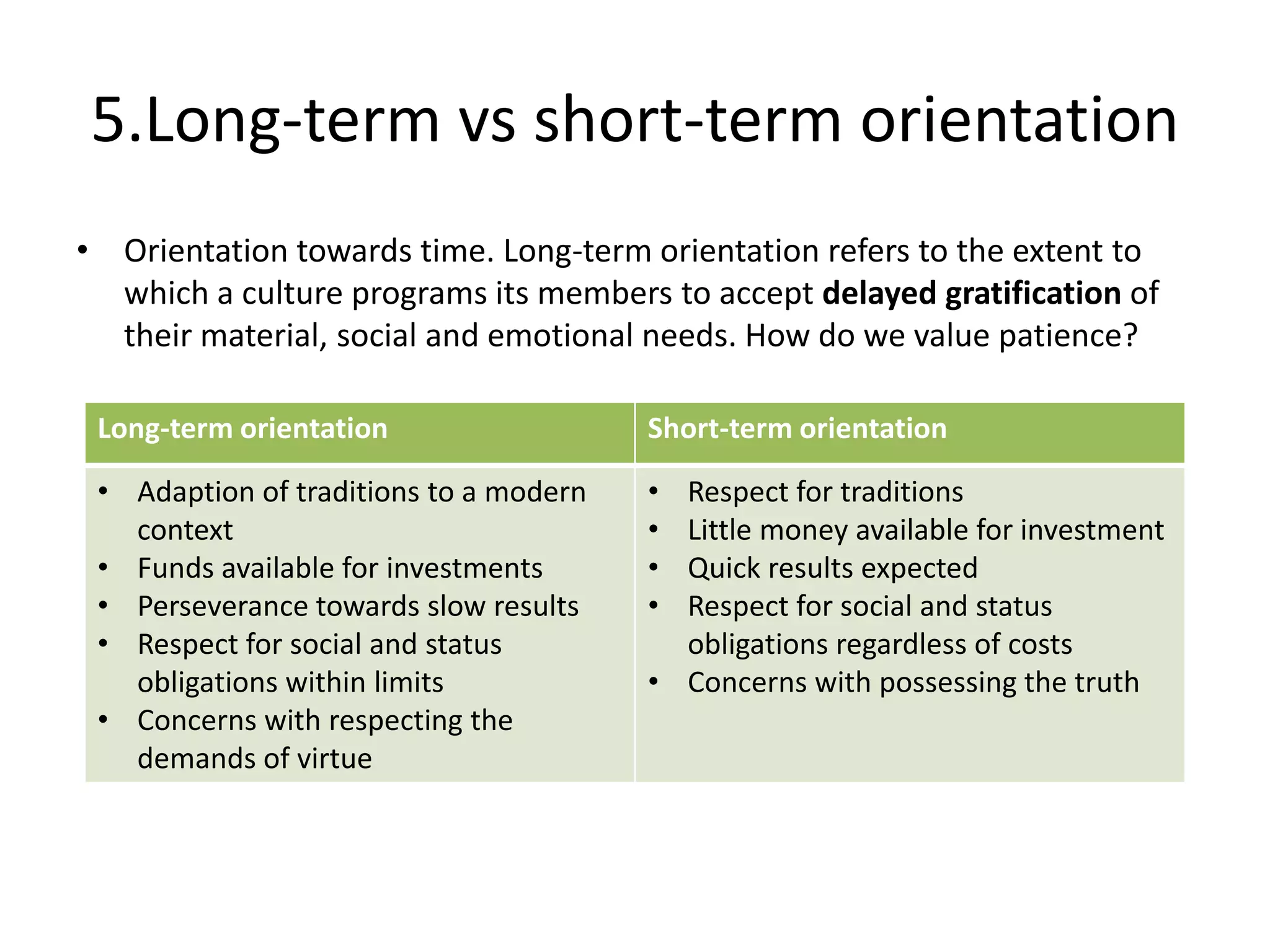
5.Long-term vs short-term orientationOrientation towards time. Long-term orientation refers to the extent to which a culture programs its members to accept delayed gratification of their material, social and emotional needs. How do we value patience?
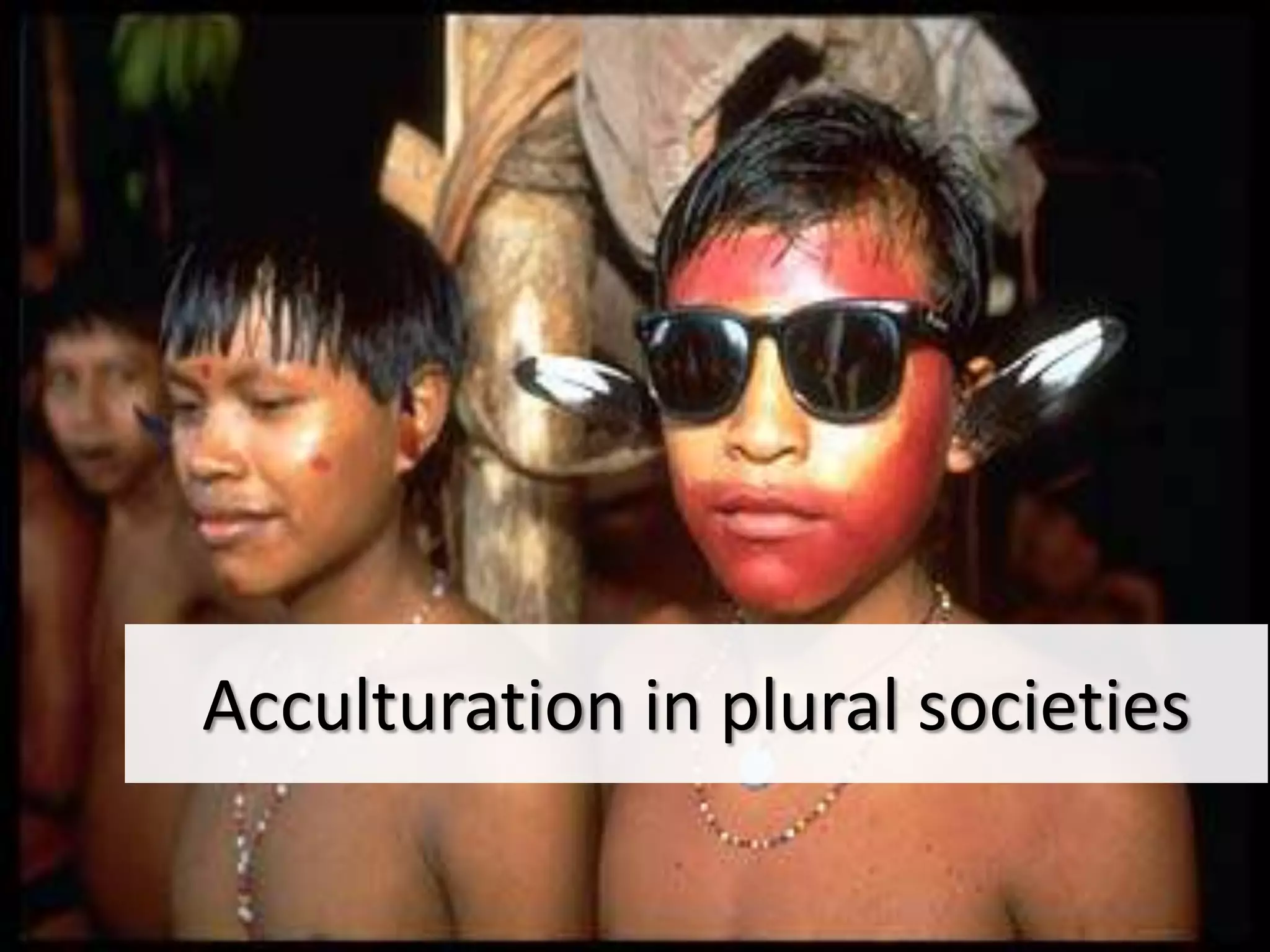
Acculturation in plural societies
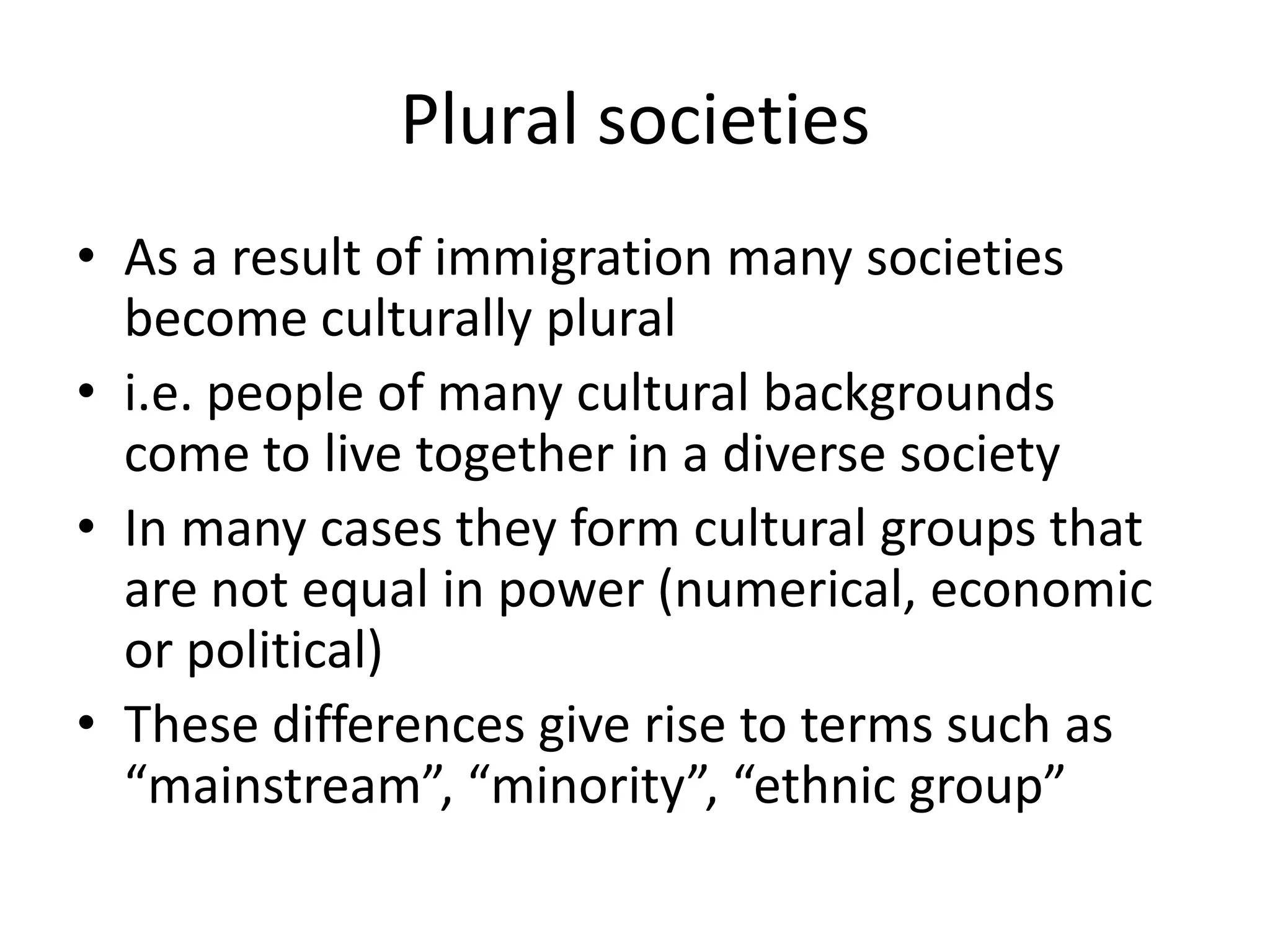
Plural societiesAs a result of immigration many societies become culturally plurali.e. people of many cultural backgrounds come to live together in a diverse societyIn many cases they form cultural groups that are not equal in power (numerical, economic or political)These differences give rise to terms such as “mainstream”, “minority”, “ethnic group”
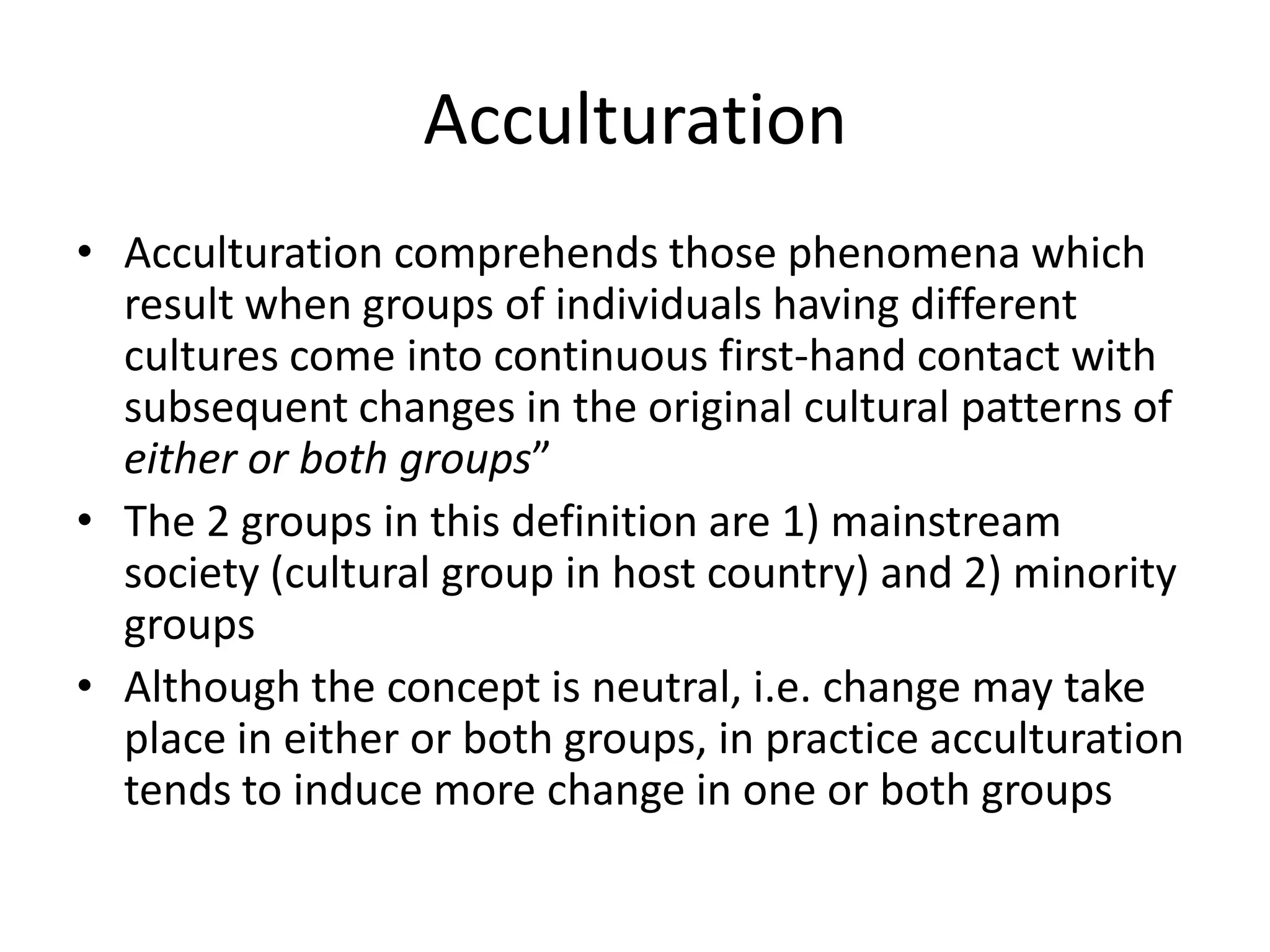
Acculturation Acculturation comprehends those phenomena which result when groups of individuals having different cultures come into continuous first-hand contact with subsequent changes in the original cultural patterns of either or both groups”The 2 groups in this definition are 1) mainstream society (cultural group in host country) and 2) minority groups Although the concept is neutral, i.e. change may take place in either or both groups, in practice acculturation tends to induce more change in one or both groups
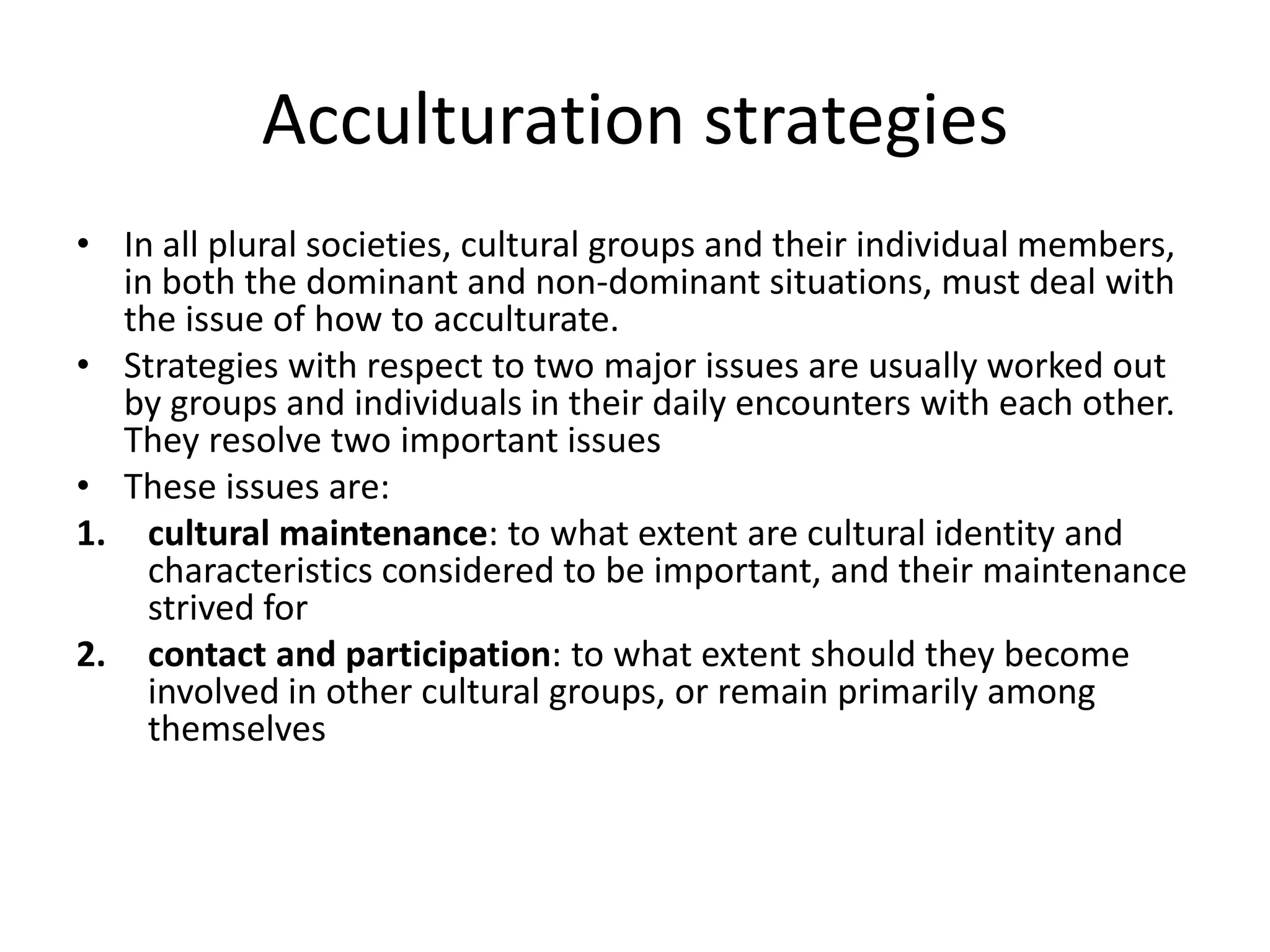
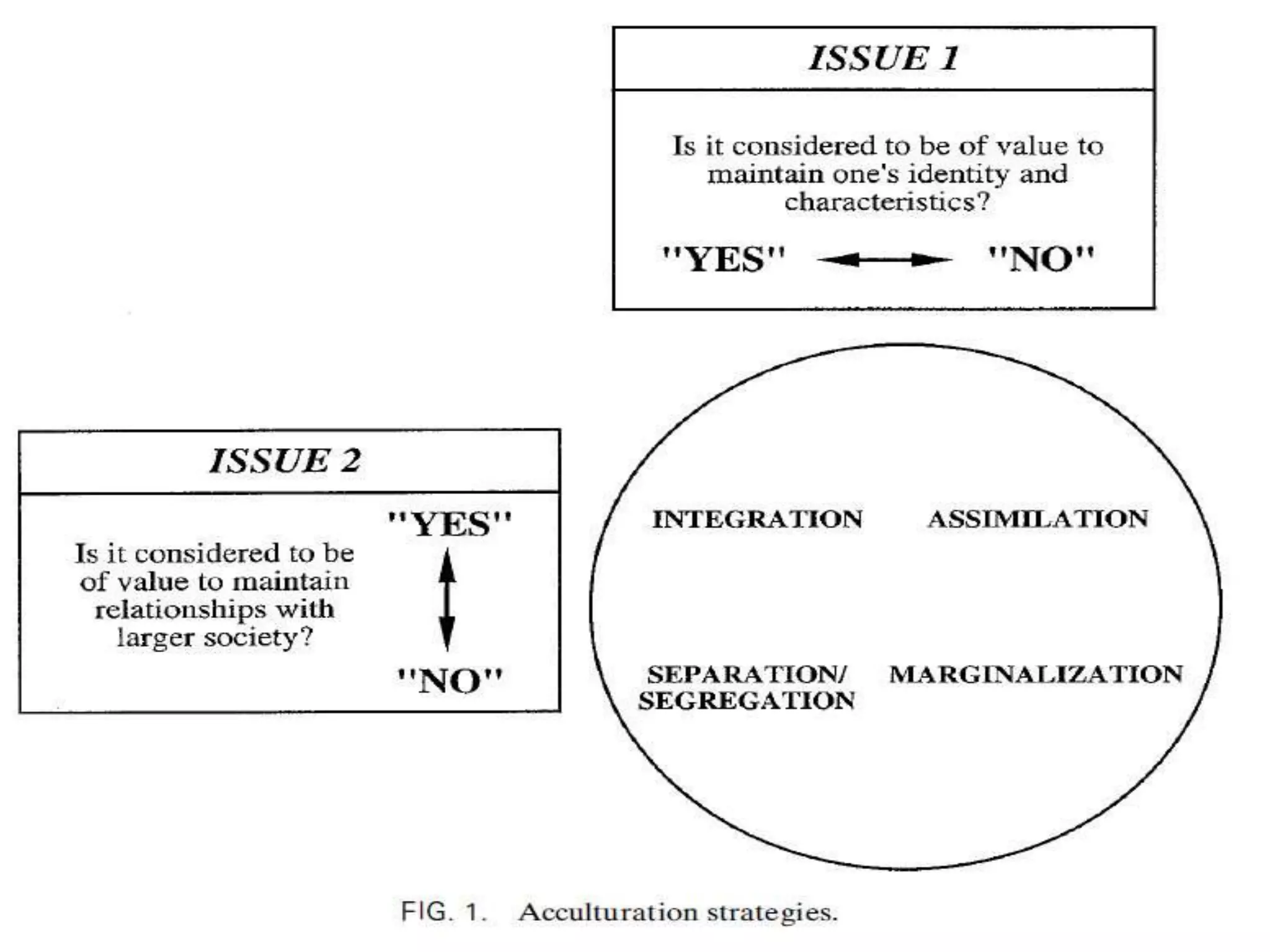
Acculturation strategiesIn all plural societies, cultural groups and their individual members, in both the dominant and non-dominant situations, must deal with the issue of how to acculturate. Strategies with respect to two major issues are usually worked out by groups and individuals in their daily encounters with each other. They resolve two important issuesThese issues are: cultural maintenance: to what extent are cultural identity and characteristics considered to be important, and their maintenance strived forcontact and participation: to what extent should they become involved in other cultural groups, or remain primarily among themselves
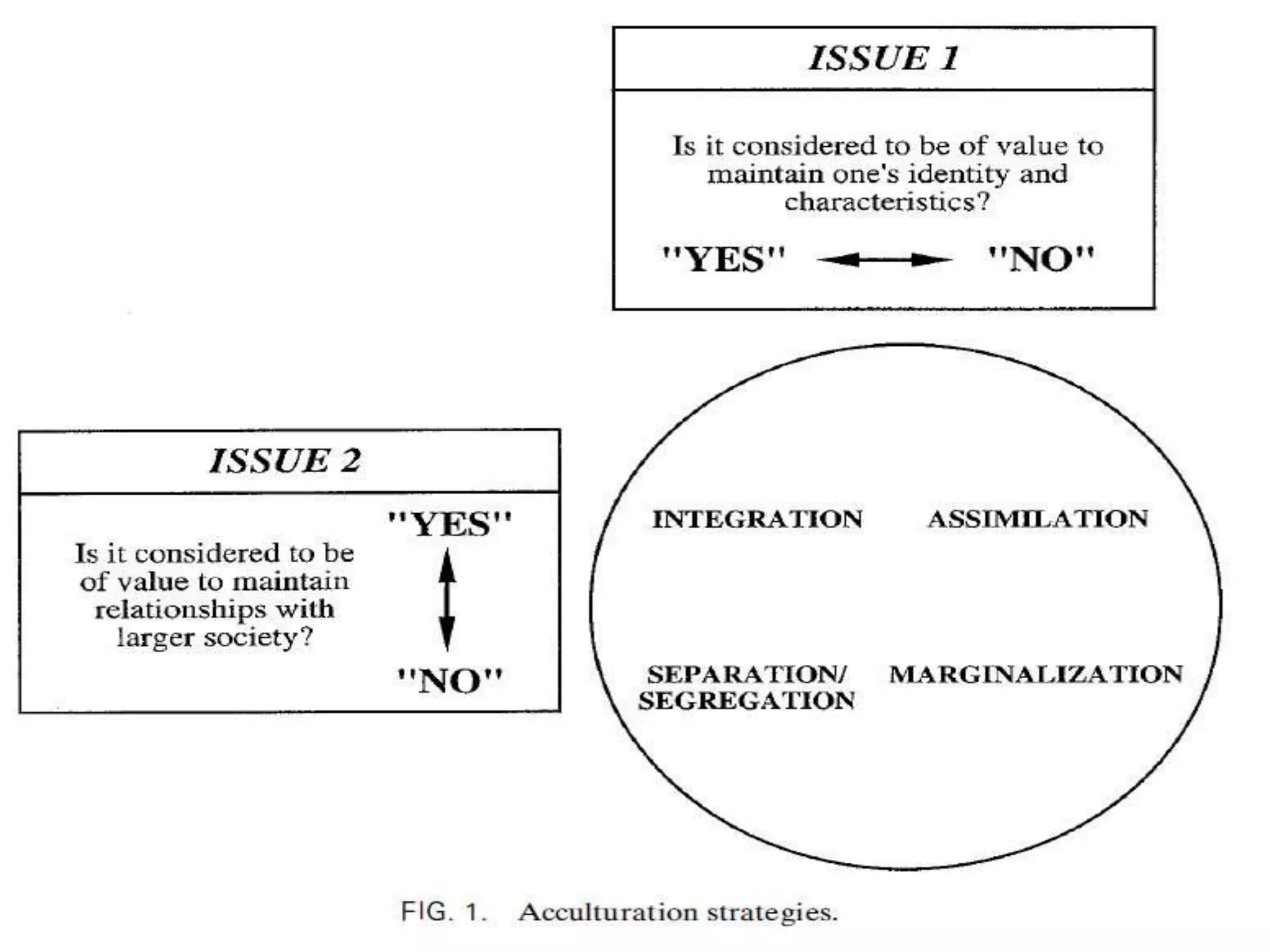
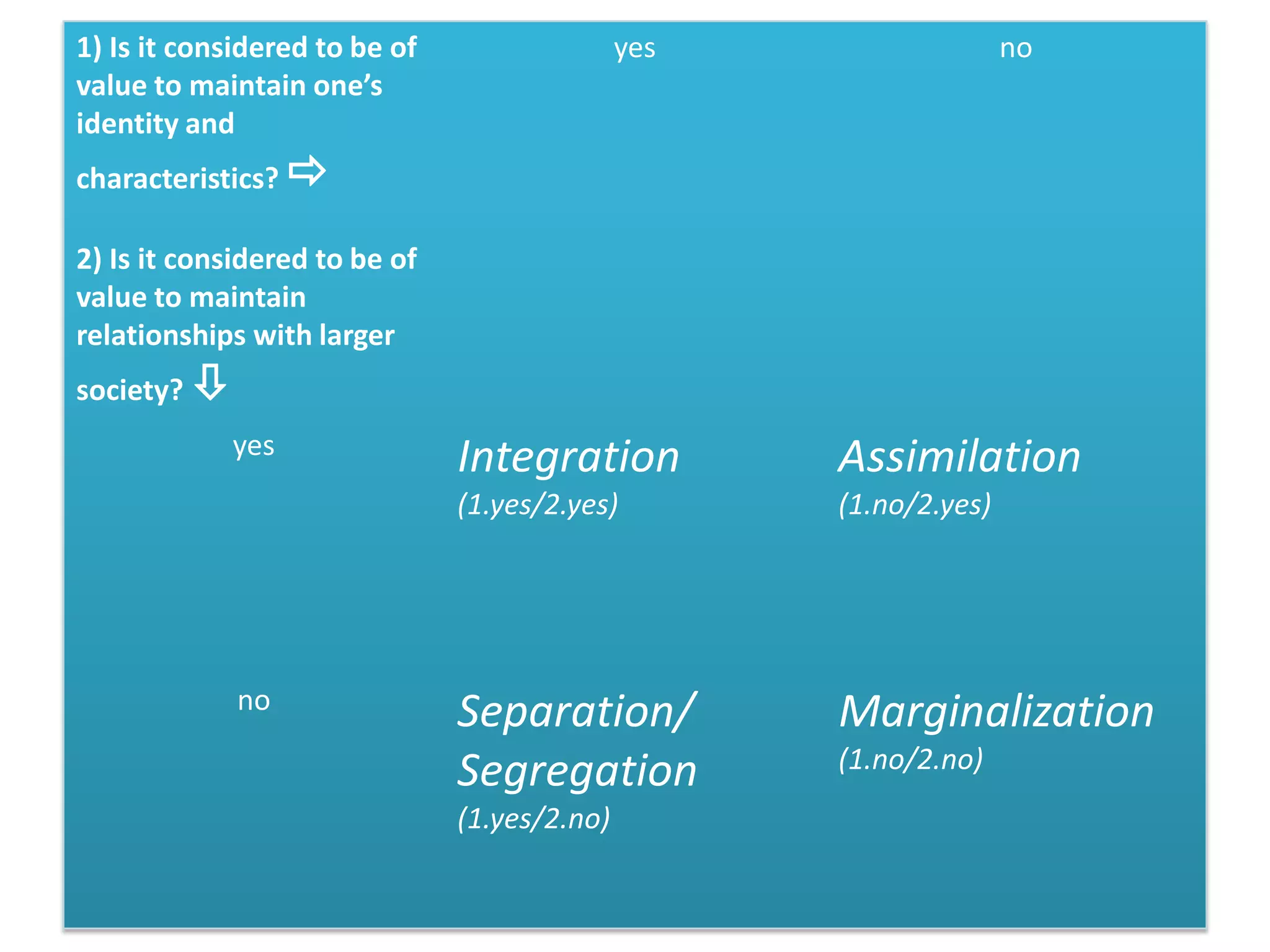
The process:When these two underlying issues are considered simultaneously, a conceptual framework (Fig. 1) is generated which posits four acculturation  strategies. These two issues can be responded to on attitudinal dimensions, represented by bipolar arrows. For purposes of presentation, generally positive or negative (“yes” or “no” responses) to these issues intersect to define four acculturation strategies
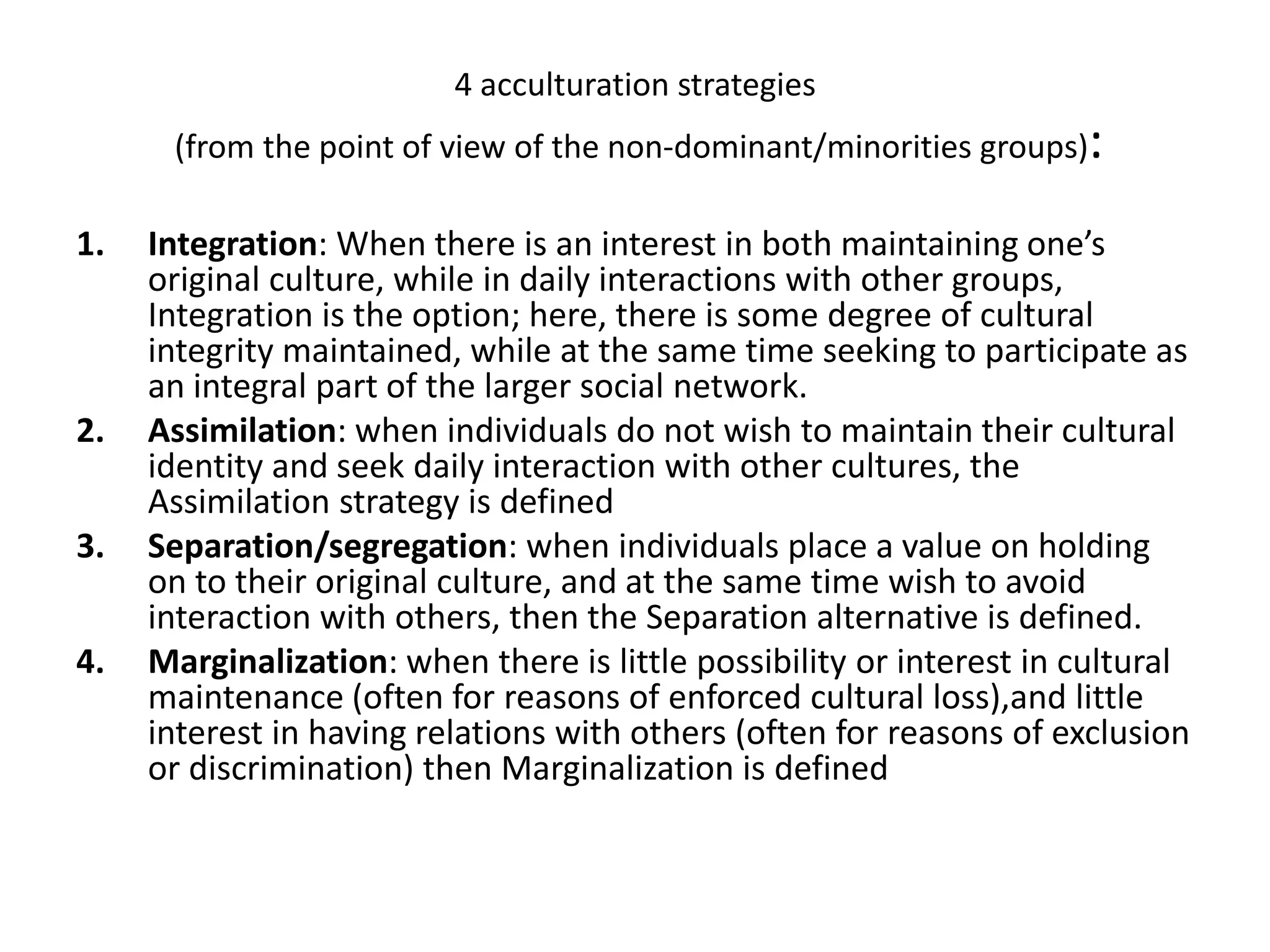
4 acculturation strategies (from the point of view of the non-dominant/minorities groups):Integration: When there is an interest in both maintaining one’s original culture, while in daily interactions with other groups, Integration is the option; here, there is some degree of cultural integrity maintained, while at the same time seeking to participate as an integral part of the larger social network.Assimilation: when individuals do not wish to maintain their cultural identity and seek daily interaction with other cultures, the Assimilation strategy is definedSeparation/segregation: when individuals place a value on holding on to their original culture, and at the same time wish to avoid interaction with others, then the Separation alternative is defined. Marginalization: when there is little possibility or interest in cultural maintenance (often for reasons of enforced cultural loss),and little interest in having relations with others (often for reasons of exclusion or discrimination) then Marginalization is defined

Unit 6 culture and identity

  • 2.
    Objectives unit 6Introducethe concept of culture Relate the concept of identity to cultureIntroduce the concept of cultural variability and operationalize this in different cultural dimensions (Hofstede)Present the concept of acculturation, how this relates to cultural identity and multicultural societiesApply abovementioned concepts/theories (point 1-4) to Aruba’s context
  • 3.
    Census Aruba 2010:Aruba is multicultural and has always been“Aruba tin 96 diferentenacionalidad di 133 diferentepais”Aruba has 96 different nationalities from 133 different countries
  • 5.
    Activity 1:In yourown words, what does culture mean to you and what associations do you get when thinking about culture?
  • 6.
    “A way oflife”The full range of learned human behavior patternsEverything that people create or develop:Values, norms, goals, and culture in general develop as people interact with each other over time;It includes beliefs, values, behaviors and physical objects that create a people’s way of lifePeople create their culture, and this culture in turn shapes their behavior
  • 7.
    The concept ofcultureDefinition of culture as a concept has implications for our categorization processes, the way we describe, evaluate, understand and communicate about cultures (ours and theirs) Difference between static and dynamic approaches of the concept cultureA statically entity, block, unchanging, monolithicA dynamic entity, changeable, contextual and with internal variations Stereotypes are often related with statically views of culture (unchanging, generalizations, “they all are the same”)
  • 8.
    Defining Culture:Cultureas “processes of continuing shifting and changingsystems of meaning” *. There are “shared systems of values, norms, ideas, attitudes, behaviours, means of communication and the products of these” ** that are continuingly created in the interaction with their particular environment. [Systems of meaning] that play an important role in shaping the behaviour of the individual.*** *Bartels en Brouwer, 1999:16**Van Oudenhoven, 2002: 14*** Berry, 1997
  • 9.
    A more practicaldefinition of cultureThe full range of learned human behaviour patterns. It refers to everything that people create or develop. Values, norms, goals and culture in general develop as people interact with one another over time. It includes beliefs, values, behaviours and physical objects that create a people’s way of lifePeople create their culture and this culture in turn shapes their behaviour
  • 11.
    Characteristics of CultureCultureis learnt (socialization, see unit 5)Culture is dynamic: ongoing process shaping and re-shaping itself, variable over time and placeCulture is shared(negotiated agreements: conventions)Culture is transmittable(from one generation to the other one)Culture is adaptive: in order to survive, it must adapt to changes in societyCulture is symbolic
  • 12.
    Activity 2:Compare theculture of your grandparents with yours:Culture is variable over time and place!
  • 13.
    2 types ofcultureMaterial culturePart of the culture that is concrete and tangible, the material things that a society creates and uses for survival; Physical and technological aspects of our daily lives, including: food, houses, clothing, paintings, books etc…Non-material cultureAll intangible components of our ways of life: language, norms, ideas, believes, it includes: religion, techniques, philosophies etc…shared by members of the society
  • 14.
    Activity 3: State whetherthe examples below represent material or non-material culture:FoodNormsMonumentsValuesReligious beliefsClothingIdeasChurch buildingsBeliefsArt
  • 15.
    Activity 4: Arubansare/ormy specific cultural group, is...Imagine you are living abroad, and you have to explain to your new friends what it means to be ‘Aruban’ or your specific cultural group?How would you describe the Arubanculture or yourspecificculturalgrouptoyour new friends?
  • 16.
    StereotypingTo stereotype someoneis to attribute to that person some characteristics which are seen to be shared by all or most of his or her fellow group members (Brown, 1995)Stereotypes canleadtoprejudice
  • 18.
    StereotypesPrejudicePrejudice: the holdingof derogatory social attitudes or cognitive beliefs, the expression of negative affect or display of hostile or discriminatory behaviour towards members of a group on account of their membership of that group (Brown, 1995)
  • 19.
  • 20.
    “Culture is likea mental software”Culture is always a collective phenomenon, shared by individuals that live in the same social environment. Culture is composed of the unwritten rules of the social game. It is the collective mental programming of the members of a group or categories of people that distinguish themselves from other groups/categoriesThe foundation for most cross-cultural interpretation is the work of Geert Hofstede. Geert Hofstede
  • 21.
    5 dimensions (Hofstede)Thefoundation for most cross-cultural interpretation is the work of Geert Hofstede. He studied the value dimensions that vary across culturesHofstede developed with the help of large-scale (+/- 50 countries) samples starting in the 1970s cultural index scores for five constructs:Power distance,Uncertainty avoidance,Individualism/Collectivism,Masculinity/Feminity andLong term/Short term orientation.
  • 24.
    Individualism - CollectivismThedegree to which individuals are supposed to look after themselves (individualism) or remain integrated into groups (collectivism).All cultures have both individual and collective dispositions
  • 25.
    1. Individualism -Collectivism
  • 26.
    2. Power distanceTheextent to which a society prefers that power in relationships, institutions, and organizations is distributed. Or: (rephrased) The extent to which the less powerful members of a society accept and expect that power is distributed unequally.The classroom/ work context/family context: how is power distributed?
  • 27.
    3. Masculinity -FeminityThe degree to which masculine or feminine traits are valued and revealed. This scale refers to the distribution of emotional roles between the genders, it opposes “tough” masculinity to “tender” feminity.
  • 28.
    4. Uncertainty avoidanceThefuture is unknown. Uncertainty Avoidance measures the extent to which a culture programs its members to feel either uncomfortable or comfortable in unstructured situations and tries to control the uncontrollable. The extent to which people within a culture are made nervous by situations which they perceive as unstructured, unclear, or unpredictable, situations which they therefore try to avoid by maintaining strict codes of behavior and a belief in absolute truths.
  • 29.
    5.Long-term vs short-termorientationOrientation towards time. Long-term orientation refers to the extent to which a culture programs its members to accept delayed gratification of their material, social and emotional needs. How do we value patience?
  • 30.
  • 31.
    Plural societiesAs aresult of immigration many societies become culturally plurali.e. people of many cultural backgrounds come to live together in a diverse societyIn many cases they form cultural groups that are not equal in power (numerical, economic or political)These differences give rise to terms such as “mainstream”, “minority”, “ethnic group”
  • 32.
    Acculturation Acculturation comprehendsthose phenomena which result when groups of individuals having different cultures come into continuous first-hand contact with subsequent changes in the original cultural patterns of either or both groups”The 2 groups in this definition are 1) mainstream society (cultural group in host country) and 2) minority groups Although the concept is neutral, i.e. change may take place in either or both groups, in practice acculturation tends to induce more change in one or both groups
  • 34.
    Acculturation strategiesIn allplural societies, cultural groups and their individual members, in both the dominant and non-dominant situations, must deal with the issue of how to acculturate. Strategies with respect to two major issues are usually worked out by groups and individuals in their daily encounters with each other. They resolve two important issuesThese issues are: cultural maintenance: to what extent are cultural identity and characteristics considered to be important, and their maintenance strived forcontact and participation: to what extent should they become involved in other cultural groups, or remain primarily among themselves
  • 35.
    The process:When thesetwo underlying issues are considered simultaneously, a conceptual framework (Fig. 1) is generated which posits four acculturation strategies. These two issues can be responded to on attitudinal dimensions, represented by bipolar arrows. For purposes of presentation, generally positive or negative (“yes” or “no” responses) to these issues intersect to define four acculturation strategies
  • 38.
    4 acculturation strategies(from the point of view of the non-dominant/minorities groups):Integration: When there is an interest in both maintaining one’s original culture, while in daily interactions with other groups, Integration is the option; here, there is some degree of cultural integrity maintained, while at the same time seeking to participate as an integral part of the larger social network.Assimilation: when individuals do not wish to maintain their cultural identity and seek daily interaction with other cultures, the Assimilation strategy is definedSeparation/segregation: when individuals place a value on holding on to their original culture, and at the same time wish to avoid interaction with others, then the Separation alternative is defined. Marginalization: when there is little possibility or interest in cultural maintenance (often for reasons of enforced cultural loss),and little interest in having relations with others (often for reasons of exclusion or discrimination) then Marginalization is defined

Editor's Notes

  • #31 The Yanomami Indians Of The Amazon Rainforest URL: http://www.rainforests.net/antoniomari.htm
  • #34 Extracted from Berry (1997). Immigration, Acculturation and Adaption (Lead Article)
  • #37 Extracted from Berry (1997). Immigration, Acculturation and Adaption (Lead Article)