IHRM – UNDERSTANDING CULTURE
    AND MULTICULTURALISM
                    Amaresh C Nayak
Understanding Culture

   • A culture refers to a system of shared meaning
     held by the organization’s members that
     distinguishes the organisation from other
     organizations.
   • The organization’s culture refers to a system of a
     shared meaning.
Understanding Culture

   • Culture is understood as the customs, beliefs,
     norms and values that guide the behaviour of the
     people in a society and that are passed on from
     one generation to the next.
Understanding Culture

   • Culture has normative value. It prescribes do's
     and don’ts which are binding on the members of a
     society.
   • Culture is a group phenomenon. Culture applies
     to the members of a society. Society's normative
     values are binding on each member and not vice
     versa.
   • Cultural practices are passed on from generation
     to generation.
Understanding Culture - Characteristics
   • Innovation and risk taking.
   • Attention to detail: employees are expected to exhibit
     precision, analysis and attention to details.
   • Outcome orientation: Focuses on results or outcomes
     rather than on the techniques and processes
   • People orientation: Takes into consideration the effect of
     outcomes on people within the organisation.
   • Team orientation: The degree to which work activities are
     organised around teams rather than individuals.
   • Aggressiveness: The people’s aggressiveness and
     competitive atmosphere.
   • Stability: The organisations activities maintains the statue
     quo in contrast to growth.
Understanding Culture

   • Dominant culture - pervasive and extends to the
     whole of a country
   • Subcultures exist within the dominant culture.
      – Subcultures subsume into the dominant culture to
        present a unified culture, typifying "unity in diversity".
   • Organisational culture - Every organisation will
     have its own distinct culture.
   • Occupational Culture - Each profession carries its
     own culture and it cuts across dominant cultures.
Organisational Culture - Functions
   • It has a boundary, defining role that creates a distinction
     between one organisation to others.
   • It conveys a sense of identity for organisation members.
   • Culture facilitates the generation of commitment to something
     larger than one’s individual self-interest.
   • It enhances the social system stability. Culture is the social
     value that helps hold the organizations together.
   • The culture serves us a sense-making and control mechanism
     that guides and shapes the attitudes and behaviours of
     employees.
   • Culture enhances the organizational commitment and
     increases the consistency of employee behaviour.
   • Culture reduces ambiguity among its members.
Factors Affecting Cultural Predispositions

   • Founder’s philosophy
   • Criteria used in hiring
   • Actions of the current top management
   • Code of conduct
   • The degree of success achieved
   • Matching new employees values to those of the
     organisation
   • The top managements preference for socialization
     methods.
Factors Affecting Cultural Predispositions

   • The Learned Modifications
     – Stories
     – Rituals
     – Material symbols
     – Language
Culture - The Organizational context
   • Culture can be defined as
      – a cumulative, crystallized and quasistable shared life-style of
        people
      – reflected in the preference of some states of life over others
        (values)
      – in the response predispositions towards several significant
        issues and phenomena (attitudes)
      – in the organized ways of filling time in relation to certain affairs
        (rituals)
      – in the ways of promoting desired, and preventing undesirable
        behaviour (sanctions).
   • The most important aspect of organizational culture are
     the values it practices.
The OCTAPACE
  •   Openness – The degree of openness of the organisation will be
      an important factor in determining the nature of the various
      dimensions of HRS being designed, as well as the way in which
      these dimensions should be introduced.
  •   Confrontation – The term confrontation is used in relation to
      problems, ‘putting the front’ rather than ‘the back’ to (escaping) the
      problems. Confrontation implies facing a problem and working
      jointly with others concerned to find its solution. If the culture of
      confrontation is low, the organisation needs to have preparatory
      work for developing counseling / coaching competencies before
      introducing a sophisticated HRDs.
  •   Trust – If the trust is low, the various dimensions of the HRS are
      likely to be seen with suspicion, and therefore, the credibility of the
      system may go down.
The OCTAPACE

  • Authenticity – It is the willingness of a person to acknowledge the
    feelings he/she has. Authenticity is reflected in the narrowest gap
    between the stated values and the actual behaviour.
  • Proactivity – The term ‘proact’ can be contrasted with the term
    ‘react’. Proaction means anticipating issues and acting to take
    advantage of this understanding.
  • Autonomy – It is the willingness to use power without fear, and
    helping others to do the same on the basis of collaboration.
  • Collaboration – This involves working together and using one
    another’s strengths for a common use. Collaboration is reflected in
    strong and effective teams and inter-teams in an organisation.
  • Experimenting – As the value emphasizes the importance given
    to innovation and trying out new ways of dealing with such
    problems in the organisations.
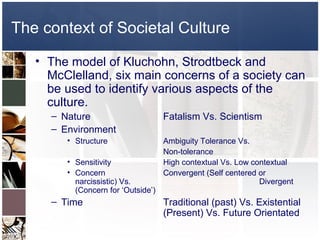
The context of Societal Culture

   • The model of Kluchohn, Strodtbeck and
     McClelland, six main concerns of a society can
     be used to identify various aspects of the
     culture.
     – Nature                       Fatalism Vs. Scientism
     – Environment
        • Structure                 Ambiguity Tolerance Vs.
                                    Non-tolerance
        • Sensitivity               High contextual Vs. Low contextual
        • Concern                   Convergent (Self centered or
          narcissistic) Vs.                                   Divergent
          (Concern for ‘Outside’)
     – Time                         Traditional (past) Vs. Existential
                                    (Present) Vs. Future Orientated
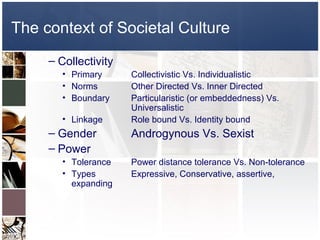
The context of Societal Culture
     – Collectivity
       • Primary      Collectivistic Vs. Individualistic
       • Norms        Other Directed Vs. Inner Directed
       • Boundary     Particularistic (or embeddedness) Vs.
                      Universalistic
       • Linkage      Role bound Vs. Identity bound
     – Gender         Androgynous Vs. Sexist
     – Power
       • Tolerance    Power distance tolerance Vs. Non-tolerance
       • Types        Expressive, Conservative, assertive,
         expanding
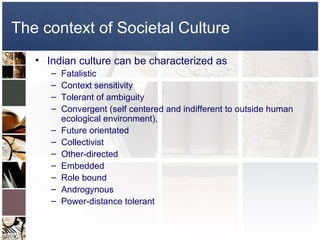
The context of Societal Culture
   • Indian culture can be characterized as
      –   Fatalistic
      –   Context sensitivity
      –   Tolerant of ambiguity
      –   Convergent (self centered and indifferent to outside human
          ecological environment),
      –   Future orientated
      –   Collectivist
      –   Other-directed
      –   Embedded
      –   Role bound
      –   Androgynous
      –   Power-distance tolerant
MULTICULTURALISM

  • Multiculturalism means that people from many
    cultures (and frequently many countries) interact
    regularly.
  • Global firms are repositories of multiculturalism.
  • Not that the domestic firms have only
    monocultures.
Cultural Predispositions

   • Ethnocentrism
   • The home country’s culture is sought to be imposed on
     subsidiaries.
   • The MNC exports its HR policies and practices from home
     office to foreign locations.
   • Ethnocentric policy is justified on the following reasons:
      – Need to maintain a unified corporate culture among all
        subsidiaries.
   • An ethnocentric policy - disadvantages:
      – Expatriate managers may not be able to adapt to local
        conditions easily and early.
      – Expatriate managers are often poorly trained for international
        assignments and tend to commit mistakes.
Cultural Predispositions

   • Polycentricism
   • Multinational Corporation seeks to adapt to the local
     cultural needs of subsidiaries
   • Polycentricism is more pronounced in the context of
     human resource practices
   • Does not bestow absolute freedom to subsidiary heads as
     stand alone units
   • Host-country managers visit home offices for extended
     periods to get acquainted with the company's culture and
     are taught how to protect the nuances of corporate culture,
     respecting of course, the host country's beliefs and values.
Cultural Predispositions

   • Regiocentricism
   • Regiocentric approach operates in the same way
     as polycentricism
   • IHRM practices are applicable to regions.
Cultural Predispositions

   • Geocentricism
   • Subsidiary operations are managed by the best
     qualified individuals, regardless of their nationality
   • The capable managers adapt easily and well to
     different cultures and usually arc bilingual or
     multilingual
CULTURE DIMENSIONS

  • Globe Project
  • The GLOBE (Global Leadership and Organisational
    Behaviour Effectiveness) project team identified nine
    cultural dimensions distinguishing one society to another
     – Assertiveness - individuals in organisations or societies are
       expected to be tough, confrontational and competitive versus
       modest
     – Future Orientation - future-oriented behaviours, delaying
       immediate gratification.
     – Performance Orientation - strive for continued improvement
       and excellence.
     – Human Orientation - individuals are encourage and reward for
       being altruistic, generous, caring and kind to others.
CULTURE DIMENSIONS

  • Globe Project
     – Gender Differentiation - role differentiation and gender
       discrimination.
     – In-group Collectivism - individuals express pride, loyalty, and
       cohesiveness in their organisations or families.
     – Collectivism/Societal - organisational and societal practices
       encourage and reward collective distribution of resources and
       collective action.
     – Power Distance - power should be unequally distributed.
     – Uncertainty Avoidance - relying on social norms, rituals and
       bureaucratic practices lo minimize the unpredictability of future
       happenings
THANK YOU

Ihrm culture

  • 1.
    IHRM – UNDERSTANDINGCULTURE AND MULTICULTURALISM Amaresh C Nayak
  • 2.
    Understanding Culture • A culture refers to a system of shared meaning held by the organization’s members that distinguishes the organisation from other organizations. • The organization’s culture refers to a system of a shared meaning.
  • 3.
    Understanding Culture • Culture is understood as the customs, beliefs, norms and values that guide the behaviour of the people in a society and that are passed on from one generation to the next.
  • 4.
    Understanding Culture • Culture has normative value. It prescribes do's and don’ts which are binding on the members of a society. • Culture is a group phenomenon. Culture applies to the members of a society. Society's normative values are binding on each member and not vice versa. • Cultural practices are passed on from generation to generation.
  • 5.
    Understanding Culture -Characteristics • Innovation and risk taking. • Attention to detail: employees are expected to exhibit precision, analysis and attention to details. • Outcome orientation: Focuses on results or outcomes rather than on the techniques and processes • People orientation: Takes into consideration the effect of outcomes on people within the organisation. • Team orientation: The degree to which work activities are organised around teams rather than individuals. • Aggressiveness: The people’s aggressiveness and competitive atmosphere. • Stability: The organisations activities maintains the statue quo in contrast to growth.
  • 6.
    Understanding Culture • Dominant culture - pervasive and extends to the whole of a country • Subcultures exist within the dominant culture. – Subcultures subsume into the dominant culture to present a unified culture, typifying "unity in diversity". • Organisational culture - Every organisation will have its own distinct culture. • Occupational Culture - Each profession carries its own culture and it cuts across dominant cultures.
  • 7.
    Organisational Culture -Functions • It has a boundary, defining role that creates a distinction between one organisation to others. • It conveys a sense of identity for organisation members. • Culture facilitates the generation of commitment to something larger than one’s individual self-interest. • It enhances the social system stability. Culture is the social value that helps hold the organizations together. • The culture serves us a sense-making and control mechanism that guides and shapes the attitudes and behaviours of employees. • Culture enhances the organizational commitment and increases the consistency of employee behaviour. • Culture reduces ambiguity among its members.
  • 8.
    Factors Affecting CulturalPredispositions • Founder’s philosophy • Criteria used in hiring • Actions of the current top management • Code of conduct • The degree of success achieved • Matching new employees values to those of the organisation • The top managements preference for socialization methods.
  • 9.
    Factors Affecting CulturalPredispositions • The Learned Modifications – Stories – Rituals – Material symbols – Language
  • 10.
    Culture - TheOrganizational context • Culture can be defined as – a cumulative, crystallized and quasistable shared life-style of people – reflected in the preference of some states of life over others (values) – in the response predispositions towards several significant issues and phenomena (attitudes) – in the organized ways of filling time in relation to certain affairs (rituals) – in the ways of promoting desired, and preventing undesirable behaviour (sanctions). • The most important aspect of organizational culture are the values it practices.
  • 11.
    The OCTAPACE • Openness – The degree of openness of the organisation will be an important factor in determining the nature of the various dimensions of HRS being designed, as well as the way in which these dimensions should be introduced. • Confrontation – The term confrontation is used in relation to problems, ‘putting the front’ rather than ‘the back’ to (escaping) the problems. Confrontation implies facing a problem and working jointly with others concerned to find its solution. If the culture of confrontation is low, the organisation needs to have preparatory work for developing counseling / coaching competencies before introducing a sophisticated HRDs. • Trust – If the trust is low, the various dimensions of the HRS are likely to be seen with suspicion, and therefore, the credibility of the system may go down.
  • 12.
    The OCTAPACE • Authenticity – It is the willingness of a person to acknowledge the feelings he/she has. Authenticity is reflected in the narrowest gap between the stated values and the actual behaviour. • Proactivity – The term ‘proact’ can be contrasted with the term ‘react’. Proaction means anticipating issues and acting to take advantage of this understanding. • Autonomy – It is the willingness to use power without fear, and helping others to do the same on the basis of collaboration. • Collaboration – This involves working together and using one another’s strengths for a common use. Collaboration is reflected in strong and effective teams and inter-teams in an organisation. • Experimenting – As the value emphasizes the importance given to innovation and trying out new ways of dealing with such problems in the organisations.
  • 13.
    The context ofSocietal Culture • The model of Kluchohn, Strodtbeck and McClelland, six main concerns of a society can be used to identify various aspects of the culture. – Nature Fatalism Vs. Scientism – Environment • Structure Ambiguity Tolerance Vs. Non-tolerance • Sensitivity High contextual Vs. Low contextual • Concern Convergent (Self centered or narcissistic) Vs. Divergent (Concern for ‘Outside’) – Time Traditional (past) Vs. Existential (Present) Vs. Future Orientated
  • 14.
    The context ofSocietal Culture – Collectivity • Primary Collectivistic Vs. Individualistic • Norms Other Directed Vs. Inner Directed • Boundary Particularistic (or embeddedness) Vs. Universalistic • Linkage Role bound Vs. Identity bound – Gender Androgynous Vs. Sexist – Power • Tolerance Power distance tolerance Vs. Non-tolerance • Types Expressive, Conservative, assertive, expanding
  • 15.
    The context ofSocietal Culture • Indian culture can be characterized as – Fatalistic – Context sensitivity – Tolerant of ambiguity – Convergent (self centered and indifferent to outside human ecological environment), – Future orientated – Collectivist – Other-directed – Embedded – Role bound – Androgynous – Power-distance tolerant
  • 16.
    MULTICULTURALISM •Multiculturalism means that people from many cultures (and frequently many countries) interact regularly. • Global firms are repositories of multiculturalism. • Not that the domestic firms have only monocultures.
  • 17.
    Cultural Predispositions • Ethnocentrism • The home country’s culture is sought to be imposed on subsidiaries. • The MNC exports its HR policies and practices from home office to foreign locations. • Ethnocentric policy is justified on the following reasons: – Need to maintain a unified corporate culture among all subsidiaries. • An ethnocentric policy - disadvantages: – Expatriate managers may not be able to adapt to local conditions easily and early. – Expatriate managers are often poorly trained for international assignments and tend to commit mistakes.
  • 18.
    Cultural Predispositions • Polycentricism • Multinational Corporation seeks to adapt to the local cultural needs of subsidiaries • Polycentricism is more pronounced in the context of human resource practices • Does not bestow absolute freedom to subsidiary heads as stand alone units • Host-country managers visit home offices for extended periods to get acquainted with the company's culture and are taught how to protect the nuances of corporate culture, respecting of course, the host country's beliefs and values.
  • 19.
    Cultural Predispositions • Regiocentricism • Regiocentric approach operates in the same way as polycentricism • IHRM practices are applicable to regions.
  • 20.
    Cultural Predispositions • Geocentricism • Subsidiary operations are managed by the best qualified individuals, regardless of their nationality • The capable managers adapt easily and well to different cultures and usually arc bilingual or multilingual
  • 21.
    CULTURE DIMENSIONS • Globe Project • The GLOBE (Global Leadership and Organisational Behaviour Effectiveness) project team identified nine cultural dimensions distinguishing one society to another – Assertiveness - individuals in organisations or societies are expected to be tough, confrontational and competitive versus modest – Future Orientation - future-oriented behaviours, delaying immediate gratification. – Performance Orientation - strive for continued improvement and excellence. – Human Orientation - individuals are encourage and reward for being altruistic, generous, caring and kind to others.
  • 22.
    CULTURE DIMENSIONS • Globe Project – Gender Differentiation - role differentiation and gender discrimination. – In-group Collectivism - individuals express pride, loyalty, and cohesiveness in their organisations or families. – Collectivism/Societal - organisational and societal practices encourage and reward collective distribution of resources and collective action. – Power Distance - power should be unequally distributed. – Uncertainty Avoidance - relying on social norms, rituals and bureaucratic practices lo minimize the unpredictability of future happenings
  • 23.