Schutte & Koerting • 2510 Metropolitan Drive • Trevose, PA 19053 • USA • tel: (215) 639-0900 • fax: (215) 639-1597 • www.s-k.com • sales@s-k.com 1
Steam Desuperheaters
Bulletin 6D
INTRODUCTION
In 1923 Schutte & Koerting introduced its first
mechanical spray desuperheater, and three years later
the company introduced a surface absorption unit. In
1939 the venturi desuperheater was developed and
successfully marketed to satisfy a wide range of
applications. An ejector, atomizing type unit, introduced
in the mid 1950’s, lead to numerous variations and larger
capacities. This was followed by a mechanical dump-
type unit for critical power plant needs. The newest unit
is the annular venturi desuperheater which compares
favorably with competitive spray nozzle designs.
APPLICATION
Although requirements for desuperheaters cover a wide
range of applications, the great majority fall into the
following standard installations:
• Power plant requirements for desuperheated steam
supplying units having limited operating temperatures
such as auxiliaries, heating systems, heat exchangers
and, more recently, dump stations.
• To improve heat transfer of surface-type heat
exchangers.
• Reduction and control of superheated steam, where
excess temperatures will harm the product.
• Use on boilers, either between superheater stages or
at boiler exit, to control superheat temperatures at
partial loads.
• Use as bypass of bleeder or back pressure turbines to
maintain balance between process steam and power
requirements.
• Miscellaneous applications where balancing or make-
up steam is required in reduced pressure systems in
refineries and process plants.
OPERATION
S&K desuperheaters reduce the temperature of
superheated steam to produce lower temperatures
(normally 10ºF above saturation, although Type 6910 is
capable of producing saturated steam). The majority of
S&K units (except Types 6905 and 6910) require water
at line pressure. Water is syphoned into the water
box/combining tube assembly, where it is heated, and
then mixed with a percentage of steam through the throat
region and introduced into the steam line as a finely
atomized mist. Water entrainment, shearing and
mixture, all within S&K internal construction, produces
extremely small water particles and alleviates
requirements of thermal liners and impingement shields.
For Type 6905, where water is injected at high pressure
and internal construction consists of a water nozzle, S&K
supplies or recommends thermal liners.
MATERIALS OF CONSTRUCTION
S&K desuperheaters are manufactured from a variety of
metals. Standard construction is carbon steel below
800°F, chrome molybdenum steel above 800°F (both
with stainless steel Type 304 internals); however, S&K
can manufacture in any metal or alloy requested.
QUALITY CONTROL
S&K products are subjected to extensive tests required
by stringent quality control policies. Equipment can be
manufactured to various ASME or ANSI codes and/or
provided with special non-destructive testing. Details on
facilities and techniques will be supplied upon request.
PERFORMANCE
Data for sizing, determining pressure drop, straight run
requirements, bulb placements, etc. can be found in the
Engineering Data Supplement to Bulletin 6D.
Schutte & Koerting • 2510 Metropolitan Drive • Trevose, PA 19053 • USA • tel: (215) 639-0900 • fax: (215) 639-1597 • www.s-k.com • sales@s-k.com2
Bulletin 6DSteam Desuperheaters
Type 6950 Desuperheater
A venturi-type, steam atomizing unit with no
separate or high pressure steam supply
required. Suitable for use under a wide
range of conditions, including steady or
variable flows. Inlet water pressure need
only equal steam pressure. Small pressure
drop across unit. Used with or without
controls.
Type 6940 Desuperheater
Also a venturi-type similar to Type 6950, but
with an integral steam inlet flange
connection. Performance is similar to Type
6950.
Type 6940M Desuperheater
"Mini" venturi in sizes 1/2" to 1 1/2". Used in
extremely low flow applications such as
found in heating and air conditioning
services. Available with flanges, threaded
or socket weld connections.
Type 6953 Desuperheater
A version of Type 6952 with the same
operating characteristics. Flanged or butt-
welded ends.
ATTEMPERATOR
(Refer to Bulletin 6D-A)
Type 6952 Desuperheater
A modification of Type 6950 in which the tail
piece is omitted and the atomized water
discharges directly into the pipeline. Suitable
for use where lower pressure drop is required
and little flow variation is encouraged.
ANNULAR VENTURI
(Refer to Bulletin 6D-VC)
Type 6985 Desuperheater
Lower cost venturi-type capable of high
turndown ratios. Suitable for use under wide
range of conditions, including steady and
variable flows. Low pressure drop. Inlet
water pressure need only equal steam
pressure.
Legend
SUPERHEATED STEAM
COOLING WATER
DESUPERHEATED STEAM
120712
VENTURI DESUPERHEATERS (Refer to Bulletin 6D-V)
MECHANICAL ATOMIZING
(Refer to Bulletin 6D-SB)
Type 6905 Desuperheater
Uses one or more spray nozzles mounted on
the periphery for injection of water into the
steamline. A thermal shield downstream of
unit is recommended.
SURFACE ABSORPTION
(Refer to Bulletin 6D-SA)
Type 6910 Desuperheater
Surface absorption type wherein steam
contacts wetted reaction rings. High
pressure drop. Unit can be used with
controls and flow can vary almost infinitely
with no downsteam piping requirements.
Can achieve saturation.
EJECTOR ATOMIZING
(Refer to Bulletin 6D-E)
Type 6970 Desuperheater
A steam ejector, atomizing unit with
water re-cycle arrangement. For
applications where combined reducing-
desuperheating station is required and
flows vary widely. Steam flow range can
be as high as 50 to 1 and greater,
depending on operating conditions.
Minimum atomizing steam pressure
required is about 1.4 times inlet steam
pressure, with low pressure drop across
unit in most cases.
Type 6972 Desuperheater
Same as Type 6970, but without the
recycling system. Gives reduced flow
variation and costs less to install.
ISO
9001
Certified
Schutte & Koerting • 2510 Metropolitan Drive • Trevose, PA 19053 • USA • tel: (215) 639-0900 • fax: (215) 639-1597 • www.s-k.com • sales@s-k.com 1
Attemperator Desuperheaters
Bulletin 6D-A
APPLICATION
Attemperator Desuperheaters reduce steam
temperature by bringing superheated steam into direct
contact with water. The steam is cooled through the
evaporation of the water.
Attemperators can be mounted either horizontally or
vertically and are normally used for relatively steady
load conditions where pressure losses must be
minimized. These desuperheaters are a modification of
the venturi-type unit, without the venturi tail, and offer
increased turndown when mounted vertically up.
OPERATION
Water enters the attemperator and is preheated in the
circulatory chamber around the water diffuser tube. It is
then introduced in many small jets to assist final
atomization by the steam flow through the center of the
throat. After leaving the throat, the mixture of steam and
water enters the main steam flow in a fog-like condition
where final heat transfer is achieved without contacting
the sidewalls - providing maximum desuperheating
effectiveness with minimum of pipe wear. Water
pressure into the attemperator should equal steam line
pressure.
PERFORMANCE
While it is less costly and has negligible pressure losses,
it normally does not have the rangeability of the venturi-
type unit. Actual turndown ratio is dependent upon a
wide variety of factors, such as installation, amount of
residual superheat downstream, piping, etc. Normal
flow variation is 75% to 15% of flow.
CONSTRUCTION, SIZES AND RATINGS
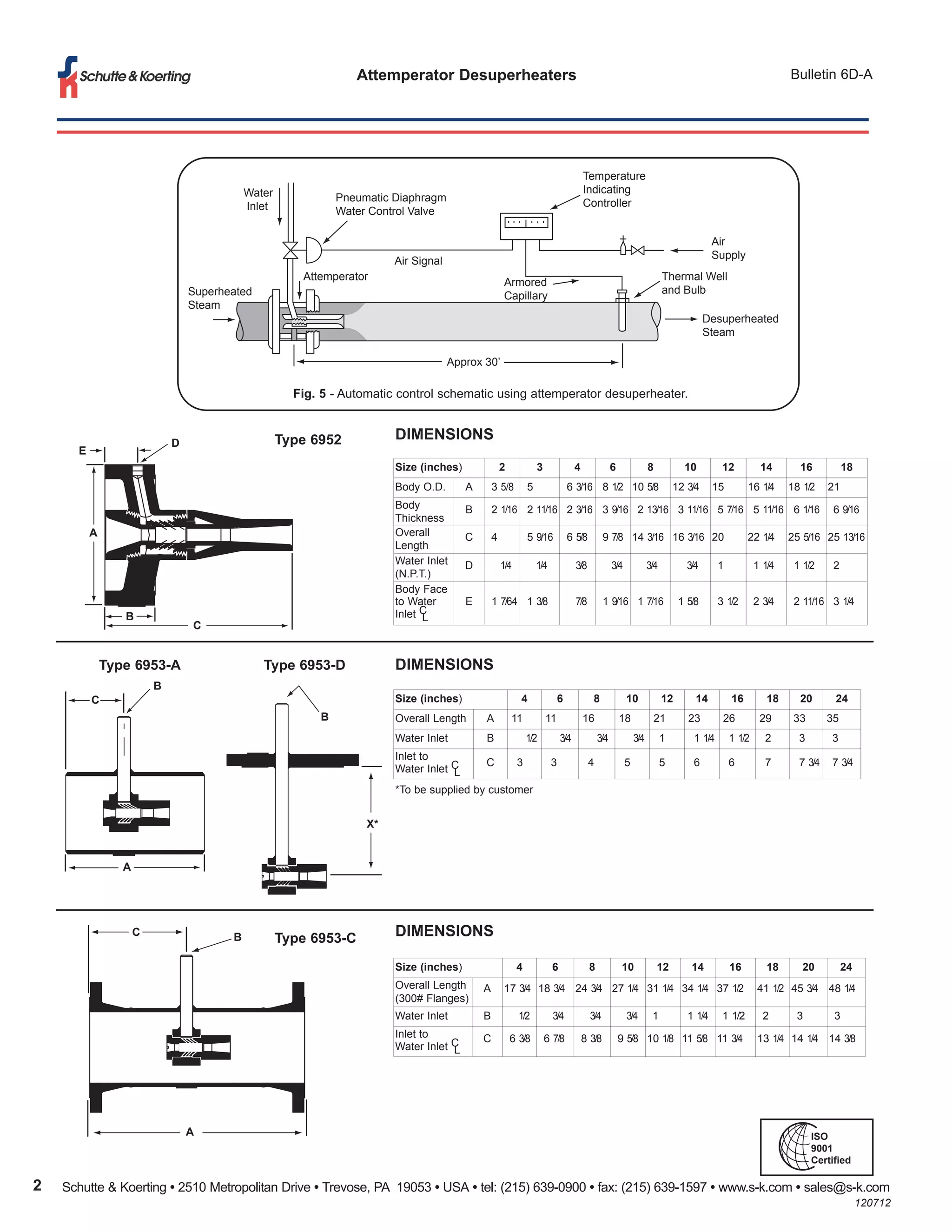
Type 6952 - 2” through 24” cast carbon or alloy steel
construction in ratings up to 600 lb., stainless steel
internals. Type 6953 - 3” through 24” fabricated carbon
or alloy steel construction with pipe, forgings, flanges,
etc. in ratings up to 1500 lb., stainless steel internals.
For sizing information refer to engineering data
supplement.
Superheated Steam
Water
Inlet
Desuperheated Steam
Fig. 1 - Type 6952 is clamped and bolted between
customer’s standard raised face flanges.
Desuperheated
Steam
Superheated
Steam
Water
Inlet
Superheated
Steam
Desuperheated
Steam
Water
Inlet
Fig. 2 - Type 6953-A fabricated
attemperator is welded into and
supported by customer’s piping.
Fig. 3 - Type 6953-D
fabricated attemperator is
mounted on a blind flange for
insertion through customer’s
flanged connection.
Superheated
Steam
Desuperheated
Steam
Water
Fig. 4 - Type 6953-C fabricated attemperator is
flanged and supported by customer’s piping.
Schutte & Koerting • 2510 Metropolitan Drive • Trevose, PA 19053 • USA • tel: (215) 639-0900 • fax: (215) 639-1597 • www.s-k.com • sales@s-k.com2
Bulletin 6D-AAttemperator Desuperheaters
Water
Inlet
Pneumatic Diaphragm
Water Control Valve
Air Signal
Attemperator
Superheated
Steam
Approx 30’
Armored
Capillary
Temperature
Indicating
Controller
Air
Supply
Thermal Well
and Bulb
Desuperheated
Steam
C
B
A
C
B
A
E
D
A
C B
X*
B
Type 6953-A Type 6953-D
Type 6952
Type 6953-C
Size (inches) 2 3 4 6 8 10 12 14 16 18
Body O.D. A 3 5/8 5 6 3/16 8 1/2 10 5/8 12 3/4 15 16 1/4 18 1/2 21
Body
Thickness
B 2 1/16 2 11/16 2 3/16 3 9/16 2 13/16 3 11/16 5 7/16 5 11/16 6 1/16 6 9/16
Overall
Length
C 4 5 9/16 6 5/8 9 7/8 14 3/16 16 3/16 20 22 1/4 25 5/16 25 13/16
Water Inlet
(N.P.T.)
D 1/4 1/4 3/8 3/4 3/4 3/4 1 1 1/4 1 1/2 2
Body Face
to Water
Inlet C
L
E 1 7/64 1 3/8 7/8 1 9/16 1 7/16 1 5/8 3 1/2 2 3/4 2 11/16 3 1/4
DIMENSIONS
Size (inches) 4 6 8 10 12 14 16 18 20 24
Overall Length A 11 11 16 18 21 23 26 29 33 35
Water Inlet B 1/2 3/4 3/4 3/4 1 1 1/4 1 1/2 2 3 3
Inlet to
Water Inlet C
L
C 3 3 4 5 5 6 6 7 7 3/4 7 3/4
Size (inches) 4 6 8 10 12 14 16 18 20 24
Overall Length
(300# Flanges)
A 17 3/4 18 3/4 24 3/4 27 1/4 31 1/4 34 1/4 37 1/2 41 1/2 45 3/4 48 1/4
Water Inlet B 1/2 3/4 3/4 3/4 1 1 1/4 1 1/2 2 3 3
Inlet to
Water Inlet C
L
C 6 3/8 6 7/8 8 3/8 9 5/8 10 1/8 11 5/8 11 3/4 13 1/4 14 1/4 14 3/8
DIMENSIONS
DIMENSIONS
*To be supplied by customer
120712
Fig. 5 - Automatic control schematic using attemperator desuperheater.
ISO
9001
Certified
Schutte & Koerting • 2510 Metropolitan Drive • Trevose, PA 19053 • USA • tel: (215) 639-0900 • fax: (215) 639-1597 • www.s-k.com • sales@s-k.com 1
Annular Venturi Orifice Desuperheater
Bulletin 6D-AVO
• Eliminates accumulation of unvaporized
water in the pipeline
• Virtually maintenance-free
Application
Fig. 6980 Annular Venturi Orifice Desuperheaters
desuperheat steam by bringing it into direct contact with
cooling water at a restricted point in the pipeline where
high turbulence is created. These units have no moving
parts of any kind and pressure drop is low. Steam can be
desuperheated down to 10°F. above saturation over an
amazing range of flow varying from 100% down to 2% of
rated capacity - a 50 to 1 turndown. This high turndown
ratio is accomplished at water pressures no higher than
the pressure of main steam flow entering the
desuperheater. No auxiliary source of high pressure
steam is required.
Water Enters
Combining
Tube
Steam
Outlet
Steam
Inlet
Fig. 6980 Annular Venturi
Orifice Desuperheater
900 lb. High Pressure Design;
Image (Top) back side of
Venturi nozzle.
Schutte & Koerting • 2510 Metropolitan Drive • Trevose, PA 19053 • USA • tel: (215) 639-0900 • fax: (215) 639-1597 • www.s-k.com • sales@s-k.com
Annular Venturi Orifice Desuperheater Bulletin 6D-AVO
Fig. 1 - Fig. 6980 AVO Desuperheater.
Unit operates in a vertical position with flow moving upward.
Steam
Inlet
Water
Inlet
Annular
Orifice
Annular
Insert
Unit
Size
(in inches)
Length
(in inches)
3 47
4 48
6 64
8 81
10 98
12 106
16 145
Construction
Fig. 6980 Annular Venturi Orifice Desuperheaters are
constructed as shown in Fig. 1. Sizes (based on pipe
OD) and approximate overall lengths (measured from
face to face of flanges) are as follows:
Operation
Desuperheaters of this type have an elongated annular
insert which forces the steam to flow around it. Midway
up the insert at the point of greatest restriction, there is an
annular orifice. Cooling water is injected, making contact
with the steam at the point of greatest turbulence. Steam
and water are thus thoroughly mixed. There is even
distribution of the water throughout the stream of steam,
and the contact between steam and water is maintained
over a long enough period to completely vaporize the
water.
The Fig. 6980 Annular Venturi Orifice Desuperheater
design overcomes the most common problem of
desuperheating - the accumulation of unvaporized water
in the pipeline. This efficiency-destroying phenomenon
cannot happen in the Fig. 6980 Desuperheater because
any water droplet that fails to vaporize immediately after
injection must fall back into the high-velocity throat region
of the desuperheater where is comes into contact with the
steam again and again until it is completely vaporized.
Refer to Bulletin 6D Supplement for performance data on
these desuperheaters.
120712
ISO
9001
Certified
Schutte & Koerting • 2510 Metropolitan Drive • Trevose, PA 19053 • USA • tel: (215) 639-0900 • fax: (215) 639-1597 • www.s-k.com • sales@s-k.com 1
Steam Ejector, Atomizing Desuperheaters
Bulletin 6D-E
APPLIcATION
Type 6970 Desuperheaters serve a wide range of applications. In
a combined pressure reducing, desuperheating station where flow
rates vary widely, this unit, with adequate controls, provides
dependable operation with turndown ratios as high as 50 to 1 and
greater, depending on exact operating conditions.
Type 6970 Desuperheaters are recommended for use where
sufficient high pressure steam is available to provide the atomizing
steam supply. The most frequent application would be in
combination reducing-desuperheating stations. The minimum
atomizing steam pressure ratio required is 1.4 times the absolute
steam pressure through the desuperheater with a minimum
atomizing steam pressure of 50 psig. The amount required is
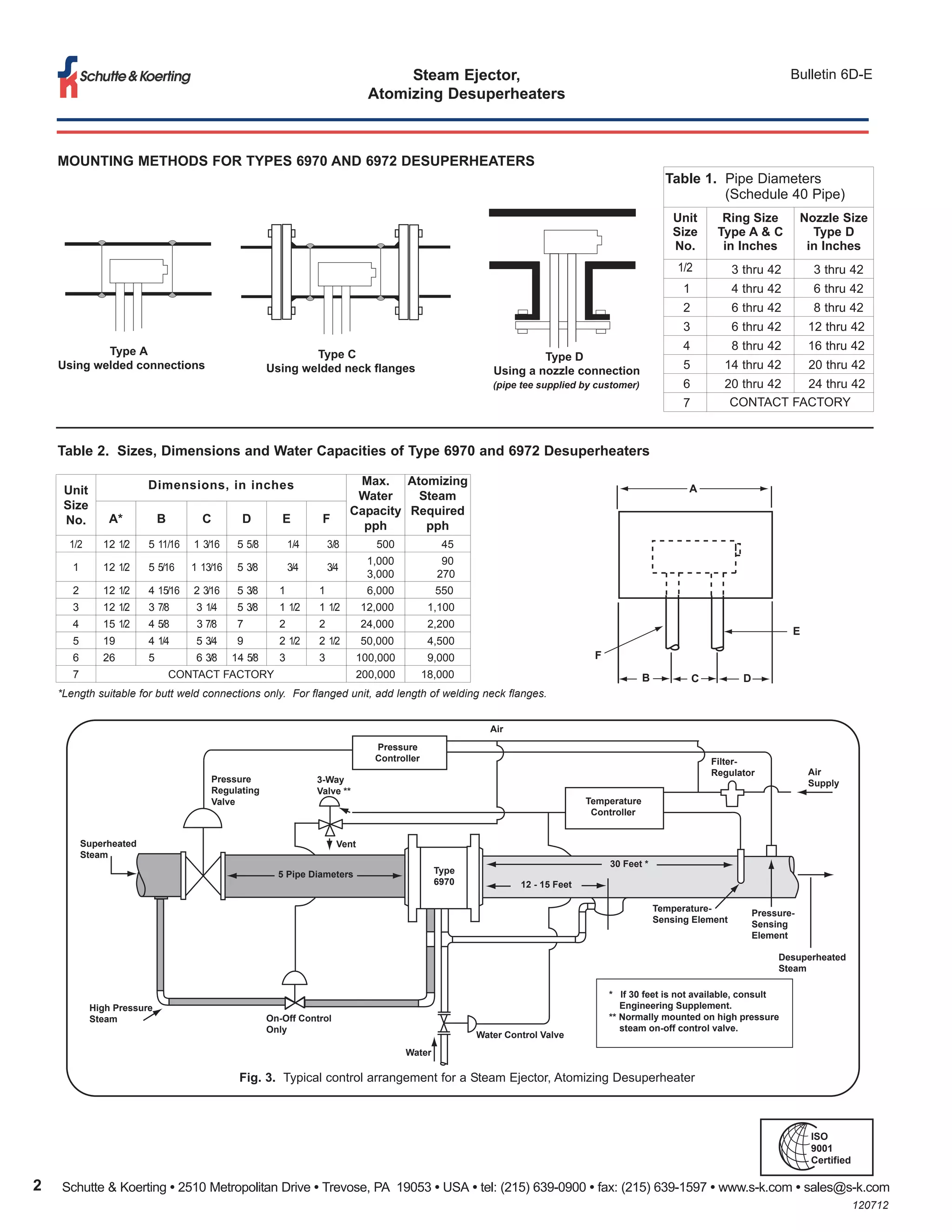
constant. (See Table 2 on reverse side for the exact rate.)
cONSTRucTION
In the Type 6970, the water preheating and distributing device is
installed in a short pipe section with weld neck flanged ends (Type
C) or butt weld ends (Type A). This unit can also be mounted on a
blind flange for insertion through a nozzle connection (Type D). The
various mounting arrangements are shown on the reverse side. It
is recommended that the unit be mounted so that the atomizing
steam and water inlet pipes enter the unit from the bottom as
shown.
This desuperheater uses a steam atomizing device, operating on
the jet principle, to entrain cooling water, preheat, and discharge the
atomized water into the superheated steam flow.
OPERATION
Ejector-type steam atomizing desuperheaters utilize steam at
higher than line pressure to atomize water. In the Type 6970, the
ejector action is used to entrain condensate from the pipeline. This
is an important S&K innovation and a feature of this type unit.
Few problems are encountered in operating desuperheaters at
normal pipeline velocities. However, S&K research has proved
conclusively that at low pipeline velocities encountered at 1/50 up
to 1/4 of normal flow, unvaporized liquid will “settle out” of a
horizontal stream. When it is desired to approach saturation
temperature within 10°F, it becomes impossible to completely
vaporize the liquid. Thus, while superheated steam is flowing
through the pipeline, water accumulates in the bottom of the line.
Since this keeps temperature from being reached, a control valve
will continue to supply or “pump” excess water into the line while
attempting to maintain the control temperature.
Type S&K 6970 overcomes these complications by recycling
excess water back into the atomizing device. The water added
through the control valve is therefore limited to the amount required
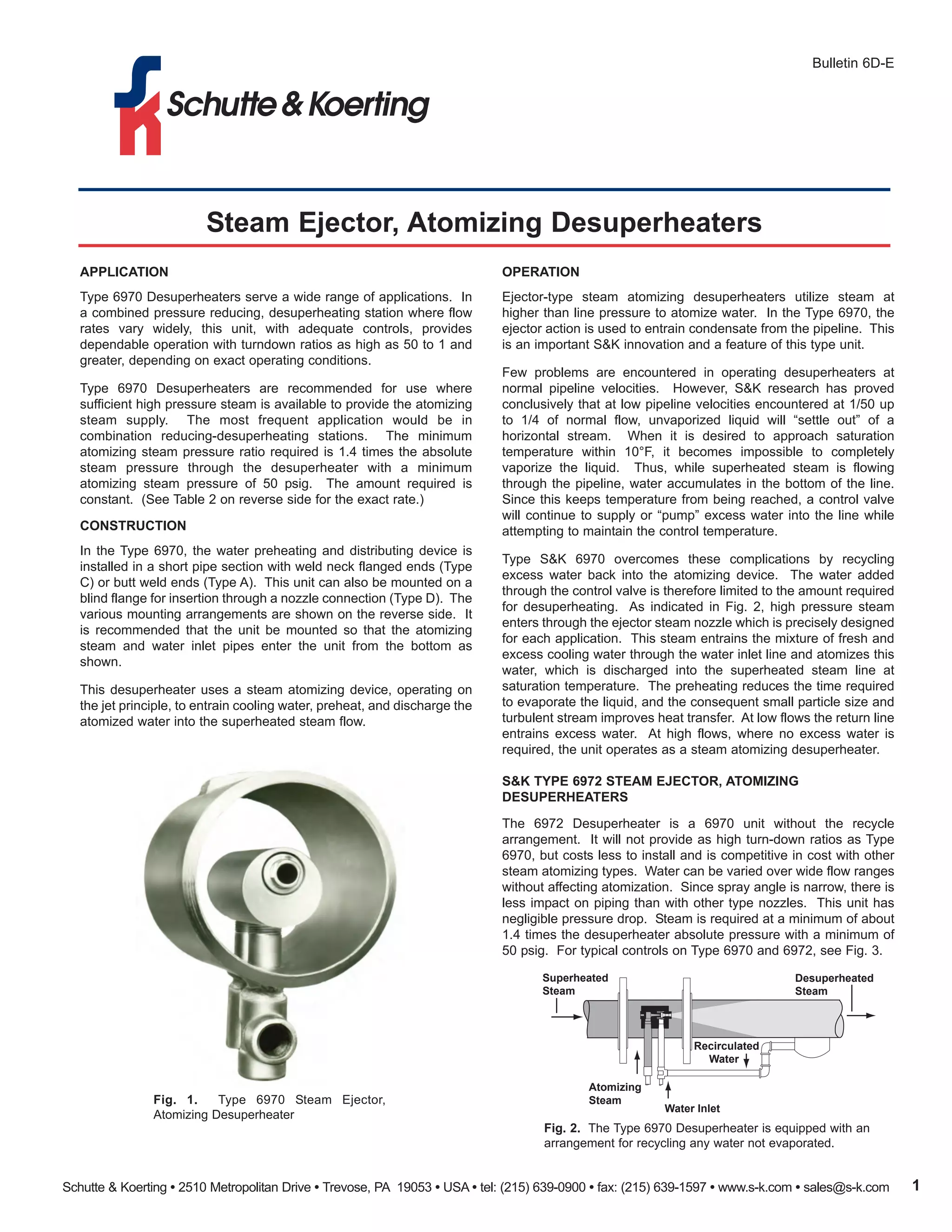
for desuperheating. As indicated in Fig. 2, high pressure steam
enters through the ejector steam nozzle which is precisely designed
for each application. This steam entrains the mixture of fresh and
excess cooling water through the water inlet line and atomizes this
water, which is discharged into the superheated steam line at
saturation temperature. The preheating reduces the time required
to evaporate the liquid, and the consequent small particle size and
turbulent stream improves heat transfer. At low flows the return line
entrains excess water. At high flows, where no excess water is
required, the unit operates as a steam atomizing desuperheater.
S&K TyPE 6972 STEAm EjEcTOR, ATOmIzINg
DESuPERhEATERS
The 6972 Desuperheater is a 6970 unit without the recycle
arrangement. It will not provide as high turn-down ratios as Type
6970, but costs less to install and is competitive in cost with other
steam atomizing types. Water can be varied over wide flow ranges
without affecting atomization. Since spray angle is narrow, there is
less impact on piping than with other type nozzles. This unit has
negligible pressure drop. Steam is required at a minimum of about
1.4 times the desuperheater absolute pressure with a minimum of
50 psig. For typical controls on Type 6970 and 6972, see Fig. 3.
Fig. 2. The Type 6970 Desuperheater is equipped with an
arrangement for recycling any water not evaporated.
Superheated
Steam
Atomizing
Steam
Water Inlet
Recirculated
Water
Desuperheated
Steam
Fig. 1. Type 6970 Steam Ejector,
Atomizing Desuperheater
Schutte & Koerting • 2510 Metropolitan Drive • Trevose, PA 19053 • USA • tel: (215) 639-0900 • fax: (215) 639-1597 • www.s-k.com • sales@s-k.com2
Bulletin 6D-ESteam Ejector,
Atomizing Desuperheaters
(pipe tee supplied by customer)
Type D
Using a nozzle connection
mOuNTINg mEThODS FOR TyPES 6970 AND 6972 DESuPERhEATERS
F
B C D
E
Aunit
Size
No.
Dimensions, in inches max.
Water
capacity
pph
Atomizing
Steam
Required
pph
A* B c D E F
1/2 12 1/2 5 11/16 1 3/16 5 5/8 1/4 3/8 500 45
1 12 1/2 5 5/16 1 13/16 5 3/8 3/4 3/4
1,000
3,000
90
270
2 12 1/2 4 15/16 2 3/16 5 3/8 1 1 6,000 550
3 12 1/2 3 7/8 3 1/4 5 3/8 1 1/2 1 1/2 12,000 1,100
4 15 1/2 4 5/8 3 7/8 7 2 2 24,000 2,200
5 19 4 1/4 5 3/4 9 2 1/2 2 1/2 50,000 4,500
6 26 5 6 3/8 14 5/8 3 3 100,000 9,000
7 CONTACT FACTORY 200,000 18,000
Table 2.  Sizes, Dimensions and Water capacities of Type 6970 and 6972 Desuperheaters
*Length suitable for butt weld connections only. For flanged unit, add length of welding neck flanges.
120712
Type C
Using welded neck flanges
Type A
Using welded connections
Table 1. Pipe Diameters
(Schedule 40 Pipe)
unit
Size
No.
Ring Size
Type A & c
in Inches
Nozzle Size
Type D
in Inches
1/2 3 thru 42 3 thru 42
1 4 thru 42 6 thru 42
2 6 thru 42 8 thru 42
3 6 thru 42 12 thru 42
4 8 thru 42 16 thru 42
5 14 thru 42 20 thru 42
6 20 thru 42 24 thru 42
7 CONTACT FACTORY
Superheated
Steam
Pressure
Regulating
Valve
3-Way
Valve **
Vent
Pressure
Controller
5 Pipe Diameters
High Pressure
Steam On-Off Control
Only
Water
Type
6970
Water Control Valve
12 - 15 Feet
30 Feet *
Temperature-
Sensing Element
Pressure-
Sensing
Element
Desuperheated
Steam
Air
Supply
Filter-
Regulator
Temperature
Controller
Air
* If 30 feet is not available, consult
Engineering Supplement.
** Normally mounted on high pressure
steam on-off control valve.
Fig. 3. Typical control arrangement for a Steam Ejector, Atomizing Desuperheater
ISO
9001
Certified
1
Type 6910 Surface Absorption Desuperheater
Bulletin 6D-SA
perfOrmANce
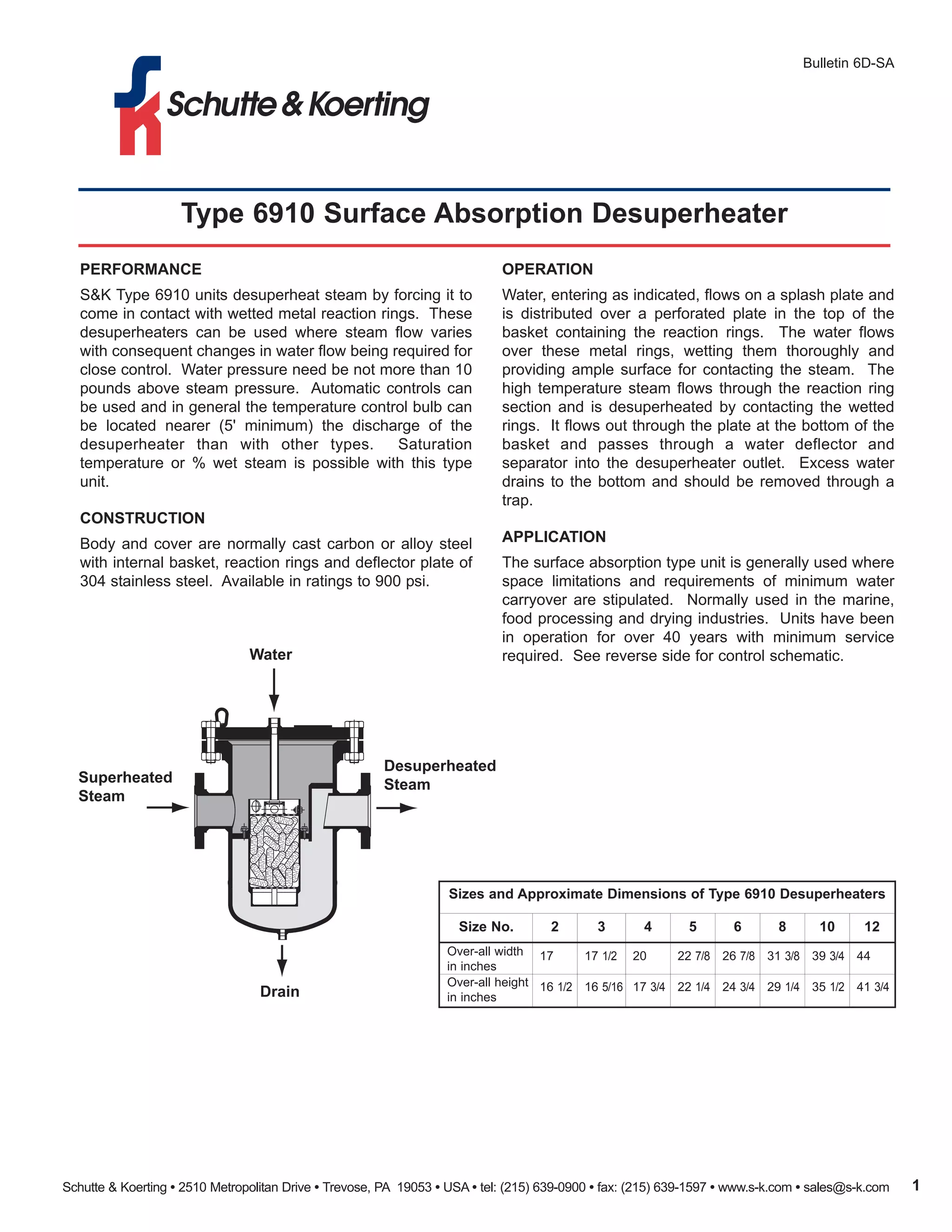
S&K Type 6910 units desuperheat steam by forcing it to
come in contact with wetted metal reaction rings. These
desuperheaters can be used where steam flow varies
with consequent changes in water flow being required for
close control. Water pressure need be not more than 10
pounds above steam pressure. Automatic controls can
be used and in general the temperature control bulb can
be located nearer (5' minimum) the discharge of the
desuperheater than with other types. Saturation
temperature or % wet steam is possible with this type
unit.
cONSTrucTiON
Body and cover are normally cast carbon or alloy steel
with internal basket, reaction rings and deflector plate of
304 stainless steel. Available in ratings to 900 psi.
Water
Superheated
Steam
Desuperheated
Steam
Drain
OperATiON
Water, entering as indicated, flows on a splash plate and
is distributed over a perforated plate in the top of the
basket containing the reaction rings. The water flows
over these metal rings, wetting them thoroughly and
providing ample surface for contacting the steam. The
high temperature steam flows through the reaction ring
section and is desuperheated by contacting the wetted
rings. It flows out through the plate at the bottom of the
basket and passes through a water deflector and
separator into the desuperheater outlet. Excess water
drains to the bottom and should be removed through a
trap.
ApplicATiON
The surface absorption type unit is generally used where
space limitations and requirements of minimum water
carryover are stipulated. Normally used in the marine,
food processing and drying industries. Units have been
in operation for over 40 years with minimum service
required. See reverse side for control schematic.
Sizes and Approximate Dimensions of Type 6910 Desuperheaters
Size No. 2 3 4 5 6 8 10 12
Over-all width
in inches
17 17 1/2 20 22 7/8 26 7/8 31 3/8 39 3/4 44
Over-all height
in inches
16 1/2 16 5/16 17 3/4 22 1/4 24 3/4 29 1/4 35 1/2 41 3/4
Schutte & Koerting • 2510 Metropolitan Drive • Trevose, PA 19053 • USA • tel: (215) 639-0900 • fax: (215) 639-1597 • www.s-k.com • sales@s-k.com
Schutte & Koerting • 2510 Metropolitan Drive • Trevose, PA 19053 • USA • tel: (215) 639-0900 • fax: (215) 639-1597 • www.s-k.com • sales@s-k.com2
Bulletin 6D-SAType 6910 Surface Absorption Desuperheater
A desuperheater is not a single piece of equipment that
succeeds or fails on its own, but is only one of several
distinct system components. For a successful
application, system engineering is a must. Neglect of any
one component may result in system failure, no matter
how excellent the design and engineering application of
the other components. Therefore, all of the control
components must be carefully selected for the specific
application to be handled.
SYSTem VAlVeS AND cONTrOlS
Steam pressure reducing Valve - This valve must have
a turndown somewhat greater than that of the system; it
must respond to plus and minus control signals even at
maximum and minimum flow rates. These valves are
selected for a useful control range of 20 to 80% of
maximum flow. They are normally an equal-percentage
type or have equal-percentage characteristics. This type
of valve has the best inherent flow characteristic and
range needed for proportional control.
Water control Valve - This valve must have sufficient
rangeability to meet the application. Two valves in
parallel may be needed to get this range - one large and
one small. Where a large water pressure differential is
encountered, be careful of possible cavitation. Consider
using a pressure control valve upstream of the main flow
valve.
Temperature controller - Must have an adjustable
proportional control band wide enough to match
response characteristics of the entire desuperheater
system. Automatic reset prevents drift in control point.
Rate action is seldom needed, but if it is provided,
complete cutoff should be possible.
pressure controller - Must prevent large pressure
variations which might interfere with temperature control;
therefore, it needs an adjustable throttling range and
automatic reset.
control Valve Actuators - Pneumatically operated
control valve actuators are the most popular type in use,
but electric, hydraulic and manual actuators are also
used. The spring-and-diaphragm pneumatic actuator is
most commonly specified due to its dependability and
simplicity of design. Pneumatically operated piston
actuators provide an integral positioner capability and
high steam force output for demanding service
conditions.
Temperature Switches - They are used in connection
with alarm systems for high and low temperatures. The
temperature sensor uses the expansion principle in which
the fluid or element in the sensing bulb reacts to the line
temperature.
pressure Switches - These switches, as above, are
generally used in connection with alarm systems for high
and low pressures. The alarm can be either audio or
visual. Pressure applied to the sensor actuates a
mechanism and its movement is then used to control the
operation of an electrical snap acting switch, or other
actuating medium.
WArNiNG: A control system cannot successfully
hold a temperature that is no higher above saturation
than the controller's degree of sensitivity and
deadband.
Desuperheated
Steam
Separable Well
Thermostatic
Bulb
5 Ft. Minimum
Superheated
Steam From
Reducing
Valve
Type 6910 Surface
Absorption Type Desuperheater
Water
Inlet
Spindle Positioner
Diaphragm-Operated
Water Control Valve
Air Supply
Filter
Regulator
Automatic
Temperature
Controller
cONTrOl ScHemATicS
DeSuperHeATer cONTrOl SYSTemS
120712
Type 6910
ISO
9001
Certified
1
type 6905 Mechanical Atomizing Dump Desuperheater
Bulletin 6D-SB
pErForMAncE
S&K Type 6905 units employ one or more special spray
nozzles to atomize the water droplets and produce the
heat transfer contact area necessary for cooling the
steam and evaporating the droplets. Because droplets
are relatively coarse and the steam temperature entering
the unit is normally above 800ºF, S&K recommends and
supplies a thermal sleeve welded to the unit which
extends approximately 1 foot downstream in the
customer's piping. Water pressure to this type unit differs
from all other S&K types in that it is required at a
minimum of 25 psi above line pressure.
ApplicAtion
The mechanical atomizing type desuperheater was
developed for economically desuperheating high steam
flows in large steam lines, i.e. 20", 24", 30", 36", etc.
Initial applications were for periodic usage on emergency
dump to condenser systems in power stations where
precise desuperheating was not necessary and excess
water flows were common. These units are also used on
controlled over-pressure dump and bypass systems.
construction
S&K Type 6905 consists of only three basic components:
body, spray shield, and nozzle assembly. Bodies are
normally cast carbon, alloy or stainless steel with weld
ends. Stainless steel nozzles are removable from body
nozzle bosses. Spray shield is stainless steel pipe or
rolled plate. See reverse side for control schematic.
Superheated
Steam
Water
Water
Desuperheated
Steam
Schutte & Koerting • 2510 Metropolitan Drive • Trevose, PA 19053 • USA • tel: (215) 639-0900 • fax: (215) 639-1597 • www.s-k.com • sales@s-k.com
Schutte & Koerting • 2510 Metropolitan Drive • Trevose, PA 19053 • USA • tel: (215) 639-0900 • fax: (215) 639-1597 • www.s-k.com • sales@s-k.com2
Bulletin 6D-SBtype 6905 Mechanical Atomizing Desuperheater
120712
A desuperheater is not a single piece of equipment that
succeeds or fails on its own, but is only one of several
distinct system components. For a successful
application, system engineering is a must. Neglect of any
one component may result in system failure, no matter
how excellent the design and engineering application of
the other components. Therefore, all of the control
components must be carefully selected for the specific
application to be handled.
sYstEM VAlVEs AnD controls
steam pressure reducing Valve - This valve must have
a turndown somewhat greater than that of the system; it
must respond to plus and minus control signals even at
maximum and minimum flow rates. These valves are
selected for a useful control range of 20 to 80% of
maximum flow. They are normally an equal-percentage
type or have equal-percentage characteristics. This type
of valve has the best inherent flow characteristic and
range needed for proportional control.
Water control Valve - This valve must have sufficient
rangeability to meet the application. Two valves in
parallel may be needed to get this range - one large and
one small. Where a large water pressure differential is
encountered, be careful of possible cavitation. Consider
using a pressure control valve upstream of the main flow
valve.
temperature controller - Must have an adjustable
proportional control band wide enough to match
response characteristics of the entire desuperheater
system. Automatic reset prevents drift in control point.
Rate action is seldom needed, but if it is provided,
complete cutoff should be possible.
pressure controller - Must prevent large pressure
variations which might interfere with temperature control;
therefore, it needs an adjustable throttling range and
automatic reset.
control Valve Actuators - Pneumatically operated
control valve actuators are the most popular type in use,
but electric, hydraulic and manual actuators are also
used. The spring-and-diaphragm pneumatic actuator is
most commonly specified due to its dependability and
simplicity of design. Pneumatically operated piston
actuators provide an integral positioner capability and
high steam force output for demanding service
conditions.
temperature switches - They are used in connection
with alarm systems for high and low temperatures. The
temperature sensor uses the expansion principle in which
the fluid or element in the sensing bulb reacts to the line
temperature.
pressure switches - These switches, as above, are
generally used in connection with alarm systems for high
and low pressures. The alarm can be either audio or
visual. Pressure applied to the sensor actuates a
mechanism and its movement is then used to control the
operation of an electrical snap acting switch, or other
actuating medium.
WArninG: A control system cannot successfully
hold a temperature that is no higher above saturation
than the controller's degree of sensitivity and
deadband.
DEsupErHEAtEr control sYstEMs
Desuperheated
Steam
Separable Well
Thermostatic
Bulb
Approx. 25 Ft. Minimum
Superheated
Steam
Type 6905 Mechanical Atomizing
Dump Desuperheater
Water
Inlet
Spindle Positioner
Diaphragm-Operated
Water Control Valve
Air Supply
Filter
Regulator
Automatic
Temperature
Controller
control scHEMAtics
type 6905
ISO
9001
Certified
Schutte & Koerting • 2510 Metropolitan Drive • Trevose, PA 19053 • USA • tel: (215) 639-0900 • fax: (215) 639-1597 • www.s-k.com • sales@s-k.com 1
Venturi desuperheaters
Bulletin 6D-V
ApplicAtion
Venturi desuperheaters reduce steam temperature by bringing
superheated steam into direct contact with water. The steam is
cooled through the evaporation of the water. These
desuperheaters are recommended for use under a wide range
of conditions, including steady and variable flows. They can be
installed horizontally or vertically up. When installed vertically
up, turndown ratios can be increased substantially.
operAtion
Water entering the desuperheaters is preheated in the
circulatory chamber around the water diffuser tube and is
introduced in many small jets to assist final atomization by the
steam flow through the center of the throat. When leaving the
throat, the mixture of steam and water enters the venturi section
for turbulent mixing prior to entering the main steam line in a
fog-like condition without contacting the sidewalls - providing
maximum desuperheating effectiveness and a minimum of wear
in the discharge piping. The water pressure required should
equal the operating steam pressure.
performAnce
Venturi desuperheaters are normally used in areas where
atomizing steam is not available. Turndown ratio is dependent
upon a wide variety of factors, such as installation (horizontal or
vertical), amount of residual superheat, and piping. Depending
on exact flow conditions, units are capable of 50% to 5% flow
variation. Pressure drop varies between 2 psi and 10 psi.
construction, sizes, And rAtings
type 6950 - 2" - 6" cast carbon or alloy steel in ratings to 900
lb.; 8" and up cast body with fabricated tail in ratings to 900 lb.
(cast bodies and tails stocked in carbon steel 150 lb. and 300 lb.
up to 6").
type 6940 - 2" - 16" cast carbon or alloy steel in ratings to 2500
lb.; 18" and above fabricated carbon or alloy steel in ratings to
1500 lb.
type 6940m - 1/2" - 1 1/2" carbon, alloy or stainless steel
barstock construction up to 600 lb. rating with NPT, socket weld
or flanged connections.
For sizing information, refer to engineering data supplement.
Water Inlet
Superheated
Steam
Desuperheated Steam
Water Inlet
Superheated Steam
Desuperheated Steam
Water Inlet
Superheated Steam
Desuperheated Steam
Fig. 1. Type 6950 Desuperheaters are mounted in
and supported by the pipeline.
Fig. 2. The Type 6940 Desuperheater, like the 6950,
is mounted directly in the pipeline.
Fig. 3. The Type 6940M Desuperheater is a
miniature version of the Type 6940.
Schutte & Koerting • 2510 Metropolitan Drive • Trevose, PA 19053 • USA • tel: (215) 639-0900 • fax: (215) 639-1597 • www.s-k.com • sales@s-k.com2
Bulletin 6D-VVenturi desuperheaters
D C
A
B
D
C
A
E
B
DD
D
A
B
BB
C
size* &
connection
A 2 3 4 5 6 8 10 12 14 16
150 lb
Overall 300 lb
Length 600 lb
B
11 1/2
11 3/4
12 1/2
15 5/16
16 5/16
16 13/16
20
20 1/16
20 1/16
24 1/8
25
25 13/16
30 1/16
30
31 7/16
41
41
41
49 1/2
50 3/4
49 5/8
59 15/16
59 15/16
62 9/16
72
72
73 3/8
81 3/4
81 3/4
81 3/4
Water Inlet (NPT) C 1/4 1/4 3/8 1/2 3/4 3/4 3/4 1 1 1/4 1 1/2
Flange Face to
Water Inlet C/L
D 2 2 1/2 2 1/2 3 4 5 1/4 7 8 1/2 9 10 1/2
tYpe 6940 dimensions (in inches)
*For other sizes and ratings, contact factory.
size & connection A 1/2 3/4 1 1 1/2
Length B 4 7/8 6 7 3/8 10 3/16
Overall Length
150, 300 & 600 lb flanged
BB 9 1/2 10 1/2 12 15
Water Inlet (NPT) C 1/8 1/8 1/4 1/4
Inlet Face to
Water Inlet C/L
D 2 2 2 1/4 2 5/8
Flange Face to
Water Inlet C/L
DD 4 5/16 4 1/4 4 9/16 5 1/32
tYpe 6940m dimensions (in inches)
tYpe 6950 dimensions (in inches)
size & connection A 2 3 4 6 8 10 12 14 16
Overall Length
150, 300 & 600 lb
flanged
B 11 7/8 15 9/16 19 7/16 28 13/16 40 3/8 47 13/16 57 15/16 69 1/16 77 13/16
Water Inlet (NPT) C 1/4 1/4 3/8 3/4 3/4 3/4 1 1 1/4 1 1/2
Inlet Face to
Water Inlet C/L
D 1 7/64 1 3/8 7/8 1 9/16 1 7/16 1 5/8 3 1/2 2 3/4 2 11/16
Body Thickness E 2 1/16 2 11/16 2 3/16 3 1/2 2 15/16 3 11/16 5 7/16 5 11/16 6 1/16
Water Inlet
Diaphragm-Operated
Water Control Valve
High Temperature
Steam
SK Type 6950
Desuperheater
Approx 30’ Low Temperature
Steam
Separable Well
Thermostatic Bulb
Air Filter
30 lb Air
Supply
Air Reducing Valve
Automatic
Temperature
Controller
fig. 4. Automatically controlled venturi-type desuperheater system.
120712
ISO
9001
Certified
Schutte & Koerting • 2510 Metropolitan Drive • Trevose, PA 19053 • USA • tel: (215) 639-0900 • fax: (215) 639-1597 • www.s-k.com • sales@s-k.com 1
annular Venturi desuperheaters
Bulletin 6D-VC
fig. 1. type 6985 annular Venturi desuperheater
aPPlication
Annular Venturi desuperheaters reduce steam tempera-
ture by bringing superheated steam into direct contact
with water. The steam is cooled through the evaporation
of the water. These desuperheaters are recommended
for use under a wide range of conditions, including steady
and variable flows. They can be installed horizontally or
vertically up. When installed vertically up, turndown ratio
can be increased substantially.
oPeration
Superheated steam is directed by the cone into the annu-
lar area between the cone and pipe wall, increasing both
velocity and turbulence. Cooling water is introduced
through a narrow slot (or small jets in the 1" and 1 ½"
sizes) in the cone at the point of maximum velocity. The
combination of velocity and turbulence improves atomiza-
tion and produces maximum desuperheater effective-
ness. The water pressure required should equal the
operating steam pressure.
Performance
Annular Venturi desuperheaters are normally used in
areas where atomizing steam is not available. Turndown
ratio is dependent upon a wide variety of factors, such as
installation (horizontal or vertical), amount or residual
superheat, and piping. Depending on exact flow condi-
tions, units are capable of 20% to 2% flow variation.
Pressure drop normally varies between 2 psi and 10 psi.
construction, sizes and ratings
Sizes 1" through 4", all stainless steel. Flanged units
have 150 or 300 lb. stainless steel R.F. flanges.
Sizes 6" through 16", carbon steel with stainless steel
water pipe and venturi cone. Flanged units have 150 or
300 lb. R.F. flanges. Stainless steel units have all stain-
less steel wetted parts and carbon steel lap joint flanges.
Schutte & Koerting • 2510 Metropolitan Drive • Trevose, PA 19053 • USA • tel: (215) 639-0900 • fax: (215) 639-1597 • www.s-k.com • sales@s-k.com2
Bulletin 6D-VCannular Venturi desuperheaters
Water Inlet
Diaphragm-Operated
Water Control Valve
High Temperature
Steam
SK Type 6985
Desuperheater
Approx 30’ Low Temperature
Steam
Separable Well
Thermostatic Bulb
Air Filter
30 lb Air
Supply
Air Reducing Valve
Automatic
Temperature
Controller
D C
Support Gusset
8” and Larger
B
A Flow
D
C
Support Gusset
8” and Larger
B
A Flow
size (inches) a 1 1 1/2 2 2 1/2 3 4 6 8 10 12 14 16
Overall Length 150 lb
300 lb
B 8
8
10
10
12
12
14
14
16
16
18
20
22
24
24
26
28
30
30
32
30
32
32
34
Water Inlet (NPT) C 1/8 1/4 1/4 1/4 1/2 1/2 1 1 1 1/2 1 1/2 2 2
Flange Face To 150 lb
Water Inlet C/L 300 lb
D 4 3/4
4 3/4
4 1/2
4 1/2
6
6
7 7/8
7 7/8
8 1/4
8 1/4
9
11
8 1/4
10 1/4
8
10
6
6
6
6
6
6
7
7
tYPe 6985-c dimensions
tYPe 6985-a dimensions
size (inches) a 1 1 1/2 2 2 1/2 3 4 6 8 10 12 14 16
Overall Length B 8 10 12 14 16 18 22 24 28 30 30 32
Water Inlet
(NPT)
C 1/8 1/4 1/4 1/4 1/2 1/2 1 1 1 1/2 1 1/2 2 2
Flange
Face To
Water Inlet C/L
D 4 3/4 4 1/2 6 7 7/8 8 1/4 9 8 1/4 8 4 4 4 5
fig. 2. automatically controlled annular venturi desuperheater system
120712
ISO
9001
Certified

Types of Steam Desuperheaters

  • 1.
    Schutte & Koerting• 2510 Metropolitan Drive • Trevose, PA 19053 • USA • tel: (215) 639-0900 • fax: (215) 639-1597 • www.s-k.com • sales@s-k.com 1 Steam Desuperheaters Bulletin 6D INTRODUCTION In 1923 Schutte & Koerting introduced its first mechanical spray desuperheater, and three years later the company introduced a surface absorption unit. In 1939 the venturi desuperheater was developed and successfully marketed to satisfy a wide range of applications. An ejector, atomizing type unit, introduced in the mid 1950’s, lead to numerous variations and larger capacities. This was followed by a mechanical dump- type unit for critical power plant needs. The newest unit is the annular venturi desuperheater which compares favorably with competitive spray nozzle designs. APPLICATION Although requirements for desuperheaters cover a wide range of applications, the great majority fall into the following standard installations: • Power plant requirements for desuperheated steam supplying units having limited operating temperatures such as auxiliaries, heating systems, heat exchangers and, more recently, dump stations. • To improve heat transfer of surface-type heat exchangers. • Reduction and control of superheated steam, where excess temperatures will harm the product. • Use on boilers, either between superheater stages or at boiler exit, to control superheat temperatures at partial loads. • Use as bypass of bleeder or back pressure turbines to maintain balance between process steam and power requirements. • Miscellaneous applications where balancing or make- up steam is required in reduced pressure systems in refineries and process plants. OPERATION S&K desuperheaters reduce the temperature of superheated steam to produce lower temperatures (normally 10ºF above saturation, although Type 6910 is capable of producing saturated steam). The majority of S&K units (except Types 6905 and 6910) require water at line pressure. Water is syphoned into the water box/combining tube assembly, where it is heated, and then mixed with a percentage of steam through the throat region and introduced into the steam line as a finely atomized mist. Water entrainment, shearing and mixture, all within S&K internal construction, produces extremely small water particles and alleviates requirements of thermal liners and impingement shields. For Type 6905, where water is injected at high pressure and internal construction consists of a water nozzle, S&K supplies or recommends thermal liners. MATERIALS OF CONSTRUCTION S&K desuperheaters are manufactured from a variety of metals. Standard construction is carbon steel below 800°F, chrome molybdenum steel above 800°F (both with stainless steel Type 304 internals); however, S&K can manufacture in any metal or alloy requested. QUALITY CONTROL S&K products are subjected to extensive tests required by stringent quality control policies. Equipment can be manufactured to various ASME or ANSI codes and/or provided with special non-destructive testing. Details on facilities and techniques will be supplied upon request. PERFORMANCE Data for sizing, determining pressure drop, straight run requirements, bulb placements, etc. can be found in the Engineering Data Supplement to Bulletin 6D.
  • 2.
    Schutte & Koerting• 2510 Metropolitan Drive • Trevose, PA 19053 • USA • tel: (215) 639-0900 • fax: (215) 639-1597 • www.s-k.com • sales@s-k.com2 Bulletin 6DSteam Desuperheaters Type 6950 Desuperheater A venturi-type, steam atomizing unit with no separate or high pressure steam supply required. Suitable for use under a wide range of conditions, including steady or variable flows. Inlet water pressure need only equal steam pressure. Small pressure drop across unit. Used with or without controls. Type 6940 Desuperheater Also a venturi-type similar to Type 6950, but with an integral steam inlet flange connection. Performance is similar to Type 6950. Type 6940M Desuperheater "Mini" venturi in sizes 1/2" to 1 1/2". Used in extremely low flow applications such as found in heating and air conditioning services. Available with flanges, threaded or socket weld connections. Type 6953 Desuperheater A version of Type 6952 with the same operating characteristics. Flanged or butt- welded ends. ATTEMPERATOR (Refer to Bulletin 6D-A) Type 6952 Desuperheater A modification of Type 6950 in which the tail piece is omitted and the atomized water discharges directly into the pipeline. Suitable for use where lower pressure drop is required and little flow variation is encouraged. ANNULAR VENTURI (Refer to Bulletin 6D-VC) Type 6985 Desuperheater Lower cost venturi-type capable of high turndown ratios. Suitable for use under wide range of conditions, including steady and variable flows. Low pressure drop. Inlet water pressure need only equal steam pressure. Legend SUPERHEATED STEAM COOLING WATER DESUPERHEATED STEAM 120712 VENTURI DESUPERHEATERS (Refer to Bulletin 6D-V) MECHANICAL ATOMIZING (Refer to Bulletin 6D-SB) Type 6905 Desuperheater Uses one or more spray nozzles mounted on the periphery for injection of water into the steamline. A thermal shield downstream of unit is recommended. SURFACE ABSORPTION (Refer to Bulletin 6D-SA) Type 6910 Desuperheater Surface absorption type wherein steam contacts wetted reaction rings. High pressure drop. Unit can be used with controls and flow can vary almost infinitely with no downsteam piping requirements. Can achieve saturation. EJECTOR ATOMIZING (Refer to Bulletin 6D-E) Type 6970 Desuperheater A steam ejector, atomizing unit with water re-cycle arrangement. For applications where combined reducing- desuperheating station is required and flows vary widely. Steam flow range can be as high as 50 to 1 and greater, depending on operating conditions. Minimum atomizing steam pressure required is about 1.4 times inlet steam pressure, with low pressure drop across unit in most cases. Type 6972 Desuperheater Same as Type 6970, but without the recycling system. Gives reduced flow variation and costs less to install. ISO 9001 Certified
  • 3.
    Schutte & Koerting• 2510 Metropolitan Drive • Trevose, PA 19053 • USA • tel: (215) 639-0900 • fax: (215) 639-1597 • www.s-k.com • sales@s-k.com 1 Attemperator Desuperheaters Bulletin 6D-A APPLICATION Attemperator Desuperheaters reduce steam temperature by bringing superheated steam into direct contact with water. The steam is cooled through the evaporation of the water. Attemperators can be mounted either horizontally or vertically and are normally used for relatively steady load conditions where pressure losses must be minimized. These desuperheaters are a modification of the venturi-type unit, without the venturi tail, and offer increased turndown when mounted vertically up. OPERATION Water enters the attemperator and is preheated in the circulatory chamber around the water diffuser tube. It is then introduced in many small jets to assist final atomization by the steam flow through the center of the throat. After leaving the throat, the mixture of steam and water enters the main steam flow in a fog-like condition where final heat transfer is achieved without contacting the sidewalls - providing maximum desuperheating effectiveness with minimum of pipe wear. Water pressure into the attemperator should equal steam line pressure. PERFORMANCE While it is less costly and has negligible pressure losses, it normally does not have the rangeability of the venturi- type unit. Actual turndown ratio is dependent upon a wide variety of factors, such as installation, amount of residual superheat downstream, piping, etc. Normal flow variation is 75% to 15% of flow. CONSTRUCTION, SIZES AND RATINGS Type 6952 - 2” through 24” cast carbon or alloy steel construction in ratings up to 600 lb., stainless steel internals. Type 6953 - 3” through 24” fabricated carbon or alloy steel construction with pipe, forgings, flanges, etc. in ratings up to 1500 lb., stainless steel internals. For sizing information refer to engineering data supplement. Superheated Steam Water Inlet Desuperheated Steam Fig. 1 - Type 6952 is clamped and bolted between customer’s standard raised face flanges. Desuperheated Steam Superheated Steam Water Inlet Superheated Steam Desuperheated Steam Water Inlet Fig. 2 - Type 6953-A fabricated attemperator is welded into and supported by customer’s piping. Fig. 3 - Type 6953-D fabricated attemperator is mounted on a blind flange for insertion through customer’s flanged connection. Superheated Steam Desuperheated Steam Water Fig. 4 - Type 6953-C fabricated attemperator is flanged and supported by customer’s piping.
  • 4.
    Schutte & Koerting• 2510 Metropolitan Drive • Trevose, PA 19053 • USA • tel: (215) 639-0900 • fax: (215) 639-1597 • www.s-k.com • sales@s-k.com2 Bulletin 6D-AAttemperator Desuperheaters Water Inlet Pneumatic Diaphragm Water Control Valve Air Signal Attemperator Superheated Steam Approx 30’ Armored Capillary Temperature Indicating Controller Air Supply Thermal Well and Bulb Desuperheated Steam C B A C B A E D A C B X* B Type 6953-A Type 6953-D Type 6952 Type 6953-C Size (inches) 2 3 4 6 8 10 12 14 16 18 Body O.D. A 3 5/8 5 6 3/16 8 1/2 10 5/8 12 3/4 15 16 1/4 18 1/2 21 Body Thickness B 2 1/16 2 11/16 2 3/16 3 9/16 2 13/16 3 11/16 5 7/16 5 11/16 6 1/16 6 9/16 Overall Length C 4 5 9/16 6 5/8 9 7/8 14 3/16 16 3/16 20 22 1/4 25 5/16 25 13/16 Water Inlet (N.P.T.) D 1/4 1/4 3/8 3/4 3/4 3/4 1 1 1/4 1 1/2 2 Body Face to Water Inlet C L E 1 7/64 1 3/8 7/8 1 9/16 1 7/16 1 5/8 3 1/2 2 3/4 2 11/16 3 1/4 DIMENSIONS Size (inches) 4 6 8 10 12 14 16 18 20 24 Overall Length A 11 11 16 18 21 23 26 29 33 35 Water Inlet B 1/2 3/4 3/4 3/4 1 1 1/4 1 1/2 2 3 3 Inlet to Water Inlet C L C 3 3 4 5 5 6 6 7 7 3/4 7 3/4 Size (inches) 4 6 8 10 12 14 16 18 20 24 Overall Length (300# Flanges) A 17 3/4 18 3/4 24 3/4 27 1/4 31 1/4 34 1/4 37 1/2 41 1/2 45 3/4 48 1/4 Water Inlet B 1/2 3/4 3/4 3/4 1 1 1/4 1 1/2 2 3 3 Inlet to Water Inlet C L C 6 3/8 6 7/8 8 3/8 9 5/8 10 1/8 11 5/8 11 3/4 13 1/4 14 1/4 14 3/8 DIMENSIONS DIMENSIONS *To be supplied by customer 120712 Fig. 5 - Automatic control schematic using attemperator desuperheater. ISO 9001 Certified
  • 5.
    Schutte & Koerting• 2510 Metropolitan Drive • Trevose, PA 19053 • USA • tel: (215) 639-0900 • fax: (215) 639-1597 • www.s-k.com • sales@s-k.com 1 Annular Venturi Orifice Desuperheater Bulletin 6D-AVO • Eliminates accumulation of unvaporized water in the pipeline • Virtually maintenance-free Application Fig. 6980 Annular Venturi Orifice Desuperheaters desuperheat steam by bringing it into direct contact with cooling water at a restricted point in the pipeline where high turbulence is created. These units have no moving parts of any kind and pressure drop is low. Steam can be desuperheated down to 10°F. above saturation over an amazing range of flow varying from 100% down to 2% of rated capacity - a 50 to 1 turndown. This high turndown ratio is accomplished at water pressures no higher than the pressure of main steam flow entering the desuperheater. No auxiliary source of high pressure steam is required. Water Enters Combining Tube Steam Outlet Steam Inlet Fig. 6980 Annular Venturi Orifice Desuperheater 900 lb. High Pressure Design; Image (Top) back side of Venturi nozzle.
  • 6.
    Schutte & Koerting• 2510 Metropolitan Drive • Trevose, PA 19053 • USA • tel: (215) 639-0900 • fax: (215) 639-1597 • www.s-k.com • sales@s-k.com Annular Venturi Orifice Desuperheater Bulletin 6D-AVO Fig. 1 - Fig. 6980 AVO Desuperheater. Unit operates in a vertical position with flow moving upward. Steam Inlet Water Inlet Annular Orifice Annular Insert Unit Size (in inches) Length (in inches) 3 47 4 48 6 64 8 81 10 98 12 106 16 145 Construction Fig. 6980 Annular Venturi Orifice Desuperheaters are constructed as shown in Fig. 1. Sizes (based on pipe OD) and approximate overall lengths (measured from face to face of flanges) are as follows: Operation Desuperheaters of this type have an elongated annular insert which forces the steam to flow around it. Midway up the insert at the point of greatest restriction, there is an annular orifice. Cooling water is injected, making contact with the steam at the point of greatest turbulence. Steam and water are thus thoroughly mixed. There is even distribution of the water throughout the stream of steam, and the contact between steam and water is maintained over a long enough period to completely vaporize the water. The Fig. 6980 Annular Venturi Orifice Desuperheater design overcomes the most common problem of desuperheating - the accumulation of unvaporized water in the pipeline. This efficiency-destroying phenomenon cannot happen in the Fig. 6980 Desuperheater because any water droplet that fails to vaporize immediately after injection must fall back into the high-velocity throat region of the desuperheater where is comes into contact with the steam again and again until it is completely vaporized. Refer to Bulletin 6D Supplement for performance data on these desuperheaters. 120712 ISO 9001 Certified
  • 7.
    Schutte & Koerting• 2510 Metropolitan Drive • Trevose, PA 19053 • USA • tel: (215) 639-0900 • fax: (215) 639-1597 • www.s-k.com • sales@s-k.com 1 Steam Ejector, Atomizing Desuperheaters Bulletin 6D-E APPLIcATION Type 6970 Desuperheaters serve a wide range of applications. In a combined pressure reducing, desuperheating station where flow rates vary widely, this unit, with adequate controls, provides dependable operation with turndown ratios as high as 50 to 1 and greater, depending on exact operating conditions. Type 6970 Desuperheaters are recommended for use where sufficient high pressure steam is available to provide the atomizing steam supply. The most frequent application would be in combination reducing-desuperheating stations. The minimum atomizing steam pressure ratio required is 1.4 times the absolute steam pressure through the desuperheater with a minimum atomizing steam pressure of 50 psig. The amount required is constant. (See Table 2 on reverse side for the exact rate.) cONSTRucTION In the Type 6970, the water preheating and distributing device is installed in a short pipe section with weld neck flanged ends (Type C) or butt weld ends (Type A). This unit can also be mounted on a blind flange for insertion through a nozzle connection (Type D). The various mounting arrangements are shown on the reverse side. It is recommended that the unit be mounted so that the atomizing steam and water inlet pipes enter the unit from the bottom as shown. This desuperheater uses a steam atomizing device, operating on the jet principle, to entrain cooling water, preheat, and discharge the atomized water into the superheated steam flow. OPERATION Ejector-type steam atomizing desuperheaters utilize steam at higher than line pressure to atomize water. In the Type 6970, the ejector action is used to entrain condensate from the pipeline. This is an important S&K innovation and a feature of this type unit. Few problems are encountered in operating desuperheaters at normal pipeline velocities. However, S&K research has proved conclusively that at low pipeline velocities encountered at 1/50 up to 1/4 of normal flow, unvaporized liquid will “settle out” of a horizontal stream. When it is desired to approach saturation temperature within 10°F, it becomes impossible to completely vaporize the liquid. Thus, while superheated steam is flowing through the pipeline, water accumulates in the bottom of the line. Since this keeps temperature from being reached, a control valve will continue to supply or “pump” excess water into the line while attempting to maintain the control temperature. Type S&K 6970 overcomes these complications by recycling excess water back into the atomizing device. The water added through the control valve is therefore limited to the amount required for desuperheating. As indicated in Fig. 2, high pressure steam enters through the ejector steam nozzle which is precisely designed for each application. This steam entrains the mixture of fresh and excess cooling water through the water inlet line and atomizes this water, which is discharged into the superheated steam line at saturation temperature. The preheating reduces the time required to evaporate the liquid, and the consequent small particle size and turbulent stream improves heat transfer. At low flows the return line entrains excess water. At high flows, where no excess water is required, the unit operates as a steam atomizing desuperheater. S&K TyPE 6972 STEAm EjEcTOR, ATOmIzINg DESuPERhEATERS The 6972 Desuperheater is a 6970 unit without the recycle arrangement. It will not provide as high turn-down ratios as Type 6970, but costs less to install and is competitive in cost with other steam atomizing types. Water can be varied over wide flow ranges without affecting atomization. Since spray angle is narrow, there is less impact on piping than with other type nozzles. This unit has negligible pressure drop. Steam is required at a minimum of about 1.4 times the desuperheater absolute pressure with a minimum of 50 psig. For typical controls on Type 6970 and 6972, see Fig. 3. Fig. 2. The Type 6970 Desuperheater is equipped with an arrangement for recycling any water not evaporated. Superheated Steam Atomizing Steam Water Inlet Recirculated Water Desuperheated Steam Fig. 1. Type 6970 Steam Ejector, Atomizing Desuperheater
  • 8.
    Schutte & Koerting• 2510 Metropolitan Drive • Trevose, PA 19053 • USA • tel: (215) 639-0900 • fax: (215) 639-1597 • www.s-k.com • sales@s-k.com2 Bulletin 6D-ESteam Ejector, Atomizing Desuperheaters (pipe tee supplied by customer) Type D Using a nozzle connection mOuNTINg mEThODS FOR TyPES 6970 AND 6972 DESuPERhEATERS F B C D E Aunit Size No. Dimensions, in inches max. Water capacity pph Atomizing Steam Required pph A* B c D E F 1/2 12 1/2 5 11/16 1 3/16 5 5/8 1/4 3/8 500 45 1 12 1/2 5 5/16 1 13/16 5 3/8 3/4 3/4 1,000 3,000 90 270 2 12 1/2 4 15/16 2 3/16 5 3/8 1 1 6,000 550 3 12 1/2 3 7/8 3 1/4 5 3/8 1 1/2 1 1/2 12,000 1,100 4 15 1/2 4 5/8 3 7/8 7 2 2 24,000 2,200 5 19 4 1/4 5 3/4 9 2 1/2 2 1/2 50,000 4,500 6 26 5 6 3/8 14 5/8 3 3 100,000 9,000 7 CONTACT FACTORY 200,000 18,000 Table 2.  Sizes, Dimensions and Water capacities of Type 6970 and 6972 Desuperheaters *Length suitable for butt weld connections only. For flanged unit, add length of welding neck flanges. 120712 Type C Using welded neck flanges Type A Using welded connections Table 1. Pipe Diameters (Schedule 40 Pipe) unit Size No. Ring Size Type A & c in Inches Nozzle Size Type D in Inches 1/2 3 thru 42 3 thru 42 1 4 thru 42 6 thru 42 2 6 thru 42 8 thru 42 3 6 thru 42 12 thru 42 4 8 thru 42 16 thru 42 5 14 thru 42 20 thru 42 6 20 thru 42 24 thru 42 7 CONTACT FACTORY Superheated Steam Pressure Regulating Valve 3-Way Valve ** Vent Pressure Controller 5 Pipe Diameters High Pressure Steam On-Off Control Only Water Type 6970 Water Control Valve 12 - 15 Feet 30 Feet * Temperature- Sensing Element Pressure- Sensing Element Desuperheated Steam Air Supply Filter- Regulator Temperature Controller Air * If 30 feet is not available, consult Engineering Supplement. ** Normally mounted on high pressure steam on-off control valve. Fig. 3. Typical control arrangement for a Steam Ejector, Atomizing Desuperheater ISO 9001 Certified
  • 9.
    1 Type 6910 SurfaceAbsorption Desuperheater Bulletin 6D-SA perfOrmANce S&K Type 6910 units desuperheat steam by forcing it to come in contact with wetted metal reaction rings. These desuperheaters can be used where steam flow varies with consequent changes in water flow being required for close control. Water pressure need be not more than 10 pounds above steam pressure. Automatic controls can be used and in general the temperature control bulb can be located nearer (5' minimum) the discharge of the desuperheater than with other types. Saturation temperature or % wet steam is possible with this type unit. cONSTrucTiON Body and cover are normally cast carbon or alloy steel with internal basket, reaction rings and deflector plate of 304 stainless steel. Available in ratings to 900 psi. Water Superheated Steam Desuperheated Steam Drain OperATiON Water, entering as indicated, flows on a splash plate and is distributed over a perforated plate in the top of the basket containing the reaction rings. The water flows over these metal rings, wetting them thoroughly and providing ample surface for contacting the steam. The high temperature steam flows through the reaction ring section and is desuperheated by contacting the wetted rings. It flows out through the plate at the bottom of the basket and passes through a water deflector and separator into the desuperheater outlet. Excess water drains to the bottom and should be removed through a trap. ApplicATiON The surface absorption type unit is generally used where space limitations and requirements of minimum water carryover are stipulated. Normally used in the marine, food processing and drying industries. Units have been in operation for over 40 years with minimum service required. See reverse side for control schematic. Sizes and Approximate Dimensions of Type 6910 Desuperheaters Size No. 2 3 4 5 6 8 10 12 Over-all width in inches 17 17 1/2 20 22 7/8 26 7/8 31 3/8 39 3/4 44 Over-all height in inches 16 1/2 16 5/16 17 3/4 22 1/4 24 3/4 29 1/4 35 1/2 41 3/4 Schutte & Koerting • 2510 Metropolitan Drive • Trevose, PA 19053 • USA • tel: (215) 639-0900 • fax: (215) 639-1597 • www.s-k.com • sales@s-k.com
  • 10.
    Schutte & Koerting• 2510 Metropolitan Drive • Trevose, PA 19053 • USA • tel: (215) 639-0900 • fax: (215) 639-1597 • www.s-k.com • sales@s-k.com2 Bulletin 6D-SAType 6910 Surface Absorption Desuperheater A desuperheater is not a single piece of equipment that succeeds or fails on its own, but is only one of several distinct system components. For a successful application, system engineering is a must. Neglect of any one component may result in system failure, no matter how excellent the design and engineering application of the other components. Therefore, all of the control components must be carefully selected for the specific application to be handled. SYSTem VAlVeS AND cONTrOlS Steam pressure reducing Valve - This valve must have a turndown somewhat greater than that of the system; it must respond to plus and minus control signals even at maximum and minimum flow rates. These valves are selected for a useful control range of 20 to 80% of maximum flow. They are normally an equal-percentage type or have equal-percentage characteristics. This type of valve has the best inherent flow characteristic and range needed for proportional control. Water control Valve - This valve must have sufficient rangeability to meet the application. Two valves in parallel may be needed to get this range - one large and one small. Where a large water pressure differential is encountered, be careful of possible cavitation. Consider using a pressure control valve upstream of the main flow valve. Temperature controller - Must have an adjustable proportional control band wide enough to match response characteristics of the entire desuperheater system. Automatic reset prevents drift in control point. Rate action is seldom needed, but if it is provided, complete cutoff should be possible. pressure controller - Must prevent large pressure variations which might interfere with temperature control; therefore, it needs an adjustable throttling range and automatic reset. control Valve Actuators - Pneumatically operated control valve actuators are the most popular type in use, but electric, hydraulic and manual actuators are also used. The spring-and-diaphragm pneumatic actuator is most commonly specified due to its dependability and simplicity of design. Pneumatically operated piston actuators provide an integral positioner capability and high steam force output for demanding service conditions. Temperature Switches - They are used in connection with alarm systems for high and low temperatures. The temperature sensor uses the expansion principle in which the fluid or element in the sensing bulb reacts to the line temperature. pressure Switches - These switches, as above, are generally used in connection with alarm systems for high and low pressures. The alarm can be either audio or visual. Pressure applied to the sensor actuates a mechanism and its movement is then used to control the operation of an electrical snap acting switch, or other actuating medium. WArNiNG: A control system cannot successfully hold a temperature that is no higher above saturation than the controller's degree of sensitivity and deadband. Desuperheated Steam Separable Well Thermostatic Bulb 5 Ft. Minimum Superheated Steam From Reducing Valve Type 6910 Surface Absorption Type Desuperheater Water Inlet Spindle Positioner Diaphragm-Operated Water Control Valve Air Supply Filter Regulator Automatic Temperature Controller cONTrOl ScHemATicS DeSuperHeATer cONTrOl SYSTemS 120712 Type 6910 ISO 9001 Certified
  • 11.
    1 type 6905 MechanicalAtomizing Dump Desuperheater Bulletin 6D-SB pErForMAncE S&K Type 6905 units employ one or more special spray nozzles to atomize the water droplets and produce the heat transfer contact area necessary for cooling the steam and evaporating the droplets. Because droplets are relatively coarse and the steam temperature entering the unit is normally above 800ºF, S&K recommends and supplies a thermal sleeve welded to the unit which extends approximately 1 foot downstream in the customer's piping. Water pressure to this type unit differs from all other S&K types in that it is required at a minimum of 25 psi above line pressure. ApplicAtion The mechanical atomizing type desuperheater was developed for economically desuperheating high steam flows in large steam lines, i.e. 20", 24", 30", 36", etc. Initial applications were for periodic usage on emergency dump to condenser systems in power stations where precise desuperheating was not necessary and excess water flows were common. These units are also used on controlled over-pressure dump and bypass systems. construction S&K Type 6905 consists of only three basic components: body, spray shield, and nozzle assembly. Bodies are normally cast carbon, alloy or stainless steel with weld ends. Stainless steel nozzles are removable from body nozzle bosses. Spray shield is stainless steel pipe or rolled plate. See reverse side for control schematic. Superheated Steam Water Water Desuperheated Steam Schutte & Koerting • 2510 Metropolitan Drive • Trevose, PA 19053 • USA • tel: (215) 639-0900 • fax: (215) 639-1597 • www.s-k.com • sales@s-k.com
  • 12.
    Schutte & Koerting• 2510 Metropolitan Drive • Trevose, PA 19053 • USA • tel: (215) 639-0900 • fax: (215) 639-1597 • www.s-k.com • sales@s-k.com2 Bulletin 6D-SBtype 6905 Mechanical Atomizing Desuperheater 120712 A desuperheater is not a single piece of equipment that succeeds or fails on its own, but is only one of several distinct system components. For a successful application, system engineering is a must. Neglect of any one component may result in system failure, no matter how excellent the design and engineering application of the other components. Therefore, all of the control components must be carefully selected for the specific application to be handled. sYstEM VAlVEs AnD controls steam pressure reducing Valve - This valve must have a turndown somewhat greater than that of the system; it must respond to plus and minus control signals even at maximum and minimum flow rates. These valves are selected for a useful control range of 20 to 80% of maximum flow. They are normally an equal-percentage type or have equal-percentage characteristics. This type of valve has the best inherent flow characteristic and range needed for proportional control. Water control Valve - This valve must have sufficient rangeability to meet the application. Two valves in parallel may be needed to get this range - one large and one small. Where a large water pressure differential is encountered, be careful of possible cavitation. Consider using a pressure control valve upstream of the main flow valve. temperature controller - Must have an adjustable proportional control band wide enough to match response characteristics of the entire desuperheater system. Automatic reset prevents drift in control point. Rate action is seldom needed, but if it is provided, complete cutoff should be possible. pressure controller - Must prevent large pressure variations which might interfere with temperature control; therefore, it needs an adjustable throttling range and automatic reset. control Valve Actuators - Pneumatically operated control valve actuators are the most popular type in use, but electric, hydraulic and manual actuators are also used. The spring-and-diaphragm pneumatic actuator is most commonly specified due to its dependability and simplicity of design. Pneumatically operated piston actuators provide an integral positioner capability and high steam force output for demanding service conditions. temperature switches - They are used in connection with alarm systems for high and low temperatures. The temperature sensor uses the expansion principle in which the fluid or element in the sensing bulb reacts to the line temperature. pressure switches - These switches, as above, are generally used in connection with alarm systems for high and low pressures. The alarm can be either audio or visual. Pressure applied to the sensor actuates a mechanism and its movement is then used to control the operation of an electrical snap acting switch, or other actuating medium. WArninG: A control system cannot successfully hold a temperature that is no higher above saturation than the controller's degree of sensitivity and deadband. DEsupErHEAtEr control sYstEMs Desuperheated Steam Separable Well Thermostatic Bulb Approx. 25 Ft. Minimum Superheated Steam Type 6905 Mechanical Atomizing Dump Desuperheater Water Inlet Spindle Positioner Diaphragm-Operated Water Control Valve Air Supply Filter Regulator Automatic Temperature Controller control scHEMAtics type 6905 ISO 9001 Certified
  • 13.
    Schutte & Koerting• 2510 Metropolitan Drive • Trevose, PA 19053 • USA • tel: (215) 639-0900 • fax: (215) 639-1597 • www.s-k.com • sales@s-k.com 1 Venturi desuperheaters Bulletin 6D-V ApplicAtion Venturi desuperheaters reduce steam temperature by bringing superheated steam into direct contact with water. The steam is cooled through the evaporation of the water. These desuperheaters are recommended for use under a wide range of conditions, including steady and variable flows. They can be installed horizontally or vertically up. When installed vertically up, turndown ratios can be increased substantially. operAtion Water entering the desuperheaters is preheated in the circulatory chamber around the water diffuser tube and is introduced in many small jets to assist final atomization by the steam flow through the center of the throat. When leaving the throat, the mixture of steam and water enters the venturi section for turbulent mixing prior to entering the main steam line in a fog-like condition without contacting the sidewalls - providing maximum desuperheating effectiveness and a minimum of wear in the discharge piping. The water pressure required should equal the operating steam pressure. performAnce Venturi desuperheaters are normally used in areas where atomizing steam is not available. Turndown ratio is dependent upon a wide variety of factors, such as installation (horizontal or vertical), amount of residual superheat, and piping. Depending on exact flow conditions, units are capable of 50% to 5% flow variation. Pressure drop varies between 2 psi and 10 psi. construction, sizes, And rAtings type 6950 - 2" - 6" cast carbon or alloy steel in ratings to 900 lb.; 8" and up cast body with fabricated tail in ratings to 900 lb. (cast bodies and tails stocked in carbon steel 150 lb. and 300 lb. up to 6"). type 6940 - 2" - 16" cast carbon or alloy steel in ratings to 2500 lb.; 18" and above fabricated carbon or alloy steel in ratings to 1500 lb. type 6940m - 1/2" - 1 1/2" carbon, alloy or stainless steel barstock construction up to 600 lb. rating with NPT, socket weld or flanged connections. For sizing information, refer to engineering data supplement. Water Inlet Superheated Steam Desuperheated Steam Water Inlet Superheated Steam Desuperheated Steam Water Inlet Superheated Steam Desuperheated Steam Fig. 1. Type 6950 Desuperheaters are mounted in and supported by the pipeline. Fig. 2. The Type 6940 Desuperheater, like the 6950, is mounted directly in the pipeline. Fig. 3. The Type 6940M Desuperheater is a miniature version of the Type 6940.
  • 14.
    Schutte & Koerting• 2510 Metropolitan Drive • Trevose, PA 19053 • USA • tel: (215) 639-0900 • fax: (215) 639-1597 • www.s-k.com • sales@s-k.com2 Bulletin 6D-VVenturi desuperheaters D C A B D C A E B DD D A B BB C size* & connection A 2 3 4 5 6 8 10 12 14 16 150 lb Overall 300 lb Length 600 lb B 11 1/2 11 3/4 12 1/2 15 5/16 16 5/16 16 13/16 20 20 1/16 20 1/16 24 1/8 25 25 13/16 30 1/16 30 31 7/16 41 41 41 49 1/2 50 3/4 49 5/8 59 15/16 59 15/16 62 9/16 72 72 73 3/8 81 3/4 81 3/4 81 3/4 Water Inlet (NPT) C 1/4 1/4 3/8 1/2 3/4 3/4 3/4 1 1 1/4 1 1/2 Flange Face to Water Inlet C/L D 2 2 1/2 2 1/2 3 4 5 1/4 7 8 1/2 9 10 1/2 tYpe 6940 dimensions (in inches) *For other sizes and ratings, contact factory. size & connection A 1/2 3/4 1 1 1/2 Length B 4 7/8 6 7 3/8 10 3/16 Overall Length 150, 300 & 600 lb flanged BB 9 1/2 10 1/2 12 15 Water Inlet (NPT) C 1/8 1/8 1/4 1/4 Inlet Face to Water Inlet C/L D 2 2 2 1/4 2 5/8 Flange Face to Water Inlet C/L DD 4 5/16 4 1/4 4 9/16 5 1/32 tYpe 6940m dimensions (in inches) tYpe 6950 dimensions (in inches) size & connection A 2 3 4 6 8 10 12 14 16 Overall Length 150, 300 & 600 lb flanged B 11 7/8 15 9/16 19 7/16 28 13/16 40 3/8 47 13/16 57 15/16 69 1/16 77 13/16 Water Inlet (NPT) C 1/4 1/4 3/8 3/4 3/4 3/4 1 1 1/4 1 1/2 Inlet Face to Water Inlet C/L D 1 7/64 1 3/8 7/8 1 9/16 1 7/16 1 5/8 3 1/2 2 3/4 2 11/16 Body Thickness E 2 1/16 2 11/16 2 3/16 3 1/2 2 15/16 3 11/16 5 7/16 5 11/16 6 1/16 Water Inlet Diaphragm-Operated Water Control Valve High Temperature Steam SK Type 6950 Desuperheater Approx 30’ Low Temperature Steam Separable Well Thermostatic Bulb Air Filter 30 lb Air Supply Air Reducing Valve Automatic Temperature Controller fig. 4. Automatically controlled venturi-type desuperheater system. 120712 ISO 9001 Certified
  • 15.
    Schutte & Koerting• 2510 Metropolitan Drive • Trevose, PA 19053 • USA • tel: (215) 639-0900 • fax: (215) 639-1597 • www.s-k.com • sales@s-k.com 1 annular Venturi desuperheaters Bulletin 6D-VC fig. 1. type 6985 annular Venturi desuperheater aPPlication Annular Venturi desuperheaters reduce steam tempera- ture by bringing superheated steam into direct contact with water. The steam is cooled through the evaporation of the water. These desuperheaters are recommended for use under a wide range of conditions, including steady and variable flows. They can be installed horizontally or vertically up. When installed vertically up, turndown ratio can be increased substantially. oPeration Superheated steam is directed by the cone into the annu- lar area between the cone and pipe wall, increasing both velocity and turbulence. Cooling water is introduced through a narrow slot (or small jets in the 1" and 1 ½" sizes) in the cone at the point of maximum velocity. The combination of velocity and turbulence improves atomiza- tion and produces maximum desuperheater effective- ness. The water pressure required should equal the operating steam pressure. Performance Annular Venturi desuperheaters are normally used in areas where atomizing steam is not available. Turndown ratio is dependent upon a wide variety of factors, such as installation (horizontal or vertical), amount or residual superheat, and piping. Depending on exact flow condi- tions, units are capable of 20% to 2% flow variation. Pressure drop normally varies between 2 psi and 10 psi. construction, sizes and ratings Sizes 1" through 4", all stainless steel. Flanged units have 150 or 300 lb. stainless steel R.F. flanges. Sizes 6" through 16", carbon steel with stainless steel water pipe and venturi cone. Flanged units have 150 or 300 lb. R.F. flanges. Stainless steel units have all stain- less steel wetted parts and carbon steel lap joint flanges.
  • 16.
    Schutte & Koerting• 2510 Metropolitan Drive • Trevose, PA 19053 • USA • tel: (215) 639-0900 • fax: (215) 639-1597 • www.s-k.com • sales@s-k.com2 Bulletin 6D-VCannular Venturi desuperheaters Water Inlet Diaphragm-Operated Water Control Valve High Temperature Steam SK Type 6985 Desuperheater Approx 30’ Low Temperature Steam Separable Well Thermostatic Bulb Air Filter 30 lb Air Supply Air Reducing Valve Automatic Temperature Controller D C Support Gusset 8” and Larger B A Flow D C Support Gusset 8” and Larger B A Flow size (inches) a 1 1 1/2 2 2 1/2 3 4 6 8 10 12 14 16 Overall Length 150 lb 300 lb B 8 8 10 10 12 12 14 14 16 16 18 20 22 24 24 26 28 30 30 32 30 32 32 34 Water Inlet (NPT) C 1/8 1/4 1/4 1/4 1/2 1/2 1 1 1 1/2 1 1/2 2 2 Flange Face To 150 lb Water Inlet C/L 300 lb D 4 3/4 4 3/4 4 1/2 4 1/2 6 6 7 7/8 7 7/8 8 1/4 8 1/4 9 11 8 1/4 10 1/4 8 10 6 6 6 6 6 6 7 7 tYPe 6985-c dimensions tYPe 6985-a dimensions size (inches) a 1 1 1/2 2 2 1/2 3 4 6 8 10 12 14 16 Overall Length B 8 10 12 14 16 18 22 24 28 30 30 32 Water Inlet (NPT) C 1/8 1/4 1/4 1/4 1/2 1/2 1 1 1 1/2 1 1/2 2 2 Flange Face To Water Inlet C/L D 4 3/4 4 1/2 6 7 7/8 8 1/4 9 8 1/4 8 4 4 4 5 fig. 2. automatically controlled annular venturi desuperheater system 120712 ISO 9001 Certified