Communication Electronics
1
OPTICAL FIBRE COMMUNICATION
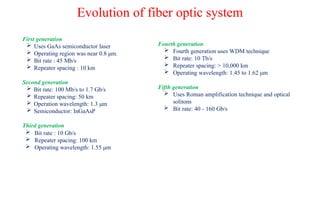
Evolution of fiber optic system
First generation
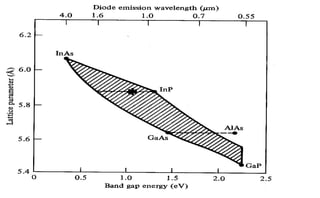
 Uses GaAs semiconductor laser
 Operating region was near 0.8 μm.
 Bit rate : 45 Mb/s
 Repeater spacing : 10 km
Second generation
 Bit rate: 100 Mb/s to 1.7 Gb/s
 Repeater spacing: 50 km
 Operation wavelength: 1.3 μm
 Semiconductor: InGaAsP
Third generation
 Bit rate : 10 Gb/s
 Repeater spacing: 100 km
 Operating wavelength: 1.55 μm
2
Fourth generation
 Fourth generation uses WDM technique
 Bit rate: 10 Tb/s
 Repeater spacing: > 10,000 km
 Operating wavelength: 1.45 to 1.62 μm
Fifth generation
 Uses Roman amplification technique and optical
solitons
 Bit rate: 40 - 160 Gb/s
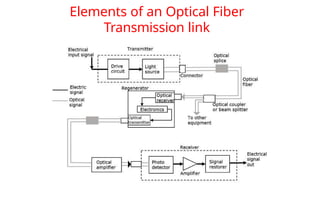
Elements of an Optical Fiber
Transmission link
9
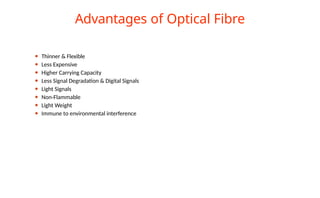
Advantages of Optical Fibre
⚫ Thinner & Flexible
⚫ Less Expensive
⚫ Higher Carrying Capacity
⚫ Less Signal Degradation & Digital Signals
⚫ Light Signals
⚫ Non-Flammable
⚫ Light Weight
⚫ Immune to environmental interference
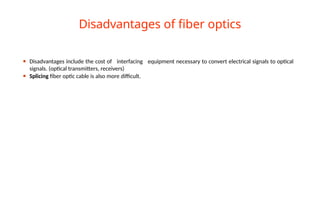
⚫ Disadvantages include the cost of interfacing equipment necessary to convert electrical signals to optical
signals. (optical transmitters, receivers)
⚫ Splicing fiber optic cable is also more difficult.
Disadvantages of fiber optics
Areas of Application
⚫ Telecommunications
⚫ Local Area Networks
⚫ Cable TV
⚫ CCTV
⚫ Optical Fiber Sensors
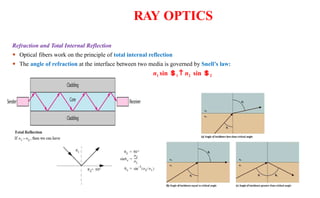
RAY OPTICS
Refraction and Total Internal Reflection
⚫ Optical fibers work on the principle of total internal reflection
⚫ The angle of refraction at the interface between two media is governed by Snell’s law:
n1 sin 1  n2 sin 2
16
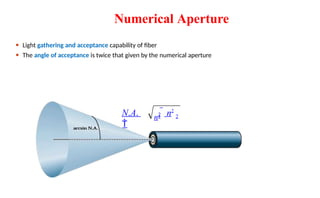
Numerical Aperture
⚫ Light gathering and acceptance capability of fiber
⚫ The angle of acceptance is twice that given by the numerical aperture
2
1
n2  n2
N.A.

REFRACTIVE INDEX
Refractiveindexisdenotedby‘n’
Refractiveindex(n)=velocityoflightinfirstsubstance/velocityoflightinsecondsubstance
9
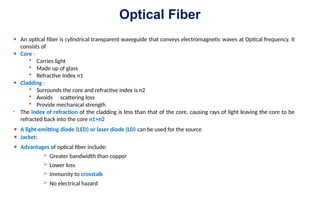
Optical Fiber
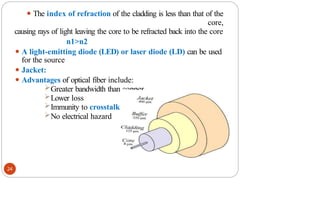
⚫ An optical fiber is cylindrical transparent waveguide that conveys electromagnetic waves at Optical frequency. It
consists of
⚫ Core :
 Carries light
 Made up of glass
 Refractive Index n1
⚫ Cladding :
 Surrounds the core and refractive index is n2
 Avoids scattering loss
 Provide mechanical strength
• The index of refraction of the cladding is less than that of the core, causing rays of light leaving the core to be
refracted back into the core n1>n2
⚫ A light-emitting diode (LED) or laser diode (LD) can be used for the source
⚫ Jacket:
⚫ Advantages of optical fiber include:
 Greater bandwidth than copper
 Lower loss
 Immunity to crosstalk
 No electrical hazard
23
⚫ The index of refraction of the cladding is less than that of the
core,
causing rays of light leaving the core to be refracted back into the core
n1>n2
⚫ A light-emitting diode (LED) or laser diode (LD) can be used
for the source
⚫ Jacket:
⚫ Advantages of optical fiber include:
Greater bandwidth than copper
Lower loss
Immunity to crosstalk
No electrical hazard
24
Optical Fiber Modes and Configurations
The optical fiber is a dielectric waveguide
that operates at optical frequency.
 The propagation of light along a waveguide can
be described in terms of a set of guided
electromagnetic waves called the modes.
These guided modes are referred to as bound or
trapped modes.
Only certain discrete number of modes
can propagate along fiber.
Modes satisfies the homogeneous equation
in the
25 fiber and boundary conditions a the
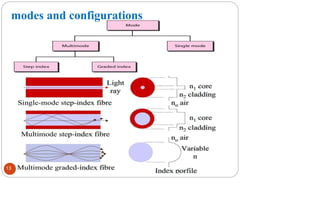
modes and configurations
13
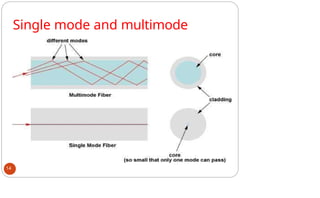
Single mode and multimode
14
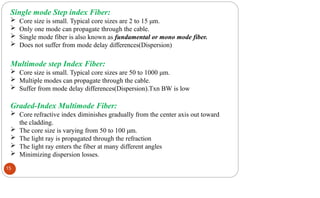
Single mode Step index Fiber:
 Core size is small. Typical core sizes are 2 to 15 μm.
 Only one mode can propagate through the cable.
 Single mode fiber is also known as fundamental or mono mode fiber.
 Does not suffer from mode delay differences(Dispersion)
Multimode step Index Fiber:
 Core size is small. Typical core sizes are 50 to 1000 μm.
 Multiple modes can propagate through the cable.
 Suffer from mode delay differences(Dispersion).Txn BW is low
Graded-Index Multimode Fiber:
 Core refractive index diminishes gradually from the center axis out toward
the cladding.
 The core size is varying from 50 to 100 μm.
 The light ray is propagated through the refraction
 The light ray enters the fiber at many different angles
 Minimizing dispersion losses.
15
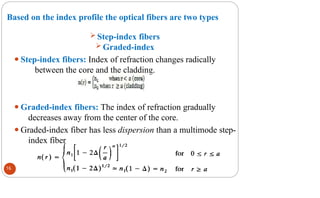
⚫Graded-index fibers: The index of refraction gradually
decreases away from the center of the core.
⚫Graded-index fiber has less dispersion than a multimode step-
index fiber
Based on the index profile the optical fibers are two types
 Step-index fibers
 Graded-index
⚫Step-index fibers: Index of refraction changes radically
between the core and the cladding.
16
Single mode fiber structure
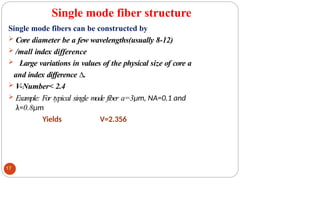
Single mode fibers can be constructed by
 Core diameter be a few wavelengths(usually 8-12)
 /mall index difference
 Large variations in values of the physical size of core a
and index difference ∆.
 V-Number< 2.4
 Example: For typical single mode fiber a=3μm, NA=0.1 and
λ=0.8μm
Yields V=2.356
17
Continued……
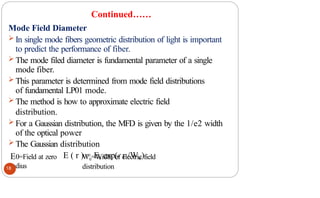
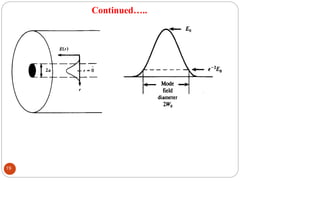
Mode Field Diameter
 In single mode fibers geometric distribution of light is important
to predict the performance of fiber.
 The mode filed diameter is fundamental parameter of a single
mode fiber.
 This parameter is determined from mode field distributions
of fundamental LP01 mode.
 The method is how to approximate electric field
distribution.
 For a Gaussian distribution, the MFD is given by the 1/e2 width
of the optical power
 The Gaussian distribution
E ( r ) = E0 exp(- r /W0)
E0=Field at zero
radius
W0=Width of electric field
distribution
18
Continued…..
19
Continued…..
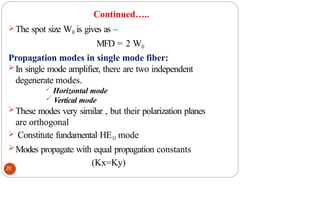
The spot size W0 is gives as –
MFD = 2 W0
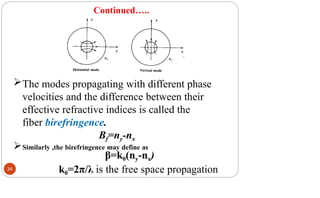
Propagation modes in single mode fiber:
In single mode amplifier, there are two independent
degenerate modes.
 Horizontal mode
 Vertical mode
These modes very similar , but their polarization planes
are orthogonal
 Constitute fundamental HE11 mode
Modes propagate with equal propagation constants
(Kx=Ky)
20
Continued…..
The modes propagating with different phase
velocities and the difference between their
effective refractive indices is called the
fiber birefringence.
Bf=ny-nx
Similarly ,the birefringence may define as
β=k0(ny-nx)
k0=2π/λ is the free space propagation
34
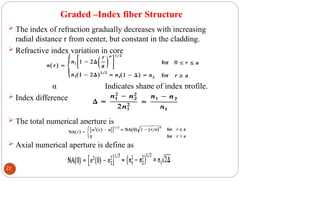
Graded –Index fiber Structure
 The index of refraction gradually decreases with increasing
radial distance r from center, but constant in the cladding.
 Refractive index variation in core
α Indicates shape of index profile.
 Index difference
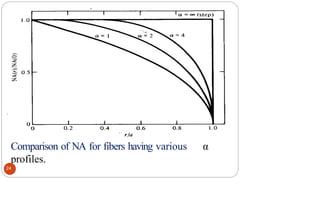
 The total numerical aperture is
 Axial numerical aperture is define as
22
TRANSMISSION CHARACTERISTICS
OF OPTICAL FIBERS
There are 2 main characteristics of optical
fiber
23
Signal
attenuation
Signal distortion
Comparison of NA for fibers having various α
profiles.
24
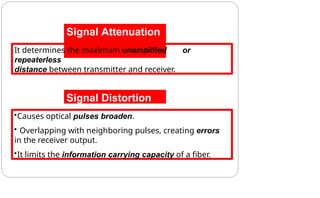
Signal Attenuation
Signal Distortion
It determines the maximum unamplified or
repeaterless
distance between transmitter and receiver.
•Causes optical pulses broaden.
• Overlapping with neighboring pulses, creating errors
in the receiver output.
•It limits the information carrying capacity of a fiber.
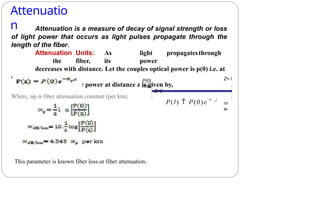
Attenuatio
n
Where, αp is fiber attenuation constant (per km).
Attenuation is a measure of decay of signal strength or loss
of light power that occurs as light pulses propagate through the
length of the fiber.
Attenuation Units: As light propagatesthrough
the fiber, its power
decreases with distance. Let the couples optical power is p(0) i.e. at
origin
(z = 0). Then the power at distance z is given by,
Z=0
P(0)
mW
Z= l
P(l)  P(0)e  p l
m
w
This parameter is known fiber loss or fiber attenuation.
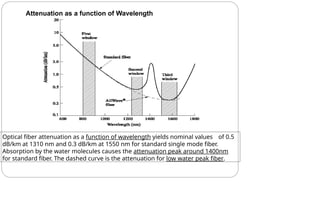
Optical fiber attenuation as a function of wavelength yields nominal values of 0.5
dB/km at 1310 nm and 0.3 dB/km at 1550 nm for standard single mode fiber.
Absorption by the water molecules causes the attenuation peak around 1400nm
for standard fiber. The dashed curve is the attenuation for low water peak fiber.
Attenuation as a function of Wavelength
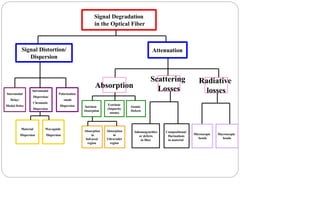
Absorption
in
Infrared
region
Absorption
Atomic
Defects
Extrinsic
(Impurity
atoms)
Intrinsic
Absorption
Absorption
in
Ultraviolet
region
Attenuation
Scattering
Losses
Compositional
fluctuations
in material
Inhomogeneities
or defects
in fiber
Radiative
losses
Macroscopic
bends
Microscopic
bends
Signal Distortion/
Dispersion
Polarization
-mode
Dispersion
Intramodal
Dispersion/
Chromatic
Dispersion
Intermodal
Delay/
Modal Delay
Material
Dispersion
Waveguide
Dispersion
Signal Degradation
in the Optical Fiber
Attenuation
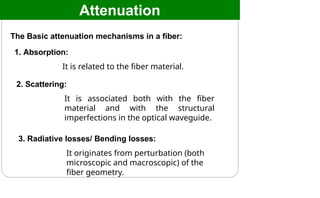
The Basic attenuation mechanisms in a fiber:
1. Absorption:
It is related to the fiber material.
2. Scattering:
It is associated both with the fiber
material and with the structural
imperfections in the optical waveguide.
3. Radiative losses/ Bending losses:
It originates from perturbation (both
microscopic and macroscopic) of the
fiber geometry.
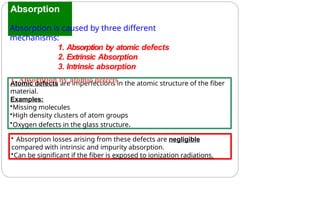
Absorption
Atomic defects are imperfections in the atomic structure of the fiber
material.
Examples:
•Missing molecules
•High density clusters of atom groups
•Oxygen defects in the glass structure.
• Absorption losses arising from these defects are negligible
compared with intrinsic and impurity absorption.
•Can be significant if the fiber is exposed to ionization radiations.
Absorption is caused by three different
mechanisms:
1. Absorption by atomic defects
2. Extrinsic Absorption
3. Intrinsic absorption
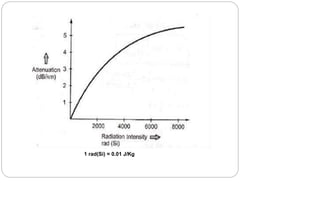
1. Absorption by atomic defects
1 rad(Si) = 0.01 J/Kg
Absorption
2. Extrinsic absorption by impurity atoms
The dominant absorption factor in silica fibers is the
presence of minute quantities of impurities in the
fiber material.
•These impurities include
•OH- (water) ions dissolved in the glass.
• Transition metal ions, such as
iron, copper, chromium and vanadium
Absorption
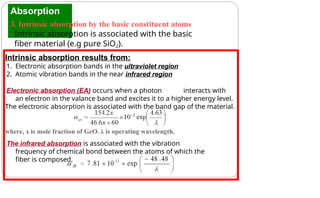
3. Intrinsic absorption by the basic constituent atoms
Intrinsic absorption is associated with the basic
fiber material (e.g pure SiO2).
Intrinsic absorption results from:
1. Electronic absorption bands in the ultraviolet region
2. Atomic vibration bands in the near infrared region
Electronic absorption (EA) occurs when a photon interacts with
an electron in the valance band and excites it to a higher energy level.
The electronic absorption is associated with the band gap of the material.
where, x is mole fraction of GeO2, λ is operating wavelength.
The infrared absorption is associated with the vibration
frequency of chemical bond between the atoms of which the
fiber is composed.
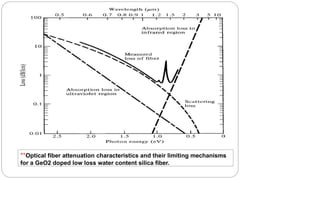
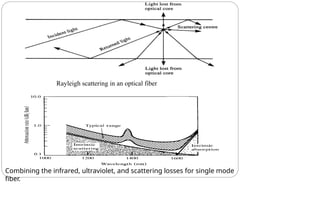
**Optical fiber attenuation characteristics and their limiting mechanisms
for a GeO2 doped low loss water content silica fiber.
Scattering Losses
Scattering losses in glass arise due to
1. Compositional fluctuations
2. Inhomogeneities or defects occurring during fiber
manufacture
These two effects give rise to refractive index variation, within the
glass
over distances.
These index variation case Rayleigh-type scattering of the light and
inversely proportional to wavelength.
It decreases dramatically with increasing wavelength.
Scattering loss for single component glass is given by,
where, n = Refractive index, KB = Boltzmann‘s constant
βT = Isothermal compressibility of material
Tf = Temperature at which density fluctuations are frozen into the glass as
it solidifies
Combining the infrared, ultraviolet, and scattering losses for single mode
fiber.
Rayleigh scattering in an optical fiber
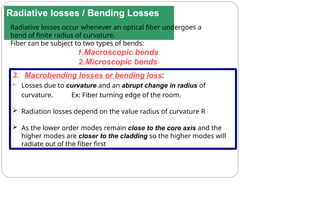
Radiative losses / Bending Losses
Radiative losses occur whenever an optical fiber undergoes a
bend of finite radius of curvature.
Fiber can be subject to two types of bends:
1.Macroscopic bends
2.Microscopic bends
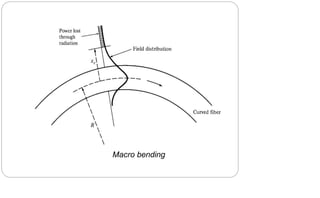
3. Macrobending losses or bending loss:
 Losses due to curvature and an abrupt change in radius of
curvature. Ex: Fiber turning edge of the room.
 Radiation losses depend on the value radius of curvature R
 As the lower order modes remain close to the core axis and the
higher modes are closer to the cladding so the higher modes will
radiate out of the fiber first
Macro bending
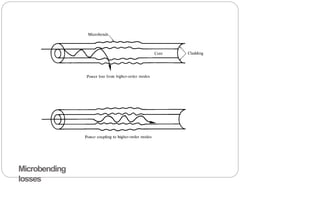
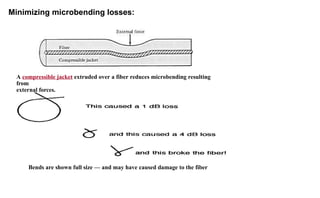
Microbending losses:
 Microbending is a loss due to small bending or
distortions
 Microbends are repetitive small scale fluctuations in
radius of curvature of the fiber axis.
 Microbends causes repetitive coupling of energy
between the guided modes and the leaky or
nonguided modes in the fiber.
Caused by:
• Nonuniformities in the manufacturing of the fiber
• Nonuniform lateral pressures during cabling
• High pressures
Radiative losses / Bending Losses
Microbending
losses
A compressible jacket extruded over a fiber reduces microbending resulting
from
external forces.
Minimizing microbending losses:
Bends are shown full size — and may have caused damage to the fiber
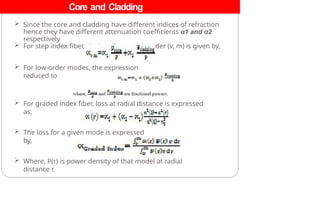
Core and Cladding
Losses
 Since the core and cladding have different indices of refraction
hence they have different attenuation coefficients α1 and α2
respectively
 For step index fiber, the loss for a mode order (v, m) is given by,
 For low-order modes, the expression
reduced to
 For graded index fiber, loss at radial distance is expressed
as,
 The loss for a given mode is expressed
by,
 Where, P(r) is power density of that model at radial
distance r.
Signal Distortion in Fibers
Optical signal weakens from attenuation mechanisms and broadens
due to distortion effects.
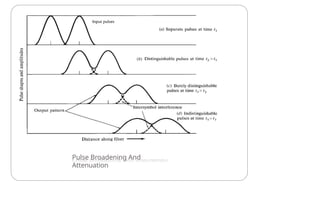
 The pulse gets distorted as it travels along the fiber
lengths as consequence of pulse spreading.
 Pulse spreading in fiber is referred as dispersion
 Dispersion is caused by difference in the propagation times of light
rays that takes different paths during the propagation.
 Dispersion limits the information bandwidth
Pulse Broadening And
Attenuation
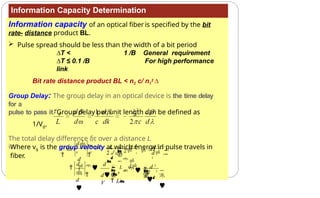
Information Capacity Determination
Information capacity of an optical fiber is specified by the bit
rate- distance product BL.
 Pulse spread should be less than the width of a bit period
∆T < 1 /B General requirement
∆T ≤ 0.1 /B For high performance
link
Bit rate distance product BL < n2 c/ n1
2 ∆
Group Delay: The group delay in an optical device is the time delay
for a
pulse to pass it. Group delay per unit length can be defined as
1/Vg=
Where vg is the group velocity at which energy in pulse travels in
fiber.
The total delay difference δτ over a distance L
is:














 


 2

 2  

d

 d 2
 
 
 L
 L

d 
V
d
d

d

d
2
2c

L  d 2 d 2


d
g

d
g
d

is called GVD parameter, and shows how much a light pulse
broadens as it travels along an optical fiber.
The more common parameter is called Dispersion, and can be
defined as
the delay difference per unit length per unit wavelength as follows
The pulse spreading σg of fiber length of L, can be well
approximated by:
D has a typical unit of
[ps/(nm.km)].
2

2

2
c
g


   


1 d g d  1

L d d V

D 



d

g

DL

d g

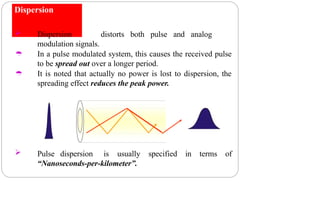
Dispersion


 Dispersion distorts both pulse and analog
modulation signals.
In a pulse modulated system, this causes the received pulse
to be spread out over a longer period.
It is noted that actually no power is lost to dispersion, the
spreading effect reduces the peak power.
 Pulse dispersion is usually specified in terms of
“Nanoseconds-per-kilometer”.
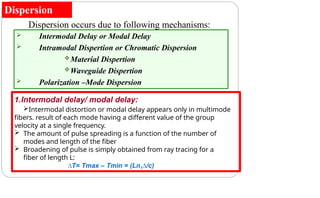
Dispersion
Dispersion occurs due to following mechanisms:
 Intermodal Delay or Modal Delay
 Intramodal Dispertion or Chromatic Dispersion
Material Dispertion
Waveguide Dispertion
 Polarization –Mode Dispersion
1.Intermodal delay/ modal delay:
Intermodal distortion or modal delay appears only in multimode
fibers. result of each mode having a different value of the group
velocity at a single frequency.
 The amount of pulse spreading is a function of the number of
modes and length of the fiber
 Broadening of pulse is simply obtained from ray tracing for a
fiber of length L:
∆T= Tmax – Tmin = (Ln1∆/c)
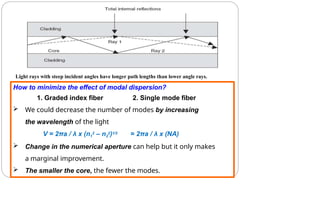
Light rays with steep incident angles have longer path lengths than lower angle rays.
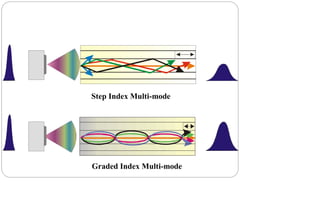
How to minimize the effect of modal dispersion?
1. Graded index fiber 2. Single mode fiber
 We could decrease the number of modes by increasing
the wavelength of the light
V = 2πa / λ x (n1
2 – n2
2)1/2 = 2πa / λ x (NA)
 Change in the numerical aperture can help but it only makes
a marginal improvement.
 The smaller the core, the fewer the modes.
Step Index Multi-mode
Graded Index Multi-mode
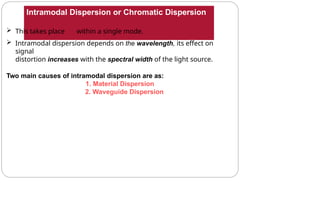
Intramodal Dispersion or Chromatic Dispersion
 This takes place within a single mode.
 Intramodal dispersion depends on the wavelength, its effect on
signal
distortion increases with the spectral width of the light source.
Two main causes of intramodal dispersion are as:
1. Material Dispersion
2. Waveguide Dispersion
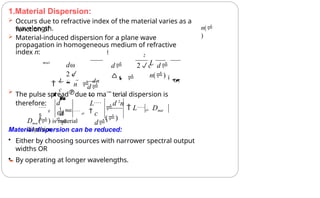
1.Material Dispersion:
 Occurs due to refractive index of the material varies as a
function of
wavelength.
 Material-induced dispersion for a plane wave
propagation in homogeneous medium of refractive
index n:
Material dispersion can be reduced:
• Either by choosing sources with narrower spectral output
widths OR
• By operating at longer wavelengths.

n(
)

The pulse spreaddue to material dispersion is
therefore:
d

c


L 
n   dn

mat
d 2c d
 
dω
2
c
 2
L
n()

L d 2
n
c
d2
d

d

  L Dmat
()
mat
 

 g

Dmat () is material
dispersion
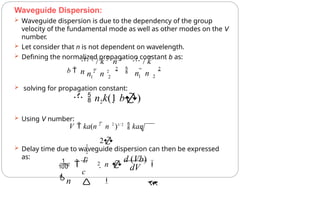
Waveguide Dispersion:
 Waveguide dispersion is due to the dependency of the group
velocity of the fundamental mode as well as other modes on the V
number.
 Let consider that n is not dependent on wavelength.
 Defining the normalized propagation constant b as:
 Delay time due to waveguide dispersion can then be expressed
as:
2
1
1 2
n  n
n 2
 n 2
b  2
 2
 2
/ k 2
 n 2
 / k 
n
 solving for propagation constant:
  n2k(1 b)
 Using V number:
V  ka(n 2
 n 2
)1/ 2
 kan
2
1
2
2


dV
c

wg  n 
d (Vb)

2
2
 
L

n
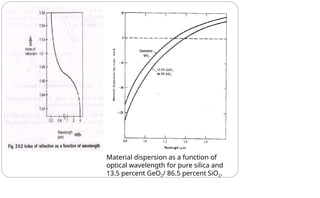
Material dispersion as a function of
optical wavelength for pure silica and
13.5 percent GeO2/ 86.5 percent SiO2.
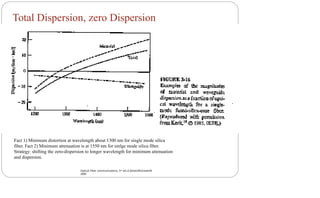
Total Dispersion, zero Dispersion
Optical Fiber communications, 3rd ed.,G.Keiser,McGrawHill,
2000
Fact 1) Minimum distortion at wavelength about 1300 nm for single mode silica
fiber. Fact 2) Minimum attenuation is at 1550 nm for sinlge mode silica fiber.
Strategy: shifting the zero-dispersion to longer wavelength for minimum attenuation
and dispersion.
References
69
⚫ https://www.thefoa.org/tech/ref/OSP/fiber.html
⚫ http://en.wikipedia.org/wiki/Optical_communication
⚫ http://www.journals.elsevier.com/optics-communications/
OPTICAL FIBER COMMUNICATION
Unit-II
Fiber Optical Sources and coupling
SIDDARTHA INSTITUTE OF SCIENCE AND
TECHNOLOGY
(Approved by AICTE, New Delhi & Affiliated to JNTUA, Ananthapuramu)
(Accrediated NBA and Accrediated NAAC with “A” Grade )
Siddharth Nagar, Naravanavanam Road, Puttur-517583, AP, India
Department of Electronics and Communication
Engineering
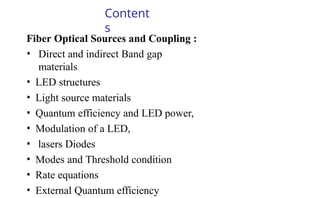
Content
s
Fiber Optical Sources and Coupling :
• Direct and indirect Band gap
materials
• LED structures
• Light source materials
• Quantum efficiency and LED power,
• Modulation of a LED,
• lasers Diodes
• Modes and Threshold condition
• Rate equations
• External Quantum efficiency
• Resonant frequencies
• Temperature effects
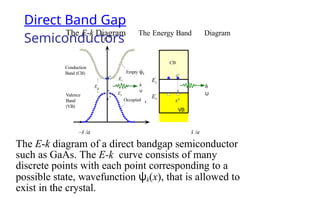
The E-k Diagram The Energy Band Diagram
Ek
Ec
Ev
Conduction
Band (CB)
Ec
Ev
CB
h+
e-
Eg
e-
h
υ
Empty ψk
h
υ
Direct Band Gap
Semiconductors
h+
VB
Occupied k
Valence
Band
(VB)
–š /a š /a
The E-k diagram of a direct bandgap semiconductor
such as GaAs. The E-k curve consists of many
discrete points with each point corresponding to a
possible state, wavefunction ψk(x), that is allowed to
exist in the crystal.
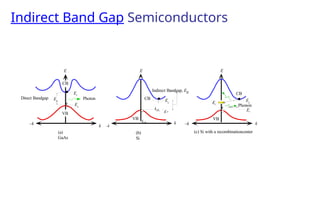
Indirect Band Gap Semiconductors
E
CB
Direct Bandgap
E
CB
VB
Indirect Bandgap, Eg
E
Eg
Ec
Ev
Ec
kcb
Ev
kvb
VB
CB
Er
Ec
Phonon
Ev
Photon
VB
–k
(a)
GaAs
k
k –k
(b)
Si
k
–k
(c) Si with a recombinationcenter
LED
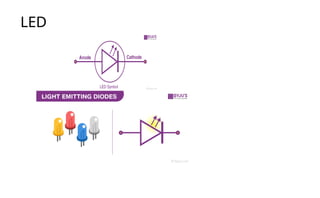
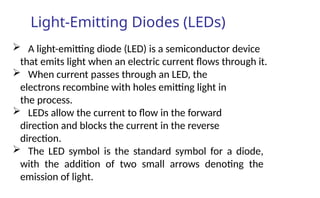
Light-Emitting Diodes (LEDs)
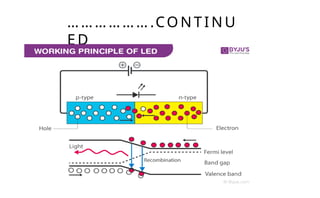
 A light-emitting diode (LED) is a semiconductor device
that emits light when an electric current flows through it.
 When current passes through an LED, the
electrons recombine with holes emitting light in
the process.
 LEDs allow the current to flow in the forward
direction and blocks the current in the reverse
direction.
 The LED symbol is the standard symbol for a diode,
with the addition of two small arrows denoting the
emission of light.
… …… … … … .CO NT I NU
ED
 The two main types of LEDs presently used for
lighting systems are aluminum gallium indium
phosphide (AlGaInP, sometimes rearranged as
AlInGaP) alloys for red, orange and yellow LEDs; and
indium gallium nitride (InGaN) alloys for green, blue
and white LEDs
… …… … … … .CO NT I NU
ED
• For photonic communications requiring data rate
100- tens of
200 Mb/s with multimode fiber
with microwatts, LEDs are usually the best
choice.
• LED configurations being used in photonic
communications:
1 Surface Emitters (Front Emitters)
2 Edge Emitters
LED STRUCTURES
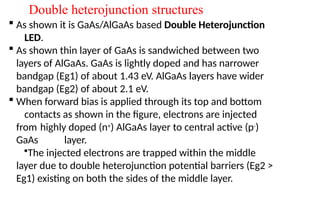
Double heterojunction structures
 As shown it is GaAs/AlGaAs based Double Heterojunction
LED.
 As shown thin layer of GaAs is sandwiched between two
layers of AlGaAs. GaAs is lightly doped and has narrower
bandgap (Eg1) of about 1.43 eV. AlGaAs layers have wider
bandgap (Eg2) of about 2.1 eV.
 When forward bias is applied through its top and bottom
contacts as shown in the figure, electrons are injected
from highly doped (n+) AlGaAs layer to central active (p-)
GaAs layer.
•The injected electrons are trapped within the middle
layer due to double heterojunction potential barriers (Eg2 >
Eg1) existing on both the sides of the middle layer.
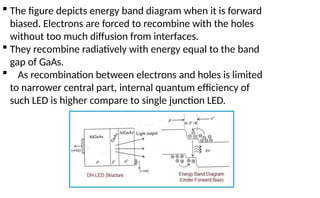
 The figure depicts energy band diagram when it is forward
biased. Electrons are forced to recombine with the holes
without too much diffusion from interfaces.
 They recombine radiatively with energy equal to the band
gap of GaAs.
 As recombination between electrons and holes is limited
to narrower central part, internal quantum efficiency of
such LED is higher compare to single junction LED.
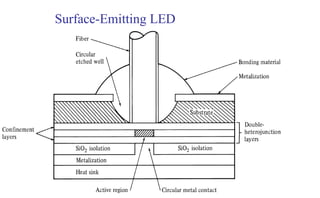
Surface-Emitting LED
Benefits or advantages of Surface Emitting LED
➨LED offers high optical coupling efficiency.
➨Optical loss (due to internal absorption) is very low. This
is because of carrier recombination near its top
heterojunction.
➨InP/InGaAsP based LED is used for long wavelength
applications.
➨It offers higher efficiency with low to high radiance.
Drawbacks ➨The surface emitting LED can transmit data
rate less than 20 Mbps than edge emitting LED.
➨It contains short optical link with large NA (Numerical
Aperture).
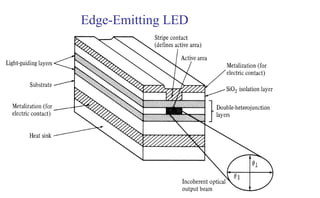
Edge-Emitting LED
Benefits or advantages ➨It offers higher efficiency with low to
high radiance. ➨It offers better modulation bandwidth and
more directional emission pattern.
➨It offers 5-6 times more coupled power into NA (Numerical
Aperture) of step/graded index fibers. This is due to small beam
divergence.
➨It offers high data rates (> 20 Mbps) than surface emitting
LED.
Drawbacks ➨Its structure is complex.
➨It is difficult to design heat sink.
➨It is expensive compare to other LED types.
➨There are many issues to be handled during mechanical
mounting and installation.
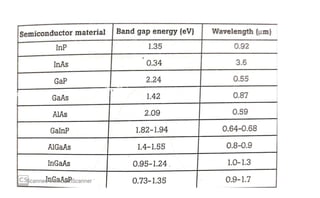
 Light Source Materials
active region material of an optical source must
have direct band gap.
In direct band gap materials,radiative recombination
is sufficiently high to produce adequete optical
emission.
These materials are compound of group III elements(
Al, Ga or In) and of group IV elements(P,As).
These materials determine the wave length of
light emitted.
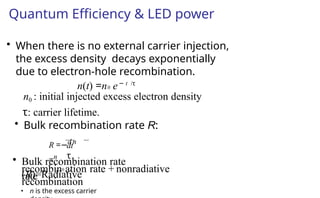
Quantum Efficiency & LED power
• When there is no external carrier injection,
the excess density decays exponentially
due to electron-hole recombination.
n(t) =n0 e− t /τ
n0 : initial injected excess electron density
τ: carrier lifetime.
• Bulk recombination rate R:
• n is the excess carrier
• Bulk recombination rate
(R)=Radiative
recombin0 ation rate + nonradiative
recombination
rate
dt
τ
R =−d n
=n
r nr r
Rr
τnr =
τ
R
+R
r nr
τ +τ
τ
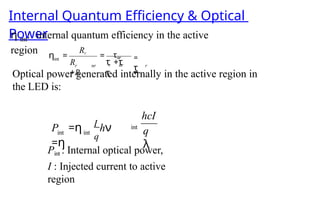
η = =
int
Internal Quantum Efficiency & Optical
Power
η int: internal quantum efficiency in the active
region
Optical power generated internally in the active region in
the LED is:
q
λ
hcI
int int
q
int
P =η I
hν
=η
Pint : Internal optical power,
I : Injected current to active
region
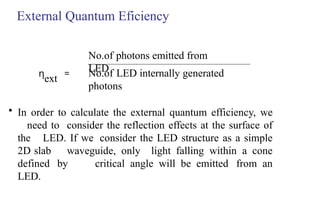
External Quantum Eficiency
No.of LED internally generated
photons
No.of photons emitted from
LED
η
ext =
• In order to calculate the external quantum efficiency, we
need to consider the reflection effects at the surface of
the LED. If we consider the LED structure as a simple
2D slab waveguide, only light falling within a cone
defined by critical angle will be emitted from an
LED.
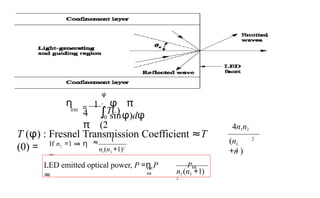
φ
c
4
π
= 1
0
∫T( )
(2
φ π
sinφ)dφ
η
ext
4n1n2
(n
+n )
2
1
2
T (φ) : Fresnel Transmission Coefficient ≈T
(0) = 1 1
1
If n2 =1 ⇒ η
ext
≈
n (n +1)2
1 1
n (n +1)
2
Pint
ext
int
LED emitted optical power, P =η P
≈
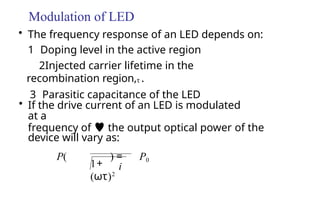
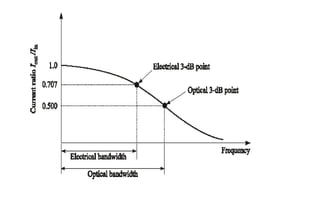
Modulation of LED
• The frequency response of an LED depends on:
1 Doping level in the active region
2Injected carrier lifetime in the
recombination region,τ .
3 Parasitic capacitance of the LED
• If the drive current of an LED is modulated
at a
frequency of  the output optical power of the
device will vary as:
P( ) = P0
i
1+
(ωτ)2
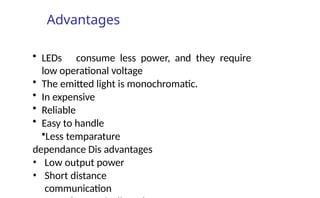
Advantages
• LEDs consume less power, and they require
low operational voltage
• The emitted light is monochromatic.
• In expensive
• Reliable
• Easy to handle
•Less temparature
dependance Dis advantages
• Low output power
• Short distance
communication
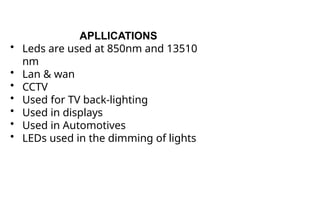
APLLICATIONS
• Leds are used at 850nm and 13510
nm
• Lan & wan
• CCTV
• Used for TV back-lighting
• Used in displays
• Used in Automotives
• LEDs used in the dimming of lights
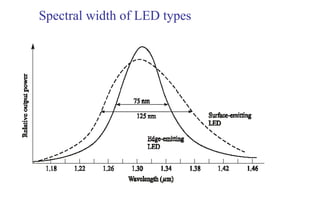
Spectral width of LED types
LASER
• LASER means light amplification by
stimulated emission of radiation.
• It is widely used optical source for
optical communication.
• It is working on the principle of
stimulated emission.
• It has coherent light.
• Laser diode suffers from 3 problems when
used as optical source :
• Temperature sensitivity
• Back reflections
• Susceptible to optical interference
Pumped active
medium
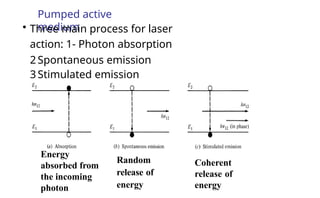
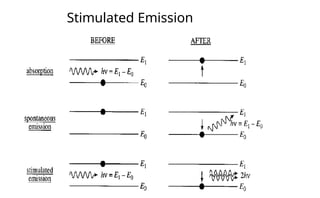
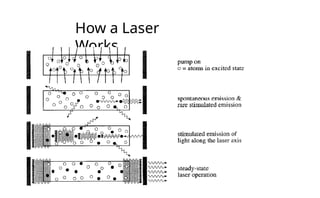
• Three main process for laser
action: 1- Photon absorption
2 Spontaneous emission
3 Stimulated emission
Energy
absorbed from
the incoming
photon
Random
release of
energy
Coherent
release of
energy
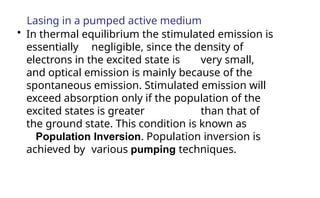
Lasing in a pumped active medium
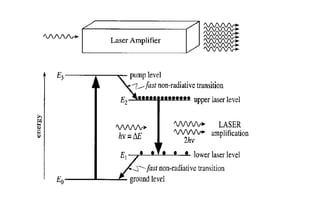
• In thermal equilibrium the stimulated emission is
essentially negligible, since the density of
electrons in the excited state is very small,
and optical emission is mainly because of the
spontaneous emission. Stimulated emission will
exceed absorption only if the population of the
excited states is greater than that of
the ground state. This condition is known as
Population Inversion. Population inversion is
achieved by various pumping techniques.
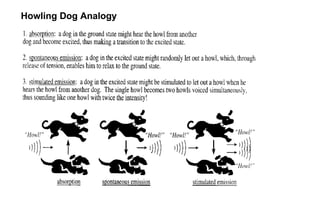
Howling Dog Analogy
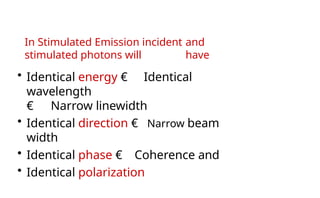
In Stimulated Emission incident and
stimulated photons will have
• Identical energy € Identical
wavelength
€ Narrow linewidth
• Identical direction € Narrow beam
width
• Identical phase € Coherence and
• Identical polarization
Stimulated Emission
Fabry-Perot
Resonator
A
B
L
M1 M2 m = 1
m = 2
m = 8
Relative intensity
υ
υm + 1
υm - 1
(a)
υm
(c)
R ~ 0.4
δυm
R ~
0.8
1 υf
(1−R)2
+4R sin2
(kL)
Schematic illustration of the Fabry-Perot optical cavity and its properties. (a) Reflected
waves interfere. (b) Only standing EM waves, modes, of certain wavelengths are allowed
in the cavity. (c) Intensity vs. frequency for various modes. R is mirror reflectance and
lower R means higher loss from the cavity.
© 1999 S.O. Kasap, Optoelectronics (Prentice Hall)
(1−R)2
Itrans
=Iinc
[4-18]
R: reflectance of the optical intensity, k: optical wavenumber
(b)
Resonant modes : kL =m m
=1,2,3,..
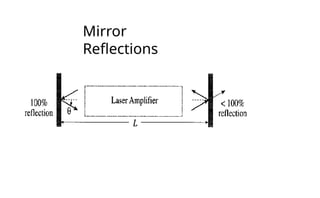
Mirror
Reflections
How a Laser
Works
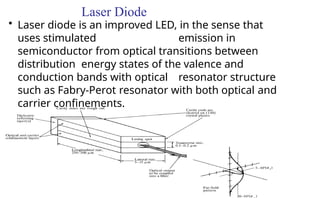
Laser Diode
• Laser diode is an improved LED, in the sense that
uses stimulated emission in
semiconductor from optical transitions between
distribution energy states of the valence and
conduction bands with optical resonator structure
such as Fabry-Perot resonator with both optical and
carrier confinements.
Laser Diode
Modes
• Nanosecond & even picosecond response time
(GHz BW)
• Spectral width of the order of nm or less
• High output power (tens of mW)
• Narrow beam (good coupling to single mode
fibers)
• Laser diodes have three distinct radiation
modes namely, longitudinal, lateral and
transverse modes.
• In laser diodes, end mirrors provide strong
optical feedback in longitudinal direction,
so by roughening the edges and cleaving the
facets, the radiation can be achieved in
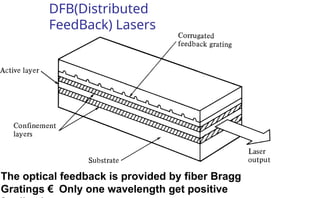
DFB(Distributed
FeedBack) Lasers
The optical feedback is provided by fiber Bragg
Gratings € Only one wavelength get positive
Threshold Condition
• To determine the lasing condition and resonant
frequencies, we should focus on the optical
wave propagation along the
longitudinal direction, z-axis. The optical field
intensity, I, can be written as:
I ( z, t ) =I ( z)e j (ωt − β z )
• Lasing is the condition at which light
amplification becomes possible by virtue of
population inversion. Then, stimulated
emission rate into a given EM mode is
proportional to the intensity of the
optical radiation in that mode.
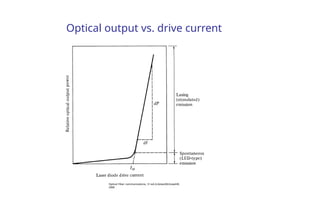
Optical output vs. drive current
Optical Fiber communications, 3rd ed.,G.Keiser,McGrawHill,
2000
Rate
equations
Rate equations relate the optical output power, or
# of photons per unit volume, Φ , to the diode
drive current or # of injected electrons per
unit volume, n. For active (carrier confinement)
region of depth d, the rate equations are:
–
Φ
dΦ =Cn Φ
+R
dt
ph
sp
τ
Photon rate =stimulated emission +spontaneou s emission +
photon loss
– n
−CnΦ
dn = J
dt
qd
τsp
[4-25]
Threshold current Density & excess electron
density
≈
0
•
At the threshold of lasing: Φ ≈0, dΦ/ dt ≥0,
Rsp
ph
=
n
th
C
τ
1
from eq.[4 - 25] ⇒ CnΦ
Φ
− /τ
ph ≥0 ⇒
n ≥
[4-26]
• The threshold current needed to maintain a steady state
threshold concentration of the excess electron, is found from
electron rate equation under steady state condition dn/dt=0
when the laser is just about to lase:
sp
th
sp τ
0 = −
qd
τ
⇒ J =qd
nth
Jth nth [4-27]
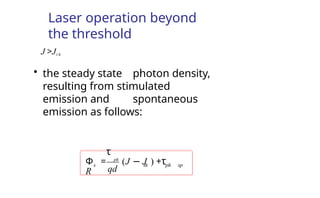
Laser operation beyond
the threshold
J >Jt h
• the steady state photon density,
resulting from stimulated
emission and spontaneous
emission as follows:
ph sp
s th
qd
τ
Φ = ph
(J − J ) +τ
R
External quantum efficiency
• Number of photons emitted per radiative electron-hole
pair recombination above threshold, gives us the external
quantum efficiency.
ext
η =ηi (gth
−α)
gth
[4-29]
Resonant
Frequencies
• Lasing condition:
exp(− j2βL) =1 ⇒ 2βL
=2mπ,
• Assuming
β =
2πn
mode is:
the resonant frequency of the
mth
m
=1,2,3,...
m
=1,2,3,...
= mc
2Ln
ν
m
c
⇔ ∆λ = λ2
2Ln 2Ln
− ν
=
m m−1
∆ν
=ν
[4-30]
[4-31]
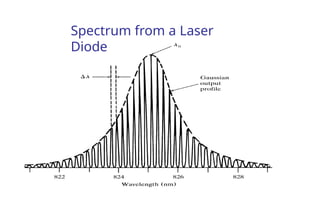
Spectrum from a Laser
Diode
REFERENCES
•https://en.wikipedia.org/wiki/Direct_and_indire
ct_b
and_gaps
•https://www.sciencedirect.com/topics/engineeri
ng/i
nternal-quantum-efficiency
•https://prezi.com/ewkesi281r3w/laser-
diode- modes-and-threshold-conditions/
•https://www.ques10.com/p/36411/illustrate-
elastic- tube-splicing-with-neat-diagram/
•FibertoFiberJointLosses
SIDDARTHA INSTITUTE OF SCIENCE AND TECHNOLOGY
(Approved by AICTE, New Delhi & Affiliated to JNTUA,
Ananthapuramu)
(Accrediated NBA and Accrediated NAAC with “A”
Grade )
Siddharth Nagar, Naravanavanam Road, Puttur-517583,
AP, India
Department of Electronics and Communication Engineering
OPTICAL FIBER COMMUNICATION
UNIT-III
FIBER OPTICAL RECEIVERS
contents
• PIN and APD diodes
• Photo detector noise
• SNR
• Detector response time
• Avalanche Multiplication noise
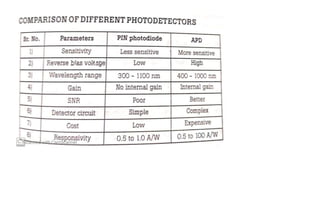
• Comparison of photo detectors
• Fundamental Receiver Operation
• Preamplifiers
• Error sources
• Receiver configuration
Photo Detectors
• Optical detectors convert optical signal (light)
to electrical signal (current/voltage)
–Hence referred ‘O/E Converter’
• Photodetector is the fundamental element
of optical receiver, followed by
amplifiers and signal conditioning
circuitry
• There are several photodetector types:
– Photodiodes, Phototransistors,
Photon multipliers, Photo-resistors
etc.
requirements of photo detectors
• Compatible Physical Dimensions (small size)
• High Response or Selectivity at desired
wavelength.
• Low Noise added to the system and
high Gain
• High Bandwidth Fast response time
• Stable performance
• Long Operating Life and low Cost
Principle of photo detector
• Working principle is optical absorption
• The main purpose ofis its fast reponse
• For foc most suited photo detectors are
PIN(P type intrinsic N type) and (Avalancha
photo diode)
Performance of photodetector
• Quantum efficiency: ratio of no of electron-
hole carrier generated to no of incident
photons
• Responsivity:output current to incident
optical power
• Wavelength
• Dark current: electrical current under
total darkness condituon.
Photodiodes
• Photodiodes meet most of the
requirements, hence widely used as photo
detectors.
• Positive-Intrinsic-Negative (pin) photodiode
– No internal gain, robust detector
• Avalanche Photo Diode (APD)
– Advanced version with internal gain M
due to self multiplication process
• Photodiodes are sufficiently reverse biased
during normal operation  no current flow
without illumination, the intrinsic region is
fully depleted of carriers
PIN DIODE
• A diode with a wide and undoped intrinsic
semiconductor region between a p-type
and an n-type semiconductor region.
• It was even used for microwave
applications and as a photo detector as it
is said to be a good light absorber.
PiN Photodiode
Semiconductor positive-negative structure
with an intrinsic region sandwiched
between the other two regions.
Normally operated by applying a reverse-
bias voltage.
Dark current can also be produced which is a
leakage current that flows when a reverse
bias is applied without incident light.
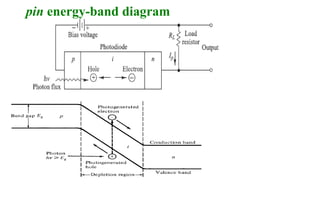
pin energy-band diagram
Structure and Working of a Pin Diode
• The PIN diode comprises a semiconductor
diode having three layers naming the P-
type layer, Intrinsic layer and N-type layer,
as shown in the figure below.
• The P and N regions are there, and the
region between them consists of the intrinsic
material, and the doping level is said to be
very low in this region.
•
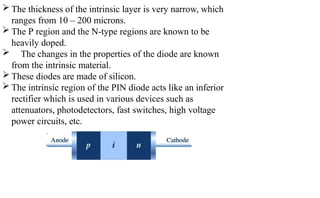
 The thickness of the intrinsic layer is very narrow, which
ranges from 10 – 200 microns.
 The P region and the N-type regions are known to be
heavily doped.
 The changes in the properties of the diode are known
from the intrinsic material.
 These diodes are made of silicon.
 The intrinsic region of the PIN diode acts like an inferior
rectifier which is used in various devices such as
attenuators, photodetectors, fast switches, high voltage
power circuits, etc.
Advantage of PIN photodiodes
The output electrical current is linearly
proportional to the input optical power making it
a highly linear device.
Low bias voltage(<4v).
Low noise
Low dark current
High-speed response
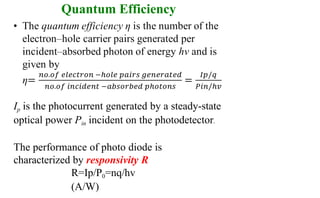
Quantum Efficiency
Ip is the photocurrent generated by a steady-state
optical power Pin incident on the photodetector.
The performance of photo diode is
characterized by responsivity R
R=Ip/P0=nq/hv
(A/W)
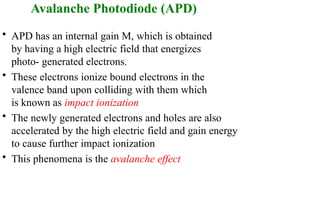
Avalanche Photodiode (APD)
• APD has an internal gain M, which is obtained
by having a high electric field that energizes
photo- generated electrons.
• These electrons ionize bound electrons in the
valence band upon colliding with them which
is known as impact ionization
• The newly generated electrons and holes are also
accelerated by the high electric field and gain energy
to cause further impact ionization
• This phenomena is the avalanche effect
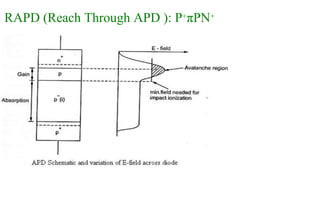
RAPD (Reach Through APD ): P+πPN+
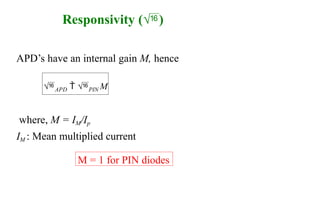
Responsivity ()
APD’s have an internal gain M, hence
where, M = IM/Ip
IM : Mean multiplied current
M = 1 for PIN diodes
APD  PIN M
advantages
• Low level light can be detected
• Increase in sensitivity of
receiver
• SNR is high
• Excellent linearity
disadvantages
• Complex structure
• High reverse bias voltage is
required
• Additional noise
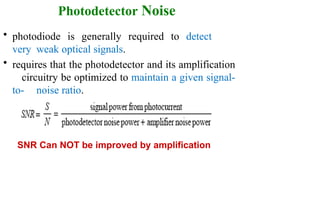
Photodetector Noise
• photodiode is generally required to detect
very weak optical signals.
• requires that the photodetector and its amplification
circuitry be optimized to maintain a given signal-
to- noise ratio.
SNR Can NOT be improved by amplification
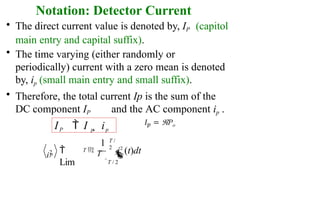
Notation: Detector Current
• The direct current value is denoted by, IP
main entry and capital suffix).
(capitol
• The time varying (either randomly or
periodically) current with a zero mean is denoted
by, ip (small main entry and small suffix).
• Therefore, the total current Ip is the sum of the
DC component IP and the AC component ip .
IP  I p  ip


Lim
1
T 
T
T /
2
T / 2
p
i2
(t)dt
p
i2
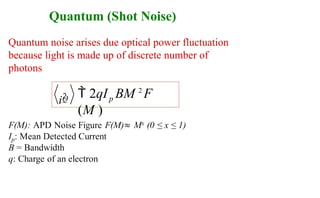
Quantum (Shot Noise)
i2 p
Q  2qI BM 2
F
(M )
Quantum noise arises due optical power fluctuation
because light is made up of discrete number of
photons
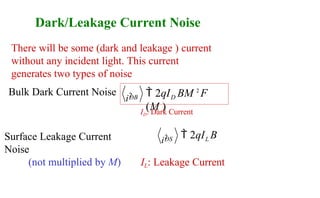
Dark/Leakage Current Noise
i2 D
DB  2qI BM 2
F
(M )
L
 2qI B
DS
i2
Bulk Dark Current Noise
Surface Leakage Current
Noise
ID: Dark Current
IL: Leakage Current
There will be some (dark and leakage ) current
without any incident light. This current
generates two types of noise
(not multiplied by M)
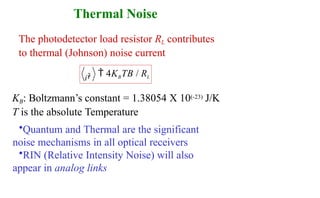
Thermal Noise
The photodetector load resistor RL contributes
to thermal (Johnson) noise current
T
i2  4KBTB / RL
KB: Boltzmann’s constant = 1.38054 X 10(-23) J/K
T is the absolute Temperature
•Quantum and Thermal are the significant
noise mechanisms in all optical receivers
•RIN (Relative Intensity Noise) will also
appear in analog links
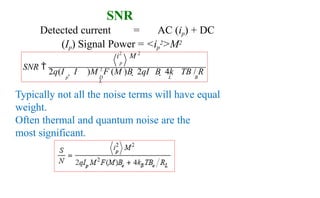
SNR
i2
M 2
p
SNR 
2q(I  I )M 2
F (M )B  2qI B  4k TB / R
p D L B
L
Detected current = AC (ip) + DC
(Ip) Signal Power = <ip
2>M2
Typically not all the noise terms will have equal
weight.
Often thermal and quantum noise are the
most significant.
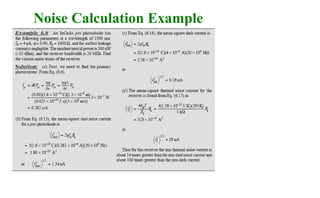
Noise Calculation Example
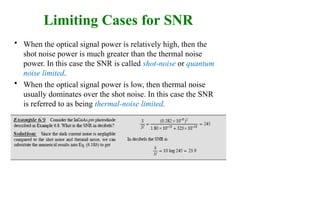
Limiting Cases for SNR
• When the optical signal power is relatively high, then the
shot noise power is much greater than the thermal noise
power. In this case the SNR is called shot-noise or quantum
noise limited.
• When the optical signal power is low, then thermal noise
usually dominates over the shot noise. In this case the SNR
is referred to as being thermal-noise limited.
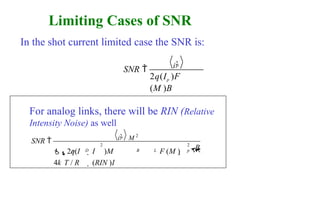
Limiting Cases of SNR
For analog links, there will be RIN (Relative
Intensity Noise) as well
p
In the shot current limited case the SNR is:
i2
2q(Ip )F
(M )B
SNR 
2
p
p D B L
2
p
i2
M 2
B
SNR 
2q(I  I )M F (M ) 
4k T / R  (RIN )I

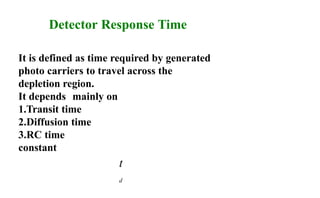
Detector Response Time
It is defined as time required by generated
photo carriers to travel across the
depletion region.
It depends mainly on
1.Transit time
2.Diffusion time
3.RC time
constant
t
d
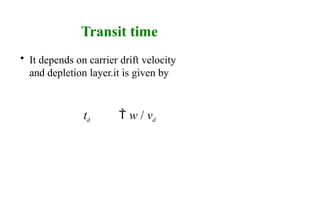
Transit time
• It depends on carrier drift velocity
and depletion layer.it is given by
td  w / vd
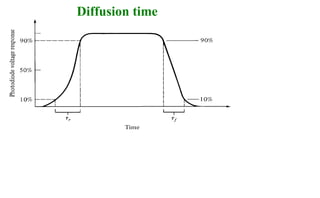
Diffusion time
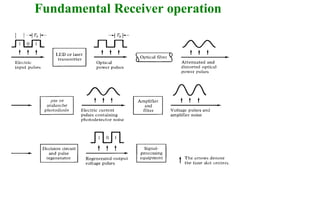
Fundamental Receiver operation
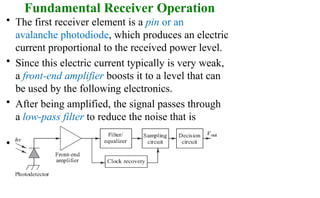
Fundamental Receiver Operation
• The first receiver element is a pin or an
avalanche photodiode, which produces an electric
current proportional to the received power level.
• Since this electric current typically is very weak,
a front-end amplifier boosts it to a level that can
be used by the following electronics.

• After being amplified, the signal passes through
a low-pass filter to reduce the noise that is
outside of the signal bandwidth.
• Also filter can reshape (equalize) the pulses
that have become distorted as they traveled
through the fiber.
Preamplifiers
• Optical amplifier being used as a front-
end preamplifier for an optical receiver.
• A weak optical signal is amplified
before photo-detection so that signal to
noise ratio degradation due to noise can be
suppressed in the receiver.
• It provides a larger gain factor and BW.
• Three types: semiconductor optical
amplifiers, Raman Amplifiers and
Erbium doped fibre amplifiers.
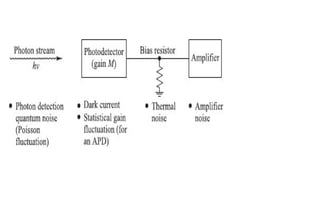
Error Sources
The term noise describes unwanted components
of an electric signal that tend to disturb the
transmission and processing of the signal
• The random arrival rate of signal photons
produces quantum (shot) noise
• Dark current comes from thermally generated e-
h pairs in the pn junction
• Additional shot noise arises from the
statistical nature of the APD process
• Thermal noises arise from the random motion
of electrons in the detector load resistor and in
the amplifier electronics
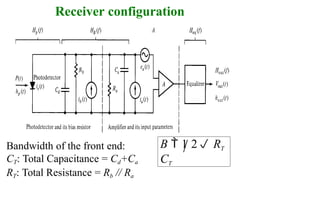
Receiver configuration
Bandwidth of the front end:
CT: Total Capacitance = Cd+Ca
RT: Total Resistance = Rb // Ra
B  1 2 RT
CT
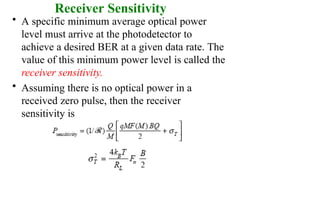
Receiver Sensitivity
• A specific minimum average optical power
level must arrive at the photodetector to
achieve a desired BER at a given data rate. The
value of this minimum power level is called the
receiver sensitivity.
• Assuming there is no optical power in a
received zero pulse, then the receiver
sensitivity is
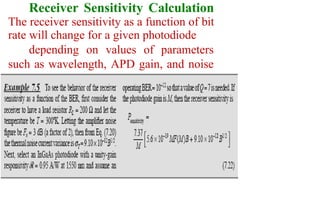
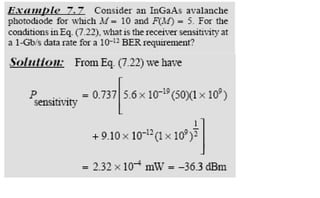
Receiver Sensitivity Calculation
The receiver sensitivity as a function of bit
rate will change for a given photodiode
depending on values of parameters
such as wavelength, APD gain, and noise
figure.
The Quantum Limit
• The minimum received optical power required
for a specific bit-error rate performance in a
digital system.
• This power level is called the quantum limit,
since all system parameters are assumed
ideal and the performance is limited only by
the detection statistics.
REFERENCES
• https://electronics360.globalspec.com/articl
e/10397/pin-vs-apd-different-sensitivity-
different-applications
• https://www.slideshare.net/Surajduvey/phot
o-detector-noise
• https://en.wikipedia.org/wiki/Quantum_limi
t
• https://www.brainkart.com/article/Fundame
ntal-Receiver-Operation_13633/
SIDDARTHA INSTITUTE OF SCIENCE AND
TECHNOLOGY
(Approved by AICTE, New Delhi & Affiliated to JNTUA,
Ananthapuramu) (Accrediated NBA and Accrediated NAAC with “A”
Grade )
Siddharth Nagar, Naravanavanam Road, Puttur-517583, AP, India
Department of Electronics and Communication Engineering
OPTICAL FIBER COMMUNICATION
Unit-IV
OPTICAL FIBER SYSTEM DESIGN AND
TECHNOLOGY
Contents
•System specification
• Point-to- links
• link power budget
•Rise Time Budget
• Bandwidth Budget
•Power Budget and Receiver Sensitivity
• Link Budget calculations
• Optical Multiplexing & Demultiplexing techniques
• Optical Amplifiers and its Applications.
System Specifications:
Photodetector, Optical Source, Fiber
•Photodetectors: Compared to APD, PINs are less
expensive and more stable with temperature. However
PINs have lower sensitivity.
•Optical Sources:
1 LEDs: 150 (Mb/s).km @ 800-900 nm and larger than 1.5
(Gb/s).km @ 1330 nm
2 InGaAsP lasers: 25 (Gb/s).km @ 1330 nm and ideally
around 500 (Gb/s).km @ 1550 nm. 10-15 dB more
power. However more costly and more complex circuitry.
•Fiber:
1 Single-mode fibers are often used with lasers or edge-
emitting LEDs.
2 Multi-mode fibers are normally used with LEDs. NA
and 
should be optimized for any particular application.
Point-to-Point Link
•The components must be carefully chosen to ensure the
desired performance level and can be maintained for
the expected system life time.
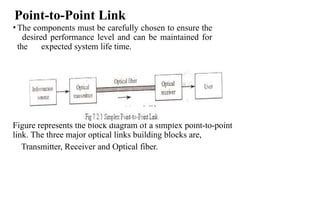
Figure represents the block diagram of a simplex point-to-point
link. The three major optical links building blocks are,
Transmitter, Receiver and Optical fiber.
The key system requirements are needed in analyzing
a link.
•Signal dispersion
•Data rate
•Transmission distance and cost.
Optical sources (such as LED or LASER) are used based
on the following characteristics.
•Emission wavelength
•Spectral line width
•Output power
•Effective radiating area
•Emission pattern
•Number of emitting modes
.
The characteristics of photo detector such as,
•Responsivity
•Operating wavelength
•Speed and
•Sensitivity
The choice of optical fiber
•Single mode and multimode (step or graded
index)
•Core size
•Core refractive index profile
•Band width or dispersion
•Attenuation
•Numerical aperture or modefield diameter
Link Budget Considerations
(1) Power Budget: determines the power margin between
the optical transmitter output and the minimum
receiver sensitivity needed to establish a specific Bit
Error Rate (BER).
(2) Bandwidth Budget: Determines dispersion
limitation of optical fiber link
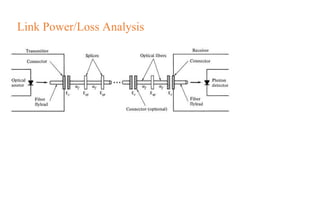
Link Power/Loss Analysis
Rise-Time Budget
1/ 2

2

B0
2
2
1/ 2
 tGVD  trx ]
  Brx
 
L2
2



 
350 



q

2
 
440L

2

ttx
2
2
tsys  [ttx  tmod

 [nm]:Spectral width of the
source
D[ns /(km.nm)]:Dispersion
q0.7
ttx [ns] : transmitter rise time
Brx [ MHz]:3dB ElectricalBW
t rx
[ns] : receiver rise time t mod
[n] : modal dispersion
L[km ]:Length of the fiber B0 [ MHz]:BW of the1 km of the
fiber;
tGVD [ns]: rise-time due to groupvelocitydispersion
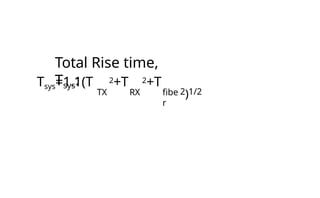
Total Rise time,
Tsys:
RX
Tsys=1.1(T 2+T 2+T
TX fibe
r
2)1/2
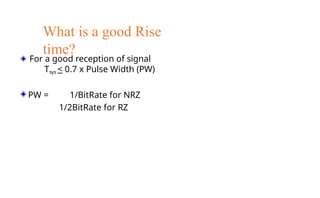
What is a good Rise
time?
For a good reception of signal
Tsys < 0.7 x Pulse Width (PW)
PW = 1/BitRate for NRZ
1/2BitRate for RZ
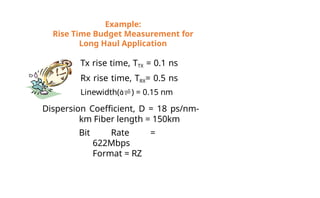
Example:
Rise Time Budget Measurement for
Long Haul Application
Tx rise time, TTX = 0.1 ns
Rx rise time, TRX= 0.5 ns
Linewidth() = 0.15 nm
Dispersion Coefficient, D = 18 ps/nm-
km Fiber length = 150km
Bit Rate =
622Mbps
Format = RZ
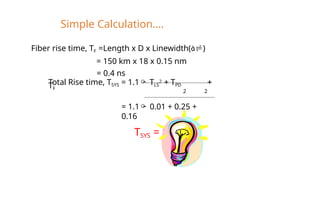
Fiber rise time, TF =Length x D x Linewidth()
= 150 km x 18 x 0.15 nm
= 0.4 ns
Total Rise time, TSYS = 1.1 TLS
2 + TPD +
TF
2 2
= 1.1 0.01 + 0.25 +
0.16
TSYS = 0.77 ns
Simple Calculation….
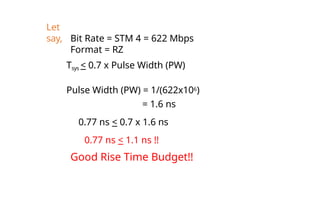
Let
say, Bit Rate = STM 4 = 622 Mbps
Format = RZ
Tsys < 0.7 x Pulse Width (PW)
Pulse Width (PW) = 1/(622x106)
= 1.6 ns
0.77 ns < 0.7 x 1.6 ns
0.77 ns < 1.1 ns !!
Good Rise Time Budget!!
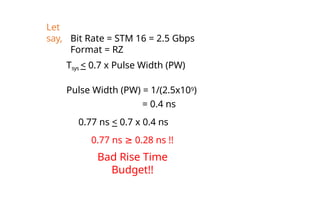
Let
say, Bit Rate = STM 16 = 2.5 Gbps
Format = RZ
Tsys < 0.7 x Pulse Width (PW)
Pulse Width (PW) = 1/(2.5x109)
= 0.4 ns
0.77 ns < 0.7 x 0.4 ns
0.77 ns ≥ 0.28 ns !!
Bad Rise Time
Budget!!
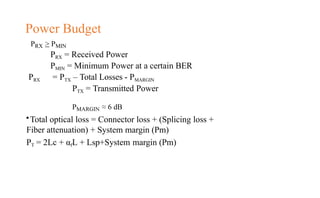
Power Budget
PRX > PMIN
PRX = Received Power
PMIN = Minimum Power at a certain BER
PRX = PTX – Total Losses - PMARGIN
PTX = Transmitted Power
PMARGIN ≈ 6 dB
•Total optical loss = Connector loss + (Splicing loss +
Fiber attenuation) + System margin (Pm)
PT = 2Lc + αfL + Lsp+System margin (Pm)
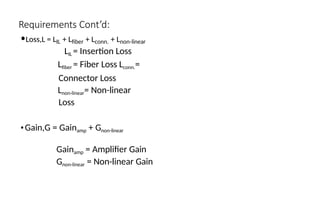
Requirements Cont’d:
•Loss,L = LIL + Lfiber + Lconn. + Lnon-linear
LIL = Insertion Loss
Lfiber = Fiber Loss Lconn.=
Connector Loss
Lnon-linear= Non-linear
Loss
•Gain,G = Gainamp + Gnon-linear
Gainamp = Amplifier Gain
Gnon-linear = Non-linear Gain
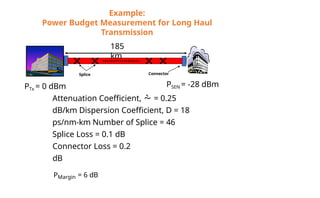
Example:
Power Budget Measurement for Long Haul
Transmission
PTx = 0 dBm
185
km
Splice
Attenuation Coefficient,  = 0.25
dB/km Dispersion Coefficient, D = 18
ps/nm-km Number of Splice = 46
Splice Loss = 0.1 dB
Connector Loss = 0.2
dB
PMargin = 6 dB
Connector
PSEN = -28 dBm
CONCLUSION:
BAD SY STEM!!
Simple
Calculation….
Fiber
Loss
= 0.25 dB/km X 185
km
= 46.3 dB
Splice Loss = 0.1 dB X 46
= 4.6 dB
PMargin = 6 dB
Total Losses = 46.3 + 4.6 + 0.4
= 51.3 dB
PRX
= PTX – Total Losses – PMargin
= 0 – 51.3 – 6
PRX = -57.3 dB
Power Budget, PRX < PSEN !!
Connector Loss = 0.2 dB X 2
= 0.4 dB
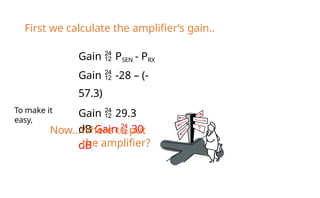
First we calculate the amplifier’s gain..
Gain  PSEN - PRX
Gain  -28 – (-
57.3)
Gain  29.3
dB Gain  30
dB
To make it
easy,
Now…Where to put
the amplifier?
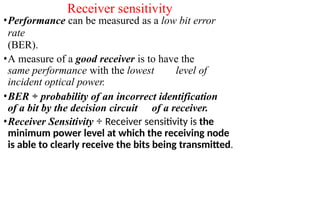
Receiver sensitivity
•Performance can be measured as a low bit error
rate
(BER).
•A measure of a good receiver is to have the
same performance with the lowest level of
incident optical power.
•BER ÷ probability of an incorrect identification
of a bit by the decision circuit of a receiver.
•Receiver Sensitivity ÷ Receiver sensitivity is the
minimum power level at which the receiving node
is able to clearly receive the bits being transmitted.
Optical
Multiplexing & Demultiplexing techniques
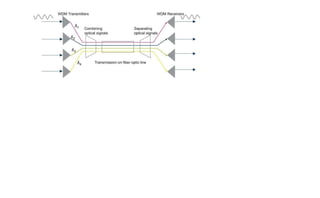
•Normally, there are three main different techniques
in multiplexing light signals onto a single optical
fiber link: optical time division multiplexing (OTDM),
code division multiplexing (CDM), and wavelength
division multiplexing (WDM).
•WDM is one of the most common way using
wavelengths to increase bandwidth by multiplexing
various optical carrier signals onto a single optical
fiber.
• What Is multiplexing?
• Multiplexing (Muxing) is a term used in the field of
communications and computer networking. It generally
refers to the process and technique of transmitting multiple
analog or digital input signals or data streams over a single
channel. Since multiplexing can integrate multiple low-
speed channels into one high-speed channel for
transmission, the high-speed channel is effectively
utilized.
• What Is demultiplexing?
• Demultiplexing (Demuxing) is a term relative to multiplexing.
It is the reverse of the multiplexing process. Demultiplex is
a process reconverting a signal containing multiple
analog or digital signal streams back into the original
separate and unrelated signals.
Optical Amplifiers and its
Applications
•However, when the length of the optical fiber
is a distance as long as 10 km or 100 km, that
transmission loss cannot be ignored. When
the light (signal) propagating a long-distance
optical fiber becomes extremely weak, it is
necessary to amplify the light using an optical
amplifier.
•An optical amplifier amplifies light as it is
without converting the optical signal to an
electrical signal, and is an extremely important
device that supports the long-distance optical
communication networks of today.
Applications of Optical Amplifiers
• Applications of Optical Amplifiers
• Typical applications of optical amplifiers are:
• An amplifier can boost the (average) power of a laser output to
higher levels (→ master oscillator power amplifier = MOPA).
• It can generate extremely high peak powers, particularly
in ultrashort pulses, if the stored energy is extracted within a short
time.
• It can amplify weak signals before photodetection, and thus
reduce
the detection noise, unless the added amplifier noise is large.
Design of Digital systems:
System specifications:
•Photodetectors: Compared to APD, PINs are
less expensive and more stable with
temperature. However PINs have lower
sensitivity.
•Optical Sources:
1 LEDs: 150 (Mb/s).km @ 800-900 nm and
larger
than 1.5 (Gb/s).km @ 1330 nm
2 InGaAsP lasers: 25 (Gb/s).km @ 1330 nm and
ideally around 500 (Gb/s).km @ 1550 nm. 10-15
dB more power. However more costly and more
complex circuitry.
•Fiber:
System Rise Time
• Calculate the total rise times
Tx, Fiber, Rx
• Calculate Fiber rise time, TFiber
Tfiber = D x  x L
D = Dispersion Coefficient
 = Linewidth
L = Fiber Length
Tx Rise Time, TTX = normally given by
manufacturer Rx Rise Time, TRX = normally given
by manufacturer
REFERENCES
• https://en.wikipedia.org/wiki/System_requirements_specification
• https://www.ques10.com/p/29974/what-is-rise-time-budget-
analysis-derive-an-expr-1/
• https://www.researchgate.net/publication/320264322_Bandwidth_B
udget_Analysis_for_Visible_Light_Communication_Systems_utilizing
_Available_Components
• https://www.youtube.com/hashtag/linkpowerbudgetanalysisofoptica
lfibercommunicationsystem
• https://study.com/academy/lesson/point-to-point-link-based-
systems-definition-uses.html
SIDDARTHA INSTITUTE OF SCIENCE AND
TECHNOLOGY
(Approved by AICTE, New Delhi & Affiliated to JNTUA, Ananthapuramu)
(Accrediated NBA and Accrediated NAAC with “A” Grade )
Siddharth Nagar, Naravanavanam Road, Puttur-517583, AP, India
Department of Electronics and Communication Engineering
OPTICAL FIBER COMMUNICATION
UNIT-V
Optical Networks
Optical Networks
•Definition: An Optical Network is basically a
communication network used for the exchange
of information through an optical fiber
cable between one end to another. It is one of the
quickest networks used for data communication.
CONTENTS
Basic Networks
Broadcast-and-select WDM Networks
Wavelength routed Networks
Performance of WDM+EDFA Networks
Ultra high capacity networks
Basics Of Networks
Station : Stations in an optical network serves as the source and destination of the
information being transmitted and received.
Examples: computers, terminals, telephones or other equipment
for communicating.
Network:
The pattern of contacts or flow of information between the stations is called
a network.
Node:
Node is nothing but acts as a hub for multiple transmission lines inside the
network. In case of a single transmission line, an optical network does not require nodes,
as in this case stations at both the ends can be directly connected to the fiber cables.
Trunk: A trunk is basically a transmission line i.e., optical fiber cable in order to
transmit the optical signal.
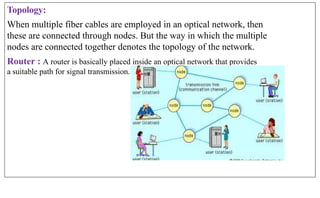
Topology:
When multiple fiber cables are employed in an optical network, then
these are connected through nodes. But the way in which the multiple
nodes are connected together denotes the topology of the network.
Router : A router is basically placed inside an optical network that provides
a suitable path for signal transmission.
Networks classification:
LANs :
LANs means Local area networks. It is a interconnect users in a localized area
such
as a department, a building, an office or factory complex, or a university campus .
MANs :
MANs means Metropolitan area networks. which provides user
connection with in a city or in the metropolitan area surrounding a city.
WANs :
WANs means wide area network. it covers a large geographical area ranging
from connection between near by cities to connection of users across a country.
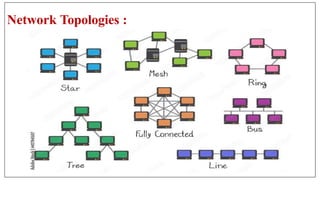
Network Topologies :
 The popular protocol used in optical LANs is the Fiber Distributed Data
Interface (FDDI).
 SONET and SDH are two protocols which are widely used on a
ring network with active nodes in MANs and WANs.
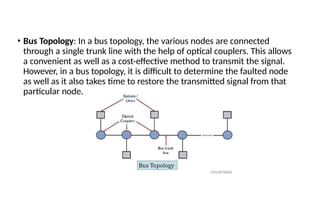
• Bus Topology: In a bus topology, the various nodes are connected
through a single trunk line with the help of optical couplers. This allows
a convenient as well as a cost-effective method to transmit the signal.
However, in a bus topology, it is difficult to determine the faulted node
as well as it also takes time to restore the transmitted signal from that
particular node.
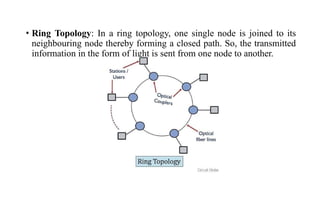
• Ring Topology: In a ring topology, one single node is joined to its
neighbouring node thereby forming a closed path. So, the transmitted
information in the form of light is sent from one node to another.
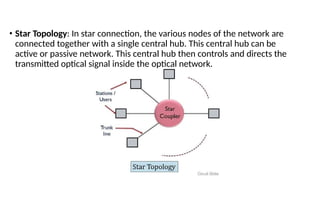
• Star Topology: In star connection, the various nodes of the network are
connected together with a single central hub. This central hub can be
active or passive network. This central hub then controls and directs the
transmitted optical signal inside the optical network.
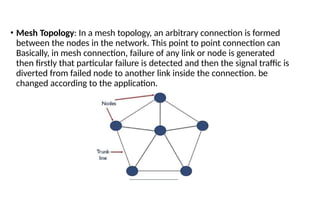
• Mesh Topology: In a mesh topology, an arbitrary connection is formed
between the nodes in the network. This point to point connection can
Basically, in mesh connection, failure of any link or node is generated
then firstly that particular failure is detected and then the signal traffic is
diverted from failed node to another link inside the connection. be
changed according to the application.
Broadcast-and-Select
Network
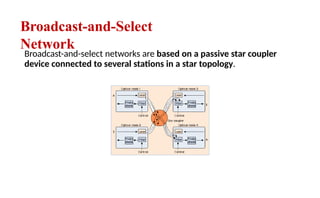
Broadcast-and-select networks are based on a passive star coupler
device connected to several stations in a star topology.
Broadcast-and-Select WDM Network
All-optical WDM networks have full potential of optical transmission capacity and
versatility of communication networks beyond SONET architectures.
 These networks can be classified as
(1) Broadcast-and-select techniques
(2) Wavelength-routing networks.
Broadcast-and select techniques employing passive
optical stars, buses and wavelength routers are used for local
networks can be classified as
(3) Single-hop networks
(4) Multi-hop networks
Single hop refers to network where information transmitted in the form of
light reaches its destination without being converted to an electrical form at
any intermediate point. In a multi hop network, intermediate electro-optical
conversion can occurred.
Broadcast and Select Signal Hop Network
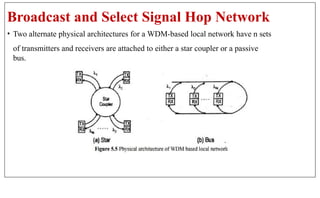
• Two alternate physical architectures for a WDM-based local network have n sets
of transmitters and receivers are attached to either a star coupler or a passive
bus.
Each transmitter sends its information at a fixed wavelength.
• All the transmissions from the various nodes are combined in a pasive star. Coupler
or coupled onto a bus and sent out to all receivers.
• An interesting point to note is that the WDM setup is protocol transparent.
Protocol transparent means that different sets of communicating nodes can use
different
information exchange rules (protocols) without affecting the other nodes in the network.
The architectures of single-hop broadcast-and-
select networks arefairly simple, there needs to be careful dynamic
coordination between the nodes.
 A transmitter sends its selective filter to that wavelength.
Two sending stations need to coordinate their transmission so the collisions of
information streams at the some wavelength do not occur.
Broadcast and Select Multi hop
Network
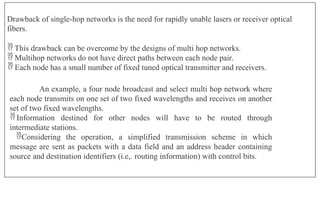
Drawback of single-hop networks is the need for rapidly unable lasers or receiver optical
fibers.
 This drawback can be overcome by the designs of multi hop networks.
 Multihop networks do not have direct paths between each node pair.
 Each node has a small number of fixed tuned optical transmitter and receivers.
An example, a four node broadcast and select multi hop network where
each node transmits on one set of two fixed wavelengths and receives on another
set of two fixed wavelengths.
 Information destined for other nodes will have to be routed through
intermediate stations.
Considering the operation, a simplified transmission scheme in which
message are sent as packets with a data field and an address header containing
source and destination identifiers (i.e,. routing information) with control bits.
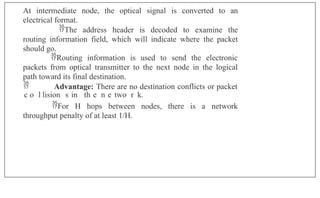
At intermediate node, the optical signal is converted to an
electrical format.
The address header is decoded to examine the
routing information field, which will indicate where the packet
should go.
Routing information is used to send the electronic
packets from optical transmitter to the next node in the logical
path toward its final destination.
 Advantage: There are no destination conflicts or packet
adccoasltlisionSesl in Mthuel nheotwoetrwk.
For H hops between nodes, there is a network
throughput penalty of at least 1/H.
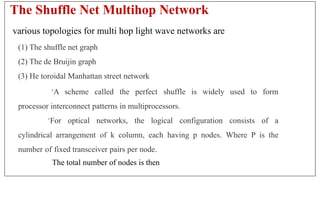
The Shuffle Net Multihop Network
various topologies for multi hop light wave networks are
(1) The shuffle net graph
(2) The de Bruijin graph
(3) He toroidal Manhattan street network
·A scheme called the perfect shuffle is widely used to form
processor interconnect patterns in multiprocessors.
·For optical networks, the logical configuration consists of a
cylindrical arrangement of k column, each having p nodes. Where P is the
number of fixed transceiver pairs per node.
The total number of nodes is then
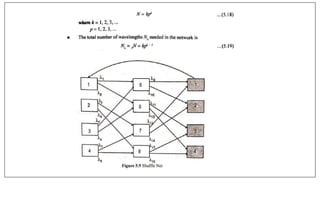
a (p,k)=(2,2) shuffle net, where the (k+1)th column represents the
completion of a trip around the cylinder back to the first column.
Performance parameter for the shuffle net is the average number of
hops between any randomly chosen nodes.
Since, all nodes have p output wavelength, p nodes can be reached
from any node in one hop, p2 additional nodes can be reached in two hope,
until all the (pk-1) other nodes are visited.
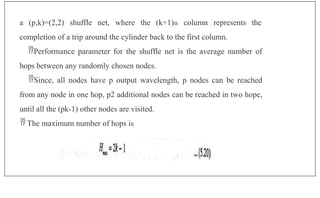
 The maximum number of hops is
Consider figure above, the connections between nodes 1 and 5 and nodes 1 and 7. In
first case, the hop number is one.
 In second case three hops are needed with routes 1- 6 – 7 or 1 – 5 – 2 -7.?
 The average of hops Bar H of a shuffle net is
In multi hopping, part of the capacity of a particular link directly connecting two nodes
is actually utilized for carrying between them.
 The rest of the link capacity is used to forward messages from other nodes.
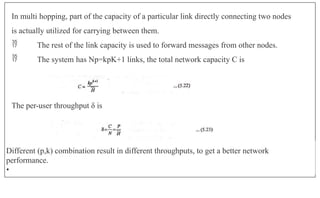
 The system has Np=kpK+1 links, the total network capacity C is
The per-user throughput δ is
Different (p,k) combination result in different throughputs, to get a better network
performance.
•
Wavelength Routed Networks
Two problems arise in broadcast and select networks,
More wavelengths are needs as the number of nodes in the network grows.
Without the widespread are use of optical booster amplifier, due to this splitting
losses is high.
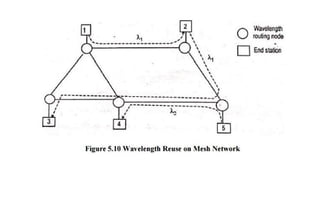
 Wavelength routed networks overcome these limitations through wavelength
reuse, wavelength conversion, and optical switching.
 The physical topology of a wavelength routed network consists of optical
wavelength routers interconnected by pair of point-to-point fiber link in an arbitrary
mesh configuration.
Each link can carry a certain number off wavelength which can be directed
independently to differently output paths at a node.
 Each node may have logical connections with several
other nodesin the network, where each connection uses a particular
wavelength.
 The paths taken by any two connections do not overlap, they can use
the same wavelength.
Optical CDMA
The simplest configuration , CDMA achieves multiple access by assigning a
unique code to each user.
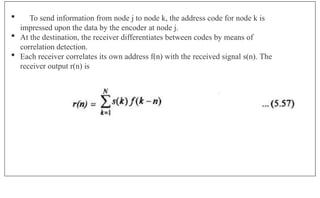
 To communicate with another node, user imprint their agreed upon code onto the data. The
receiver can then decode the bit stream by locking onto the code sequence.
 The principle of optical CDMA is based on spread-spectrum techniques.
 The concept is to spread the energy of the optical signal over a frequency band that
is much wider than the minimum bandwidth required to send the information.
 Spreading is done by a code that is independent of the signal itself.
 On optical encoder is used to map each bit of information into the high-rate (longer-
code-length) optical sequence. The symbols is the spreading code are called chips.
 The energy density of the transmitted waveform is distributed more or less
uniformly over the entire spread-spectrum bandwidth.
 The set of optical sequences becomes a set of unique ‘address codes or signature
sequences’ the individual network users.
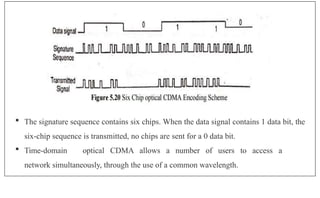
 The signature sequence contains six chips. When the data signal contains 1 data bit, the
six-chip sequence is transmitted, no chips are sent for a 0 data bit.
 Time-domain optical CDMA allows a number of users to access a
network simultaneously, through the use of a common wavelength.
 Both asynchronous and synchronous optical CDMA techniques. In synchronous
accessing schemes follow rigorous transmission schedules, the produce more
successful transmission (higher throughputs) than asynchronous methods where
network access is random and collisions between users can occurs.
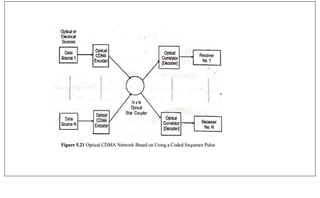
 An optical CDMA network is based on the use of a coded sequence of pulses.
 The setup consists of N transmitter and receiver pairs interconnected in a star
Basics of EDFA
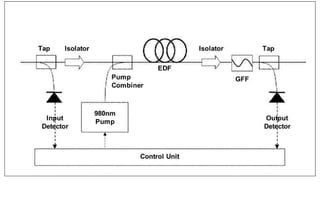
The key feature of EDFA technology is the Erbium Doped Fiber (EDF),
which is a conventional silica fiber doped with erbium. Basically, EDFA consists of a
length of EDF, a pump laser, and a WDM combiner. The WDM combiner is for
combining the signal and pump wavelength so that they can propagate
simultaneously through the EDF. EDFAs can be designed that
pump energy propagates in the same direction as the signal (forward pumping),
the opposite direction to the signal (backward pumping), or both direction
together. The pump energy may either by 980nm pump energy or 1480nm
pump energy, or a combination of both. The most common configuration is
the forward pumping configuration using 980nm pump energy. Because
this configuration takes advantage of the 980nm semiconductor pump laser
diodes, which feature effective cost, reliability and low power consumption. Thus
providing the best overall design in regard to performance and cost trade-offs.
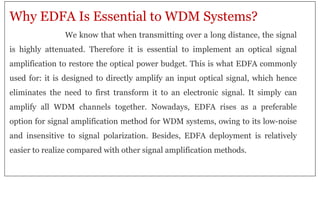
Why EDFA Is Essential to WDM Systems?
We know that when transmitting over a long distance, the signal
is highly attenuated. Therefore it is essential to implement an optical signal
amplification to restore the optical power budget. This is what EDFA commonly
used for: it is designed to directly amplify an input optical signal, which hence
eliminates the need to first transform it to an electronic signal. It simply can
amplify all WDM channels together. Nowadays, EDFA rises as a preferable
option for signal amplification method for WDM systems, owing to its low-noise
and insensitive to signal polarization. Besides, EDFA deployment is relatively
easier to realize compared with other signal amplification methods.
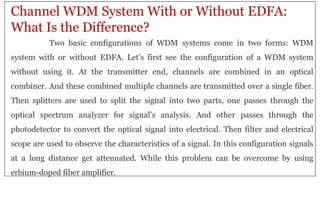
Channel WDM System With or Without EDFA:
What Is the Difference?
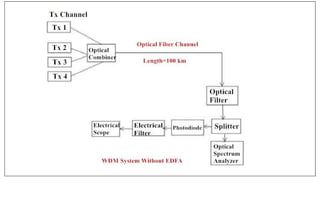
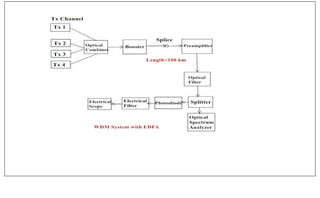
Two basic configurations of WDM systems come in two forms: WDM
system with or without EDFA. Let’s first see the configuration of a WDM system
without using it. At the transmitter end, channels are combined in an optical
combiner. And these combined multiple channels are transmitted over a single fiber.
Then splitters are used to split the signal into two parts, one passes through the
optical spectrum analyzer for signal’s analysis. And other passes through the
photodetector to convert the optical signal into electrical. Then filter and electrical
scope are used to observe the characteristics of a signal. In this configuration signals
at a long distance get attenuated. While this problem can be overcome by using
erbium-doped fiber amplifier.
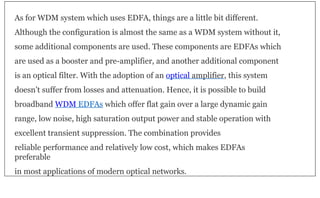
As for WDM system which uses EDFA, things are a little bit different.
Although the configuration is almost the same as a WDM system without it,
some additional components are used. These components are EDFAs which
are used as a booster and pre-amplifier, and another additional component
is an optical filter. With the adoption of an optical amplifier, this system
doesn’t suffer from losses and attenuation. Hence, it is possible to build
broadband WDM EDFAs which offer flat gain over a large dynamic gain
range, low noise, high saturation output power and stable operation with
excellent transient suppression. The combination provides
reliable performance and relatively low cost, which makes EDFAs
preferable
in most applications of modern optical networks.
Among the various technologies available for optical amplifiers, EDFA
technology proves to be the most advanced one that holds the dominant position in
the market. In the future, the WDM system integrated with high-performance
EDFA, as well as the demand for more bandwidth at lower costs have made optical
networking an attractive solution for advanced networks.
Performance of WDM+EFDA
An optical network that involves WDM (wavelength division
multiplexing) currently gains in much popularity in existing telecom infrastructure.
Which is expected to play a significant role in next-generation networks to support
various services with a very different requirement. WDM technology, together with
EDFA (Erbium Doped Fiber Amplifier), allowing the transmission of multiple
channels over the same fiber, that makes it possible to transmit many terabits of data
over distances from a few hundred kilometers to transoceanic distances, which
satisfy the data capacity required for current and future communication networks.
This article explains how can WDM system benefit from this technology.
 To send information from node j to node k, the address code for node k is
impressed upon the data by the encoder at node j.
 At the destination, the receiver differentiates between codes by means of
correlation detection.
 Each receiver correlates its own address f(n) with the received signal s(n). The
receiver output r(n) is
If the received signal arrives at the correct destination, then
s(n)=f(n).
f(n) the
Equation (5.57) represents an autocorrelation function, if s(n) not equal to
equation (5.57) represents a cross-correlation function.
For a receiver to be able to distinguish the proper address correctly, it is necessary to
maximize the autocorrelation function and minimize the cross-correlation function.
Prime-sequence codes and optical orthogonal codes (OOCs) are the commonly used
spreading sequences in optical CDMA systems.
An OOC systems the number of simultaneous user an is bounded by
ULTRA HIGH CAPACITY NETWORKS
Advance of optical communication systems has provide
channels with enormous bandwidth at least 25THz and dense WDM technology,
ultrafast optical TDM.
To using dense WDM techniques to increase the capacity of long-haul
transmission link and ultrafast optical TDM schemes.
These are particularly attractive in LAN or MANs
TDM Schemes To Shared-Media Local Neteorks Have Two
Methods:
(1) Bit-interleaved TDM.
(2) Time-slotted TDM.
1. Ultra High Capacity WDM Networks
Two popular approaches are used to achieve increased capacity.
(a) to widen the spectral bandwidth of EDFAs from 30 to 80 nm, by using
broadening techniques.
(b) Increasing the capacity of a WDM link is to improve the spectral efficiency of
the WDM signals.
Most of the demonstrations use a rate of 20 Gb/s for each individual wavelength to
avoid non-linear effects.
Examples are,
(1) A 50-channel WDM system operating at an aggregated 1-Tb/s rate over a 600
km link.
(2)A 132-channel WDM system operating at an aggregated 2.6 Tb/s rate over a
120- km/link.
2. Bit-Interleaved Optical TDM
 Repetition rate typically ranges from 2.5 to 10 Gb/S, which corresponds to the
bit rate of the electric data tributaries feeding the system.
 An optical splitter divides the pulse train into N separate streams.
 The pulse streams is 10 Gb/S and N=4, each of these channels is then
individually modulated by an electrical tributary data source at a bit rate
B.
 The modulated outputs are delayed individually by different fractions of the
clock period, and are then interleaved through an optical combiner to produce
an aggregate bitrate of NXB.
 Optical post amplifier and preamplifier are generally included in the link
to compenstate for splitting and attenuation loss.
 At the receiving end, the aggregate pulse stream is demultiplexed into
the original N independent data channels for further signal processing.
 A clock-recovery mechanism operating at the base bit rate B is required at
the receiver to drive and synchronize the demultiplexer.
Optical Fiber Communication (R20)_OFC ref.pptx

Optical Fiber Communication (R20)_OFC ref.pptx

  • 1.
  • 2.
    Evolution of fiberoptic system First generation  Uses GaAs semiconductor laser  Operating region was near 0.8 μm.  Bit rate : 45 Mb/s  Repeater spacing : 10 km Second generation  Bit rate: 100 Mb/s to 1.7 Gb/s  Repeater spacing: 50 km  Operation wavelength: 1.3 μm  Semiconductor: InGaAsP Third generation  Bit rate : 10 Gb/s  Repeater spacing: 100 km  Operating wavelength: 1.55 μm 2 Fourth generation  Fourth generation uses WDM technique  Bit rate: 10 Tb/s  Repeater spacing: > 10,000 km  Operating wavelength: 1.45 to 1.62 μm Fifth generation  Uses Roman amplification technique and optical solitons  Bit rate: 40 - 160 Gb/s
  • 3.
    Elements of anOptical Fiber Transmission link 9
  • 4.
    Advantages of OpticalFibre ⚫ Thinner & Flexible ⚫ Less Expensive ⚫ Higher Carrying Capacity ⚫ Less Signal Degradation & Digital Signals ⚫ Light Signals ⚫ Non-Flammable ⚫ Light Weight ⚫ Immune to environmental interference
  • 5.
    ⚫ Disadvantages includethe cost of interfacing equipment necessary to convert electrical signals to optical signals. (optical transmitters, receivers) ⚫ Splicing fiber optic cable is also more difficult. Disadvantages of fiber optics
  • 6.
    Areas of Application ⚫Telecommunications ⚫ Local Area Networks ⚫ Cable TV ⚫ CCTV ⚫ Optical Fiber Sensors
  • 7.
    RAY OPTICS Refraction andTotal Internal Reflection ⚫ Optical fibers work on the principle of total internal reflection ⚫ The angle of refraction at the interface between two media is governed by Snell’s law: n1 sin 1  n2 sin 2 16
  • 8.
    Numerical Aperture ⚫ Lightgathering and acceptance capability of fiber ⚫ The angle of acceptance is twice that given by the numerical aperture 2 1 n2  n2 N.A. 
  • 9.
  • 10.
    Optical Fiber ⚫ Anoptical fiber is cylindrical transparent waveguide that conveys electromagnetic waves at Optical frequency. It consists of ⚫ Core :  Carries light  Made up of glass  Refractive Index n1 ⚫ Cladding :  Surrounds the core and refractive index is n2  Avoids scattering loss  Provide mechanical strength • The index of refraction of the cladding is less than that of the core, causing rays of light leaving the core to be refracted back into the core n1>n2 ⚫ A light-emitting diode (LED) or laser diode (LD) can be used for the source ⚫ Jacket: ⚫ Advantages of optical fiber include:  Greater bandwidth than copper  Lower loss  Immunity to crosstalk  No electrical hazard 23
  • 11.
    ⚫ The indexof refraction of the cladding is less than that of the core, causing rays of light leaving the core to be refracted back into the core n1>n2 ⚫ A light-emitting diode (LED) or laser diode (LD) can be used for the source ⚫ Jacket: ⚫ Advantages of optical fiber include: Greater bandwidth than copper Lower loss Immunity to crosstalk No electrical hazard 24
  • 12.
    Optical Fiber Modesand Configurations The optical fiber is a dielectric waveguide that operates at optical frequency.  The propagation of light along a waveguide can be described in terms of a set of guided electromagnetic waves called the modes. These guided modes are referred to as bound or trapped modes. Only certain discrete number of modes can propagate along fiber. Modes satisfies the homogeneous equation in the 25 fiber and boundary conditions a the
  • 13.
  • 14.
    Single mode andmultimode 14
  • 15.
    Single mode Stepindex Fiber:  Core size is small. Typical core sizes are 2 to 15 μm.  Only one mode can propagate through the cable.  Single mode fiber is also known as fundamental or mono mode fiber.  Does not suffer from mode delay differences(Dispersion) Multimode step Index Fiber:  Core size is small. Typical core sizes are 50 to 1000 μm.  Multiple modes can propagate through the cable.  Suffer from mode delay differences(Dispersion).Txn BW is low Graded-Index Multimode Fiber:  Core refractive index diminishes gradually from the center axis out toward the cladding.  The core size is varying from 50 to 100 μm.  The light ray is propagated through the refraction  The light ray enters the fiber at many different angles  Minimizing dispersion losses. 15
  • 16.
    ⚫Graded-index fibers: Theindex of refraction gradually decreases away from the center of the core. ⚫Graded-index fiber has less dispersion than a multimode step- index fiber Based on the index profile the optical fibers are two types  Step-index fibers  Graded-index ⚫Step-index fibers: Index of refraction changes radically between the core and the cladding. 16
  • 17.
    Single mode fiberstructure Single mode fibers can be constructed by  Core diameter be a few wavelengths(usually 8-12)  /mall index difference  Large variations in values of the physical size of core a and index difference ∆.  V-Number< 2.4  Example: For typical single mode fiber a=3μm, NA=0.1 and λ=0.8μm Yields V=2.356 17
  • 18.
    Continued…… Mode Field Diameter In single mode fibers geometric distribution of light is important to predict the performance of fiber.  The mode filed diameter is fundamental parameter of a single mode fiber.  This parameter is determined from mode field distributions of fundamental LP01 mode.  The method is how to approximate electric field distribution.  For a Gaussian distribution, the MFD is given by the 1/e2 width of the optical power  The Gaussian distribution E ( r ) = E0 exp(- r /W0) E0=Field at zero radius W0=Width of electric field distribution 18
  • 19.
  • 20.
    Continued….. The spot sizeW0 is gives as – MFD = 2 W0 Propagation modes in single mode fiber: In single mode amplifier, there are two independent degenerate modes.  Horizontal mode  Vertical mode These modes very similar , but their polarization planes are orthogonal  Constitute fundamental HE11 mode Modes propagate with equal propagation constants (Kx=Ky) 20
  • 21.
    Continued….. The modes propagatingwith different phase velocities and the difference between their effective refractive indices is called the fiber birefringence. Bf=ny-nx Similarly ,the birefringence may define as β=k0(ny-nx) k0=2π/λ is the free space propagation 34
  • 22.
    Graded –Index fiberStructure  The index of refraction gradually decreases with increasing radial distance r from center, but constant in the cladding.  Refractive index variation in core α Indicates shape of index profile.  Index difference  The total numerical aperture is  Axial numerical aperture is define as 22
  • 23.
    TRANSMISSION CHARACTERISTICS OF OPTICALFIBERS There are 2 main characteristics of optical fiber 23 Signal attenuation Signal distortion
  • 24.
    Comparison of NAfor fibers having various α profiles. 24
  • 25.
    Signal Attenuation Signal Distortion Itdetermines the maximum unamplified or repeaterless distance between transmitter and receiver. •Causes optical pulses broaden. • Overlapping with neighboring pulses, creating errors in the receiver output. •It limits the information carrying capacity of a fiber.
  • 26.
    Attenuatio n Where, αp isfiber attenuation constant (per km). Attenuation is a measure of decay of signal strength or loss of light power that occurs as light pulses propagate through the length of the fiber. Attenuation Units: As light propagatesthrough the fiber, its power decreases with distance. Let the couples optical power is p(0) i.e. at origin (z = 0). Then the power at distance z is given by, Z=0 P(0) mW Z= l P(l)  P(0)e  p l m w This parameter is known fiber loss or fiber attenuation.
  • 27.
    Optical fiber attenuationas a function of wavelength yields nominal values of 0.5 dB/km at 1310 nm and 0.3 dB/km at 1550 nm for standard single mode fiber. Absorption by the water molecules causes the attenuation peak around 1400nm for standard fiber. The dashed curve is the attenuation for low water peak fiber. Attenuation as a function of Wavelength
  • 28.
    Absorption in Infrared region Absorption Atomic Defects Extrinsic (Impurity atoms) Intrinsic Absorption Absorption in Ultraviolet region Attenuation Scattering Losses Compositional fluctuations in material Inhomogeneities or defects infiber Radiative losses Macroscopic bends Microscopic bends Signal Distortion/ Dispersion Polarization -mode Dispersion Intramodal Dispersion/ Chromatic Dispersion Intermodal Delay/ Modal Delay Material Dispersion Waveguide Dispersion Signal Degradation in the Optical Fiber
  • 29.
    Attenuation The Basic attenuationmechanisms in a fiber: 1. Absorption: It is related to the fiber material. 2. Scattering: It is associated both with the fiber material and with the structural imperfections in the optical waveguide. 3. Radiative losses/ Bending losses: It originates from perturbation (both microscopic and macroscopic) of the fiber geometry.
  • 30.
    Absorption Atomic defects areimperfections in the atomic structure of the fiber material. Examples: •Missing molecules •High density clusters of atom groups •Oxygen defects in the glass structure. • Absorption losses arising from these defects are negligible compared with intrinsic and impurity absorption. •Can be significant if the fiber is exposed to ionization radiations. Absorption is caused by three different mechanisms: 1. Absorption by atomic defects 2. Extrinsic Absorption 3. Intrinsic absorption 1. Absorption by atomic defects
  • 31.
    1 rad(Si) =0.01 J/Kg
  • 32.
    Absorption 2. Extrinsic absorptionby impurity atoms The dominant absorption factor in silica fibers is the presence of minute quantities of impurities in the fiber material. •These impurities include •OH- (water) ions dissolved in the glass. • Transition metal ions, such as iron, copper, chromium and vanadium
  • 33.
    Absorption 3. Intrinsic absorptionby the basic constituent atoms Intrinsic absorption is associated with the basic fiber material (e.g pure SiO2). Intrinsic absorption results from: 1. Electronic absorption bands in the ultraviolet region 2. Atomic vibration bands in the near infrared region Electronic absorption (EA) occurs when a photon interacts with an electron in the valance band and excites it to a higher energy level. The electronic absorption is associated with the band gap of the material. where, x is mole fraction of GeO2, λ is operating wavelength. The infrared absorption is associated with the vibration frequency of chemical bond between the atoms of which the fiber is composed.
  • 34.
    **Optical fiber attenuationcharacteristics and their limiting mechanisms for a GeO2 doped low loss water content silica fiber.
  • 35.
    Scattering Losses Scattering lossesin glass arise due to 1. Compositional fluctuations 2. Inhomogeneities or defects occurring during fiber manufacture These two effects give rise to refractive index variation, within the glass over distances. These index variation case Rayleigh-type scattering of the light and inversely proportional to wavelength. It decreases dramatically with increasing wavelength. Scattering loss for single component glass is given by, where, n = Refractive index, KB = Boltzmann‘s constant βT = Isothermal compressibility of material Tf = Temperature at which density fluctuations are frozen into the glass as it solidifies
  • 36.
    Combining the infrared,ultraviolet, and scattering losses for single mode fiber. Rayleigh scattering in an optical fiber
  • 37.
    Radiative losses /Bending Losses Radiative losses occur whenever an optical fiber undergoes a bend of finite radius of curvature. Fiber can be subject to two types of bends: 1.Macroscopic bends 2.Microscopic bends 3. Macrobending losses or bending loss:  Losses due to curvature and an abrupt change in radius of curvature. Ex: Fiber turning edge of the room.  Radiation losses depend on the value radius of curvature R  As the lower order modes remain close to the core axis and the higher modes are closer to the cladding so the higher modes will radiate out of the fiber first
  • 38.
  • 39.
    Microbending losses:  Microbendingis a loss due to small bending or distortions  Microbends are repetitive small scale fluctuations in radius of curvature of the fiber axis.  Microbends causes repetitive coupling of energy between the guided modes and the leaky or nonguided modes in the fiber. Caused by: • Nonuniformities in the manufacturing of the fiber • Nonuniform lateral pressures during cabling • High pressures Radiative losses / Bending Losses
  • 40.
  • 41.
    A compressible jacketextruded over a fiber reduces microbending resulting from external forces. Minimizing microbending losses: Bends are shown full size — and may have caused damage to the fiber
  • 42.
    Core and Cladding Losses Since the core and cladding have different indices of refraction hence they have different attenuation coefficients α1 and α2 respectively  For step index fiber, the loss for a mode order (v, m) is given by,  For low-order modes, the expression reduced to  For graded index fiber, loss at radial distance is expressed as,  The loss for a given mode is expressed by,  Where, P(r) is power density of that model at radial distance r.
  • 43.
    Signal Distortion inFibers Optical signal weakens from attenuation mechanisms and broadens due to distortion effects.  The pulse gets distorted as it travels along the fiber lengths as consequence of pulse spreading.  Pulse spreading in fiber is referred as dispersion  Dispersion is caused by difference in the propagation times of light rays that takes different paths during the propagation.  Dispersion limits the information bandwidth
  • 44.
  • 45.
    Information Capacity Determination Informationcapacity of an optical fiber is specified by the bit rate- distance product BL.  Pulse spread should be less than the width of a bit period ∆T < 1 /B General requirement ∆T ≤ 0.1 /B For high performance link Bit rate distance product BL < n2 c/ n1 2 ∆ Group Delay: The group delay in an optical device is the time delay for a pulse to pass it. Group delay per unit length can be defined as 1/Vg= Where vg is the group velocity at which energy in pulse travels in fiber. The total delay difference δτ over a distance L is:                    2   2    d   d 2      L  L  d  V d d  d  d 2 2c  L  d 2 d 2   d g  d g d 
  • 46.
    is called GVDparameter, and shows how much a light pulse broadens as it travels along an optical fiber. The more common parameter is called Dispersion, and can be defined as the delay difference per unit length per unit wavelength as follows The pulse spreading σg of fiber length of L, can be well approximated by: D has a typical unit of [ps/(nm.km)]. 2  2  2 c g         1 d g d  1  L d d V  D     d  g  DL  d g 
  • 47.
    Dispersion    Dispersion distortsboth pulse and analog modulation signals. In a pulse modulated system, this causes the received pulse to be spread out over a longer period. It is noted that actually no power is lost to dispersion, the spreading effect reduces the peak power.  Pulse dispersion is usually specified in terms of “Nanoseconds-per-kilometer”.
  • 48.
    Dispersion Dispersion occurs dueto following mechanisms:  Intermodal Delay or Modal Delay  Intramodal Dispertion or Chromatic Dispersion Material Dispertion Waveguide Dispertion  Polarization –Mode Dispersion 1.Intermodal delay/ modal delay: Intermodal distortion or modal delay appears only in multimode fibers. result of each mode having a different value of the group velocity at a single frequency.  The amount of pulse spreading is a function of the number of modes and length of the fiber  Broadening of pulse is simply obtained from ray tracing for a fiber of length L: ∆T= Tmax – Tmin = (Ln1∆/c)
  • 49.
    Light rays withsteep incident angles have longer path lengths than lower angle rays. How to minimize the effect of modal dispersion? 1. Graded index fiber 2. Single mode fiber  We could decrease the number of modes by increasing the wavelength of the light V = 2πa / λ x (n1 2 – n2 2)1/2 = 2πa / λ x (NA)  Change in the numerical aperture can help but it only makes a marginal improvement.  The smaller the core, the fewer the modes.
  • 50.
  • 51.
    Intramodal Dispersion orChromatic Dispersion  This takes place within a single mode.  Intramodal dispersion depends on the wavelength, its effect on signal distortion increases with the spectral width of the light source. Two main causes of intramodal dispersion are as: 1. Material Dispersion 2. Waveguide Dispersion
  • 52.
    1.Material Dispersion:  Occursdue to refractive index of the material varies as a function of wavelength.  Material-induced dispersion for a plane wave propagation in homogeneous medium of refractive index n: Material dispersion can be reduced: • Either by choosing sources with narrower spectral output widths OR • By operating at longer wavelengths.  n( )  The pulse spreaddue to material dispersion is therefore: d  c   L  n   dn  mat d 2c d   dω 2 c  2 L n()  L d 2 n c d2 d  d    L Dmat () mat     g  Dmat () is material dispersion
  • 53.
    Waveguide Dispersion:  Waveguidedispersion is due to the dependency of the group velocity of the fundamental mode as well as other modes on the V number.  Let consider that n is not dependent on wavelength.  Defining the normalized propagation constant b as:  Delay time due to waveguide dispersion can then be expressed as: 2 1 1 2 n  n n 2  n 2 b  2  2  2 / k 2  n 2  / k  n  solving for propagation constant:   n2k(1 b)  Using V number: V  ka(n 2  n 2 )1/ 2  kan 2 1 2 2   dV c  wg  n  d (Vb)  2 2   L  n
  • 54.
    Material dispersion asa function of optical wavelength for pure silica and 13.5 percent GeO2/ 86.5 percent SiO2.
  • 55.
    Total Dispersion, zeroDispersion Optical Fiber communications, 3rd ed.,G.Keiser,McGrawHill, 2000 Fact 1) Minimum distortion at wavelength about 1300 nm for single mode silica fiber. Fact 2) Minimum attenuation is at 1550 nm for sinlge mode silica fiber. Strategy: shifting the zero-dispersion to longer wavelength for minimum attenuation and dispersion.
  • 56.
  • 57.
    OPTICAL FIBER COMMUNICATION Unit-II FiberOptical Sources and coupling SIDDARTHA INSTITUTE OF SCIENCE AND TECHNOLOGY (Approved by AICTE, New Delhi & Affiliated to JNTUA, Ananthapuramu) (Accrediated NBA and Accrediated NAAC with “A” Grade ) Siddharth Nagar, Naravanavanam Road, Puttur-517583, AP, India Department of Electronics and Communication Engineering
  • 58.
    Content s Fiber Optical Sourcesand Coupling : • Direct and indirect Band gap materials • LED structures • Light source materials • Quantum efficiency and LED power, • Modulation of a LED, • lasers Diodes • Modes and Threshold condition • Rate equations • External Quantum efficiency
  • 59.
    • Resonant frequencies •Temperature effects
  • 60.
    The E-k DiagramThe Energy Band Diagram Ek Ec Ev Conduction Band (CB) Ec Ev CB h+ e- Eg e- h υ Empty ψk h υ Direct Band Gap Semiconductors h+ VB Occupied k Valence Band (VB) –š /a š /a The E-k diagram of a direct bandgap semiconductor such as GaAs. The E-k curve consists of many discrete points with each point corresponding to a possible state, wavefunction ψk(x), that is allowed to exist in the crystal.
  • 61.
    Indirect Band GapSemiconductors E CB Direct Bandgap E CB VB Indirect Bandgap, Eg E Eg Ec Ev Ec kcb Ev kvb VB CB Er Ec Phonon Ev Photon VB –k (a) GaAs k k –k (b) Si k –k (c) Si with a recombinationcenter
  • 62.
  • 63.
    Light-Emitting Diodes (LEDs) A light-emitting diode (LED) is a semiconductor device that emits light when an electric current flows through it.  When current passes through an LED, the electrons recombine with holes emitting light in the process.  LEDs allow the current to flow in the forward direction and blocks the current in the reverse direction.  The LED symbol is the standard symbol for a diode, with the addition of two small arrows denoting the emission of light.
  • 64.
    … …… …… … .CO NT I NU ED  The two main types of LEDs presently used for lighting systems are aluminum gallium indium phosphide (AlGaInP, sometimes rearranged as AlInGaP) alloys for red, orange and yellow LEDs; and indium gallium nitride (InGaN) alloys for green, blue and white LEDs
  • 65.
    … …… …… … .CO NT I NU ED
  • 66.
    • For photoniccommunications requiring data rate 100- tens of 200 Mb/s with multimode fiber with microwatts, LEDs are usually the best choice. • LED configurations being used in photonic communications: 1 Surface Emitters (Front Emitters) 2 Edge Emitters LED STRUCTURES
  • 67.
    Double heterojunction structures As shown it is GaAs/AlGaAs based Double Heterojunction LED.  As shown thin layer of GaAs is sandwiched between two layers of AlGaAs. GaAs is lightly doped and has narrower bandgap (Eg1) of about 1.43 eV. AlGaAs layers have wider bandgap (Eg2) of about 2.1 eV.  When forward bias is applied through its top and bottom contacts as shown in the figure, electrons are injected from highly doped (n+) AlGaAs layer to central active (p-) GaAs layer. •The injected electrons are trapped within the middle layer due to double heterojunction potential barriers (Eg2 > Eg1) existing on both the sides of the middle layer.
  • 68.
     The figuredepicts energy band diagram when it is forward biased. Electrons are forced to recombine with the holes without too much diffusion from interfaces.  They recombine radiatively with energy equal to the band gap of GaAs.  As recombination between electrons and holes is limited to narrower central part, internal quantum efficiency of such LED is higher compare to single junction LED.
  • 69.
  • 70.
    Benefits or advantagesof Surface Emitting LED ➨LED offers high optical coupling efficiency. ➨Optical loss (due to internal absorption) is very low. This is because of carrier recombination near its top heterojunction. ➨InP/InGaAsP based LED is used for long wavelength applications. ➨It offers higher efficiency with low to high radiance. Drawbacks ➨The surface emitting LED can transmit data rate less than 20 Mbps than edge emitting LED. ➨It contains short optical link with large NA (Numerical Aperture).
  • 71.
  • 72.
    Benefits or advantages➨It offers higher efficiency with low to high radiance. ➨It offers better modulation bandwidth and more directional emission pattern. ➨It offers 5-6 times more coupled power into NA (Numerical Aperture) of step/graded index fibers. This is due to small beam divergence. ➨It offers high data rates (> 20 Mbps) than surface emitting LED. Drawbacks ➨Its structure is complex. ➨It is difficult to design heat sink. ➨It is expensive compare to other LED types. ➨There are many issues to be handled during mechanical mounting and installation.
  • 73.
     Light SourceMaterials active region material of an optical source must have direct band gap. In direct band gap materials,radiative recombination is sufficiently high to produce adequete optical emission. These materials are compound of group III elements( Al, Ga or In) and of group IV elements(P,As). These materials determine the wave length of light emitted.
  • 74.
    Quantum Efficiency &LED power • When there is no external carrier injection, the excess density decays exponentially due to electron-hole recombination. n(t) =n0 e− t /τ n0 : initial injected excess electron density τ: carrier lifetime. • Bulk recombination rate R: • n is the excess carrier • Bulk recombination rate (R)=Radiative recombin0 ation rate + nonradiative recombination rate dt τ R =−d n =n
  • 75.
    r nr r Rr τnr= τ R +R r nr τ +τ τ η = = int Internal Quantum Efficiency & Optical Power η int: internal quantum efficiency in the active region Optical power generated internally in the active region in the LED is: q λ hcI int int q int P =η I hν =η Pint : Internal optical power, I : Injected current to active region
  • 76.
    External Quantum Eficiency No.ofLED internally generated photons No.of photons emitted from LED η ext = • In order to calculate the external quantum efficiency, we need to consider the reflection effects at the surface of the LED. If we consider the LED structure as a simple 2D slab waveguide, only light falling within a cone defined by critical angle will be emitted from an LED.
  • 77.
    φ c 4 π = 1 0 ∫T( ) (2 φπ sinφ)dφ η ext 4n1n2 (n +n ) 2 1 2 T (φ) : Fresnel Transmission Coefficient ≈T (0) = 1 1 1 If n2 =1 ⇒ η ext ≈ n (n +1)2 1 1 n (n +1) 2 Pint ext int LED emitted optical power, P =η P ≈
  • 78.
    Modulation of LED •The frequency response of an LED depends on: 1 Doping level in the active region 2Injected carrier lifetime in the recombination region,τ . 3 Parasitic capacitance of the LED • If the drive current of an LED is modulated at a frequency of  the output optical power of the device will vary as: P( ) = P0 i 1+ (ωτ)2
  • 80.
    Advantages • LEDs consumeless power, and they require low operational voltage • The emitted light is monochromatic. • In expensive • Reliable • Easy to handle •Less temparature dependance Dis advantages • Low output power • Short distance communication
  • 81.
    APLLICATIONS • Leds areused at 850nm and 13510 nm • Lan & wan • CCTV • Used for TV back-lighting • Used in displays • Used in Automotives • LEDs used in the dimming of lights
  • 84.
  • 85.
    LASER • LASER meanslight amplification by stimulated emission of radiation. • It is widely used optical source for optical communication. • It is working on the principle of stimulated emission. • It has coherent light. • Laser diode suffers from 3 problems when used as optical source : • Temperature sensitivity • Back reflections • Susceptible to optical interference
  • 86.
    Pumped active medium • Threemain process for laser action: 1- Photon absorption 2 Spontaneous emission 3 Stimulated emission Energy absorbed from the incoming photon Random release of energy Coherent release of energy
  • 87.
    Lasing in apumped active medium • In thermal equilibrium the stimulated emission is essentially negligible, since the density of electrons in the excited state is very small, and optical emission is mainly because of the spontaneous emission. Stimulated emission will exceed absorption only if the population of the excited states is greater than that of the ground state. This condition is known as Population Inversion. Population inversion is achieved by various pumping techniques.
  • 88.
  • 89.
    In Stimulated Emissionincident and stimulated photons will have • Identical energy € Identical wavelength € Narrow linewidth • Identical direction € Narrow beam width • Identical phase € Coherence and • Identical polarization
  • 90.
  • 92.
    Fabry-Perot Resonator A B L M1 M2 m= 1 m = 2 m = 8 Relative intensity υ υm + 1 υm - 1 (a) υm (c) R ~ 0.4 δυm R ~ 0.8 1 υf (1−R)2 +4R sin2 (kL) Schematic illustration of the Fabry-Perot optical cavity and its properties. (a) Reflected waves interfere. (b) Only standing EM waves, modes, of certain wavelengths are allowed in the cavity. (c) Intensity vs. frequency for various modes. R is mirror reflectance and lower R means higher loss from the cavity. © 1999 S.O. Kasap, Optoelectronics (Prentice Hall) (1−R)2 Itrans =Iinc [4-18] R: reflectance of the optical intensity, k: optical wavenumber (b) Resonant modes : kL =m m =1,2,3,..
  • 93.
  • 94.
  • 95.
    Laser Diode • Laserdiode is an improved LED, in the sense that uses stimulated emission in semiconductor from optical transitions between distribution energy states of the valence and conduction bands with optical resonator structure such as Fabry-Perot resonator with both optical and carrier confinements.
  • 96.
    Laser Diode Modes • Nanosecond& even picosecond response time (GHz BW) • Spectral width of the order of nm or less • High output power (tens of mW) • Narrow beam (good coupling to single mode fibers) • Laser diodes have three distinct radiation modes namely, longitudinal, lateral and transverse modes. • In laser diodes, end mirrors provide strong optical feedback in longitudinal direction, so by roughening the edges and cleaving the facets, the radiation can be achieved in
  • 97.
    DFB(Distributed FeedBack) Lasers The opticalfeedback is provided by fiber Bragg Gratings € Only one wavelength get positive
  • 98.
    Threshold Condition • Todetermine the lasing condition and resonant frequencies, we should focus on the optical wave propagation along the longitudinal direction, z-axis. The optical field intensity, I, can be written as: I ( z, t ) =I ( z)e j (ωt − β z ) • Lasing is the condition at which light amplification becomes possible by virtue of population inversion. Then, stimulated emission rate into a given EM mode is proportional to the intensity of the optical radiation in that mode.
  • 99.
    Optical output vs.drive current Optical Fiber communications, 3rd ed.,G.Keiser,McGrawHill, 2000
  • 100.
    Rate equations Rate equations relatethe optical output power, or # of photons per unit volume, Φ , to the diode drive current or # of injected electrons per unit volume, n. For active (carrier confinement) region of depth d, the rate equations are: – Φ dΦ =Cn Φ +R dt ph sp τ Photon rate =stimulated emission +spontaneou s emission + photon loss – n −CnΦ dn = J dt qd τsp [4-25]
  • 101.
    Threshold current Density& excess electron density ≈ 0 • At the threshold of lasing: Φ ≈0, dΦ/ dt ≥0, Rsp ph = n th C τ 1 from eq.[4 - 25] ⇒ CnΦ Φ − /τ ph ≥0 ⇒ n ≥ [4-26] • The threshold current needed to maintain a steady state threshold concentration of the excess electron, is found from electron rate equation under steady state condition dn/dt=0 when the laser is just about to lase: sp th sp τ 0 = − qd τ ⇒ J =qd nth Jth nth [4-27]
  • 102.
    Laser operation beyond thethreshold J >Jt h • the steady state photon density, resulting from stimulated emission and spontaneous emission as follows: ph sp s th qd τ Φ = ph (J − J ) +τ R
  • 103.
    External quantum efficiency •Number of photons emitted per radiative electron-hole pair recombination above threshold, gives us the external quantum efficiency. ext η =ηi (gth −α) gth [4-29]
  • 104.
    Resonant Frequencies • Lasing condition: exp(−j2βL) =1 ⇒ 2βL =2mπ, • Assuming β = 2πn mode is: the resonant frequency of the mth m =1,2,3,... m =1,2,3,... = mc 2Ln ν m c ⇔ ∆λ = λ2 2Ln 2Ln − ν = m m−1 ∆ν =ν [4-30] [4-31]
  • 105.
    Spectrum from aLaser Diode
  • 106.
  • 107.
    SIDDARTHA INSTITUTE OFSCIENCE AND TECHNOLOGY (Approved by AICTE, New Delhi & Affiliated to JNTUA, Ananthapuramu) (Accrediated NBA and Accrediated NAAC with “A” Grade ) Siddharth Nagar, Naravanavanam Road, Puttur-517583, AP, India Department of Electronics and Communication Engineering OPTICAL FIBER COMMUNICATION UNIT-III FIBER OPTICAL RECEIVERS
  • 108.
    contents • PIN andAPD diodes • Photo detector noise • SNR • Detector response time • Avalanche Multiplication noise • Comparison of photo detectors • Fundamental Receiver Operation • Preamplifiers • Error sources • Receiver configuration
  • 109.
    Photo Detectors • Opticaldetectors convert optical signal (light) to electrical signal (current/voltage) –Hence referred ‘O/E Converter’ • Photodetector is the fundamental element of optical receiver, followed by amplifiers and signal conditioning circuitry • There are several photodetector types: – Photodiodes, Phototransistors, Photon multipliers, Photo-resistors etc.
  • 110.
    requirements of photodetectors • Compatible Physical Dimensions (small size) • High Response or Selectivity at desired wavelength. • Low Noise added to the system and high Gain • High Bandwidth Fast response time • Stable performance • Long Operating Life and low Cost
  • 111.
    Principle of photodetector • Working principle is optical absorption • The main purpose ofis its fast reponse • For foc most suited photo detectors are PIN(P type intrinsic N type) and (Avalancha photo diode)
  • 112.
    Performance of photodetector •Quantum efficiency: ratio of no of electron- hole carrier generated to no of incident photons • Responsivity:output current to incident optical power • Wavelength • Dark current: electrical current under total darkness condituon.
  • 113.
    Photodiodes • Photodiodes meetmost of the requirements, hence widely used as photo detectors. • Positive-Intrinsic-Negative (pin) photodiode – No internal gain, robust detector • Avalanche Photo Diode (APD) – Advanced version with internal gain M due to self multiplication process • Photodiodes are sufficiently reverse biased during normal operation  no current flow without illumination, the intrinsic region is fully depleted of carriers
  • 114.
    PIN DIODE • Adiode with a wide and undoped intrinsic semiconductor region between a p-type and an n-type semiconductor region. • It was even used for microwave applications and as a photo detector as it is said to be a good light absorber.
  • 115.
    PiN Photodiode Semiconductor positive-negativestructure with an intrinsic region sandwiched between the other two regions. Normally operated by applying a reverse- bias voltage. Dark current can also be produced which is a leakage current that flows when a reverse bias is applied without incident light.
  • 116.
  • 117.
    Structure and Workingof a Pin Diode • The PIN diode comprises a semiconductor diode having three layers naming the P- type layer, Intrinsic layer and N-type layer, as shown in the figure below. • The P and N regions are there, and the region between them consists of the intrinsic material, and the doping level is said to be very low in this region. •
  • 118.
     The thicknessof the intrinsic layer is very narrow, which ranges from 10 – 200 microns.  The P region and the N-type regions are known to be heavily doped.  The changes in the properties of the diode are known from the intrinsic material.  These diodes are made of silicon.  The intrinsic region of the PIN diode acts like an inferior rectifier which is used in various devices such as attenuators, photodetectors, fast switches, high voltage power circuits, etc.
  • 119.
    Advantage of PINphotodiodes The output electrical current is linearly proportional to the input optical power making it a highly linear device. Low bias voltage(<4v). Low noise Low dark current High-speed response
  • 120.
    Quantum Efficiency Ip isthe photocurrent generated by a steady-state optical power Pin incident on the photodetector. The performance of photo diode is characterized by responsivity R R=Ip/P0=nq/hv (A/W)
  • 121.
    Avalanche Photodiode (APD) •APD has an internal gain M, which is obtained by having a high electric field that energizes photo- generated electrons. • These electrons ionize bound electrons in the valence band upon colliding with them which is known as impact ionization • The newly generated electrons and holes are also accelerated by the high electric field and gain energy to cause further impact ionization • This phenomena is the avalanche effect
  • 122.
    RAPD (Reach ThroughAPD ): P+πPN+
  • 123.
    Responsivity () APD’s havean internal gain M, hence where, M = IM/Ip IM : Mean multiplied current M = 1 for PIN diodes APD  PIN M
  • 124.
    advantages • Low levellight can be detected • Increase in sensitivity of receiver • SNR is high • Excellent linearity
  • 125.
    disadvantages • Complex structure •High reverse bias voltage is required • Additional noise
  • 126.
    Photodetector Noise • photodiodeis generally required to detect very weak optical signals. • requires that the photodetector and its amplification circuitry be optimized to maintain a given signal- to- noise ratio. SNR Can NOT be improved by amplification
  • 127.
    Notation: Detector Current •The direct current value is denoted by, IP main entry and capital suffix). (capitol • The time varying (either randomly or periodically) current with a zero mean is denoted by, ip (small main entry and small suffix). • Therefore, the total current Ip is the sum of the DC component IP and the AC component ip . IP  I p  ip   Lim 1 T  T T / 2 T / 2 p i2 (t)dt p i2
  • 128.
    Quantum (Shot Noise) i2p Q  2qI BM 2 F (M ) Quantum noise arises due optical power fluctuation because light is made up of discrete number of photons
  • 129.
    Dark/Leakage Current Noise i2D DB  2qI BM 2 F (M ) L  2qI B DS i2 Bulk Dark Current Noise Surface Leakage Current Noise ID: Dark Current IL: Leakage Current There will be some (dark and leakage ) current without any incident light. This current generates two types of noise (not multiplied by M)
  • 130.
    Thermal Noise The photodetectorload resistor RL contributes to thermal (Johnson) noise current T i2  4KBTB / RL KB: Boltzmann’s constant = 1.38054 X 10(-23) J/K T is the absolute Temperature •Quantum and Thermal are the significant noise mechanisms in all optical receivers •RIN (Relative Intensity Noise) will also appear in analog links
  • 131.
    SNR i2 M 2 p SNR  2q(I I )M 2 F (M )B  2qI B  4k TB / R p D L B L Detected current = AC (ip) + DC (Ip) Signal Power = <ip 2>M2 Typically not all the noise terms will have equal weight. Often thermal and quantum noise are the most significant.
  • 132.
  • 133.
    Limiting Cases forSNR • When the optical signal power is relatively high, then the shot noise power is much greater than the thermal noise power. In this case the SNR is called shot-noise or quantum noise limited. • When the optical signal power is low, then thermal noise usually dominates over the shot noise. In this case the SNR is referred to as being thermal-noise limited.
  • 134.
    Limiting Cases ofSNR For analog links, there will be RIN (Relative Intensity Noise) as well p In the shot current limited case the SNR is: i2 2q(Ip )F (M )B SNR  2 p p D B L 2 p i2 M 2 B SNR  2q(I  I )M F (M )  4k T / R  (RIN )I 
  • 135.
    Detector Response Time Itis defined as time required by generated photo carriers to travel across the depletion region. It depends mainly on 1.Transit time 2.Diffusion time 3.RC time constant t d
  • 136.
    Transit time • Itdepends on carrier drift velocity and depletion layer.it is given by td  w / vd
  • 137.
  • 140.
  • 141.
    Fundamental Receiver Operation •The first receiver element is a pin or an avalanche photodiode, which produces an electric current proportional to the received power level. • Since this electric current typically is very weak, a front-end amplifier boosts it to a level that can be used by the following electronics. • After being amplified, the signal passes through a low-pass filter to reduce the noise that is outside of the signal bandwidth. • Also filter can reshape (equalize) the pulses that have become distorted as they traveled through the fiber.
  • 142.
    Preamplifiers • Optical amplifierbeing used as a front- end preamplifier for an optical receiver. • A weak optical signal is amplified before photo-detection so that signal to noise ratio degradation due to noise can be suppressed in the receiver. • It provides a larger gain factor and BW. • Three types: semiconductor optical amplifiers, Raman Amplifiers and Erbium doped fibre amplifiers.
  • 143.
    Error Sources The termnoise describes unwanted components of an electric signal that tend to disturb the transmission and processing of the signal • The random arrival rate of signal photons produces quantum (shot) noise • Dark current comes from thermally generated e- h pairs in the pn junction • Additional shot noise arises from the statistical nature of the APD process • Thermal noises arise from the random motion of electrons in the detector load resistor and in the amplifier electronics
  • 145.
    Receiver configuration Bandwidth ofthe front end: CT: Total Capacitance = Cd+Ca RT: Total Resistance = Rb // Ra B  1 2 RT CT
  • 146.
    Receiver Sensitivity • Aspecific minimum average optical power level must arrive at the photodetector to achieve a desired BER at a given data rate. The value of this minimum power level is called the receiver sensitivity. • Assuming there is no optical power in a received zero pulse, then the receiver sensitivity is
  • 147.
    Receiver Sensitivity Calculation Thereceiver sensitivity as a function of bit rate will change for a given photodiode depending on values of parameters such as wavelength, APD gain, and noise figure.
  • 149.
    The Quantum Limit •The minimum received optical power required for a specific bit-error rate performance in a digital system. • This power level is called the quantum limit, since all system parameters are assumed ideal and the performance is limited only by the detection statistics.
  • 151.
  • 152.
    SIDDARTHA INSTITUTE OFSCIENCE AND TECHNOLOGY (Approved by AICTE, New Delhi & Affiliated to JNTUA, Ananthapuramu) (Accrediated NBA and Accrediated NAAC with “A” Grade ) Siddharth Nagar, Naravanavanam Road, Puttur-517583, AP, India Department of Electronics and Communication Engineering OPTICAL FIBER COMMUNICATION Unit-IV OPTICAL FIBER SYSTEM DESIGN AND TECHNOLOGY
  • 153.
    Contents •System specification • Point-to-links • link power budget •Rise Time Budget • Bandwidth Budget •Power Budget and Receiver Sensitivity • Link Budget calculations • Optical Multiplexing & Demultiplexing techniques • Optical Amplifiers and its Applications.
  • 154.
    System Specifications: Photodetector, OpticalSource, Fiber •Photodetectors: Compared to APD, PINs are less expensive and more stable with temperature. However PINs have lower sensitivity. •Optical Sources: 1 LEDs: 150 (Mb/s).km @ 800-900 nm and larger than 1.5 (Gb/s).km @ 1330 nm 2 InGaAsP lasers: 25 (Gb/s).km @ 1330 nm and ideally around 500 (Gb/s).km @ 1550 nm. 10-15 dB more power. However more costly and more complex circuitry. •Fiber: 1 Single-mode fibers are often used with lasers or edge- emitting LEDs. 2 Multi-mode fibers are normally used with LEDs. NA and  should be optimized for any particular application.
  • 155.
    Point-to-Point Link •The componentsmust be carefully chosen to ensure the desired performance level and can be maintained for the expected system life time. Figure represents the block diagram of a simplex point-to-point link. The three major optical links building blocks are, Transmitter, Receiver and Optical fiber.
  • 156.
    The key systemrequirements are needed in analyzing a link. •Signal dispersion •Data rate •Transmission distance and cost. Optical sources (such as LED or LASER) are used based on the following characteristics. •Emission wavelength •Spectral line width •Output power •Effective radiating area •Emission pattern •Number of emitting modes .
  • 157.
    The characteristics ofphoto detector such as, •Responsivity •Operating wavelength •Speed and •Sensitivity The choice of optical fiber •Single mode and multimode (step or graded index) •Core size •Core refractive index profile •Band width or dispersion •Attenuation •Numerical aperture or modefield diameter
  • 158.
    Link Budget Considerations (1)Power Budget: determines the power margin between the optical transmitter output and the minimum receiver sensitivity needed to establish a specific Bit Error Rate (BER). (2) Bandwidth Budget: Determines dispersion limitation of optical fiber link
  • 159.
  • 160.
    Rise-Time Budget 1/ 2  2  B0 2 2 1/2  tGVD  trx ]   Brx   L2 2      350     q  2   440L  2  ttx 2 2 tsys  [ttx  tmod   [nm]:Spectral width of the source D[ns /(km.nm)]:Dispersion q0.7 ttx [ns] : transmitter rise time Brx [ MHz]:3dB ElectricalBW t rx [ns] : receiver rise time t mod [n] : modal dispersion L[km ]:Length of the fiber B0 [ MHz]:BW of the1 km of the fiber; tGVD [ns]: rise-time due to groupvelocitydispersion
  • 161.
    Total Rise time, Tsys: RX Tsys=1.1(T2+T 2+T TX fibe r 2)1/2
  • 162.
    What is agood Rise time? For a good reception of signal Tsys < 0.7 x Pulse Width (PW) PW = 1/BitRate for NRZ 1/2BitRate for RZ
  • 163.
    Example: Rise Time BudgetMeasurement for Long Haul Application Tx rise time, TTX = 0.1 ns Rx rise time, TRX= 0.5 ns Linewidth() = 0.15 nm Dispersion Coefficient, D = 18 ps/nm- km Fiber length = 150km Bit Rate = 622Mbps Format = RZ
  • 164.
    Fiber rise time,TF =Length x D x Linewidth() = 150 km x 18 x 0.15 nm = 0.4 ns Total Rise time, TSYS = 1.1 TLS 2 + TPD + TF 2 2 = 1.1 0.01 + 0.25 + 0.16 TSYS = 0.77 ns Simple Calculation….
  • 165.
    Let say, Bit Rate= STM 4 = 622 Mbps Format = RZ Tsys < 0.7 x Pulse Width (PW) Pulse Width (PW) = 1/(622x106) = 1.6 ns 0.77 ns < 0.7 x 1.6 ns 0.77 ns < 1.1 ns !! Good Rise Time Budget!!
  • 166.
    Let say, Bit Rate= STM 16 = 2.5 Gbps Format = RZ Tsys < 0.7 x Pulse Width (PW) Pulse Width (PW) = 1/(2.5x109) = 0.4 ns 0.77 ns < 0.7 x 0.4 ns 0.77 ns ≥ 0.28 ns !! Bad Rise Time Budget!!
  • 167.
    Power Budget PRX >PMIN PRX = Received Power PMIN = Minimum Power at a certain BER PRX = PTX – Total Losses - PMARGIN PTX = Transmitted Power PMARGIN ≈ 6 dB •Total optical loss = Connector loss + (Splicing loss + Fiber attenuation) + System margin (Pm) PT = 2Lc + αfL + Lsp+System margin (Pm)
  • 168.
    Requirements Cont’d: •Loss,L =LIL + Lfiber + Lconn. + Lnon-linear LIL = Insertion Loss Lfiber = Fiber Loss Lconn.= Connector Loss Lnon-linear= Non-linear Loss •Gain,G = Gainamp + Gnon-linear Gainamp = Amplifier Gain Gnon-linear = Non-linear Gain
  • 169.
    Example: Power Budget Measurementfor Long Haul Transmission PTx = 0 dBm 185 km Splice Attenuation Coefficient,  = 0.25 dB/km Dispersion Coefficient, D = 18 ps/nm-km Number of Splice = 46 Splice Loss = 0.1 dB Connector Loss = 0.2 dB PMargin = 6 dB Connector PSEN = -28 dBm
  • 170.
    CONCLUSION: BAD SY STEM!! Simple Calculation…. Fiber Loss =0.25 dB/km X 185 km = 46.3 dB Splice Loss = 0.1 dB X 46 = 4.6 dB PMargin = 6 dB Total Losses = 46.3 + 4.6 + 0.4 = 51.3 dB PRX = PTX – Total Losses – PMargin = 0 – 51.3 – 6 PRX = -57.3 dB Power Budget, PRX < PSEN !! Connector Loss = 0.2 dB X 2 = 0.4 dB
  • 171.
    First we calculatethe amplifier’s gain.. Gain  PSEN - PRX Gain  -28 – (- 57.3) Gain  29.3 dB Gain  30 dB To make it easy, Now…Where to put the amplifier?
  • 172.
    Receiver sensitivity •Performance canbe measured as a low bit error rate (BER). •A measure of a good receiver is to have the same performance with the lowest level of incident optical power. •BER ÷ probability of an incorrect identification of a bit by the decision circuit of a receiver. •Receiver Sensitivity ÷ Receiver sensitivity is the minimum power level at which the receiving node is able to clearly receive the bits being transmitted.
  • 174.
    Optical Multiplexing & Demultiplexingtechniques •Normally, there are three main different techniques in multiplexing light signals onto a single optical fiber link: optical time division multiplexing (OTDM), code division multiplexing (CDM), and wavelength division multiplexing (WDM). •WDM is one of the most common way using wavelengths to increase bandwidth by multiplexing various optical carrier signals onto a single optical fiber.
  • 176.
    • What Ismultiplexing? • Multiplexing (Muxing) is a term used in the field of communications and computer networking. It generally refers to the process and technique of transmitting multiple analog or digital input signals or data streams over a single channel. Since multiplexing can integrate multiple low- speed channels into one high-speed channel for transmission, the high-speed channel is effectively utilized. • What Is demultiplexing? • Demultiplexing (Demuxing) is a term relative to multiplexing. It is the reverse of the multiplexing process. Demultiplex is a process reconverting a signal containing multiple analog or digital signal streams back into the original separate and unrelated signals.
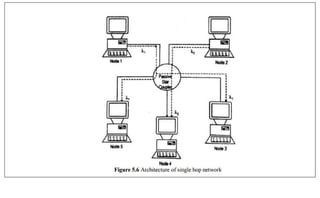
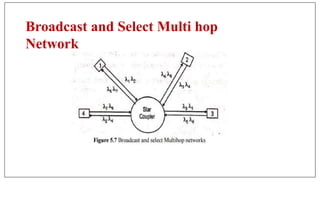
  • 177.
    Optical Amplifiers andits Applications •However, when the length of the optical fiber is a distance as long as 10 km or 100 km, that transmission loss cannot be ignored. When the light (signal) propagating a long-distance optical fiber becomes extremely weak, it is necessary to amplify the light using an optical amplifier. •An optical amplifier amplifies light as it is without converting the optical signal to an electrical signal, and is an extremely important device that supports the long-distance optical communication networks of today.
  • 178.
    Applications of OpticalAmplifiers • Applications of Optical Amplifiers • Typical applications of optical amplifiers are: • An amplifier can boost the (average) power of a laser output to higher levels (→ master oscillator power amplifier = MOPA). • It can generate extremely high peak powers, particularly in ultrashort pulses, if the stored energy is extracted within a short time. • It can amplify weak signals before photodetection, and thus reduce the detection noise, unless the added amplifier noise is large.
  • 179.
    Design of Digitalsystems: System specifications: •Photodetectors: Compared to APD, PINs are less expensive and more stable with temperature. However PINs have lower sensitivity. •Optical Sources: 1 LEDs: 150 (Mb/s).km @ 800-900 nm and larger than 1.5 (Gb/s).km @ 1330 nm 2 InGaAsP lasers: 25 (Gb/s).km @ 1330 nm and ideally around 500 (Gb/s).km @ 1550 nm. 10-15 dB more power. However more costly and more complex circuitry. •Fiber:
  • 180.
    System Rise Time •Calculate the total rise times Tx, Fiber, Rx • Calculate Fiber rise time, TFiber Tfiber = D x  x L D = Dispersion Coefficient  = Linewidth L = Fiber Length Tx Rise Time, TTX = normally given by manufacturer Rx Rise Time, TRX = normally given by manufacturer
  • 181.
    REFERENCES • https://en.wikipedia.org/wiki/System_requirements_specification • https://www.ques10.com/p/29974/what-is-rise-time-budget- analysis-derive-an-expr-1/ •https://www.researchgate.net/publication/320264322_Bandwidth_B udget_Analysis_for_Visible_Light_Communication_Systems_utilizing _Available_Components • https://www.youtube.com/hashtag/linkpowerbudgetanalysisofoptica lfibercommunicationsystem • https://study.com/academy/lesson/point-to-point-link-based- systems-definition-uses.html
  • 182.
    SIDDARTHA INSTITUTE OFSCIENCE AND TECHNOLOGY (Approved by AICTE, New Delhi & Affiliated to JNTUA, Ananthapuramu) (Accrediated NBA and Accrediated NAAC with “A” Grade ) Siddharth Nagar, Naravanavanam Road, Puttur-517583, AP, India Department of Electronics and Communication Engineering OPTICAL FIBER COMMUNICATION UNIT-V Optical Networks
  • 183.
    Optical Networks •Definition: AnOptical Network is basically a communication network used for the exchange of information through an optical fiber cable between one end to another. It is one of the quickest networks used for data communication.
  • 184.
    CONTENTS Basic Networks Broadcast-and-select WDMNetworks Wavelength routed Networks Performance of WDM+EDFA Networks Ultra high capacity networks
  • 185.
    Basics Of Networks Station: Stations in an optical network serves as the source and destination of the information being transmitted and received. Examples: computers, terminals, telephones or other equipment for communicating. Network: The pattern of contacts or flow of information between the stations is called a network. Node: Node is nothing but acts as a hub for multiple transmission lines inside the network. In case of a single transmission line, an optical network does not require nodes, as in this case stations at both the ends can be directly connected to the fiber cables. Trunk: A trunk is basically a transmission line i.e., optical fiber cable in order to transmit the optical signal.
  • 186.
    Topology: When multiple fibercables are employed in an optical network, then these are connected through nodes. But the way in which the multiple nodes are connected together denotes the topology of the network. Router : A router is basically placed inside an optical network that provides a suitable path for signal transmission.
  • 187.
    Networks classification: LANs : LANsmeans Local area networks. It is a interconnect users in a localized area such as a department, a building, an office or factory complex, or a university campus . MANs : MANs means Metropolitan area networks. which provides user connection with in a city or in the metropolitan area surrounding a city. WANs : WANs means wide area network. it covers a large geographical area ranging from connection between near by cities to connection of users across a country.
  • 188.
  • 189.
     The popularprotocol used in optical LANs is the Fiber Distributed Data Interface (FDDI).  SONET and SDH are two protocols which are widely used on a ring network with active nodes in MANs and WANs.
  • 190.
    • Bus Topology:In a bus topology, the various nodes are connected through a single trunk line with the help of optical couplers. This allows a convenient as well as a cost-effective method to transmit the signal. However, in a bus topology, it is difficult to determine the faulted node as well as it also takes time to restore the transmitted signal from that particular node.
  • 191.
    • Ring Topology:In a ring topology, one single node is joined to its neighbouring node thereby forming a closed path. So, the transmitted information in the form of light is sent from one node to another.
  • 192.
    • Star Topology:In star connection, the various nodes of the network are connected together with a single central hub. This central hub can be active or passive network. This central hub then controls and directs the transmitted optical signal inside the optical network.
  • 193.
    • Mesh Topology:In a mesh topology, an arbitrary connection is formed between the nodes in the network. This point to point connection can Basically, in mesh connection, failure of any link or node is generated then firstly that particular failure is detected and then the signal traffic is diverted from failed node to another link inside the connection. be changed according to the application.
  • 194.
    Broadcast-and-Select Network Broadcast-and-select networks arebased on a passive star coupler device connected to several stations in a star topology.
  • 195.
    Broadcast-and-Select WDM Network All-opticalWDM networks have full potential of optical transmission capacity and versatility of communication networks beyond SONET architectures.  These networks can be classified as (1) Broadcast-and-select techniques (2) Wavelength-routing networks. Broadcast-and select techniques employing passive optical stars, buses and wavelength routers are used for local networks can be classified as (3) Single-hop networks (4) Multi-hop networks Single hop refers to network where information transmitted in the form of light reaches its destination without being converted to an electrical form at any intermediate point. In a multi hop network, intermediate electro-optical conversion can occurred.
  • 196.
    Broadcast and SelectSignal Hop Network • Two alternate physical architectures for a WDM-based local network have n sets of transmitters and receivers are attached to either a star coupler or a passive bus.
  • 197.
    Each transmitter sendsits information at a fixed wavelength. • All the transmissions from the various nodes are combined in a pasive star. Coupler or coupled onto a bus and sent out to all receivers. • An interesting point to note is that the WDM setup is protocol transparent. Protocol transparent means that different sets of communicating nodes can use different information exchange rules (protocols) without affecting the other nodes in the network. The architectures of single-hop broadcast-and- select networks arefairly simple, there needs to be careful dynamic coordination between the nodes.  A transmitter sends its selective filter to that wavelength. Two sending stations need to coordinate their transmission so the collisions of information streams at the some wavelength do not occur.
  • 199.
    Broadcast and SelectMulti hop Network
  • 200.
    Drawback of single-hopnetworks is the need for rapidly unable lasers or receiver optical fibers.  This drawback can be overcome by the designs of multi hop networks.  Multihop networks do not have direct paths between each node pair.  Each node has a small number of fixed tuned optical transmitter and receivers. An example, a four node broadcast and select multi hop network where each node transmits on one set of two fixed wavelengths and receives on another set of two fixed wavelengths.  Information destined for other nodes will have to be routed through intermediate stations. Considering the operation, a simplified transmission scheme in which message are sent as packets with a data field and an address header containing source and destination identifiers (i.e,. routing information) with control bits.
  • 201.
    At intermediate node,the optical signal is converted to an electrical format. The address header is decoded to examine the routing information field, which will indicate where the packet should go. Routing information is used to send the electronic packets from optical transmitter to the next node in the logical path toward its final destination.  Advantage: There are no destination conflicts or packet adccoasltlisionSesl in Mthuel nheotwoetrwk. For H hops between nodes, there is a network throughput penalty of at least 1/H.
  • 202.
    The Shuffle NetMultihop Network various topologies for multi hop light wave networks are (1) The shuffle net graph (2) The de Bruijin graph (3) He toroidal Manhattan street network ·A scheme called the perfect shuffle is widely used to form processor interconnect patterns in multiprocessors. ·For optical networks, the logical configuration consists of a cylindrical arrangement of k column, each having p nodes. Where P is the number of fixed transceiver pairs per node. The total number of nodes is then
  • 204.
    a (p,k)=(2,2) shufflenet, where the (k+1)th column represents the completion of a trip around the cylinder back to the first column. Performance parameter for the shuffle net is the average number of hops between any randomly chosen nodes. Since, all nodes have p output wavelength, p nodes can be reached from any node in one hop, p2 additional nodes can be reached in two hope, until all the (pk-1) other nodes are visited.  The maximum number of hops is
  • 205.
    Consider figure above,the connections between nodes 1 and 5 and nodes 1 and 7. In first case, the hop number is one.  In second case three hops are needed with routes 1- 6 – 7 or 1 – 5 – 2 -7.?  The average of hops Bar H of a shuffle net is
  • 206.
    In multi hopping,part of the capacity of a particular link directly connecting two nodes is actually utilized for carrying between them.  The rest of the link capacity is used to forward messages from other nodes.  The system has Np=kpK+1 links, the total network capacity C is The per-user throughput δ is Different (p,k) combination result in different throughputs, to get a better network performance. •
  • 207.
    Wavelength Routed Networks Twoproblems arise in broadcast and select networks, More wavelengths are needs as the number of nodes in the network grows. Without the widespread are use of optical booster amplifier, due to this splitting losses is high.  Wavelength routed networks overcome these limitations through wavelength reuse, wavelength conversion, and optical switching.  The physical topology of a wavelength routed network consists of optical wavelength routers interconnected by pair of point-to-point fiber link in an arbitrary mesh configuration.
  • 209.
    Each link cancarry a certain number off wavelength which can be directed independently to differently output paths at a node.  Each node may have logical connections with several other nodesin the network, where each connection uses a particular wavelength.  The paths taken by any two connections do not overlap, they can use the same wavelength.
  • 210.
    Optical CDMA The simplestconfiguration , CDMA achieves multiple access by assigning a unique code to each user.  To communicate with another node, user imprint their agreed upon code onto the data. The receiver can then decode the bit stream by locking onto the code sequence.  The principle of optical CDMA is based on spread-spectrum techniques.  The concept is to spread the energy of the optical signal over a frequency band that is much wider than the minimum bandwidth required to send the information.
  • 211.
     Spreading isdone by a code that is independent of the signal itself.  On optical encoder is used to map each bit of information into the high-rate (longer- code-length) optical sequence. The symbols is the spreading code are called chips.  The energy density of the transmitted waveform is distributed more or less uniformly over the entire spread-spectrum bandwidth.  The set of optical sequences becomes a set of unique ‘address codes or signature sequences’ the individual network users.
  • 212.
     The signaturesequence contains six chips. When the data signal contains 1 data bit, the six-chip sequence is transmitted, no chips are sent for a 0 data bit.  Time-domain optical CDMA allows a number of users to access a network simultaneously, through the use of a common wavelength.
  • 213.
     Both asynchronousand synchronous optical CDMA techniques. In synchronous accessing schemes follow rigorous transmission schedules, the produce more successful transmission (higher throughputs) than asynchronous methods where network access is random and collisions between users can occurs.  An optical CDMA network is based on the use of a coded sequence of pulses.  The setup consists of N transmitter and receiver pairs interconnected in a star
  • 215.
    Basics of EDFA Thekey feature of EDFA technology is the Erbium Doped Fiber (EDF), which is a conventional silica fiber doped with erbium. Basically, EDFA consists of a length of EDF, a pump laser, and a WDM combiner. The WDM combiner is for combining the signal and pump wavelength so that they can propagate simultaneously through the EDF. EDFAs can be designed that pump energy propagates in the same direction as the signal (forward pumping), the opposite direction to the signal (backward pumping), or both direction together. The pump energy may either by 980nm pump energy or 1480nm pump energy, or a combination of both. The most common configuration is the forward pumping configuration using 980nm pump energy. Because this configuration takes advantage of the 980nm semiconductor pump laser diodes, which feature effective cost, reliability and low power consumption. Thus providing the best overall design in regard to performance and cost trade-offs.
  • 217.
    Why EDFA IsEssential to WDM Systems? We know that when transmitting over a long distance, the signal is highly attenuated. Therefore it is essential to implement an optical signal amplification to restore the optical power budget. This is what EDFA commonly used for: it is designed to directly amplify an input optical signal, which hence eliminates the need to first transform it to an electronic signal. It simply can amplify all WDM channels together. Nowadays, EDFA rises as a preferable option for signal amplification method for WDM systems, owing to its low-noise and insensitive to signal polarization. Besides, EDFA deployment is relatively easier to realize compared with other signal amplification methods.
  • 218.
    Channel WDM SystemWith or Without EDFA: What Is the Difference? Two basic configurations of WDM systems come in two forms: WDM system with or without EDFA. Let’s first see the configuration of a WDM system without using it. At the transmitter end, channels are combined in an optical combiner. And these combined multiple channels are transmitted over a single fiber. Then splitters are used to split the signal into two parts, one passes through the optical spectrum analyzer for signal’s analysis. And other passes through the photodetector to convert the optical signal into electrical. Then filter and electrical scope are used to observe the characteristics of a signal. In this configuration signals at a long distance get attenuated. While this problem can be overcome by using erbium-doped fiber amplifier.
  • 220.
    As for WDMsystem which uses EDFA, things are a little bit different. Although the configuration is almost the same as a WDM system without it, some additional components are used. These components are EDFAs which are used as a booster and pre-amplifier, and another additional component is an optical filter. With the adoption of an optical amplifier, this system doesn’t suffer from losses and attenuation. Hence, it is possible to build broadband WDM EDFAs which offer flat gain over a large dynamic gain range, low noise, high saturation output power and stable operation with excellent transient suppression. The combination provides reliable performance and relatively low cost, which makes EDFAs preferable in most applications of modern optical networks.
  • 222.
    Among the varioustechnologies available for optical amplifiers, EDFA technology proves to be the most advanced one that holds the dominant position in the market. In the future, the WDM system integrated with high-performance EDFA, as well as the demand for more bandwidth at lower costs have made optical networking an attractive solution for advanced networks.
  • 223.
    Performance of WDM+EFDA Anoptical network that involves WDM (wavelength division multiplexing) currently gains in much popularity in existing telecom infrastructure. Which is expected to play a significant role in next-generation networks to support various services with a very different requirement. WDM technology, together with EDFA (Erbium Doped Fiber Amplifier), allowing the transmission of multiple channels over the same fiber, that makes it possible to transmit many terabits of data over distances from a few hundred kilometers to transoceanic distances, which satisfy the data capacity required for current and future communication networks. This article explains how can WDM system benefit from this technology.
  • 224.
     To sendinformation from node j to node k, the address code for node k is impressed upon the data by the encoder at node j.  At the destination, the receiver differentiates between codes by means of correlation detection.  Each receiver correlates its own address f(n) with the received signal s(n). The receiver output r(n) is
  • 225.
    If the receivedsignal arrives at the correct destination, then s(n)=f(n). f(n) the Equation (5.57) represents an autocorrelation function, if s(n) not equal to equation (5.57) represents a cross-correlation function. For a receiver to be able to distinguish the proper address correctly, it is necessary to maximize the autocorrelation function and minimize the cross-correlation function. Prime-sequence codes and optical orthogonal codes (OOCs) are the commonly used spreading sequences in optical CDMA systems. An OOC systems the number of simultaneous user an is bounded by
  • 226.
    ULTRA HIGH CAPACITYNETWORKS Advance of optical communication systems has provide channels with enormous bandwidth at least 25THz and dense WDM technology, ultrafast optical TDM. To using dense WDM techniques to increase the capacity of long-haul transmission link and ultrafast optical TDM schemes. These are particularly attractive in LAN or MANs TDM Schemes To Shared-Media Local Neteorks Have Two Methods: (1) Bit-interleaved TDM. (2) Time-slotted TDM.
  • 227.
    1. Ultra HighCapacity WDM Networks Two popular approaches are used to achieve increased capacity. (a) to widen the spectral bandwidth of EDFAs from 30 to 80 nm, by using broadening techniques. (b) Increasing the capacity of a WDM link is to improve the spectral efficiency of the WDM signals. Most of the demonstrations use a rate of 20 Gb/s for each individual wavelength to avoid non-linear effects. Examples are, (1) A 50-channel WDM system operating at an aggregated 1-Tb/s rate over a 600 km link. (2)A 132-channel WDM system operating at an aggregated 2.6 Tb/s rate over a 120- km/link.
  • 228.
  • 229.
     Repetition ratetypically ranges from 2.5 to 10 Gb/S, which corresponds to the bit rate of the electric data tributaries feeding the system.  An optical splitter divides the pulse train into N separate streams.  The pulse streams is 10 Gb/S and N=4, each of these channels is then individually modulated by an electrical tributary data source at a bit rate B.  The modulated outputs are delayed individually by different fractions of the clock period, and are then interleaved through an optical combiner to produce an aggregate bitrate of NXB.  Optical post amplifier and preamplifier are generally included in the link to compenstate for splitting and attenuation loss.  At the receiving end, the aggregate pulse stream is demultiplexed into the original N independent data channels for further signal processing.  A clock-recovery mechanism operating at the base bit rate B is required at the receiver to drive and synchronize the demultiplexer.