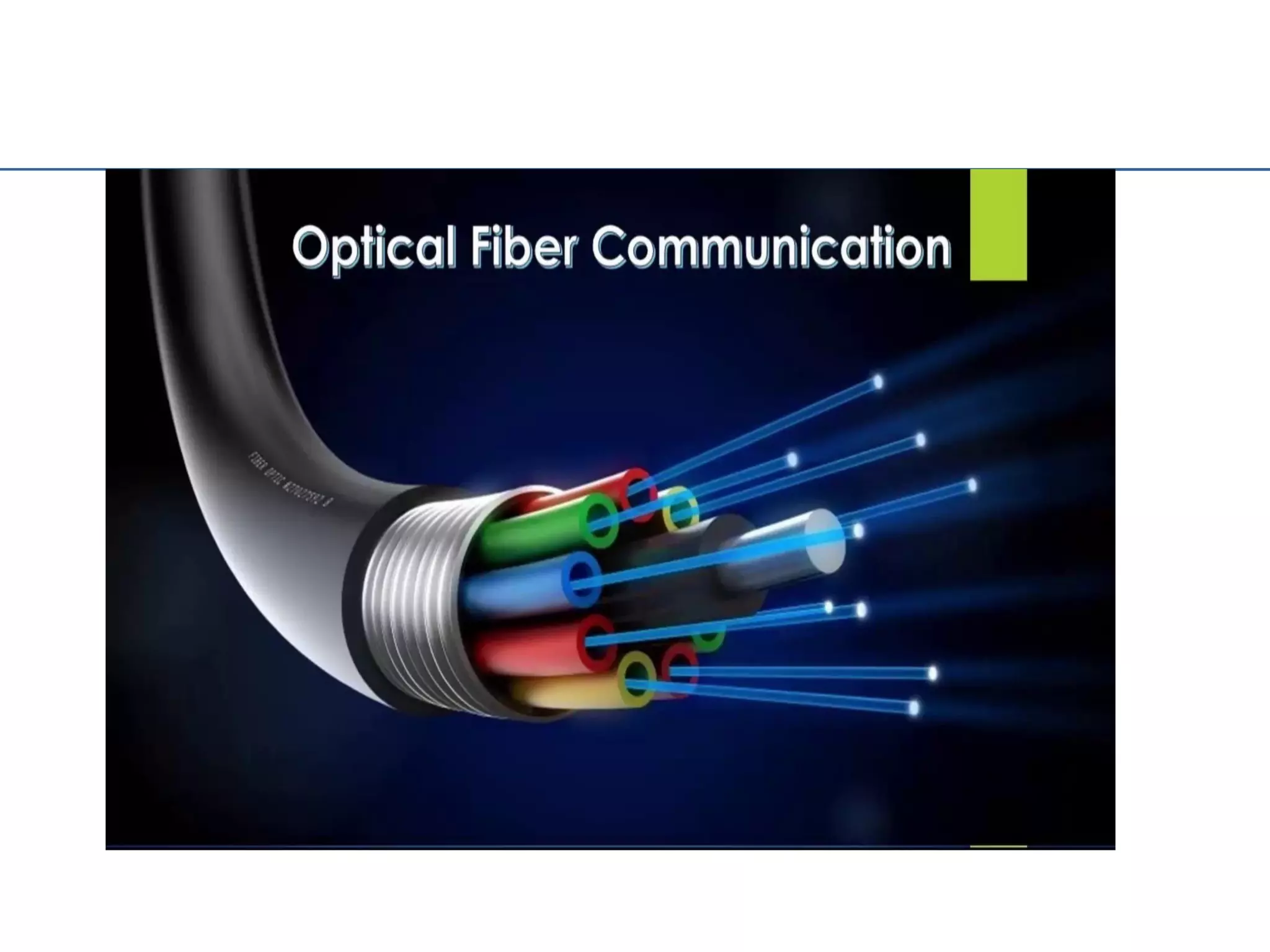
Optical Fiber Communication
• Optical Fiber Communication
– Method of transmitting information by sending
pulses of light through an optical fiber.
OPTICAL FIBER
Main job of optical fiber is to guide light waves with a minimum
attenuation.
Optical fibers are composed of fine threads of glass in layers. The
fine threads are of silica glass mix with some dopant material.
It transmits the Optical waves (Light) through it at the speed of 2/3 of
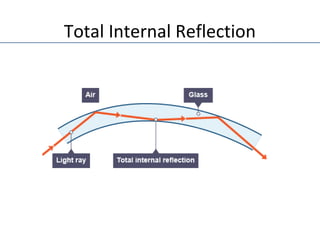
speed of light in vacuum observing the total internal reflection
principle.
Transmission sequence
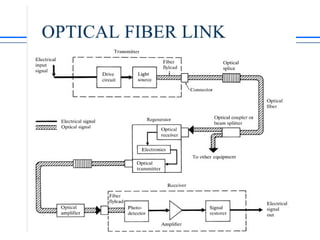
• Information is encoded into electrical signals.
• Electrical signals are converted into light signals.
• Light travels down the fiber.
• A detector changes the light signals into electrical signals.
• Electrical signals are decoded into information
Advantages of Fibre Optics
• Optical Fibers are non conductive (Dielectrics)
• Electromagnetic Immunity
• Large Bandwidth
• Low Loss
• Small, Light weight cables
• Available in Long lengths
• Security
Application of fiber optics in communications
• Common carrier nationwide networks.
• Telephone Inter-office Trunk lines.
• Customer premise communication networks.
• Undersea cables.
• High EMI areas (Power lines, Rails, Roads).
• Control systems
• High lightning areas
• Military applications
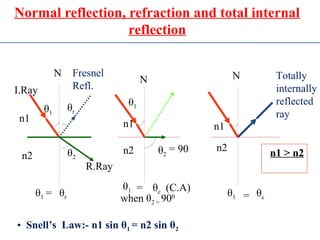
Normal reflection, refraction and total internal
reflection
n2
n1
n2
n1
n2
n1
N
N N
θ2
θ2
= 90
R.Ray
Totally
internally
reflected
rayθ1
θr
I.Ray
Fresnel
Refl.
θ1
θ1 = θr
θ1 = θc
when θ2 = 900
(C.A)
θ1 = θc
n1 > n2
• Snell’s Law:- n1 sin θ1 = n2 sin θ2
Total Internal Reflection
Light propogation in optical fibers
• Follows Laws of Reflection and Refraction.
• Different Wavelengths of Light travel at different speeds in the
same material.
• Refractive index of any Fiber material, n= c/v where c is the
Velocity of light in free space and v is its velocity in a specific
material.
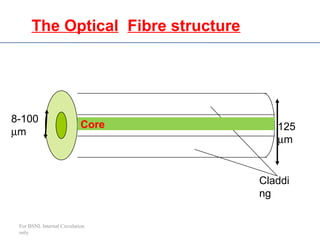
The Optical Fibre structure
Claddi
ng
125
µm
Core
8-100
µm
For BSNL Internal Circulation
only
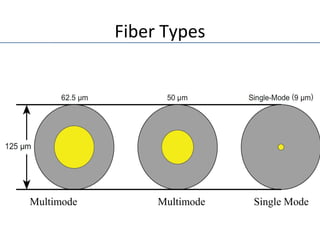
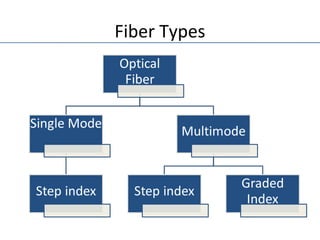
Fiber Types
Multimode Multimode Single Mode
Fiber Types
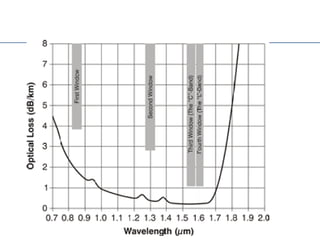
Optical fiber wavelength
• Optical fiber transmission uses wavelengths which are above the
visible light spectrum, and thus undetectable to the unaided eye.
Optical window
•There are ranges of wavelengths at which the fiber operates best. Each
range is known as an operating window.
• Each window is centered around the typical operational wavelength
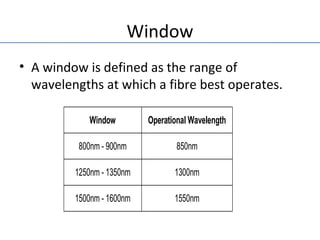
Window
• A window is defined as the range of
wavelengths at which a fibre best operates.
Window Operational Wavelength
800nm - 900nm 850nm
1250nm - 1350nm 1300nm
1500nm - 1600nm 1550nm
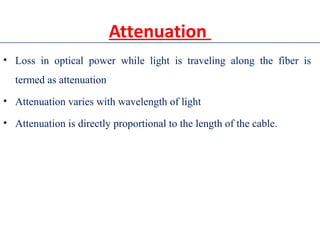
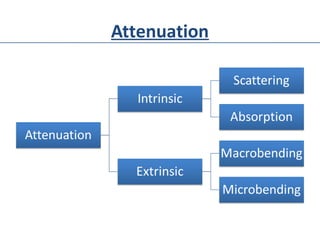
Attenuation
• Loss in optical power while light is traveling along the fiber is
termed as attenuation
• Attenuation varies with wavelength of light
• Attenuation is directly proportional to the length of the cable.
Attenuation
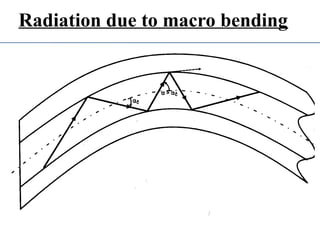
Radiation due to macro bending
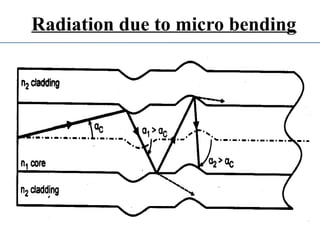
Radiation due to micro bending
NUMERICALAPERTURE
• Numerical aperture is defined as the “light gathering” capacity of
the fiber.
• Only light injected into the fiber at angles greater than critical angle
will be propagated
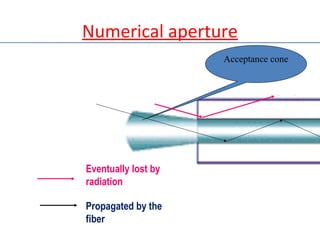
Numerical aperture
Acceptance cone
Eventually lost by
radiation
Propagated by the
fiber
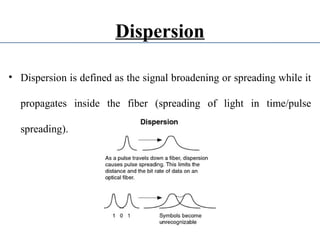
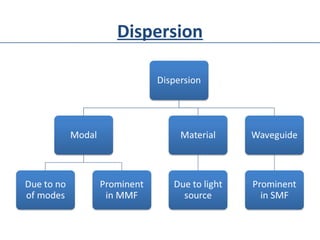
Dispersion
• Dispersion is defined as the signal broadening or spreading while it
propagates inside the fiber (spreading of light in time/pulse
spreading).
Dispersion
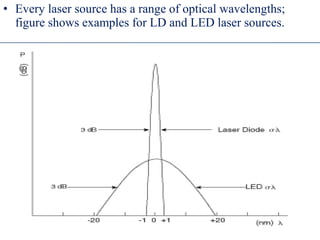
• Every laser source has a range of optical wavelengths;
figure shows examples for LD and LED laser sources.
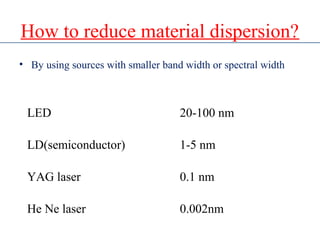
How to reduce material dispersion?
• By using sources with smaller band width or spectral width
LED 20-100 nm
LD(semiconductor) 1-5 nm
YAG laser 0.1 nm
He Ne laser 0.002nm
Wave guide dispersion
• Predominant in SM Fibers
• Occurs because guided optical energy is divided between core and
cladding
• On account of energy traveling at slightly different velocities
between core and cladding.
Waveguide Dispersion
• Whenever any optical signal is passed through the optical
fiber, practically 80% of optical power is confined to core &
rest 20% optical power into cladding.
BANDWIDTH
• It is defined as the amount of information that a system can carry
such that each pulse is distinguishable by the receiver.
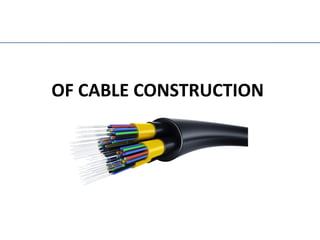
OF CABLE CONSTRUCTION
OFCable
The main Parts of OF Cable are
Optical Fibre
Buffer
Strength member
Jacket
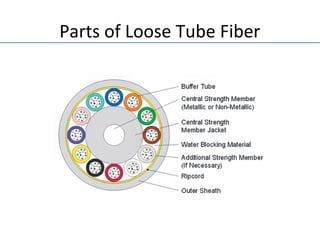
Parts of Loose Tube Fiber
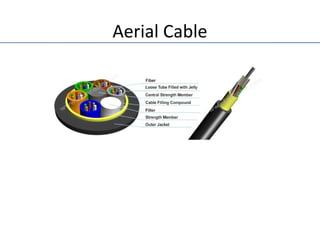
Aerial Cable
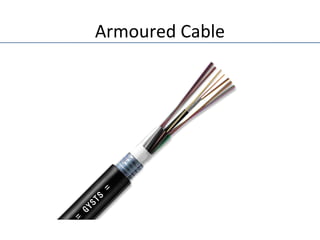
Armoured Cable
Ofc introduction

Ofc introduction

  • 2.
    Optical Fiber Communication •Optical Fiber Communication – Method of transmitting information by sending pulses of light through an optical fiber.
  • 3.
    OPTICAL FIBER Main jobof optical fiber is to guide light waves with a minimum attenuation. Optical fibers are composed of fine threads of glass in layers. The fine threads are of silica glass mix with some dopant material. It transmits the Optical waves (Light) through it at the speed of 2/3 of speed of light in vacuum observing the total internal reflection principle.
  • 5.
    Transmission sequence • Informationis encoded into electrical signals. • Electrical signals are converted into light signals. • Light travels down the fiber. • A detector changes the light signals into electrical signals. • Electrical signals are decoded into information
  • 6.
    Advantages of FibreOptics • Optical Fibers are non conductive (Dielectrics) • Electromagnetic Immunity • Large Bandwidth • Low Loss • Small, Light weight cables • Available in Long lengths • Security
  • 7.
    Application of fiberoptics in communications • Common carrier nationwide networks. • Telephone Inter-office Trunk lines. • Customer premise communication networks. • Undersea cables. • High EMI areas (Power lines, Rails, Roads). • Control systems • High lightning areas • Military applications
  • 8.
    Normal reflection, refractionand total internal reflection n2 n1 n2 n1 n2 n1 N N N θ2 θ2 = 90 R.Ray Totally internally reflected rayθ1 θr I.Ray Fresnel Refl. θ1 θ1 = θr θ1 = θc when θ2 = 900 (C.A) θ1 = θc n1 > n2 • Snell’s Law:- n1 sin θ1 = n2 sin θ2
  • 9.
  • 10.
    Light propogation inoptical fibers • Follows Laws of Reflection and Refraction. • Different Wavelengths of Light travel at different speeds in the same material. • Refractive index of any Fiber material, n= c/v where c is the Velocity of light in free space and v is its velocity in a specific material.
  • 11.
    The Optical Fibrestructure Claddi ng 125 µm Core 8-100 µm For BSNL Internal Circulation only
  • 12.
  • 13.
  • 14.
    Optical fiber wavelength •Optical fiber transmission uses wavelengths which are above the visible light spectrum, and thus undetectable to the unaided eye.
  • 15.
    Optical window •There areranges of wavelengths at which the fiber operates best. Each range is known as an operating window. • Each window is centered around the typical operational wavelength
  • 16.
    Window • A windowis defined as the range of wavelengths at which a fibre best operates. Window Operational Wavelength 800nm - 900nm 850nm 1250nm - 1350nm 1300nm 1500nm - 1600nm 1550nm
  • 18.
    Attenuation • Loss inoptical power while light is traveling along the fiber is termed as attenuation • Attenuation varies with wavelength of light • Attenuation is directly proportional to the length of the cable.
  • 19.
  • 20.
    Radiation due tomacro bending
  • 21.
    Radiation due tomicro bending
  • 22.
    NUMERICALAPERTURE • Numerical apertureis defined as the “light gathering” capacity of the fiber. • Only light injected into the fiber at angles greater than critical angle will be propagated
  • 23.
    Numerical aperture Acceptance cone Eventuallylost by radiation Propagated by the fiber
  • 24.
    Dispersion • Dispersion isdefined as the signal broadening or spreading while it propagates inside the fiber (spreading of light in time/pulse spreading).
  • 25.
  • 26.
    • Every lasersource has a range of optical wavelengths; figure shows examples for LD and LED laser sources.
  • 27.
    How to reducematerial dispersion? • By using sources with smaller band width or spectral width LED 20-100 nm LD(semiconductor) 1-5 nm YAG laser 0.1 nm He Ne laser 0.002nm
  • 28.
    Wave guide dispersion •Predominant in SM Fibers • Occurs because guided optical energy is divided between core and cladding • On account of energy traveling at slightly different velocities between core and cladding.
  • 29.
    Waveguide Dispersion • Wheneverany optical signal is passed through the optical fiber, practically 80% of optical power is confined to core & rest 20% optical power into cladding.
  • 30.
    BANDWIDTH • It isdefined as the amount of information that a system can carry such that each pulse is distinguishable by the receiver.
  • 31.
  • 32.
    OFCable The main Partsof OF Cable are Optical Fibre Buffer Strength member Jacket
  • 33.
    Parts of LooseTube Fiber
  • 34.
  • 35.