THE COLD WAR BEGINS
Unit 5, Section 1, Lesson 1
Objectives

  • Trace the reasons that the wartime alliance
    between the United States and the Soviet
    Union unraveled.

  • Explain how President Truman responded to
    Soviet domination of Eastern Europe.

  • Describe the causes and results of Stalin’s
    blockade of Berlin.
Terms and People
• iron curtain − imaginary barrier separating Soviet-
  controlled countries and the free world
• containment − American policy to keep communism
  contained within its existing borders
• Marshall Plan − U.S. aid program to help Western Europe
  rebuild after World War II
• Berlin airlift − operation in which the U.S. and Britain broke
  the Soviet blockade of West Berlin
• NATO − North Atlantic Treaty Organization; military alliance
  to counter Soviet expansion
• Warsaw Pact − rival military alliance formed by the Soviet
  Union and its satellite states
How did U.S. leaders respond to the
threat of Soviet expansion in Europe?


World War II convinced U.S. leaders that the
policies of isolationism and appeasement had
been mistakes.

To counter the growing Soviet threat, they
sought new ways to keep the U.S. safe and
protect its interests abroad.
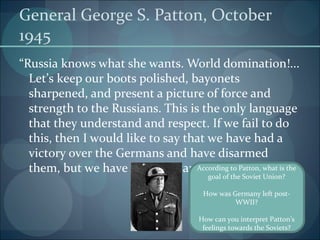
General George S. Patton, October
1945
“Russia knows what she wants. World domination!...
  Let’s keep our boots polished, bayonets
  sharpened, and present a picture of force and
  strength to the Russians. This is the only language
  that they understand and respect. If we fail to do
  this, then I would like to say that we have had a
  victory over the Germans and have disarmed
  them, but we have lost the war.” ccording to Patton, what is the
                                   A
                                            goal of the Soviet Union?

                                           How was Germany left post-
                                                    WWII?

                                          How can you interpret Patton’s
                                           feelings towards the Soviets?
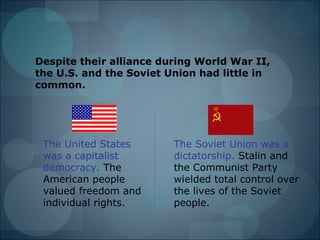
Despite their alliance during World War II,
the U.S. and the Soviet Union had little in
common.


 The United States       The Soviet Union was a
 was a capitalist        dictatorship. Stalin and
 democracy. The          the Communist Party
 American people         wielded total control over
 valued freedom and      the lives of the Soviet
 individual rights.      people.
AS


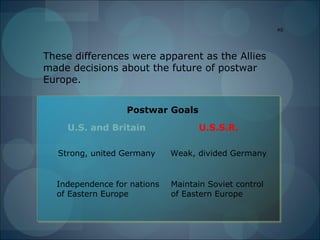
These differences were apparent as the Allies
made decisions about the future of postwar
Europe.


                  Postwar Goals
    U.S. and Britain               U.S.S.R.

  Strong, united Germany     Weak, divided Germany


  Independence for nations   Maintain Soviet control
  of Eastern Europe          of Eastern Europe
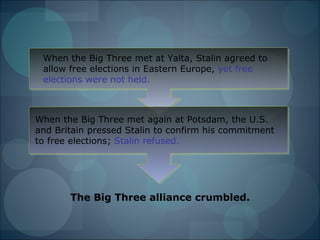
When the Big Three met at Yalta, Stalin agreed to
 allow free elections in Eastern Europe, yet free
 elections were not held.


When the Big Three met again at Potsdam, the U.S.
and Britain pressed Stalin to confirm his commitment
to free elections; Stalin refused.


       The Big Three alliance crumbled.
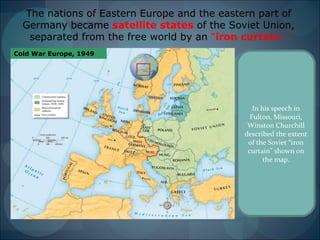
The nations of Eastern Europe and the eastern part of
  Germany became satellite states of the Soviet Union,
   separated from the free world by an “iron curtain.”
Cold War Europe, 1949


                                                In his speech in
                                               Fulton, Missouri,
                                              Winston Churchill
                                             described the extent
                                              of the Soviet “iron
                                              curtain” shown on
                                                    the map.
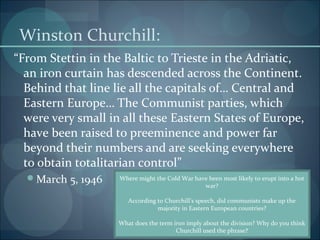
Winston Churchill:
“From Stettin in the Baltic to Trieste in the Adriatic,
  an iron curtain has descended across the Continent.
  Behind that line lie all the capitals of… Central and
  Eastern Europe… The Communist parties, which
  were very small in all these Eastern States of Europe,
  have been raised to preeminence and power far
  beyond their numbers and are seeking everywhere
  to obtain totalitarian control”
  March 5, 1946    Where might the Cold War have been most likely to erupt into a hot
                                                war?

                       According to Churchill’s speech, did communists make up the
                                 majority in Eastern European countries?

                    What does the term iron imply about the division? Why do you think
                                        Churchill used the phrase?
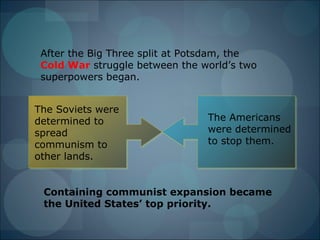
After the Big Three split at Potsdam, the
 Cold War struggle between the world’s two
 superpowers began.


The Soviets were
determined to                   The Americans
spread                          were determined
communism to                    to stop them.
other lands.


 Containing communist expansion became
 the United States’ top priority.
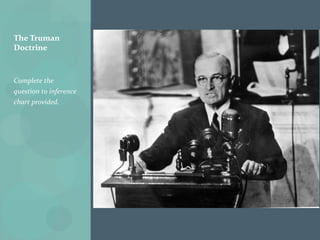
The Truman
Doctrine


Complete the
question to inference
chart provided.
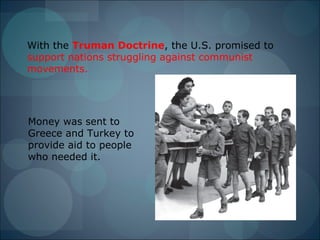
With the Truman Doctrine, the U.S. promised to
support nations struggling against communist
movements.


Money was sent to
Greece and Turkey to
provide aid to people
who needed it.
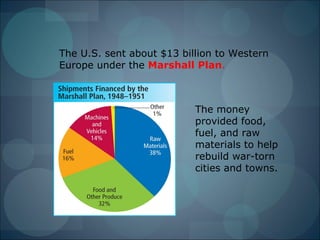
The U.S. sent about $13 billion to Western
Europe under the Marshall Plan.


                           The money
                           provided food,
                           fuel, and raw
                           materials to help
                           rebuild war-torn
                           cities and towns.
Germany, and the city of Berlin, became
   flashpoints in the Cold War.


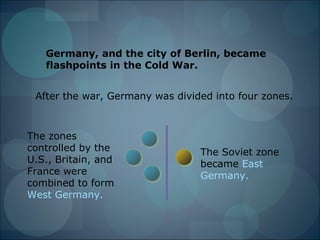
 After the war, Germany was divided into four zones.


The zones
controlled by the                The Soviet zone
U.S., Britain, and               became East
France were                      Germany.
combined to form
West Germany.
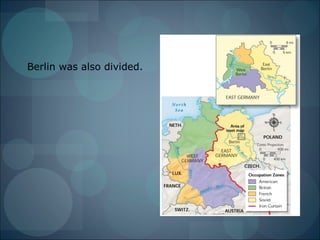
Berlin was also divided.
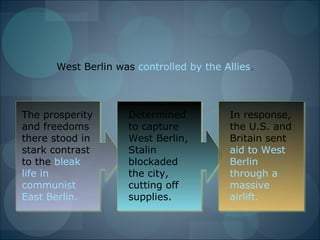
West Berlin was controlled by the Allies.


The prosperity      Determined           In response,
and freedoms        to capture           the U.S. and
there stood in      West Berlin,         Britain sent
stark contrast      Stalin               aid to West
to the bleak        blockaded            Berlin
life in             the city,            through a
communist           cutting off          massive
East Berlin.        supplies.            airlift.
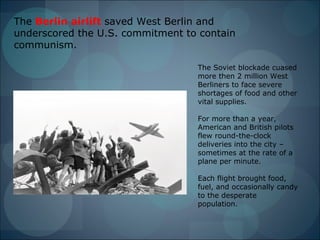
The Berlin airlift saved West Berlin and
underscored the U.S. commitment to contain
communism.

                                  The Soviet blockade cuased
                                  more then 2 million West
                                  Berliners to face severe
                                  shortages of food and other
                                  vital supplies.

                                  For more than a year,
                                  American and British pilots
                                  flew round-the-clock
                                  deliveries into the city –
                                  sometimes at the rate of a
                                  plane per minute.

                                  Each flight brought food,
                                  fuel, and occasionally candy
                                  to the desperate
                                  population.
The Berlin Airlift
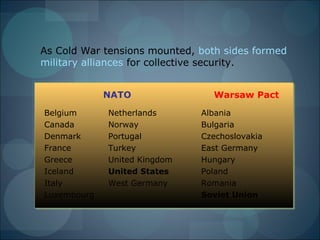
As Cold War tensions mounted, both sides formed
military alliances for collective security.


             NATO                Warsaw Pact

Belgium      Netherlands      Albania
Canada       Norway           Bulgaria
Denmark      Portugal         Czechoslovakia
France       Turkey           East Germany
Greece       United Kingdom   Hungary
Iceland      United States    Poland
Italy        West Germany     Romania
Luxembourg                    Soviet Union
Ticket out the Door:
1. How did the U.S. leaders respond to the threat of
   communism and the Soviet Union?
2. What options besides containment might
   Truman have considered in response to Soviet
   expansion?

Do you believe that the United States should, or
 should not have, expanded their military globally
 during the early years of the Cold War? Why, or
 why not? Use evidence from your notes to explain.

Unit 5 lesson 1 the cold war begins

  • 1.
    THE COLD WARBEGINS Unit 5, Section 1, Lesson 1
  • 2.
    Objectives •Trace the reasons that the wartime alliance between the United States and the Soviet Union unraveled. • Explain how President Truman responded to Soviet domination of Eastern Europe. • Describe the causes and results of Stalin’s blockade of Berlin.
  • 3.
    Terms and People •iron curtain − imaginary barrier separating Soviet- controlled countries and the free world • containment − American policy to keep communism contained within its existing borders • Marshall Plan − U.S. aid program to help Western Europe rebuild after World War II • Berlin airlift − operation in which the U.S. and Britain broke the Soviet blockade of West Berlin • NATO − North Atlantic Treaty Organization; military alliance to counter Soviet expansion • Warsaw Pact − rival military alliance formed by the Soviet Union and its satellite states
  • 4.
    How did U.S.leaders respond to the threat of Soviet expansion in Europe? World War II convinced U.S. leaders that the policies of isolationism and appeasement had been mistakes. To counter the growing Soviet threat, they sought new ways to keep the U.S. safe and protect its interests abroad.
  • 5.
    General George S.Patton, October 1945 “Russia knows what she wants. World domination!... Let’s keep our boots polished, bayonets sharpened, and present a picture of force and strength to the Russians. This is the only language that they understand and respect. If we fail to do this, then I would like to say that we have had a victory over the Germans and have disarmed them, but we have lost the war.” ccording to Patton, what is the A goal of the Soviet Union? How was Germany left post- WWII? How can you interpret Patton’s feelings towards the Soviets?
  • 6.
    Despite their allianceduring World War II, the U.S. and the Soviet Union had little in common. The United States The Soviet Union was a was a capitalist dictatorship. Stalin and democracy. The the Communist Party American people wielded total control over valued freedom and the lives of the Soviet individual rights. people.
  • 7.
    AS These differences wereapparent as the Allies made decisions about the future of postwar Europe. Postwar Goals U.S. and Britain U.S.S.R. Strong, united Germany Weak, divided Germany Independence for nations Maintain Soviet control of Eastern Europe of Eastern Europe
  • 8.
    When the BigThree met at Yalta, Stalin agreed to allow free elections in Eastern Europe, yet free elections were not held. When the Big Three met again at Potsdam, the U.S. and Britain pressed Stalin to confirm his commitment to free elections; Stalin refused. The Big Three alliance crumbled.
  • 9.
    The nations ofEastern Europe and the eastern part of Germany became satellite states of the Soviet Union, separated from the free world by an “iron curtain.” Cold War Europe, 1949 In his speech in Fulton, Missouri, Winston Churchill described the extent of the Soviet “iron curtain” shown on the map.
  • 10.
    Winston Churchill: “From Stettinin the Baltic to Trieste in the Adriatic, an iron curtain has descended across the Continent. Behind that line lie all the capitals of… Central and Eastern Europe… The Communist parties, which were very small in all these Eastern States of Europe, have been raised to preeminence and power far beyond their numbers and are seeking everywhere to obtain totalitarian control” March 5, 1946 Where might the Cold War have been most likely to erupt into a hot war? According to Churchill’s speech, did communists make up the majority in Eastern European countries? What does the term iron imply about the division? Why do you think Churchill used the phrase?
  • 11.
    After the BigThree split at Potsdam, the Cold War struggle between the world’s two superpowers began. The Soviets were determined to The Americans spread were determined communism to to stop them. other lands. Containing communist expansion became the United States’ top priority.
  • 12.
    The Truman Doctrine Complete the questionto inference chart provided.
  • 13.
    With the TrumanDoctrine, the U.S. promised to support nations struggling against communist movements. Money was sent to Greece and Turkey to provide aid to people who needed it.
  • 14.
    The U.S. sentabout $13 billion to Western Europe under the Marshall Plan. The money provided food, fuel, and raw materials to help rebuild war-torn cities and towns.
  • 15.
    Germany, and thecity of Berlin, became flashpoints in the Cold War. After the war, Germany was divided into four zones. The zones controlled by the The Soviet zone U.S., Britain, and became East France were Germany. combined to form West Germany.
  • 16.
  • 17.
    West Berlin wascontrolled by the Allies. The prosperity Determined In response, and freedoms to capture the U.S. and there stood in West Berlin, Britain sent stark contrast Stalin aid to West to the bleak blockaded Berlin life in the city, through a communist cutting off massive East Berlin. supplies. airlift.
  • 18.
    The Berlin airliftsaved West Berlin and underscored the U.S. commitment to contain communism. The Soviet blockade cuased more then 2 million West Berliners to face severe shortages of food and other vital supplies. For more than a year, American and British pilots flew round-the-clock deliveries into the city – sometimes at the rate of a plane per minute. Each flight brought food, fuel, and occasionally candy to the desperate population.
  • 19.
  • 20.
    As Cold Wartensions mounted, both sides formed military alliances for collective security. NATO Warsaw Pact Belgium Netherlands Albania Canada Norway Bulgaria Denmark Portugal Czechoslovakia France Turkey East Germany Greece United Kingdom Hungary Iceland United States Poland Italy West Germany Romania Luxembourg Soviet Union
  • 21.
    Ticket out theDoor: 1. How did the U.S. leaders respond to the threat of communism and the Soviet Union? 2. What options besides containment might Truman have considered in response to Soviet expansion? Do you believe that the United States should, or should not have, expanded their military globally during the early years of the Cold War? Why, or why not? Use evidence from your notes to explain.