What was it?
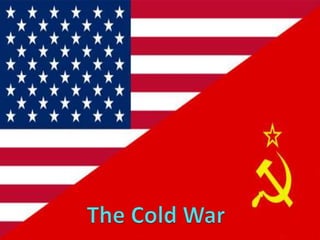
 Hostility between the Superpowers - the USA (America)
and the USSR (Russia) from 1945 to 1990.
 Never became a “hot” or shooting war.
 What were the differences between the two sides?
 USA was a Capitalist Democracy
 USSR was a Communist Dictatorship
 Both sides disagreed on what should happen in Europe
after World War 2
 Stalin – Soviet (Russian) Dictator, Communist. Believed
Germany should be kept weak after WW2 and that Russia
needed Communist allies in Europe
World leaders in 1945
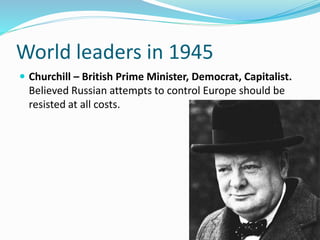
 Churchill – British Prime Minister, Democrat, Capitalist.
Believed Russian attempts to control Europe should be
resisted at all costs.
World leaders in 1945
 Truman – American President, Democrat, Capitalist.
Took over after Roosevelt died. Believed Russian attempts
to control Europe should be resisted at all costs.
 One advantage – Nuclear weapons
World leaders in 1945
Germany Divided after the War
 This was meant to be temporary, however Stalin wanted
Germany to be kept permanently divided and weak.
 Berlin (German Capital) was also divided
Eastern Europe becomes
Communist
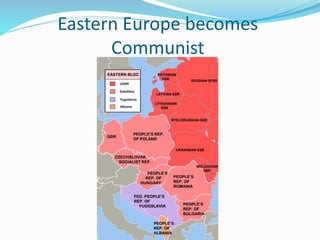
Eastern Europe becomes
Communist
 To defeat Germany Russia had to pass through many
countries in Eastern Europe.
 After the war, Russia occupied these countries and forced
them to have pro-Russian Communist Governments in
order to create a “buffer” between itself and Germany
 http://www.bbc.co.uk/apps/ifl/schools/gcsebitesize/histo
ry/quizengine?quiz=ideologicaldifferencestest&templateS
tyle=history
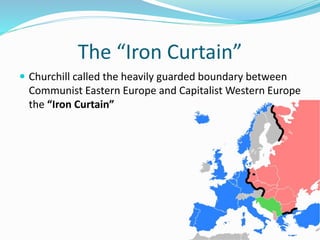
The “Iron Curtain”
 Churchill called the heavily guarded boundary between
Communist Eastern Europe and Capitalist Western Europe
the “Iron Curtain”
Churchill peeking through the Iron
Curtain
Europe in Ruins – Communism
becomes more popular
Communism grows – American
Response
 Lack of Jobs, food and housing meant that people in
Europe began to support Communism more.
 America’s response was:
 The Truman Doctrine – America would give military help to
countries facing a communist takeover
 The Marshall Plan – America would give money to
Capitalist, Democratic countries to help them rebuild after
the war
 This helped stop Communism spreading in Europe
Berlin – Containment in Action
 The Americans wanted to keep Communism from
spreading – this was known as Containment
 Berlin was divided between the Britain, USA, France and
Russia despite being inside the Russian controlled part of
Germany
 In 1947, Stalin attempted to force the US, Britain and
France to abandon Berlin – this was known as the “Berlin
Blockade”
Berlin, located inside
the Russian
controlled part of
Germany
The Berlin Blockade
 Stalin closed all land routes into Berlin, hoping to force
the Western Allies (Britain, France and USA) to abandon
the city
 The Allies used Planes to bring in supplies to Berlin, this
was known as the Berlin Airlift or Operation Vittles
 Eventually Stalin gave up the blockade and reopened the
roads from West Germany to Berlin
Milk being delivered to Berlin by
air
Berlin supplied by air
Consequences of the Berlin
Blockade
 Deep hostility between the USA and USSR
 “Arms race” as both sides built up their military
 Western European countries and USA formed the North
Atlantic Treaty Organisation (NATO) to oppose Russian
aggression
 In Response the Russians formed the Warsaw Pact alliance
(Russia and Eastern European Communist countries)
 Germany (and Berlin) stayed divided
2013 Junior Cert (Higher)
The Cold War Goes Global
 When Communists gained control of China, it became a
new front in the Cold War
 New Chinese leader was Mao Tse-Tung.
 This frightened America as it seemed the Communists
were winning the Cold War
Mao in Chinese Communist
Propaganda
The Korean War
The Korean War
 Korea was one country until after World War 2, when the
North became Communist Dictatorship and the South became
a Capitalist Democracy
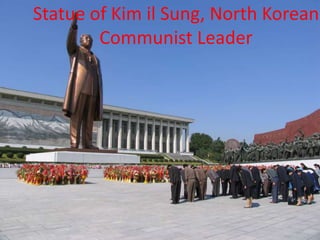
 Kim il Sung, the North Korean dictator, wanted to gain control
of all of Korea and invaded the south, starting the Korean War
 Russia and China supported the Communist North
 America supported the Capitalist South
Douglas McArthur, American
Leader in Korea
The Korean War
 The Americans, led by General Douglas McArthur, fought the
Communists and invaded North Korea
 China became afraid that America would then invade and
invaded Korea in retaliation
 After two years of fighting a truce was agreed which exists to
this day
 As part of the truce, a demilitarised buffer zone between
North and South Korea was created
Statue of Kim il Sung, North Korean
Communist Leader
Korea today – the demilitarised
zone
Korea today – American troops
help guard South Korea from attack
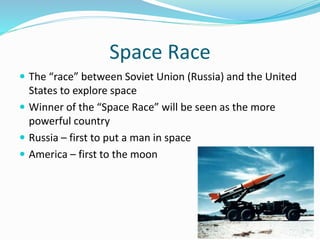
Space Race
 The “race” between Soviet Union (Russia) and the United
States to explore space
 Winner of the “Space Race” will be seen as the more
powerful country
 Russia – first to put a man in space
 America – first to the moon
Space race – P84
 A demonstration of rocket power
 Same rockets that bring people to the moon can be used
to carry nuclear weapons around the world
 By going into space, the US and Russia were saying to the
countries of the world “Look how powerful we are – you
would not want to be our enemy”
Peaceful space rocket or nuclear
weapon?
Space Race – America reaches the
Moon
Berlin Wall – P 85
 Berlin Wall was a wall seperating West (Capitalist) Berlin
from the rest of (Communist) East Germany
 Built to stop people leaving East Germany for Capitalist
West Germany
 Lasted from 1960s until 1989
The Berlin Wall
Cuban Missile Crisis
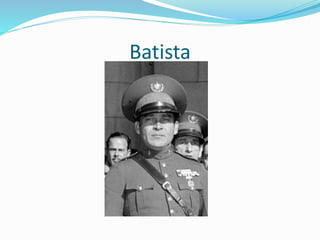
 Cuba in the 1950s was ruled by a corrupt dictator known
as General Batista.
 Batista oppressed the Cuban people badly
 Corrupt…. But friendly to America
 In 1959 he was overthrown by Fidel Castro (Communist)
who is still alive today
Cuba ruled by Batista
Batista
Castro
Cuban Missile Crisis
 USSR (Communist) installed nuclear missiles on Cuba
 This threatened the USA and they made plans to invade
Cuba
 USSR (Russia) said if America invaded it would be an “Act
of War”
 After a tense stand off the USSR eventually backed down
 This was the closest world has come to Nuclear War
 Afterwards both sides worked to reduce nuclear weapons
tensions by Test Ban Treaties
Missiles Discovered In Cuba
The world awaits….
Castro in 2000
End of the Cold War
 By the 1980s the USSR was struggling economically by
trying to keep up with America in the “Arms Race”
 In 1985 a new Soviet leader, Gorbachev came to power
and introduced Glasnost (openness) and Perestroika
(Reform)
 In 1989 Gorbachev said that the USSR would no longer
support Communist Governments in eastern Europe and
they became democracies, ending the “Cold War”
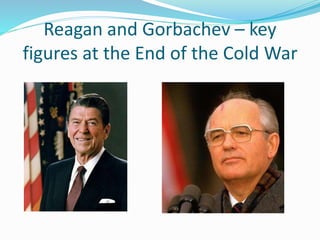
Reagan and Gorbachev – key
figures at the End of the Cold War
Reagan and Gorbachev discuss
nuclear disarmament (1987)
1989 – Berlin Wall falls, end of
Cold War
2012 Junior Cert Question (HL)

The Cold War

  • 2.
    What was it? Hostility between the Superpowers - the USA (America) and the USSR (Russia) from 1945 to 1990.  Never became a “hot” or shooting war.  What were the differences between the two sides?  USA was a Capitalist Democracy  USSR was a Communist Dictatorship  Both sides disagreed on what should happen in Europe after World War 2
  • 3.
     Stalin –Soviet (Russian) Dictator, Communist. Believed Germany should be kept weak after WW2 and that Russia needed Communist allies in Europe World leaders in 1945
  • 4.
     Churchill –British Prime Minister, Democrat, Capitalist. Believed Russian attempts to control Europe should be resisted at all costs. World leaders in 1945
  • 5.
     Truman –American President, Democrat, Capitalist. Took over after Roosevelt died. Believed Russian attempts to control Europe should be resisted at all costs.  One advantage – Nuclear weapons World leaders in 1945
  • 6.
    Germany Divided afterthe War  This was meant to be temporary, however Stalin wanted Germany to be kept permanently divided and weak.  Berlin (German Capital) was also divided
  • 7.
  • 8.
    Eastern Europe becomes Communist To defeat Germany Russia had to pass through many countries in Eastern Europe.  After the war, Russia occupied these countries and forced them to have pro-Russian Communist Governments in order to create a “buffer” between itself and Germany  http://www.bbc.co.uk/apps/ifl/schools/gcsebitesize/histo ry/quizengine?quiz=ideologicaldifferencestest&templateS tyle=history
  • 9.
    The “Iron Curtain” Churchill called the heavily guarded boundary between Communist Eastern Europe and Capitalist Western Europe the “Iron Curtain”
  • 10.
    Churchill peeking throughthe Iron Curtain
  • 11.
    Europe in Ruins– Communism becomes more popular
  • 12.
    Communism grows –American Response  Lack of Jobs, food and housing meant that people in Europe began to support Communism more.  America’s response was:  The Truman Doctrine – America would give military help to countries facing a communist takeover  The Marshall Plan – America would give money to Capitalist, Democratic countries to help them rebuild after the war  This helped stop Communism spreading in Europe
  • 13.
    Berlin – Containmentin Action  The Americans wanted to keep Communism from spreading – this was known as Containment  Berlin was divided between the Britain, USA, France and Russia despite being inside the Russian controlled part of Germany  In 1947, Stalin attempted to force the US, Britain and France to abandon Berlin – this was known as the “Berlin Blockade”
  • 14.
    Berlin, located inside theRussian controlled part of Germany
  • 15.
    The Berlin Blockade Stalin closed all land routes into Berlin, hoping to force the Western Allies (Britain, France and USA) to abandon the city  The Allies used Planes to bring in supplies to Berlin, this was known as the Berlin Airlift or Operation Vittles  Eventually Stalin gave up the blockade and reopened the roads from West Germany to Berlin
  • 16.
    Milk being deliveredto Berlin by air
  • 17.
  • 18.
    Consequences of theBerlin Blockade  Deep hostility between the USA and USSR  “Arms race” as both sides built up their military  Western European countries and USA formed the North Atlantic Treaty Organisation (NATO) to oppose Russian aggression  In Response the Russians formed the Warsaw Pact alliance (Russia and Eastern European Communist countries)  Germany (and Berlin) stayed divided
  • 20.
  • 21.
    The Cold WarGoes Global  When Communists gained control of China, it became a new front in the Cold War  New Chinese leader was Mao Tse-Tung.  This frightened America as it seemed the Communists were winning the Cold War
  • 22.
    Mao in ChineseCommunist Propaganda
  • 23.
  • 24.
    The Korean War Korea was one country until after World War 2, when the North became Communist Dictatorship and the South became a Capitalist Democracy  Kim il Sung, the North Korean dictator, wanted to gain control of all of Korea and invaded the south, starting the Korean War  Russia and China supported the Communist North  America supported the Capitalist South
  • 25.
  • 26.
    The Korean War The Americans, led by General Douglas McArthur, fought the Communists and invaded North Korea  China became afraid that America would then invade and invaded Korea in retaliation  After two years of fighting a truce was agreed which exists to this day  As part of the truce, a demilitarised buffer zone between North and South Korea was created
  • 27.
    Statue of Kimil Sung, North Korean Communist Leader
  • 28.
    Korea today –the demilitarised zone
  • 29.
    Korea today –American troops help guard South Korea from attack
  • 30.
    Space Race  The“race” between Soviet Union (Russia) and the United States to explore space  Winner of the “Space Race” will be seen as the more powerful country  Russia – first to put a man in space  America – first to the moon
  • 31.
    Space race –P84  A demonstration of rocket power  Same rockets that bring people to the moon can be used to carry nuclear weapons around the world  By going into space, the US and Russia were saying to the countries of the world “Look how powerful we are – you would not want to be our enemy”
  • 32.
    Peaceful space rocketor nuclear weapon?
  • 33.
    Space Race –America reaches the Moon
  • 34.
    Berlin Wall –P 85  Berlin Wall was a wall seperating West (Capitalist) Berlin from the rest of (Communist) East Germany  Built to stop people leaving East Germany for Capitalist West Germany  Lasted from 1960s until 1989
  • 35.
  • 36.
    Cuban Missile Crisis Cuba in the 1950s was ruled by a corrupt dictator known as General Batista.  Batista oppressed the Cuban people badly  Corrupt…. But friendly to America  In 1959 he was overthrown by Fidel Castro (Communist) who is still alive today
  • 37.
  • 38.
  • 39.
  • 40.
    Cuban Missile Crisis USSR (Communist) installed nuclear missiles on Cuba  This threatened the USA and they made plans to invade Cuba  USSR (Russia) said if America invaded it would be an “Act of War”  After a tense stand off the USSR eventually backed down  This was the closest world has come to Nuclear War  Afterwards both sides worked to reduce nuclear weapons tensions by Test Ban Treaties
  • 41.
  • 42.
  • 43.
  • 45.
    End of theCold War  By the 1980s the USSR was struggling economically by trying to keep up with America in the “Arms Race”  In 1985 a new Soviet leader, Gorbachev came to power and introduced Glasnost (openness) and Perestroika (Reform)  In 1989 Gorbachev said that the USSR would no longer support Communist Governments in eastern Europe and they became democracies, ending the “Cold War”
  • 46.
    Reagan and Gorbachev– key figures at the End of the Cold War
  • 47.
    Reagan and Gorbachevdiscuss nuclear disarmament (1987)
  • 48.
    1989 – BerlinWall falls, end of Cold War
  • 50.
    2012 Junior CertQuestion (HL)