The Movement Gains Ground

Unit 7, Section 1, Lesson 2
Objectives
 •   Describe the sit-ins, freedom rides, and the
     actions of James Meredith in the early 1960s.

 •   Explain how the protests at Birmingham and
     the March on Washington were linked to the
     Civil Rights Act of 1964.

 •   Summarize the provisions of the Civil Rights
     Act of 1964.
Terms and People
•   sit-in − a form of protest where participants sit and refuse to
    move
•   SNCC − the Student Nonviolent Coordinating Committee, a
    grass-roots civil rights organization
•   freedom ride − 1961 protest by activists who rode buses
    through southern states to test the ban on rider segregation
    on interstate buses
• March on Washington − 1963 demonstration in which
  200,000 people rallied for economic equality and civil rights
• filibuster − tactic by which senators give long speeches in
  order to delay action on legislation
• Civil Rights Act of 1964 − outlawed discrimination in
  public places and employment based on race, religion, or
  national origin
How did the civil rights movement
gain ground in the 1960s?
Through victories in the courts and the success
of sit-ins and other nonviolent protests, African
Americans slowly began to win their battle for
civil rights.

But it was the landmark Civil Rights Act of
1964 that signaled a dramatic change in race
relations by outlawing discrimination based on
race, religion, or national origin.
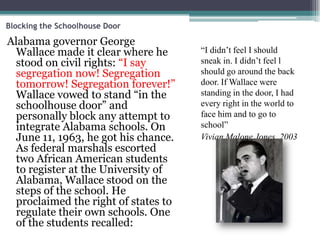
Blocking the Schoolhouse Door

Alabama governor George
 Wallace made it clear where he      “I didn’t feel I should
 stood on civil rights: “I say       sneak in. I didn’t feel l
 segregation now! Segregation        should go around the back
 tomorrow! Segregation forever!”     door. If Wallace were
 Wallace vowed to stand “in the      standing in the door, I had
 schoolhouse door” and               every right in the world to
 personally block any attempt to     face him and to go to
 integrate Alabama schools. On       school”
 June 11, 1963, he got his chance.   Vivian Malone Jones, 2003
 As federal marshals escorted
 two African American students
 to register at the University of
 Alabama, Wallace stood on the
 steps of the school. He
 proclaimed the right of states to
 regulate their own schools. One
 of the students recalled:
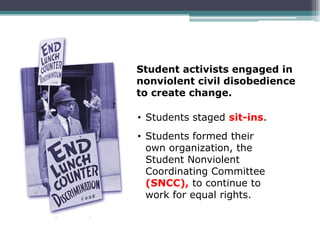
Student activists engaged in
nonviolent civil disobedience
to create change.

• Students staged sit-ins.
• Students formed their
  own organization, the
  Student Nonviolent
  Coordinating Committee
  (SNCC), to continue to
  work for equal rights.
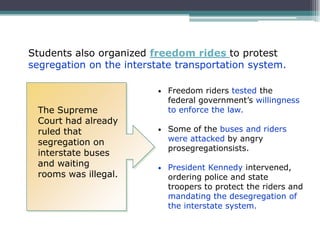
Students also organized freedom rides to protest
segregation on the interstate transportation system.

                          •   Freedom riders tested the
                              federal government’s willingness
 The Supreme                  to enforce the law.
 Court had already
 ruled that               •   Some of the buses and riders
 segregation on               were attacked by angry
                              prosegregationsists.
 interstate buses
 and waiting              •   President Kennedy intervened,
 rooms was illegal.           ordering police and state
                              troopers to protect the riders and
                              mandating the desegregation of
                              the interstate system.
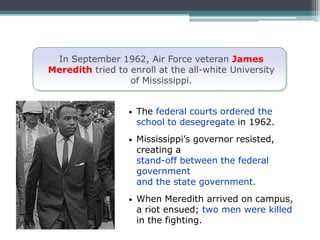
In September 1962, Air Force veteran James
Meredith tried to enroll at the all-white University
                  of Mississippi.


                  •   The federal courts ordered the
                      school to desegregate in 1962.
                  •   Mississippi’s governor resisted,
                      creating a
                      stand-off between the federal
                      government
                      and the state government.
                  •   When Meredith arrived on campus,
                      a riot ensued; two men were killed
                      in the fighting.
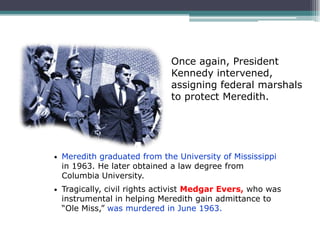
Once again, President
                               Kennedy intervened,
                               assigning federal marshals
                               to protect Meredith.


•   Meredith graduated from the University of Mississippi
    in 1963. He later obtained a law degree from
    Columbia University.
•   Tragically, civil rights activist Medgar Evers, who was
    instrumental in helping Meredith gain admittance to
    “Ole Miss,” was murdered in June 1963.
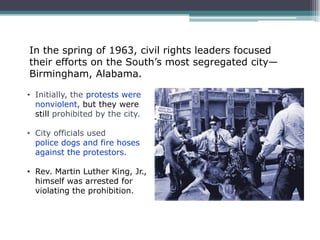
In the spring of 1963, civil rights leaders focused
their efforts on the South’s most segregated city—
Birmingham, Alabama.

• Initially, the protests were
  nonviolent, but they were
  still prohibited by the city.

• City officials used
  police dogs and fire hoses
  against the protestors.

• Rev. Martin Luther King, Jr.,
  himself was arrested for
  violating the prohibition.
Reaction to the Birmingham protests was overwhelming.


                                      Civil rights
Shocked             Calling it a
                                      leaders held a
Americans           “moral issue,”
                                      March on
demanded            Kennedy
                                      Washington
that President      proposed
                                      to pressure the
Kennedy take        sweeping civil
                                      government to
action to end       rights
                                      pass the
the violence.       legislation.
                                      President’s bill.
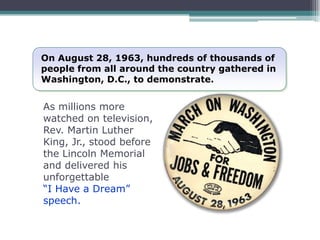
On August 28, 1963, hundreds of thousands of
people from all around the country gathered in
Washington, D.C., to demonstrate.


As millions more
watched on television,
Rev. Martin Luther
King, Jr., stood before
the Lincoln Memorial
and delivered his
unforgettable
“I Have a Dream”
speech.
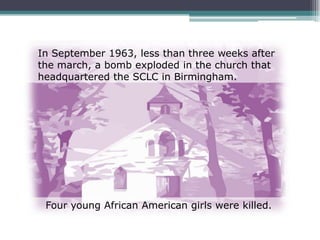
In September 1963, less than three weeks after
the march, a bomb exploded in the church that
headquartered the SCLC in Birmingham.


 Four young African American girls were killed.
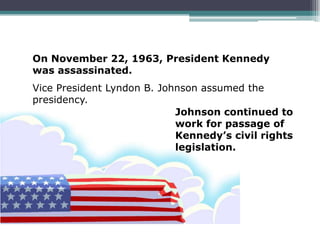
On November 22, 1963, President Kennedy
was assassinated.
Vice President Lyndon B. Johnson assumed the
presidency.
                            Johnson continued to
                            work for passage of
                            Kennedy’s civil rights
                            legislation.
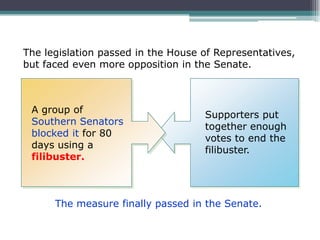
The legislation passed in the House of Representatives,
but faced even more opposition in the Senate.


 A group of
                                    Supporters put
 Southern Senators
                                    together enough
 blocked it for 80
                                    votes to end the
 days using a
                                    filibuster.
 filibuster.


      The measure finally passed in the Senate.
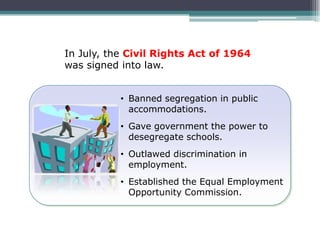
In July, the Civil Rights Act of 1964
was signed into law.


           • Banned segregation in public
             accommodations.
           • Gave government the power to
             desegregate schools.
           • Outlawed discrimination in
             employment.
           • Established the Equal Employment
             Opportunity Commission.
How did the civil rights movement
   gain ground in the 1960s?

Unit 7 section 1 lesson 2 the movement gains ground

  • 1.
    The Movement GainsGround Unit 7, Section 1, Lesson 2
  • 2.
    Objectives • Describe the sit-ins, freedom rides, and the actions of James Meredith in the early 1960s. • Explain how the protests at Birmingham and the March on Washington were linked to the Civil Rights Act of 1964. • Summarize the provisions of the Civil Rights Act of 1964.
  • 3.
    Terms and People • sit-in − a form of protest where participants sit and refuse to move • SNCC − the Student Nonviolent Coordinating Committee, a grass-roots civil rights organization • freedom ride − 1961 protest by activists who rode buses through southern states to test the ban on rider segregation on interstate buses • March on Washington − 1963 demonstration in which 200,000 people rallied for economic equality and civil rights • filibuster − tactic by which senators give long speeches in order to delay action on legislation • Civil Rights Act of 1964 − outlawed discrimination in public places and employment based on race, religion, or national origin
  • 4.
    How did thecivil rights movement gain ground in the 1960s? Through victories in the courts and the success of sit-ins and other nonviolent protests, African Americans slowly began to win their battle for civil rights. But it was the landmark Civil Rights Act of 1964 that signaled a dramatic change in race relations by outlawing discrimination based on race, religion, or national origin.
  • 5.
    Blocking the SchoolhouseDoor Alabama governor George Wallace made it clear where he “I didn’t feel I should stood on civil rights: “I say sneak in. I didn’t feel l segregation now! Segregation should go around the back tomorrow! Segregation forever!” door. If Wallace were Wallace vowed to stand “in the standing in the door, I had schoolhouse door” and every right in the world to personally block any attempt to face him and to go to integrate Alabama schools. On school” June 11, 1963, he got his chance. Vivian Malone Jones, 2003 As federal marshals escorted two African American students to register at the University of Alabama, Wallace stood on the steps of the school. He proclaimed the right of states to regulate their own schools. One of the students recalled:
  • 6.
    Student activists engagedin nonviolent civil disobedience to create change. • Students staged sit-ins. • Students formed their own organization, the Student Nonviolent Coordinating Committee (SNCC), to continue to work for equal rights.
  • 7.
    Students also organizedfreedom rides to protest segregation on the interstate transportation system. • Freedom riders tested the federal government’s willingness The Supreme to enforce the law. Court had already ruled that • Some of the buses and riders segregation on were attacked by angry prosegregationsists. interstate buses and waiting • President Kennedy intervened, rooms was illegal. ordering police and state troopers to protect the riders and mandating the desegregation of the interstate system.
  • 8.
    In September 1962,Air Force veteran James Meredith tried to enroll at the all-white University of Mississippi. • The federal courts ordered the school to desegregate in 1962. • Mississippi’s governor resisted, creating a stand-off between the federal government and the state government. • When Meredith arrived on campus, a riot ensued; two men were killed in the fighting.
  • 9.
    Once again, President Kennedy intervened, assigning federal marshals to protect Meredith. • Meredith graduated from the University of Mississippi in 1963. He later obtained a law degree from Columbia University. • Tragically, civil rights activist Medgar Evers, who was instrumental in helping Meredith gain admittance to “Ole Miss,” was murdered in June 1963.
  • 10.
    In the springof 1963, civil rights leaders focused their efforts on the South’s most segregated city— Birmingham, Alabama. • Initially, the protests were nonviolent, but they were still prohibited by the city. • City officials used police dogs and fire hoses against the protestors. • Rev. Martin Luther King, Jr., himself was arrested for violating the prohibition.
  • 11.
    Reaction to theBirmingham protests was overwhelming. Civil rights Shocked Calling it a leaders held a Americans “moral issue,” March on demanded Kennedy Washington that President proposed to pressure the Kennedy take sweeping civil government to action to end rights pass the the violence. legislation. President’s bill.
  • 12.
    On August 28,1963, hundreds of thousands of people from all around the country gathered in Washington, D.C., to demonstrate. As millions more watched on television, Rev. Martin Luther King, Jr., stood before the Lincoln Memorial and delivered his unforgettable “I Have a Dream” speech.
  • 13.
    In September 1963,less than three weeks after the march, a bomb exploded in the church that headquartered the SCLC in Birmingham. Four young African American girls were killed.
  • 14.
    On November 22,1963, President Kennedy was assassinated. Vice President Lyndon B. Johnson assumed the presidency. Johnson continued to work for passage of Kennedy’s civil rights legislation.
  • 15.
    The legislation passedin the House of Representatives, but faced even more opposition in the Senate. A group of Supporters put Southern Senators together enough blocked it for 80 votes to end the days using a filibuster. filibuster. The measure finally passed in the Senate.
  • 16.
    In July, theCivil Rights Act of 1964 was signed into law. • Banned segregation in public accommodations. • Gave government the power to desegregate schools. • Outlawed discrimination in employment. • Established the Equal Employment Opportunity Commission.
  • 17.
    How did thecivil rights movement gain ground in the 1960s?