The Origins of the Cold War
2
The Cold War Begins
• At the end of World War II, much of Europe lay in ruins. The
United States, however, emerged from the war stronger than
ever. The Soviet Union, with its huge land mass and
abundant resources, was also poised to become a great
power. Together, these two superpowers [an extremely
powerful nation, one of a very few dominant states in an
era when the world is divided politically into these states
and their satellites] would dominate world affairs.
3
Signs of Cooperation
• At first there were hopeful signs that the United States and the USSR might
cooperate in the postwar era. In February 1945, as the war was winding
down, the “Big Three” Allied leaders—Franklin Roosevelt, Joseph Stalin, and
Winston Churchill—met in the Soviet city of Yalta. There they made plans for
postwar Europe. They agreed to divide Germany into four Allied occupation
zones to be administered by the United States, Great Britain, France, and
the Soviet Union. Berlin, the German capital, lay within the Soviet zone but
would also be divided among the Allies. In addition, Stalin agreed to support
free and fair elections in the liberated countries of Eastern Europe.
• At Yalta, the Soviets also agreed to join the United Nations [an
international organization founded in 1945 to promote peace, security,
and cooperation among the world’s nations] (UN). This international body
was founded in June 1945, when 50 nations signed the UN Charter. The
charter established a General Assembly of all the member-states, plus an
11-member Security Council to settle disputes. UN members agreed to
promote peace, security, and international cooperation. They pledged “to
save succeeding generations from the scourge of war.”
4
U.S.-Soviet Divisions
• Despite these hopeful signs, deep divisions between the superpowers
made lasting cooperation unlikely. These divisions were based on the
two nations' differing histories and different goals for the postwar world.
• Some of the differences arose from the war itself. During the war, nearly
300,000 American troops lost their lives. Aside from the attack on Pearl
Harbor, however, no fighting took place on American soil. The American
economy also boomed during the war because of wartime spending. In
contrast, about 28 million Soviet people—soldiers and civilians—died
during the war. The fighting devastated the Soviet Union and its
economy. Virtually no Soviet citizen was untouched by the war.
• The two superpowers also had contrasting goals and beliefs. Having
been profoundly scarred by the war, the chief aim of the Soviets was to
ensure their security. During the war—and throughout its history—Russia
had been highly vulnerable to invasion. The Soviet state wanted to make
sure it protected itself from any future attack, particularly from the west. It
wanted to create a buffer zone of friendly countries in Eastern Europe
5
• In neighboring countries, the Soviets also wanted to promote regimes sympathetic to
communism, the ideological foundation of the USSR government. Soviet leaders
envisioned a communist utopia of social justice and economic equality. To achieve that
goal, the government set out to reorganize the economy along socialist lines. Under
socialism, the government owned all factories. The state seized private land and took
charge of agricultural production, or turned land over to peasant collectives. Soviet
leaders were confident communism would inevitably prevail over capitalism as ordinary
workers and peasants in other nations followed the Soviet model. But they knew that this
victory would not occur without a struggle.
• The United States was also concerned with security. Pearl Harbor had made it clear that
the United States was no longer safe from attack. It needed to defend itself against
threats from abroad. A key part of its strategy was to prevent hostile powers from taking
control of the countries and resources of Eurasia, as the Axis powers had tried to do
during the war. To accomplish that, the United States would need to maintain a strong
military presence overseas, with military bases and strong allies in Europe and Asia.
• Americans believed that their system of democratic capitalism—with its ideology of
individual liberty and personal freedom—would prevail over socialism. To achieve that
end, the United States required the free flow of global trade, with access to resources and
markets for its goods. Given their differences, the United States and the Soviet Union
were unlikely to remain allies for long. Although they both wanted a peaceful, secure
world, their contrasting perspectives on how to achieve that objective put them in
conflict.
6
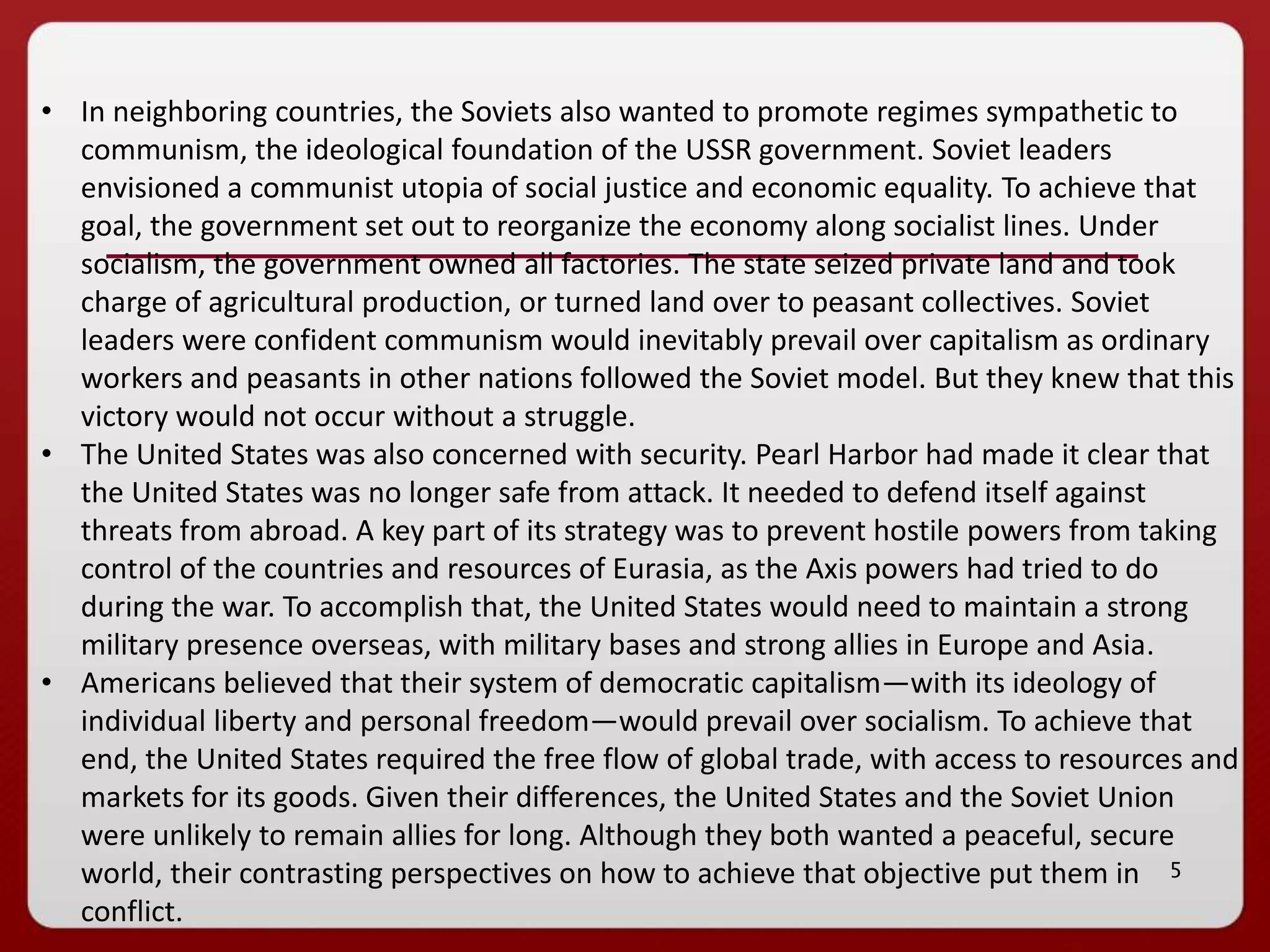
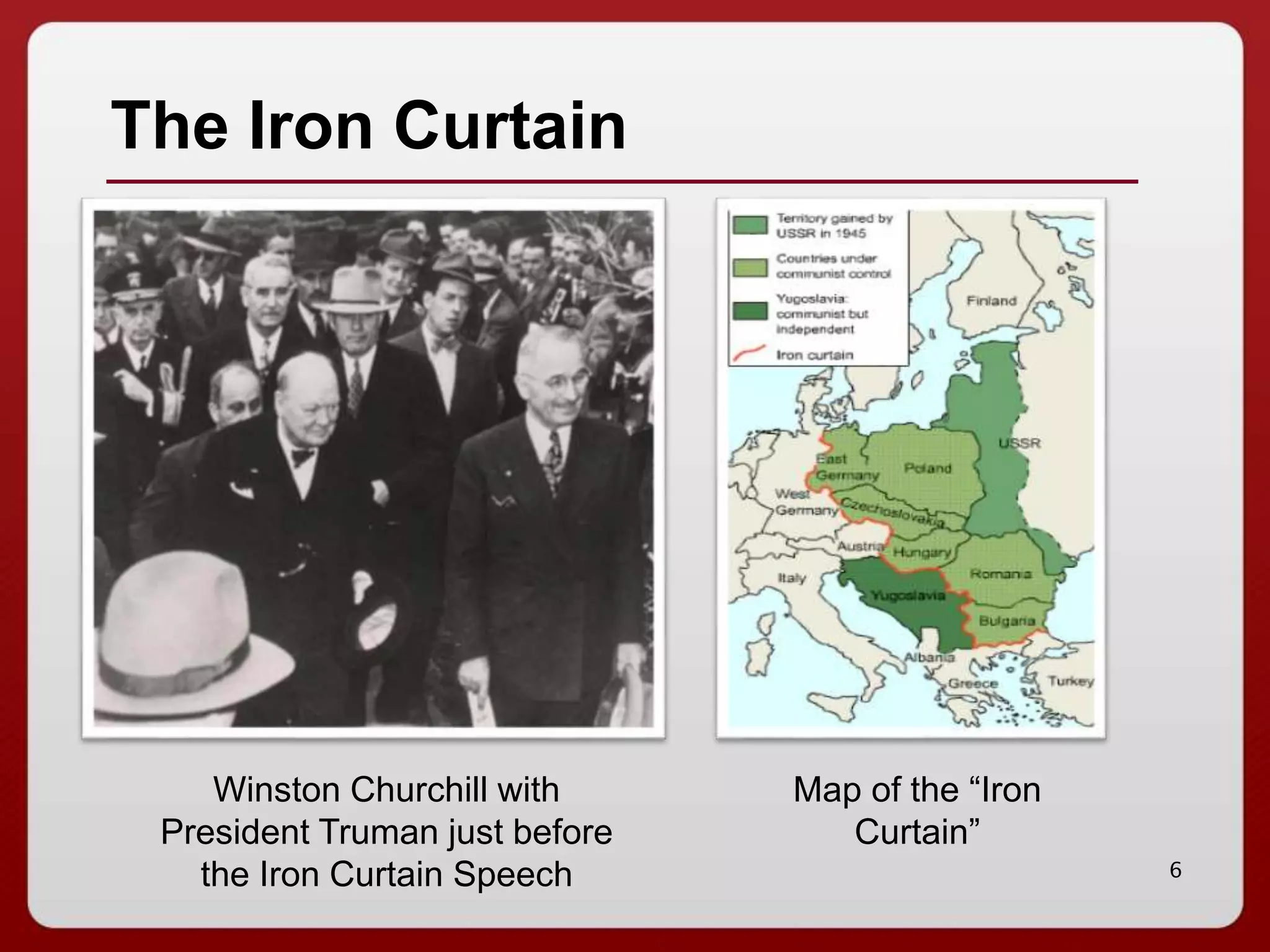
The Iron Curtain
Winston Churchill with
President Truman just before
the Iron Curtain Speech
Map of the “Iron
Curtain”
7
The Emerging Conflict
• The first obvious signs of trouble appeared in Eastern Europe. Although
Stalin had promised to allow Eastern European countries to decide their
own fate, he soon withdrew that pledge. In Poland, Bulgaria, and
Romania, he made sure that pro-Soviet governments took power. He
later did the same in the rest of Eastern Europe. The Soviet-dominated
countries of Eastern Europe became known as Soviet “satellites.”
• In response, the United States and Great Britain accused the Soviets of
dividing Europe and stifling national self-determination. In a famous
speech in March 1946, Winston Churchill warned of the Soviet
threat. “From Stettin in the Baltic to Trieste in the Adriatic,” he declared,
“an iron curtain has descended across the continent.” The term Iron
Curtain [the ideological barrier that divided Eastern and Western
Europe during the Cold War] came to symbolize the growing divide
between East and West. From Moscow, Stalin blasted Churchill's speech
as a “call to war.”
8
Meanwhile, the United States was devising policies to counter Soviet power. Early in 1946, a
U.S. official in Moscow, George Kennan, wrote a tough analysis of Soviet aims. He said that
the USSR had imposed tyranny on its people and meant to do so elsewhere. The only
effective response, he argued, was for the West to check, or contain, the spread of Soviet
power and influence. This approach, known as containment [containment: the U.S. policy
of attempting to restrict Soviet power and influence around the world by preventing the
spread of communism] , became official U.S. policy.
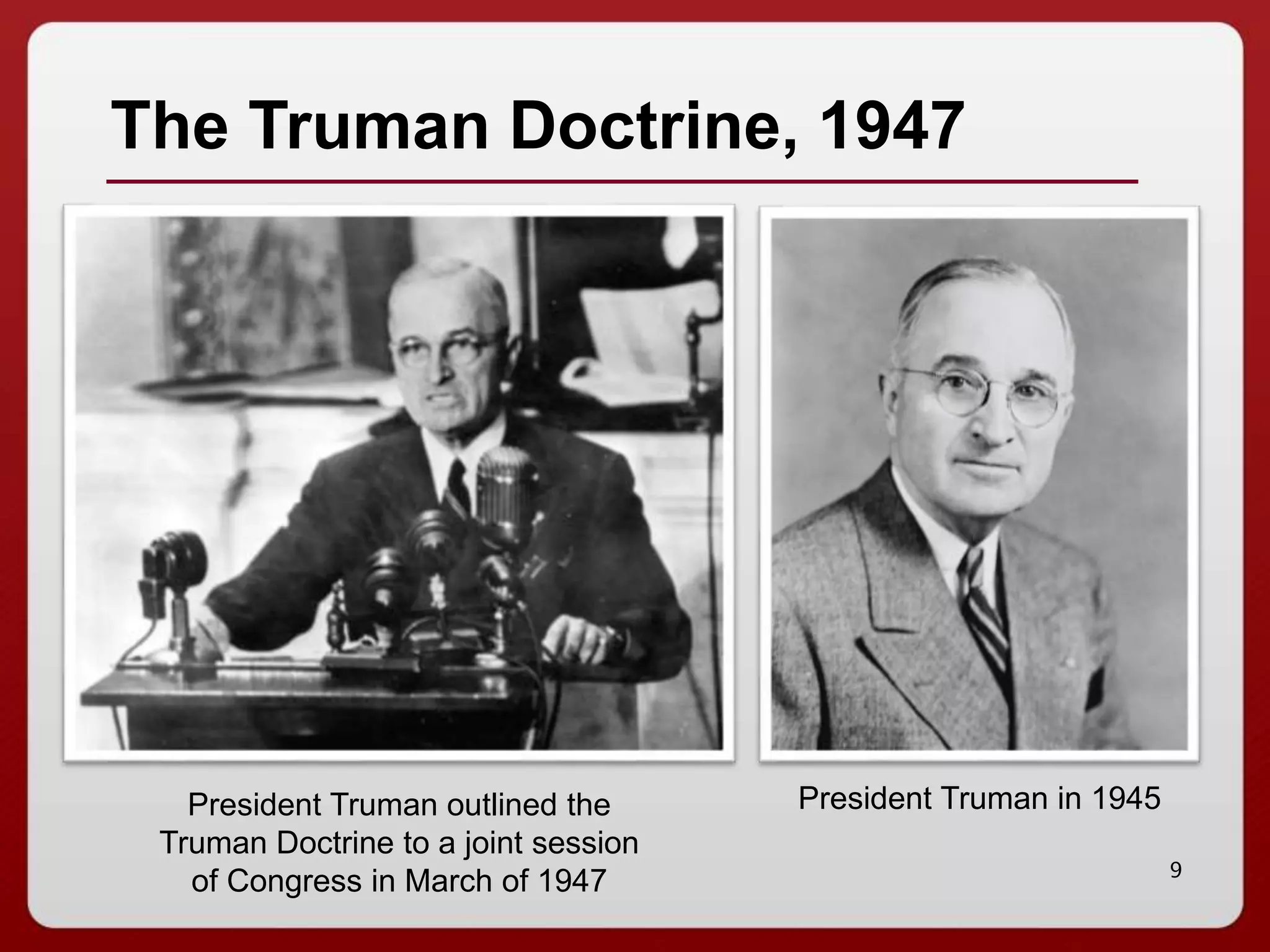
President Harry Truman, who had taken office after Roosevelt's death in 1945, soon acted
on the containment policy. In March 1947, he called for American aid to Greece and Turkey,
two countries under threat from communist elements and backed by the USSR. In a speech
Truman declared, “We must assist free peoples to work out their own destinies in their own
way.” This support for countries seeking to resist communist influence was known as the
Truman Doctrine. It became a key principle in U.S. Cold War policy.
9
The Truman Doctrine, 1947
President Truman outlined the
Truman Doctrine to a joint session
of Congress in March of 1947
President Truman in 1945
10
The United States followed up with another action designed to limit Soviet power. In June
1947, Secretary of State George Marshall unveiled a financial aid plan to assist postwar
recovery in Europe. This plan, known as the Marshall Plan [Marshall Plan: a U.S. aid plan
designed to promote economic recovery in Europe after World War II] , was warmly
received in Western Europe. But the Soviets forbade their Eastern European satellites from
participating, recognizing that U.S. aid would undermine Soviet influence. The Marshall Plan
eventually provided $13 billion in aid to Western Europe, helping to promote economic
growth and political stability.
The Western allies also announced plans to combine their German occupation zones into a
new West German state. Angered by this move, Stalin declared a blockade of the Allied
sectors of West Berlin in June 1948. Berlin was entirely within the Soviet zone, but the city
had been divided into Western allied and Soviet sections. The Berlin blockade cut West
Berlin off from all supplies brought in by land. Stalin hoped to starve the city into submission
and force the Allies to retract their plans for West Germany. Instead, the United States
organized the Berlin airlift, a massive effort to fly food and other essential goods into
Berlin. The plan succeeded, and after a year Stalin lifted the blockade. Soon afterward,
Germany split into two nations. The Federal Republic of Germany, commonly known as West
Germany, was under Western influence. The German Democratic Republic, known as East
Germany, became a Soviet satellite.
11
The Marshall Plan, 1947
Nations that had received Marshall
Plan aid by 1950
12
Marshall Plan, 1947
Stuttgart, Germany before and after Marshall Plan aid
13
The Lines Harden
• By 1949, the lines of the Cold War were clearly drawn. Europe was
divided between the communist East and capitalist West. The two sides
carried out the Cold War through economic policy, diplomatic actions,
propaganda, espionage, and secret operations. Although the
superpowers never engaged in a direct shooting war, the threat of
violence was always present.
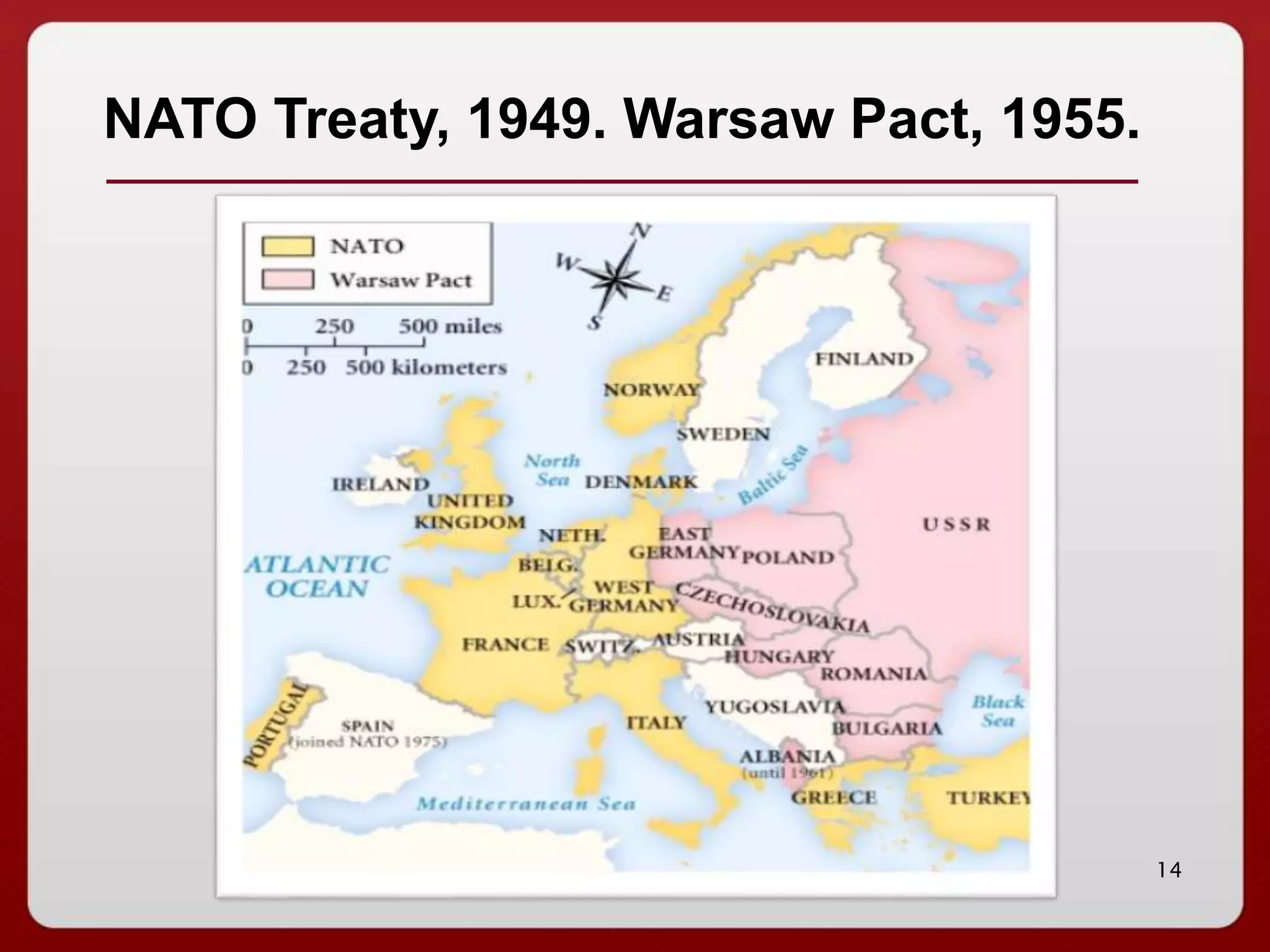
• In 1949, the Western allies formed NATO [a mutual defense pact
formed by Western nations in 1949] , the North Atlantic Treaty
Organization. This group, which included the United States, Canada, and
Western European nations, was dedicated to mutual defense. Members
agreed to treat an attack on one country as an attack on all. Six years
later, in 1955, the Soviet Union formed its own defense alliance,
the Warsaw Pact [a 1955 defense pact between the USSR and
Eastern European nations] , which included the nations of Eastern
Europe.
14
NATO Treaty, 1949. Warsaw Pact, 1955.
15
These mutual defense pacts revealed the rising military tensions between East and
West. They also reflected the threat posed by nuclear weapons. The United States had used
the atomic bomb against Japan in 1945. Four years later, the Soviet Union exploded its own
atomic bomb. By the early 1950s, both superpowers had developed a more powerful
nuclear device, the hydrogen bomb, or H-bomb. By the 1960s, they had created long-range
missiles called intercontinental ballistic missiles, or ICBMs, which could carry nuclear
warheads to targets a continent away. The superpowers had become engaged in an
expensive and deadly arms race [a competition to achieve weapons superiority] . This
competition over weaponry stoked fears of nuclear war and raised the stakes in the
superpower conflict.
The United States and Soviet Union also got involved in a space race. In 1957, the Soviet
Union launched Sputnik, the first artificial satellite to orbit Earth. A few months later, the
United States put its own satellite into space. In 1961, the Soviet Union sent the first human
into orbit, followed soon after by the first American astronaut. In 1969, the United States
landed the first men on the moon. The space race was another costly form of superpower
competition, but it also brought important advances in science and technology.
The Cold War continued for more than 40 years. During that time, the superpowers sought
to dominate each other and bring less powerful nations over to their side. The United
States and the Soviet Union were not the only major players in the Cold War,
however. Another important actor was China.
-
Central Historical Question:
Who started the Cold War?
Until the 1960s, most historians followed the official government
line – that the Cold War was the direct result of Stalin's aggressive
Soviet expansionism.
In 1959, however, William Appleman Williams published his The
Tragedy of American Diplomacy. Williams blamed the US for the
Cold War. Williams, and the historians who followed him were
called the ‘revisionists’. This ‘revisionist’ approach reached its
height during the Vietnam War when many people suggested that
America was as bad as Russia.
17
Reform and Revolution in China
• As Indian leaders worked to reform British rule in
India, Chinese reformers sought to bring change to
their nation and its government. In 1850, radicals
tried to end the Qing (ching) dynasty whose
emperors had ruled China for more than 200
years. The resulting Taiping Rebellion turned into a
long civil war. Chinese troops finally defeated the
rebels in 1864. The rebellion cost some 20 million
lives, according to conservative estimates, and it
seriously weakened the Qing dynasty.
18
Reform Movements Lead to Power Struggles
• The Self-Strengthening Movement, which began in the 1860s, tried to
establish modern industries and otherwise reform China according to
Western ideas. However, conservative Qing rulers opposed China's
Westernization and disliked the spheres of influence that Western
nations established in China by late 1800s. However, the Qing were too
weak to resist this economic imperialism. China was also too weak to
prevent Japan from seizing Korea in the Sino-Japanese War of 1894–95
and taking control of part of Manchuria.
• China's defeat in the Sino-Japanese War increased the calls for
reform. When the emperor began to make some of these changes, he
angered the conservative empress dowager (the widow of a dead
emperor) Cixi (tsoo-SHEE). In 1898, Chinese officials loyal to Cixi
removed the emperor. She took power and reversed his reforms.
19
20
• Cixi supported Chinese leaders who encouraged an uprising
against foreigners called the Boxer Rebellion [Boxer Rebellion:
an uprising by a secret group known as the Righteous and
Harmonious Fists, called “Boxers” by Westerners, that
attempted to drive all foreigners from China] . Bands of Boxers
roamed the countryside in 1899 attacking Christian missionaries
and destroying foreign-owned mines and other property.
• Many foreigners fled to Beijing, China's
capital. In August 1900, some 19,000 troops
sent to Beijing by Western nations defeated
Chinese forces and freed the foreigners the
Boxers had trapped there. The Boxers were
Buddhist mystics who believed that they
were immune to bullets, which proved not to
be the case. A coalition of British, French, and
other European forces crushed their rebellion.
21
• After the Boxer Rebellion failed, Cixi
began making some of the reforms she
had reversed in 1898. However, it was
too late. The Qing dynasty had been
hopelessly weakened. Protests and
revolts broke out across China. Cixi
died in 1908. Just before her death, she
had the emperor she replaced in 1898
killed by poison. This left his three-year-
old nephew Puyi to be emperor.
• A regent [person who rules a country
while its monarch is too young, old,
or ill to rule, or is absent] ruled until
1912, when revolution forced Puyi from
the throne. Puyi was China's last
emperor. His overthrow ended 267
years of Qing rule and a form of
government more than 2,000 years old.
22
The Revolution of 1911
• Although the Boxer Rebellion failed to drive foreigners from China, it strengthened Chinese
nationalism. This was especially true for young and well-educated Chinese. When the reform
movement also failed, many of these Chinese came to believe that revolution was the only
solution. They wanted to replace China's old ruling system with a republican form of
government.
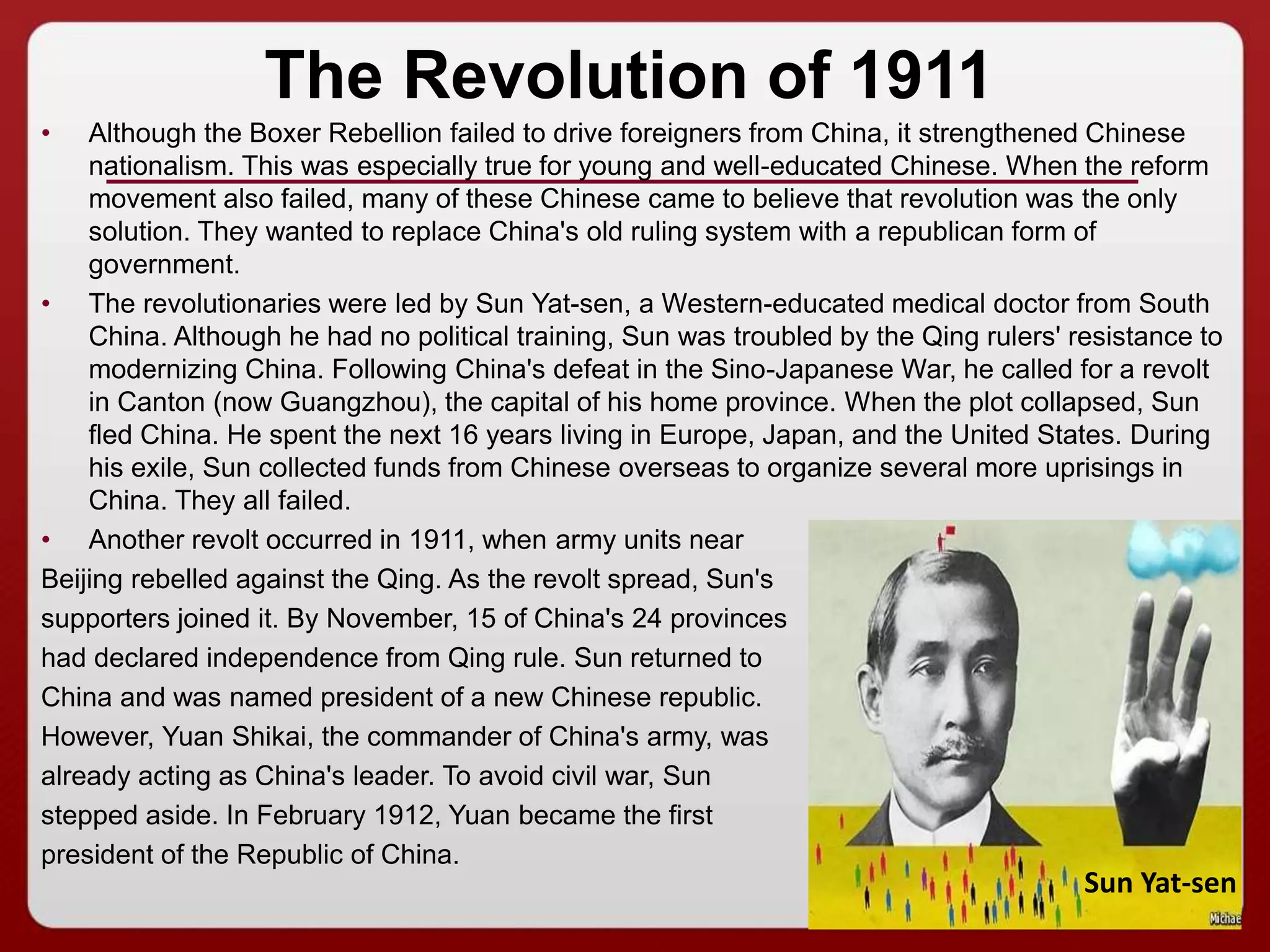
• The revolutionaries were led by Sun Yat-sen, a Western-educated medical doctor from South
China. Although he had no political training, Sun was troubled by the Qing rulers' resistance to
modernizing China. Following China's defeat in the Sino-Japanese War, he called for a revolt
in Canton (now Guangzhou), the capital of his home province. When the plot collapsed, Sun
fled China. He spent the next 16 years living in Europe, Japan, and the United States. During
his exile, Sun collected funds from Chinese overseas to organize several more uprisings in
China. They all failed.
• Another revolt occurred in 1911, when army units near
Beijing rebelled against the Qing. As the revolt spread, Sun's
supporters joined it. By November, 15 of China's 24 provinces
had declared independence from Qing rule. Sun returned to
China and was named president of a new Chinese republic.
However, Yuan Shikai, the commander of China's army, was
already acting as China's leader. To avoid civil war, Sun
stepped aside. In February 1912, Yuan became the first
president of the Republic of China.
Sun Yat-sen
23
China’s Civil War
• Sun Yat-sen, leader of China's 1911 revolution, is known as the father of
modern China. He hoped to build a nation based on what he called the
Three Principles of the People—nationalism, democracy, and
socialism. However, the new republic's first president, Yuan Shikai, was
mainly interested in increasing his power. To counter Yuan, Sun joined
with other former revolutionaries to found a new political party—the
Kuomintang (KMT) or Nationalist Party.
The Republic's Early Struggles
• Elections in February 1913 gave the Nationalist Party a majority of the
seats in China's new parliament. Yuan responded by having the party's
leader killed. When a revolt against Yuan failed in the summer of 1913,
Sun and its other leaders fled to Japan. In November, Yuan banned the
Nationalists and removed its members from parliament. In 1914, he
dissolved parliament and issued a new constitution that made him
president for life.
24
• Yuan declared China neutral when World
War I began in August 1914. However,
Japan, which fought for the Allies, seized
the German sphere of influence in
Shandong, in eastern China. Japan also
forced Yuan to grant it a sphere of
influence in Manchuria. When Yuan
appealed to the United States and other
Western powers for help, they refused to
get involved.
• Perhaps unwisely, Yuan chose this moment
of humiliation to announce his plans to
make himself emperor. Rebellions broke
out all over China. Japan secretly provided
arms and money to Sun and other leaders
to aid these revolts. In several
provinces, warlords [a military leader who
governs by force, usually within a limited
area] declared their independence of the
central government in Beijing.
25
• After Yuan fell ill and died in June 1916, alliances of warlords
fought for control of that government. Sun Yat-sen and warlords in
southern China organized a rival government in 1917. Its repeated
efforts to control all of China plunged China into a long civil war.
• Hoping to regain Shandong, both governments declared war on
Germany in 1917. However, the Paris Peace Conference following
World War I let Japan keep German holdings in China. Some
Chinese nationalists blamed the Beijing government for this
failure.
• On May 4, 1919, a massive
student protest erupted in
Beijing. The calls for change
that followed became known
as the May Fourth Movement.
They ranged from the
westernization of China to the establishment of socialism. The May
Fourth Movement, along with China's split between the two rival
governments, soon sent the nation down a new revolutionary path.
26
China's Nationalist Government
• In October 1919, Sun Yat-sen restarted the Nationalist Party. He hoped
that a democratic political party in the south would weaken the warlords
in Beijing, which the West recognized as China's legal government. In
1921, Sun became president of China's southern government. Because
of its domination by the KMT, that government became known as the
Nationalist government.
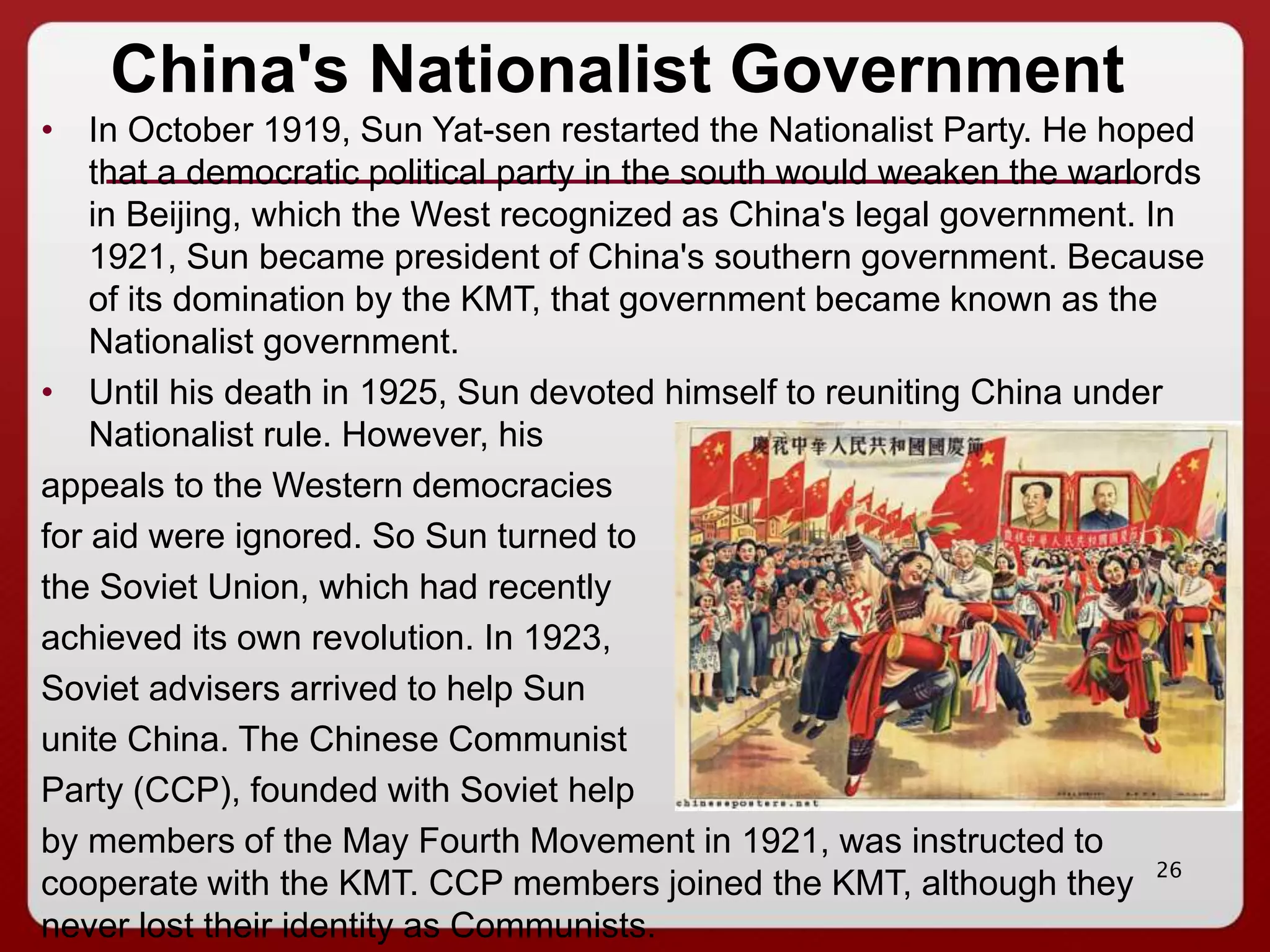
• Until his death in 1925, Sun devoted himself to reuniting China under
Nationalist rule. However, his
appeals to the Western democracies
for aid were ignored. So Sun turned to
the Soviet Union, which had recently
achieved its own revolution. In 1923,
Soviet advisers arrived to help Sun
unite China. The Chinese Communist
Party (CCP), founded with Soviet help
by members of the May Fourth Movement in 1921, was instructed to
cooperate with the KMT. CCP members joined the KMT, although they
never lost their identity as Communists.
27
The Rise of Chiang Kai-shek
• One result of Sun's cooperation with the Communists was the rise of Chiang Kai-
shek as leader of China. Chiang came from a prosperous farm and merchant
family in northern China. He had gone to Japan as a young man to train for a
military career. There he met Chinese exiles plotting the overthrow of the Qing
dynasty and became a revolutionary. When China's 1911 revolution began, he
returned home to fight against the Qing.
• In 1918, Chiang joined Sun Yat-sen in reorganizing
the Nationalist Party. Sun sent Chiang to the Soviet
Union, where he learned Western military strategy from
the Red Army. Returning home, he organized the
Nationalist government's National Revolutionary Army
and was named its commander. In 1926, Chiang led this
army north to fulfill Sun's dream of reuniting China.
Chiang's army was accompanied by Soviet military
advisers. He was also assisted by a KMT “propaganda
corps” of Chinese Communists who stirred up unrest
against the Beijing government in the regions it controlled.
By 1927, much of China was in Nationalist hands.
28
Nationalists Versus Communists
• While the Nationalist army was on what was called the Northern
Expedition, serious splits took place in the KMT. With Sun gone, a struggle
developed among its leaders for control of the party. Radical party
members wanted to establish socialism or communism in China. They
hoped to gain the support of China's poverty-stricken masses with calls for
social revolution. This alarmed the party's conservative wing, which
wanted only to unify China under Nationalist rule. Many KMT
conservatives were well-to-do. They preferred Chinese society as it
was. At the same time, the party's socialists and conservatives shared a
concern over the Communists' growing power.
• All these issues came to a head in early 1927, when radical leaders
moved the Nationalist capital from southern to northern China. The party's
conservatives appealed to the leader they backed, Chiang Kai-shek. In
April, he set up a rival Nationalist government in the city of Nanjing and
expelled Communists from the army and the party. He also used
Nationalist troops to brutally end a Communist-led general strike by
workers in Shanghai. Large numbers of Communists were arrested and
executed. Similar anti-Communists actions were carried out in several
other Chinese cities. Those who survived fled into hiding in the
countryside.
29
• In 1928, Chiang captured Beijing and completed the
Nationalists' reunification of China. A new national
government was established at Nanjing, with Chiang at its
head. The West quickly recognized Chiang's Nationalist
government as China's legal government.
Communist Flag Nationalist Flag
30
The Rise of Mao Zedong
• One of the Communists who escaped to the countryside in 1927 was the
head of the KMT's propaganda corps, Mao Zedong. Like Chiang Kai-shek,
Mao was the son of a prosperous farmer and merchant. Although he had no
formal military training, he too took part in the 1911 revolution that overthrew
the Qing dynasty. After the revolution, Mao drifted about, in search of
education and a profession. May 1919 found him
at Beijing University, where he took part in the May
Fourth Movement.
• Mao helped found the CCP in 1921 and was one
of the first Communists to join the KMT, where he
quickly rose to a leadership position. Along with
other radical KMT leaders, Mao worked to organize
peasants for a communist revolution. After being
expelled from the KMT in 1927, he led a peasant
revolt in Hunan Province. When Nationalist forces
crushed the revolt, Mao and a few hundred survivors fled into the
mountains. There he helped organize a Red Army of peasants and workers that
by the spring of 1928 had some 10,000 troops.
31
The Communists' Struggle for Power
• Mao wanted to wage a guerrilla war [a form of warfare that involves surprise
attacks by small groups of fighters, including harassment of the enemy and
sabotage] from bases in the Chinese countryside. The leaders of the CCP opposed this
strategy. They ordered the Red Army to attack several major cities in south-central China
in hopes of inspiring a workers' revolution. No such revolution took place and the
Communist forces were crushed by the Nationalist army.
• The urban campaign's failure increased Mao's standing in the CCP. His followers created
15 rural bases in central China. From these areas, they seized land from wealthy
landowners and gave it to the peasants. By 1931, the Red Army had grown to some
200,000 troops. Mao established the Chinese Soviet Republic in southeastern China,
with himself as its head. Under his leadership, the Communists soon controlled a
population of several million.
32
• Chiang sent four expeditions to crush Mao's government. The Red Army successfully
fought them off using guerrilla warfare tactics. Finally, in late 1934, some 700,000
Nationalist troops advanced on the Communist capital. CCP leaders ordered the Red
Army to directly attack this overwhelming force. The Red Army was nearly destroyed
as a result. In October, Mao, other government and CCP officials, and the remains of
their army broke through the Nationalist lines and fled.
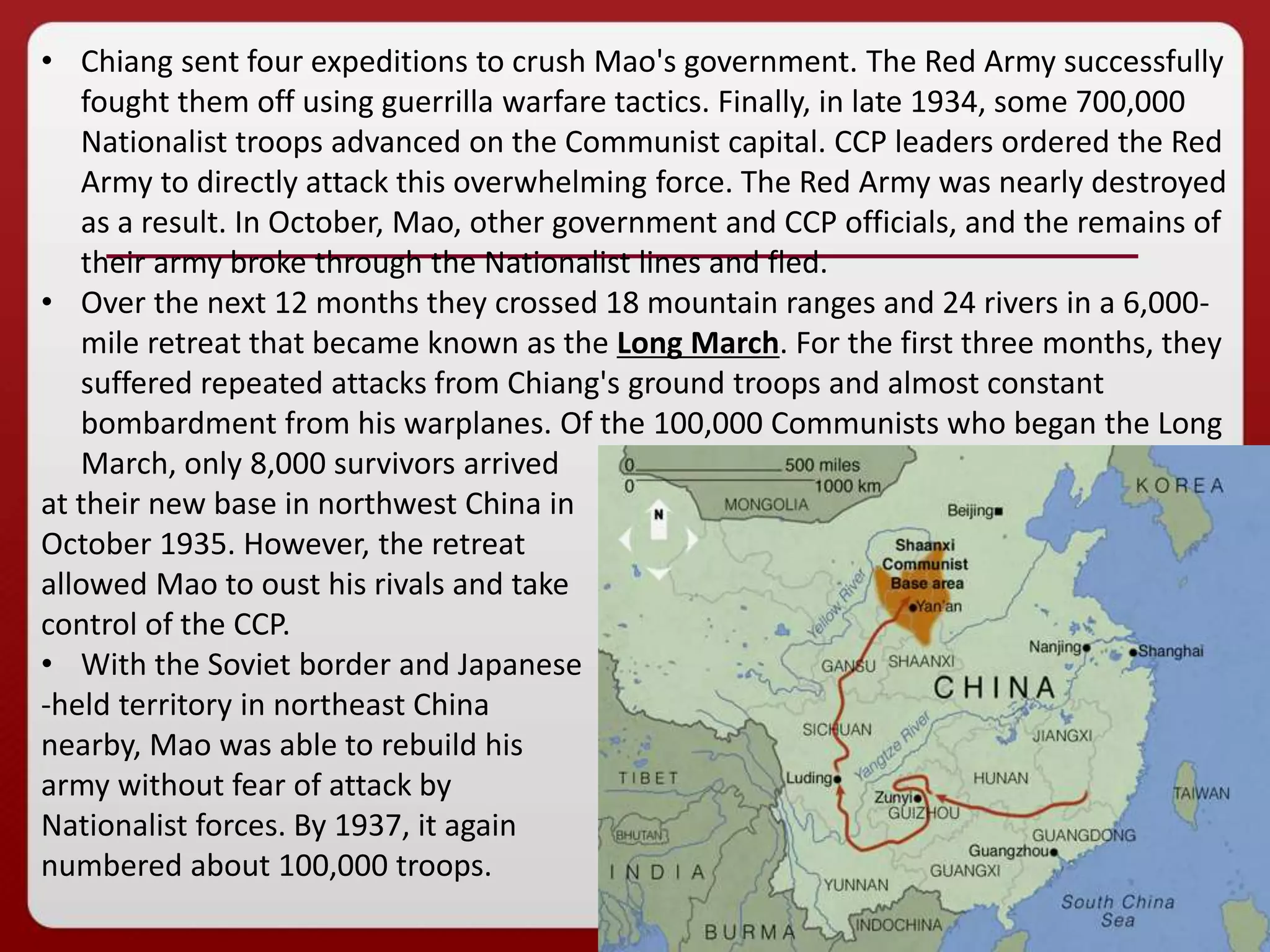
• Over the next 12 months they crossed 18 mountain ranges and 24 rivers in a 6,000-
mile retreat that became known as the Long March. For the first three months, they
suffered repeated attacks from Chiang's ground troops and almost constant
bombardment from his warplanes. Of the 100,000 Communists who began the Long
March, only 8,000 survivors arrived
at their new base in northwest China in
October 1935. However, the retreat
allowed Mao to oust his rivals and take
control of the CCP.
• With the Soviet border and Japanese
-held territory in northeast China
nearby, Mao was able to rebuild his
army without fear of attack by
Nationalist forces. By 1937, it again
numbered about 100,000 troops.
33
The Nationalists and Communists in World War II
• Japan's invasion of China in 1937 brought a temporary halt to China's civil war. Nationalist
and Communist leaders agreed that it was better for both armies to resist the Japanese
than to continue fighting each other. An uneasy alliance was formed. However, little
cooperation existed. The burden of resisting the invasion fell on the Nationalist army. By
the time Japan's conquest was complete in 1939, Chiang's army had been seriously
weakened. It retreated into western China, along with other Chinese who fled from
Japanese rule. This region became known as Free China.
• For the rest of World War II, Japan tried to bomb Free China into surrender. Thousands of
soldiers and civilians died. Free China was also plagued by political disputes and
corruption. The Nationalist government and its army were further weakened as a result.
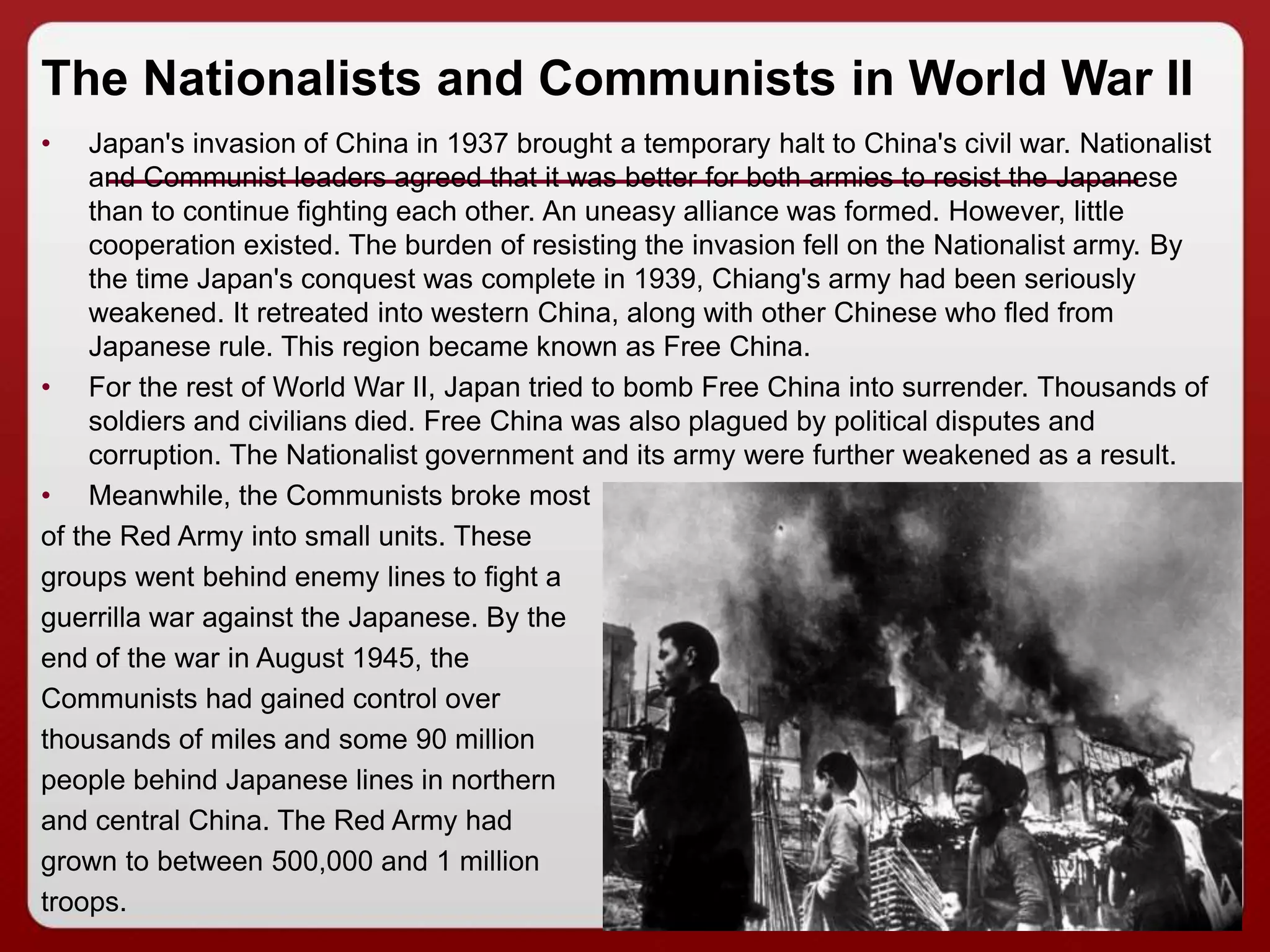
• Meanwhile, the Communists broke most
of the Red Army into small units. These
groups went behind enemy lines to fight a
guerrilla war against the Japanese. By the
end of the war in August 1945, the
Communists had gained control over
thousands of miles and some 90 million
people behind Japanese lines in northern
and central China. The Red Army had
grown to between 500,000 and 1 million
troops.
34
Formation of the People's Republic of China
• With World War II over, conflict between China's Communists and Nationalists
resumed. The situation had changed, however. The war had left the Nationalists unpopular
and weak, while the Communists emerged from it much stronger. A negotiated peace
between the two groups was blocked by conservatives in the KMT, who still believed in a
military victory. The fighting resumed in March 1946. The Nationalists made gains at first,
but the tide soon turned in the Communists' favor.
• Buoyed by widespread peasant support in the countryside and supplied with weapons left
behind by the Japanese, the People's Liberation Army (the Red Army's new name after the
war) began to push south in 1947. By late 1948, the Nationalist position was looking
increasingly hopeless. In January 1949, the Communists took Beijing without a fight. Most
of China's other major cities soon passed from Nationalist to Communist control. Chiang
Kai-shek abandoned mainland China, moving his government and remaining Nationalist
forces to the nearby island of
Formosa, which became the nation
of Taiwan. He proclaimed the
Taiwanese city of Taipei the
temporary capital of China. On
October 1, 1949, Mao Zedong
announced the formation of the
People's Republic of China, with its
capital at Beijing. The Nationalists
remained in Taiwan.

The Cold War Powerpoint Slides

  • 1.
    The Origins ofthe Cold War
  • 2.
    2 The Cold WarBegins • At the end of World War II, much of Europe lay in ruins. The United States, however, emerged from the war stronger than ever. The Soviet Union, with its huge land mass and abundant resources, was also poised to become a great power. Together, these two superpowers [an extremely powerful nation, one of a very few dominant states in an era when the world is divided politically into these states and their satellites] would dominate world affairs.
  • 3.
    3 Signs of Cooperation •At first there were hopeful signs that the United States and the USSR might cooperate in the postwar era. In February 1945, as the war was winding down, the “Big Three” Allied leaders—Franklin Roosevelt, Joseph Stalin, and Winston Churchill—met in the Soviet city of Yalta. There they made plans for postwar Europe. They agreed to divide Germany into four Allied occupation zones to be administered by the United States, Great Britain, France, and the Soviet Union. Berlin, the German capital, lay within the Soviet zone but would also be divided among the Allies. In addition, Stalin agreed to support free and fair elections in the liberated countries of Eastern Europe. • At Yalta, the Soviets also agreed to join the United Nations [an international organization founded in 1945 to promote peace, security, and cooperation among the world’s nations] (UN). This international body was founded in June 1945, when 50 nations signed the UN Charter. The charter established a General Assembly of all the member-states, plus an 11-member Security Council to settle disputes. UN members agreed to promote peace, security, and international cooperation. They pledged “to save succeeding generations from the scourge of war.”
  • 4.
    4 U.S.-Soviet Divisions • Despitethese hopeful signs, deep divisions between the superpowers made lasting cooperation unlikely. These divisions were based on the two nations' differing histories and different goals for the postwar world. • Some of the differences arose from the war itself. During the war, nearly 300,000 American troops lost their lives. Aside from the attack on Pearl Harbor, however, no fighting took place on American soil. The American economy also boomed during the war because of wartime spending. In contrast, about 28 million Soviet people—soldiers and civilians—died during the war. The fighting devastated the Soviet Union and its economy. Virtually no Soviet citizen was untouched by the war. • The two superpowers also had contrasting goals and beliefs. Having been profoundly scarred by the war, the chief aim of the Soviets was to ensure their security. During the war—and throughout its history—Russia had been highly vulnerable to invasion. The Soviet state wanted to make sure it protected itself from any future attack, particularly from the west. It wanted to create a buffer zone of friendly countries in Eastern Europe
  • 5.
    5 • In neighboringcountries, the Soviets also wanted to promote regimes sympathetic to communism, the ideological foundation of the USSR government. Soviet leaders envisioned a communist utopia of social justice and economic equality. To achieve that goal, the government set out to reorganize the economy along socialist lines. Under socialism, the government owned all factories. The state seized private land and took charge of agricultural production, or turned land over to peasant collectives. Soviet leaders were confident communism would inevitably prevail over capitalism as ordinary workers and peasants in other nations followed the Soviet model. But they knew that this victory would not occur without a struggle. • The United States was also concerned with security. Pearl Harbor had made it clear that the United States was no longer safe from attack. It needed to defend itself against threats from abroad. A key part of its strategy was to prevent hostile powers from taking control of the countries and resources of Eurasia, as the Axis powers had tried to do during the war. To accomplish that, the United States would need to maintain a strong military presence overseas, with military bases and strong allies in Europe and Asia. • Americans believed that their system of democratic capitalism—with its ideology of individual liberty and personal freedom—would prevail over socialism. To achieve that end, the United States required the free flow of global trade, with access to resources and markets for its goods. Given their differences, the United States and the Soviet Union were unlikely to remain allies for long. Although they both wanted a peaceful, secure world, their contrasting perspectives on how to achieve that objective put them in conflict.
  • 6.
    6 The Iron Curtain WinstonChurchill with President Truman just before the Iron Curtain Speech Map of the “Iron Curtain”
  • 7.
    7 The Emerging Conflict •The first obvious signs of trouble appeared in Eastern Europe. Although Stalin had promised to allow Eastern European countries to decide their own fate, he soon withdrew that pledge. In Poland, Bulgaria, and Romania, he made sure that pro-Soviet governments took power. He later did the same in the rest of Eastern Europe. The Soviet-dominated countries of Eastern Europe became known as Soviet “satellites.” • In response, the United States and Great Britain accused the Soviets of dividing Europe and stifling national self-determination. In a famous speech in March 1946, Winston Churchill warned of the Soviet threat. “From Stettin in the Baltic to Trieste in the Adriatic,” he declared, “an iron curtain has descended across the continent.” The term Iron Curtain [the ideological barrier that divided Eastern and Western Europe during the Cold War] came to symbolize the growing divide between East and West. From Moscow, Stalin blasted Churchill's speech as a “call to war.”
  • 8.
    8 Meanwhile, the UnitedStates was devising policies to counter Soviet power. Early in 1946, a U.S. official in Moscow, George Kennan, wrote a tough analysis of Soviet aims. He said that the USSR had imposed tyranny on its people and meant to do so elsewhere. The only effective response, he argued, was for the West to check, or contain, the spread of Soviet power and influence. This approach, known as containment [containment: the U.S. policy of attempting to restrict Soviet power and influence around the world by preventing the spread of communism] , became official U.S. policy. President Harry Truman, who had taken office after Roosevelt's death in 1945, soon acted on the containment policy. In March 1947, he called for American aid to Greece and Turkey, two countries under threat from communist elements and backed by the USSR. In a speech Truman declared, “We must assist free peoples to work out their own destinies in their own way.” This support for countries seeking to resist communist influence was known as the Truman Doctrine. It became a key principle in U.S. Cold War policy.
  • 9.
    9 The Truman Doctrine,1947 President Truman outlined the Truman Doctrine to a joint session of Congress in March of 1947 President Truman in 1945
  • 10.
    10 The United Statesfollowed up with another action designed to limit Soviet power. In June 1947, Secretary of State George Marshall unveiled a financial aid plan to assist postwar recovery in Europe. This plan, known as the Marshall Plan [Marshall Plan: a U.S. aid plan designed to promote economic recovery in Europe after World War II] , was warmly received in Western Europe. But the Soviets forbade their Eastern European satellites from participating, recognizing that U.S. aid would undermine Soviet influence. The Marshall Plan eventually provided $13 billion in aid to Western Europe, helping to promote economic growth and political stability. The Western allies also announced plans to combine their German occupation zones into a new West German state. Angered by this move, Stalin declared a blockade of the Allied sectors of West Berlin in June 1948. Berlin was entirely within the Soviet zone, but the city had been divided into Western allied and Soviet sections. The Berlin blockade cut West Berlin off from all supplies brought in by land. Stalin hoped to starve the city into submission and force the Allies to retract their plans for West Germany. Instead, the United States organized the Berlin airlift, a massive effort to fly food and other essential goods into Berlin. The plan succeeded, and after a year Stalin lifted the blockade. Soon afterward, Germany split into two nations. The Federal Republic of Germany, commonly known as West Germany, was under Western influence. The German Democratic Republic, known as East Germany, became a Soviet satellite.
  • 11.
    11 The Marshall Plan,1947 Nations that had received Marshall Plan aid by 1950
  • 12.
    12 Marshall Plan, 1947 Stuttgart,Germany before and after Marshall Plan aid
  • 13.
    13 The Lines Harden •By 1949, the lines of the Cold War were clearly drawn. Europe was divided between the communist East and capitalist West. The two sides carried out the Cold War through economic policy, diplomatic actions, propaganda, espionage, and secret operations. Although the superpowers never engaged in a direct shooting war, the threat of violence was always present. • In 1949, the Western allies formed NATO [a mutual defense pact formed by Western nations in 1949] , the North Atlantic Treaty Organization. This group, which included the United States, Canada, and Western European nations, was dedicated to mutual defense. Members agreed to treat an attack on one country as an attack on all. Six years later, in 1955, the Soviet Union formed its own defense alliance, the Warsaw Pact [a 1955 defense pact between the USSR and Eastern European nations] , which included the nations of Eastern Europe.
  • 14.
    14 NATO Treaty, 1949.Warsaw Pact, 1955.
  • 15.
    15 These mutual defensepacts revealed the rising military tensions between East and West. They also reflected the threat posed by nuclear weapons. The United States had used the atomic bomb against Japan in 1945. Four years later, the Soviet Union exploded its own atomic bomb. By the early 1950s, both superpowers had developed a more powerful nuclear device, the hydrogen bomb, or H-bomb. By the 1960s, they had created long-range missiles called intercontinental ballistic missiles, or ICBMs, which could carry nuclear warheads to targets a continent away. The superpowers had become engaged in an expensive and deadly arms race [a competition to achieve weapons superiority] . This competition over weaponry stoked fears of nuclear war and raised the stakes in the superpower conflict. The United States and Soviet Union also got involved in a space race. In 1957, the Soviet Union launched Sputnik, the first artificial satellite to orbit Earth. A few months later, the United States put its own satellite into space. In 1961, the Soviet Union sent the first human into orbit, followed soon after by the first American astronaut. In 1969, the United States landed the first men on the moon. The space race was another costly form of superpower competition, but it also brought important advances in science and technology. The Cold War continued for more than 40 years. During that time, the superpowers sought to dominate each other and bring less powerful nations over to their side. The United States and the Soviet Union were not the only major players in the Cold War, however. Another important actor was China. -
  • 16.
    Central Historical Question: Whostarted the Cold War? Until the 1960s, most historians followed the official government line – that the Cold War was the direct result of Stalin's aggressive Soviet expansionism. In 1959, however, William Appleman Williams published his The Tragedy of American Diplomacy. Williams blamed the US for the Cold War. Williams, and the historians who followed him were called the ‘revisionists’. This ‘revisionist’ approach reached its height during the Vietnam War when many people suggested that America was as bad as Russia.
  • 17.
    17 Reform and Revolutionin China • As Indian leaders worked to reform British rule in India, Chinese reformers sought to bring change to their nation and its government. In 1850, radicals tried to end the Qing (ching) dynasty whose emperors had ruled China for more than 200 years. The resulting Taiping Rebellion turned into a long civil war. Chinese troops finally defeated the rebels in 1864. The rebellion cost some 20 million lives, according to conservative estimates, and it seriously weakened the Qing dynasty.
  • 18.
    18 Reform Movements Leadto Power Struggles • The Self-Strengthening Movement, which began in the 1860s, tried to establish modern industries and otherwise reform China according to Western ideas. However, conservative Qing rulers opposed China's Westernization and disliked the spheres of influence that Western nations established in China by late 1800s. However, the Qing were too weak to resist this economic imperialism. China was also too weak to prevent Japan from seizing Korea in the Sino-Japanese War of 1894–95 and taking control of part of Manchuria. • China's defeat in the Sino-Japanese War increased the calls for reform. When the emperor began to make some of these changes, he angered the conservative empress dowager (the widow of a dead emperor) Cixi (tsoo-SHEE). In 1898, Chinese officials loyal to Cixi removed the emperor. She took power and reversed his reforms.
  • 19.
  • 20.
    20 • Cixi supportedChinese leaders who encouraged an uprising against foreigners called the Boxer Rebellion [Boxer Rebellion: an uprising by a secret group known as the Righteous and Harmonious Fists, called “Boxers” by Westerners, that attempted to drive all foreigners from China] . Bands of Boxers roamed the countryside in 1899 attacking Christian missionaries and destroying foreign-owned mines and other property. • Many foreigners fled to Beijing, China's capital. In August 1900, some 19,000 troops sent to Beijing by Western nations defeated Chinese forces and freed the foreigners the Boxers had trapped there. The Boxers were Buddhist mystics who believed that they were immune to bullets, which proved not to be the case. A coalition of British, French, and other European forces crushed their rebellion.
  • 21.
    21 • After theBoxer Rebellion failed, Cixi began making some of the reforms she had reversed in 1898. However, it was too late. The Qing dynasty had been hopelessly weakened. Protests and revolts broke out across China. Cixi died in 1908. Just before her death, she had the emperor she replaced in 1898 killed by poison. This left his three-year- old nephew Puyi to be emperor. • A regent [person who rules a country while its monarch is too young, old, or ill to rule, or is absent] ruled until 1912, when revolution forced Puyi from the throne. Puyi was China's last emperor. His overthrow ended 267 years of Qing rule and a form of government more than 2,000 years old.
  • 22.
    22 The Revolution of1911 • Although the Boxer Rebellion failed to drive foreigners from China, it strengthened Chinese nationalism. This was especially true for young and well-educated Chinese. When the reform movement also failed, many of these Chinese came to believe that revolution was the only solution. They wanted to replace China's old ruling system with a republican form of government. • The revolutionaries were led by Sun Yat-sen, a Western-educated medical doctor from South China. Although he had no political training, Sun was troubled by the Qing rulers' resistance to modernizing China. Following China's defeat in the Sino-Japanese War, he called for a revolt in Canton (now Guangzhou), the capital of his home province. When the plot collapsed, Sun fled China. He spent the next 16 years living in Europe, Japan, and the United States. During his exile, Sun collected funds from Chinese overseas to organize several more uprisings in China. They all failed. • Another revolt occurred in 1911, when army units near Beijing rebelled against the Qing. As the revolt spread, Sun's supporters joined it. By November, 15 of China's 24 provinces had declared independence from Qing rule. Sun returned to China and was named president of a new Chinese republic. However, Yuan Shikai, the commander of China's army, was already acting as China's leader. To avoid civil war, Sun stepped aside. In February 1912, Yuan became the first president of the Republic of China. Sun Yat-sen
  • 23.
    23 China’s Civil War •Sun Yat-sen, leader of China's 1911 revolution, is known as the father of modern China. He hoped to build a nation based on what he called the Three Principles of the People—nationalism, democracy, and socialism. However, the new republic's first president, Yuan Shikai, was mainly interested in increasing his power. To counter Yuan, Sun joined with other former revolutionaries to found a new political party—the Kuomintang (KMT) or Nationalist Party. The Republic's Early Struggles • Elections in February 1913 gave the Nationalist Party a majority of the seats in China's new parliament. Yuan responded by having the party's leader killed. When a revolt against Yuan failed in the summer of 1913, Sun and its other leaders fled to Japan. In November, Yuan banned the Nationalists and removed its members from parliament. In 1914, he dissolved parliament and issued a new constitution that made him president for life.
  • 24.
    24 • Yuan declaredChina neutral when World War I began in August 1914. However, Japan, which fought for the Allies, seized the German sphere of influence in Shandong, in eastern China. Japan also forced Yuan to grant it a sphere of influence in Manchuria. When Yuan appealed to the United States and other Western powers for help, they refused to get involved. • Perhaps unwisely, Yuan chose this moment of humiliation to announce his plans to make himself emperor. Rebellions broke out all over China. Japan secretly provided arms and money to Sun and other leaders to aid these revolts. In several provinces, warlords [a military leader who governs by force, usually within a limited area] declared their independence of the central government in Beijing.
  • 25.
    25 • After Yuanfell ill and died in June 1916, alliances of warlords fought for control of that government. Sun Yat-sen and warlords in southern China organized a rival government in 1917. Its repeated efforts to control all of China plunged China into a long civil war. • Hoping to regain Shandong, both governments declared war on Germany in 1917. However, the Paris Peace Conference following World War I let Japan keep German holdings in China. Some Chinese nationalists blamed the Beijing government for this failure. • On May 4, 1919, a massive student protest erupted in Beijing. The calls for change that followed became known as the May Fourth Movement. They ranged from the westernization of China to the establishment of socialism. The May Fourth Movement, along with China's split between the two rival governments, soon sent the nation down a new revolutionary path.
  • 26.
    26 China's Nationalist Government •In October 1919, Sun Yat-sen restarted the Nationalist Party. He hoped that a democratic political party in the south would weaken the warlords in Beijing, which the West recognized as China's legal government. In 1921, Sun became president of China's southern government. Because of its domination by the KMT, that government became known as the Nationalist government. • Until his death in 1925, Sun devoted himself to reuniting China under Nationalist rule. However, his appeals to the Western democracies for aid were ignored. So Sun turned to the Soviet Union, which had recently achieved its own revolution. In 1923, Soviet advisers arrived to help Sun unite China. The Chinese Communist Party (CCP), founded with Soviet help by members of the May Fourth Movement in 1921, was instructed to cooperate with the KMT. CCP members joined the KMT, although they never lost their identity as Communists.
  • 27.
    27 The Rise ofChiang Kai-shek • One result of Sun's cooperation with the Communists was the rise of Chiang Kai- shek as leader of China. Chiang came from a prosperous farm and merchant family in northern China. He had gone to Japan as a young man to train for a military career. There he met Chinese exiles plotting the overthrow of the Qing dynasty and became a revolutionary. When China's 1911 revolution began, he returned home to fight against the Qing. • In 1918, Chiang joined Sun Yat-sen in reorganizing the Nationalist Party. Sun sent Chiang to the Soviet Union, where he learned Western military strategy from the Red Army. Returning home, he organized the Nationalist government's National Revolutionary Army and was named its commander. In 1926, Chiang led this army north to fulfill Sun's dream of reuniting China. Chiang's army was accompanied by Soviet military advisers. He was also assisted by a KMT “propaganda corps” of Chinese Communists who stirred up unrest against the Beijing government in the regions it controlled. By 1927, much of China was in Nationalist hands.
  • 28.
    28 Nationalists Versus Communists •While the Nationalist army was on what was called the Northern Expedition, serious splits took place in the KMT. With Sun gone, a struggle developed among its leaders for control of the party. Radical party members wanted to establish socialism or communism in China. They hoped to gain the support of China's poverty-stricken masses with calls for social revolution. This alarmed the party's conservative wing, which wanted only to unify China under Nationalist rule. Many KMT conservatives were well-to-do. They preferred Chinese society as it was. At the same time, the party's socialists and conservatives shared a concern over the Communists' growing power. • All these issues came to a head in early 1927, when radical leaders moved the Nationalist capital from southern to northern China. The party's conservatives appealed to the leader they backed, Chiang Kai-shek. In April, he set up a rival Nationalist government in the city of Nanjing and expelled Communists from the army and the party. He also used Nationalist troops to brutally end a Communist-led general strike by workers in Shanghai. Large numbers of Communists were arrested and executed. Similar anti-Communists actions were carried out in several other Chinese cities. Those who survived fled into hiding in the countryside.
  • 29.
    29 • In 1928,Chiang captured Beijing and completed the Nationalists' reunification of China. A new national government was established at Nanjing, with Chiang at its head. The West quickly recognized Chiang's Nationalist government as China's legal government. Communist Flag Nationalist Flag
  • 30.
    30 The Rise ofMao Zedong • One of the Communists who escaped to the countryside in 1927 was the head of the KMT's propaganda corps, Mao Zedong. Like Chiang Kai-shek, Mao was the son of a prosperous farmer and merchant. Although he had no formal military training, he too took part in the 1911 revolution that overthrew the Qing dynasty. After the revolution, Mao drifted about, in search of education and a profession. May 1919 found him at Beijing University, where he took part in the May Fourth Movement. • Mao helped found the CCP in 1921 and was one of the first Communists to join the KMT, where he quickly rose to a leadership position. Along with other radical KMT leaders, Mao worked to organize peasants for a communist revolution. After being expelled from the KMT in 1927, he led a peasant revolt in Hunan Province. When Nationalist forces crushed the revolt, Mao and a few hundred survivors fled into the mountains. There he helped organize a Red Army of peasants and workers that by the spring of 1928 had some 10,000 troops.
  • 31.
    31 The Communists' Strugglefor Power • Mao wanted to wage a guerrilla war [a form of warfare that involves surprise attacks by small groups of fighters, including harassment of the enemy and sabotage] from bases in the Chinese countryside. The leaders of the CCP opposed this strategy. They ordered the Red Army to attack several major cities in south-central China in hopes of inspiring a workers' revolution. No such revolution took place and the Communist forces were crushed by the Nationalist army. • The urban campaign's failure increased Mao's standing in the CCP. His followers created 15 rural bases in central China. From these areas, they seized land from wealthy landowners and gave it to the peasants. By 1931, the Red Army had grown to some 200,000 troops. Mao established the Chinese Soviet Republic in southeastern China, with himself as its head. Under his leadership, the Communists soon controlled a population of several million.
  • 32.
    32 • Chiang sentfour expeditions to crush Mao's government. The Red Army successfully fought them off using guerrilla warfare tactics. Finally, in late 1934, some 700,000 Nationalist troops advanced on the Communist capital. CCP leaders ordered the Red Army to directly attack this overwhelming force. The Red Army was nearly destroyed as a result. In October, Mao, other government and CCP officials, and the remains of their army broke through the Nationalist lines and fled. • Over the next 12 months they crossed 18 mountain ranges and 24 rivers in a 6,000- mile retreat that became known as the Long March. For the first three months, they suffered repeated attacks from Chiang's ground troops and almost constant bombardment from his warplanes. Of the 100,000 Communists who began the Long March, only 8,000 survivors arrived at their new base in northwest China in October 1935. However, the retreat allowed Mao to oust his rivals and take control of the CCP. • With the Soviet border and Japanese -held territory in northeast China nearby, Mao was able to rebuild his army without fear of attack by Nationalist forces. By 1937, it again numbered about 100,000 troops.
  • 33.
    33 The Nationalists andCommunists in World War II • Japan's invasion of China in 1937 brought a temporary halt to China's civil war. Nationalist and Communist leaders agreed that it was better for both armies to resist the Japanese than to continue fighting each other. An uneasy alliance was formed. However, little cooperation existed. The burden of resisting the invasion fell on the Nationalist army. By the time Japan's conquest was complete in 1939, Chiang's army had been seriously weakened. It retreated into western China, along with other Chinese who fled from Japanese rule. This region became known as Free China. • For the rest of World War II, Japan tried to bomb Free China into surrender. Thousands of soldiers and civilians died. Free China was also plagued by political disputes and corruption. The Nationalist government and its army were further weakened as a result. • Meanwhile, the Communists broke most of the Red Army into small units. These groups went behind enemy lines to fight a guerrilla war against the Japanese. By the end of the war in August 1945, the Communists had gained control over thousands of miles and some 90 million people behind Japanese lines in northern and central China. The Red Army had grown to between 500,000 and 1 million troops.
  • 34.
    34 Formation of thePeople's Republic of China • With World War II over, conflict between China's Communists and Nationalists resumed. The situation had changed, however. The war had left the Nationalists unpopular and weak, while the Communists emerged from it much stronger. A negotiated peace between the two groups was blocked by conservatives in the KMT, who still believed in a military victory. The fighting resumed in March 1946. The Nationalists made gains at first, but the tide soon turned in the Communists' favor. • Buoyed by widespread peasant support in the countryside and supplied with weapons left behind by the Japanese, the People's Liberation Army (the Red Army's new name after the war) began to push south in 1947. By late 1948, the Nationalist position was looking increasingly hopeless. In January 1949, the Communists took Beijing without a fight. Most of China's other major cities soon passed from Nationalist to Communist control. Chiang Kai-shek abandoned mainland China, moving his government and remaining Nationalist forces to the nearby island of Formosa, which became the nation of Taiwan. He proclaimed the Taiwanese city of Taipei the temporary capital of China. On October 1, 1949, Mao Zedong announced the formation of the People's Republic of China, with its capital at Beijing. The Nationalists remained in Taiwan.

Editor's Notes

  • #7 Image on the left retrieved from the Library of Congress: http://www.loc.gov/pictures/item/2004666482/
  • #10 Image on the left retrieved from: https://www.loc.gov/item/96523444/
  • #12 Image retrieved from the Library of Congress: http://www.loc.gov/exhibits/marshall/images/wholemap.jpg
  • #13 Image retrieved from the Library of Congress: http://www.loc.gov/exhibits/marshall/images/p4647.jpg