Unit 11: The Cold War
Essential Understandings

1) The Cold War set the framework for
 GLOBAL POLITICS for 45 years after the
 end of WORLD WAR II. It also influenced
 American DOMESTIC POLITICS, the
 conduct of FOREIGN AFFAIRS, and the
 role of the GOVERNMENT in the
 ECONOMY after 1945
2) The Cold War was essentially a
      COMPETITION between two very different
      ways of organizing GOVERNMENT,
      SOCIETY, and the ECONOMY:

A) The AMERICAN-led          B) The SOVIET belief in
western nations’ belief in   a TOTALITARIAN state
DEMOCRACY, INDIVIDAUL
                             and SOCIALISM
freedom, and a MARKET
economy
Origins of the Cold War
Definition: “The COMPETITION that
developed after WWII between the
UNITED STATES and the SOVIET
UNION for power and influence in the
world
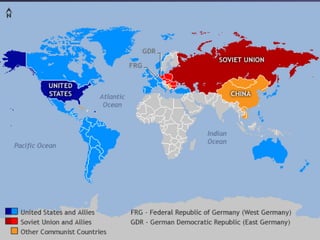
The Cold War lasted from 1945 to
the COLLAPSE of the Soviet
Union in 1991.”
1945 – A Critical Year
Cooperation during WWII between United
States and Soviet Union was
TEMPORARY arrangement
History of Hostility
STRAINED relationship between U.S. and
Soviet Union

    RUSSIAN REVOLUTION of 1917 – American troops
    supported anti-Communist resistance
   USSR NOT INVITED to peace conferences after WWI
   U.S. DIDN’T recognize Soviet government until 1933
   Soviets signed a pact with HITLER before WWII

    Soviets DISAGREED with Americans/British over
    battle TACTICS, postwar PLANS during WWII

    Americans FEARED communism
YALTA Conference of 1945 –
Roosevelt, Stalin, Churchill
met to work out future of
GERMANY and POLAND

    Germany divided into
    American, British, French,
    and Soviet OCCUPATION
    ZONES

    American, British, French
    zones  WEST GERMANY

    Soviet zone  EAST
    GERMANY
   Conflict over future of
    POLAND
Leaders agreed to form UNITED
NATIONS
TRUMAN becomes president
Conflicting postwar goals
United States                Soviet Union
1) Fought to bring           1) Wanted to REBUILD
DEMOCRACY, economic          and protect its own
OPPORTUNITY to               interests = “SATELLITE
conquered nations of         NATIONS”
Europe/Asia.                 2) Spread of
 2) Economically strong      COMMUNISM throughout
and politically open world   the world = supported
= MARKETS for American       totalitarian Communist
products                     governments in EASTERN
                             EUROPE
Creation of Soviet “satellite nations”
Clash of Ideologies
             United States        Soviet Union

Political    DEMOCRATIC         TOTALITARIAN
system        government         government

              Democracy:       Totalitarianism:
             government by      STATE controls
              the PEOPLE,          all aspects of
            either directly or citizens’ lives, one
            through elected      ultimate leader
            representatives
United States        Soviet Union
Economic CAPITALIST           COMMUNIST
 system  (free market)         (socialism)

           Capitalism:          Socialism:
          economic system
             in which the     economic system in
               factors of    which property/means
            production are     of production are
                 owned               owned
           INDIVIDUALLY;     COMMUNALLY; NO
             DIFFERENT        SOCIAL CLASSES
                SOCIAL
          CLASSES EXIST
Communism: “economic system in which
there is NO state or private property, all
goods are owned in COMMON, and there
is NO CLASS DIVISION of citizens
The “Iron Curtain”   February 1946 –
                     STALIN predicted
                     ultimate triumph
                     of communism
                     over capitalism.
                     March 5, 1946 –
                     WINSTON
                     CHURCHILL
                     responded while
                     speaking in
                     Fulton, Missouri
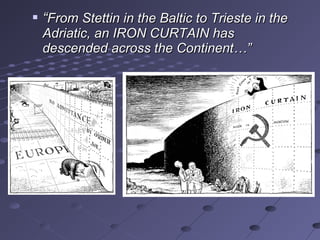
   “From Stettin in the Baltic to Trieste in the
    Adriatic, an IRON CURTAIN has
    descended across the Continent…”
Marshall Plan

    Unveiled by Secretary of State George C.
    Marshall in 1947

    United States supported European
    ECONOMIC RECOVERY from World War II
   U.S. allocated approx. $13 BILLION to
    Western Europe
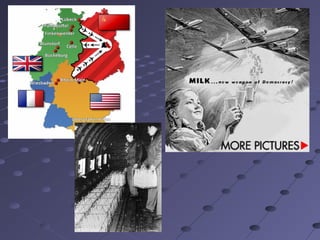
Berlin Airlift of 1948-1949
   Soviets BLOCKED Allied access to West
    Berlin

    Blockade caused severe SHORTAGES of
    FOOD and SUPPLIES for 2.5 million people
    in WEST BERLIN
   British and American AIRCRAFT made more
    than 200,000 flights to deliver food, fuel, other
    supplies until May 1949
Communist Takeover of China
 The Communist takeover in China led by
 MAO ZEDONG shortly after WWII
 increased American fears of communist
 DOMINATION
 Rather than being strong allies, however,
 CHINA and the SOVIET UNION
 eventually became RIVALS for territory
 and diplomatic influence
                 Chinese communist
                dictator Mao Zedong
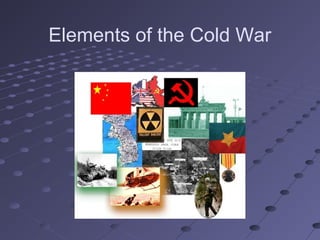
Elements of the Cold War
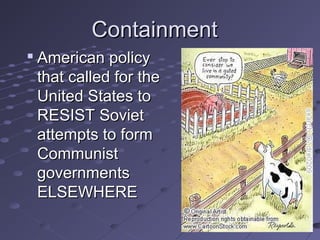
Containment

    American policy
    that called for the
    United States to
    RESIST Soviet
    attempts to form
    Communist
    governments
    ELSEWHERE
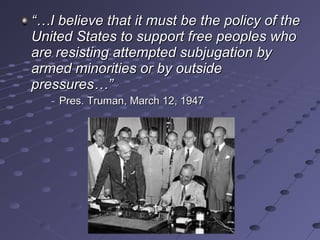
Truman Doctrine
Pres. Harry Truman’s 1947 SPEECH
before a joint session of Congress, calling
United States to take LEADERSHIP role in
the world, and declaring that the UNITED
STATES would SUPPORT nations
threatened by communism
“…I believe that it must be the policy of the
United States to support free peoples who
are resisting attempted subjugation by
armed minorities or by outside
pressures…”
   - Pres. Truman, March 12, 1947
Development of Competing
            Alliances
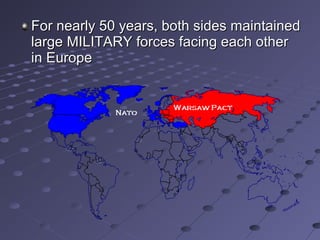
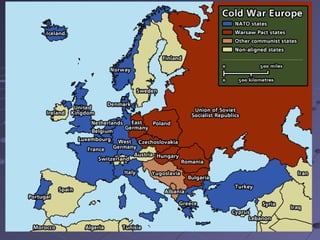
      NATO (1949)           The Warsaw Pact
  North Atlantic Treaty          (1955)
     Organization

US & WESTERN              USSR & EASTERN
EUROPE promise            EUROPE promised
common defense            common defense


   IF ONE IS ATTACKED, ALL ARE ATTACKED
For nearly 50 years, both sides maintained
large MILITARY forces facing each other
in Europe
Arms Race
Struggle between U.S. and Soviet Union
to gain weapons SUPERIORITY
DETERRENCE – policy of making military
power of U.S. and allies so strong that no
enemy would dare attack out of fear
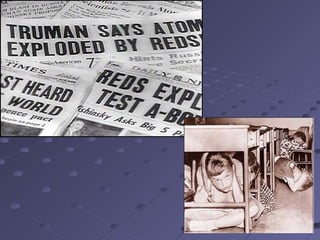
1949 – U.S.S.R. exploded a nuclear bomb
= new threat of nuclear war
United States NOT the only ones with the
BOMB anymore
Soviets focused on long-range rockets
called ICBMs (Inter Continental Ballistic
Missiles)


May 1960, Soviet military used guided
missile to SHOOT DOWN an American U-
2 spy plane over Soviet territory
Massive retaliation
STRATEGIC
DOCTRINE instituted by
Pres. Dwight D.
EISENHOWER
If the Soviets attacked
at all, the United States
would respond with
TOTAL destructive
nuclear force
Established
“MUTUALLY ASSURED
DESTRUCTION”
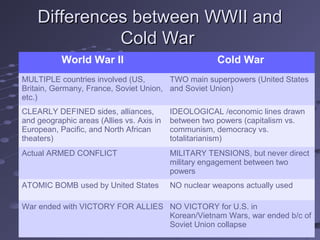
Differences between WWII and
              Cold War
           World War II                                Cold War
MULTIPLE countries involved (US,        TWO main superpowers (United States
Britain, Germany, France, Soviet Union, and Soviet Union)
etc.)
CLEARLY DEFINED sides, alliances,          IDEOLOGICAL /economic lines drawn
and geographic areas (Allies vs. Axis in   between two powers (capitalism vs.
European, Pacific, and North African       communism, democracy vs.
theaters)                                  totalitarianism)
Actual ARMED CONFLICT                      MILITARY TENSIONS, but never direct
                                           military engagement between two
                                           powers
ATOMIC BOMB used by United States          NO nuclear weapons actually used

War ended with VICTORY FOR ALLIES NO VICTORY for U.S. in
                                  Korean/Vietnam Wars, war ended b/c of
                                  Soviet Union collapse

Cold war origins and elements

  • 1.
    Unit 11: TheCold War
  • 2.
    Essential Understandings 1) TheCold War set the framework for GLOBAL POLITICS for 45 years after the end of WORLD WAR II. It also influenced American DOMESTIC POLITICS, the conduct of FOREIGN AFFAIRS, and the role of the GOVERNMENT in the ECONOMY after 1945
  • 3.
    2) The ColdWar was essentially a COMPETITION between two very different ways of organizing GOVERNMENT, SOCIETY, and the ECONOMY: A) The AMERICAN-led B) The SOVIET belief in western nations’ belief in a TOTALITARIAN state DEMOCRACY, INDIVIDAUL and SOCIALISM freedom, and a MARKET economy
  • 4.
    Origins of theCold War Definition: “The COMPETITION that developed after WWII between the UNITED STATES and the SOVIET UNION for power and influence in the world
  • 6.
    The Cold Warlasted from 1945 to the COLLAPSE of the Soviet Union in 1991.”
  • 7.
    1945 – ACritical Year Cooperation during WWII between United States and Soviet Union was TEMPORARY arrangement
  • 8.
    History of Hostility STRAINEDrelationship between U.S. and Soviet Union  RUSSIAN REVOLUTION of 1917 – American troops supported anti-Communist resistance  USSR NOT INVITED to peace conferences after WWI  U.S. DIDN’T recognize Soviet government until 1933  Soviets signed a pact with HITLER before WWII  Soviets DISAGREED with Americans/British over battle TACTICS, postwar PLANS during WWII  Americans FEARED communism
  • 9.
    YALTA Conference of1945 – Roosevelt, Stalin, Churchill met to work out future of GERMANY and POLAND  Germany divided into American, British, French, and Soviet OCCUPATION ZONES  American, British, French zones  WEST GERMANY  Soviet zone  EAST GERMANY  Conflict over future of POLAND
  • 10.
    Leaders agreed toform UNITED NATIONS TRUMAN becomes president
  • 11.
    Conflicting postwar goals UnitedStates Soviet Union 1) Fought to bring 1) Wanted to REBUILD DEMOCRACY, economic and protect its own OPPORTUNITY to interests = “SATELLITE conquered nations of NATIONS” Europe/Asia. 2) Spread of 2) Economically strong COMMUNISM throughout and politically open world the world = supported = MARKETS for American totalitarian Communist products governments in EASTERN EUROPE
  • 12.
    Creation of Soviet“satellite nations”
  • 13.
    Clash of Ideologies United States Soviet Union Political DEMOCRATIC TOTALITARIAN system government government Democracy: Totalitarianism: government by STATE controls the PEOPLE, all aspects of either directly or citizens’ lives, one through elected ultimate leader representatives
  • 14.
    United States Soviet Union Economic CAPITALIST COMMUNIST system (free market) (socialism) Capitalism: Socialism: economic system in which the economic system in factors of which property/means production are of production are owned owned INDIVIDUALLY; COMMUNALLY; NO DIFFERENT SOCIAL CLASSES SOCIAL CLASSES EXIST
  • 15.
    Communism: “economic systemin which there is NO state or private property, all goods are owned in COMMON, and there is NO CLASS DIVISION of citizens
  • 17.
    The “Iron Curtain” February 1946 – STALIN predicted ultimate triumph of communism over capitalism. March 5, 1946 – WINSTON CHURCHILL responded while speaking in Fulton, Missouri
  • 18.
    “From Stettin in the Baltic to Trieste in the Adriatic, an IRON CURTAIN has descended across the Continent…”
  • 19.
    Marshall Plan  Unveiled by Secretary of State George C. Marshall in 1947  United States supported European ECONOMIC RECOVERY from World War II  U.S. allocated approx. $13 BILLION to Western Europe
  • 20.
    Berlin Airlift of1948-1949  Soviets BLOCKED Allied access to West Berlin  Blockade caused severe SHORTAGES of FOOD and SUPPLIES for 2.5 million people in WEST BERLIN  British and American AIRCRAFT made more than 200,000 flights to deliver food, fuel, other supplies until May 1949
  • 23.
    Communist Takeover ofChina The Communist takeover in China led by MAO ZEDONG shortly after WWII increased American fears of communist DOMINATION Rather than being strong allies, however, CHINA and the SOVIET UNION eventually became RIVALS for territory and diplomatic influence Chinese communist dictator Mao Zedong
  • 24.
  • 25.
    Containment  American policy that called for the United States to RESIST Soviet attempts to form Communist governments ELSEWHERE
  • 26.
    Truman Doctrine Pres. HarryTruman’s 1947 SPEECH before a joint session of Congress, calling United States to take LEADERSHIP role in the world, and declaring that the UNITED STATES would SUPPORT nations threatened by communism
  • 27.
    “…I believe thatit must be the policy of the United States to support free peoples who are resisting attempted subjugation by armed minorities or by outside pressures…” - Pres. Truman, March 12, 1947
  • 28.
    Development of Competing Alliances NATO (1949) The Warsaw Pact North Atlantic Treaty (1955) Organization US & WESTERN USSR & EASTERN EUROPE promise EUROPE promised common defense common defense IF ONE IS ATTACKED, ALL ARE ATTACKED
  • 29.
    For nearly 50years, both sides maintained large MILITARY forces facing each other in Europe
  • 31.
    Arms Race Struggle betweenU.S. and Soviet Union to gain weapons SUPERIORITY DETERRENCE – policy of making military power of U.S. and allies so strong that no enemy would dare attack out of fear 1949 – U.S.S.R. exploded a nuclear bomb = new threat of nuclear war United States NOT the only ones with the BOMB anymore
  • 33.
    Soviets focused onlong-range rockets called ICBMs (Inter Continental Ballistic Missiles) May 1960, Soviet military used guided missile to SHOOT DOWN an American U- 2 spy plane over Soviet territory
  • 34.
    Massive retaliation STRATEGIC DOCTRINE institutedby Pres. Dwight D. EISENHOWER If the Soviets attacked at all, the United States would respond with TOTAL destructive nuclear force Established “MUTUALLY ASSURED DESTRUCTION”
  • 36.
    Differences between WWIIand Cold War World War II Cold War MULTIPLE countries involved (US, TWO main superpowers (United States Britain, Germany, France, Soviet Union, and Soviet Union) etc.) CLEARLY DEFINED sides, alliances, IDEOLOGICAL /economic lines drawn and geographic areas (Allies vs. Axis in between two powers (capitalism vs. European, Pacific, and North African communism, democracy vs. theaters) totalitarianism) Actual ARMED CONFLICT MILITARY TENSIONS, but never direct military engagement between two powers ATOMIC BOMB used by United States NO nuclear weapons actually used War ended with VICTORY FOR ALLIES NO VICTORY for U.S. in Korean/Vietnam Wars, war ended b/c of Soviet Union collapse