1
SEED
what is a
seed
Parts of a
seed and
its’
purpose
Germination
process and
types
Types of
seeds
LEARNING FOCUS
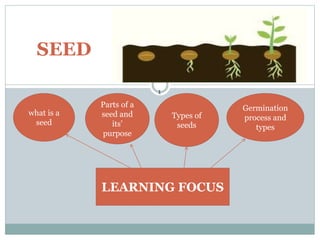
SEED
 It’s a reproductive structure which disperses, and can survive for some
time.
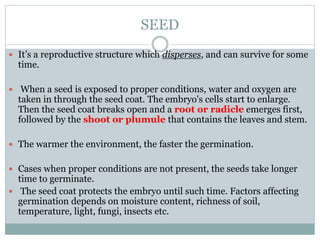
 When a seed is exposed to proper conditions, water and oxygen are
taken in through the seed coat. The embryo's cells start to enlarge.
Then the seed coat breaks open and a root or radicle emerges first,
followed by the shoot or plumule that contains the leaves and stem.
 The warmer the environment, the faster the germination.
 Cases when proper conditions are not present, the seeds take longer
time to germinate.
 The seed coat protects the embryo until such time. Factors affecting
germination depends on moisture content, richness of soil,
temperature, light, fungi, insects etc.
Parts of a seed
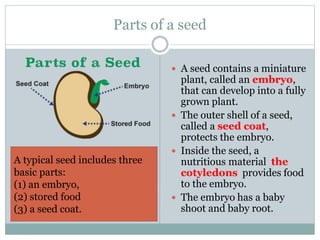
 A seed contains a miniature
plant, called an embryo,
that can develop into a fully
grown plant.
 The outer shell of a seed,
called a seed coat,
protects the embryo.
 Inside the seed, a
nutritious material the
cotyledons provides food
to the embryo.
 The embryo has a baby
shoot and baby root.
A typical seed includes three
basic parts:
(1) an embryo,
(2) stored food
(3) a seed coat.
Types of seeds
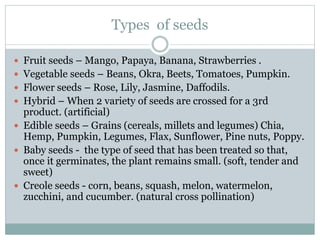
 Fruit seeds – Mango, Papaya, Banana, Strawberries .
 Vegetable seeds – Beans, Okra, Beets, Tomatoes, Pumpkin.
 Flower seeds – Rose, Lily, Jasmine, Daffodils.
 Hybrid – When 2 variety of seeds are crossed for a 3rd
product. (artificial)
 Edible seeds – Grains (cereals, millets and legumes) Chia,
Hemp, Pumpkin, Legumes, Flax, Sunflower, Pine nuts, Poppy.
 Baby seeds - the type of seed that has been treated so that,
once it germinates, the plant remains small. (soft, tender and
sweet)
 Creole seeds - corn, beans, squash, melon, watermelon,
zucchini, and cucumber. (natural cross pollination)
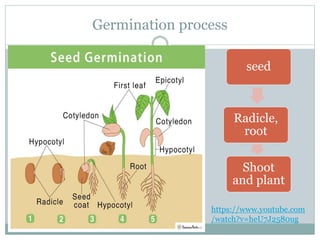
Germination process
seed
Radicle,
root
Shoot
and plant
https://www.youtube.com
/watch?v=heU7J2580ug
Epigeal Germination Hypogeal Germination
 Epigeal germination is
when the germination of
a plant takes place
above the ground.
E.g., onion, beans,
cotton, castor.
 The cotyledons are
brought on the surface of
the soil along with the
shoot.
 Botanical term
indicating that the
germination of a plant
takes place below the
ground.
E.g. Mango, rice,
groundnuts, Maize.
 Cotyledons remain
below the soil surface.
Types of germination
 The hypocotyl has a
curved terminal part to
protect the plumule as it
comes out of the soil.
 The plumule comes out of
the seed by the elongation
of the hypocotyl.
 The energy for the growth
comes from the
cotyledons.
 The epicotyl has a
curved terminal part to
protect the plumule from
friction in soil particles.
 The plumule comes out
of the seed by the
elongation of the
epicotyl.
 The energy primarily
comes from the
endosperm.
Epigeal Germination Hypogeal Germination
Reflection time
 What is a seed?
 Name any three types of seeds?
 What is the use of a seed coat?
 Does germination take place when the soil is dry?
Explain.
 Explain hypogeal germination with examples.

SCIENCE GRADE 5 - SEED.pptx

  • 1.
    1 SEED what is a seed Partsof a seed and its’ purpose Germination process and types Types of seeds LEARNING FOCUS
  • 2.
    SEED  It’s areproductive structure which disperses, and can survive for some time.  When a seed is exposed to proper conditions, water and oxygen are taken in through the seed coat. The embryo's cells start to enlarge. Then the seed coat breaks open and a root or radicle emerges first, followed by the shoot or plumule that contains the leaves and stem.  The warmer the environment, the faster the germination.  Cases when proper conditions are not present, the seeds take longer time to germinate.  The seed coat protects the embryo until such time. Factors affecting germination depends on moisture content, richness of soil, temperature, light, fungi, insects etc.
  • 3.
    Parts of aseed  A seed contains a miniature plant, called an embryo, that can develop into a fully grown plant.  The outer shell of a seed, called a seed coat, protects the embryo.  Inside the seed, a nutritious material the cotyledons provides food to the embryo.  The embryo has a baby shoot and baby root. A typical seed includes three basic parts: (1) an embryo, (2) stored food (3) a seed coat.
  • 4.
    Types of seeds Fruit seeds – Mango, Papaya, Banana, Strawberries .  Vegetable seeds – Beans, Okra, Beets, Tomatoes, Pumpkin.  Flower seeds – Rose, Lily, Jasmine, Daffodils.  Hybrid – When 2 variety of seeds are crossed for a 3rd product. (artificial)  Edible seeds – Grains (cereals, millets and legumes) Chia, Hemp, Pumpkin, Legumes, Flax, Sunflower, Pine nuts, Poppy.  Baby seeds - the type of seed that has been treated so that, once it germinates, the plant remains small. (soft, tender and sweet)  Creole seeds - corn, beans, squash, melon, watermelon, zucchini, and cucumber. (natural cross pollination)
  • 5.
  • 6.
    Epigeal Germination HypogealGermination  Epigeal germination is when the germination of a plant takes place above the ground. E.g., onion, beans, cotton, castor.  The cotyledons are brought on the surface of the soil along with the shoot.  Botanical term indicating that the germination of a plant takes place below the ground. E.g. Mango, rice, groundnuts, Maize.  Cotyledons remain below the soil surface. Types of germination
  • 7.
     The hypocotylhas a curved terminal part to protect the plumule as it comes out of the soil.  The plumule comes out of the seed by the elongation of the hypocotyl.  The energy for the growth comes from the cotyledons.  The epicotyl has a curved terminal part to protect the plumule from friction in soil particles.  The plumule comes out of the seed by the elongation of the epicotyl.  The energy primarily comes from the endosperm. Epigeal Germination Hypogeal Germination
  • 8.
    Reflection time  Whatis a seed?  Name any three types of seeds?  What is the use of a seed coat?  Does germination take place when the soil is dry? Explain.  Explain hypogeal germination with examples.