UNIT 3
PERSONALITY
Prof. Kanchan Kumari
Personality
• Personality can be defined as a dynamic and organized set of.
characteristics possessed by a person that uniquely influences his or
her cognitions, motivations and behaviors in various situations. The
word "personality" originates from the Latin persona, which means mask
• Personality encompasses the thoughts, feelings, and behaviors that
describe or define a person. Often personality is a generalization that
provides insights into how someone will perceive, feel about, and react
to a given situation or stimulus. Personality is generally an established,
stable, and constant characteristic; however, personalities do change.
This is particularly true of individuals as they are developing mentally
and physically. For purposes of organizational behavior studies,
personality has a strong impact on an individuals behavior daily and in a
given circumstance.
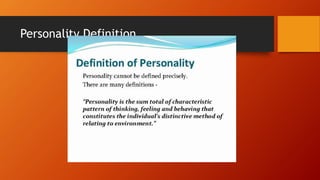
Personality Definition
Robbins Definition
• It signifies the role which a person plays in public. Every
individual has a unique, personal and major determinant of his
behavior that defines his/her personality. Personality trait is
basically influenced by two major features − Inherited
characteristics. Learned characteristics.
• Personality refers to the enduring characteristics and behavior
that comprise a person's unique adjustment to life, including
major traits, interests, drives, values, self-concept, abilities, and
emotional patterns.
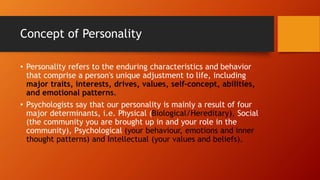
Concept of Personality
• Personality refers to the enduring characteristics and behavior
that comprise a person's unique adjustment to life, including
major traits, interests, drives, values, self-concept, abilities,
and emotional patterns.
• Psychologists say that our personality is mainly a result of four
major determinants, i.e. Physical (Biological/Hereditary), Social
(the community you are brought up in and your role in the
community), Psychological (your behaviour, emotions and inner
thought patterns) and Intellectual (your values and beliefs).
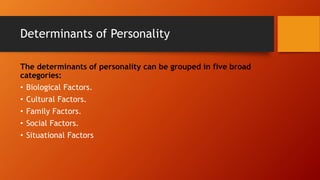
Determinants of Personality
The determinants of personality can be grouped in five broad
categories:
• Biological Factors.
• Cultural Factors.
• Family Factors.
• Social Factors.
• Situational Factors
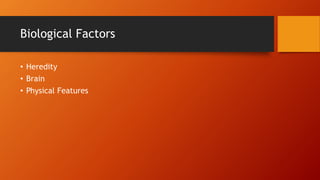
Biological Factors
• Heredity
• Brain
• Physical Features
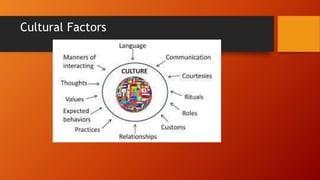
Cultural Factors
Physical Features
• These are aspects of appearance that are visually apparent to
others, even with no other information about the person. They
can include a variety of things. Hair and facial features play a big
role but aren't the whole picture. Physical characteristics are what
you see with the naked eye.
• Your physical features are your height, weight, size, shape or
another bodily characteristic. These also include facial features,
hair, scarring and birthmarks.
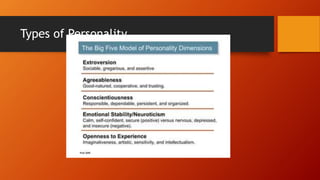
Types of Personality
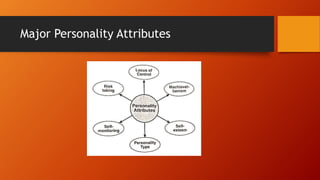
Major Personality Attributes
Major Personality Attributes Influencing
Organizational Behavior
(1) Authoritarianism-status and power
(2) Bureaucratic Personality-value subordinate
(3) Machiavellianism-how to use power
(4) Introversion and Extroversion-
(5) Problem Solving Style-sensation feeling/thinking, intuition feeling/thinking
(6) Achievement Orientation-in better way
(7) Locus of Control
(8) Self Esteem
(9) Self Monitoring
(10) Risk Taking
(11) ‘Type A’ and ‘Type B’ Personality
(12) Myers-Briggs Type Indicator (MBTI)
Locus of Control
• Locus of control refers to an individual’s belief that events are
either within one’s control (Internal Locus of Control) or are
determined by forces beyond one’s control. Some people believe
that they are the masters of their own fate. Other people see
themselves as pawns of fate, believing that whatever happens to
them in their lives is due to their luck or fate. The first type is
labeled as internals and the latter has been called externals. A
PERSON’S PERCEPTION OF THE SOURCE OF HIS OR HER FATE IS
TERMED LOCUS OF CONTROL
• Ex- control over his own behavior/ active decision making
Machiavellianism
• This personality trait of Machiavellianism also known as Mach is
named after Niccolo Machiavelli
(i) A Mach man is pragmatic, maintains emotional distance and
believes that ends can justify means.
(ii) A high Mach man manipulates more, wins more, are persuaded
less and persuade others more than the low machs.
(iii) High Mach people flourish when they interact face to face with
others rather than indirectly.
Thank You
Prof. Kanchan Kumari

UNIT 3 Personality OBprof. kanchan.pptx

  • 1.
  • 2.
    Personality • Personality canbe defined as a dynamic and organized set of. characteristics possessed by a person that uniquely influences his or her cognitions, motivations and behaviors in various situations. The word "personality" originates from the Latin persona, which means mask • Personality encompasses the thoughts, feelings, and behaviors that describe or define a person. Often personality is a generalization that provides insights into how someone will perceive, feel about, and react to a given situation or stimulus. Personality is generally an established, stable, and constant characteristic; however, personalities do change. This is particularly true of individuals as they are developing mentally and physically. For purposes of organizational behavior studies, personality has a strong impact on an individuals behavior daily and in a given circumstance.
  • 3.
  • 4.
    Robbins Definition • Itsignifies the role which a person plays in public. Every individual has a unique, personal and major determinant of his behavior that defines his/her personality. Personality trait is basically influenced by two major features − Inherited characteristics. Learned characteristics. • Personality refers to the enduring characteristics and behavior that comprise a person's unique adjustment to life, including major traits, interests, drives, values, self-concept, abilities, and emotional patterns.
  • 5.
    Concept of Personality •Personality refers to the enduring characteristics and behavior that comprise a person's unique adjustment to life, including major traits, interests, drives, values, self-concept, abilities, and emotional patterns. • Psychologists say that our personality is mainly a result of four major determinants, i.e. Physical (Biological/Hereditary), Social (the community you are brought up in and your role in the community), Psychological (your behaviour, emotions and inner thought patterns) and Intellectual (your values and beliefs).
  • 6.
    Determinants of Personality Thedeterminants of personality can be grouped in five broad categories: • Biological Factors. • Cultural Factors. • Family Factors. • Social Factors. • Situational Factors
  • 7.
    Biological Factors • Heredity •Brain • Physical Features
  • 8.
  • 9.
    Physical Features • Theseare aspects of appearance that are visually apparent to others, even with no other information about the person. They can include a variety of things. Hair and facial features play a big role but aren't the whole picture. Physical characteristics are what you see with the naked eye. • Your physical features are your height, weight, size, shape or another bodily characteristic. These also include facial features, hair, scarring and birthmarks.
  • 10.
  • 11.
  • 12.
    Major Personality AttributesInfluencing Organizational Behavior (1) Authoritarianism-status and power (2) Bureaucratic Personality-value subordinate (3) Machiavellianism-how to use power (4) Introversion and Extroversion- (5) Problem Solving Style-sensation feeling/thinking, intuition feeling/thinking (6) Achievement Orientation-in better way (7) Locus of Control (8) Self Esteem (9) Self Monitoring (10) Risk Taking (11) ‘Type A’ and ‘Type B’ Personality (12) Myers-Briggs Type Indicator (MBTI)
  • 13.
    Locus of Control •Locus of control refers to an individual’s belief that events are either within one’s control (Internal Locus of Control) or are determined by forces beyond one’s control. Some people believe that they are the masters of their own fate. Other people see themselves as pawns of fate, believing that whatever happens to them in their lives is due to their luck or fate. The first type is labeled as internals and the latter has been called externals. A PERSON’S PERCEPTION OF THE SOURCE OF HIS OR HER FATE IS TERMED LOCUS OF CONTROL • Ex- control over his own behavior/ active decision making
  • 14.
    Machiavellianism • This personalitytrait of Machiavellianism also known as Mach is named after Niccolo Machiavelli (i) A Mach man is pragmatic, maintains emotional distance and believes that ends can justify means. (ii) A high Mach man manipulates more, wins more, are persuaded less and persuade others more than the low machs. (iii) High Mach people flourish when they interact face to face with others rather than indirectly.
  • 15.