Methods of Performance Appraisal
1
MEANING OF PERFORMANCE
APPRAISAL
 Performance appraisal is a system of review and evaluation of an individual
or team’s job performance.
 Performance management is a process that significantly affects
organizational success by having managers and employees work together to
set expectations, review results, and reward performance.
 Its goal is to provide an accurate picture of past and / or future employee
performance.
2
Objective of Performance Appraisal
 Give feedback on performance to employees.
 Identify employee training needs.
 Document criteria used to allocate organizational rewards.
 Form a basis for personnel decisions: salary increases, promotions,
disciplinary actions, etc.
 Provide the opportunity for organizational diagnosis and development.
 Facilitate communication between employee and administration
3
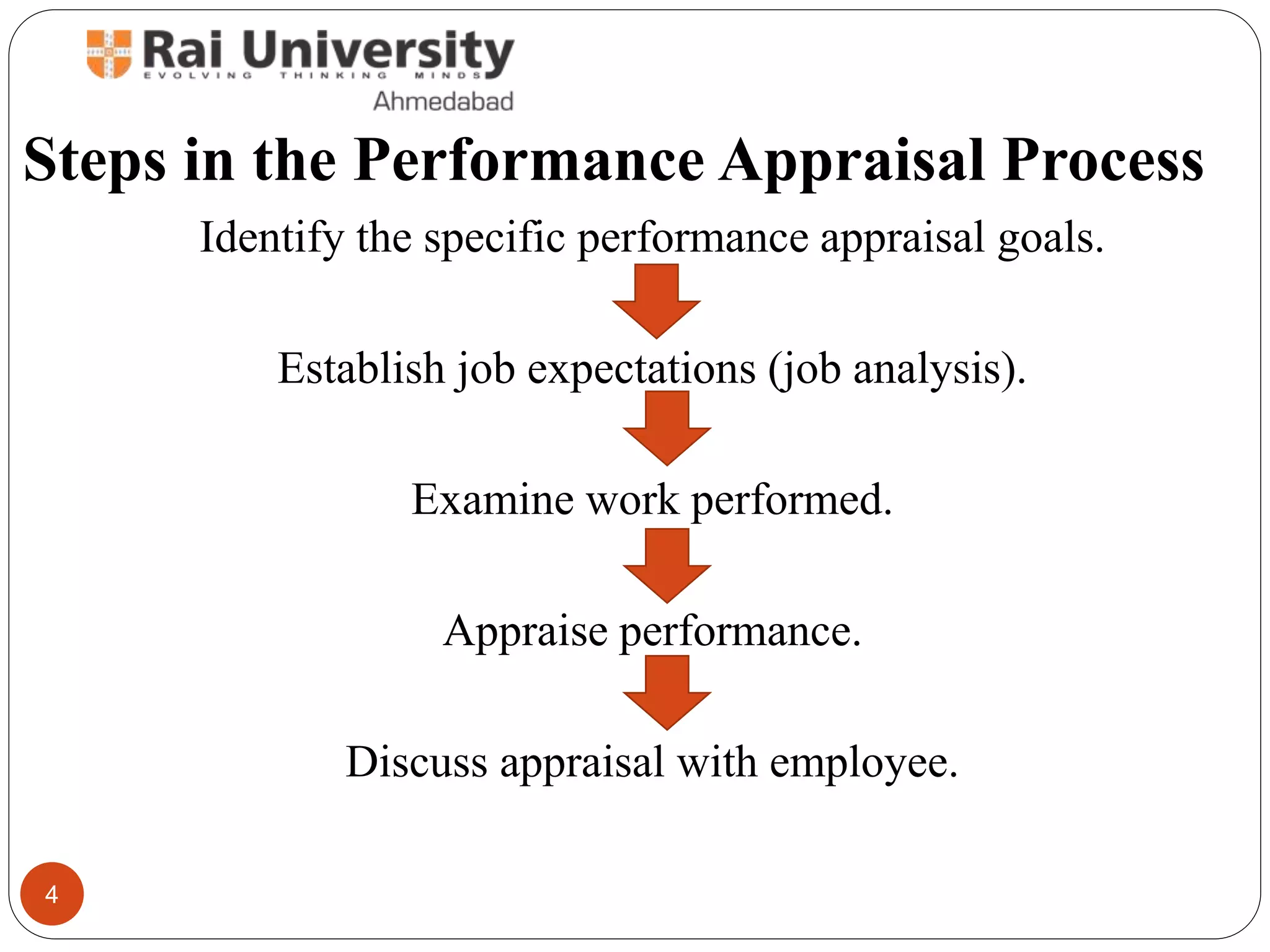
Steps in the Performance Appraisal Process
Identify the specific performance appraisal goals.
Establish job expectations (job analysis).
Examine work performed.
Appraise performance.
Discuss appraisal with employee.
4
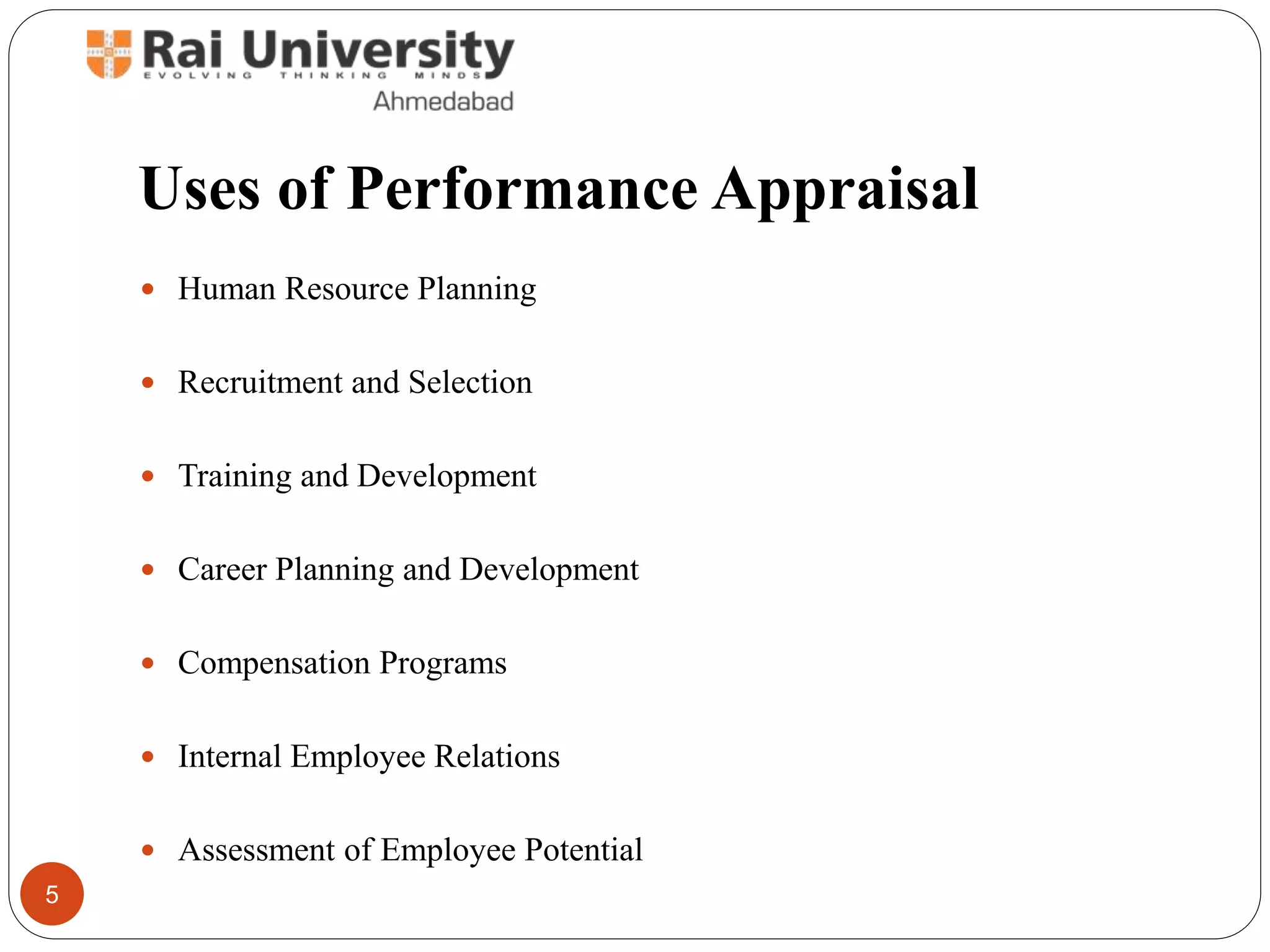
Uses of Performance Appraisal
 Human Resource Planning
 Recruitment and Selection
 Training and Development
 Career Planning and Development
 Compensation Programs
 Internal Employee Relations
 Assessment of Employee Potential
5
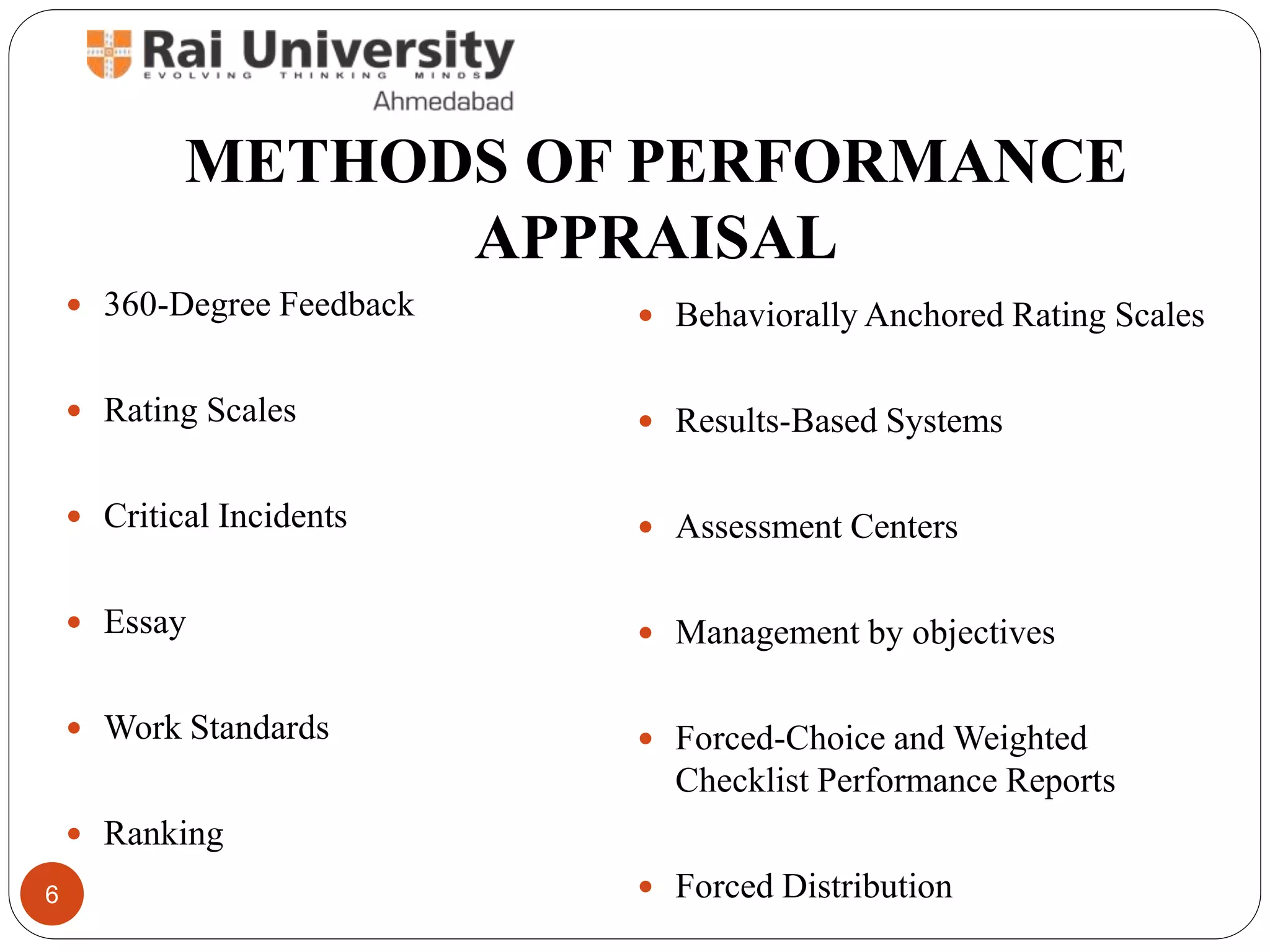
METHODS OF PERFORMANCE
APPRAISAL
 360-Degree Feedback
 Rating Scales
 Critical Incidents
 Essay
 Work Standards
 Ranking
 Behaviorally Anchored Rating Scales
 Results-Based Systems
 Assessment Centers
 Management by objectives
 Forced-Choice and Weighted
Checklist Performance Reports
 Forced Distribution6
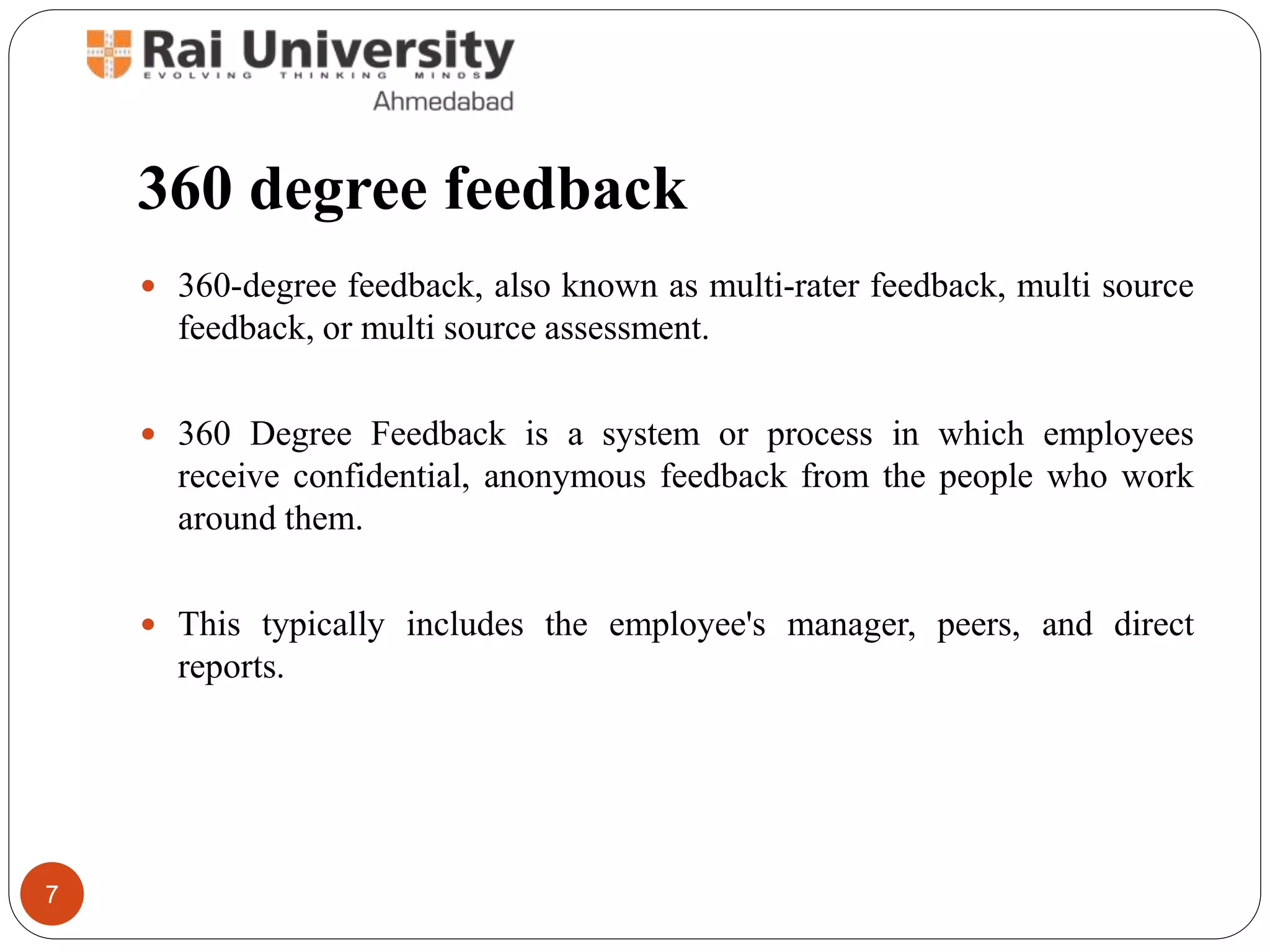
360 degree feedback
 360-degree feedback, also known as multi-rater feedback, multi source
feedback, or multi source assessment.
 360 Degree Feedback is a system or process in which employees
receive confidential, anonymous feedback from the people who work
around them.
 This typically includes the employee's manager, peers, and direct
reports.
7
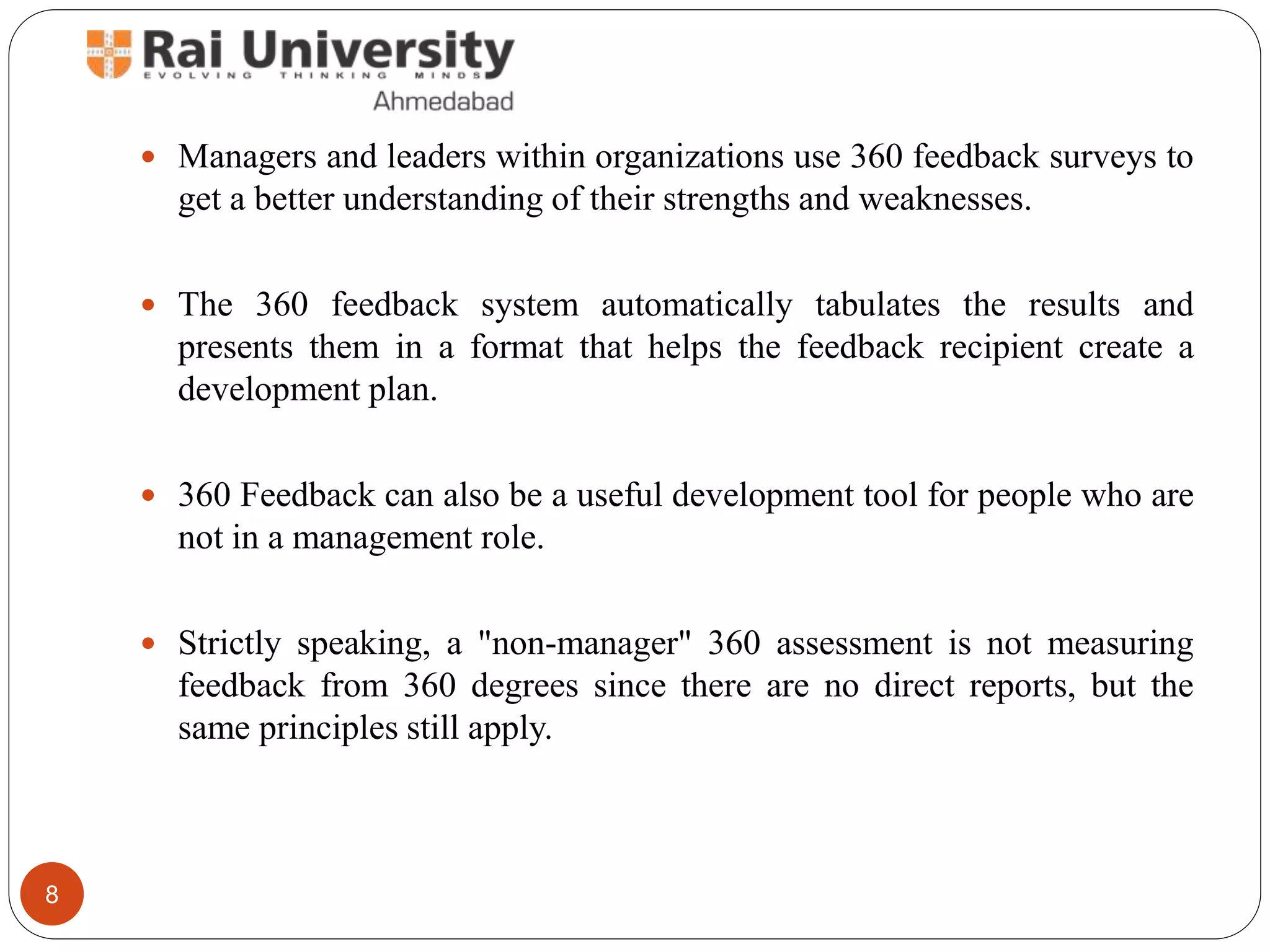
 Managers and leaders within organizations use 360 feedback surveys to
get a better understanding of their strengths and weaknesses.
 The 360 feedback system automatically tabulates the results and
presents them in a format that helps the feedback recipient create a
development plan.
 360 Feedback can also be a useful development tool for people who are
not in a management role.
 Strictly speaking, a "non-manager" 360 assessment is not measuring
feedback from 360 degrees since there are no direct reports, but the
same principles still apply.
8
How is 360 Degree Feedback Used?
 Companies typically use a 360 feedback system in one of two ways:
i. 360 Feedback as a Development Tool to help employees recognize
strengths and weaknesses and become more effective
ii. 360 Feedback as a Performance Appraisal Tool to measure employee
performance
9
 Rating Scales: Rates employees according to defined factors. The
factors chosen for evaluation are typically of two types: job related and
personal characteristics.
 Critical Incidents — Requires written records be kept of highly
favorable and highly unfavorable work actions.
 Essay — The rater simply writes a brief narrative describing the
employee’s performance. This method tends to focus on extreme
behavior in the employee’s work rather than routine day-to-day
performance.
10
 Work Standards — Compares each employee’s performance to a
predetermined standard, or expected level of output.
 Ranking —The rater simply places all employees in a given group in
rank order on the basis of their overall performance.
 Forced Distribution — An appraisal approach where the rater is
required to assign individuals in the work group to a limited number of
categories similar to a normal frequency distribution.
11
 Forced-Choice and Weighted Checklist Performance Reports —
The forced-choice performance report is a technique in which the
appraiser is given a series of statements about an individual and the
rater indicates which items are most or least descriptive of the
employee.
 Behaviorally Anchored Rating Scales—A performance appraisal
method that combines elements of the traditional rating scales and
critical incidents methods.
 Results-Based Systems — In a result-based system the superior and
the subordinate jointly agree on objectives for the next appraisal period.
12
 Assessment Centers—Recognizing the differences in purposes, and
the difficulty that a PA system will have in achieving both aims, some
firms opt to use an assessment center as an adjunct to their appraisal
system.
 Management by objectives (MBO) — It is a goal-oriented
performance appraisal method, requires that supervisors and employees
determine objectives for employees to meet during the rating period,
and the employees appraise how well they have achieved their
objectives
13
Merits of 360 degree
feedback
Demerits of 360 degree
feedback
 Evaluates methods applied to
achieve targets
 Reveals strength and weakness
in management style
 Forces inflexible managers to
initiate self change
 Creates an atmosphere of
teamwork and improvement
 Unearths truths about
organizational culture and
ambience
 Ignores performance in terms of
reaching goals
 Colleague’s responses tend to
be biased
 Assesssees deny the truth of
negative feedback
 The system can be used to
humiliate people
 Linking findings to rewards can
prove to be unfair.
14
PROBLEMS IN PERFORMANCE
APPRAISAL
 Lack of Objectivity
 Halo Error
 Leniency/Strictness
 Central Tendency
 Personal Bias
 Recent Behavior Bias
 Manipulating the Evaluation
 Poor Appraisal Forms
15
Thank You!!
16

Methods of Performance appraisal - Principles of Human Resource Management

  • 1.
  • 2.
    MEANING OF PERFORMANCE APPRAISAL Performance appraisal is a system of review and evaluation of an individual or team’s job performance.  Performance management is a process that significantly affects organizational success by having managers and employees work together to set expectations, review results, and reward performance.  Its goal is to provide an accurate picture of past and / or future employee performance. 2
  • 3.
    Objective of PerformanceAppraisal  Give feedback on performance to employees.  Identify employee training needs.  Document criteria used to allocate organizational rewards.  Form a basis for personnel decisions: salary increases, promotions, disciplinary actions, etc.  Provide the opportunity for organizational diagnosis and development.  Facilitate communication between employee and administration 3
  • 4.
    Steps in thePerformance Appraisal Process Identify the specific performance appraisal goals. Establish job expectations (job analysis). Examine work performed. Appraise performance. Discuss appraisal with employee. 4
  • 5.
    Uses of PerformanceAppraisal  Human Resource Planning  Recruitment and Selection  Training and Development  Career Planning and Development  Compensation Programs  Internal Employee Relations  Assessment of Employee Potential 5
  • 6.
    METHODS OF PERFORMANCE APPRAISAL 360-Degree Feedback  Rating Scales  Critical Incidents  Essay  Work Standards  Ranking  Behaviorally Anchored Rating Scales  Results-Based Systems  Assessment Centers  Management by objectives  Forced-Choice and Weighted Checklist Performance Reports  Forced Distribution6
  • 7.
    360 degree feedback 360-degree feedback, also known as multi-rater feedback, multi source feedback, or multi source assessment.  360 Degree Feedback is a system or process in which employees receive confidential, anonymous feedback from the people who work around them.  This typically includes the employee's manager, peers, and direct reports. 7
  • 8.
     Managers andleaders within organizations use 360 feedback surveys to get a better understanding of their strengths and weaknesses.  The 360 feedback system automatically tabulates the results and presents them in a format that helps the feedback recipient create a development plan.  360 Feedback can also be a useful development tool for people who are not in a management role.  Strictly speaking, a "non-manager" 360 assessment is not measuring feedback from 360 degrees since there are no direct reports, but the same principles still apply. 8
  • 9.
    How is 360Degree Feedback Used?  Companies typically use a 360 feedback system in one of two ways: i. 360 Feedback as a Development Tool to help employees recognize strengths and weaknesses and become more effective ii. 360 Feedback as a Performance Appraisal Tool to measure employee performance 9
  • 10.
     Rating Scales:Rates employees according to defined factors. The factors chosen for evaluation are typically of two types: job related and personal characteristics.  Critical Incidents — Requires written records be kept of highly favorable and highly unfavorable work actions.  Essay — The rater simply writes a brief narrative describing the employee’s performance. This method tends to focus on extreme behavior in the employee’s work rather than routine day-to-day performance. 10
  • 11.
     Work Standards— Compares each employee’s performance to a predetermined standard, or expected level of output.  Ranking —The rater simply places all employees in a given group in rank order on the basis of their overall performance.  Forced Distribution — An appraisal approach where the rater is required to assign individuals in the work group to a limited number of categories similar to a normal frequency distribution. 11
  • 12.
     Forced-Choice andWeighted Checklist Performance Reports — The forced-choice performance report is a technique in which the appraiser is given a series of statements about an individual and the rater indicates which items are most or least descriptive of the employee.  Behaviorally Anchored Rating Scales—A performance appraisal method that combines elements of the traditional rating scales and critical incidents methods.  Results-Based Systems — In a result-based system the superior and the subordinate jointly agree on objectives for the next appraisal period. 12
  • 13.
     Assessment Centers—Recognizingthe differences in purposes, and the difficulty that a PA system will have in achieving both aims, some firms opt to use an assessment center as an adjunct to their appraisal system.  Management by objectives (MBO) — It is a goal-oriented performance appraisal method, requires that supervisors and employees determine objectives for employees to meet during the rating period, and the employees appraise how well they have achieved their objectives 13
  • 14.
    Merits of 360degree feedback Demerits of 360 degree feedback  Evaluates methods applied to achieve targets  Reveals strength and weakness in management style  Forces inflexible managers to initiate self change  Creates an atmosphere of teamwork and improvement  Unearths truths about organizational culture and ambience  Ignores performance in terms of reaching goals  Colleague’s responses tend to be biased  Assesssees deny the truth of negative feedback  The system can be used to humiliate people  Linking findings to rewards can prove to be unfair. 14
  • 15.
    PROBLEMS IN PERFORMANCE APPRAISAL Lack of Objectivity  Halo Error  Leniency/Strictness  Central Tendency  Personal Bias  Recent Behavior Bias  Manipulating the Evaluation  Poor Appraisal Forms 15
  • 16.