Fermentation processes and
fermenter
2.1 Design of a fermentor: Stirred Tank Fermentor- Basic Design; Parts of a
Typical Industrial Fermentor. Fermentation Media: Components; Design
andOptimization. 2.2 Sterilization: Sterilization of Fermentor and
FermentationMedia. 2.3 Process Parameters: pH, Temperature, Aeration,
Agitation, Foam,etc. 2.4 Types of Fermentation: Surface and Submerged,
Batch and Continuous,Aerobicand Anaerobic. 2.5 Product Isolation and
Purification. 2.6 Study of Representative Fermentation Processes: Outline of
Penicillin and Ethanol Production by fermentation along with a flow-diagram.
BASIC STEPS OF FERMENTATION PROCESS A N D GENERAL REQUIREMENTS
1. Formulation of fermentation media: it is chemically a cell culture media which
is a mixture of molecules used for cellular metabolism and growth. e.g. Carbon
source, energy source, oxygen, nitrogen etc.
2. Sterilisation: sterilisation of fermentation media, Fermenters and other
equipments.
3. Inoculum formation: production of an active , pure culture In su cient
ffi quantity
to inoculate into the production vessel.
4. Fermentation: growth of the micro-organism in the production fermenter under
optimum conditions for formation of by-products.
5. Extraction and purification of the product.
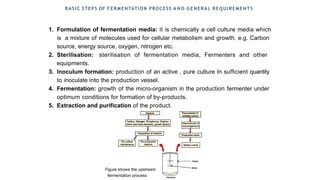
Figure shows the upstream
fermentation process
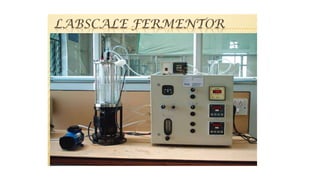
Fig. Pilot scale fermenter
Microbial Growth Kinetics
Modes of fermentation
• Batch
• Fed batch
• Continuous
•Batch culture technique is also called as closed system of cultivation.
•In this technique at first nutrient solution is prepared and it is inoculated with
inoculum and then nothing is added in the fermentation tank except aeration.
•In batch culture, neither fresh medium is added nor used up media is removed
from the cultivation vessel. Therefore, volume of culture remains same.
•Since fresh media is not added during the course of incubation, concentration of
nutrition decreases continuously.
•Furthermore, various toxic metabolites also accumulates in the culture vessel.
Therefore, batch culture technique gives characteristics microbial kinetics (growth
curve) with lag phase, log phase, stationary phase and decline phase.
•Fed-batch culture
•semi-closed system of cultivation.
•a particular nutrient is added at intervals without removing the used
up media
•so the volume of culture increases continuously
•nutrients are kept in lower concentration initially and it is added
slowly and continuously during the course of fermentation.
•Continuous culture technique
•open system of cultivation.
•fresh sterile medium is added continuously in the vessel and used up media
with bacterial culture is removed continuously at the same rate.
•So, the volume and bacterial density remain same in the cultivation vessel.
•In this technique, bacteria grow continuously in their log phase. This type of
growth is known as steady state growth.
•The cell density in continuous culture remains constant and it is achieved
by maintaining constant dilution and flow rate.
Continuous culture apparatus
Fermenter:
• A Fermenter is a device that accomplishes the fermentation process by the help of
certain microorganisms, and thus it also refers as “Biofermenter or Bioreactor“.
it is equipped with all the elements that are necessary to carry out the commercial
production of substances like antibiotics, enzymes, beverages etc. in many
industries.
Basic design of fermenter
BASIC DESIGN OF FERMENTER
Stirred Tank Bioreactor
• A fermenter is to provide a suitable environment in
which an organism can efficiently produce a target
product that may be cell biomass, a metabolite or
bioconversion product.
• A stirred tank reactor will
either be approximately
cylindrical or have a curved
base
• A curved base assists in the
mixing of the reactor contents.
• The performance of any
fermenter depends on many
factors, but the key physical and
chemical parameters that must
be controlled are agitation rate,
oxygen transfer, pH, temperature
and foam production.
• A mechanically stirred tank bioreactor fitted with
a sparger and a rushton turbine.
• A bioreactor is divided in a working volume and a
headspace volume.
• The working volume is the fraction of the total
volume taken up by the medium, microbes, and gas
bubbles and the remaining volume is called the
headspace.
• Typically, the working volume
will be around 60% of the
total fermenter volume.
Basic features of a stirred tank bioreactor
1. An agitator system
2. An oxygen delivery system
3. A foam control system
4. A temperature control system
5. A pH control system
6. Sampling ports
7. A cleaning and sterilization system.
8. A sump and dump line for emptying of
the reactor
Diagram of a stirred tank reactor.
1. Agitation System
• The function of the agitation system is to :
– provide good mixing and thus increase mass transfer
rates through the bulk liquid and bubble boundary
layers.
– provide the appropriate shear
conditions required for the breaking
up of bubbles.
• The agitation system consists of
the agitator and the baffles.
• The baffles are used to break the
liquid flow to increase turbulence
and mixing efficiency.
• The agitator consists of an impeller attached to a long rod called shaft. The
number of impellers will depend on the height of the liquid in the reactor.
Each impeller will have between 2 and 6 blades
• Speed control or speed reduction devices are used to control the agitation
speed.
• Depending on the installation of the shaft in the fermentor, it is
differentiated as Top entry and Bottom entry impellers.
2. Oxygen delivery system
The oxygen delivery system consists of
1. Compressor
2. Inlet air filter
3. Air Sparger
4. Exit air filter
• A compressor forces the air into the reactor. The compressor will need
to generate sufficient pressure to force the air through the filter,
sparger holes and into the liquid.
• The air should be dry and oil free so as to not block the inlet air filter
or contaminate the medium.
• Sterilization of the inlet air is undertaken to prevent contaminating
organisms from entering the reactor.
• The exit air on the other hand is sterilized not only to keep
contaminants from entering but also to prevent organisms in the
reactor from contaminating the air.
• A common method of sterilizing the inlet and exit air is filtration.
• A disk shaped hydrophobic Teflon membranes of polypropylene are
used. Teflon is tough, reusable and does not readily block.
• Heat sterilization is alternative option. Steam can be used to sterilize
the air.
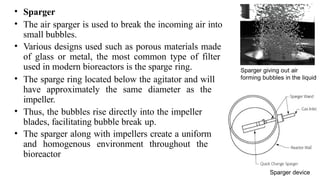
• Sparger
• The air sparger is used to break the incoming air into
small bubbles.
• Various designs used such as porous materials made
of glass or metal, the most common type of filter
used in modern bioreactors is the sparge ring.
• The sparge ring located below the agitator and will
have approximately the same diameter as the
impeller.
• Thus, the bubbles rise directly into the impeller
blades, facilitating bubble break up.
• The sparger along with impellers create a uniform
and homogenous environment throughout the
bioreactor
Sparger giving out air
forming bubbles in the liquid
Sparger device
• Effect of Impeller speed
• The shear forces that an impeller generates play a major role in determining
bubble size. If the impeller speed is too slow then the bubbles will not be
broken down.
3. Foam Control System
• Foam control is an essential element of the operation of a stirred
tank bioreactor.
• Excessive foam formation can lead to blocked air exit filters and
to build up of pressure in the reactor.
• The latter can lead to a loss of medium, damage to the reactor and
even injury to operating personnel.
• Foam is typically controlled with aid of antifoaming agents
based on silicone or on vegetable oils.
• Excessive antifoam addition can however result in poor
oxygen transfer rates.
The antifoam requirement will depend on
• The nature of the medium.
• The products produced by the fermentation.
• The aeration rate and stirrer speed.
• The use of mechanical foam control devices
• The head space volume
• Condenser temperature
 Alcohols; stearyl and octyl decanol
 Esters
 Fatty acids and derivatives (glycerides)
linseed oil, cottonseed oil, olive oil, castor oil,
sunflower oil, rapeseed oil and cod liver oil.
 Silicones
 Sulphonates
 Alkaterge C, oxazaline, poly-propylene
glycol.
4. Temperature control system
• The temperature control system consists of
– temperature probes
– heat transfer system
• Typically the heat transfer system will use a jacket to
transfer heat in or out of the reactor.
• The jacket is a shell which surrounds part of the reactor.
• The liquid in the jacket does not come in direct contact
with the fermentation fluid.
• An alternative to using jackets are coils.
• Coils have a much higher heat transfer efficiency than
jackets. However coils take up valuable reactor volume
and can be difficult to clean and sterilize.
5. pH control system
• The neutralizing agents used to control pH should be
noncorrosive and non-toxic to cells when diluted in the medium
• Potassium hydroxide is preferred to NaOH, as potassium ions
tend to be less toxic to cells than sodium ions. However KOH is
more expensive than NaOH. Sodium carbonate is also commonly
used in small scale bioreactor systems.
• Hydrochloric acid should never be used as it is corrosive even to
stainless steel.
• Sulphuric acid concentrations should not be above 10%, as above
this the sulphuric acid is most corrosive.
6. Cleaning and sterilization facilities
• Small scale reactors are taken apart and then cleaned before being re-
assembled, filled and then sterilized in an autoclave.
• Reactors with volumes greater than 5 litres cannot be placed in an
autoclave and sterilized. These reactors must be cleaned and sterilized
in place. This process is referred to "Clean in Place”.
• CIP involves the complete cleaning of not only the fermenter but also
all lines linked to the internal components of the reactor. Steam,
cleaning and sterilizing chemicals, spray balls and high pressure
pumps are used in these processes. The process is usually automated
to minimize the possibility of human error.
STERILISATION MET HODS
•
•
•
Heat sterilisation is the most commonly used for sterilisation of media or
vessels. Medium is sterilised at high heat and high pressure .
Medium can be sterilised by Filtration, Radiation, chemical treatment or heat.
STERILISATION MET HODS
• Heat: For sterilization, the type of heat, time of application and temperature required
to ensure destruction of all microorganisms must always be considered. Endospores
of bacteria are the most thermo-resistant of all cells so their destruction usually
guarantees sterility.
• Boiling: Boiling is done at >100˚C for 20-30 min. It kills everything except for some
endospores. To kill endospores and therefore perfectly sterilize the solution, very long
boiling is required.
• Autoclaving: Autoclaving is the process of using steam under pressure in an autoclave
or pressure cooker. It involves heating at 121˚C for 15-20 min under 15 psi pressure
and can be used to sterilize almost anything.
• Dry Heat (Hot Air Oven): The process involves heating at 160˚C for 2 hours or at 170˚C
for 1 hour. It is used for glassware, metal and objects that will not melt.
• Sterilization in industry-scale fermenters (or bioreactors) is more complex. Steam is
used to sterilize fermentation media sterilisation is the most commonly used for
sterilisation of media or vessels.
LARGE SCALE PRODUCTI ON FERMENTER DESIGN A N D ITS VARIOUS CONTROLS
An Industrial Aerobic Fermenter
Fermentation techniques
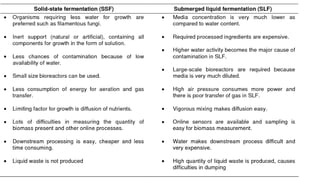
• Submerged Liquid Fermentations
• Solid-State Fermentation (SSF)
Submerged Liquid Fermentations
• traditionally used for the production enzymes
• involves submersion of the microorganism in an aqueous solution containing all
the nutrients needed for growth.
• Fermentation takes place in large vessels (fermenter) with volumes of up to
1,000 cub mtrs.
• Most industrial enzymes are secreted by microorganisms into the fermentation
medium in order to break down the carbon and nitrogen sources.
• Batch, fed batch and continuous mode
• In the fed batch mode, sterilised nutrients are added to the fermenter during the
growth of the biomass.
• In the continuous process, sterilised liquid nutrients are fed into the fermenter at the same flow
rate as the fermentation broth leaving the system.
• Parameters like temperature, pH, O2 consumption and CO2 formation are measured and
controlled to optimize the fermentation process.
• Next in harvesting enzymes from the fermentation medium one must remove insoluble products,
e.g. microbial cells. (centrifugation)
• most industrial enzymes are extracellular they remain in the fermented broth after the biomass
has been removed.
• The enzymes in the remaining broth are then concentrated by evaporation, membrane filtration or
crystallization
• For pure enzyme preparation, gel or ion exchange chromatography are used
Solid-State Fermentation (SSF)
• SSF is used for the production of bioproducts
from microorganisms under conditions of low
moisture content for growth.
• The SSF is alternative to submerged
fermentation for production of value-added
products like antibiotics, single cell protein,
PUFA’s, enzymes, organic acids, biopesticides,
biofuel and aroma production.
• Medium - solid substrate (e.g., rice bran, wheat
bran, or grain)
• fewer problems due to contamination
• Pros-power requirements are lower than
submerged fermentation.
• Cons -Inadequate mixing, limitations of nutrient
diffusion, metabolic heat accumulation, and
ineffective process control
•The most regularly used solid substrates are cereal grains
(rice, wheat, barley, and corn), legume seeds, wheat bran,
lignocellulose materials such as straws, sawdust or wood
shavings, and a wide range of plant and animal materials.
•Most of these compounds are polymeric molecules –
insoluble or sparingly soluble in water – but most are cheap
and easily obtainable and represent a concentrated source of
nutrients for microbial growth.
•The microbiological components of SSF can occur as single
pure cultures, mixed identifiable cultures or totally mixed
indigenous microorganisms.
•Some SSF processes e.g., tempeh and ontjom production,
requires selective growth of organisms such as molds that
need low moisture levels to carry out fermentation with the
help of extracellular enzymes secreted by fermenting
microorganisms.
•However, bacteria and yeasts, which require higher moisture
content for efficient fermentation, can also be used for SSF,
but with a lower yield.
Advantages of Solid State Fermentation (SSF)
• The main advantage of such methods is that it produces a minimum amount of
waste and liquid effluent thus not very damaging to the environment.
• Solid substrate fermentation employs simple natural solids as the media.
• Low technology, low energy expenditure and requires less capital investment.
• No need for sterilization, less microbial contamination, and easy downstream
processing.
• Utilization of agro-industrial residues as substrates in SSF processes provides an
alternative avenue and value-addition to these otherwise under- or non-utilized
residues.
• The yield of the products is reasonably high.
• Bioreactor design, aeration process, and effluent treatment are quite simple.
• Many domestic, industrial and agricultural wastes can be fruitfully used in SSF.
 Types of fermentation based on oxygen
requirements
• Aerobic fermentation
• Anaerobic fermentation
AEROBIC FERMENTATION
 A number of industrial processes, although called “
fermentations”, are carried out by microorganisms under
aerobic conditions.
 In older aerobic processes it was necessary to furnish a
large surface area by exposing fermentation media to air
 In modern fermentation processes aerobic conditions are
maintained in a closed fermenter with submerged
cultures.
 The contents of the fermenter are agitated with impellers
and aerated by forcing sterilized air.
• E.g. of aerobic fermentations are mushroom production, steroid
biotransformation, vaccine and vitamin production
ANAEROBIC FERMENTATIONS
 Basically a fermenter designed to operate under micro aerophilic
conditions will be the same as that designed to operate under
aerobic conditions, except that arrangements for intense agitation
and aeration are unnecessary.
 Many anaerobic fermentations do, however, require mild aeration
for the initial growth phase, and sufficient N agitation for mixing
and maintenance of temperature.
• Anaerobic fermentation can be carried out in closed airtight
fermentation systems
• E.g. acetone fementation, butanol fementation,ethanol fermentation,
glycerol fermentation, biogas plant
PROCESS
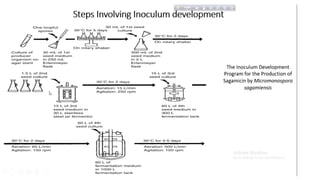
• Inoculum development
• Characteristics of proper inoculum
• 1. Healthy, active state thus minimizing the length of the lag phase in the
subsequent fermentation.
• 2. Available in sufficiently large volumes to provide an inoculum of optimum size.
• 3. In a suitable morphological form.
• 4. Free of contamination.
• 5. Have product-forming capabilities
‘Process adopted to produce an inoculum, meeting these criterias is called
inoculum development’
Steps in inoculum preparation:
small scale fermentation processes
• Preservation culture
• Generation culture on agar slants, this is then sub-cultured
to:
• Working culture
• At this stage microbes starts growing
• This culture is then used as inoculum in small scale fermentation
processes
• Medium formulation
• Must satisfy the nutritional needs of microbes
• Complete analysis is needed
• Formulating medium at lab scale can be done by adding main
ingredients like water, carbon source, nitrogen source, minerals
and other supplements in pure form
• Following criteria need to be satisfied for the material to be
treated as medium at industrial level.
• It should give maximum yield of product.
• It should give minimum yield of undesired product.
• It should be consistently available throughout the year.
• It should be cheap.
Microbe requires:
Water
Energy
Carbon Nitrogen
Mineral elements Vitamins
Oxygen
Major component of all fermentation.
• Ancillary services : heating, cooling, cleaning and rinsing.
• Suitable water:
• pH, dissolved salts
• Brewing: mineral content of the water.
• Reuse of water after fermentation –
• Oxidation of the medium components (carbohydrates,
lipids and proteins)
• light
• Carbohydrates
• Oils and fats
• Hydrocarbon and their derivatives
Carbohydrates
• Starch from maize, cassava, cereals, potatoes
• Barley grains – malt.
• Sucrose from sugar cane and sugar beet. Molasses –
high volume, low-value product. Lactose and crude
lactose
• Corn steep liquor.
• First used as carriers for antifoams in antibiotic
processes.
• Vegetable oils – olive, maize, cotton seed, lin seed,
soybean, etc.
• Used as carbon substrates.
• Also provides antifoaming property.
• Methly oleate – sole ‘c’source in cephalosporin
production.
• Methane, methanol and n-alkanes – substrates for biomass
production.
• N-alkanes – for the production of organic acids, amino acids,
vitamins and co-factors, nucleic acids, antibiotics, enzymes
and proteins.
• Scp from hydrocarbons:
• BP plc developed Toprina from yeast grown on n - alkanes.
• ICI plc developed pruteen from bacteria grown on methanol.
• Hoechst/UBHE (protein from bacteria on methanol)
• Shell plc (bacteria on methane).
Inorganic source and organic source Inorganic
Nitrogen:
1. Ammonia gas
2. Ammonium salts
3. Nitrates Organic nitrogen:
4. Amino acids
5. Protein
6. Urea
Protenaceous nitrogen compounds:
CSL, soya meal, peanut meal, cotton-seed meal, distiller’s
solubles, meal and yeast extract.
 Penicillin
 Bacitracin
 Riboflavin
 Novobiocin
 Rifomycin
 CSL
 Peanut granules
 Pancreatic digest of gelatine
 Distillers solubles
 Pharmamedia, soybean
meal, (NH4)2 SO4.
Best nitrogen source for some secondary metabolites
 KH2 PO4
 MgSO4. 7H20
 KCl
 CaCO3
 FeSo4. 4H2O
 ZnSO4. 8H20
 MnSo4. H2O
 CuSO4.5H2O
 Na2MoO4. 2H20
Product Trace elements
 Bacitracin
 Protease
 Gentamicin
 Riboflavin
 Chloramphenicol
 Citric acid
 Penicillin
 Patulin
 Mn
 Mn
 Co
 Fe, Co
 Fe, Zn
 Fe, Zn, Cu
 Fe, Zn, Cu
 Fe, Zn
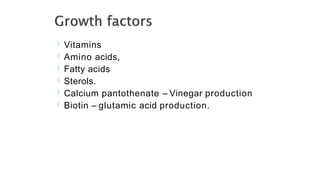
 Vitamins
 Amino acids,
 Fatty acids
 Sterols.
 Calcium pantothenate – Vinegar production
 Biotin – glutamic acid production.
 Calcium carbonate
 Phosphates
 Balanced use of C/N ratio controls pH
 pH can be controlled externally by adding
ammonia or sodium hydroxide and sulfuric
acid.
 Penicillin production – phenlyacetic acid – precursor
 Inducers: amylase – starch, maltose
 Pullulanase – maltose
 Penicillin acylase – phenlyacetic acid
 Proteases – various proteins
 Cellulase – cellulose
 Pectinases - pectin
Sterilization
Sterilization is a term referring to any process that eliminates (removes) or
kills all forms of life, including transmissible agents such as fungi,
bacteria, viruses, spore forms, etc.
There are many sterilizing agents e. g. steam, U.V. light, chemical
agents, etc.
Steam is preferred to other agents, because it is cheaper for mass
sterilization.
Sterilization removes infecting micro-organisms it can
also remove pathogenic micro-organisms or spoiling
agents.
Sterilization is accomplished either by chemical or
physical means.
Moist heat is a most common physical agent.
It allows for satisfactory industrial
sterilization.
The other method of sterilization is the removal
of infecting micro-organisms.
This is done by filtration. Numerous type of filter
papers are available for this purpose.
It depends on the-
(i)- The size of micro-organisms and
(ii)-The retention efficiency of the filter.
Usually sterilization of gases and biostatic
fluids is done by filtration.
Usually media are sterilized before they are inoculated.
Sterilization of media is decided by the chemical composition.
Sterilization of media may be done by one of the following three methods-
(i)-by boiling
(ii)-by passing live steam
(iii)-by subjecting the medium to steam under pressure(i.e. autoclaving)
Sterilization of media
The classical technique of making the medium sterile by the use of
steam may be carried out in two ways-
(i)-batch wise in fermentor and
(ii)-continuous sterilization
The vessel is equipped with a coil or jacket for heating and cooling.
Also the agitator may be fitted to aid heat- exchange.
 It is needed to raise the temperature of the medium to 1200C with
steam to maintain this for a period of 20 minutes before cooling the
system.
This is the simplest method of sterilizing production media.
i) BATCH WISE IN FERMENTOR
There is an interconnecting pipeline between
the batch cooker and the fermentor for
transferring the sterile medium from the cooker
to steam sterilized fermentor.
ADVANTAGE
The batch cooker method saves the production
time, since the fermentor is unoccupied between
two fermentor runs.
LIMITATION
It occupies increased plant
space.
It involve higher cost of the additional
equipment
required, and
It involves increased steam
usages.
CONTINUOUS STERILIZATION
This methods involves passing of production
medium through a heat exchanger, a
holding coil and a cooler.
The temperature of medium undergoing
sterilization is raised to the desired level in the
heat exchanger.
The medium is then passes on to a holding coil.
Where it is maintained at the sterilizing
temperature for a predetermined time period.
Finally the medium is rapidly cooled by
counter circulating it in the exchanger against
the cool input medium, and then against cold
water.
 In continuous sterilization the temperature
is higher than 1200C.
ADVANTAGES
It saves both production time and plant space.
It gives improved quality of the medium.
It involves some economy in steam cost.
It allows the use of lower sterilizing
temperature
or shorter holding period.
Fig. no. 1-Media sterilization.
15
Sterilization of air
With aerobic fermentation continuous supply
of sterile air is vital for successful
fermentation.
Air can be sterilized by many methods
namely- (i)-filtration
(ii)-heat
(iii)-electrostatic repulsion
(iv)-U.V. light
(iv)-chemical agents
86
The sterilization of air in fermentation
industries is widely carried out by the filtration
method.
For sterilizing large volumes of air was studied
by Terjesen and cherry.
They used a performed slab wool 3 inches thick.
The air velocity through the slab was kept
below 1ft./sec. to avoid channeling through the
slag wool material.
Fig. no. 2-Air sterilization.
18
Product isolation and purification
DOWNSTREAM PROCESSING
Downstream processing refers to the recovery and
purification of biosynthetic products, particularly
pharmaceuticals, from natural sources such as animal or
plant tissue or fermentation broth, including the recycling of
salvageable components and the proper treatment and
disposal of waste. It is an essential step in the manufacture
of pharmaceuticals such as antibiotics, hormones (e.g. insulin
and humans growth hormone), antibodies (e.g. infliximab
and abciximab) and vaccines; antibodies and enzymes used
in diagnostics; industrial enzymes; and natural fragrance and
flavor compounds.
 Cell disruption is an essential part of biotechnology and the
downstream processes related to the manufacturing of
biological products.
 The disruption of cells is necessary for the extraction and
retrieval of the desired products, as cell disruption
significantly enhances the recovery of biological products.
 Mechanical
 Non-mechanical
 Bead mill- The main principle requires a
jacketed grinding chamber with a rotating
shaft, running in its center.
 Agitators are fitted with the shaft, and
provide kinetic energy to the small beads
that are present in the chamber. That makes
the beads collide with each other causing
disruption
 Ultrasound- Ultrasonic disruption
is caused by ultrasonic vibrators
that produce a high frequency
sound with a wave density of
about 20 kHz/s.
 A transducer then converts the
waves into mechanical
oscillations through a titanium
probe, which is immersed into
the cell suspension. Such a
method is used for both bacterial
and fungal cell disruption.
 Thermolysis- use of heat to disrupt the cell membrane.
 Periplasmic proteins in G(-) bacteria are released when the
cells are heated up to 50ºC.
 Cytoplasmic proteins can be released from E.coli within
10min at 90 ºC.
 Freezing and thawing of a cell slurry can cause the cells to
burst due to the formation and melting of ice crystals.
 Decompression- During explosive decompression, the cell
suspension is mixed with pressurized subcritical gas for a
specified time, depending on the cell type.
 The gas enters the cell and expends on release, causing
the cell to burst. Gases like carbon dioxide can be used
 Osmotic shocks- here
cells are first exposed to
either high or low salt
concentration.Then the
conditions are quickly
changed to opposite
conditions which leads to
osmotic pressure and
cell lysis.
 In addition to physical and mechanical methods,
several chemical methods for cell disruption
exist. These methods rely on utilization of
chemical substances or enzymes in disruption
process.
 The mechanisms of actions are multiple, but the
most widely used methods act by destroying the cell
wall by enzymes, osmotic pressure, or by interfering
or precipitating cell wall proteins.
 Detergents-
Detergents that are
used for disrupting
cells are divided
into anionic,
cationic and non-
ionic detergents.
 The common
thing for all
detergents is that
they directly
damage the cell
wall or membrane,
and this will lead to
release of
intracellular
content.
 Solvents- Solvents which can be used for cell
lysis include for example some alcohols,
dimethyl sulfoxide, methyl ethyl ketone or
toluene.
 These solvents extract cell wall’s lipid
components which leads to release of
intracellular components.
• Enzymes- Use of enzymes depending on the cell wall composition
• Use of digestive enzyme decomposes the microbial cell wall.
• Used enzyme depends on microbe.
3
2
Lysozyme is
commonly used
enzyme to
digest cell wall
of gram
positive
bacteria.
It hydrolyzes
β- 1-4-
glucosidic
bonds in the
peptidoglycan
8/4/2017
 Liquid -liquid extraction (LLE) is the process of separation of a
liquid mixture of components where liquid solvents are used
followed by dilution of one or more components of the initial
mixture.
 This downstream process is significantly useful in Bioprocess
technology.
 This is a unit process which requires the knowledge of phase
behavior and physicochemical characterization of different
compounds.
 In liquid-liquid extraction, components in the
fed material, consisting of liquid phases are
separated when third liquid also known as
solvent is added to the process.
 By adding this new component which is
insoluble in the feed, a new phase is formed.
 The component which is more important
during the extraction or which is the desired
component to be extracted during the
process is transferred to extract.
1. FERMENTAION AND ALGAE BROTH
2. REMOVAL OF HIGH ORGANIC WASTES FROM
WASTEWATER
3. REMOVAL OF CARBOXYLIC ACID
4. PROTEIN SEPERATION AND PURIFICATION
5. ESSENTIAL OIL EXTRACTION
6. FOOD INDUSTRY APPLICATION
PRECIPITATION
■ Formation of a solid in a solution during a
chemical reaction.
■ Solid formed is called the precipitate and the
liquid remaining above the solid is called the
supernate.
■ It is the most commonly used technique in
industry for the concentration of
macromolecules.
■ It can also be employed for the removal of
certain unwanted by-products.
■ Neutral salts, organic salts, alteration in
temperature and pH are used in precipitation.
■ Precipitation of protein is widely used in downstream
processing in order to concentrate proteins
and purify them from various contaminants.
■ Protein precipitation can be – non-specific protein
precipitationand protein specific precipitation
■ Protein specific precipitation –
■ e.g.- affinity precipitation- ligand precipitation
SOLID-LIQUID SEPARATION
■ the separation of cells from the culture broth,
removal of cell debris, collection of protein
precipitate, etc.
■ The term harvesting of microbial cells are used
for the separation of cells from the culture
medium.
■ Several methods used for solid-liquid
separation are –
■ flotation
■ flocculation
■ filtration
■ centrifugation
FLOTATION
■ When gas is introduced into the liquid broth, it
forms bubbles.
■ The cells and other solid particles get absorbed on
gas bubbles.
■ These bubbles rise to the foam layer which can
be collected and removed.
■ Certain substances called as collector
substances are used to facilitate stable foam
formation.
■ Collector substances used are like – long chain
fatty
acids
FLOCCULATION
■ In flocculation, the cells or cell debris form large aggregates to settle
down for easy removal.
■ The process of flocculation depends on the nature of cells and the ionic constituents
of the medium.
■ Sometimes flocculating agents are also used to achieve appropriate flocculation.
■ Some flocculating agents are – inorganic salts, organic polyelectrolyte, mineral
hydrocolloid.
FILTRATION
■ Filtration is the most commonly used technique for separating the
biomass and culture filtrate.
■ The mixture goes through a filter which retains the particles according to
size while allows the passage of fluid through the filter.
■ The efficiency of filtration depends on many factors – size of
the organism, viscosity of the medium, temperature.
■ Several filters are in use like – depth filter
absolute filter
rotary drum vacuum
filter membrane filter
FILTERS USED
DEPTH FILTERS ABSOLUTE FILTERS
ROTARY DRUM VACUUM
FILTERS
MEMBRANE FILTERS
 Filtration is used at various stages of the downstream
processing in the bioreactor harvest as well as
processing of purified products.
 Several filtration process are used. Most common ones
are-
1. Microfiltration - used at the start of the
downstream process to clarify the feed
2. Ultrafiltration – used between chromatography steps
to concentrate the product and change the buffer
conditions
3. Reverse Osmosis- use of pressure for osmosis
CENTRIFUGATION
■ Separation by means of the accelerated gravitational
force achieved by a rapid rotation.
■ Relies on the density difference between the particles
and the surrounding medium.
■ Most effective when the particles to be separated are
large, the liquid viscosity is low and the density
difference between particles and fluid is great.
■ Batch centrifuge is common in the labs but the low
processing capacity limits its use in large scale.
■ Continuous centrifuges are common in large-scale
processing in which the deposited solids are removed
continuously or intermittently.
TUBULAR BOWL CENTRIFUGE
■ High speed
■ Length diameter ratio 4.8
■ 15000r.p.m.
■ Used widely in emulsion
■ Used in solid with small amount
■ Can be run in both batch or continuous mode
CHROMATOGRAPHY
 ‘Chromatography’ is an analytical technique commonly used for separating a
mixture of chemical substances into its individual components, so that the
individual components can be thoroughly analyzed
 The mixture is dissolved in a fluid called the mobile phase, which carries it
through a structure holding another material called the stationary phase
 Chromatography is used in downstream processing to effectively purify the
biological products (proteins, pharmaceuticals, diagnostic compounds and
research materials)
 There are many types of chromatography e.g., liquid chromatography, gas
chromatography, ion-exchange chromatography, affinity chromatography, but all of
these employ the same basic principles
PRINCIPLE
 Chromatography is based on the principle of separation of compounds
into different bands (color graphs) and then identification of those
bands.
 The preferential separation is done due to differential affinities of
compounds towards stationary and mobile phase. After separation of
the compounds, they are identified by suitable detection methods.
 The differences in affinities arise due to relative adsorption or
partition coefficient in between components towards both the phases.
CHROMATOGRAPHIC TECHNIQUES
•CHROMATOGRAPHY
• GEL – FILTRATION ( size exclusion)
• ION EXCHANGE
• CHROMATOFOCUSSING
• AFFINITY
• HYDROPHOBIC INTERACTION
• IMMOBILIZED METAL ION-AFFINITY
PRINCIPLE
SIZE AND
SHAPE NET
CHARGE NET
CHARGE
BIOLOGICAL
AFFINITY AND
MOLECULAR
RECOGNITION
POLARITY
METAL ION
BINDING
Based on shape of
chromatographic beds
Chromatography
Plana
r
Pape
r
Thin Layer
(TLC)
Colum
n
GAS
(GC
)
Liquid
(LC)
Planar Chromatography
 In Planar Chromatography stationary phase is
present on a plane.
 The Plane can be a paper impregnated by a
substance acting as a stationary phase- Paper
Chromatography OR a Thin layer of a substance
acting as a stationary phase spread on a glass, metal
or plastic plate- Thin Layer Chromatography.
 Planar chromatography is also termed as Open Bed
Chromatography.
Paper Chromatography
 Paper chromatography is a liquid partition chromatography.
 In paper chromatography, the end of the paper
is dipped in solvent mixture consisting of aqueous
and organic components.
 The solvent soaks in paper by capillary action
because of fibrous nature of paper.
 The aqueous component of the solvent binds to
the cellulose paper and thereby forms stationary
phase with it .
 The organic component of the solvent binds continues
migrating, thus forming the mobile phase.
Mechanism of Separation
 Mobile Phase rises up by capillary action.
 Testing sample is concentrated as a minute spot at the bottom of the
filter paper.
 Sample mixture gradually rises up with the mobile phase which is liquid.
 Compounds in the mixture will be separated according to their ability of
solubility.
 More Polar substances will move slower and less polar substances will
travel faster.
Procedure
 A small spot of sample is applied to a strip of chromatography paper about
two centimeters away from the
base of the plate.
 This sample is absorbed onto the paper
and may form interactions with it.
 The paper is then dipped into a solvent,
such as ethanol or water, taking care
that the spot is above the surface of
solvent , and placed in a sealed
the
container
.
 The solvent moves up the paper by capillary action and dissolves the
sample mixture, which will then travel up the paper with the solvent solute
sample.
 Different compounds in the sample mixture travel at different rates .
 It takes several minutes to several hours.
 Analysis- Spots corresponding to different compounds may be located
by their color, UV light, Ninhydrin or by treatment with iodine vapors.
Significance of Paper
Chromatography
 It is very easy, simple , rapid and highly efficient method of
separation.
 Can be applied in even in micrograms quantities of the
sample.
 Can also be used for the separation of a wide variety of material
like amino acids , oligosaccharides, glycosides, purines and
pyrimidines, steroids, vitamins and alkaloids like penicillin ,
tetracyclin and streptomycin.
Thin Layer Chromatography (TLC)
•  Stationary Phase consists of a thin layer of adsorbent
material, usually silica gel , aluminium oxide, or cellulose
immobilized onto a flat carrier sheet.
•  A Liqiud Phase consisting of the solutio to be
separated which is dissolved in
• an appropriate solvent and is drawn up the plate via capillary
action , separating the solution based on the polarity of the
compound.
n
Steps of
TLC
Significance
Its wide range uses include -
 Determination of the pigments a plant contains.
 Detection of pesticides or insecticides in food .
 Identifying compounds present in a given substance.
 Monitoring organic reaction.
Advantages Of TLC over Paper
Chromatography
 In case of Paper Chromatography, it takes 14- 16 hrs for the separation of
the components, but in TLC , it takes only 3-4 hrs.
 TLC has the advantage that the corrosive reagents like sulphuric acid can
also be used which pose a limitation for the paper chromatography.
 It is easier to separate and visualise the components by this method.
 It has capacity to analyse multiple samples in a single run.
 It is relatively a low cost.
RF value -
 The rate of migration of the various
substances being separated are governed by
their relative solubilities in the polar
stationary phase and non polar mobile phase.
 The migration rate of a substances usually
expressed as Rf (relative front).
 Rf = Distance travelled by the substance/
Distance travelled by the solvent front
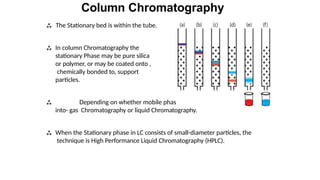
Column Chromatography
 The Stationary bed is within the tube.
 In column Chromatography the
stationary Phase may be pure silica
or polymer, or may be coated onto ,
chemically bonded to, support
particles.
 Depending on whether mobile phase is a gas or a liquid it is divided
into- gas Chromatography or liquid Chromatography.
 When the Stationary phase in LC consists of small-diameter particles, the
technique is High Performance Liquid Chromatography (HPLC).
Adsorption
Chromatography
Principle
 Certain solid materials, collectively known as adsorbents, have the ability to hold
molecules at their
surface.
 This adsorption process,
which involves weak, non-ionic
attractive forces of the van der
Waals’ and hydrogen-bonding type,
occur at specific adsorption sites.
 Silica is a typical adsorbent. It has
silanol (Si-OH) groups on its surface,
which are slightly acidic, and can
interact with polar functional
groups of the
analyte or eluent.
 Other commonly used adsorbents
are alumina and carbon.
Size Exclusion
Chromatography
Principle-
 The separation of molecules on the basis of their molecular size and shape
exploits the molecular sieve properties of a variety of porous materials.
Gel Permeation Chromatography
 Size exclusion chromatography includes :- and Gel Filteration Chromatography.
 A column of microparticulate cross-linked copolymers generally of either
styrene or divinylbenzene and with a narrow range of pore sizes is in
equilibrium with a suitable mobile phase for the analytes to be separated.
 Large analytes that are completely excluded from the
pores will pass through the interstitial spaces between
the particles and will appear
first in the eluate.
 Smaller analytes will be
distributed between the
mobile phase inside and
outside the particles and will
therefore pass through the
column at a slower rate,
hence appearing last in the
eluate.
Applications
It can be used for :-
 Fractionation of molecules and complexes within a
predetermined size range .
 Size analysis and determination
 Removal of large proteins and complexes
 Buffer exchange
 Desalting
 Removal of small molecules such as nucleotides ,
primers, dyes and contaminants
 Assesment of sample purity
 Separation of bound and unbound radioisotopes.
Penicillin Production by fermentation
• Alexander Fleming, 1952
Chains of conidia (spores)
produced by hyphal branch
from mycelium
Mechanism : Penicillium fungi blocks the growth of gram positive bacteria
in culture
The strain
Penicillium chrysogenum Penicillium notatum
Mold conidiophores, fruiting structures, sporangia, conidia, and asexual spores of Penicillium notatum, also known as Penicillium chrysogenum.
The mold is commonly found in homes, is used in the production of green- and blue-mold cheese, and is used to produce the antibiotic
penicillin. Penicillin was the first antibiotic to be discovered by Alexander Fleming. Magnification of X600
•
More than fifty years have passed since penicillin was first produced in volume
Mechanism of
antibiotics
Inhibition of Bacterial Cell Wall
Synthesis
• large fermenting vats which can hold 10,000 gallons of liquid. The
network of pipes keep the temperatures constant during the process of
making Penicillin
Penicillin synthesis
involves:
1. Media
2. Inocula preparation
3. Process and control parameters (ph, Aeration ,
Agitation , Temp etc)
4. Downstream processing (Recovery and Purification)
Media
Component Concentration(gm/ltr)
Cornsteep liquor 21.88
(NH4)2SO4 10.70
KH2PO4 2.74
Sodium phenyl acetate 15.90
Glucose 81.90
MgSO4
7H2
O,CaCO3,
antifoam
oil
qs
•
•
Total Composition of Typical Media:
Solids (40-60%), lactic acid (12-27%),total nitrogen(7.4-7.8%) , amino
nitrogen(2.6-3.3%),reducing sugars as glucose (1.5-
14%)magnmasum(18-20%).
Carbon source: Lactose in concentration of 6% satisfactory.
Cornsteep (greatly enhances the yield of penicillin ). And/or one of
the protein rich oil cakes like cotton seed and groundnut.
One or more sugars like lactose, sucrose and glucose and glucose
along with a vegetable oil like soybean oil, groundnut oil
Nitrogen source : Sodium nitrate,ammonium sulphate,ammonium
acetate, ammonium lactate,cornsteep liquor etc.serve as N-source
•
•
•
• Amino acids such as L-cystine,L-cysteine and valine are important in
the synthesis of the b-lactum thiazolidine ring system of the penicillins.
Mineral salts including sources of sulphate and phosphate
Precursors are used to increase the yield of penicillin by the
fermentation The requisite precursor, eg. phenylacetic acid,phenoxy
acetic acid and phenylacetamide are commonly used as precursors.
•
•
Inoculation methods
• Various media employed in the manufacture of penicillin can be
inoculated by several methods, like ..
surface culture :surface of the medium is inoculated with dry spores.
the spore material is applied in such a way as to cover the surface
as uniformly as possible.
submerged culture : production medium is inoculated with dry spores,by
pellet inocula or by ungerminated spores can be prepared in sterile
0.1% soap solutions, in sterile water containing 100 ppm of sodium
lauryl sulphonate.pellet inoculation saves time in the production stage.
pellet inocula are prepared by growing mycelium from mold spores
under submerged conditions.
Fermenter
Fed-Batch Penicillin Production
Conditions of fermentation
•
•
Optimum Temperature : 25 O
C.
Optimum ph Range: 5 to 7.5, lower ph range yield penicillin
substantially lower
Buffering agent : Calcium carbonate , however it is not suitable in
surface culture production as it decreases the growth of the molds
and the yield of penicillin.P.chrysogenum being strictly aerobic,
Rate of Aeration: adequate aeration of the fermenter is essential, rate
vary from around 0.5 volume of air/volume of liquid/minute.,
Effectiveness may be enhanced by increase in pressure of abt 20lb/sq
inch.
Aeration rate is also attained by the use of proper type of stirrer and
at correct speed.
Antifoam agents such as tributyl citrate, octadecanol, and lard oil,
prevent excessive foam formation during the production of penicillin
by submerged culture method.
Prevention of contamination during the production of penicillin is
essential because contamination usually causes rapid destruction
of penicillin.
Sterilization of facilities and media are easily achieved through
steam.
•
•
•
•
•
•
Isolation and Purification
 The first step is the recovery process is the removal of mycelium or cells by
 filtration or centrifuging.
 Second step is to remove the antibiotic from the spent production medium by
solvent extraction, adsorption or precipitation.
 Additional solvent extraction,distillation,sublimation, column
chromatography or other methods accomplish purification.
 Semi-synthetic penicillins.
 Semi synthetic such as penicillin such as Ampicillin, Methicillin, Oxocillin,
Propicllin are prepared by chemical acylation of 6-aminopenicillanic acid.
Ethanol production
ETHANOL- GRAIN ALCOHOL/ ETHYL
ALCOHOL
• Ethanol is a volatile, flammable, colorless
liquid with a slight chemical odor.
• It is used as an antiseptic, a solvent, and a
fuel.
ETHANOL FERMENTATION
• A biological process in which sugars such as glucose, fructose,
and sucrose are converted into cellular energy and thereby
produces ethanol and CO2 as metabolic waste products.
• It is an anaerobic process.
• Performed by microbes such as yeast and bacteria.
• The type of the organism chosen mostly depends on the
nature of the substrate used.
• Among the yeast, Saccharomyces cerevisiae is the most
commonly used, while among the bacteria, Zymomonas
mobilis is the most frequently employed for ethanol
production.
SUBSTRATES FOR ETHANOL
PRODUCTION
• The substrates are chosen based on the regional availability
and economical efficiency.
• Categories of substrates are :
SUCROSE
CONTAININ
G
MATERIALS
Sugarcane
Sugar beet
Sugar sorghum
STARCHY
MATERIALS
Corn
Other starchy
materials( sweet
potato, wheat etc.)
LIGNOCELLULOSI C AND
CELLULOSIC MATERIALS
Maize silage
Barley hull
Paper sludge
Wood etc
MICROORGANISMS INVOLVED
• Microorganisms such as yeasts and bacteria play an essential
role in ethanol production by fermenting a wide range of
sugars to ethanol.
• They are used in industrial plants due to valuable properties in
ethanol yield (>90.0% theoretical yield), ethanol tolerance
(>40.0 g/L), ethanol productivity (>1.0 g/L/h), growth in
simple, inexpensive media and undiluted fermentation broth
with resistance to inhibitors and retard contaminants from
growth condition.
• These microorganisms provide the enzymes needed to
catalyze
the reaction.
Saccharomyces cerevisiae
• zymomonas mobilis
high specific growth rate (0.27).
high ethanol tolerance up to 130g/l.
a broad pH range for production (pH 3.5-
7.5).
consumes glucose faster than s.cerevisiae,
leading to higher ethanol productivity.
anaerobic carbohydrate metabolism is
carried out through the Entner- Doudoroff
pathway, where only one mole of ATP is
produced per mole of glucose used, thus
reducing the amount of glucose that is
converted to biomass rather than ethanol.
specific growth rate of 0.13.
can tolerate high concentrations of
ethanol .
ethanol production is coupled with
yeast cell growth
by- products like glycerol, organic acids,
are also produced.
uses the Embden-Meyerhof Pathway,
generating 2 moles of ATPs under
anaerobic conditions.
SOME PROPERTIES OF MICROORGANISMS USED IN FERMENTATION
BIOCHEMISTRY OF THE REACTION
PROCESS OF ETHANOL PRODUCTION
• The proces is carried out in a fermenter/ bioreactor.
•There are five basic steps for ethanol production. These are-
1.Pretreatment of raw materials
 depends on the chemical composition of the raw material/substrate,
 sugary raw materials require mild or no pretreatment,
 cellulosic and lignocellulosic materials need extensive pretreatment,
 involves Liquefaction and Saccharification.
2. Preparation of nutrient solution (media)
 media composition must contains specific nutrients, such as trace
elements, vitamins, nitrogen, phosphorus, growth regulators etc.
fermentation performance of the microbes highly depends on the composition of media.
thermotolerant vitamins ( inositol, pantothenic acid, and biotin) are required to obtain rapid
fermentation and high ethanol levels.
Process contd…
• 3. Preparation Of Inoculum
 INOCULUM :
 a small amount of substance containing bacteria or any other
micoorganism from a pure culture which is used to start a new culture.
 the desired organism is isolated and organisms are first cultured in flasks
under aerobic condition to increase the size of the inoculum.
Process contd…
4. Fermentation process
•For the production of ethanol to occur properly, following conditions should be
maintained-
1.Fermentation conditions-
Temperature : a moderate temperature of 25ᵒC to 50ᵒC [ if the temperature is too low, the
yeast will be inactive and if it is too high, the enzymes in the yeast will be denatured and
will stop working]
pH : 4.0-4.5
Sugar concentration : higher glucose concentration rate does not enhance the
production of ethanol due to substrate inhibition at a higher glucose concentration in
the system.
2.Intrinsic Factors-
 Culture medium
 Dissolved Oxygen : Aeration is initially required for good growth of the organisms. Later,
anaerobic conditions are created by withdrawal of oxygen coupled with production of CO2.
 Immobilization
 Other micronutrients.
Process contd…
•production of biomass in aerobic conditions and production of ethanol in
anaerobic conditions.
•As the fermentation is complete, the fermentation broth contains ethanol in
the range of 6-9% by volume. This represents about 90-95% conversion of
substrate to ethanol.
Corn Fermenter Ethanol
Process contd…
5. Recovery of ethanol
 Energy demanding step.
 Fermentation by-products are mostly removed by distillation.
Distillation is the most dominant and recognized industrial
purification technique .
It utilizes the differences of volatilities of components in a
mixture.
Principle : by heating a mixture, low boiling point
components are concentrated in the vapor phase. By
condensing this vapor, more concentrated less volatile
compounds is obtained in liquid phase.
• It involves two main problems:
 Separation of volatile compounds- impurities with similar boiling
points to ethanol lodges in ethanol even after distillation.
 Cost
 We cannot completely separate ethanol from water since they are
strongly bound to each other due to the presence of -OH group in both
of them ( ethanol and water).
 An additional method must be utilized to remove all the water from
ethanol ( since the ethanol fraction contains about 5% water and 95%
ethanol) : DEHYDRATION.
 material used in this is called ZEOLITE.
 Zeolite absorbs the water into it, but the ethanol will not go into the
zeolite
( because the pore sizes of zeolite are too small to allow the ethanol to
enter.)
Diagrammatic view of process-
ETHANOL AS A BIOFUEL
• Ethanol fuel is cost effective compared to other
biofuels.
• Ecologically effective.
• Minimizes global warming
• Easily accessible
• Minimizes dependence on fossil fuels
• Contributes to creation of employment to the
country
• Opens up untapped agricultural sector
• Variety of sources of raw material
• Ethanol is classified as a renewable energy
source

Fermentation process_downstream processing

  • 1.
    Fermentation processes and fermenter 2.1Design of a fermentor: Stirred Tank Fermentor- Basic Design; Parts of a Typical Industrial Fermentor. Fermentation Media: Components; Design andOptimization. 2.2 Sterilization: Sterilization of Fermentor and FermentationMedia. 2.3 Process Parameters: pH, Temperature, Aeration, Agitation, Foam,etc. 2.4 Types of Fermentation: Surface and Submerged, Batch and Continuous,Aerobicand Anaerobic. 2.5 Product Isolation and Purification. 2.6 Study of Representative Fermentation Processes: Outline of Penicillin and Ethanol Production by fermentation along with a flow-diagram.
  • 2.
    BASIC STEPS OFFERMENTATION PROCESS A N D GENERAL REQUIREMENTS 1. Formulation of fermentation media: it is chemically a cell culture media which is a mixture of molecules used for cellular metabolism and growth. e.g. Carbon source, energy source, oxygen, nitrogen etc. 2. Sterilisation: sterilisation of fermentation media, Fermenters and other equipments. 3. Inoculum formation: production of an active , pure culture In su cient ffi quantity to inoculate into the production vessel. 4. Fermentation: growth of the micro-organism in the production fermenter under optimum conditions for formation of by-products. 5. Extraction and purification of the product. Figure shows the upstream fermentation process
  • 5.
  • 6.
  • 8.
    Modes of fermentation •Batch • Fed batch • Continuous
  • 9.
    •Batch culture techniqueis also called as closed system of cultivation. •In this technique at first nutrient solution is prepared and it is inoculated with inoculum and then nothing is added in the fermentation tank except aeration. •In batch culture, neither fresh medium is added nor used up media is removed from the cultivation vessel. Therefore, volume of culture remains same. •Since fresh media is not added during the course of incubation, concentration of nutrition decreases continuously. •Furthermore, various toxic metabolites also accumulates in the culture vessel. Therefore, batch culture technique gives characteristics microbial kinetics (growth curve) with lag phase, log phase, stationary phase and decline phase.
  • 11.
    •Fed-batch culture •semi-closed systemof cultivation. •a particular nutrient is added at intervals without removing the used up media •so the volume of culture increases continuously •nutrients are kept in lower concentration initially and it is added slowly and continuously during the course of fermentation.
  • 12.
    •Continuous culture technique •opensystem of cultivation. •fresh sterile medium is added continuously in the vessel and used up media with bacterial culture is removed continuously at the same rate. •So, the volume and bacterial density remain same in the cultivation vessel. •In this technique, bacteria grow continuously in their log phase. This type of growth is known as steady state growth. •The cell density in continuous culture remains constant and it is achieved by maintaining constant dilution and flow rate.
  • 13.
  • 15.
    Fermenter: • A Fermenteris a device that accomplishes the fermentation process by the help of certain microorganisms, and thus it also refers as “Biofermenter or Bioreactor“. it is equipped with all the elements that are necessary to carry out the commercial production of substances like antibiotics, enzymes, beverages etc. in many industries. Basic design of fermenter BASIC DESIGN OF FERMENTER
  • 16.
  • 17.
    • A fermenteris to provide a suitable environment in which an organism can efficiently produce a target product that may be cell biomass, a metabolite or bioconversion product. • A stirred tank reactor will either be approximately cylindrical or have a curved base • A curved base assists in the mixing of the reactor contents. • The performance of any fermenter depends on many factors, but the key physical and chemical parameters that must be controlled are agitation rate, oxygen transfer, pH, temperature and foam production.
  • 18.
    • A mechanicallystirred tank bioreactor fitted with a sparger and a rushton turbine. • A bioreactor is divided in a working volume and a headspace volume. • The working volume is the fraction of the total volume taken up by the medium, microbes, and gas bubbles and the remaining volume is called the headspace. • Typically, the working volume will be around 60% of the total fermenter volume.
  • 19.
    Basic features ofa stirred tank bioreactor 1. An agitator system 2. An oxygen delivery system 3. A foam control system 4. A temperature control system 5. A pH control system 6. Sampling ports 7. A cleaning and sterilization system. 8. A sump and dump line for emptying of the reactor
  • 20.
    Diagram of astirred tank reactor.
  • 21.
    1. Agitation System •The function of the agitation system is to : – provide good mixing and thus increase mass transfer rates through the bulk liquid and bubble boundary layers. – provide the appropriate shear conditions required for the breaking up of bubbles. • The agitation system consists of the agitator and the baffles. • The baffles are used to break the liquid flow to increase turbulence and mixing efficiency.
  • 22.
    • The agitatorconsists of an impeller attached to a long rod called shaft. The number of impellers will depend on the height of the liquid in the reactor. Each impeller will have between 2 and 6 blades • Speed control or speed reduction devices are used to control the agitation speed. • Depending on the installation of the shaft in the fermentor, it is differentiated as Top entry and Bottom entry impellers.
  • 23.
    2. Oxygen deliverysystem The oxygen delivery system consists of 1. Compressor 2. Inlet air filter 3. Air Sparger 4. Exit air filter
  • 24.
    • A compressorforces the air into the reactor. The compressor will need to generate sufficient pressure to force the air through the filter, sparger holes and into the liquid. • The air should be dry and oil free so as to not block the inlet air filter or contaminate the medium. • Sterilization of the inlet air is undertaken to prevent contaminating organisms from entering the reactor. • The exit air on the other hand is sterilized not only to keep contaminants from entering but also to prevent organisms in the reactor from contaminating the air. • A common method of sterilizing the inlet and exit air is filtration. • A disk shaped hydrophobic Teflon membranes of polypropylene are used. Teflon is tough, reusable and does not readily block. • Heat sterilization is alternative option. Steam can be used to sterilize the air.
  • 25.
    • Sparger • Theair sparger is used to break the incoming air into small bubbles. • Various designs used such as porous materials made of glass or metal, the most common type of filter used in modern bioreactors is the sparge ring. • The sparge ring located below the agitator and will have approximately the same diameter as the impeller. • Thus, the bubbles rise directly into the impeller blades, facilitating bubble break up. • The sparger along with impellers create a uniform and homogenous environment throughout the bioreactor Sparger giving out air forming bubbles in the liquid Sparger device
  • 26.
    • Effect ofImpeller speed • The shear forces that an impeller generates play a major role in determining bubble size. If the impeller speed is too slow then the bubbles will not be broken down.
  • 27.
    3. Foam ControlSystem • Foam control is an essential element of the operation of a stirred tank bioreactor. • Excessive foam formation can lead to blocked air exit filters and to build up of pressure in the reactor. • The latter can lead to a loss of medium, damage to the reactor and even injury to operating personnel. • Foam is typically controlled with aid of antifoaming agents based on silicone or on vegetable oils. • Excessive antifoam addition can however result in poor oxygen transfer rates.
  • 28.
    The antifoam requirementwill depend on • The nature of the medium. • The products produced by the fermentation. • The aeration rate and stirrer speed. • The use of mechanical foam control devices • The head space volume • Condenser temperature
  • 29.
     Alcohols; stearyland octyl decanol  Esters  Fatty acids and derivatives (glycerides) linseed oil, cottonseed oil, olive oil, castor oil, sunflower oil, rapeseed oil and cod liver oil.  Silicones  Sulphonates  Alkaterge C, oxazaline, poly-propylene glycol.
  • 30.
    4. Temperature controlsystem • The temperature control system consists of – temperature probes – heat transfer system • Typically the heat transfer system will use a jacket to transfer heat in or out of the reactor. • The jacket is a shell which surrounds part of the reactor. • The liquid in the jacket does not come in direct contact with the fermentation fluid. • An alternative to using jackets are coils. • Coils have a much higher heat transfer efficiency than jackets. However coils take up valuable reactor volume and can be difficult to clean and sterilize.
  • 31.
  • 32.
    • The neutralizingagents used to control pH should be noncorrosive and non-toxic to cells when diluted in the medium • Potassium hydroxide is preferred to NaOH, as potassium ions tend to be less toxic to cells than sodium ions. However KOH is more expensive than NaOH. Sodium carbonate is also commonly used in small scale bioreactor systems. • Hydrochloric acid should never be used as it is corrosive even to stainless steel. • Sulphuric acid concentrations should not be above 10%, as above this the sulphuric acid is most corrosive.
  • 33.
    6. Cleaning andsterilization facilities • Small scale reactors are taken apart and then cleaned before being re- assembled, filled and then sterilized in an autoclave. • Reactors with volumes greater than 5 litres cannot be placed in an autoclave and sterilized. These reactors must be cleaned and sterilized in place. This process is referred to "Clean in Place”. • CIP involves the complete cleaning of not only the fermenter but also all lines linked to the internal components of the reactor. Steam, cleaning and sterilizing chemicals, spray balls and high pressure pumps are used in these processes. The process is usually automated to minimize the possibility of human error.
  • 34.
    STERILISATION MET HODS • • • Heatsterilisation is the most commonly used for sterilisation of media or vessels. Medium is sterilised at high heat and high pressure . Medium can be sterilised by Filtration, Radiation, chemical treatment or heat.
  • 35.
    STERILISATION MET HODS •Heat: For sterilization, the type of heat, time of application and temperature required to ensure destruction of all microorganisms must always be considered. Endospores of bacteria are the most thermo-resistant of all cells so their destruction usually guarantees sterility. • Boiling: Boiling is done at >100˚C for 20-30 min. It kills everything except for some endospores. To kill endospores and therefore perfectly sterilize the solution, very long boiling is required. • Autoclaving: Autoclaving is the process of using steam under pressure in an autoclave or pressure cooker. It involves heating at 121˚C for 15-20 min under 15 psi pressure and can be used to sterilize almost anything. • Dry Heat (Hot Air Oven): The process involves heating at 160˚C for 2 hours or at 170˚C for 1 hour. It is used for glassware, metal and objects that will not melt. • Sterilization in industry-scale fermenters (or bioreactors) is more complex. Steam is used to sterilize fermentation media sterilisation is the most commonly used for sterilisation of media or vessels.
  • 36.
    LARGE SCALE PRODUCTION FERMENTER DESIGN A N D ITS VARIOUS CONTROLS An Industrial Aerobic Fermenter
  • 37.
    Fermentation techniques • SubmergedLiquid Fermentations • Solid-State Fermentation (SSF)
  • 38.
    Submerged Liquid Fermentations •traditionally used for the production enzymes • involves submersion of the microorganism in an aqueous solution containing all the nutrients needed for growth. • Fermentation takes place in large vessels (fermenter) with volumes of up to 1,000 cub mtrs. • Most industrial enzymes are secreted by microorganisms into the fermentation medium in order to break down the carbon and nitrogen sources. • Batch, fed batch and continuous mode • In the fed batch mode, sterilised nutrients are added to the fermenter during the growth of the biomass.
  • 39.
    • In thecontinuous process, sterilised liquid nutrients are fed into the fermenter at the same flow rate as the fermentation broth leaving the system. • Parameters like temperature, pH, O2 consumption and CO2 formation are measured and controlled to optimize the fermentation process. • Next in harvesting enzymes from the fermentation medium one must remove insoluble products, e.g. microbial cells. (centrifugation) • most industrial enzymes are extracellular they remain in the fermented broth after the biomass has been removed. • The enzymes in the remaining broth are then concentrated by evaporation, membrane filtration or crystallization • For pure enzyme preparation, gel or ion exchange chromatography are used
  • 40.
    Solid-State Fermentation (SSF) •SSF is used for the production of bioproducts from microorganisms under conditions of low moisture content for growth. • The SSF is alternative to submerged fermentation for production of value-added products like antibiotics, single cell protein, PUFA’s, enzymes, organic acids, biopesticides, biofuel and aroma production. • Medium - solid substrate (e.g., rice bran, wheat bran, or grain) • fewer problems due to contamination • Pros-power requirements are lower than submerged fermentation. • Cons -Inadequate mixing, limitations of nutrient diffusion, metabolic heat accumulation, and ineffective process control
  • 41.
    •The most regularlyused solid substrates are cereal grains (rice, wheat, barley, and corn), legume seeds, wheat bran, lignocellulose materials such as straws, sawdust or wood shavings, and a wide range of plant and animal materials. •Most of these compounds are polymeric molecules – insoluble or sparingly soluble in water – but most are cheap and easily obtainable and represent a concentrated source of nutrients for microbial growth. •The microbiological components of SSF can occur as single pure cultures, mixed identifiable cultures or totally mixed indigenous microorganisms. •Some SSF processes e.g., tempeh and ontjom production, requires selective growth of organisms such as molds that need low moisture levels to carry out fermentation with the help of extracellular enzymes secreted by fermenting microorganisms. •However, bacteria and yeasts, which require higher moisture content for efficient fermentation, can also be used for SSF, but with a lower yield.
  • 43.
    Advantages of SolidState Fermentation (SSF) • The main advantage of such methods is that it produces a minimum amount of waste and liquid effluent thus not very damaging to the environment. • Solid substrate fermentation employs simple natural solids as the media. • Low technology, low energy expenditure and requires less capital investment. • No need for sterilization, less microbial contamination, and easy downstream processing. • Utilization of agro-industrial residues as substrates in SSF processes provides an alternative avenue and value-addition to these otherwise under- or non-utilized residues. • The yield of the products is reasonably high. • Bioreactor design, aeration process, and effluent treatment are quite simple. • Many domestic, industrial and agricultural wastes can be fruitfully used in SSF.
  • 45.
     Types offermentation based on oxygen requirements • Aerobic fermentation • Anaerobic fermentation
  • 46.
    AEROBIC FERMENTATION  Anumber of industrial processes, although called “ fermentations”, are carried out by microorganisms under aerobic conditions.  In older aerobic processes it was necessary to furnish a large surface area by exposing fermentation media to air  In modern fermentation processes aerobic conditions are maintained in a closed fermenter with submerged cultures.  The contents of the fermenter are agitated with impellers and aerated by forcing sterilized air.
  • 50.
    • E.g. ofaerobic fermentations are mushroom production, steroid biotransformation, vaccine and vitamin production
  • 51.
    ANAEROBIC FERMENTATIONS  Basicallya fermenter designed to operate under micro aerophilic conditions will be the same as that designed to operate under aerobic conditions, except that arrangements for intense agitation and aeration are unnecessary.  Many anaerobic fermentations do, however, require mild aeration for the initial growth phase, and sufficient N agitation for mixing and maintenance of temperature.
  • 52.
    • Anaerobic fermentationcan be carried out in closed airtight fermentation systems • E.g. acetone fementation, butanol fementation,ethanol fermentation, glycerol fermentation, biogas plant
  • 53.
  • 54.
    • Inoculum development •Characteristics of proper inoculum • 1. Healthy, active state thus minimizing the length of the lag phase in the subsequent fermentation. • 2. Available in sufficiently large volumes to provide an inoculum of optimum size. • 3. In a suitable morphological form. • 4. Free of contamination. • 5. Have product-forming capabilities ‘Process adopted to produce an inoculum, meeting these criterias is called inoculum development’
  • 55.
    Steps in inoculumpreparation: small scale fermentation processes • Preservation culture • Generation culture on agar slants, this is then sub-cultured to: • Working culture • At this stage microbes starts growing • This culture is then used as inoculum in small scale fermentation processes
  • 57.
    • Medium formulation •Must satisfy the nutritional needs of microbes • Complete analysis is needed • Formulating medium at lab scale can be done by adding main ingredients like water, carbon source, nitrogen source, minerals and other supplements in pure form • Following criteria need to be satisfied for the material to be treated as medium at industrial level. • It should give maximum yield of product. • It should give minimum yield of undesired product. • It should be consistently available throughout the year. • It should be cheap.
  • 59.
  • 60.
    Major component ofall fermentation. • Ancillary services : heating, cooling, cleaning and rinsing. • Suitable water: • pH, dissolved salts • Brewing: mineral content of the water. • Reuse of water after fermentation –
  • 61.
    • Oxidation ofthe medium components (carbohydrates, lipids and proteins) • light
  • 62.
    • Carbohydrates • Oilsand fats • Hydrocarbon and their derivatives
  • 63.
    Carbohydrates • Starch frommaize, cassava, cereals, potatoes • Barley grains – malt. • Sucrose from sugar cane and sugar beet. Molasses – high volume, low-value product. Lactose and crude lactose • Corn steep liquor.
  • 64.
    • First usedas carriers for antifoams in antibiotic processes. • Vegetable oils – olive, maize, cotton seed, lin seed, soybean, etc. • Used as carbon substrates. • Also provides antifoaming property. • Methly oleate – sole ‘c’source in cephalosporin production.
  • 65.
    • Methane, methanoland n-alkanes – substrates for biomass production. • N-alkanes – for the production of organic acids, amino acids, vitamins and co-factors, nucleic acids, antibiotics, enzymes and proteins. • Scp from hydrocarbons: • BP plc developed Toprina from yeast grown on n - alkanes. • ICI plc developed pruteen from bacteria grown on methanol. • Hoechst/UBHE (protein from bacteria on methanol) • Shell plc (bacteria on methane).
  • 66.
    Inorganic source andorganic source Inorganic Nitrogen: 1. Ammonia gas 2. Ammonium salts 3. Nitrates Organic nitrogen: 4. Amino acids 5. Protein 6. Urea Protenaceous nitrogen compounds: CSL, soya meal, peanut meal, cotton-seed meal, distiller’s solubles, meal and yeast extract.
  • 67.
     Penicillin  Bacitracin Riboflavin  Novobiocin  Rifomycin  CSL  Peanut granules  Pancreatic digest of gelatine  Distillers solubles  Pharmamedia, soybean meal, (NH4)2 SO4. Best nitrogen source for some secondary metabolites
  • 68.
     KH2 PO4 MgSO4. 7H20  KCl  CaCO3  FeSo4. 4H2O  ZnSO4. 8H20  MnSo4. H2O  CuSO4.5H2O  Na2MoO4. 2H20
  • 69.
    Product Trace elements Bacitracin  Protease  Gentamicin  Riboflavin  Chloramphenicol  Citric acid  Penicillin  Patulin  Mn  Mn  Co  Fe, Co  Fe, Zn  Fe, Zn, Cu  Fe, Zn, Cu  Fe, Zn
  • 70.
     Vitamins  Aminoacids,  Fatty acids  Sterols.  Calcium pantothenate – Vinegar production  Biotin – glutamic acid production.
  • 71.
     Calcium carbonate Phosphates  Balanced use of C/N ratio controls pH  pH can be controlled externally by adding ammonia or sodium hydroxide and sulfuric acid.
  • 72.
     Penicillin production– phenlyacetic acid – precursor  Inducers: amylase – starch, maltose  Pullulanase – maltose  Penicillin acylase – phenlyacetic acid  Proteases – various proteins  Cellulase – cellulose  Pectinases - pectin
  • 73.
    Sterilization Sterilization is aterm referring to any process that eliminates (removes) or kills all forms of life, including transmissible agents such as fungi, bacteria, viruses, spore forms, etc. There are many sterilizing agents e. g. steam, U.V. light, chemical agents, etc. Steam is preferred to other agents, because it is cheaper for mass sterilization.
  • 74.
    Sterilization removes infectingmicro-organisms it can also remove pathogenic micro-organisms or spoiling agents. Sterilization is accomplished either by chemical or physical means. Moist heat is a most common physical agent. It allows for satisfactory industrial sterilization.
  • 75.
    The other methodof sterilization is the removal of infecting micro-organisms. This is done by filtration. Numerous type of filter papers are available for this purpose. It depends on the- (i)- The size of micro-organisms and (ii)-The retention efficiency of the filter. Usually sterilization of gases and biostatic fluids is done by filtration.
  • 76.
    Usually media aresterilized before they are inoculated. Sterilization of media is decided by the chemical composition. Sterilization of media may be done by one of the following three methods- (i)-by boiling (ii)-by passing live steam (iii)-by subjecting the medium to steam under pressure(i.e. autoclaving) Sterilization of media
  • 77.
    The classical techniqueof making the medium sterile by the use of steam may be carried out in two ways- (i)-batch wise in fermentor and (ii)-continuous sterilization
  • 78.
    The vessel isequipped with a coil or jacket for heating and cooling. Also the agitator may be fitted to aid heat- exchange.  It is needed to raise the temperature of the medium to 1200C with steam to maintain this for a period of 20 minutes before cooling the system. This is the simplest method of sterilizing production media. i) BATCH WISE IN FERMENTOR
  • 79.
    There is aninterconnecting pipeline between the batch cooker and the fermentor for transferring the sterile medium from the cooker to steam sterilized fermentor. ADVANTAGE The batch cooker method saves the production time, since the fermentor is unoccupied between two fermentor runs.
  • 80.
    LIMITATION It occupies increasedplant space. It involve higher cost of the additional equipment required, and It involves increased steam usages.
  • 81.
    CONTINUOUS STERILIZATION This methodsinvolves passing of production medium through a heat exchanger, a holding coil and a cooler. The temperature of medium undergoing sterilization is raised to the desired level in the heat exchanger. The medium is then passes on to a holding coil.
  • 82.
    Where it ismaintained at the sterilizing temperature for a predetermined time period. Finally the medium is rapidly cooled by counter circulating it in the exchanger against the cool input medium, and then against cold water.  In continuous sterilization the temperature is higher than 1200C.
  • 83.
    ADVANTAGES It saves bothproduction time and plant space. It gives improved quality of the medium. It involves some economy in steam cost. It allows the use of lower sterilizing temperature or shorter holding period.
  • 84.
    Fig. no. 1-Mediasterilization. 15
  • 85.
    Sterilization of air Withaerobic fermentation continuous supply of sterile air is vital for successful fermentation. Air can be sterilized by many methods namely- (i)-filtration (ii)-heat (iii)-electrostatic repulsion (iv)-U.V. light (iv)-chemical agents
  • 86.
    86 The sterilization ofair in fermentation industries is widely carried out by the filtration method. For sterilizing large volumes of air was studied by Terjesen and cherry. They used a performed slab wool 3 inches thick. The air velocity through the slab was kept below 1ft./sec. to avoid channeling through the slag wool material.
  • 87.
    Fig. no. 2-Airsterilization. 18
  • 88.
  • 89.
  • 90.
    Downstream processing refersto the recovery and purification of biosynthetic products, particularly pharmaceuticals, from natural sources such as animal or plant tissue or fermentation broth, including the recycling of salvageable components and the proper treatment and disposal of waste. It is an essential step in the manufacture of pharmaceuticals such as antibiotics, hormones (e.g. insulin and humans growth hormone), antibodies (e.g. infliximab and abciximab) and vaccines; antibodies and enzymes used in diagnostics; industrial enzymes; and natural fragrance and flavor compounds.
  • 92.
     Cell disruptionis an essential part of biotechnology and the downstream processes related to the manufacturing of biological products.  The disruption of cells is necessary for the extraction and retrieval of the desired products, as cell disruption significantly enhances the recovery of biological products.
  • 93.
  • 94.
     Bead mill-The main principle requires a jacketed grinding chamber with a rotating shaft, running in its center.  Agitators are fitted with the shaft, and provide kinetic energy to the small beads that are present in the chamber. That makes the beads collide with each other causing disruption
  • 96.
     Ultrasound- Ultrasonicdisruption is caused by ultrasonic vibrators that produce a high frequency sound with a wave density of about 20 kHz/s.  A transducer then converts the waves into mechanical oscillations through a titanium probe, which is immersed into the cell suspension. Such a method is used for both bacterial and fungal cell disruption.
  • 98.
     Thermolysis- useof heat to disrupt the cell membrane.  Periplasmic proteins in G(-) bacteria are released when the cells are heated up to 50ºC.  Cytoplasmic proteins can be released from E.coli within 10min at 90 ºC.  Freezing and thawing of a cell slurry can cause the cells to burst due to the formation and melting of ice crystals.
  • 99.
     Decompression- Duringexplosive decompression, the cell suspension is mixed with pressurized subcritical gas for a specified time, depending on the cell type.  The gas enters the cell and expends on release, causing the cell to burst. Gases like carbon dioxide can be used
  • 100.
     Osmotic shocks-here cells are first exposed to either high or low salt concentration.Then the conditions are quickly changed to opposite conditions which leads to osmotic pressure and cell lysis.
  • 101.
     In additionto physical and mechanical methods, several chemical methods for cell disruption exist. These methods rely on utilization of chemical substances or enzymes in disruption process.  The mechanisms of actions are multiple, but the most widely used methods act by destroying the cell wall by enzymes, osmotic pressure, or by interfering or precipitating cell wall proteins.
  • 102.
     Detergents- Detergents thatare used for disrupting cells are divided into anionic, cationic and non- ionic detergents.  The common thing for all detergents is that they directly damage the cell wall or membrane, and this will lead to release of intracellular content.
  • 103.
     Solvents- Solventswhich can be used for cell lysis include for example some alcohols, dimethyl sulfoxide, methyl ethyl ketone or toluene.  These solvents extract cell wall’s lipid components which leads to release of intracellular components.
  • 104.
    • Enzymes- Useof enzymes depending on the cell wall composition • Use of digestive enzyme decomposes the microbial cell wall. • Used enzyme depends on microbe. 3 2 Lysozyme is commonly used enzyme to digest cell wall of gram positive bacteria. It hydrolyzes β- 1-4- glucosidic bonds in the peptidoglycan 8/4/2017
  • 105.
     Liquid -liquidextraction (LLE) is the process of separation of a liquid mixture of components where liquid solvents are used followed by dilution of one or more components of the initial mixture.  This downstream process is significantly useful in Bioprocess technology.  This is a unit process which requires the knowledge of phase behavior and physicochemical characterization of different compounds.
  • 106.
     In liquid-liquidextraction, components in the fed material, consisting of liquid phases are separated when third liquid also known as solvent is added to the process.  By adding this new component which is insoluble in the feed, a new phase is formed.  The component which is more important during the extraction or which is the desired component to be extracted during the process is transferred to extract.
  • 108.
    1. FERMENTAION ANDALGAE BROTH 2. REMOVAL OF HIGH ORGANIC WASTES FROM WASTEWATER 3. REMOVAL OF CARBOXYLIC ACID 4. PROTEIN SEPERATION AND PURIFICATION 5. ESSENTIAL OIL EXTRACTION 6. FOOD INDUSTRY APPLICATION
  • 109.
    PRECIPITATION ■ Formation ofa solid in a solution during a chemical reaction. ■ Solid formed is called the precipitate and the liquid remaining above the solid is called the supernate. ■ It is the most commonly used technique in industry for the concentration of macromolecules. ■ It can also be employed for the removal of certain unwanted by-products. ■ Neutral salts, organic salts, alteration in temperature and pH are used in precipitation.
  • 110.
    ■ Precipitation ofprotein is widely used in downstream processing in order to concentrate proteins and purify them from various contaminants. ■ Protein precipitation can be – non-specific protein precipitationand protein specific precipitation ■ Protein specific precipitation – ■ e.g.- affinity precipitation- ligand precipitation
  • 111.
    SOLID-LIQUID SEPARATION ■ theseparation of cells from the culture broth, removal of cell debris, collection of protein precipitate, etc. ■ The term harvesting of microbial cells are used for the separation of cells from the culture medium. ■ Several methods used for solid-liquid separation are – ■ flotation ■ flocculation ■ filtration ■ centrifugation
  • 112.
    FLOTATION ■ When gasis introduced into the liquid broth, it forms bubbles. ■ The cells and other solid particles get absorbed on gas bubbles. ■ These bubbles rise to the foam layer which can be collected and removed. ■ Certain substances called as collector substances are used to facilitate stable foam formation. ■ Collector substances used are like – long chain fatty acids
  • 113.
    FLOCCULATION ■ In flocculation,the cells or cell debris form large aggregates to settle down for easy removal. ■ The process of flocculation depends on the nature of cells and the ionic constituents of the medium. ■ Sometimes flocculating agents are also used to achieve appropriate flocculation. ■ Some flocculating agents are – inorganic salts, organic polyelectrolyte, mineral hydrocolloid.
  • 114.
    FILTRATION ■ Filtration isthe most commonly used technique for separating the biomass and culture filtrate. ■ The mixture goes through a filter which retains the particles according to size while allows the passage of fluid through the filter. ■ The efficiency of filtration depends on many factors – size of the organism, viscosity of the medium, temperature. ■ Several filters are in use like – depth filter absolute filter rotary drum vacuum filter membrane filter
  • 115.
    FILTERS USED DEPTH FILTERSABSOLUTE FILTERS ROTARY DRUM VACUUM FILTERS MEMBRANE FILTERS
  • 116.
     Filtration isused at various stages of the downstream processing in the bioreactor harvest as well as processing of purified products.  Several filtration process are used. Most common ones are- 1. Microfiltration - used at the start of the downstream process to clarify the feed 2. Ultrafiltration – used between chromatography steps to concentrate the product and change the buffer conditions 3. Reverse Osmosis- use of pressure for osmosis
  • 117.
    CENTRIFUGATION ■ Separation bymeans of the accelerated gravitational force achieved by a rapid rotation. ■ Relies on the density difference between the particles and the surrounding medium. ■ Most effective when the particles to be separated are large, the liquid viscosity is low and the density difference between particles and fluid is great. ■ Batch centrifuge is common in the labs but the low processing capacity limits its use in large scale. ■ Continuous centrifuges are common in large-scale processing in which the deposited solids are removed continuously or intermittently.
  • 118.
    TUBULAR BOWL CENTRIFUGE ■High speed ■ Length diameter ratio 4.8 ■ 15000r.p.m. ■ Used widely in emulsion ■ Used in solid with small amount ■ Can be run in both batch or continuous mode
  • 120.
    CHROMATOGRAPHY  ‘Chromatography’ isan analytical technique commonly used for separating a mixture of chemical substances into its individual components, so that the individual components can be thoroughly analyzed  The mixture is dissolved in a fluid called the mobile phase, which carries it through a structure holding another material called the stationary phase  Chromatography is used in downstream processing to effectively purify the biological products (proteins, pharmaceuticals, diagnostic compounds and research materials)  There are many types of chromatography e.g., liquid chromatography, gas chromatography, ion-exchange chromatography, affinity chromatography, but all of these employ the same basic principles
  • 121.
    PRINCIPLE  Chromatography isbased on the principle of separation of compounds into different bands (color graphs) and then identification of those bands.  The preferential separation is done due to differential affinities of compounds towards stationary and mobile phase. After separation of the compounds, they are identified by suitable detection methods.  The differences in affinities arise due to relative adsorption or partition coefficient in between components towards both the phases.
  • 122.
    CHROMATOGRAPHIC TECHNIQUES •CHROMATOGRAPHY • GEL– FILTRATION ( size exclusion) • ION EXCHANGE • CHROMATOFOCUSSING • AFFINITY • HYDROPHOBIC INTERACTION • IMMOBILIZED METAL ION-AFFINITY PRINCIPLE SIZE AND SHAPE NET CHARGE NET CHARGE BIOLOGICAL AFFINITY AND MOLECULAR RECOGNITION POLARITY METAL ION BINDING
  • 123.
    Based on shapeof chromatographic beds Chromatography Plana r Pape r Thin Layer (TLC) Colum n GAS (GC ) Liquid (LC)
  • 124.
    Planar Chromatography  InPlanar Chromatography stationary phase is present on a plane.  The Plane can be a paper impregnated by a substance acting as a stationary phase- Paper Chromatography OR a Thin layer of a substance acting as a stationary phase spread on a glass, metal or plastic plate- Thin Layer Chromatography.  Planar chromatography is also termed as Open Bed Chromatography.
  • 125.
    Paper Chromatography  Paperchromatography is a liquid partition chromatography.  In paper chromatography, the end of the paper is dipped in solvent mixture consisting of aqueous and organic components.  The solvent soaks in paper by capillary action because of fibrous nature of paper.  The aqueous component of the solvent binds to the cellulose paper and thereby forms stationary phase with it .  The organic component of the solvent binds continues migrating, thus forming the mobile phase.
  • 126.
    Mechanism of Separation Mobile Phase rises up by capillary action.  Testing sample is concentrated as a minute spot at the bottom of the filter paper.  Sample mixture gradually rises up with the mobile phase which is liquid.  Compounds in the mixture will be separated according to their ability of solubility.  More Polar substances will move slower and less polar substances will travel faster.
  • 127.
    Procedure  A smallspot of sample is applied to a strip of chromatography paper about two centimeters away from the base of the plate.  This sample is absorbed onto the paper and may form interactions with it.  The paper is then dipped into a solvent, such as ethanol or water, taking care that the spot is above the surface of solvent , and placed in a sealed the container .
  • 128.
     The solventmoves up the paper by capillary action and dissolves the sample mixture, which will then travel up the paper with the solvent solute sample.  Different compounds in the sample mixture travel at different rates .  It takes several minutes to several hours.  Analysis- Spots corresponding to different compounds may be located by their color, UV light, Ninhydrin or by treatment with iodine vapors.
  • 129.
    Significance of Paper Chromatography It is very easy, simple , rapid and highly efficient method of separation.  Can be applied in even in micrograms quantities of the sample.  Can also be used for the separation of a wide variety of material like amino acids , oligosaccharides, glycosides, purines and pyrimidines, steroids, vitamins and alkaloids like penicillin , tetracyclin and streptomycin.
  • 130.
    Thin Layer Chromatography(TLC) •  Stationary Phase consists of a thin layer of adsorbent material, usually silica gel , aluminium oxide, or cellulose immobilized onto a flat carrier sheet. •  A Liqiud Phase consisting of the solutio to be separated which is dissolved in • an appropriate solvent and is drawn up the plate via capillary action , separating the solution based on the polarity of the compound. n
  • 131.
  • 132.
    Significance Its wide rangeuses include -  Determination of the pigments a plant contains.  Detection of pesticides or insecticides in food .  Identifying compounds present in a given substance.  Monitoring organic reaction.
  • 133.
    Advantages Of TLCover Paper Chromatography  In case of Paper Chromatography, it takes 14- 16 hrs for the separation of the components, but in TLC , it takes only 3-4 hrs.  TLC has the advantage that the corrosive reagents like sulphuric acid can also be used which pose a limitation for the paper chromatography.  It is easier to separate and visualise the components by this method.  It has capacity to analyse multiple samples in a single run.  It is relatively a low cost.
  • 134.
    RF value - The rate of migration of the various substances being separated are governed by their relative solubilities in the polar stationary phase and non polar mobile phase.  The migration rate of a substances usually expressed as Rf (relative front).  Rf = Distance travelled by the substance/ Distance travelled by the solvent front
  • 135.
    Column Chromatography  TheStationary bed is within the tube.  In column Chromatography the stationary Phase may be pure silica or polymer, or may be coated onto , chemically bonded to, support particles.  Depending on whether mobile phase is a gas or a liquid it is divided into- gas Chromatography or liquid Chromatography.  When the Stationary phase in LC consists of small-diameter particles, the technique is High Performance Liquid Chromatography (HPLC).
  • 136.
  • 137.
    Principle  Certain solidmaterials, collectively known as adsorbents, have the ability to hold molecules at their surface.  This adsorption process, which involves weak, non-ionic attractive forces of the van der Waals’ and hydrogen-bonding type, occur at specific adsorption sites.  Silica is a typical adsorbent. It has silanol (Si-OH) groups on its surface, which are slightly acidic, and can interact with polar functional groups of the analyte or eluent.  Other commonly used adsorbents are alumina and carbon.
  • 138.
  • 139.
    Principle-  The separationof molecules on the basis of their molecular size and shape exploits the molecular sieve properties of a variety of porous materials. Gel Permeation Chromatography  Size exclusion chromatography includes :- and Gel Filteration Chromatography.  A column of microparticulate cross-linked copolymers generally of either styrene or divinylbenzene and with a narrow range of pore sizes is in equilibrium with a suitable mobile phase for the analytes to be separated.
  • 140.
     Large analytesthat are completely excluded from the pores will pass through the interstitial spaces between the particles and will appear first in the eluate.  Smaller analytes will be distributed between the mobile phase inside and outside the particles and will therefore pass through the column at a slower rate, hence appearing last in the eluate.
  • 141.
    Applications It can beused for :-  Fractionation of molecules and complexes within a predetermined size range .  Size analysis and determination  Removal of large proteins and complexes  Buffer exchange  Desalting  Removal of small molecules such as nucleotides , primers, dyes and contaminants  Assesment of sample purity  Separation of bound and unbound radioisotopes.
  • 142.
  • 143.
    • Alexander Fleming,1952 Chains of conidia (spores) produced by hyphal branch from mycelium
  • 144.
    Mechanism : Penicilliumfungi blocks the growth of gram positive bacteria in culture
  • 145.
    The strain Penicillium chrysogenumPenicillium notatum Mold conidiophores, fruiting structures, sporangia, conidia, and asexual spores of Penicillium notatum, also known as Penicillium chrysogenum. The mold is commonly found in homes, is used in the production of green- and blue-mold cheese, and is used to produce the antibiotic penicillin. Penicillin was the first antibiotic to be discovered by Alexander Fleming. Magnification of X600
  • 147.
    • More than fiftyyears have passed since penicillin was first produced in volume
  • 148.
  • 150.
    Inhibition of BacterialCell Wall Synthesis
  • 151.
    • large fermentingvats which can hold 10,000 gallons of liquid. The network of pipes keep the temperatures constant during the process of making Penicillin
  • 152.
    Penicillin synthesis involves: 1. Media 2.Inocula preparation 3. Process and control parameters (ph, Aeration , Agitation , Temp etc) 4. Downstream processing (Recovery and Purification)
  • 153.
    Media Component Concentration(gm/ltr) Cornsteep liquor21.88 (NH4)2SO4 10.70 KH2PO4 2.74 Sodium phenyl acetate 15.90 Glucose 81.90 MgSO4 7H2 O,CaCO3, antifoam oil qs
  • 154.
    • • Total Composition ofTypical Media: Solids (40-60%), lactic acid (12-27%),total nitrogen(7.4-7.8%) , amino nitrogen(2.6-3.3%),reducing sugars as glucose (1.5- 14%)magnmasum(18-20%). Carbon source: Lactose in concentration of 6% satisfactory. Cornsteep (greatly enhances the yield of penicillin ). And/or one of the protein rich oil cakes like cotton seed and groundnut. One or more sugars like lactose, sucrose and glucose and glucose along with a vegetable oil like soybean oil, groundnut oil Nitrogen source : Sodium nitrate,ammonium sulphate,ammonium acetate, ammonium lactate,cornsteep liquor etc.serve as N-source • • •
  • 155.
    • Amino acidssuch as L-cystine,L-cysteine and valine are important in the synthesis of the b-lactum thiazolidine ring system of the penicillins. Mineral salts including sources of sulphate and phosphate Precursors are used to increase the yield of penicillin by the fermentation The requisite precursor, eg. phenylacetic acid,phenoxy acetic acid and phenylacetamide are commonly used as precursors. • •
  • 156.
    Inoculation methods • Variousmedia employed in the manufacture of penicillin can be inoculated by several methods, like .. surface culture :surface of the medium is inoculated with dry spores. the spore material is applied in such a way as to cover the surface as uniformly as possible. submerged culture : production medium is inoculated with dry spores,by pellet inocula or by ungerminated spores can be prepared in sterile 0.1% soap solutions, in sterile water containing 100 ppm of sodium lauryl sulphonate.pellet inoculation saves time in the production stage. pellet inocula are prepared by growing mycelium from mold spores under submerged conditions.
  • 157.
  • 158.
  • 159.
    Conditions of fermentation • • OptimumTemperature : 25 O C. Optimum ph Range: 5 to 7.5, lower ph range yield penicillin substantially lower Buffering agent : Calcium carbonate , however it is not suitable in surface culture production as it decreases the growth of the molds and the yield of penicillin.P.chrysogenum being strictly aerobic, Rate of Aeration: adequate aeration of the fermenter is essential, rate vary from around 0.5 volume of air/volume of liquid/minute., Effectiveness may be enhanced by increase in pressure of abt 20lb/sq inch. Aeration rate is also attained by the use of proper type of stirrer and at correct speed. Antifoam agents such as tributyl citrate, octadecanol, and lard oil, prevent excessive foam formation during the production of penicillin by submerged culture method. Prevention of contamination during the production of penicillin is essential because contamination usually causes rapid destruction of penicillin. Sterilization of facilities and media are easily achieved through steam. • • • • • •
  • 161.
    Isolation and Purification The first step is the recovery process is the removal of mycelium or cells by  filtration or centrifuging.  Second step is to remove the antibiotic from the spent production medium by solvent extraction, adsorption or precipitation.  Additional solvent extraction,distillation,sublimation, column chromatography or other methods accomplish purification.  Semi-synthetic penicillins.  Semi synthetic such as penicillin such as Ampicillin, Methicillin, Oxocillin, Propicllin are prepared by chemical acylation of 6-aminopenicillanic acid.
  • 163.
  • 164.
    ETHANOL- GRAIN ALCOHOL/ETHYL ALCOHOL • Ethanol is a volatile, flammable, colorless liquid with a slight chemical odor. • It is used as an antiseptic, a solvent, and a fuel.
  • 165.
    ETHANOL FERMENTATION • Abiological process in which sugars such as glucose, fructose, and sucrose are converted into cellular energy and thereby produces ethanol and CO2 as metabolic waste products. • It is an anaerobic process. • Performed by microbes such as yeast and bacteria. • The type of the organism chosen mostly depends on the nature of the substrate used. • Among the yeast, Saccharomyces cerevisiae is the most commonly used, while among the bacteria, Zymomonas mobilis is the most frequently employed for ethanol production.
  • 166.
    SUBSTRATES FOR ETHANOL PRODUCTION •The substrates are chosen based on the regional availability and economical efficiency. • Categories of substrates are : SUCROSE CONTAININ G MATERIALS Sugarcane Sugar beet Sugar sorghum STARCHY MATERIALS Corn Other starchy materials( sweet potato, wheat etc.) LIGNOCELLULOSI C AND CELLULOSIC MATERIALS Maize silage Barley hull Paper sludge Wood etc
  • 167.
    MICROORGANISMS INVOLVED • Microorganismssuch as yeasts and bacteria play an essential role in ethanol production by fermenting a wide range of sugars to ethanol. • They are used in industrial plants due to valuable properties in ethanol yield (>90.0% theoretical yield), ethanol tolerance (>40.0 g/L), ethanol productivity (>1.0 g/L/h), growth in simple, inexpensive media and undiluted fermentation broth with resistance to inhibitors and retard contaminants from growth condition. • These microorganisms provide the enzymes needed to catalyze the reaction.
  • 168.
    Saccharomyces cerevisiae • zymomonasmobilis high specific growth rate (0.27). high ethanol tolerance up to 130g/l. a broad pH range for production (pH 3.5- 7.5). consumes glucose faster than s.cerevisiae, leading to higher ethanol productivity. anaerobic carbohydrate metabolism is carried out through the Entner- Doudoroff pathway, where only one mole of ATP is produced per mole of glucose used, thus reducing the amount of glucose that is converted to biomass rather than ethanol. specific growth rate of 0.13. can tolerate high concentrations of ethanol . ethanol production is coupled with yeast cell growth by- products like glycerol, organic acids, are also produced. uses the Embden-Meyerhof Pathway, generating 2 moles of ATPs under anaerobic conditions. SOME PROPERTIES OF MICROORGANISMS USED IN FERMENTATION
  • 169.
  • 170.
    PROCESS OF ETHANOLPRODUCTION • The proces is carried out in a fermenter/ bioreactor. •There are five basic steps for ethanol production. These are- 1.Pretreatment of raw materials  depends on the chemical composition of the raw material/substrate,  sugary raw materials require mild or no pretreatment,  cellulosic and lignocellulosic materials need extensive pretreatment,  involves Liquefaction and Saccharification. 2. Preparation of nutrient solution (media)  media composition must contains specific nutrients, such as trace elements, vitamins, nitrogen, phosphorus, growth regulators etc. fermentation performance of the microbes highly depends on the composition of media. thermotolerant vitamins ( inositol, pantothenic acid, and biotin) are required to obtain rapid fermentation and high ethanol levels.
  • 171.
    Process contd… • 3.Preparation Of Inoculum  INOCULUM :  a small amount of substance containing bacteria or any other micoorganism from a pure culture which is used to start a new culture.  the desired organism is isolated and organisms are first cultured in flasks under aerobic condition to increase the size of the inoculum.
  • 172.
    Process contd… 4. Fermentationprocess •For the production of ethanol to occur properly, following conditions should be maintained- 1.Fermentation conditions- Temperature : a moderate temperature of 25ᵒC to 50ᵒC [ if the temperature is too low, the yeast will be inactive and if it is too high, the enzymes in the yeast will be denatured and will stop working] pH : 4.0-4.5 Sugar concentration : higher glucose concentration rate does not enhance the production of ethanol due to substrate inhibition at a higher glucose concentration in the system. 2.Intrinsic Factors-  Culture medium  Dissolved Oxygen : Aeration is initially required for good growth of the organisms. Later, anaerobic conditions are created by withdrawal of oxygen coupled with production of CO2.  Immobilization  Other micronutrients.
  • 173.
    Process contd… •production ofbiomass in aerobic conditions and production of ethanol in anaerobic conditions. •As the fermentation is complete, the fermentation broth contains ethanol in the range of 6-9% by volume. This represents about 90-95% conversion of substrate to ethanol. Corn Fermenter Ethanol
  • 175.
    Process contd… 5. Recoveryof ethanol  Energy demanding step.  Fermentation by-products are mostly removed by distillation. Distillation is the most dominant and recognized industrial purification technique . It utilizes the differences of volatilities of components in a mixture. Principle : by heating a mixture, low boiling point components are concentrated in the vapor phase. By condensing this vapor, more concentrated less volatile compounds is obtained in liquid phase.
  • 176.
    • It involvestwo main problems:  Separation of volatile compounds- impurities with similar boiling points to ethanol lodges in ethanol even after distillation.  Cost  We cannot completely separate ethanol from water since they are strongly bound to each other due to the presence of -OH group in both of them ( ethanol and water).  An additional method must be utilized to remove all the water from ethanol ( since the ethanol fraction contains about 5% water and 95% ethanol) : DEHYDRATION.  material used in this is called ZEOLITE.  Zeolite absorbs the water into it, but the ethanol will not go into the zeolite ( because the pore sizes of zeolite are too small to allow the ethanol to enter.)
  • 178.
  • 179.
    ETHANOL AS ABIOFUEL • Ethanol fuel is cost effective compared to other biofuels. • Ecologically effective. • Minimizes global warming • Easily accessible • Minimizes dependence on fossil fuels • Contributes to creation of employment to the country • Opens up untapped agricultural sector • Variety of sources of raw material • Ethanol is classified as a renewable energy source