Branch - MBA
International Business Management
DR. APJ ABDUL KALAM TECHNICAL UNIVERSITY
By
Dr. B. B.Tiwari
Professor
Department of Management
Shri Ramswaroop Memorial Group of Professional Colleges, Lucknow
Unit-3: Lecture – 8
International Labour Relations
Industrial Relations
• Industrial relations
encompasses
or employment
the interrelations
relations
between
unions,employers and employees, labor/trade
employer organizations and the state/ government.
International Industrial relations
• International industrial relations deals with the
complex relationships among employers employing
foreign national, employees of different
nationalities, home and host country governments
and trade unions of the organizations operating in
various countries and their national & international
federations.
Key Players
• Government
• Employers and their organisation
• Employees and their Organisation(Trade
Unions)
• Unitarist
• Mutual cooperation, teamwork, sharing common objectives,
conflict is seen as destructive
• Pluralist
• Conflict is inevitable, and trade unions are seen as legitimate
to counter management authority
• Marxist
• Industrial conflict is because of division in the society ,
the solution being the overthrow of the capitalist system
Trade unions/ Labour Unions
• Labour unions or trade unions are
organizations formed by workers from related
fields that work for the common interest of its
members.
• They help workers in issues like fairness of pay,
good working environment, hours of work and
benefits.
Functions of Trade Unions
• Protective or intra mural functions
• Protecting the workers interest
• Fraternal or extramural functions
• Providing financial and non financial assistance to
workers during strikes and lockout
• Political functions
• Affiliating a union to a political party, helping the
political party in enrolling members, collecting
donations
• Social functions
• social responsibilities through educating the customers
• Ancillary functions
• includes communication, welfare, education and
research.
Union Structure
• Craft Unions
• Members do one type of job
• Industrial Union
• Includes members working in same industry
• General Union
• Members working in different industries within a
particular city / region
• Federations & Confederation
• National level entities
• Confederation: Association of Federations
• International Federation
• Federations at the national levels join to form international
federation to deal with the HR issues of the
Key Issues in IIRs (International
Industrial Relations)
Key issues in IIRs can broadly divided into categories:
1. Who should handle Labour Relations – HQ or
Subsidiaries in the concerned countries.
2. What should be the Union Tactics?
Who should handle Labour Relations – HQ or
Subsidiaries in the concerned countries?
• Multinationals generally delegate the
management of industrial relations to their
foreign subsidiaries.
• Corporate HQ will become involved in or
oversee labour agreements made by foreign
subsidiaries.
Multinational headquarters involvement in industrial
relations is influenced by following factors
• The degree of inter-subsidiary production integration
• Higher degree of the degree of inter-subsidiary
production integration results in centralisation of IR
• Nationality of ownership of the subsidiary.
• Centralisation is more in US firms than European Firms
• International human resource management approach
• Ethnocentric- centralised IR
• Polycentric- Decentralised IR
• Subsidiary characteristics
• Acquisition- Decentralised IR
• Greenfield – Centralised IR
• life stage of subsidiary- initial stages- centralised IR
• Performance- Poor performance – centralisation of IR
• Characteristics of the home product market.
• Large domestic sales- centralised IR
Influence of trade unions on HR
practices of MNCs
• Employment
• Trade unions prefer host country nationals
• Salaries and benefits (Influencing wage levels )
• Salary discrimination between expatriates and HCN
• Enhancement of Salary for all kinds of employees
• MNC’s Optimum size
• Limits the economies of scale that MNC can avail by mergers,
takeovers and joint ventures.
• Location and shifting (Social Dumping)
• Opposes the shift to other countries because of the fear of losing
job opportunities
• Closure of units
• Lobby the national governments against the closure of units
Ligo Koshy, Faculty, MACFAST ,Tiruvalla
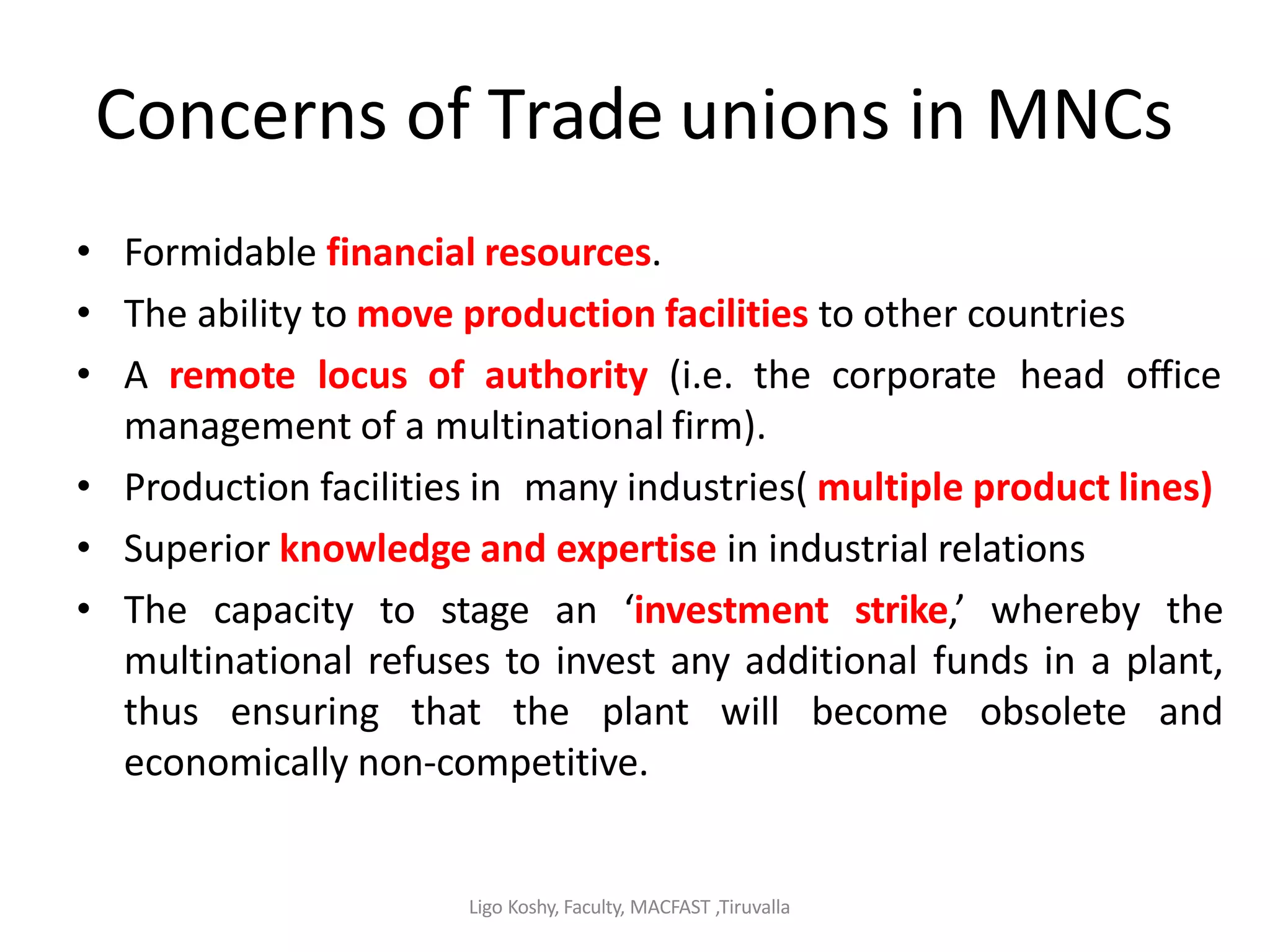
Concerns of Trade unions in MNCs
• Formidable financial resources.
• The ability to move production facilities to other countries
• A remote locus of authority (i.e. the corporate head office
management of a multinational firm).
• Production facilities in many industries( multiple product lines)
• Superior knowledge and expertise in industrial relations
• The capacity to stage an ‘investment strike,’ whereby the
multinational refuses to invest any additional funds in a plant,
thus ensuring that the plant will become obsolete and
economically non-competitive.
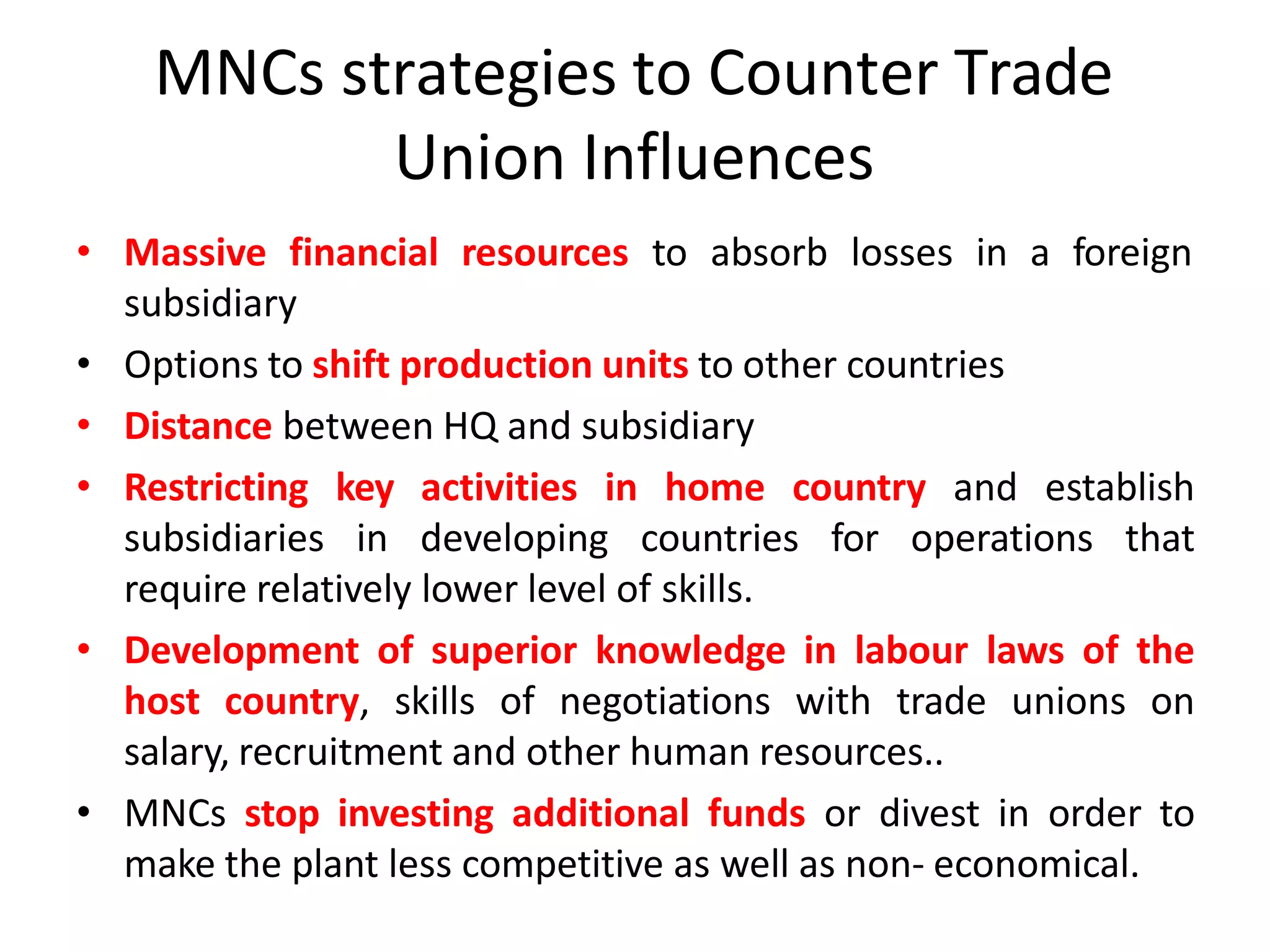
MNCs strategies to Counter Trade
Union Influences
• Massive financial resources to absorb losses in a foreign
subsidiary
• Options to shift production units to other countries
• Distance between HQ and subsidiary
• Restricting key activities in home country and establish
subsidiaries in developing countries for operations that
require relatively lower level of skills.
• Development of superior knowledge in labour laws of the
host country, skills of negotiations with trade unions on
salary, recruitment and other human resources..
• MNCs stop investing additional funds or divest in order to
make the plant less competitive as well as non- economical.
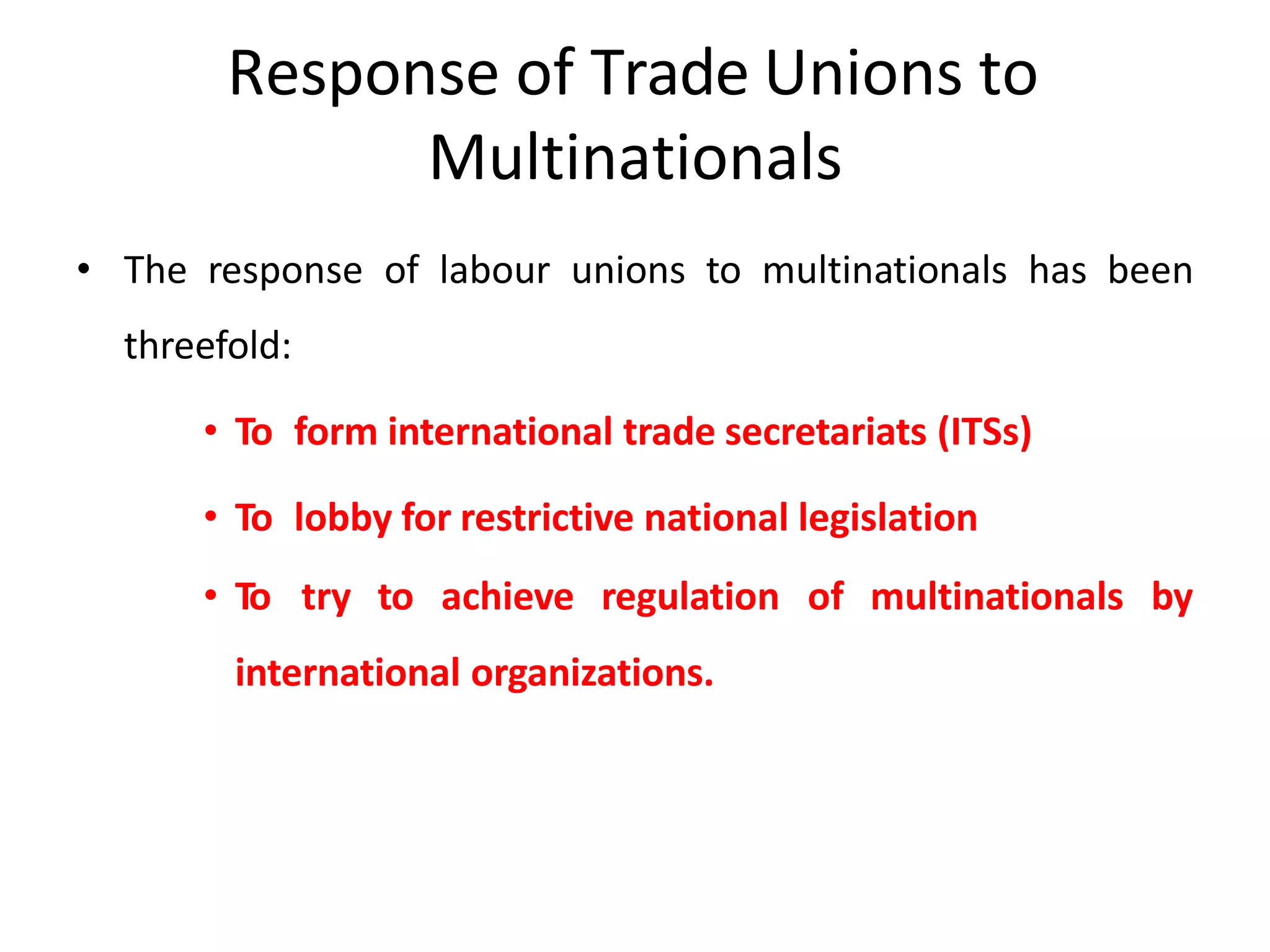
Response of Trade Unions to
Multinationals
• The response of labour unions to multinationals has been
threefold:
• To form international trade secretariats (ITSs)
• To lobby for restrictive national legislation
• To try to achieve regulation of multinationals by
international organizations.
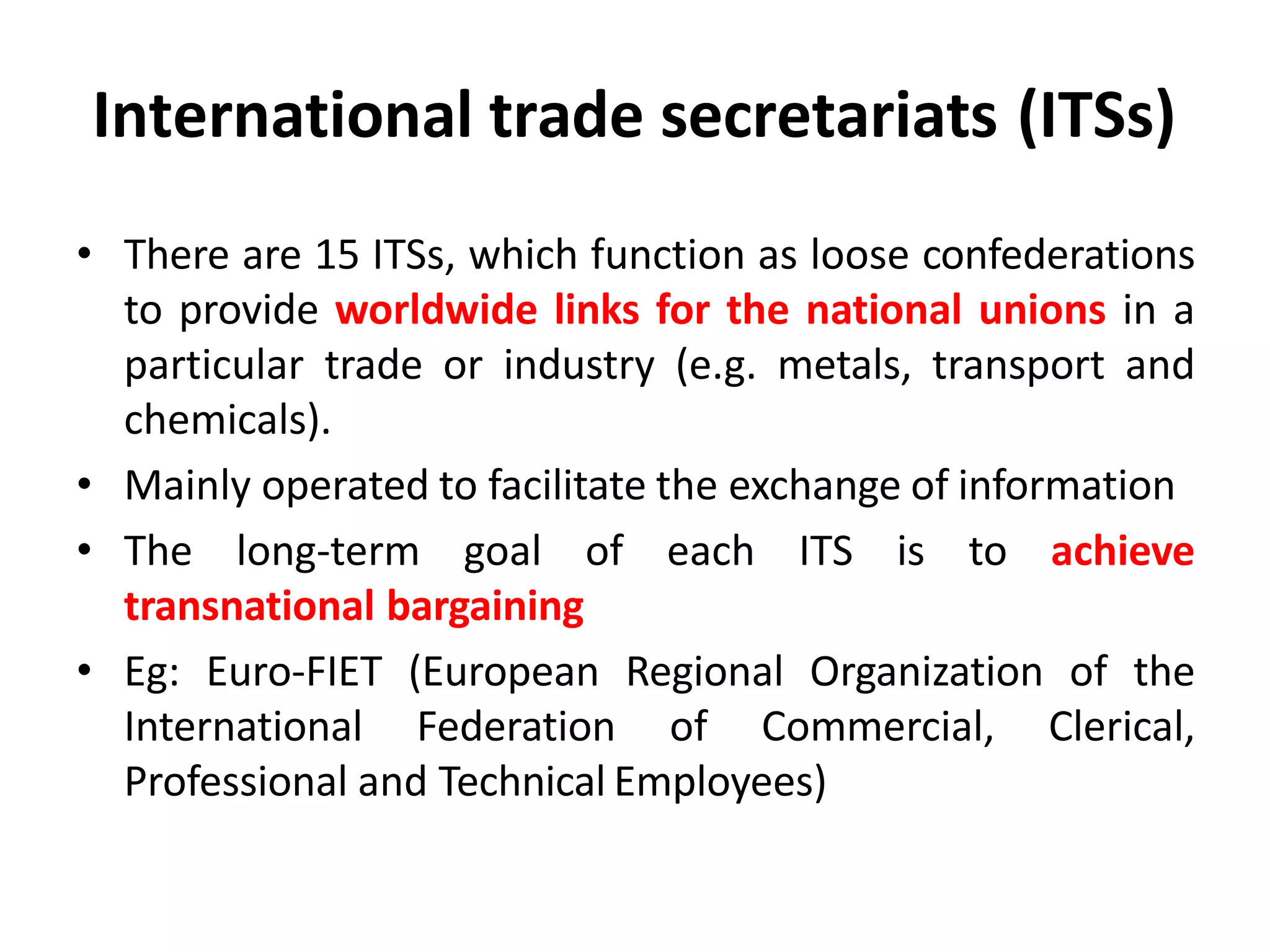
International trade secretariats (ITSs)
• There are 15 ITSs, which function as loose confederations
to provide worldwide links for the national unions in a
particular trade or industry (e.g. metals, transport and
chemicals).
• Mainly operated to facilitate the exchange of information
• The long-term goal of each ITS is to achieve
transnational bargaining
• Eg: Euro-FIET (European Regional Organization of the
International Federation of Commercial, Clerical,
Professional and Technical Employees)
Lobbying for restrictive national
legislation
• Trade unions have lobbied for restrictive
national legislation in the USA and Europe for
– Preventing the export of jobs by the
multinational to other locations
Regulation of multinationals by
international organizations
• Attempts are made by trade unions to exert
influence over multinationals via international
organizations such as
• Organization for Economic Cooperation and
Development (OECD)
• International Labour Organization (ILO)
• United Nations Conference on Trade and
Development (UNCTAD)
• For issuing guidelines covering disclosure of
information, competition, financing, taxation,
employment andLigionKodshyu, Fascutltry,iMaAClFArSeT ,Tlirauvtalilaons
Social Dumping
• Social dumping is a practice of employers to
use cheaper labour than is usually available at
their site of production or sale.
• In the latter case(Sale), migrant workers are
employed; in the former, production is moved
to a low-wage country or area.
Industrial relations issues involved in
social dumping
• The movement of work from one region to another,
and its effect on employment levels
• The need for trade union solidarity to prevent
workers in one region from accepting pay cuts to
attract investment, at the expense of workers in
another region
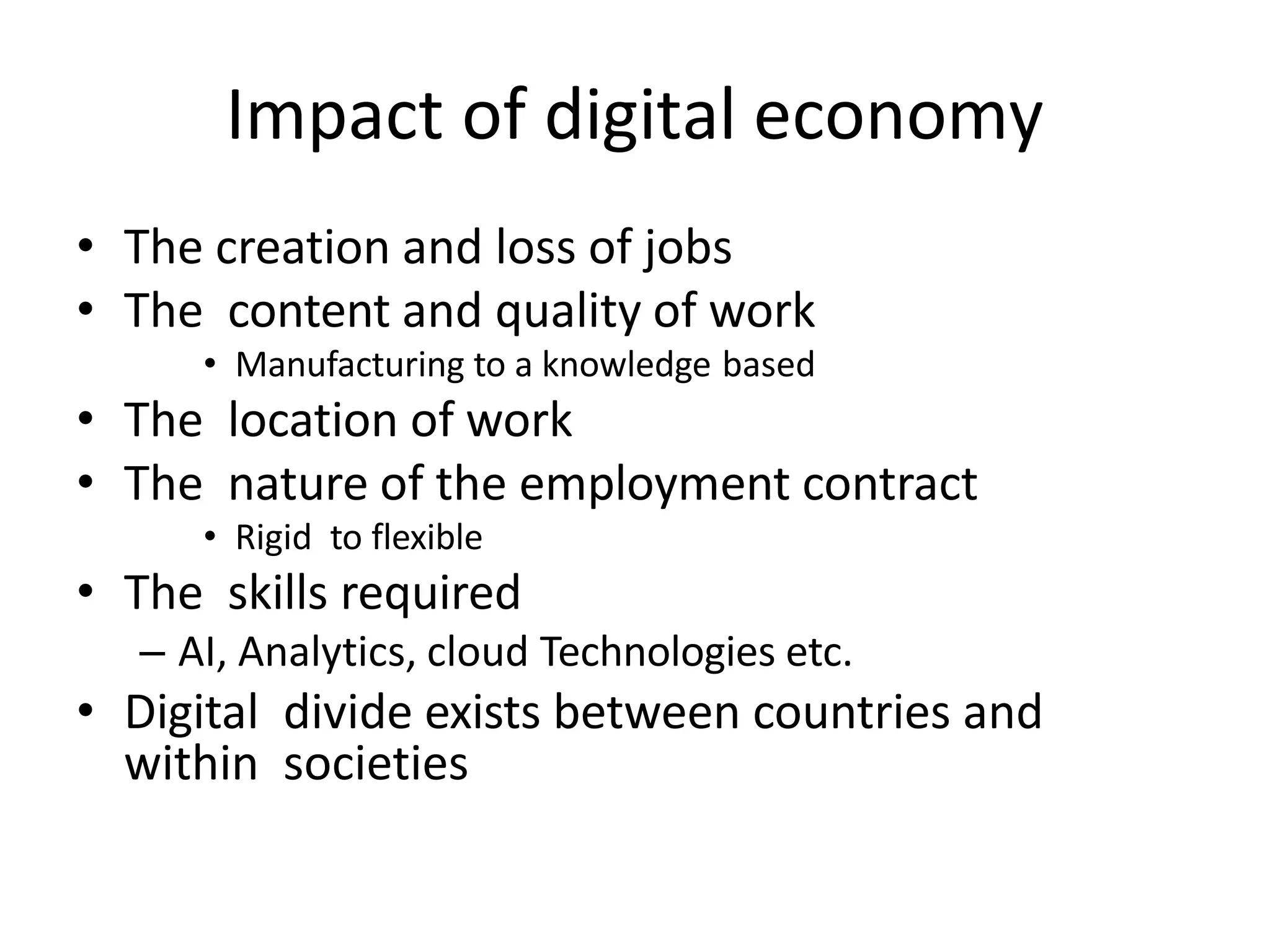
Impact of digital economy
• The creation and loss of jobs
• The content and quality of work
• Manufacturing to a knowledge based
• The location of work
• The nature of the employment contract
• Rigid to flexible
• The skills required
– AI, Analytics, cloud Technologies etc.
• Digital divide exists between countries and
within societies
Thank You

Unit- 3: Lecture-8(international Labor Relations)

  • 1.
    Branch - MBA InternationalBusiness Management DR. APJ ABDUL KALAM TECHNICAL UNIVERSITY By Dr. B. B.Tiwari Professor Department of Management Shri Ramswaroop Memorial Group of Professional Colleges, Lucknow Unit-3: Lecture – 8 International Labour Relations
  • 2.
    Industrial Relations • Industrialrelations encompasses or employment the interrelations relations between unions,employers and employees, labor/trade employer organizations and the state/ government.
  • 3.
    International Industrial relations •International industrial relations deals with the complex relationships among employers employing foreign national, employees of different nationalities, home and host country governments and trade unions of the organizations operating in various countries and their national & international federations.
  • 4.
    Key Players • Government •Employers and their organisation • Employees and their Organisation(Trade Unions)
  • 5.
    • Unitarist • Mutualcooperation, teamwork, sharing common objectives, conflict is seen as destructive • Pluralist • Conflict is inevitable, and trade unions are seen as legitimate to counter management authority • Marxist • Industrial conflict is because of division in the society , the solution being the overthrow of the capitalist system
  • 6.
    Trade unions/ LabourUnions • Labour unions or trade unions are organizations formed by workers from related fields that work for the common interest of its members. • They help workers in issues like fairness of pay, good working environment, hours of work and benefits.
  • 7.
    Functions of TradeUnions • Protective or intra mural functions • Protecting the workers interest • Fraternal or extramural functions • Providing financial and non financial assistance to workers during strikes and lockout • Political functions • Affiliating a union to a political party, helping the political party in enrolling members, collecting donations • Social functions • social responsibilities through educating the customers • Ancillary functions • includes communication, welfare, education and research.
  • 8.
    Union Structure • CraftUnions • Members do one type of job • Industrial Union • Includes members working in same industry • General Union • Members working in different industries within a particular city / region • Federations & Confederation • National level entities • Confederation: Association of Federations • International Federation • Federations at the national levels join to form international federation to deal with the HR issues of the
  • 9.
    Key Issues inIIRs (International Industrial Relations) Key issues in IIRs can broadly divided into categories: 1. Who should handle Labour Relations – HQ or Subsidiaries in the concerned countries. 2. What should be the Union Tactics?
  • 10.
    Who should handleLabour Relations – HQ or Subsidiaries in the concerned countries? • Multinationals generally delegate the management of industrial relations to their foreign subsidiaries. • Corporate HQ will become involved in or oversee labour agreements made by foreign subsidiaries.
  • 11.
    Multinational headquarters involvementin industrial relations is influenced by following factors • The degree of inter-subsidiary production integration • Higher degree of the degree of inter-subsidiary production integration results in centralisation of IR • Nationality of ownership of the subsidiary. • Centralisation is more in US firms than European Firms • International human resource management approach • Ethnocentric- centralised IR • Polycentric- Decentralised IR • Subsidiary characteristics • Acquisition- Decentralised IR • Greenfield – Centralised IR • life stage of subsidiary- initial stages- centralised IR • Performance- Poor performance – centralisation of IR • Characteristics of the home product market. • Large domestic sales- centralised IR
  • 12.
    Influence of tradeunions on HR practices of MNCs • Employment • Trade unions prefer host country nationals • Salaries and benefits (Influencing wage levels ) • Salary discrimination between expatriates and HCN • Enhancement of Salary for all kinds of employees • MNC’s Optimum size • Limits the economies of scale that MNC can avail by mergers, takeovers and joint ventures. • Location and shifting (Social Dumping) • Opposes the shift to other countries because of the fear of losing job opportunities • Closure of units • Lobby the national governments against the closure of units
  • 13.
    Ligo Koshy, Faculty,MACFAST ,Tiruvalla Concerns of Trade unions in MNCs • Formidable financial resources. • The ability to move production facilities to other countries • A remote locus of authority (i.e. the corporate head office management of a multinational firm). • Production facilities in many industries( multiple product lines) • Superior knowledge and expertise in industrial relations • The capacity to stage an ‘investment strike,’ whereby the multinational refuses to invest any additional funds in a plant, thus ensuring that the plant will become obsolete and economically non-competitive.
  • 14.
    MNCs strategies toCounter Trade Union Influences • Massive financial resources to absorb losses in a foreign subsidiary • Options to shift production units to other countries • Distance between HQ and subsidiary • Restricting key activities in home country and establish subsidiaries in developing countries for operations that require relatively lower level of skills. • Development of superior knowledge in labour laws of the host country, skills of negotiations with trade unions on salary, recruitment and other human resources.. • MNCs stop investing additional funds or divest in order to make the plant less competitive as well as non- economical.
  • 15.
    Response of TradeUnions to Multinationals • The response of labour unions to multinationals has been threefold: • To form international trade secretariats (ITSs) • To lobby for restrictive national legislation • To try to achieve regulation of multinationals by international organizations.
  • 16.
    International trade secretariats(ITSs) • There are 15 ITSs, which function as loose confederations to provide worldwide links for the national unions in a particular trade or industry (e.g. metals, transport and chemicals). • Mainly operated to facilitate the exchange of information • The long-term goal of each ITS is to achieve transnational bargaining • Eg: Euro-FIET (European Regional Organization of the International Federation of Commercial, Clerical, Professional and Technical Employees)
  • 17.
    Lobbying for restrictivenational legislation • Trade unions have lobbied for restrictive national legislation in the USA and Europe for – Preventing the export of jobs by the multinational to other locations
  • 18.
    Regulation of multinationalsby international organizations • Attempts are made by trade unions to exert influence over multinationals via international organizations such as • Organization for Economic Cooperation and Development (OECD) • International Labour Organization (ILO) • United Nations Conference on Trade and Development (UNCTAD) • For issuing guidelines covering disclosure of information, competition, financing, taxation, employment andLigionKodshyu, Fascutltry,iMaAClFArSeT ,Tlirauvtalilaons
  • 19.
    Social Dumping • Socialdumping is a practice of employers to use cheaper labour than is usually available at their site of production or sale. • In the latter case(Sale), migrant workers are employed; in the former, production is moved to a low-wage country or area.
  • 20.
    Industrial relations issuesinvolved in social dumping • The movement of work from one region to another, and its effect on employment levels • The need for trade union solidarity to prevent workers in one region from accepting pay cuts to attract investment, at the expense of workers in another region
  • 21.
    Impact of digitaleconomy • The creation and loss of jobs • The content and quality of work • Manufacturing to a knowledge based • The location of work • The nature of the employment contract • Rigid to flexible • The skills required – AI, Analytics, cloud Technologies etc. • Digital divide exists between countries and within societies
  • 22.