International Trade and Development
UAF20203T
Classical Trade Theories – International Trade
• Adam Smith and David Ricardo gave the
classical theories of international trade.
• According to the theories given by them, when
a country enters in foreign trade, it benefits
from specialization and efficient resource
allocation.
• The foreign trade also helps in bringing new
technologies and skills that lead to higher
productivity.
The assumptions taken under this theory’ are
as follows:
a. There are two countries producing two goods.
b. The size of economies of these countries is equal
c. There is perfect mobility of factors of production
within countries
d. Transportation cost is ignored
e. Before specialization, country’s resources are
equally divided to produce each good
The classical theories are divided into three theories, as shown in Figure
Theory of Mercantilism
• Mercantilism is the term that was popularized by Adam
Smith, Father of Economics, in his book, The Wealth of
Nations. Western European economic policies were
greatly dominated by this theory. The theory of
mercantilism holds that countries should encourage
export and discourage import.
• It states that a country’s wealth depends on the balance
of export minus import. According to this theory,
government should play an important role in the
economy for encouraging export and discouraging
import by using subsidies and taxes, respectively. In
those days, gold was used for trading goods between
countries.
• Thus, export was treated as good as it helped in earning
gold, whereas, import was treated as bad as it led to the
outflow of gold.
• If a nation has abundant gold, then it is considered to be
a wealthy nation.
• If all the countries follow this policy, there may be
conflicts, as no one would promote import. The theory
of mercantilism believed in selfish trade that is a one-
way transaction and ignored enhancing the world trade.
Mercantilism was called as a zero-sum game as only
one country benefitted from it.
Theory of AbsoluteAdvantage
• Given by Adam Smith in 1776, the theory of absolute
advantage stated that a country should specialize in
those products, which it can produce efficiently. This
theory assumes that there is only one factor of
production that is labor.
• Adam Smith stated that under mercantilism, it was
impossible for nations to become rich simultaneously.
He also stated that wealth of the countries does not
depend upon the gold reserves, but upon the goods and
services available to their citizens.
• Adam Smith wrote in The Wealth of Nations,
”If a foreign country can supply us with a
commodity cheaper than we ourselves can
make it, better buy them”.
• He stated that trade would be beneficial for
both the countries if country A exports the
goods, which it can produce with lower cost
than country B and import the goods, which
country B can produce with lower cost than it.
• An example can be used to prove this theory. Suppose
there are two countries A and B, which produce tea and
coffee with equal amount of resources that is 200
laborers. Country A uses 10 laborers to produce 1 ton of
tea and 20 laborers to produce 1 ton of coffee. Country B
uses 25 units of laborers to produce tea and 5 units of
laborers to produce 1 ton of coffee.
• This is shown in Table- 1:
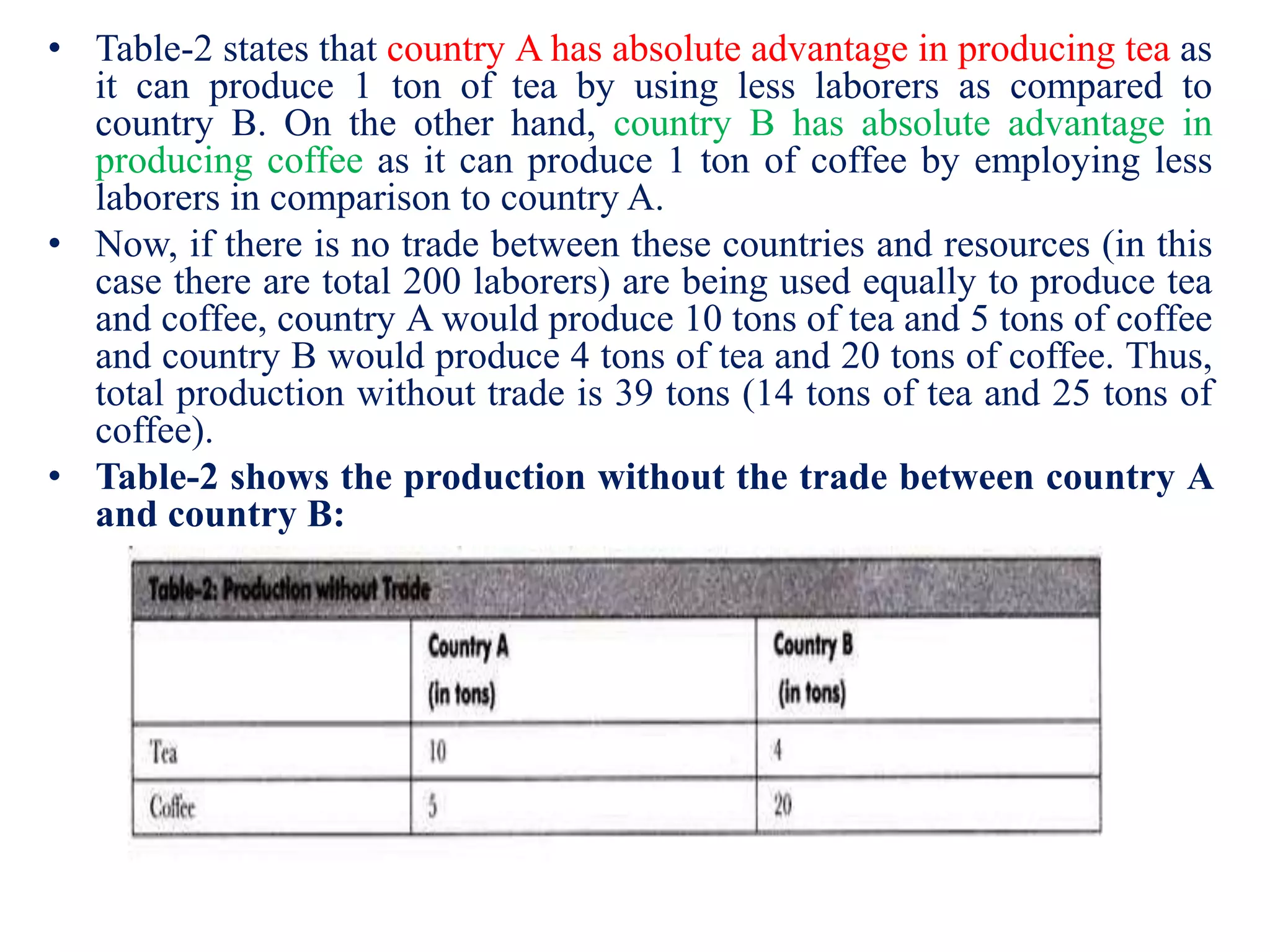
• Table-2 states that country A has absolute advantage in producing tea as
it can produce 1 ton of tea by using less laborers as compared to
country B. On the other hand, country B has absolute advantage in
producing coffee as it can produce 1 ton of coffee by employing less
laborers in comparison to country A.
• Now, if there is no trade between these countries and resources (in this
case there are total 200 laborers) are being used equally to produce tea
and coffee, country A would produce 10 tons of tea and 5 tons of coffee
and country B would produce 4 tons of tea and 20 tons of coffee. Thus,
total production without trade is 39 tons (14 tons of tea and 25 tons of
coffee).
• Table-2 shows the production without the trade between country A
and country B:
• If both the countries trade with each other and
specialize in goods in which they have absolute
advantage, the total production would be higher.
Country A would produce 20 tons of tea with 200
units of laborers; whereas, country B would
produce 40 tons of coffee with 200 units of
laborers. Thus, total production would be 60 units
(20 tons of tea and 40 tons of coffee).
• The production of tea and coffee after trade is
shown in Table-3:
• Without specialization, total production of
countries was 39 tons, which becomes 60 tons
after specialization. Therefore, the theory of
absolute advantages shows that trade would be
beneficial for both the countries.
Theory of Comparative Advantage
• Many questions may come in mind after reading the
absolute advantage theory that what would happen if a
country has absolute advantage in all the products or no
absolute advantage in any of the product.
• How such a country would benefit from trade? The answers
of these questions was given by David Ricardo in his theory
of comparative advantage, which states that trade can be
beneficial for two countries if one country has absolute
advantage in all the products and the other country has no
absolute advantage in any of the products.
• According to Ricardo, “…a nation, like a person, gains
from the trade by exporting the goods or services in
which it has its greatest comparative advantage in
productivity and importing those in which it has the
least comparative advantage. ”
• This theory assumes that labor as the only factor of
production in two countries, zero transport cost, and
no trade barriers within the countries. Let us
understand this theory with the help of an example.
• Suppose there are two countries A and B, producing
two commodities wheat and wine with labor as the
only factor of production. Now assume that both the
countries have 200 laborers and they use 100 laborers
to produce wheat and 100 laborers to produce wine.
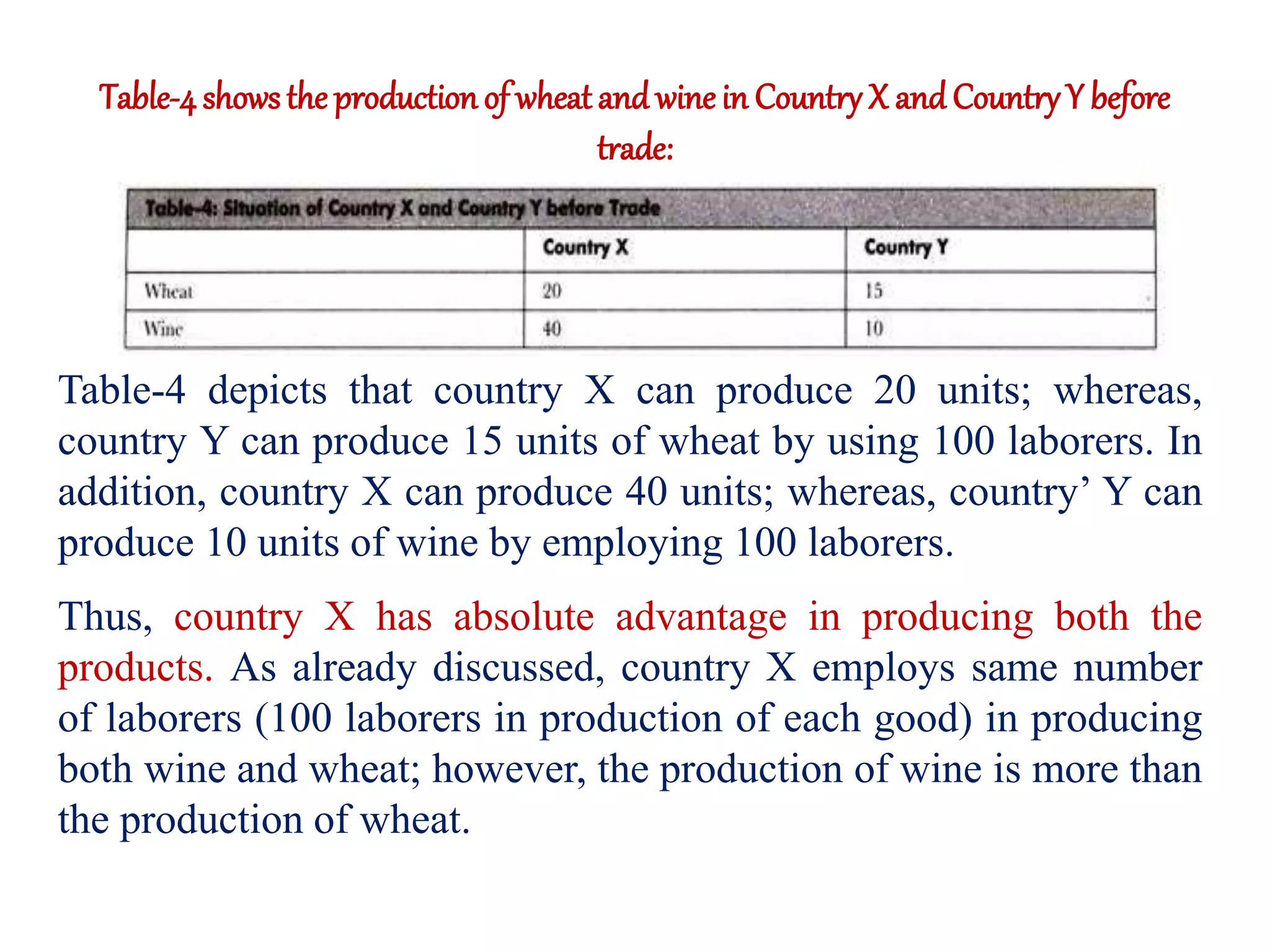
Table-4showsthe production of wheat and wine in CountryX and Country Y before
trade:
Table-4 depicts that country X can produce 20 units; whereas,
country Y can produce 15 units of wheat by using 100 laborers. In
addition, country X can produce 40 units; whereas, country’ Y can
produce 10 units of wine by employing 100 laborers.
Thus, country X has absolute advantage in producing both the
products. As already discussed, country X employs same number
of laborers (100 laborers in production of each good) in producing
both wine and wheat; however, the production of wine is more than
the production of wheat.
• It shows that country’ X has comparative advantage in
producing wine. Similarly, country Y also employs same
number of laborers (100 laborers in production of each good)
in manufacturing wheat and wine; however, its production of
wheat is more than the wine. It indicates that country Y has
comparative advantage in manufacturing wheat.
• For example, country X has decided to produce 60 units of
wine by employing 150 laborers. It uses 50 laborers to produce
10 units of wheat. On the other hand, country Y has decided to
use all the 200 laborers to produce 30 units of wheat. It would
not produce any unit of wine.
This data is represented in Table-5:
Now, country X exchanges 14 units of wine with 14 units
of wheat produced by country Y.
The situation of both the countries after trade is shown
in Table-6:
• It can be observed from Table-6 that both the countries
have gained from trade. Before trade, country X has 20
units of wheat and 40 units of wine; however, after
trade, country X has 24 units of wheat and 46 units of
wine.
• On the other hand, country Y has 15 units of wheat and
10 units of wine before trade; however, it has 16 units
of wheat and 14 units of wine after trade. Therefore,
comparative advantage explains that trade can create
benefit for both the countries even if one country has
absolute advantage in the production of both the goods.
Limitation of the theory of comparative advantage
• Transport costs may overshadow any comparative
advantage
• Increased specialization may lead to diseconomies
(cost disadvantages) of scale
• Governments may restrict trade
• Comparative advantage measures static (fixed)
advantage but not any dynamic (active) advantage for
example in the future India could become good at
producing books if it made the necessary investment

Classical trade theory

  • 1.
    International Trade andDevelopment UAF20203T
  • 2.
    Classical Trade Theories– International Trade • Adam Smith and David Ricardo gave the classical theories of international trade. • According to the theories given by them, when a country enters in foreign trade, it benefits from specialization and efficient resource allocation. • The foreign trade also helps in bringing new technologies and skills that lead to higher productivity.
  • 3.
    The assumptions takenunder this theory’ are as follows: a. There are two countries producing two goods. b. The size of economies of these countries is equal c. There is perfect mobility of factors of production within countries d. Transportation cost is ignored e. Before specialization, country’s resources are equally divided to produce each good
  • 4.
    The classical theoriesare divided into three theories, as shown in Figure
  • 5.
    Theory of Mercantilism •Mercantilism is the term that was popularized by Adam Smith, Father of Economics, in his book, The Wealth of Nations. Western European economic policies were greatly dominated by this theory. The theory of mercantilism holds that countries should encourage export and discourage import. • It states that a country’s wealth depends on the balance of export minus import. According to this theory, government should play an important role in the economy for encouraging export and discouraging import by using subsidies and taxes, respectively. In those days, gold was used for trading goods between countries.
  • 6.
    • Thus, exportwas treated as good as it helped in earning gold, whereas, import was treated as bad as it led to the outflow of gold. • If a nation has abundant gold, then it is considered to be a wealthy nation. • If all the countries follow this policy, there may be conflicts, as no one would promote import. The theory of mercantilism believed in selfish trade that is a one- way transaction and ignored enhancing the world trade. Mercantilism was called as a zero-sum game as only one country benefitted from it.
  • 7.
    Theory of AbsoluteAdvantage •Given by Adam Smith in 1776, the theory of absolute advantage stated that a country should specialize in those products, which it can produce efficiently. This theory assumes that there is only one factor of production that is labor. • Adam Smith stated that under mercantilism, it was impossible for nations to become rich simultaneously. He also stated that wealth of the countries does not depend upon the gold reserves, but upon the goods and services available to their citizens.
  • 8.
    • Adam Smithwrote in The Wealth of Nations, ”If a foreign country can supply us with a commodity cheaper than we ourselves can make it, better buy them”. • He stated that trade would be beneficial for both the countries if country A exports the goods, which it can produce with lower cost than country B and import the goods, which country B can produce with lower cost than it.
  • 9.
    • An examplecan be used to prove this theory. Suppose there are two countries A and B, which produce tea and coffee with equal amount of resources that is 200 laborers. Country A uses 10 laborers to produce 1 ton of tea and 20 laborers to produce 1 ton of coffee. Country B uses 25 units of laborers to produce tea and 5 units of laborers to produce 1 ton of coffee. • This is shown in Table- 1:
  • 10.
    • Table-2 statesthat country A has absolute advantage in producing tea as it can produce 1 ton of tea by using less laborers as compared to country B. On the other hand, country B has absolute advantage in producing coffee as it can produce 1 ton of coffee by employing less laborers in comparison to country A. • Now, if there is no trade between these countries and resources (in this case there are total 200 laborers) are being used equally to produce tea and coffee, country A would produce 10 tons of tea and 5 tons of coffee and country B would produce 4 tons of tea and 20 tons of coffee. Thus, total production without trade is 39 tons (14 tons of tea and 25 tons of coffee). • Table-2 shows the production without the trade between country A and country B:
  • 11.
    • If boththe countries trade with each other and specialize in goods in which they have absolute advantage, the total production would be higher. Country A would produce 20 tons of tea with 200 units of laborers; whereas, country B would produce 40 tons of coffee with 200 units of laborers. Thus, total production would be 60 units (20 tons of tea and 40 tons of coffee). • The production of tea and coffee after trade is shown in Table-3:
  • 12.
    • Without specialization,total production of countries was 39 tons, which becomes 60 tons after specialization. Therefore, the theory of absolute advantages shows that trade would be beneficial for both the countries.
  • 13.
    Theory of ComparativeAdvantage • Many questions may come in mind after reading the absolute advantage theory that what would happen if a country has absolute advantage in all the products or no absolute advantage in any of the product. • How such a country would benefit from trade? The answers of these questions was given by David Ricardo in his theory of comparative advantage, which states that trade can be beneficial for two countries if one country has absolute advantage in all the products and the other country has no absolute advantage in any of the products.
  • 14.
    • According toRicardo, “…a nation, like a person, gains from the trade by exporting the goods or services in which it has its greatest comparative advantage in productivity and importing those in which it has the least comparative advantage. ” • This theory assumes that labor as the only factor of production in two countries, zero transport cost, and no trade barriers within the countries. Let us understand this theory with the help of an example. • Suppose there are two countries A and B, producing two commodities wheat and wine with labor as the only factor of production. Now assume that both the countries have 200 laborers and they use 100 laborers to produce wheat and 100 laborers to produce wine.
  • 15.
    Table-4showsthe production ofwheat and wine in CountryX and Country Y before trade: Table-4 depicts that country X can produce 20 units; whereas, country Y can produce 15 units of wheat by using 100 laborers. In addition, country X can produce 40 units; whereas, country’ Y can produce 10 units of wine by employing 100 laborers. Thus, country X has absolute advantage in producing both the products. As already discussed, country X employs same number of laborers (100 laborers in production of each good) in producing both wine and wheat; however, the production of wine is more than the production of wheat.
  • 16.
    • It showsthat country’ X has comparative advantage in producing wine. Similarly, country Y also employs same number of laborers (100 laborers in production of each good) in manufacturing wheat and wine; however, its production of wheat is more than the wine. It indicates that country Y has comparative advantage in manufacturing wheat. • For example, country X has decided to produce 60 units of wine by employing 150 laborers. It uses 50 laborers to produce 10 units of wheat. On the other hand, country Y has decided to use all the 200 laborers to produce 30 units of wheat. It would not produce any unit of wine.
  • 17.
    This data isrepresented in Table-5: Now, country X exchanges 14 units of wine with 14 units of wheat produced by country Y. The situation of both the countries after trade is shown in Table-6:
  • 18.
    • It canbe observed from Table-6 that both the countries have gained from trade. Before trade, country X has 20 units of wheat and 40 units of wine; however, after trade, country X has 24 units of wheat and 46 units of wine. • On the other hand, country Y has 15 units of wheat and 10 units of wine before trade; however, it has 16 units of wheat and 14 units of wine after trade. Therefore, comparative advantage explains that trade can create benefit for both the countries even if one country has absolute advantage in the production of both the goods.
  • 19.
    Limitation of thetheory of comparative advantage • Transport costs may overshadow any comparative advantage • Increased specialization may lead to diseconomies (cost disadvantages) of scale • Governments may restrict trade • Comparative advantage measures static (fixed) advantage but not any dynamic (active) advantage for example in the future India could become good at producing books if it made the necessary investment