Branch - MBA
International Business Management
DR. APJ ABDUL KALAM TECHNICAL UNIVERSITY
By
Dr. B. B.Tiwari
Professor
Department of Management
Shri Ramswaroop Memorial Group of Professional Colleges, Lucknow
Unit-2: Lecture – 9
International Trade Theories:
Forms of Protection
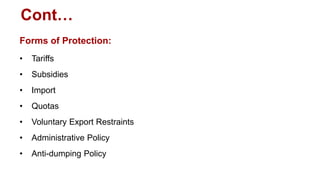
• Protection on trade occurs when countries impose restrictions on imports into the
economy. It can be defined as nation or a group of nations working in conjunction as
a trade bloc, creating trade barriers with the specific goal of protecting its economy
from the possible perils of international trading.
• Protectionism, policy of protecting domestic industries against foreign competition
by means of tariffs, subsidies, import quotas, or other restrictions or handicaps placed
on the imports of foreign competitors.
• The main aim of protectionism is to cushion domestic businesses and industries
from overseas competition and prevent the outcome resulting solely from the
interplay of free market forces of supply and demand.
Forms of Protection
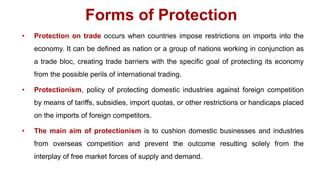
Forms of Protection:
• Tariffs
• Subsidies
• Import
• Quotas
• Voluntary Export Restraints
• Administrative Policy
• Anti-dumping Policy
Cont…
Tariffs:
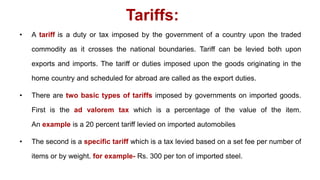
• A tariff is a duty or tax imposed by the government of a country upon the traded
commodity as it crosses the national boundaries. Tariff can be levied both upon
exports and imports. The tariff or duties imposed upon the goods originating in the
home country and scheduled for abroad are called as the export duties.
• There are two basic types of tariffs imposed by governments on imported goods.
First is the ad valorem tax which is a percentage of the value of the item.
An example is a 20 percent tariff levied on imported automobiles
• The second is a specific tariff which is a tax levied based on a set fee per number of
items or by weight. for example- Rs. 300 per ton of imported steel.
Cont….
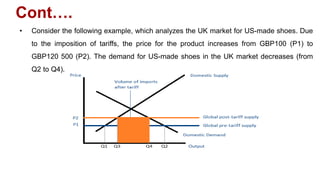
• Consider the following example, which analyzes the UK market for US-made shoes. Due
to the imposition of tariffs, the price for the product increases from GBP100 (P1) to
GBP120 500 (P2). The demand for US-made shoes in the UK market decreases (from
Q2 to Q4).
Subsidies:
• Subsidies are government payments to domestic producers and are
aimed to provide the producer an extra-cash so that they can produce
goods at low manufacturing costs and access foreign markets. The
subsidies can be in the form of cash payments, low-to-no-interest loans,
tax breaks and government ownership of common stock in domestic
companies.
• An example of an export subsidy is the one offered by the Indian
government. This involves offering export incentives for 1.4 million tonnes
of raw sugar as mills start sales of surplus sugar overseas to pay cane
• Import subsidies consist of subsidies on goods and services that
become payable to resident producers when the goods cross the frontier
of the economic territory or when the services are delivered to resident
institutional units.
• Example: When the government gives money to a farmer or Consumers
for consuming the agriculture product in case of low production in home
country i.e. Onion, rice, wheat etc.
Cont….
Import Quotas
• An import quota is a type of trade restriction that sets a physical limit on the quantity of a good
that can be imported into a country in a given period of time. Quotas, like other trade restrictions,
are typically used to benefit the producers of a good in that economy.
• For example, until 2014, South Korea maintained strict quotas on imported rice. It has now replaced
a quota with import tariffs designed to protect South Korean rice farmers.
• Quotas do not normally bring in any immediate tax revenue for the government although if they
cause domestic production and incomes to expand, there will be a beneficial impact on taxes paid.
• absolute quota: A limitation of the quantity of certain goods that may enter commerce during a
specific period.
• tariff-rate quota: Allows a specified quantity of imported goods to be entered at a reduced rate of
duty during the quota period, with quantities entered in excess of the quota limit subject to a higher
duty rate.
Voluntary Export Restraints
• This is where two countries make an agreement to limit the volume of their exports to one
another over an agreed time period. Sometimes this is enforced by a government for
example the USA enforced VER on Japan during the late 1980s.
• Voluntary export restraints (VER) are arrangements between exporting and importing
countries in which the exporting country agrees to limit the quantity of specific exports
below a certain level in order to avoid imposition of mandatory restrictions by the importing
country. The arrangement may be concluded either at the industry or government level.
• They became a popular form of protection during the 1980s, perhaps in part because they
did not violate countries' agreements under the GATT. As a result of the Uruguay round of
the GATT, completed in 1994, WTO members agreed not to implement any new VERs and
to phase out any existing VERs over a four year period.
Administrative Policy
• Administrative trade policies are bureaucratic rules that are almost always
deliberately designed to restrict the flow of a particular import into a
country. The Japanese are considered masters of this trade barrier.
• The Netherlands exports tulip bulbs toal most every country of the world
except Japan. The reason is that Japanese customs inspectors insist on
checking every tulip bulb by cutting it vertically down the middle, which in
effect ruins the bulb
Anti-dumping Policy
• Dumping is defined as selling goods in a foreign market at below their costs of
production, or as selling goods in a foreign market at below their "fair" market value.
Antidumping policies are designed to punish foreign firms that engage in dumping. If
a firm is found to be dumping, countervailing duties may be imposed. These duties
can be fairly substantial and stay in place for up to five years.
• The government imposes anti-dumping duty on foreign imports when it believes that
the goods are being “dumped” – through the low pricing – in the domestic
market. Anti-dumping duty is imposed to protect local businesses and markets from
unfair competition by foreign imports.
THANK YOU

Unit- 2: lecture-9 (forms of protection)

  • 1.
    Branch - MBA InternationalBusiness Management DR. APJ ABDUL KALAM TECHNICAL UNIVERSITY By Dr. B. B.Tiwari Professor Department of Management Shri Ramswaroop Memorial Group of Professional Colleges, Lucknow Unit-2: Lecture – 9 International Trade Theories: Forms of Protection
  • 2.
    • Protection ontrade occurs when countries impose restrictions on imports into the economy. It can be defined as nation or a group of nations working in conjunction as a trade bloc, creating trade barriers with the specific goal of protecting its economy from the possible perils of international trading. • Protectionism, policy of protecting domestic industries against foreign competition by means of tariffs, subsidies, import quotas, or other restrictions or handicaps placed on the imports of foreign competitors. • The main aim of protectionism is to cushion domestic businesses and industries from overseas competition and prevent the outcome resulting solely from the interplay of free market forces of supply and demand. Forms of Protection
  • 3.
    Forms of Protection: •Tariffs • Subsidies • Import • Quotas • Voluntary Export Restraints • Administrative Policy • Anti-dumping Policy Cont…
  • 4.
    Tariffs: • A tariffis a duty or tax imposed by the government of a country upon the traded commodity as it crosses the national boundaries. Tariff can be levied both upon exports and imports. The tariff or duties imposed upon the goods originating in the home country and scheduled for abroad are called as the export duties. • There are two basic types of tariffs imposed by governments on imported goods. First is the ad valorem tax which is a percentage of the value of the item. An example is a 20 percent tariff levied on imported automobiles • The second is a specific tariff which is a tax levied based on a set fee per number of items or by weight. for example- Rs. 300 per ton of imported steel.
  • 5.
    Cont…. • Consider thefollowing example, which analyzes the UK market for US-made shoes. Due to the imposition of tariffs, the price for the product increases from GBP100 (P1) to GBP120 500 (P2). The demand for US-made shoes in the UK market decreases (from Q2 to Q4).
  • 6.
    Subsidies: • Subsidies aregovernment payments to domestic producers and are aimed to provide the producer an extra-cash so that they can produce goods at low manufacturing costs and access foreign markets. The subsidies can be in the form of cash payments, low-to-no-interest loans, tax breaks and government ownership of common stock in domestic companies. • An example of an export subsidy is the one offered by the Indian government. This involves offering export incentives for 1.4 million tonnes of raw sugar as mills start sales of surplus sugar overseas to pay cane
  • 7.
    • Import subsidiesconsist of subsidies on goods and services that become payable to resident producers when the goods cross the frontier of the economic territory or when the services are delivered to resident institutional units. • Example: When the government gives money to a farmer or Consumers for consuming the agriculture product in case of low production in home country i.e. Onion, rice, wheat etc. Cont….
  • 8.
    Import Quotas • Animport quota is a type of trade restriction that sets a physical limit on the quantity of a good that can be imported into a country in a given period of time. Quotas, like other trade restrictions, are typically used to benefit the producers of a good in that economy. • For example, until 2014, South Korea maintained strict quotas on imported rice. It has now replaced a quota with import tariffs designed to protect South Korean rice farmers. • Quotas do not normally bring in any immediate tax revenue for the government although if they cause domestic production and incomes to expand, there will be a beneficial impact on taxes paid. • absolute quota: A limitation of the quantity of certain goods that may enter commerce during a specific period. • tariff-rate quota: Allows a specified quantity of imported goods to be entered at a reduced rate of duty during the quota period, with quantities entered in excess of the quota limit subject to a higher duty rate.
  • 9.
    Voluntary Export Restraints •This is where two countries make an agreement to limit the volume of their exports to one another over an agreed time period. Sometimes this is enforced by a government for example the USA enforced VER on Japan during the late 1980s. • Voluntary export restraints (VER) are arrangements between exporting and importing countries in which the exporting country agrees to limit the quantity of specific exports below a certain level in order to avoid imposition of mandatory restrictions by the importing country. The arrangement may be concluded either at the industry or government level. • They became a popular form of protection during the 1980s, perhaps in part because they did not violate countries' agreements under the GATT. As a result of the Uruguay round of the GATT, completed in 1994, WTO members agreed not to implement any new VERs and to phase out any existing VERs over a four year period.
  • 10.
    Administrative Policy • Administrativetrade policies are bureaucratic rules that are almost always deliberately designed to restrict the flow of a particular import into a country. The Japanese are considered masters of this trade barrier. • The Netherlands exports tulip bulbs toal most every country of the world except Japan. The reason is that Japanese customs inspectors insist on checking every tulip bulb by cutting it vertically down the middle, which in effect ruins the bulb
  • 11.
    Anti-dumping Policy • Dumpingis defined as selling goods in a foreign market at below their costs of production, or as selling goods in a foreign market at below their "fair" market value. Antidumping policies are designed to punish foreign firms that engage in dumping. If a firm is found to be dumping, countervailing duties may be imposed. These duties can be fairly substantial and stay in place for up to five years. • The government imposes anti-dumping duty on foreign imports when it believes that the goods are being “dumped” – through the low pricing – in the domestic market. Anti-dumping duty is imposed to protect local businesses and markets from unfair competition by foreign imports.
  • 12.