ASSIGNMENT, Drive SPRING 2015
Program MBA, Semester 1
Subject code & name- MB0042 – Managerial Economics
Book ID B1625, Credit & Marks 4 CREDIT, 60 MARKS
Answerall questions.
Q. 1. What is production function and its uses? Explain the two types of production functions.
Q. 2. Consumers' interview method is a survey method used for estimating the demand for new
products.Thismethodisvery importantwithregardto collectthe relevantinformationdirectlyfrom
the consumers with regard to their future purchase plans. Opinion surveys and direct interview
method are the two important techniques among all. Describe these two methods in detail.
Q. 3. A cost-schedule is a statement of variations in costs resulting from variations in the levels of
Output and it shows the response of costs to changes in output. If we represent the relationship
betweenchangesinthe level of outputandcostsof production,we getdifferenttypesof costcurves
in the short run. Define the kinds of cost concepts like TFC, TVC, TC, AFC, AVC, AC and MC and its
corresponding curves with suitable diagrams for each.
Q. 4. Inflationisaglobal Phenomenonwhichisassociatedwithhighprice causesdecline inthe value
for money.It existswhenthe amount of moneyinthe country is in excessof the physical volume of
goods and services. Explain the reasons for this monetary phenomenon.
Q. 5. Discuss the practical application of Price elasticity and Income elasticity of demand.
Q. 6. Define revenue.Explainthe typesof revenue andthe relationshipbetweenTR,AR and MR with
an example of a hypothetical revenue schedule.
Q. No 1. What is production function and its uses? Explain the two types of production functions.
Ans.1- Productionfunction: - A “productionfunction”expressesthe technological orengineering
relationshipbetweenphysical quantityof inputsemployedandphysicalquantityof outputs
obtainedbya firm.Itspecifiesaflowof outputresultingfromaflow of inputsduringa specified
periodof time.Itmay be inthe formof a table,a graphor an equationspecifyingmaximumoutput
rate froma givenamountof inputsused.Asitrelatesinputstooutputs,itisalso called“input-
outputrelation.”The productionispurelyphysical innature and isdeterminedbythe quantumof
technology,availabilityof equipment,labour,raw materials,etc.employedbyafirm.
Productionfunctionexplainsthatthe maximumoutputof goodsorservicesthatcanbe produced
by a firm in a specific time with a given amount of inputs or factors of production.
Production Function: Q = f (K, L)
We are producing Q quantities of goods by employing K capital and L labour.
Here, Q=Represents quantity of goods, K=Represents Capital employed, L=Represents Labour employed
Usesof productionfunction
Thoughproductionfunctionmayappearas highlyabstractandunrealistic,inreality,itisbothlogical
and useful.Itisof immense utilitytothe managersandexecutivesinthe decisionmakingprocessat
the firmlevel.
There are several possiblecombinationsof inputsand,decisionmakershave tochoose the most
appropriate amongthem.The followingare some of the importantusesof productionfunction:
1. It can be usedto calculate orwork outthe leastcostinputcombinationforagivenoutputor the
maximumoutput-inputcombinationforagivencost.
2. It is useful inworkingoutanoptimal andeconomiccombinationof inputsforgettingacertain
level of output.The utilityof employingaunitof variable factorinputinthe productionprocesscan
be betterjudgedwiththe helpof productionfunction.Additional employmentof avariable factor
inputisdesirable onlywhenthe marginal revenue productivityof variablefactorinputisgreater
than or equal tocost of employingitinan organisation.
3. Productionfunctionalsohelpsinmakinglongrundecisions.If returnstoscale are increasing,itis
wise toemploymore factorunitsandincrease production.If returnstoscale are diminishing,itis
unwise toemploymore factorinputs&increase production.Managerswill be indifferentwhetherto
increase ordecrease production,if productionissubjecttoconstantreturnsto scale.
Thus,productionfunctionhelpsbothinthe shortrunand longrun decision - makingprocess.
Two types of productionfunctions are as follows:
1). Short run productionfunction – In thiscase,the producerwill keepall fixedfactorsasconstant
and change onlya fewvariable factorinputs.Inthe shortrun,we come across twokindsof
productionfunctions:
 Quantitiesof all inputsbothfixedandvariable will be keptconstantandonlyone variable input
will be varied,forexample,lawof variableproportions.
 Quantitiesof all factorinputsare keptconstantand onlytwovariable factorinputsare varied,
for example,iso-quantsandiso-costcurves.
Short-Termproductionfunctionisafunction,whichwe are producinggoodsinthe short-termby
employingtwoinputsthatare:
Capital (K): It isfixedinputwhichisconstantinthe short-term.
Labour (L) : It is variable inputinthe short-term.
In the short-termwe are producingonlyone productbyemployingtwoinputs
The two inputsare K capital and L is labour.
In the short termwe will increase Linputandwe will keepKasconstant.
2). Long run production function – In thiscase,the producerwill varythe quantitiesof all factor
inputs,bothfixedaswell asvariable inthe same proportion,forexample,the lawsof returnsto
scale.
Each firmhas its ownproductionfunctionwhichisdeterminedbythe state of technology,
managerial ability,organisationalskills,etc. of afirm.It maybe inthe followingmanner:
1. The quantityof inputsmaybe reducedwhile the quantityof outputmayremainsame.
2. The quantityof inputsmaybe reducedwhile the quantityof outputmayincrease.
3. The quantityof inputsmay be keptconstantwhile the quantityof outputmayincrease.
If there are any improvementsinthe firm, the oldproductionfunctionisdisturbedandanew one
takesitsplace.
According to economic theory, if an increase in a firm’s inputs by some proportion results in an
increase output by a greater proportion, the firm experiences increasing returns to scale. If output
increases by the same proportion as the inputs increase, the firm experiences constant returns to
scale. A less than proportional increase in output is called decreasing returns to scale.
One way to measure returns to scale is to use a coefficient of output elasticity.
EQ = Percentage change in Q (Percentage change in all inputs)
Thus,
If E > 1, we have increasing returns to scale (IRTS).
If E = 1, we have increasing returns to scale (CRTS).
If E < 1, we have increasing returns to scale (DRTS)
Q. No 2. Consumers' interviewmethodisa survey methodusedfor estimatingthe demandfor new
products. This method is very important with regard to collect the relevant information directly
fromthe consumerswithregardto theirfuture purchase plans.Opinionsurveysanddirectinterview
method are the two important techniques among all. Describe these two methods in detail.
Ans.2- Consumers’interviewmethod:- Under thismethod,effortsare made tocollectthe relevant
informationdirectlyfromthe consumerswithregardtotheirfuture purchase plans.Inorderto
gatherinformationfromconsumers,anumberof alternativetechniques are developedfromtime to
time.Amongthem,the followingare some of the importantones:
 Surveyof buyers’intentionsthroughquestionnaire.
 DirectInterviewMethod.
i) Complete EnumerationMethod ii) SampleSurveyMethod
Opinionsurvey method:-
Thisis a variantof the surveymethod.Thismethodisalsoknownas“Sales-force polling”or“Opinion
poll method”.Underthismethod,salesrepresentatives,professionalexperts,the market
consultantsandothersare askedto expresstheirconsideredopinions aboutthe volume of sales
expectedinthe future.The logicandreasoningbehindthe methodisthatthese salesmenandother
people connectedwiththe salesdepartmentare directlyinvolvedinthe marketingandsellingof the
productsin differentregions.Salesmen,beingveryclose tothe customers,willbe inapositionto
knowand feel the customers’reactionstowardsthe product.Theycanstudythe pulse of the people
and identifythe specificviewsof the customers.These peopleare quite capable of estimatingthe
likelydemandforthe productswiththe helpof theirintimate andfriendlycontactwiththe
customersandtheirpersonal judgmentsbasedonthe pastexperience.Thus,theyprovide
approximate,if notaccurate estimates.Then,the viewsof all salesmenare aggregatedtogetthe
overall probable demandforaproduct.
Further,the opinionsorestimatescollectedfromthe variousexpertsare considered,consolidated
and reviewedbythe topexecutivestoeliminatethe bias,optimismorpessimismof different
salesmen.Theserevisedestimatesare furtherexaminedinthe lightof factorslike proposedchange
insellingprices,productdesigns,advertisementprograms,expectedchangesinthe degree of
competition,income distribution,population,etc.The final salesforecastwouldemergeafterthese
factors have beentakenintoaccount.Thismethodheavilydependsonthe collective wisdomof
salesmen,departmental headsandthe topexecutives.
It issimple,lessexpensive anduseful forshortrunforecasting,particularlyincase of new products.
The main drawbackisthat it issubjective anddependsonthe intelligenceandawarenessof the
salesmen.Itcannotbe relieduponforlongtermbusinessplanning.
Direct interviewmethodand its two types ofit
Direct interviewmethod:- Experienceshowsthatdue tovaried reasons,manycustomersdonot
respondtoquestionnairesaddressedtothem, evenif itissimple.Hence,analternative methodis
developed.Underthismethod,customersare directlycontactedandinterviewed.Directandsimple
questionsare askedtothem. Theyare requestedtoanswerspecificallyabouttheirbudget,
expenditure plans,particularitemstobe selected,the qualityandquantityof products,relative
price preferences,etc.fora particularperiodof time.There are twodifferentmethodsof direct
personal interviews.Theyare asfollows:
i) Complete enumerationmethod
Under thismethod,all potential customersare interviewedinaparticularcityor a region.The
answerselicitedare consolidatedandcarefullystudiedtoobtainthe mostprobable demandfora
product.The managementcansafelyprojectthe future demandforitsproducts.Thismethodisfree
fromall typesof prejudices.The resultmainlydependsonthe nature of questionsaskedand
answersreceivedfromthe customers.
However, this method cannotbe used successfully by all sellers in all cases.This method can be employed to
only those products whose customers are concentrated in a small region or locality.In caseconsumers are
widely dispersed,this method may not be physically adopted or prove costly both in terms of time and money.
Hence, this method is highly cumbersome in nature.
ii) Sample survey methodor the consumer panel method
Experience of the expertsshowthatitisimpossibletoapproachall customerstherefore,careful
samplingof representativecustomersisessential.Hence,anothervariantof completeenumeration
methodhasbeendeveloped,whichispopularlyknownassample surveymethod.Underthis
method,differentcrosssectionsof customersthatmake upthe bulkof the marketare carefully
chosen.Onlysuchconsumers,whoare selectedfromthe relevantmarketthroughsome sampling
method,are interviewedorsurveyed.Inotherwords,agroupof consumersare chosenandqueried
abouttheirpreferencesinconcrete situations.The selectionof afew customersisknownas
sampling.The selectedconsumersformapanel.Thismethoduseseitherrandomsamplingorthe
stratifiedsamplingtechnique.The methodof surveymaybe directinterviewormailed
questionnaire tothe selectedconsumers.Onthe basisof the viewsexpressedbythese selected
consumers,the mostlikelydemandmaybe estimated.The advantage of apanel liesinthe factthat
the same panel iscontinuedanda newexpensive panel doesnothave tobe formulated,everytime
a newproduct isinvestigated.
As comparedtothe complete enumerationmethod,the sample surveymethodislesstedious,less
expensive,muchsimplerandlesstime consuming.Thismethodisgenerallyusedtoestimate short
run demand bygovernmentdepartmentsandbusinessfirms.
Successof this methoddependsuponthe sincere co-operationof the selectedcustomers.Hence,
selectionof suitable consumersforthe specificpurpose isof greatimportance.
Evenwithcareful selectionof customersandthe truthful informationabouttheirbuyingintention,
the resultsof the surveycan onlybe of limiteduse.A suddenchange inprice,inconsistencyinbuying
intentionsof consumers,numberof sensible questionsaskedanddropoutsfromthe panel for
variousreasonsputa seriouslimitationonthe practical usefulnessof the panel method.
Q. No 3. A cost-schedule isa statementof variations in costs resultingfrom variations in the levels
of Output and it shows the response ofcosts to changesin output. If we representthe relationship
betweenchangesin the level ofoutput and costs of production,we get differenttypesofcost
curves in the short run. Define the kindsof cost concepts like TFC, TVC, TC, AFC,AVC, AC and MC
and its correspondingcurves with suitable diagrams for each.
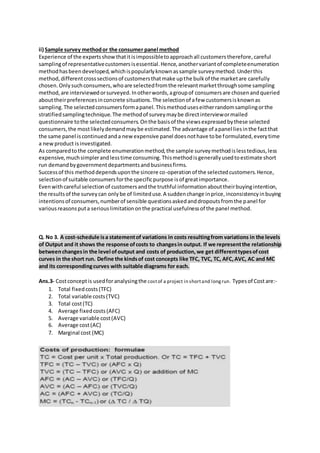
Ans.3- Costconceptis usedforanalysingthe costof a project in shortand longrun. Typesof Costare:-
1. Total fixedcosts(TFC)
2. Total variable costs(TVC)
3. Total cost(TC)
4. Average fixedcosts(AFC)
5. Average variable cost(AVC)
6. Average cost(AC)
7. Marginal cost (MC)
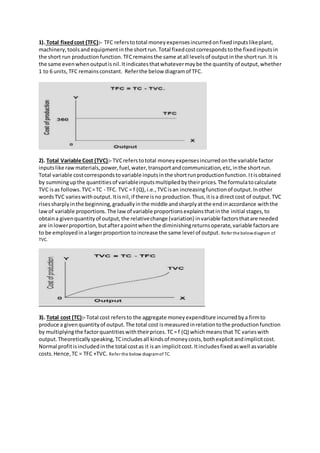
1). Total fixedcost (TFC):- TFC referstototal moneyexpensesincurredonfixedinputslikeplant,
machinery,toolsand equipmentinthe shortrun.Total fixedcostcorrespondstothe fixedinputsin
the short run productionfunction.TFCremainsthe same atall levelsof outputinthe shortrun.It is
the same evenwhenoutputisnil.Itindicatesthatwhatevermaybe the quantity of output,whether
1 to 6 units,TFC remainsconstant. Referthe below diagramof TFC.
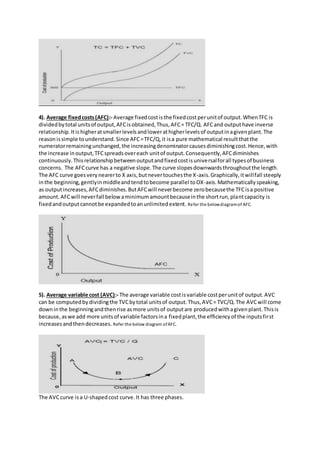
2). Total Variable Cost (TVC):- TVCreferstototal moneyexpensesincurredonthe variable factor
inputslike rawmaterials,power,fuel,water,transportandcommunication,etc,inthe shortrun.
Total variable costcorrespondstovariable inputsinthe shortrunproductionfunction.Itisobtained
by summingupthe quantitiesof variableinputsmultipliedbytheirprices.The formulatocalculate
TVC isas follows.TVC=TC - TFC. TVC = f (Q),i.e.,TVCisan increasingfunctionof output.Inother
wordsTVC varieswithoutput.Itisnil,if there isno production.Thus,itisa directcost of output.TVC
risessharplyinthe beginning,graduallyinthe middle andsharplyatthe endinaccordance withthe
lawof variable proportions.The lawof variable proportionsexplainsthatinthe initial stages,to
obtaina givenquantityof output,the relativechange (variation) invariable factorsthatare needed
are inlowerproportion,butafterapointwhenthe diminishingreturnsoperate,variable factorsare
to be employedinalargerproportiontoincrease the same level of output. Refer the belowdiagram of
TVC.
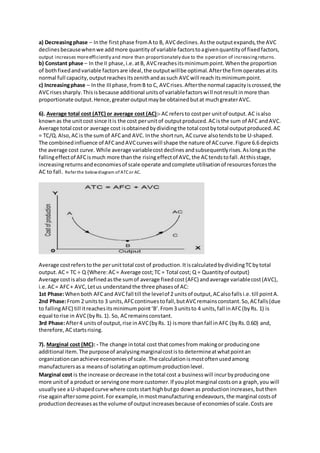
3). Total cost (TC):- Total cost refersto the aggregate moneyexpenditure incurredbya firmto
produce a givenquantityof output.The total cost ismeasuredinrelationtothe productionfunction
by multiplyingthe factorquantitieswiththeirprices.TC= f (Q) whichmeansthat TC varieswith
output.Theoreticallyspeaking,TCincludesall kindsof moneycosts,bothexplicitandimplicitcost.
Normal profitisincludedinthe total costas it isan implicitcost.Itincludesfixedaswell asvariable
costs.Hence,TC = TFC +TVC. Refer the below diagramof TC.
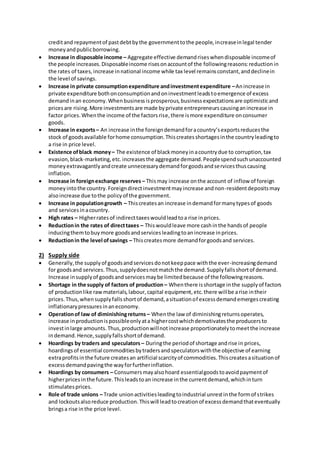
4). Average fixedcosts(AFC):- Average fixedcostisthe fixedcostperunitof output.WhenTFC is
dividedbytotal unitsof output,AFCisobtained,Thus,AFC= TFC/Q. AFCand outputhave inverse
relationship.Itis higheratsmallerlevelsandlowerathigherlevelsof outputinagivenplant.The
reasonissimple tounderstand.Since AFC=TFC/Q,it isa pure mathematical resultthatthe
numeratorremainingunchanged,the increasingdenominatorcausesdiminishingcost.Hence,with
the increase inoutput,TFCspreadsovereach unitof output.Consequently,AFCdiminishes
continuously.Thisrelationshipbetweenoutputandfixedcostisuniversalforall typesof business
concerns. The AFCcurve has a negative slope.The curve slopesdownwardsthroughoutthe length.
The AFC curve goesverynearerto X axis,butnevertouchesthe X-axis.Graphically,itwillfall steeply
inthe beginning,gentlyinmiddleandtendtobecome parallel toOX-axis.Mathematicallyspeaking,
as outputincreases,AFCdiminishes.ButAFCwill neverbecome zerobecausethe TFCisa positive
amount.AFCwill neverfall belowaminimumamountbecauseinthe shortrun,plantcapacity is
fixedandoutputcannotbe expandedtoanunlimitedextent. Refer the belowdiagramof AFC.
5). Average variable cost (AVC):- The average variable costisvariable costperunitof output.AVC
can be computedbydividingthe TVCbytotal unitsof output.Thus,AVC= TVC/Q.The AVCwill come
downinthe beginningandthenrise asmore unitsof outputare producedwithagivenplant.Thisis
because,aswe add more unitsof variable factorsina fixedplant,the efficiencyof the inputsfirst
increasesandthendecreases. Refer the below diagram ofAFC.
The AVCcurve isa U-shapedcost curve.It has three phases.
a) Decreasingphase – Inthe firstphase fromA to B, AVCdeclines.Asthe outputexpands,the AVC
declinesbecausewhenwe addmore quantityof variable factorstoagivenquantityof fixedfactors,
output increases moreefficiently and more than proportionately due to the operation of increasingreturns.
b) Constant phase – In the II phase,i.e.atB, AVCreachesitsminimumpoint.Whenthe proportion
of bothfixedandvariable factorsare ideal,the outputwillbe optimal.Afterthe firmoperatesatits
normal full capacity,outputreachesitszenithandassuch AVCwill reachitsminimumpoint.
c) Increasingphase – Inthe IIIphase,fromB to C, AVCrises.Afterthe normal capacityiscrossed,the
AVCrisessharply.Thisisbecause additional unitsof variablefactorswill notresultinmore than
proportionate output.Hence,greateroutputmaybe obtainedbutat muchgreaterAVC.
6). Average total cost (ATC) or average cost (AC):- ACrefersto costper unitof output.AC isalso
knownas the unitcost since itis the cost perunitof outputproduced.ACisthe sum of AFC andAVC.
Average total costor average cost isobtainedbydividingthe total costbytotal outputproduced.AC
= TC/Q.Also,ACis the sumof AFCand AVC. Inthe shortrun, ACcurve alsotendstobe U-shaped.
The combinedinfluence of AFCandAVCcurveswill shape the nature of ACcurve.Figure 6.6 depicts
the average cost curve. While average variablecostdeclines andsubsequentlyrises.Aslongasthe
fallingeffectof AFCismuch more thanthe risingeffectof AVC,the ACtendstofall.Atthisstage,
increasingreturnsandeconomiesof scale operate andcomplete utilisationof resourcesforcesthe
AC to fall. Refer the belowdiagram of ATCor AC.
Average costreferstothe perunittotal cost of production.ItiscalculatedbydividingTCbytotal
output. AC= TC ÷ Q {Where:AC= Average cost;TC = Total cost; Q = Quantityof output}
Average costisalso definedasthe sumof average fixedcost(AFC) andaverage variablecost(AVC),
i.e.AC= AFC+ AVC,Letus understandthe three phasesof AC:
1st Phase:Whenboth AFCand AVCfall till the levelof 2 unitsof output,ACalsofallsi.e.till pointA.
2nd Phase:From 2 unitsto 3 units,AFCcontinuestofall,butAVCremainsconstant.So,ACfalls(due
to fallingAFC) till itreachesitsminimumpoint‘B’.From3 unitsto 4 units,fall inAFC(byRs. 1) is
equal torise in AVC(byRs.1). So, ACremainsconstant.
3rd Phase:After4 unitsof output,rise inAVC(byRs. 1) ismore thanfall inAFC (byRs.0.60) and,
therefore,ACstartsrising.
7). Marginal cost (MC): - The change intotal cost thatcomesfrom makingor producingone
additional item.The purposeof analysingmarginalcostisto determineatwhatpointan
organizationcanachieve economiesof scale.The calculationismostoftenusedamong
manufacturersas a meansof isolatinganoptimumproductionlevel.
Marginal cost is the increase ordecrease inthe total cost a businesswill incurbyproducingone
more unitof a product or servingone more customer.If youplotmarginal costsona graph,you will
usuallysee aU-shapedcurve where costsstart highbutgo downas productionincreases,butthen
rise againaftersome point.For example,inmostmanufacturing endeavours,the marginal costsof
productiondecreasesasthe volume of outputincreasesbecause of economiesof scale.Costsare
lowerbecause youcantake advantage of discountsforbulkpurchasesof raw materials,make full
use of machinery,andengage specializedlabour.
However,productionwill reachapointwhere diseconomiesof scale willenterthe picture and
marginal costswill begintorise again.Costsmayrise because youhave to hire more management,
buymore equipment,orbecause youhave tappedoutyourlocal source of raw materials,causing
youto spendmore moneytoobtainthe resources. Refer the below diagram of MC.
FormulaforMarginal Cost:-
Marginal Cost = Change in costs/ Change inquantity.
Q. 4. Inflationisaglobal Phenomenon whichisassociatedwithhighprice causesdeclineinthe value
for money.Itexistswhenthe amountof moneyinthe countryisinexcessof the physical volume of
goodsand services.Explainthe reasonsforthismonetaryphenomenon.
Ans.4- Inflation:- Inflation iscommonlyunderstoodasa situationof substantial andrapidincrease
inthe level of pricesandconsequentdeteriorationinthe value of moneyoveraperiodof time.It
referstothe average rise inthe general level of pricesandfall inthe value of money.Inflationisan
upwardmovementinthe average level of prices.The opposite of inflationisdeflation,adownward
movementinthe average level of prices.The commonfeature of inflationisrise inpricesandthe
degree of inflationmaybe measuredbyprice indices.
Inflationisstatisticallymeasuredintermsof percentageincrease inthe price index,asarate
(percent) perunitof time- usuallyayearor a month. The trendof price indicesrevealsthe course of
inflationinthe economy. Usually,the WholesalePrice Index (WPI) numbersare usedtomeasure
inflation.Alternatively,the ConsumerPrice Index(CPI) orthe costof livingindex canbe adoptedto
measure the rate of inflation.Inordertomeasure the percentage rate of inflation, the following
formulacan be used:
Percentage rate of inflation,P[t] = (Change in Price*100)/ Price[t-1], Change in price[t] = P [t] – P [t-1].
Here,P = price level, [t],[t-1] =periodsof calendartime inwhichthe observationsare made.
Most of the economistsconsideredinflation asapurelymonetaryphenomenon.Accordingtothis
approach,it isthe increase inthe quantityof moneywhichcausesaninflationaryrise inthe price
level
Causes of inflation:-
1) Demand side:- Increase in aggregative effective demandisresponsible forinflation.Inthiscase,
aggregate demandexceedsaggregate supplyof goodsandservices. Demandrisesmuchfaster
than supply.We can enumerate the followingreasonsforincrease ineffective demand.
 Increase in moneysupply – Supplyof moneyincirculationincreasesonaccountof the following
reasons:deficitfinancingbythe government,expansioninpublicexpenditure,expansioninbank
creditand repaymentof pastdebtbythe governmenttothe people,increaseinlegal tender
moneyandpublicborrowing.
 Increase in disposable income – Aggregate effective demandriseswhendisposable incomeof
the people increases.Disposableincome risesonaccountof the followingreasons:reductionin
the rates of taxes,increase innational income while tax level remainsconstant,anddeclinein
the level of savings.
 Increase in private consumptionexpenditure andinvestmentexpenditure –Anincrease in
private expenditure bothonconsumptionandoninvestmentleadstoemergence of excess
demandinan economy.Whenbusinessisprosperous,businessexpectationsare optimisticand
pricesare rising.More investmentsare made byprivate entrepreneurscausinganincrease in
factor prices.Whenthe income of the factorsrise,there ismore expenditure onconsumer
goods.
 Increase in exports – An increase inthe foreigndemandforacountry’sexportsreducesthe
stock of goodsavailable forhome consumption.Thiscreatesshortagesinthe countryleadingto
a rise in price level.
 Existence ofblack money– The existence of blackmoneyinacountrydue to corruption,tax
evasion,black-marketing,etc.increasesthe aggregate demand.Peoplespendsuchunaccounted
moneyextravagantlyandcreate unnecessarydemandforgoodsandservicesthuscausing
inflation.
 Increase in foreignexchange reserves – Thismay increase onthe account of inflow of foreign
moneyintothe country.Foreigndirectinvestmentmayincrease andnon-residentdepositsmay
alsoincrease due tothe policyof the government.
 Increase in populationgrowth – Thiscreatesan increase indemandformanytypesof goods
and servicesinacountry.
 High rates – Higherratesof indirecttaxeswouldleadtoa rise inprices.
 Reductionin the rates of directtaxes – Thiswouldleave more cashinthe handsof people
inducingthemtobuymore goodsandservicesleadingtoanincrease inprices.
 Reductionin the level ofsavings – Thiscreatesmore demandforgoodsand services.
2) Supply side
 Generally,the supplyof goodsandservicesdonotkeeppace withthe ever-increasingdemand
for goodsand services.Thus,supplydoesnotmatchthe demand.Supplyfallsshortof demand.
Increase insupplyof goodsandservicesmaybe limitedbecause of the followingreasons.
 Shortage in the supply of factors of production – Whenthere isshortage inthe supplyof factors
of productionlike rawmaterials,labour,capital equipment,etc.there willbe arise intheir
prices.Thus,whensupplyfallsshortof demand,asituationof excessdemandemergescreating
inflationarypressuresinaneconomy.
 Operationof law of diminishingreturns – Whenthe law of diminishingreturnsoperates,
increase inproductionispossibleonlyata highercostwhichdemotivatesthe producersto
investinlarge amounts.Thus,productionwillnotincrease proportionatelytomeetthe increase
indemand.Hence,supplyfallsshortof demand.
 Hoardings by traders and speculators – Duringthe periodof shortage andrise in prices,
hoardingsof essential commoditiesbytradersandspeculatorswiththe objective of earning
extraprofitsinthe future createsan artificial scarcityof commodities.Thiscreatesasituationof
excessdemandpavingthe wayforfurtherinflation.
 Hoardings by consumers – Consumersmayalsohoard essentialgoodstoavoidpaymentof
higherpricesinthe future.Thisleadstoan increase inthe currentdemand,whichinturn
stimulatesprices.
 Role of trade unions – Trade unionactivitiesleadingtoindustrial unrestinthe formof strikes
and lockoutsalsoreduce production.Thiswill leadtocreationof excessdemandthateventually
bringsa rise inthe price level.
 Role of natural calamities – Natural calamitiessuchasearthquake,floods,anddrought
conditionsalsoaffectthe suppliesof agricultural productsadversely.Theyalsocreate shortage
of foodgrainsandraw materials,whichinturncreatesinflationaryconditions.
 War – Duringthe periodof war, shortage of essential goodscreatesarise inprices.
 International factors – These factorswouldcause eithershortage of goodsandservicesorrise in
the pricesof factorinputsleadingtoinflation.E.g.,higherpricesof imports.
 Increase in prices ofinputs withinthe country
3) Role of expectations:- Expectationsalsoplayasignificantrole inaccentuatinginflation.The
followingpointsare worthmentioning:
 If people expectfurtherrise inprice,the currentaggregate demandincreases,whichinturn
causesa rise in the prices.
 Expectationsabouthigherwagesandsalariesaffectthe pricesof relatedgoods.
 Expectationsof wage increase ofteninduce some businesshousestoincrease pricesevenbefore
upwardwage revisionsare actuallymade.
Thus,many factorsare responsibleforescalationof prices.
Q. 5. Discuss the practical applicationof Price elasticityand Income elasticityof demand.
Ans.5:- Price elasticityof demand: - Price elasticityof demand(PEDorEd) isa measure usedin
economicstoshowthe responsiveness,orelasticity,of the quantitydemandedof agoodor service
to a change in itsprice.More precisely,itgivesthe percentage change inquantitydemandedin
response toa one percentchange inprice (ceterisparibus,i.e.holdingconstantall the other
determinantsof demand,suchasincome).ItwasdevisedbyAlfredMarshall.
Practical Applicationsof Price elasticity:Few examplesonthe practical applicationof price elasticity
of demandare as follows:
1. Productionplanning– It helpsa producertodecide aboutthe volume of production.If the
demandforhisproductsis inelastic,specificquantitiescanbe producedwhilehe hastoproduce
differentquantities,if the demandiselastic.
2. Helpsin fixingthe prices ofdifferentgoods– It helpsaproducerto fix the price of his product.If
the demandforhis productisinelastic,he canfix a higherprice andif the demandiselastic,he has
to charge a lowerprice.Thus,price-increase policyistobe followedif the demandisinelasticinthe
marketand price-decrease policyistobe followedif the demandiselastic.Similarly,ithelpsa
monopolisttopractice price discriminationonthe basisof elasticityof demand.
3. Helpsin fixingthe rewards for factor inputs – Factor rewardsrefertothe price paidfortheir
servicesinthe productionprocess.Ithelpsthe producertodeterminethe rewardsforfactorsof
production.If the demandforany factorunitis inelastic,the producerhasto payhigherreward.
4. Helpsin determiningthe foreignexchange rates – Exchange rate refersto the rate at which
currencyof one countryis convertedintothe currency of anothercountry.It helpsinthe
determinationof the rate of exchange betweenthe currenciesof twodifferentnations.Fore.g.if
the demandforUS dollartoan Indianrupee isinelastic,inthatcase,an Indianhasto pay more
Indiancurrencyto getone unitof US dollarand vice-versa.
5. Helpsin determiningthe termsof trade – t is the basisfordecidingthe ‘termsof trade’between
twonations.The termsof trade impliesthe rate atwhichthe domesticgoodsare exchangedfor
foreigngoods.Fore.g.if the demandforJapan’sproductsin Indiaisinelastic,we have topaymore
interms of our commoditiestogetone unitof a commodityfromJapanand vice-versa.
6. Helpsin fixingthe rate of taxes – Taxesrefertothe compulsorypaymentmade bya citizentothe
governmentperiodicallywithoutexpectinganydirectreturnbenefitfromit.Ithelpsthe Finance
Ministertoformulate soundtaxationpolicyof the country.He can impose more taxesonthose
goodsfor whichthe demandisinelasticandlowertaxesif the demandiselasticinthe market.
7. Helpsin declarationof publicutilities – Publicutilitiesare those institutionswhichprovidecertain
essential goodstothe general publicateconomical prices.The governmentmaydeclare aparticular
industryas‘publicutility’or nationalizeit,if the demandforitsproductsisinelastic.
8. Povertyin the midstof plenty– The concept explainsthe paradox of povertyinthe midstof
plenty.A bumpercropof rice or wheat,insteadof bringingprosperitytofarmers,mayactuallybring
povertytothembecause the demandforrice and wheatisinelastic.
Income elasticityof demand maybe definedasthe ratioor proportionate change inthe quantity
demandedof acommoditytoa givenproportionchange inthe income.Inshort,itindicatesthe
extenttowhichdemandchangeswithavariationinconsumer‘sincome.Thefollowingformulahelps
to measure the income elasticity(Ey). OrWhere,Eyisincome elasticityof demand,Dischange in
demand,D isoriginal demand,Yischange inincome and Y isoriginal income.
GenerallyspeakingEyispositive.Thisisbecause there isadirectrelationshipbetweenincome and
demand,i.e.higherthe income;higherwouldbe the demandandvice versa.Onthe basisof the
numerical value of the co-efficient,Eyisclassifiedasgreaterthanone,lessthanone,equal toone,
equal tozero andnegative.The conceptof eyhelpsusinclassifyingcommoditiesintodifferent
categories.
 When Ey is positive,the commodity is normal (used in day-to-day life)
 When Ey is negative, the commodity is inferior.( for example jowar,beedi etc)
 When Ey is positiveand greater than one, the commodity is luxury.
 When Ey is positivebutless than one, the commodity is essential.
 When Ey is zero, the commodity is neutral.E.g. salt,match box etc.
Practical application of income elasticityofdemand
1. Helpsin determiningthe rate of growth of the firm.
If the growthrate of the economyand income growthof the people isreasonable forecasted,inthat
case itis possible predictexpectedincreaseinthe salesof afirmand vice versa.
2. Helpsin the demand forecastingof a firm.
It can be inestimatingfuture demandprovidedthe rate of increase inincome andEyfor the
productsare known.Thus,ithelpsindemandforecastingactivitiesof afirm.
3. Helpsin productionplanning and marketing.
The knowledge of Eyisessential forproductionplanning,formulatingmarketingstrategy,deciding
advertisingexpendituresandnature of distributionchannel etcinthe longrun.
4. Helpsin ensuringstabilityin production.
Properestimationof differentdegrees of income elasticityof demandfordifferenttypesof product
helpsinavoidingover-productionorunder-productionof afirm.One shouldknow whetherrise or
fall inincome ispermanentortemporary.
5. Helpsin estimatingconstruction ofhouses.
The rate of growthinincomesof people alsohelpsinhousingprogramsinacountry.
Thus ithelpsa lotinmanagerial decisionsof afirm.
Q. 6. Define revenue.Explainthe typesof revenue and the relationshipbetweenTR,AR and MR
with an example of a hypothetical revenue schedule.
Ans.6- Definitionof 'Revenue':The amountof moneythata company actuallyreceivesduringa
specificperiod,includingdiscountsanddeductionsforreturnedmerchandise.Itisthe "topline"or
"grossincome"figure fromwhich costsare subtractedto determine netincome.Revenueisalso
knownas "REVs." Revenue isthe amountof moneythatisbroughtinto a companyby itsbusiness
activities.Inthe case of government,revenueisthe moneyreceivedfromtaxation,fees,fines,inter-
governmental grantsortransfers,securitiessales,mineral rightsandresource rights,aswell asany
salesthatare made.
Types ofRevenue are as follows:-
SalesRevenue - makingmoneyfromsellinggoodsorservices.
Tax Revenue - makingmoneyfrom taxpayers.
InterestRevenue - makingmoneyfroman investment,usuallyfromabankaccount.
DividendRevenue - if you have a stockin a companythat pays dividends,that'sconsideredrevenue.
Lease Revenue - makingmoneyfromrentingthingsout,i.e.car rental,office rental,etc.
Royalty Revenue - youmake moneywhenotherpeopleuse yourasset.Inthe musicindustry,for
example,recordcompaniescancharge a royaltyto internetradiostationsthatplaytheirsongs.
RelationshipbetweenTR,MR and AR:
• The slope of MR istwice the slope of AR
• MR curve is notthe demandcurve (the relationshipbetweenprice andquantity).
• However,if the price searcherpractisesprice discriminationorAll-or-NothingPricing
Arrangement,thenAll-or-nothingpricing=
• All-or-nothingDD= AUV, whichis> MUV, and alsodownward-sloping.
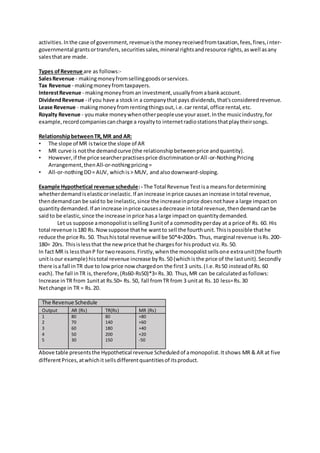
Example Hypothetical revenue schedule:- The Total Revenue Testisa meansfordetermining
whetherdemandiselasticorinelastic.If anincrease inprice causesanincrease intotal revenue,
thendemandcan be saidto be inelastic,since the increaseinprice doesnothave a large impacton
quantitydemanded.If anincrease inprice causesadecrease intotal revenue,thendemandcanbe
saidto be elastic,since the increase inprice hasa large impacton quantitydemanded.
Let us suppose amonopolistisselling3unitof a commodityperday at a price of Rs. 60. His
total revenue is180 Rs.Nowsuppose thathe wantto sell the fourthunit.Thisispossible thathe
reduce the price Rs. 50. Thushistotal revenue will be 50*4=200rs. Thus, marginal revenue isRs.200-
180= 20rs. Thisislessthat the newprice that he chargesfor hisproduct viz.Rs.50.
In fact MR is lessthanP for tworeasons.Firstly,whenthe monopolistsellsone extraunit(the fourth
unitisour example) histotal revenue increase byRs.50 (whichisthe price of the lastunit).Secondly
there isa fall inTR due to lowprice nowchargedon the first3 units.(I.e.Rs50 insteadof Rs.60
each).The fall inTR is,therefore,(Rs60-Rs50)*3=Rs.30. Thus,MR can be calculatedasfollows:
Increase inTR from 1unitat Rs.50= Rs. 50, fall fromTR from 3 unitat Rs.10 less=Rs.30
Netchange in TR = Rs.20.
The Revenue Schedule
Output AR (Rs) TR(Rs) MR (Rs)
1
2
3
4
5
80
70
60
50
30
80
140
180
200
150
+80
+60
+40
+20
-50
Above table presentsthe Hypothetical revenue Scheduledof amonopolist.Itshows MR & AR at five
differentPrices,atwhichitsellsdifferentquantitiesof itsproduct.

SMU_MBA-Solved-Assignment-Mb0042 managerial economics spring2015_assignment

  • 1.
    ASSIGNMENT, Drive SPRING2015 Program MBA, Semester 1 Subject code & name- MB0042 – Managerial Economics Book ID B1625, Credit & Marks 4 CREDIT, 60 MARKS Answerall questions. Q. 1. What is production function and its uses? Explain the two types of production functions. Q. 2. Consumers' interview method is a survey method used for estimating the demand for new products.Thismethodisvery importantwithregardto collectthe relevantinformationdirectlyfrom the consumers with regard to their future purchase plans. Opinion surveys and direct interview method are the two important techniques among all. Describe these two methods in detail. Q. 3. A cost-schedule is a statement of variations in costs resulting from variations in the levels of Output and it shows the response of costs to changes in output. If we represent the relationship betweenchangesinthe level of outputandcostsof production,we getdifferenttypesof costcurves in the short run. Define the kinds of cost concepts like TFC, TVC, TC, AFC, AVC, AC and MC and its corresponding curves with suitable diagrams for each. Q. 4. Inflationisaglobal Phenomenonwhichisassociatedwithhighprice causesdecline inthe value for money.It existswhenthe amount of moneyinthe country is in excessof the physical volume of goods and services. Explain the reasons for this monetary phenomenon. Q. 5. Discuss the practical application of Price elasticity and Income elasticity of demand. Q. 6. Define revenue.Explainthe typesof revenue andthe relationshipbetweenTR,AR and MR with an example of a hypothetical revenue schedule. Q. No 1. What is production function and its uses? Explain the two types of production functions. Ans.1- Productionfunction: - A “productionfunction”expressesthe technological orengineering relationshipbetweenphysical quantityof inputsemployedandphysicalquantityof outputs obtainedbya firm.Itspecifiesaflowof outputresultingfromaflow of inputsduringa specified periodof time.Itmay be inthe formof a table,a graphor an equationspecifyingmaximumoutput rate froma givenamountof inputsused.Asitrelatesinputstooutputs,itisalso called“input- outputrelation.”The productionispurelyphysical innature and isdeterminedbythe quantumof technology,availabilityof equipment,labour,raw materials,etc.employedbyafirm. Productionfunctionexplainsthatthe maximumoutputof goodsorservicesthatcanbe produced by a firm in a specific time with a given amount of inputs or factors of production. Production Function: Q = f (K, L) We are producing Q quantities of goods by employing K capital and L labour. Here, Q=Represents quantity of goods, K=Represents Capital employed, L=Represents Labour employed Usesof productionfunction Thoughproductionfunctionmayappearas highlyabstractandunrealistic,inreality,itisbothlogical and useful.Itisof immense utilitytothe managersandexecutivesinthe decisionmakingprocessat the firmlevel. There are several possiblecombinationsof inputsand,decisionmakershave tochoose the most appropriate amongthem.The followingare some of the importantusesof productionfunction: 1. It can be usedto calculate orwork outthe leastcostinputcombinationforagivenoutputor the maximumoutput-inputcombinationforagivencost. 2. It is useful inworkingoutanoptimal andeconomiccombinationof inputsforgettingacertain level of output.The utilityof employingaunitof variable factorinputinthe productionprocesscan be betterjudgedwiththe helpof productionfunction.Additional employmentof avariable factor
  • 2.
    inputisdesirable onlywhenthe marginalrevenue productivityof variablefactorinputisgreater than or equal tocost of employingitinan organisation. 3. Productionfunctionalsohelpsinmakinglongrundecisions.If returnstoscale are increasing,itis wise toemploymore factorunitsandincrease production.If returnstoscale are diminishing,itis unwise toemploymore factorinputs&increase production.Managerswill be indifferentwhetherto increase ordecrease production,if productionissubjecttoconstantreturnsto scale. Thus,productionfunctionhelpsbothinthe shortrunand longrun decision - makingprocess. Two types of productionfunctions are as follows: 1). Short run productionfunction – In thiscase,the producerwill keepall fixedfactorsasconstant and change onlya fewvariable factorinputs.Inthe shortrun,we come across twokindsof productionfunctions:  Quantitiesof all inputsbothfixedandvariable will be keptconstantandonlyone variable input will be varied,forexample,lawof variableproportions.  Quantitiesof all factorinputsare keptconstantand onlytwovariable factorinputsare varied, for example,iso-quantsandiso-costcurves. Short-Termproductionfunctionisafunction,whichwe are producinggoodsinthe short-termby employingtwoinputsthatare: Capital (K): It isfixedinputwhichisconstantinthe short-term. Labour (L) : It is variable inputinthe short-term. In the short-termwe are producingonlyone productbyemployingtwoinputs The two inputsare K capital and L is labour. In the short termwe will increase Linputandwe will keepKasconstant. 2). Long run production function – In thiscase,the producerwill varythe quantitiesof all factor inputs,bothfixedaswell asvariable inthe same proportion,forexample,the lawsof returnsto scale. Each firmhas its ownproductionfunctionwhichisdeterminedbythe state of technology, managerial ability,organisationalskills,etc. of afirm.It maybe inthe followingmanner: 1. The quantityof inputsmaybe reducedwhile the quantityof outputmayremainsame. 2. The quantityof inputsmaybe reducedwhile the quantityof outputmayincrease. 3. The quantityof inputsmay be keptconstantwhile the quantityof outputmayincrease. If there are any improvementsinthe firm, the oldproductionfunctionisdisturbedandanew one takesitsplace. According to economic theory, if an increase in a firm’s inputs by some proportion results in an increase output by a greater proportion, the firm experiences increasing returns to scale. If output increases by the same proportion as the inputs increase, the firm experiences constant returns to scale. A less than proportional increase in output is called decreasing returns to scale. One way to measure returns to scale is to use a coefficient of output elasticity. EQ = Percentage change in Q (Percentage change in all inputs) Thus, If E > 1, we have increasing returns to scale (IRTS). If E = 1, we have increasing returns to scale (CRTS). If E < 1, we have increasing returns to scale (DRTS) Q. No 2. Consumers' interviewmethodisa survey methodusedfor estimatingthe demandfor new products. This method is very important with regard to collect the relevant information directly fromthe consumerswithregardto theirfuture purchase plans.Opinionsurveysanddirectinterview method are the two important techniques among all. Describe these two methods in detail.
  • 3.
    Ans.2- Consumers’interviewmethod:- Underthismethod,effortsare made tocollectthe relevant informationdirectlyfromthe consumerswithregardtotheirfuture purchase plans.Inorderto gatherinformationfromconsumers,anumberof alternativetechniques are developedfromtime to time.Amongthem,the followingare some of the importantones:  Surveyof buyers’intentionsthroughquestionnaire.  DirectInterviewMethod. i) Complete EnumerationMethod ii) SampleSurveyMethod Opinionsurvey method:- Thisis a variantof the surveymethod.Thismethodisalsoknownas“Sales-force polling”or“Opinion poll method”.Underthismethod,salesrepresentatives,professionalexperts,the market consultantsandothersare askedto expresstheirconsideredopinions aboutthe volume of sales expectedinthe future.The logicandreasoningbehindthe methodisthatthese salesmenandother people connectedwiththe salesdepartmentare directlyinvolvedinthe marketingandsellingof the productsin differentregions.Salesmen,beingveryclose tothe customers,willbe inapositionto knowand feel the customers’reactionstowardsthe product.Theycanstudythe pulse of the people and identifythe specificviewsof the customers.These peopleare quite capable of estimatingthe likelydemandforthe productswiththe helpof theirintimate andfriendlycontactwiththe customersandtheirpersonal judgmentsbasedonthe pastexperience.Thus,theyprovide approximate,if notaccurate estimates.Then,the viewsof all salesmenare aggregatedtogetthe overall probable demandforaproduct. Further,the opinionsorestimatescollectedfromthe variousexpertsare considered,consolidated and reviewedbythe topexecutivestoeliminatethe bias,optimismorpessimismof different salesmen.Theserevisedestimatesare furtherexaminedinthe lightof factorslike proposedchange insellingprices,productdesigns,advertisementprograms,expectedchangesinthe degree of competition,income distribution,population,etc.The final salesforecastwouldemergeafterthese factors have beentakenintoaccount.Thismethodheavilydependsonthe collective wisdomof salesmen,departmental headsandthe topexecutives. It issimple,lessexpensive anduseful forshortrunforecasting,particularlyincase of new products. The main drawbackisthat it issubjective anddependsonthe intelligenceandawarenessof the salesmen.Itcannotbe relieduponforlongtermbusinessplanning. Direct interviewmethodand its two types ofit Direct interviewmethod:- Experienceshowsthatdue tovaried reasons,manycustomersdonot respondtoquestionnairesaddressedtothem, evenif itissimple.Hence,analternative methodis developed.Underthismethod,customersare directlycontactedandinterviewed.Directandsimple questionsare askedtothem. Theyare requestedtoanswerspecificallyabouttheirbudget, expenditure plans,particularitemstobe selected,the qualityandquantityof products,relative price preferences,etc.fora particularperiodof time.There are twodifferentmethodsof direct personal interviews.Theyare asfollows: i) Complete enumerationmethod Under thismethod,all potential customersare interviewedinaparticularcityor a region.The answerselicitedare consolidatedandcarefullystudiedtoobtainthe mostprobable demandfora product.The managementcansafelyprojectthe future demandforitsproducts.Thismethodisfree fromall typesof prejudices.The resultmainlydependsonthe nature of questionsaskedand answersreceivedfromthe customers. However, this method cannotbe used successfully by all sellers in all cases.This method can be employed to only those products whose customers are concentrated in a small region or locality.In caseconsumers are widely dispersed,this method may not be physically adopted or prove costly both in terms of time and money. Hence, this method is highly cumbersome in nature.
  • 4.
    ii) Sample surveymethodor the consumer panel method Experience of the expertsshowthatitisimpossibletoapproachall customerstherefore,careful samplingof representativecustomersisessential.Hence,anothervariantof completeenumeration methodhasbeendeveloped,whichispopularlyknownassample surveymethod.Underthis method,differentcrosssectionsof customersthatmake upthe bulkof the marketare carefully chosen.Onlysuchconsumers,whoare selectedfromthe relevantmarketthroughsome sampling method,are interviewedorsurveyed.Inotherwords,agroupof consumersare chosenandqueried abouttheirpreferencesinconcrete situations.The selectionof afew customersisknownas sampling.The selectedconsumersformapanel.Thismethoduseseitherrandomsamplingorthe stratifiedsamplingtechnique.The methodof surveymaybe directinterviewormailed questionnaire tothe selectedconsumers.Onthe basisof the viewsexpressedbythese selected consumers,the mostlikelydemandmaybe estimated.The advantage of apanel liesinthe factthat the same panel iscontinuedanda newexpensive panel doesnothave tobe formulated,everytime a newproduct isinvestigated. As comparedtothe complete enumerationmethod,the sample surveymethodislesstedious,less expensive,muchsimplerandlesstime consuming.Thismethodisgenerallyusedtoestimate short run demand bygovernmentdepartmentsandbusinessfirms. Successof this methoddependsuponthe sincere co-operationof the selectedcustomers.Hence, selectionof suitable consumersforthe specificpurpose isof greatimportance. Evenwithcareful selectionof customersandthe truthful informationabouttheirbuyingintention, the resultsof the surveycan onlybe of limiteduse.A suddenchange inprice,inconsistencyinbuying intentionsof consumers,numberof sensible questionsaskedanddropoutsfromthe panel for variousreasonsputa seriouslimitationonthe practical usefulnessof the panel method. Q. No 3. A cost-schedule isa statementof variations in costs resultingfrom variations in the levels of Output and it shows the response ofcosts to changesin output. If we representthe relationship betweenchangesin the level ofoutput and costs of production,we get differenttypesofcost curves in the short run. Define the kindsof cost concepts like TFC, TVC, TC, AFC,AVC, AC and MC and its correspondingcurves with suitable diagrams for each. Ans.3- Costconceptis usedforanalysingthe costof a project in shortand longrun. Typesof Costare:- 1. Total fixedcosts(TFC) 2. Total variable costs(TVC) 3. Total cost(TC) 4. Average fixedcosts(AFC) 5. Average variable cost(AVC) 6. Average cost(AC) 7. Marginal cost (MC)
  • 5.
    1). Total fixedcost(TFC):- TFC referstototal moneyexpensesincurredonfixedinputslikeplant, machinery,toolsand equipmentinthe shortrun.Total fixedcostcorrespondstothe fixedinputsin the short run productionfunction.TFCremainsthe same atall levelsof outputinthe shortrun.It is the same evenwhenoutputisnil.Itindicatesthatwhatevermaybe the quantity of output,whether 1 to 6 units,TFC remainsconstant. Referthe below diagramof TFC. 2). Total Variable Cost (TVC):- TVCreferstototal moneyexpensesincurredonthe variable factor inputslike rawmaterials,power,fuel,water,transportandcommunication,etc,inthe shortrun. Total variable costcorrespondstovariable inputsinthe shortrunproductionfunction.Itisobtained by summingupthe quantitiesof variableinputsmultipliedbytheirprices.The formulatocalculate TVC isas follows.TVC=TC - TFC. TVC = f (Q),i.e.,TVCisan increasingfunctionof output.Inother wordsTVC varieswithoutput.Itisnil,if there isno production.Thus,itisa directcost of output.TVC risessharplyinthe beginning,graduallyinthe middle andsharplyatthe endinaccordance withthe lawof variable proportions.The lawof variable proportionsexplainsthatinthe initial stages,to obtaina givenquantityof output,the relativechange (variation) invariable factorsthatare needed are inlowerproportion,butafterapointwhenthe diminishingreturnsoperate,variable factorsare to be employedinalargerproportiontoincrease the same level of output. Refer the belowdiagram of TVC. 3). Total cost (TC):- Total cost refersto the aggregate moneyexpenditure incurredbya firmto produce a givenquantityof output.The total cost ismeasuredinrelationtothe productionfunction by multiplyingthe factorquantitieswiththeirprices.TC= f (Q) whichmeansthat TC varieswith output.Theoreticallyspeaking,TCincludesall kindsof moneycosts,bothexplicitandimplicitcost. Normal profitisincludedinthe total costas it isan implicitcost.Itincludesfixedaswell asvariable costs.Hence,TC = TFC +TVC. Refer the below diagramof TC.
  • 6.
    4). Average fixedcosts(AFC):-Average fixedcostisthe fixedcostperunitof output.WhenTFC is dividedbytotal unitsof output,AFCisobtained,Thus,AFC= TFC/Q. AFCand outputhave inverse relationship.Itis higheratsmallerlevelsandlowerathigherlevelsof outputinagivenplant.The reasonissimple tounderstand.Since AFC=TFC/Q,it isa pure mathematical resultthatthe numeratorremainingunchanged,the increasingdenominatorcausesdiminishingcost.Hence,with the increase inoutput,TFCspreadsovereach unitof output.Consequently,AFCdiminishes continuously.Thisrelationshipbetweenoutputandfixedcostisuniversalforall typesof business concerns. The AFCcurve has a negative slope.The curve slopesdownwardsthroughoutthe length. The AFC curve goesverynearerto X axis,butnevertouchesthe X-axis.Graphically,itwillfall steeply inthe beginning,gentlyinmiddleandtendtobecome parallel toOX-axis.Mathematicallyspeaking, as outputincreases,AFCdiminishes.ButAFCwill neverbecome zerobecausethe TFCisa positive amount.AFCwill neverfall belowaminimumamountbecauseinthe shortrun,plantcapacity is fixedandoutputcannotbe expandedtoanunlimitedextent. Refer the belowdiagramof AFC. 5). Average variable cost (AVC):- The average variable costisvariable costperunitof output.AVC can be computedbydividingthe TVCbytotal unitsof output.Thus,AVC= TVC/Q.The AVCwill come downinthe beginningandthenrise asmore unitsof outputare producedwithagivenplant.Thisis because,aswe add more unitsof variable factorsina fixedplant,the efficiencyof the inputsfirst increasesandthendecreases. Refer the below diagram ofAFC. The AVCcurve isa U-shapedcost curve.It has three phases.
  • 7.
    a) Decreasingphase –Inthe firstphase fromA to B, AVCdeclines.Asthe outputexpands,the AVC declinesbecausewhenwe addmore quantityof variable factorstoagivenquantityof fixedfactors, output increases moreefficiently and more than proportionately due to the operation of increasingreturns. b) Constant phase – In the II phase,i.e.atB, AVCreachesitsminimumpoint.Whenthe proportion of bothfixedandvariable factorsare ideal,the outputwillbe optimal.Afterthe firmoperatesatits normal full capacity,outputreachesitszenithandassuch AVCwill reachitsminimumpoint. c) Increasingphase – Inthe IIIphase,fromB to C, AVCrises.Afterthe normal capacityiscrossed,the AVCrisessharply.Thisisbecause additional unitsof variablefactorswill notresultinmore than proportionate output.Hence,greateroutputmaybe obtainedbutat muchgreaterAVC. 6). Average total cost (ATC) or average cost (AC):- ACrefersto costper unitof output.AC isalso knownas the unitcost since itis the cost perunitof outputproduced.ACisthe sum of AFC andAVC. Average total costor average cost isobtainedbydividingthe total costbytotal outputproduced.AC = TC/Q.Also,ACis the sumof AFCand AVC. Inthe shortrun, ACcurve alsotendstobe U-shaped. The combinedinfluence of AFCandAVCcurveswill shape the nature of ACcurve.Figure 6.6 depicts the average cost curve. While average variablecostdeclines andsubsequentlyrises.Aslongasthe fallingeffectof AFCismuch more thanthe risingeffectof AVC,the ACtendstofall.Atthisstage, increasingreturnsandeconomiesof scale operate andcomplete utilisationof resourcesforcesthe AC to fall. Refer the belowdiagram of ATCor AC. Average costreferstothe perunittotal cost of production.ItiscalculatedbydividingTCbytotal output. AC= TC ÷ Q {Where:AC= Average cost;TC = Total cost; Q = Quantityof output} Average costisalso definedasthe sumof average fixedcost(AFC) andaverage variablecost(AVC), i.e.AC= AFC+ AVC,Letus understandthe three phasesof AC: 1st Phase:Whenboth AFCand AVCfall till the levelof 2 unitsof output,ACalsofallsi.e.till pointA. 2nd Phase:From 2 unitsto 3 units,AFCcontinuestofall,butAVCremainsconstant.So,ACfalls(due to fallingAFC) till itreachesitsminimumpoint‘B’.From3 unitsto 4 units,fall inAFC(byRs. 1) is equal torise in AVC(byRs.1). So, ACremainsconstant. 3rd Phase:After4 unitsof output,rise inAVC(byRs. 1) ismore thanfall inAFC (byRs.0.60) and, therefore,ACstartsrising. 7). Marginal cost (MC): - The change intotal cost thatcomesfrom makingor producingone additional item.The purposeof analysingmarginalcostisto determineatwhatpointan organizationcanachieve economiesof scale.The calculationismostoftenusedamong manufacturersas a meansof isolatinganoptimumproductionlevel. Marginal cost is the increase ordecrease inthe total cost a businesswill incurbyproducingone more unitof a product or servingone more customer.If youplotmarginal costsona graph,you will usuallysee aU-shapedcurve where costsstart highbutgo downas productionincreases,butthen rise againaftersome point.For example,inmostmanufacturing endeavours,the marginal costsof productiondecreasesasthe volume of outputincreasesbecause of economiesof scale.Costsare
  • 8.
    lowerbecause youcantake advantageof discountsforbulkpurchasesof raw materials,make full use of machinery,andengage specializedlabour. However,productionwill reachapointwhere diseconomiesof scale willenterthe picture and marginal costswill begintorise again.Costsmayrise because youhave to hire more management, buymore equipment,orbecause youhave tappedoutyourlocal source of raw materials,causing youto spendmore moneytoobtainthe resources. Refer the below diagram of MC. FormulaforMarginal Cost:- Marginal Cost = Change in costs/ Change inquantity. Q. 4. Inflationisaglobal Phenomenon whichisassociatedwithhighprice causesdeclineinthe value for money.Itexistswhenthe amountof moneyinthe countryisinexcessof the physical volume of goodsand services.Explainthe reasonsforthismonetaryphenomenon. Ans.4- Inflation:- Inflation iscommonlyunderstoodasa situationof substantial andrapidincrease inthe level of pricesandconsequentdeteriorationinthe value of moneyoveraperiodof time.It referstothe average rise inthe general level of pricesandfall inthe value of money.Inflationisan upwardmovementinthe average level of prices.The opposite of inflationisdeflation,adownward movementinthe average level of prices.The commonfeature of inflationisrise inpricesandthe degree of inflationmaybe measuredbyprice indices. Inflationisstatisticallymeasuredintermsof percentageincrease inthe price index,asarate (percent) perunitof time- usuallyayearor a month. The trendof price indicesrevealsthe course of inflationinthe economy. Usually,the WholesalePrice Index (WPI) numbersare usedtomeasure inflation.Alternatively,the ConsumerPrice Index(CPI) orthe costof livingindex canbe adoptedto measure the rate of inflation.Inordertomeasure the percentage rate of inflation, the following formulacan be used: Percentage rate of inflation,P[t] = (Change in Price*100)/ Price[t-1], Change in price[t] = P [t] – P [t-1]. Here,P = price level, [t],[t-1] =periodsof calendartime inwhichthe observationsare made. Most of the economistsconsideredinflation asapurelymonetaryphenomenon.Accordingtothis approach,it isthe increase inthe quantityof moneywhichcausesaninflationaryrise inthe price level Causes of inflation:- 1) Demand side:- Increase in aggregative effective demandisresponsible forinflation.Inthiscase, aggregate demandexceedsaggregate supplyof goodsandservices. Demandrisesmuchfaster than supply.We can enumerate the followingreasonsforincrease ineffective demand.  Increase in moneysupply – Supplyof moneyincirculationincreasesonaccountof the following reasons:deficitfinancingbythe government,expansioninpublicexpenditure,expansioninbank
  • 9.
    creditand repaymentof pastdebtbythegovernmenttothe people,increaseinlegal tender moneyandpublicborrowing.  Increase in disposable income – Aggregate effective demandriseswhendisposable incomeof the people increases.Disposableincome risesonaccountof the followingreasons:reductionin the rates of taxes,increase innational income while tax level remainsconstant,anddeclinein the level of savings.  Increase in private consumptionexpenditure andinvestmentexpenditure –Anincrease in private expenditure bothonconsumptionandoninvestmentleadstoemergence of excess demandinan economy.Whenbusinessisprosperous,businessexpectationsare optimisticand pricesare rising.More investmentsare made byprivate entrepreneurscausinganincrease in factor prices.Whenthe income of the factorsrise,there ismore expenditure onconsumer goods.  Increase in exports – An increase inthe foreigndemandforacountry’sexportsreducesthe stock of goodsavailable forhome consumption.Thiscreatesshortagesinthe countryleadingto a rise in price level.  Existence ofblack money– The existence of blackmoneyinacountrydue to corruption,tax evasion,black-marketing,etc.increasesthe aggregate demand.Peoplespendsuchunaccounted moneyextravagantlyandcreate unnecessarydemandforgoodsandservicesthuscausing inflation.  Increase in foreignexchange reserves – Thismay increase onthe account of inflow of foreign moneyintothe country.Foreigndirectinvestmentmayincrease andnon-residentdepositsmay alsoincrease due tothe policyof the government.  Increase in populationgrowth – Thiscreatesan increase indemandformanytypesof goods and servicesinacountry.  High rates – Higherratesof indirecttaxeswouldleadtoa rise inprices.  Reductionin the rates of directtaxes – Thiswouldleave more cashinthe handsof people inducingthemtobuymore goodsandservicesleadingtoanincrease inprices.  Reductionin the level ofsavings – Thiscreatesmore demandforgoodsand services. 2) Supply side  Generally,the supplyof goodsandservicesdonotkeeppace withthe ever-increasingdemand for goodsand services.Thus,supplydoesnotmatchthe demand.Supplyfallsshortof demand. Increase insupplyof goodsandservicesmaybe limitedbecause of the followingreasons.  Shortage in the supply of factors of production – Whenthere isshortage inthe supplyof factors of productionlike rawmaterials,labour,capital equipment,etc.there willbe arise intheir prices.Thus,whensupplyfallsshortof demand,asituationof excessdemandemergescreating inflationarypressuresinaneconomy.  Operationof law of diminishingreturns – Whenthe law of diminishingreturnsoperates, increase inproductionispossibleonlyata highercostwhichdemotivatesthe producersto investinlarge amounts.Thus,productionwillnotincrease proportionatelytomeetthe increase indemand.Hence,supplyfallsshortof demand.  Hoardings by traders and speculators – Duringthe periodof shortage andrise in prices, hoardingsof essential commoditiesbytradersandspeculatorswiththe objective of earning extraprofitsinthe future createsan artificial scarcityof commodities.Thiscreatesasituationof excessdemandpavingthe wayforfurtherinflation.  Hoardings by consumers – Consumersmayalsohoard essentialgoodstoavoidpaymentof higherpricesinthe future.Thisleadstoan increase inthe currentdemand,whichinturn stimulatesprices.  Role of trade unions – Trade unionactivitiesleadingtoindustrial unrestinthe formof strikes and lockoutsalsoreduce production.Thiswill leadtocreationof excessdemandthateventually bringsa rise inthe price level.
  • 10.
     Role ofnatural calamities – Natural calamitiessuchasearthquake,floods,anddrought conditionsalsoaffectthe suppliesof agricultural productsadversely.Theyalsocreate shortage of foodgrainsandraw materials,whichinturncreatesinflationaryconditions.  War – Duringthe periodof war, shortage of essential goodscreatesarise inprices.  International factors – These factorswouldcause eithershortage of goodsandservicesorrise in the pricesof factorinputsleadingtoinflation.E.g.,higherpricesof imports.  Increase in prices ofinputs withinthe country 3) Role of expectations:- Expectationsalsoplayasignificantrole inaccentuatinginflation.The followingpointsare worthmentioning:  If people expectfurtherrise inprice,the currentaggregate demandincreases,whichinturn causesa rise in the prices.  Expectationsabouthigherwagesandsalariesaffectthe pricesof relatedgoods.  Expectationsof wage increase ofteninduce some businesshousestoincrease pricesevenbefore upwardwage revisionsare actuallymade. Thus,many factorsare responsibleforescalationof prices. Q. 5. Discuss the practical applicationof Price elasticityand Income elasticityof demand. Ans.5:- Price elasticityof demand: - Price elasticityof demand(PEDorEd) isa measure usedin economicstoshowthe responsiveness,orelasticity,of the quantitydemandedof agoodor service to a change in itsprice.More precisely,itgivesthe percentage change inquantitydemandedin response toa one percentchange inprice (ceterisparibus,i.e.holdingconstantall the other determinantsof demand,suchasincome).ItwasdevisedbyAlfredMarshall. Practical Applicationsof Price elasticity:Few examplesonthe practical applicationof price elasticity of demandare as follows: 1. Productionplanning– It helpsa producertodecide aboutthe volume of production.If the demandforhisproductsis inelastic,specificquantitiescanbe producedwhilehe hastoproduce differentquantities,if the demandiselastic. 2. Helpsin fixingthe prices ofdifferentgoods– It helpsaproducerto fix the price of his product.If the demandforhis productisinelastic,he canfix a higherprice andif the demandiselastic,he has to charge a lowerprice.Thus,price-increase policyistobe followedif the demandisinelasticinthe marketand price-decrease policyistobe followedif the demandiselastic.Similarly,ithelpsa monopolisttopractice price discriminationonthe basisof elasticityof demand. 3. Helpsin fixingthe rewards for factor inputs – Factor rewardsrefertothe price paidfortheir servicesinthe productionprocess.Ithelpsthe producertodeterminethe rewardsforfactorsof production.If the demandforany factorunitis inelastic,the producerhasto payhigherreward. 4. Helpsin determiningthe foreignexchange rates – Exchange rate refersto the rate at which currencyof one countryis convertedintothe currency of anothercountry.It helpsinthe determinationof the rate of exchange betweenthe currenciesof twodifferentnations.Fore.g.if the demandforUS dollartoan Indianrupee isinelastic,inthatcase,an Indianhasto pay more Indiancurrencyto getone unitof US dollarand vice-versa. 5. Helpsin determiningthe termsof trade – t is the basisfordecidingthe ‘termsof trade’between twonations.The termsof trade impliesthe rate atwhichthe domesticgoodsare exchangedfor foreigngoods.Fore.g.if the demandforJapan’sproductsin Indiaisinelastic,we have topaymore interms of our commoditiestogetone unitof a commodityfromJapanand vice-versa. 6. Helpsin fixingthe rate of taxes – Taxesrefertothe compulsorypaymentmade bya citizentothe governmentperiodicallywithoutexpectinganydirectreturnbenefitfromit.Ithelpsthe Finance
  • 11.
    Ministertoformulate soundtaxationpolicyof thecountry.He can impose more taxesonthose goodsfor whichthe demandisinelasticandlowertaxesif the demandiselasticinthe market. 7. Helpsin declarationof publicutilities – Publicutilitiesare those institutionswhichprovidecertain essential goodstothe general publicateconomical prices.The governmentmaydeclare aparticular industryas‘publicutility’or nationalizeit,if the demandforitsproductsisinelastic. 8. Povertyin the midstof plenty– The concept explainsthe paradox of povertyinthe midstof plenty.A bumpercropof rice or wheat,insteadof bringingprosperitytofarmers,mayactuallybring povertytothembecause the demandforrice and wheatisinelastic. Income elasticityof demand maybe definedasthe ratioor proportionate change inthe quantity demandedof acommoditytoa givenproportionchange inthe income.Inshort,itindicatesthe extenttowhichdemandchangeswithavariationinconsumer‘sincome.Thefollowingformulahelps to measure the income elasticity(Ey). OrWhere,Eyisincome elasticityof demand,Dischange in demand,D isoriginal demand,Yischange inincome and Y isoriginal income. GenerallyspeakingEyispositive.Thisisbecause there isadirectrelationshipbetweenincome and demand,i.e.higherthe income;higherwouldbe the demandandvice versa.Onthe basisof the numerical value of the co-efficient,Eyisclassifiedasgreaterthanone,lessthanone,equal toone, equal tozero andnegative.The conceptof eyhelpsusinclassifyingcommoditiesintodifferent categories.  When Ey is positive,the commodity is normal (used in day-to-day life)  When Ey is negative, the commodity is inferior.( for example jowar,beedi etc)  When Ey is positiveand greater than one, the commodity is luxury.  When Ey is positivebutless than one, the commodity is essential.  When Ey is zero, the commodity is neutral.E.g. salt,match box etc. Practical application of income elasticityofdemand 1. Helpsin determiningthe rate of growth of the firm. If the growthrate of the economyand income growthof the people isreasonable forecasted,inthat case itis possible predictexpectedincreaseinthe salesof afirmand vice versa. 2. Helpsin the demand forecastingof a firm. It can be inestimatingfuture demandprovidedthe rate of increase inincome andEyfor the productsare known.Thus,ithelpsindemandforecastingactivitiesof afirm. 3. Helpsin productionplanning and marketing. The knowledge of Eyisessential forproductionplanning,formulatingmarketingstrategy,deciding advertisingexpendituresandnature of distributionchannel etcinthe longrun. 4. Helpsin ensuringstabilityin production. Properestimationof differentdegrees of income elasticityof demandfordifferenttypesof product helpsinavoidingover-productionorunder-productionof afirm.One shouldknow whetherrise or fall inincome ispermanentortemporary. 5. Helpsin estimatingconstruction ofhouses. The rate of growthinincomesof people alsohelpsinhousingprogramsinacountry. Thus ithelpsa lotinmanagerial decisionsof afirm. Q. 6. Define revenue.Explainthe typesof revenue and the relationshipbetweenTR,AR and MR with an example of a hypothetical revenue schedule. Ans.6- Definitionof 'Revenue':The amountof moneythata company actuallyreceivesduringa specificperiod,includingdiscountsanddeductionsforreturnedmerchandise.Itisthe "topline"or "grossincome"figure fromwhich costsare subtractedto determine netincome.Revenueisalso knownas "REVs." Revenue isthe amountof moneythatisbroughtinto a companyby itsbusiness
  • 12.
    activities.Inthe case ofgovernment,revenueisthe moneyreceivedfromtaxation,fees,fines,inter- governmental grantsortransfers,securitiessales,mineral rightsandresource rights,aswell asany salesthatare made. Types ofRevenue are as follows:- SalesRevenue - makingmoneyfromsellinggoodsorservices. Tax Revenue - makingmoneyfrom taxpayers. InterestRevenue - makingmoneyfroman investment,usuallyfromabankaccount. DividendRevenue - if you have a stockin a companythat pays dividends,that'sconsideredrevenue. Lease Revenue - makingmoneyfromrentingthingsout,i.e.car rental,office rental,etc. Royalty Revenue - youmake moneywhenotherpeopleuse yourasset.Inthe musicindustry,for example,recordcompaniescancharge a royaltyto internetradiostationsthatplaytheirsongs. RelationshipbetweenTR,MR and AR: • The slope of MR istwice the slope of AR • MR curve is notthe demandcurve (the relationshipbetweenprice andquantity). • However,if the price searcherpractisesprice discriminationorAll-or-NothingPricing Arrangement,thenAll-or-nothingpricing= • All-or-nothingDD= AUV, whichis> MUV, and alsodownward-sloping. Example Hypothetical revenue schedule:- The Total Revenue Testisa meansfordetermining whetherdemandiselasticorinelastic.If anincrease inprice causesanincrease intotal revenue, thendemandcan be saidto be inelastic,since the increaseinprice doesnothave a large impacton quantitydemanded.If anincrease inprice causesadecrease intotal revenue,thendemandcanbe saidto be elastic,since the increase inprice hasa large impacton quantitydemanded. Let us suppose amonopolistisselling3unitof a commodityperday at a price of Rs. 60. His total revenue is180 Rs.Nowsuppose thathe wantto sell the fourthunit.Thisispossible thathe reduce the price Rs. 50. Thushistotal revenue will be 50*4=200rs. Thus, marginal revenue isRs.200- 180= 20rs. Thisislessthat the newprice that he chargesfor hisproduct viz.Rs.50. In fact MR is lessthanP for tworeasons.Firstly,whenthe monopolistsellsone extraunit(the fourth unitisour example) histotal revenue increase byRs.50 (whichisthe price of the lastunit).Secondly there isa fall inTR due to lowprice nowchargedon the first3 units.(I.e.Rs50 insteadof Rs.60 each).The fall inTR is,therefore,(Rs60-Rs50)*3=Rs.30. Thus,MR can be calculatedasfollows: Increase inTR from 1unitat Rs.50= Rs. 50, fall fromTR from 3 unitat Rs.10 less=Rs.30 Netchange in TR = Rs.20. The Revenue Schedule Output AR (Rs) TR(Rs) MR (Rs) 1 2 3 4 5 80 70 60 50 30 80 140 180 200 150 +80 +60 +40 +20 -50 Above table presentsthe Hypothetical revenue Scheduledof amonopolist.Itshows MR & AR at five differentPrices,atwhichitsellsdifferentquantitiesof itsproduct.