First Day of Class
• Attendance
• Fire Drill Procedures
• Medical Team/Crisis Response Team
• Bathroom Sign-out
• Syllabus
• Assign Books
• Questions
Sociology
Unit 1: Foundations and Research
Unit 1 Overview
Unit EQ:
How does sociology view and think about society?
You will need to be able to “Do” the following:
• Explain origins of sociology
• Explain the difference between the three major theoretical
perspectives in sociology.
• Analyze sociological research through a seven step research
process and an ethical perspective.
You will need to be able to “Understand” the
following:
• Sociology is a social science that looks at human society.
• Social upheaval in Europe during the 1700-1800’s led to
the development of the academic discipline of sociology.

• Sociology employs three major theoretical perspectives—
functionalism, conflict theory, and interactionism.
• Sociologists use several approaches to conducting
research, all sociologists follow a seven step research
process, ,and sociologists are bound by ethical guidelines.
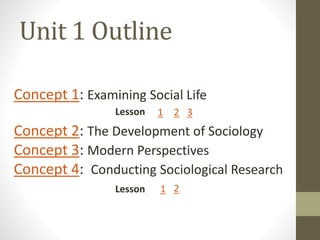
Unit 1 Outline
Concept 1: Examining Social Life
Lesson

1

2 3

Concept 2: The Development of Sociology
Concept 3: Modern Perspectives
Concept 4: Conducting Sociological Research
Lesson

1 2
Examining Social Life
EQ: What is sociology?
How does sociology differ from the other
social sciences?

Vocabulary
•
•
•
•
•

Social sciences
Sociology
Social interaction
Social perspective
Social imagination
Lesson 1: Sociology and The Social Sciences
Brainstorm the following questions:
1) What are social sciences?
2) What is sociology?
After directed, discuss and explore using textbook (pg 5)
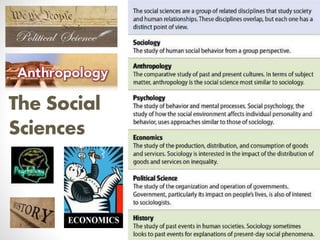
The Social
Sciences
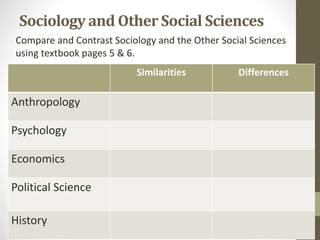
Sociology and Other Social Sciences
Compare and Contrast Sociology and the Other Social Sciences
using textbook pages 5 & 6.

Similarities

Anthropology
Psychology
Economics
Political Science
History

Differences
Assignment: Lunch Observation
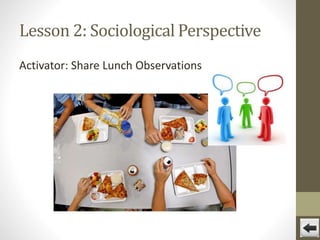
Lesson 2: Sociological Perspective
Activator: Share Lunch Observations
Sociological Perspective
• Sociology can help you gain a
new perspective on yourself and the world
around you.
• This new view involves looking at social life
in a scientific, systematic way rather than
depending on common-sense explanations
usually found in the media.
• You can look beyond commonly held
beliefs to the hidden meanings behind
human actions.
Sociological Perspective Cont.
It can also be said that “sociological
perspective can help you find an
acceptable balance between your
personal desires and the demands of
your social environment.”
• Identify one area in your life where you
experience this tension.
• Write it down and raise your hand when
finished.
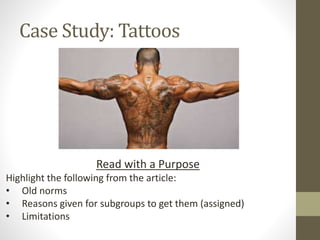
Case Study: Tattoos

Read with a Purpose
Highlight the following from the article:
• Old norms
• Reasons given for subgroups to get them (assigned)
• Limitations
Sociological Imagination
C. Wright Mills described the sociological
imagination as…
“the capacity to range from the most impersonal
and remote [topics] to the most intimate features
of the human self—and to see the relations
between the two.”
1) What does this mean?
2) Why would Mills think that all good sociologists
need to possess this?
The Development of Sociology
EQ: How did sociology develop?

Activator: Discuss Key Factors/Events that led
to sociology

Vocabulary
•
•
•
•
•

Auguste Comte
Harriet Martineau
Herbert Spencer
Social Darwinism
Karl Marx

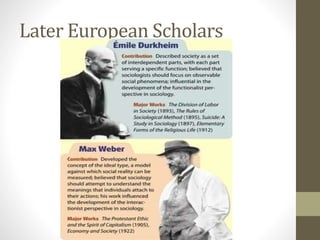
• Emile Durkheim
• Max Weber
• W.E. B. Du Bois
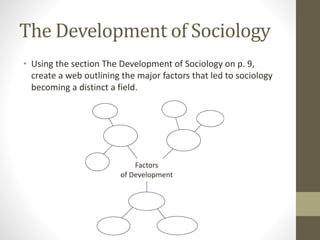
The Development of Sociology
• Using the section The Development of Sociology on p. 9,
create a web outlining the major factors that led to sociology
becoming a distinct a field.

Factors
of Development
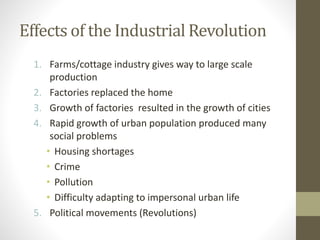
Effects of the Industrial Revolution
1. Farms/cottage industry gives way to large scale
production
2. Factories replaced the home
3. Growth of factories resulted in the growth of cities
4. Rapid growth of urban population produced many
social problems
• Housing shortages
• Crime
• Pollution
• Difficulty adapting to impersonal urban life
5. Political movements (Revolutions)
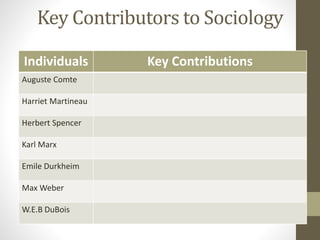
Key Contributors to Sociology
Individuals
Auguste Comte

Harriet Martineau
Herbert Spencer
Karl Marx

Emile Durkheim
Max Weber
W.E.B DuBois

Key Contributions
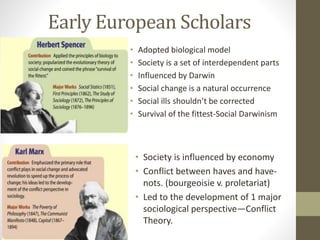
Early European Scholars
• Founder of sociology
• Coined the term sociology
• Scientific method to study social
life
• Studied social order/change
• Established the focus of
sociological study- marriage/family,
race, education, and religion
• Translated Comte’s work
• Scholars should advocate for
change
Early European Scholars
•
•
•
•
•
•

Adopted biological model
Society is a set of interdependent parts
Influenced by Darwin
Social change is a natural occurrence
Social ills shouldn’t be corrected
Survival of the fittest-Social Darwinism

• Society is influenced by economy
• Conflict between haves and havenots. (bourgeoisie v. proletariat)
• Led to the development of 1 major
sociological perspective—Conflict
Theory.
Later European Scholars
American Scholars: Jane Addams
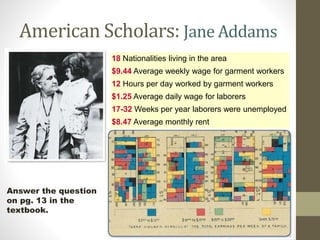
18 Nationalities living in the area
$9.44 Average weekly wage for garment workers
12 Hours per day worked by garment workers
$1.25 Average daily wage for laborers
17-32 Weeks per year laborers were unemployed
$8.47 Average monthly rent

Answer the question
on pg. 13 in the
textbook.
American Scholars

• First African American to earn a
doctorate at Harvard
• First empirical community studies
in the U.S.
• Helped found the NAACP
Summarizing Activity

• 3 Factors that led to the development of sociology
• 2 Contributors
• 1 Question
Modern Perspectives
EQ: How do the three theoretical perspectives
differ in terms of their levels of analysis?

Vocabulary
•
•
•
•
•

Functional perspective
Conflict perspective
Interactionist perspective
Macrosociology
Microsociology
Functionalist Perspective
• AKA Structural Functionalism
• Views society as a set of interrelated parts that work
together to produce a stable social system
• Society is held together through consensus
• Views the elements of society in terms of their function
•
•
•
•

Function = positive consequences for society’s stability
Dysfunction = negative consequences for society’s stability
Manifest function = intended consequence of an element
Latent function = unintended consequence of an element
Conflict Perspective
• Focus is on the forces that promote competition and change
• Competition over scarce resources is the basis of social
conflict
• Power/Wealth are in limited supply
• Power dynamics between those in control and those who are
not.
• Once a group obtains power, it uses its power to create a
system to keep them in power
• men/women, different age groups, or racial groupings

• Conflict leads to social change
• Topics of interest: family, racial relationships, workplace
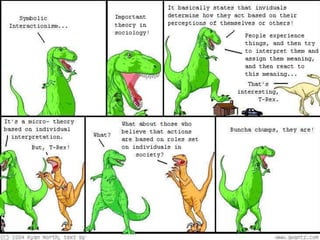
Interactionist Perspective
• AKA Symbolic Interactionism
• Focus is on how individuals interact with one another in
society
• How do individuals respond to one another?
• Interested in the meanings that individuals attach to their own
actions and to the actions of others.
• Interested in the role that symbols play
• Symbol: anything that represents something else. Ex. Words,
gestures, events
• Ex. American flag, bald eagle, Fourth of July, Uncle Sam

• Topics: child development, relationships with small groups and
mate selection
Symbolic Interactionism
1. Symbolic interaction theory analyzes society by addressing the
subjective meanings that people impose on objects, events, and
behaviors.
2. Subjective meanings are given priority because it is believe that
people behave based on what they believe and not just on what is
objectively true.
3. Thus, society is thought to be socially constructed through human
interpretation.
4. People interpret one another’s behavior and it is these
interpretations that form the social bond.

EX. Studies find that teenagers are well informed about the
risks of tobacco, but they also think that smoking is cool, that
they themselves will be safe from harm, and that smoking
projects a positive image to their peers. So, the symbolic
meaning of smoking overrides that actual facts regarding
smoking and risk.
Assignment
• Locate a media article on a
social issue
• Discuss the social issue in
terms of Sociological
Perspectives.
• Articulate how each
perspective would view
the issue from your article.
• Compose a small
paragraph for each of the
three perspectives.
Conducting Sociological
Research
EQ: How is sociological research conducted?

Vocabulary
•
•
•
•

Scientific method
Hypothesis
Variable
Correlation
Activator:

1. What role do scientific methods
play in sociology?
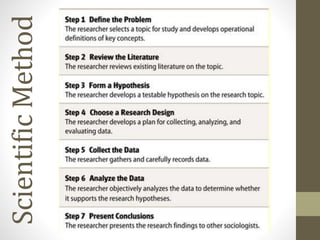
2. Steps of the Scientific Method
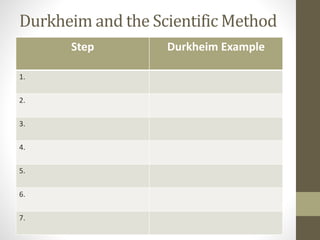
Durkheim and the Scientific Method
Step
1.
2.
3.

4.
5.

6.
7.

Durkheim Example
Scientific Method
Assignment

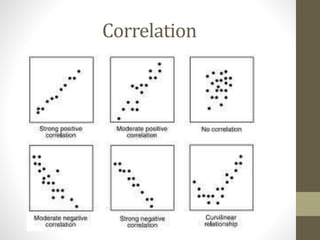
Read: Causation and Correlation
pg. 22-23
1. What is the difference?
2. How are they related to
variables?
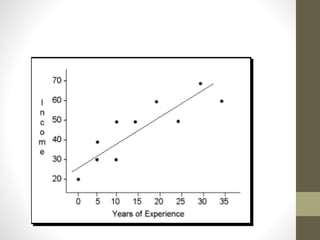
Correlation
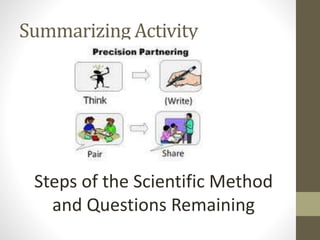
Summarizing Activity

Steps of the Scientific Method
and Questions Remaining
Conducting Sociological
Research
EQ: How is sociological research conducted?

Vocabulary
•
•
•
•
•
•
•

Scientific method
Hypothesis
Variable
Correlation
Survey
Sample
Historical method

•
•
•
•
•
•

Content analysis
Participant observation
Case study
Experiment
Statistical analysis
Ethics
Activator:

1. Other than experimentation, what
other research methods are there?
2. Steps of the Scientific Method
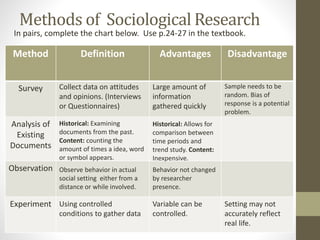
Methods of Sociological Research
In pairs, complete the chart below. Use p.24-27 in the textbook.

Method

Definition

Advantages

Survey

Collect data on attitudes
and opinions. (Interviews
or Questionnaires)

Large amount of
information
gathered quickly

Analysis of
Existing
Documents

Historical: Examining
documents from the past.
Content: counting the
amount of times a idea, word
or symbol appears.
Observe behavior in actual
social setting either from a
distance or while involved.

Sample needs to be
random. Bias of
response is a potential
problem.

Historical: Allows for
comparison between
time periods and
trend study. Content:
Inexpensive.

Observation

Disadvantage

Behavior not changed
by researcher
presence.

Experiment Using controlled
conditions to gather data

Variable can be
controlled.

Setting may not
accurately reflect
real life.
Enrichment Assignment

In Pairs, Complete “Conducting
Interviews on p. 24
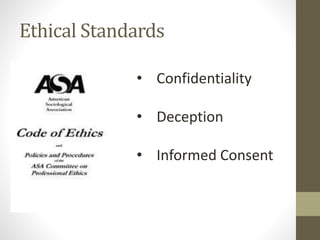
Ethical Standards
• Confidentiality

• Deception
• Informed Consent

Sociology unit 1 power point

  • 1.
    First Day ofClass • Attendance • Fire Drill Procedures • Medical Team/Crisis Response Team • Bathroom Sign-out • Syllabus • Assign Books • Questions
  • 2.
  • 3.
    Unit 1 Overview UnitEQ: How does sociology view and think about society? You will need to be able to “Do” the following: • Explain origins of sociology • Explain the difference between the three major theoretical perspectives in sociology. • Analyze sociological research through a seven step research process and an ethical perspective.
  • 4.
    You will needto be able to “Understand” the following: • Sociology is a social science that looks at human society. • Social upheaval in Europe during the 1700-1800’s led to the development of the academic discipline of sociology. • Sociology employs three major theoretical perspectives— functionalism, conflict theory, and interactionism. • Sociologists use several approaches to conducting research, all sociologists follow a seven step research process, ,and sociologists are bound by ethical guidelines.
  • 5.
    Unit 1 Outline Concept1: Examining Social Life Lesson 1 2 3 Concept 2: The Development of Sociology Concept 3: Modern Perspectives Concept 4: Conducting Sociological Research Lesson 1 2
  • 6.
    Examining Social Life EQ:What is sociology? How does sociology differ from the other social sciences? Vocabulary • • • • • Social sciences Sociology Social interaction Social perspective Social imagination
  • 7.
    Lesson 1: Sociologyand The Social Sciences Brainstorm the following questions: 1) What are social sciences? 2) What is sociology? After directed, discuss and explore using textbook (pg 5)
  • 8.
  • 9.
    Sociology and OtherSocial Sciences Compare and Contrast Sociology and the Other Social Sciences using textbook pages 5 & 6. Similarities Anthropology Psychology Economics Political Science History Differences
  • 10.
  • 11.
    Lesson 2: SociologicalPerspective Activator: Share Lunch Observations
  • 12.
    Sociological Perspective • Sociologycan help you gain a new perspective on yourself and the world around you. • This new view involves looking at social life in a scientific, systematic way rather than depending on common-sense explanations usually found in the media. • You can look beyond commonly held beliefs to the hidden meanings behind human actions.
  • 13.
    Sociological Perspective Cont. Itcan also be said that “sociological perspective can help you find an acceptable balance between your personal desires and the demands of your social environment.” • Identify one area in your life where you experience this tension. • Write it down and raise your hand when finished.
  • 14.
    Case Study: Tattoos Readwith a Purpose Highlight the following from the article: • Old norms • Reasons given for subgroups to get them (assigned) • Limitations
  • 15.
    Sociological Imagination C. WrightMills described the sociological imagination as… “the capacity to range from the most impersonal and remote [topics] to the most intimate features of the human self—and to see the relations between the two.” 1) What does this mean? 2) Why would Mills think that all good sociologists need to possess this?
  • 16.
    The Development ofSociology EQ: How did sociology develop? Activator: Discuss Key Factors/Events that led to sociology Vocabulary • • • • • Auguste Comte Harriet Martineau Herbert Spencer Social Darwinism Karl Marx • Emile Durkheim • Max Weber • W.E. B. Du Bois
  • 17.
    The Development ofSociology • Using the section The Development of Sociology on p. 9, create a web outlining the major factors that led to sociology becoming a distinct a field. Factors of Development
  • 18.
    Effects of theIndustrial Revolution 1. Farms/cottage industry gives way to large scale production 2. Factories replaced the home 3. Growth of factories resulted in the growth of cities 4. Rapid growth of urban population produced many social problems • Housing shortages • Crime • Pollution • Difficulty adapting to impersonal urban life 5. Political movements (Revolutions)
  • 19.
    Key Contributors toSociology Individuals Auguste Comte Harriet Martineau Herbert Spencer Karl Marx Emile Durkheim Max Weber W.E.B DuBois Key Contributions
  • 20.
    Early European Scholars •Founder of sociology • Coined the term sociology • Scientific method to study social life • Studied social order/change • Established the focus of sociological study- marriage/family, race, education, and religion • Translated Comte’s work • Scholars should advocate for change
  • 21.
    Early European Scholars • • • • • • Adoptedbiological model Society is a set of interdependent parts Influenced by Darwin Social change is a natural occurrence Social ills shouldn’t be corrected Survival of the fittest-Social Darwinism • Society is influenced by economy • Conflict between haves and havenots. (bourgeoisie v. proletariat) • Led to the development of 1 major sociological perspective—Conflict Theory.
  • 22.
  • 23.
    American Scholars: JaneAddams 18 Nationalities living in the area $9.44 Average weekly wage for garment workers 12 Hours per day worked by garment workers $1.25 Average daily wage for laborers 17-32 Weeks per year laborers were unemployed $8.47 Average monthly rent Answer the question on pg. 13 in the textbook.
  • 24.
    American Scholars • FirstAfrican American to earn a doctorate at Harvard • First empirical community studies in the U.S. • Helped found the NAACP
  • 25.
    Summarizing Activity • 3Factors that led to the development of sociology • 2 Contributors • 1 Question
  • 26.
    Modern Perspectives EQ: Howdo the three theoretical perspectives differ in terms of their levels of analysis? Vocabulary • • • • • Functional perspective Conflict perspective Interactionist perspective Macrosociology Microsociology
  • 27.
    Functionalist Perspective • AKAStructural Functionalism • Views society as a set of interrelated parts that work together to produce a stable social system • Society is held together through consensus • Views the elements of society in terms of their function • • • • Function = positive consequences for society’s stability Dysfunction = negative consequences for society’s stability Manifest function = intended consequence of an element Latent function = unintended consequence of an element
  • 28.
    Conflict Perspective • Focusis on the forces that promote competition and change • Competition over scarce resources is the basis of social conflict • Power/Wealth are in limited supply • Power dynamics between those in control and those who are not. • Once a group obtains power, it uses its power to create a system to keep them in power • men/women, different age groups, or racial groupings • Conflict leads to social change • Topics of interest: family, racial relationships, workplace
  • 30.
    Interactionist Perspective • AKASymbolic Interactionism • Focus is on how individuals interact with one another in society • How do individuals respond to one another? • Interested in the meanings that individuals attach to their own actions and to the actions of others. • Interested in the role that symbols play • Symbol: anything that represents something else. Ex. Words, gestures, events • Ex. American flag, bald eagle, Fourth of July, Uncle Sam • Topics: child development, relationships with small groups and mate selection
  • 31.
    Symbolic Interactionism 1. Symbolicinteraction theory analyzes society by addressing the subjective meanings that people impose on objects, events, and behaviors. 2. Subjective meanings are given priority because it is believe that people behave based on what they believe and not just on what is objectively true. 3. Thus, society is thought to be socially constructed through human interpretation. 4. People interpret one another’s behavior and it is these interpretations that form the social bond. EX. Studies find that teenagers are well informed about the risks of tobacco, but they also think that smoking is cool, that they themselves will be safe from harm, and that smoking projects a positive image to their peers. So, the symbolic meaning of smoking overrides that actual facts regarding smoking and risk.
  • 33.
    Assignment • Locate amedia article on a social issue • Discuss the social issue in terms of Sociological Perspectives. • Articulate how each perspective would view the issue from your article. • Compose a small paragraph for each of the three perspectives.
  • 34.
    Conducting Sociological Research EQ: Howis sociological research conducted? Vocabulary • • • • Scientific method Hypothesis Variable Correlation
  • 35.
    Activator: 1. What roledo scientific methods play in sociology? 2. Steps of the Scientific Method
  • 36.
    Durkheim and theScientific Method Step 1. 2. 3. 4. 5. 6. 7. Durkheim Example
  • 37.
  • 38.
    Assignment Read: Causation andCorrelation pg. 22-23 1. What is the difference? 2. How are they related to variables?
  • 40.
  • 41.
    Summarizing Activity Steps ofthe Scientific Method and Questions Remaining
  • 42.
    Conducting Sociological Research EQ: Howis sociological research conducted? Vocabulary • • • • • • • Scientific method Hypothesis Variable Correlation Survey Sample Historical method • • • • • • Content analysis Participant observation Case study Experiment Statistical analysis Ethics
  • 43.
    Activator: 1. Other thanexperimentation, what other research methods are there? 2. Steps of the Scientific Method
  • 44.
    Methods of SociologicalResearch In pairs, complete the chart below. Use p.24-27 in the textbook. Method Definition Advantages Survey Collect data on attitudes and opinions. (Interviews or Questionnaires) Large amount of information gathered quickly Analysis of Existing Documents Historical: Examining documents from the past. Content: counting the amount of times a idea, word or symbol appears. Observe behavior in actual social setting either from a distance or while involved. Sample needs to be random. Bias of response is a potential problem. Historical: Allows for comparison between time periods and trend study. Content: Inexpensive. Observation Disadvantage Behavior not changed by researcher presence. Experiment Using controlled conditions to gather data Variable can be controlled. Setting may not accurately reflect real life.
  • 45.
    Enrichment Assignment In Pairs,Complete “Conducting Interviews on p. 24
  • 46.
    Ethical Standards • Confidentiality •Deception • Informed Consent