PHYSICS Matters for GCE ‘O’ Level
Unit 2: Kinematics
2.1 Distance, Time and Speed
In this section, you’ll be able to:
• state what speed is
• calculate average speed
• plot and interpret a distance-time graph

Copyright © 2006-2011 Marshall Cavendish International (Singapore) Pte. Ltd.

4 February 2014
2.1 Distance, Time and Speed
What is Speed?
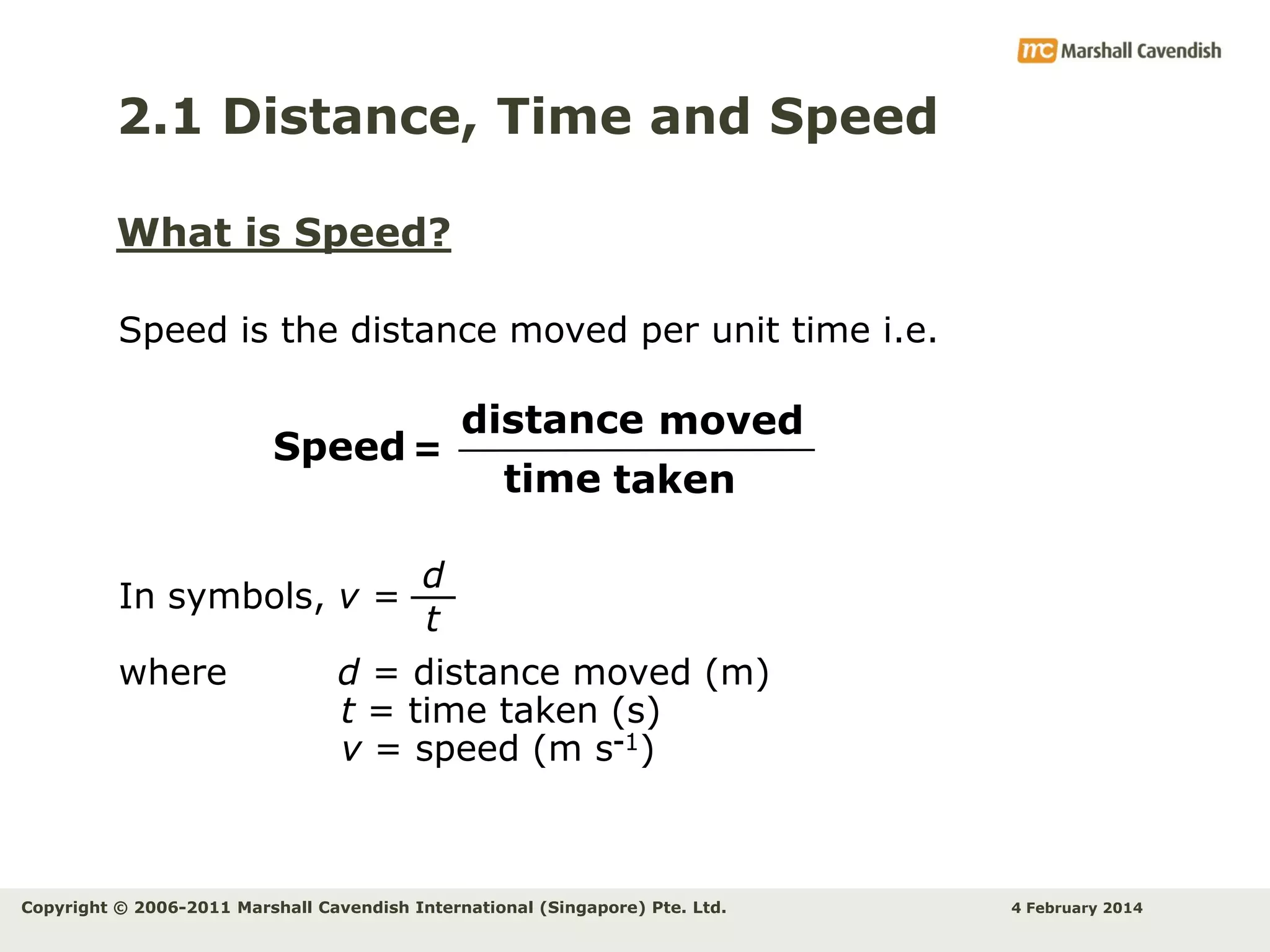
Speed is the distance moved per unit time i.e.

Speed =

In symbols, v =
where

distance moved
time taken

d
t

d = distance moved (m)
t = time taken (s)
v = speed (m s-1)

Copyright © 2006-2011 Marshall Cavendish International (Singapore) Pte. Ltd.

4 February 2014
2.1 Distance, Time and Speed
The ‘Triangle’ Method
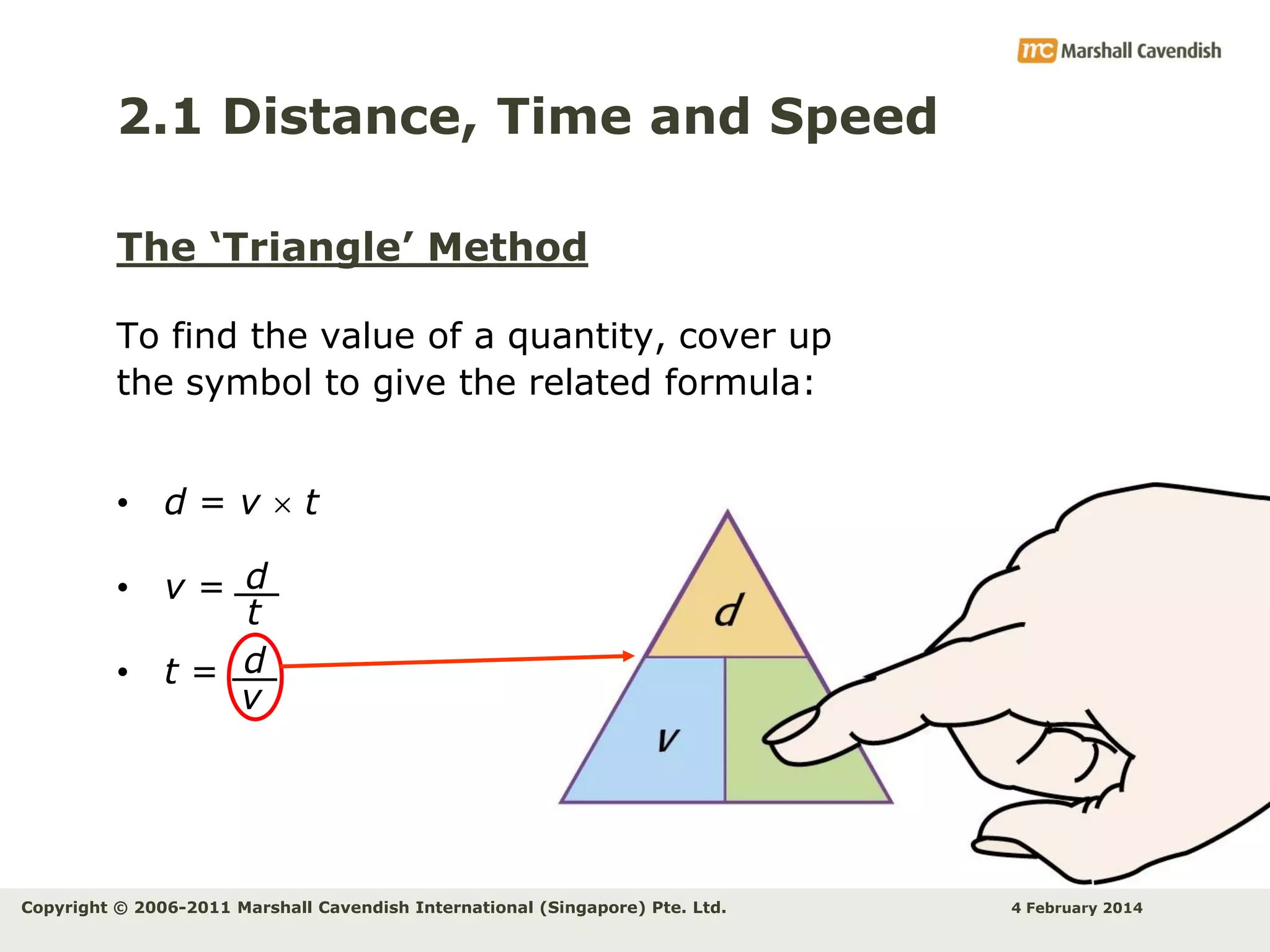
To find the value of a quantity, cover up
the symbol to give the related formula:
• d=vt
• v= d
t
• t= d
v

Copyright © 2006-2011 Marshall Cavendish International (Singapore) Pte. Ltd.

4 February 2014
2.1 Distance, Time and Speed
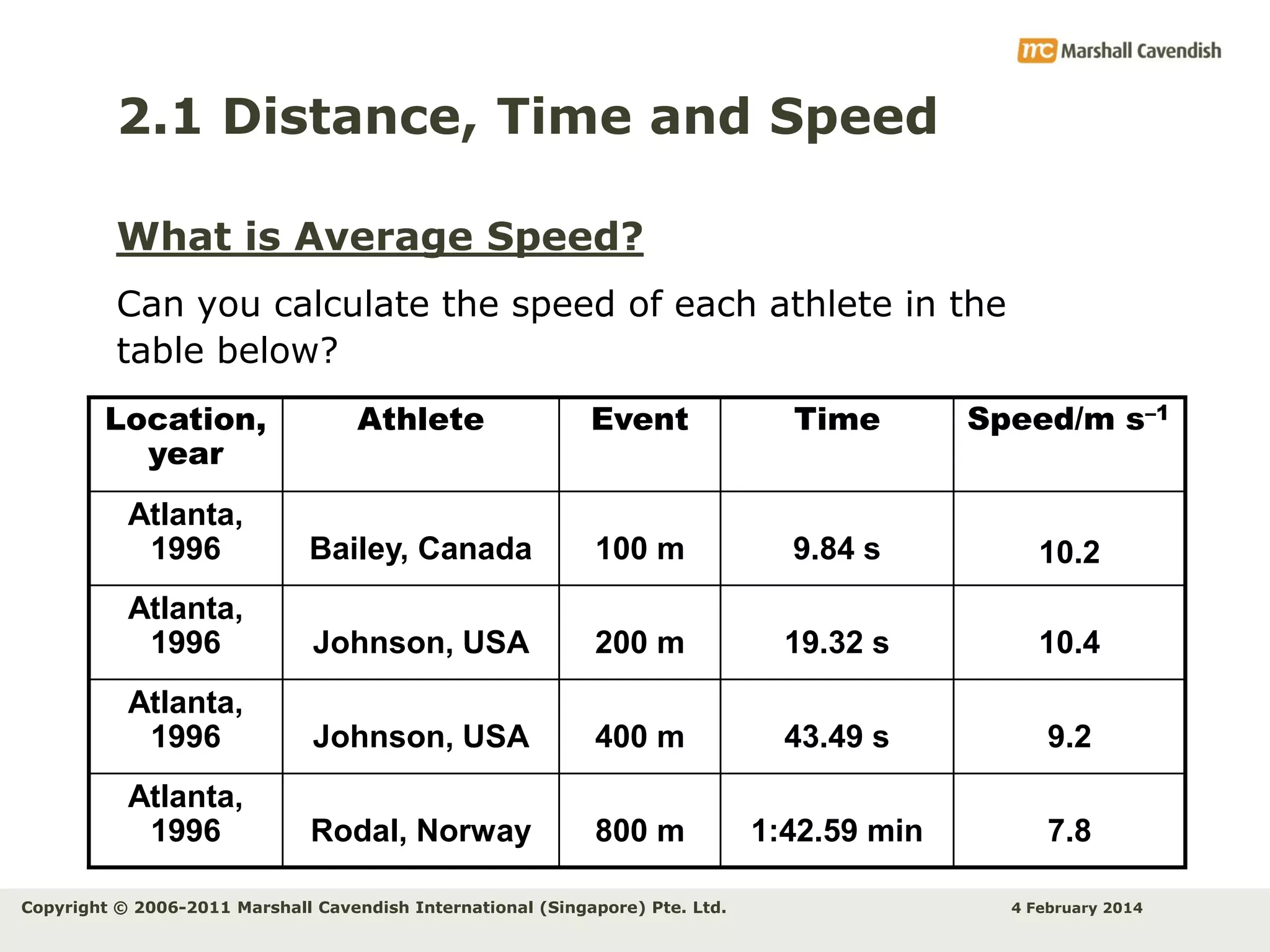
What is Average Speed?
Can you calculate the speed of each athlete in the
table below?
Athlete

Event

Time

Speed/m s–1

Atlanta,
1996

Bailey, Canada

100 m

9.84 s

10.2

Atlanta,
1996

Johnson, USA

200 m

19.32 s

10.4

Atlanta,
1996

Johnson, USA

400 m

43.49 s

9.2

Atlanta,
1996

Rodal, Norway

800 m

1:42.59 min

7.8

Location,
year

Copyright © 2006-2011 Marshall Cavendish International (Singapore) Pte. Ltd.

4 February 2014
2.1 Distance, Time and Speed
What is Average Speed?
• The speed that you have calculated for each athlete is
actually the average speed.
• Each athlete did not run at the same speed throughout
the race.

• In short, average speed assumes that the object travels
at the same speed throughout the entire distance.

Copyright © 2006-2011 Marshall Cavendish International (Singapore) Pte. Ltd.

4 February 2014
2.1 Distance, Time and Speed
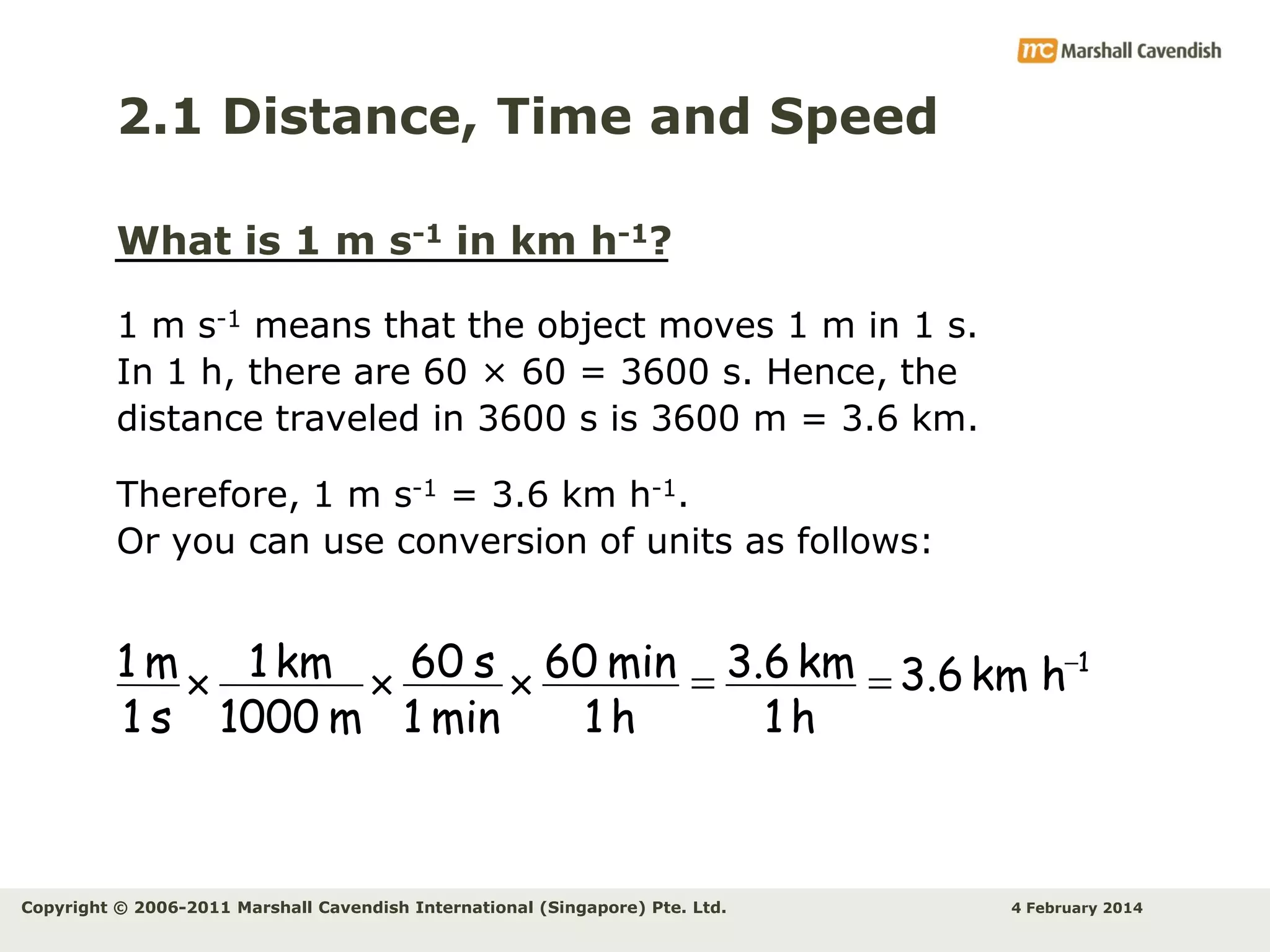
What is 1 m s-1 in km h-1?
1 m s-1 means that the object moves 1 m in 1 s.
In 1 h, there are 60 × 60 = 3600 s. Hence, the
distance traveled in 3600 s is 3600 m = 3.6 km.
Therefore, 1 m s-1 = 3.6 km h-1.
Or you can use conversion of units as follows:

1 m  1 km  60 s  60 min = 3.6 km = 3.6 km h-1
1 s 1000 m 1 min
1h
1h

Copyright © 2006-2011 Marshall Cavendish International (Singapore) Pte. Ltd.

4 February 2014
2.1 Distance, Time and Speed
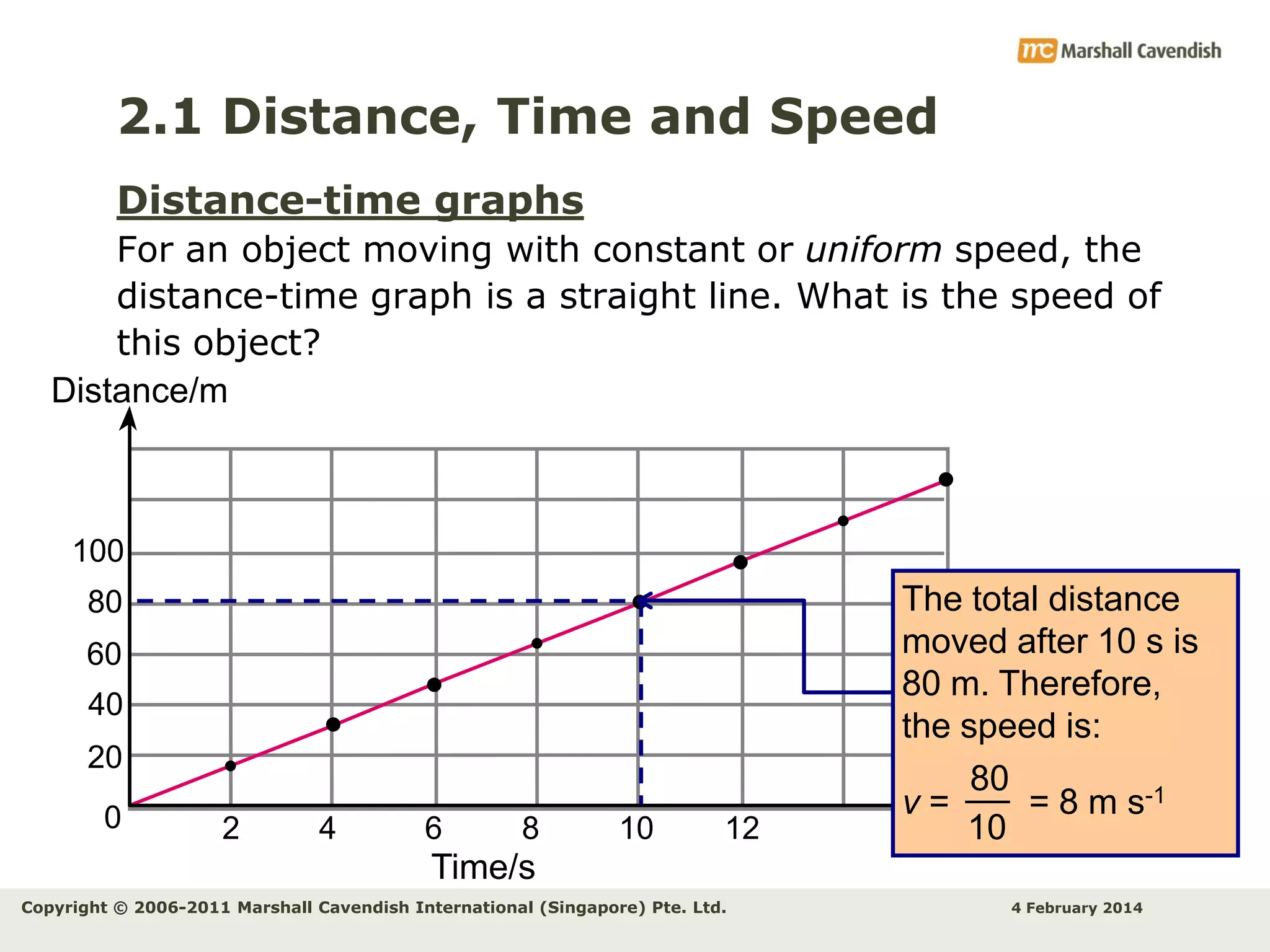
Distance-time graphs
For an object moving with constant or uniform speed, the
distance-time graph is a straight line. What is the speed of
this object?
Distance/m

100

80
60
40
20
0

2

4

6

8

10

12

The total distance
moved after 10 s is
80 m. Therefore,
the speed is:
80
v=
= 8 m s-1
10

Time/s
Copyright © 2006-2011 Marshall Cavendish International (Singapore) Pte. Ltd.

4 February 2014
2.1 Distance, Time and Speed
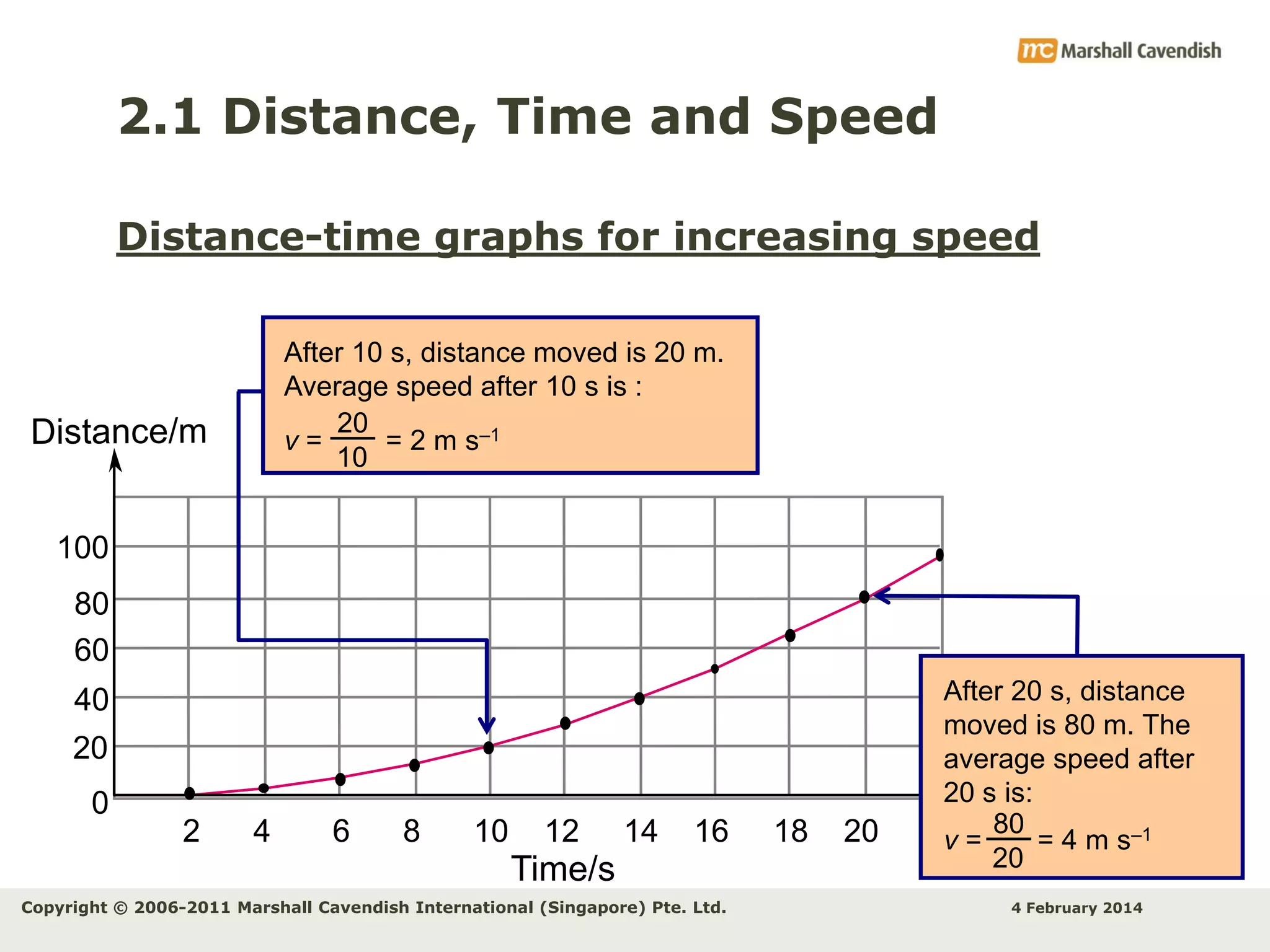
Distance-time graphs for increasing speed
After 10 s, distance moved is 20 m.
Average speed after 10 s is :
20
v=
= 2 m s–1
10

100
80
60

40
20

0

2

4

6

8

10

12

14

16

Time/s
Copyright © 2006-2011 Marshall Cavendish International (Singapore) Pte. Ltd.

18

20

After 20 s, distance
moved is 80 m. The
average speed after
20 s is:
80
v=
= 4 m s–1
20
4 February 2014
2.1 Distance, Time and Speed
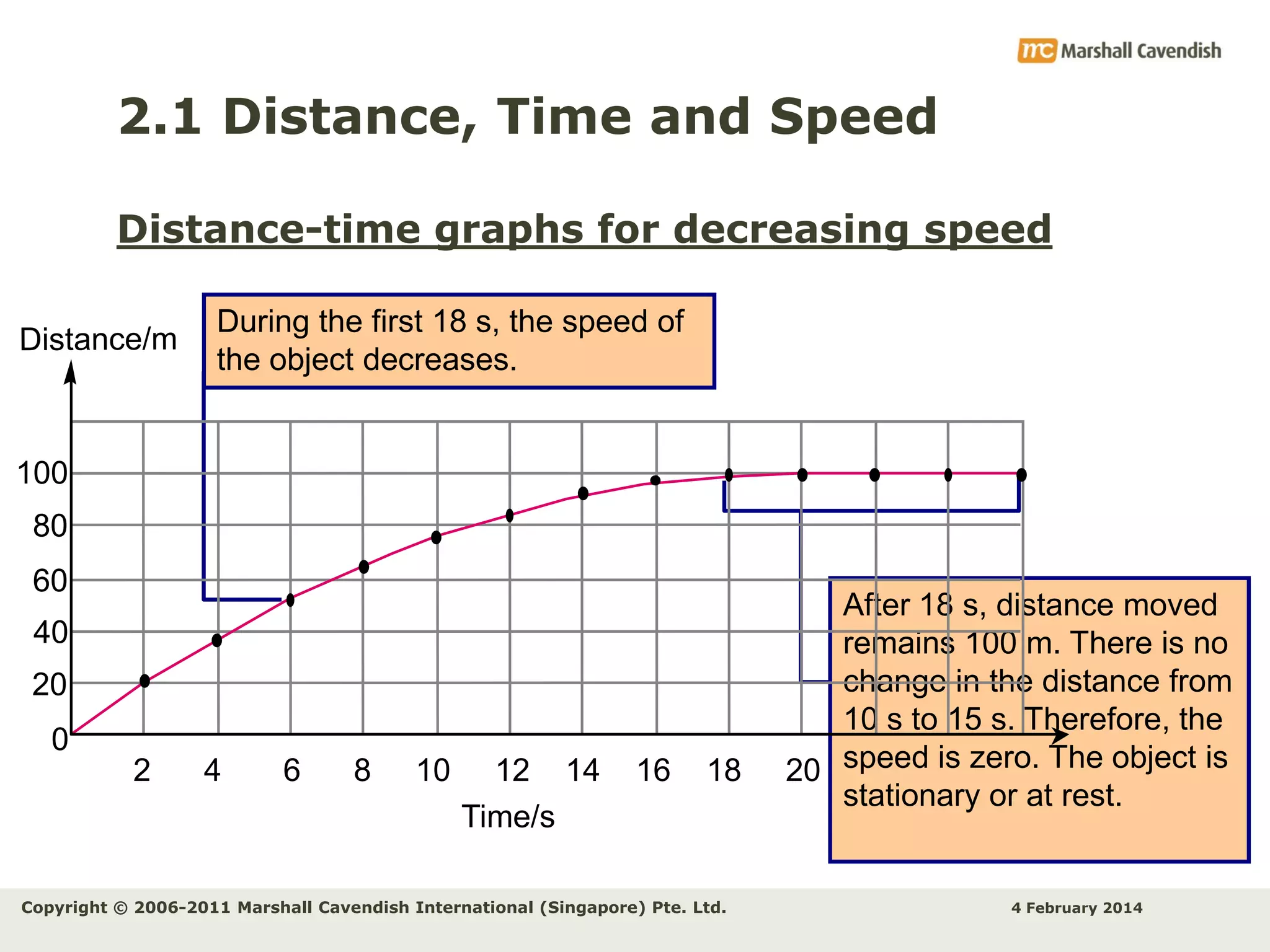
Distance-time graphs for decreasing speed
During the first 18 s, the speed of
the object decreases.

100
80

60
40
20
0

2

4

6

8

10

12 14
Time/s

16

18

Copyright © 2006-2011 Marshall Cavendish International (Singapore) Pte. Ltd.

After 18 s, distance moved
remains 100 m. There is no
change in the distance from
10 s to 15 s. Therefore, the
20 speed is zero. The object is
stationary or at rest.

4 February 2014
2.1 Distance, Time and Speed
Instantaneous Speed
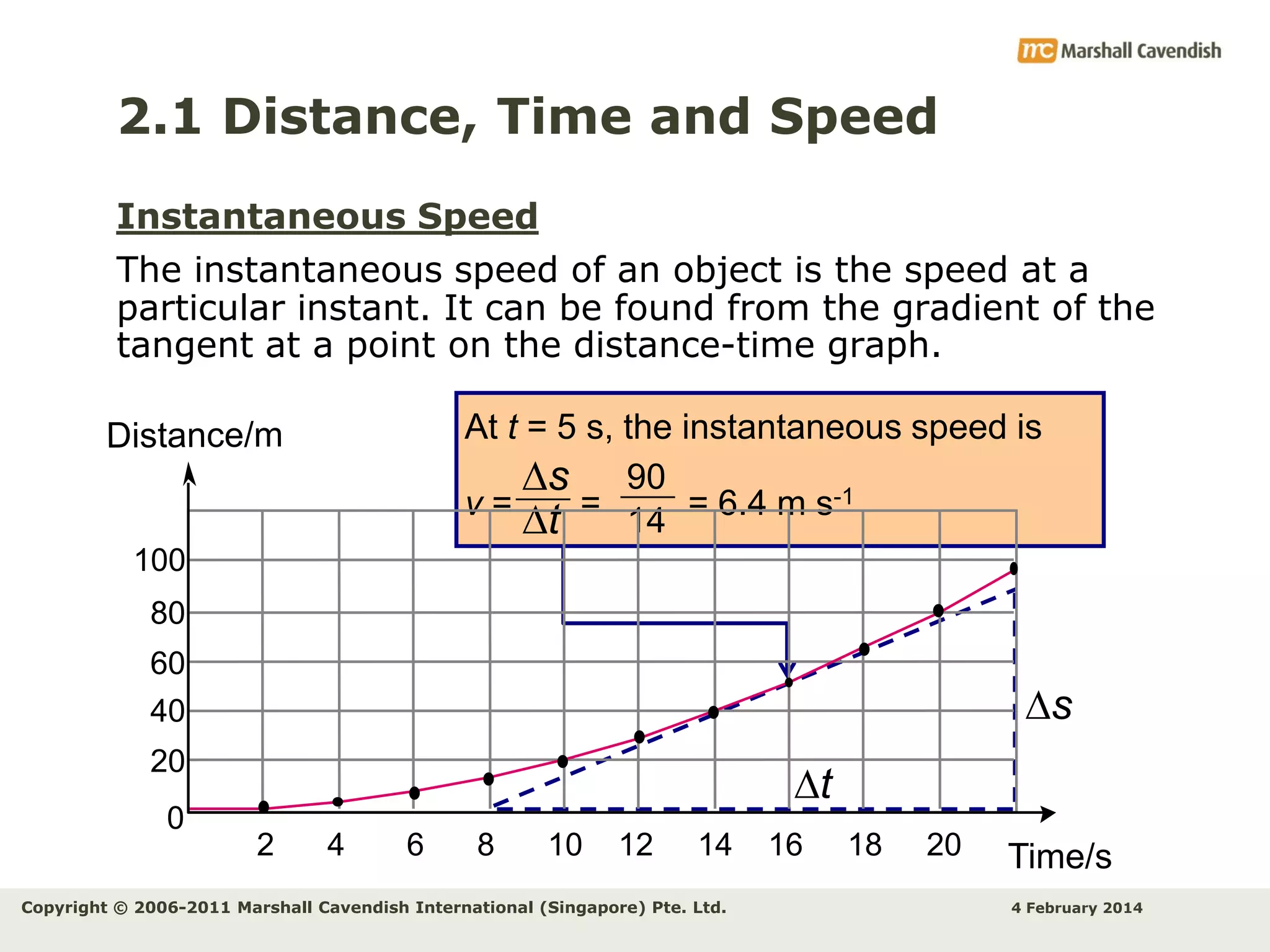
The instantaneous speed of an object is the speed at a
particular instant. It can be found from the gradient of the
tangent at a point on the distance-time graph.
At t = 5 s, the instantaneous speed is
s 90
v=
= 14 = 6.4 m s-1
t
100
80
60
40

s

20
0

t
2

4

6

8

10

12

14

Copyright © 2006-2011 Marshall Cavendish International (Singapore) Pte. Ltd.

16

18

20

Time/s
4 February 2014
2.1 Distance, Time and Speed
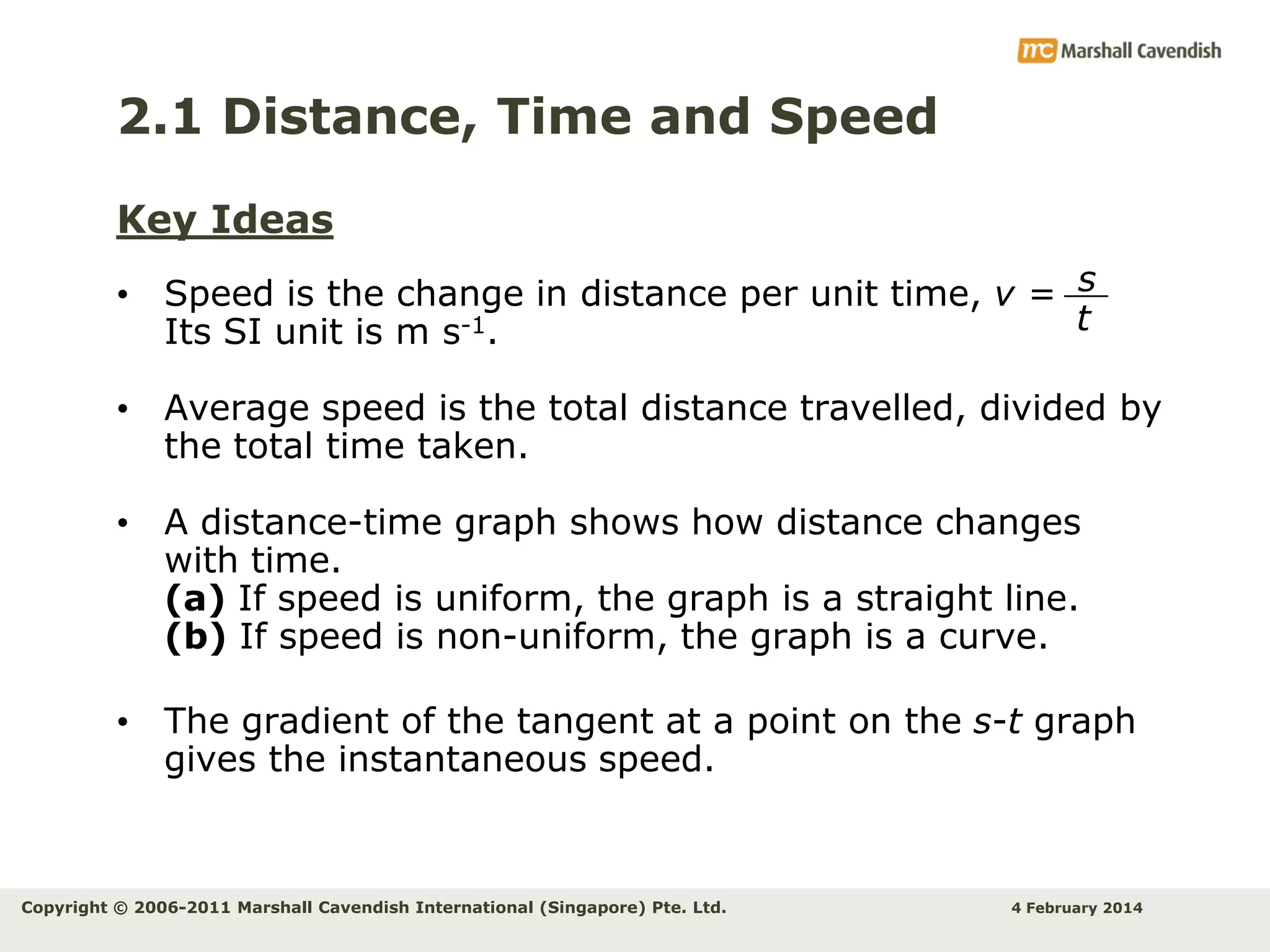
Key Ideas
• Speed is the change in distance per unit time, v = s
t
Its SI unit is m s-1.
• Average speed is the total distance travelled, divided by
the total time taken.
• A distance-time graph shows how distance changes
with time.
(a) If speed is uniform, the graph is a straight line.
(b) If speed is non-uniform, the graph is a curve.
• The gradient of the tangent at a point on the s-t graph
gives the instantaneous speed.

Copyright © 2006-2011 Marshall Cavendish International (Singapore) Pte. Ltd.

4 February 2014
2.1 Distance, Time and Speed
Test Yourself 2.1
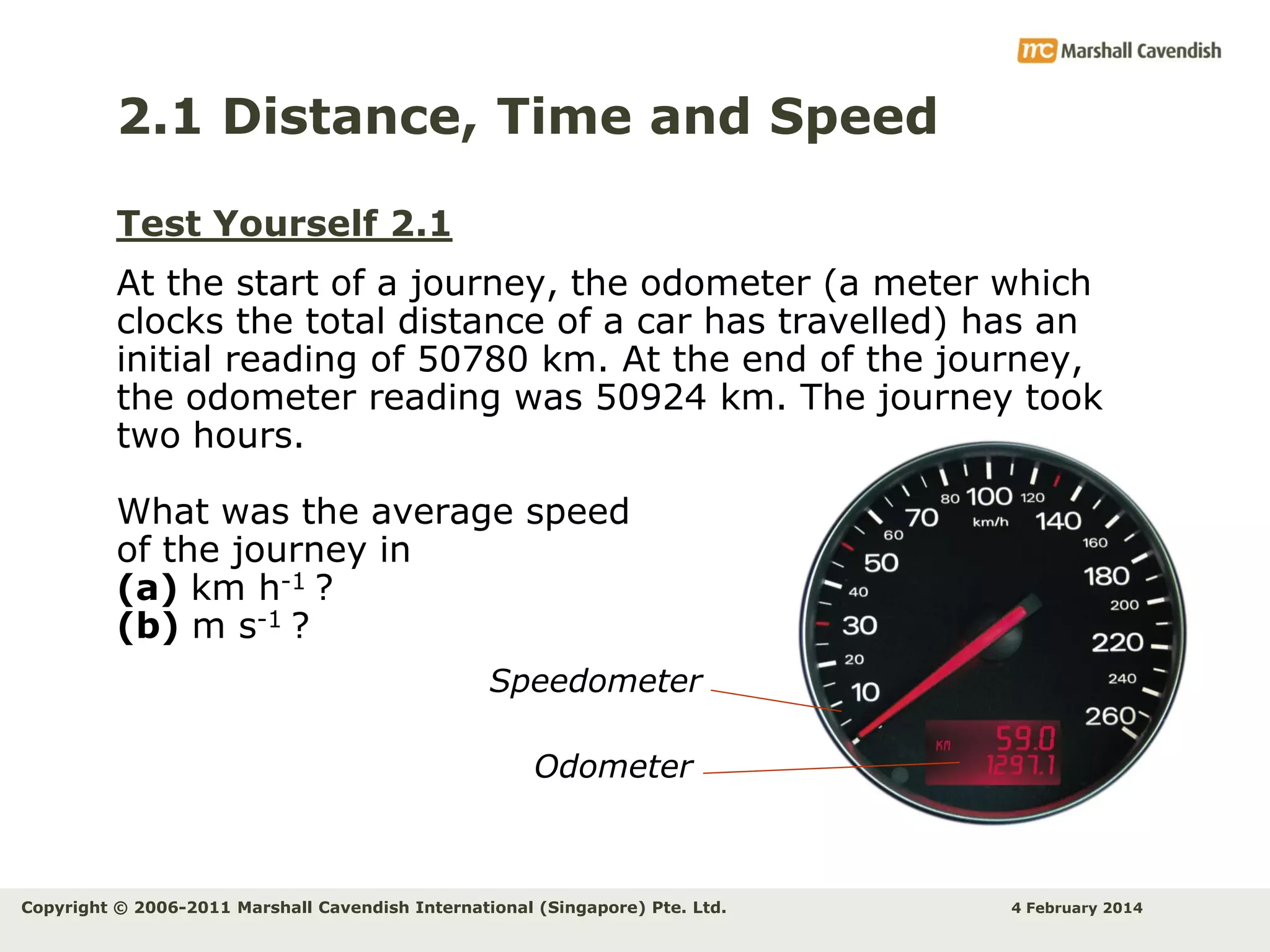
At the start of a journey, the odometer (a meter which
clocks the total distance of a car has travelled) has an
initial reading of 50780 km. At the end of the journey,
the odometer reading was 50924 km. The journey took
two hours.
What was the average speed
of the journey in
(a) km h-1 ?
(b) m s-1 ?
Speedometer
Odometer

Copyright © 2006-2011 Marshall Cavendish International (Singapore) Pte. Ltd.

4 February 2014
2.2 Speed, Velocity and Acceleration
In this section, you’ll be able to:
• state what velocity and uniform acceleration are
change in velocity
• calculate acceleration using
Time taken
• interpret given examples of non-uniform acceleration

Copyright © 2006-2011 Marshall Cavendish International (Singapore) Pte. Ltd.

4 February 2014
2.2 Speed, Velocity and Acceleration
Speed and Velocity
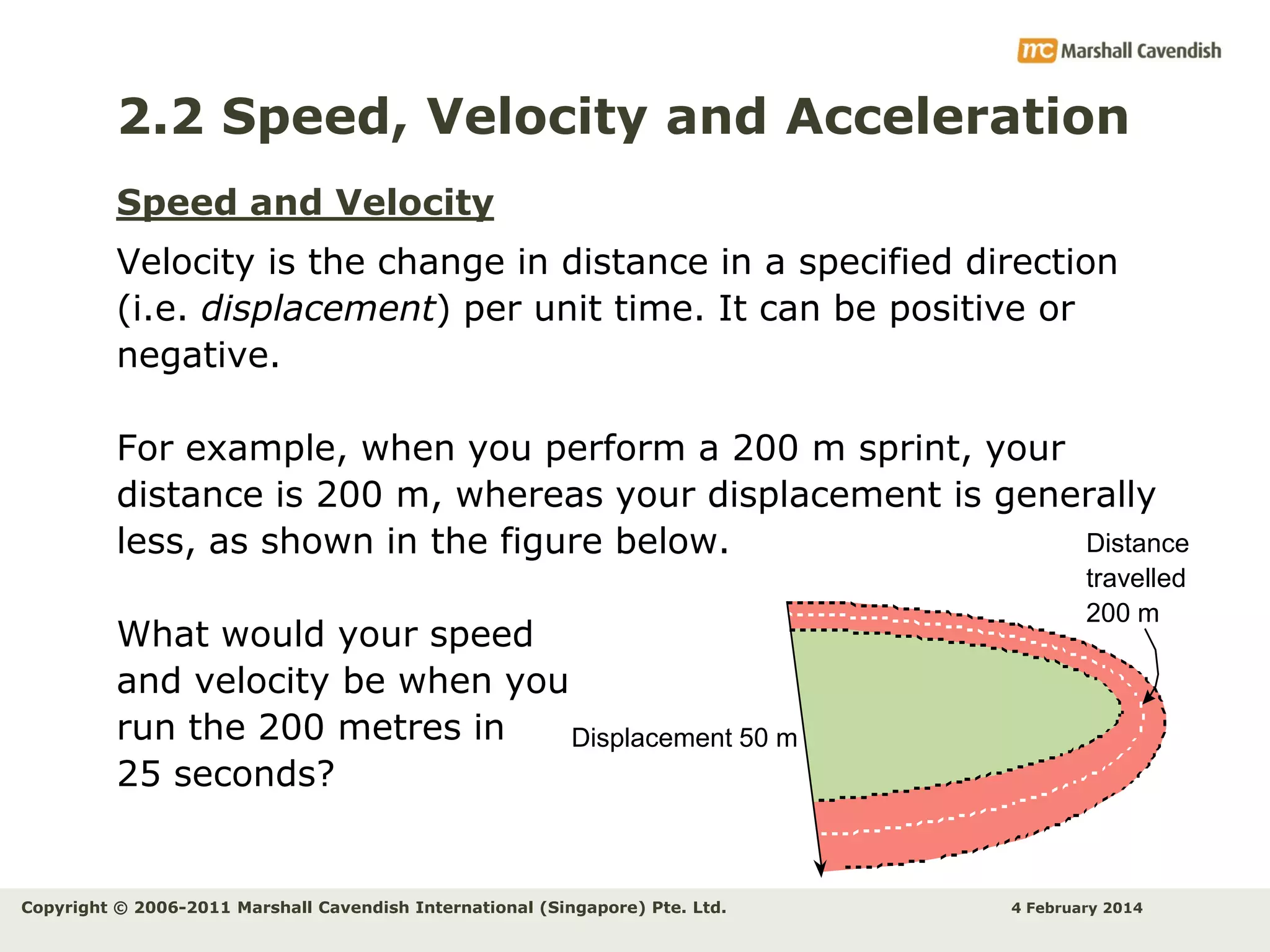
Velocity is the change in distance in a specified direction
(i.e. displacement) per unit time. It can be positive or
negative.
For example, when you perform a 200 m sprint, your
distance is 200 m, whereas your displacement is generally
Distance
less, as shown in the figure below.
What would your speed
and velocity be when you
run the 200 metres in
Displacement 50 m
25 seconds?

Copyright © 2006-2011 Marshall Cavendish International (Singapore) Pte. Ltd.

travelled
200 m

4 February 2014
2.2 Speed, Velocity and Acceleration
Acceleration
Acceleration is the change in
velocity with time. In symbols:

a =  v (in m s-2)
t
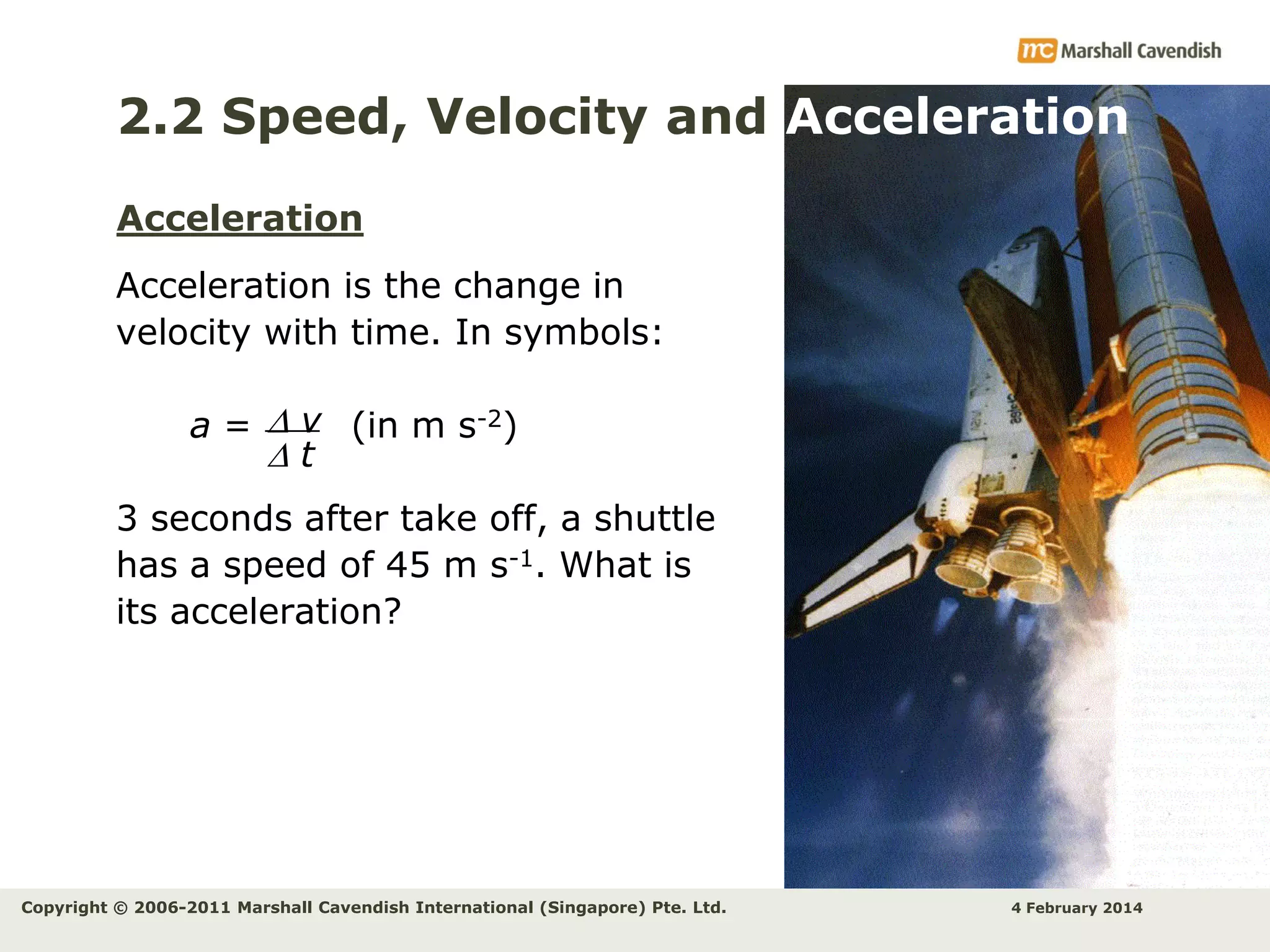
3 seconds after take off, a shuttle
has a speed of 45 m s-1. What is
its acceleration?

Copyright © 2006-2011 Marshall Cavendish International (Singapore) Pte. Ltd.

4 February 2014
2.2 Speed, Velocity and Acceleration
Key Ideas
• Velocity is the change in displacement per unit time.
It is speed in a specified direction. Its SI unit is m s-1,
which is the same for speed.
• Acceleration is the change in velocity per unit time.
Its SI unit is m s-2.

Copyright © 2006-2011 Marshall Cavendish International (Singapore) Pte. Ltd.

4 February 2014
2.2 Speed, Velocity and Acceleration
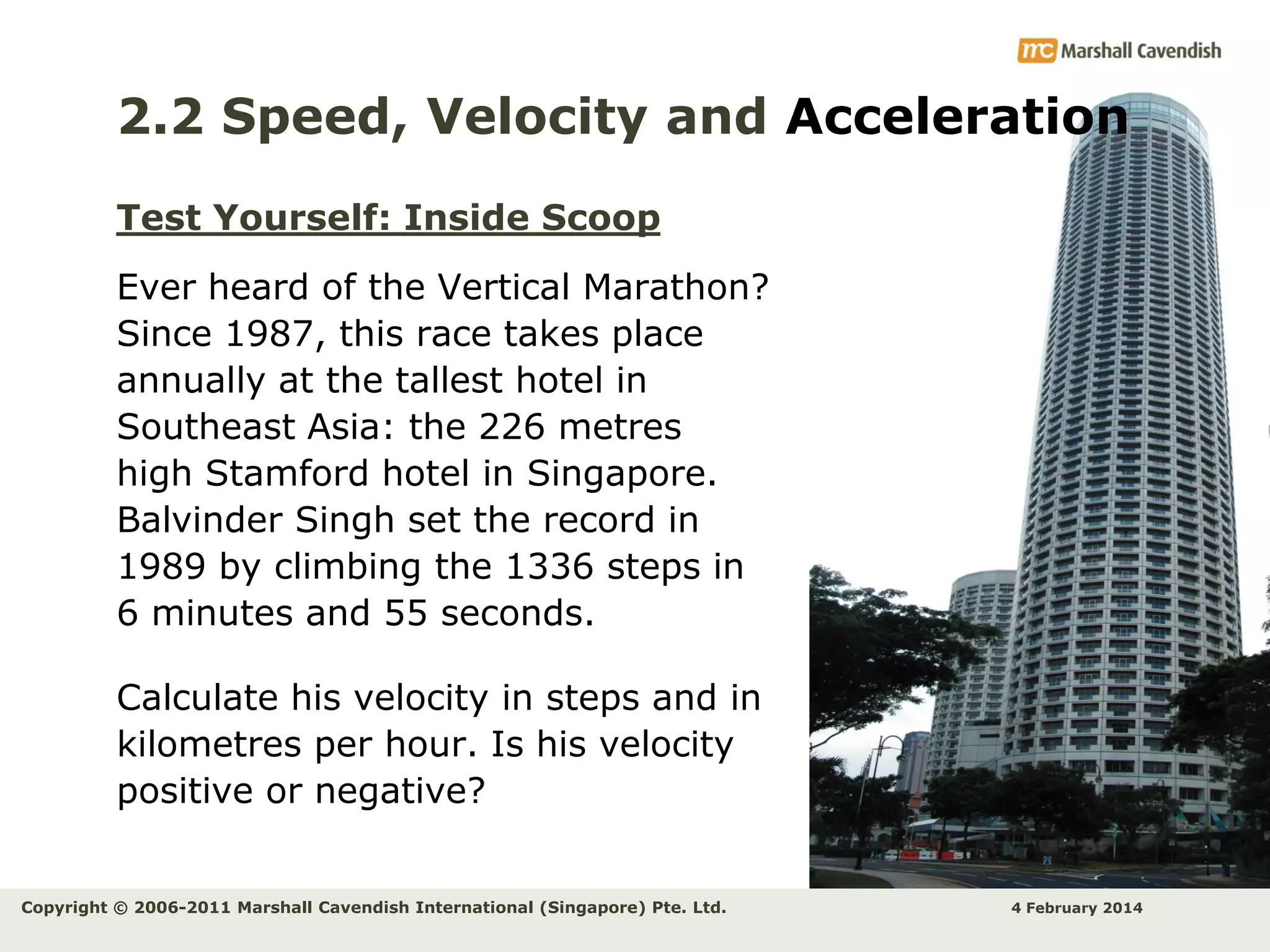
Test Yourself: Inside Scoop
Ever heard of the Vertical Marathon?
Since 1987, this race takes place
annually at the tallest hotel in
Southeast Asia: the 226 metres
high Stamford hotel in Singapore.
Balvinder Singh set the record in
1989 by climbing the 1336 steps in
6 minutes and 55 seconds.
Calculate his velocity in steps and in
kilometres per hour. Is his velocity
positive or negative?
Copyright © 2006-2011 Marshall Cavendish International (Singapore) Pte. Ltd.

4 February 2014
2.3 Speed-Time Graphs
In this section, you’ll be able to:
• plot and interpret speed-time graphs
• determine the distance travelled by calculating the area
under the speed-time graph

Copyright © 2006-2011 Marshall Cavendish International (Singapore) Pte. Ltd.

4 February 2014
2.3 Speed-Time Graphs
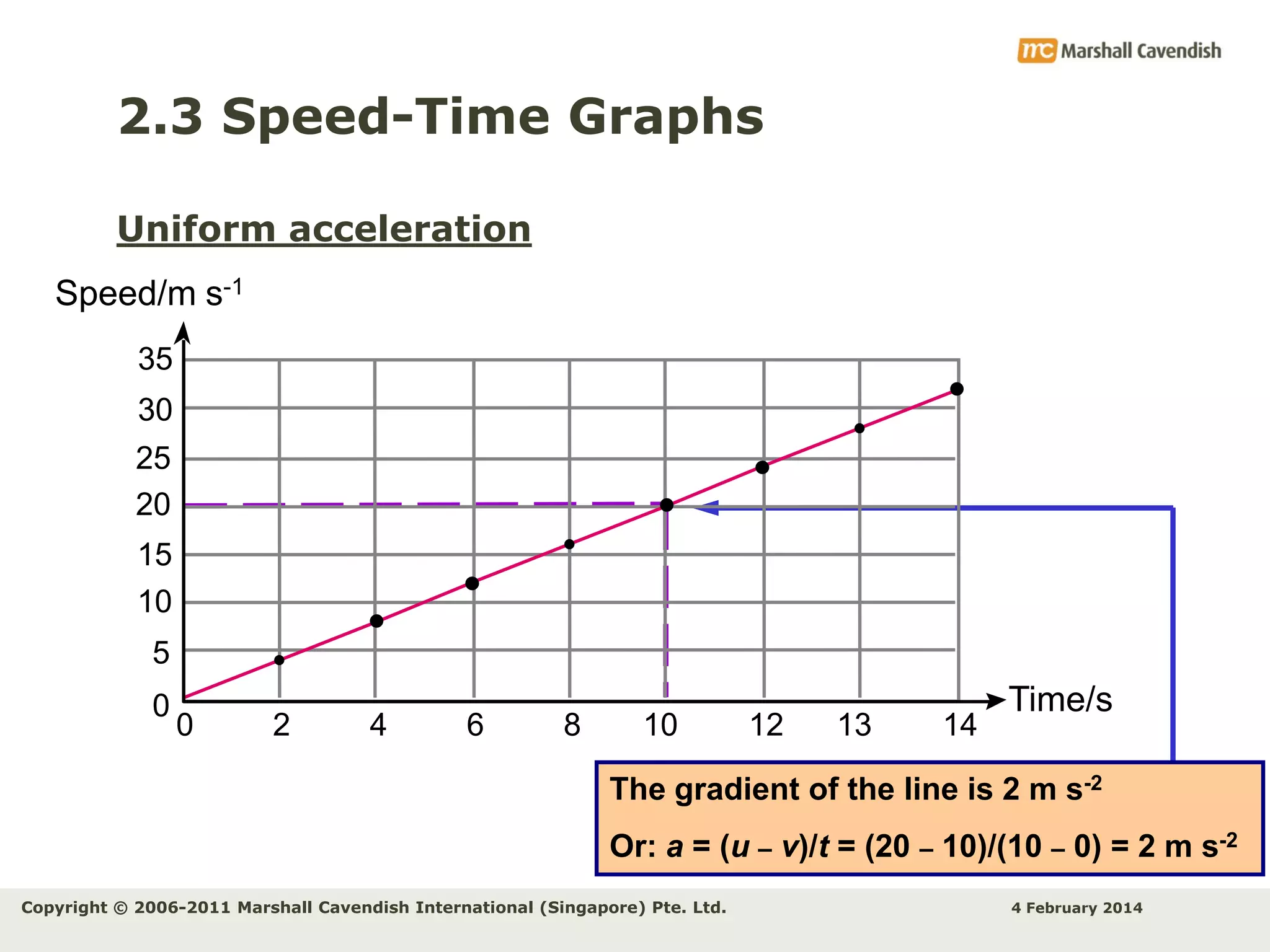
Uniform acceleration
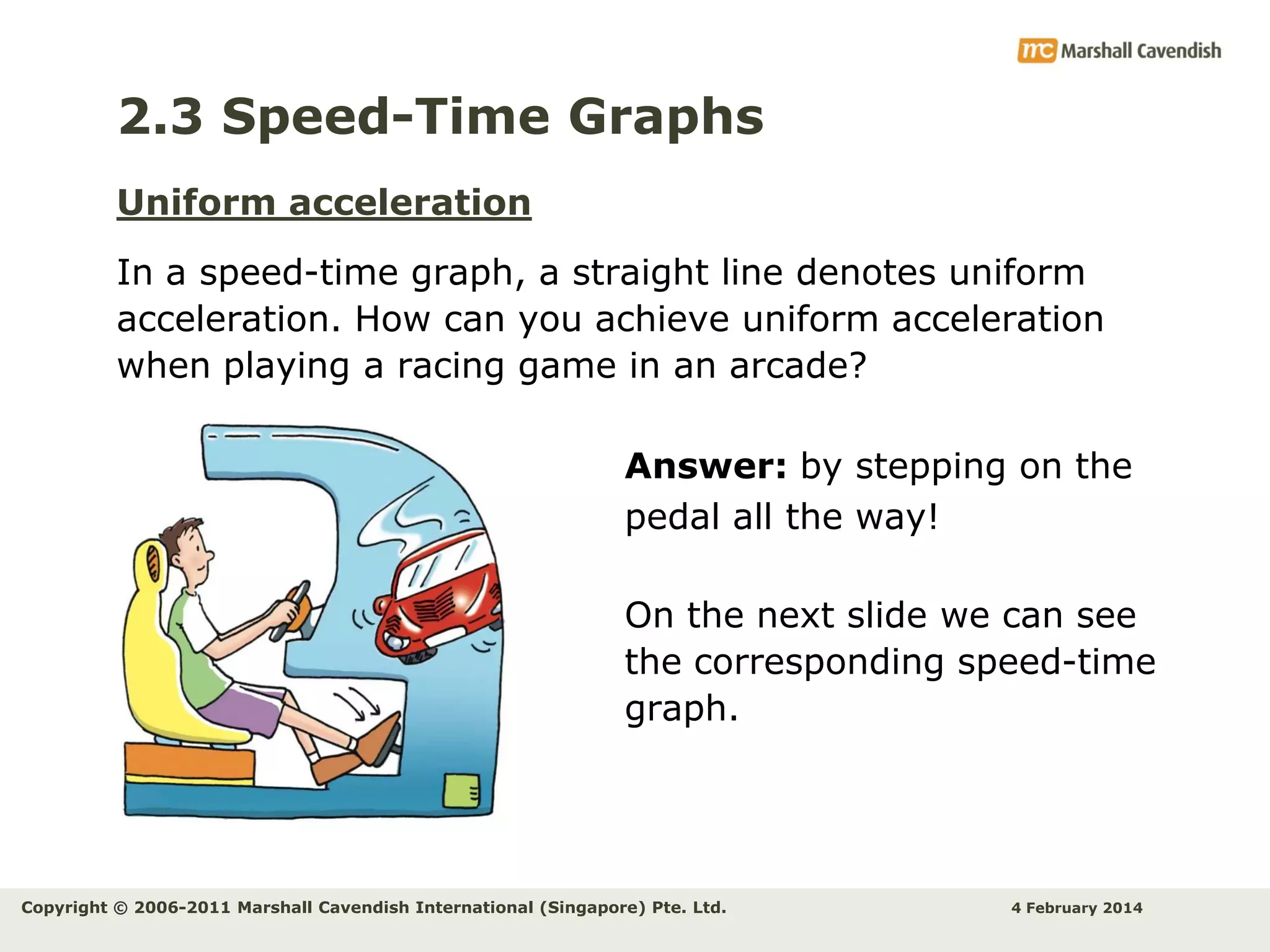
In a speed-time graph, a straight line denotes uniform
acceleration. How can you achieve uniform acceleration
when playing a racing game in an arcade?
Answer: by stepping on the
pedal all the way!
On the next slide we can see
the corresponding speed-time
graph.

Copyright © 2006-2011 Marshall Cavendish International (Singapore) Pte. Ltd.

4 February 2014
2.3 Speed-Time Graphs
Uniform acceleration
Speed/m s-1
35
30
25
20
15
10
5
0

0

2

4

6

8

10

12

13

14

Time/s

The gradient of the line is 2 m s-2

Or: a = (u – v)/t = (20 – 10)/(10 – 0) = 2 m s-2
Copyright © 2006-2011 Marshall Cavendish International (Singapore) Pte. Ltd.

4 February 2014
2.3 Speed-Time Graphs
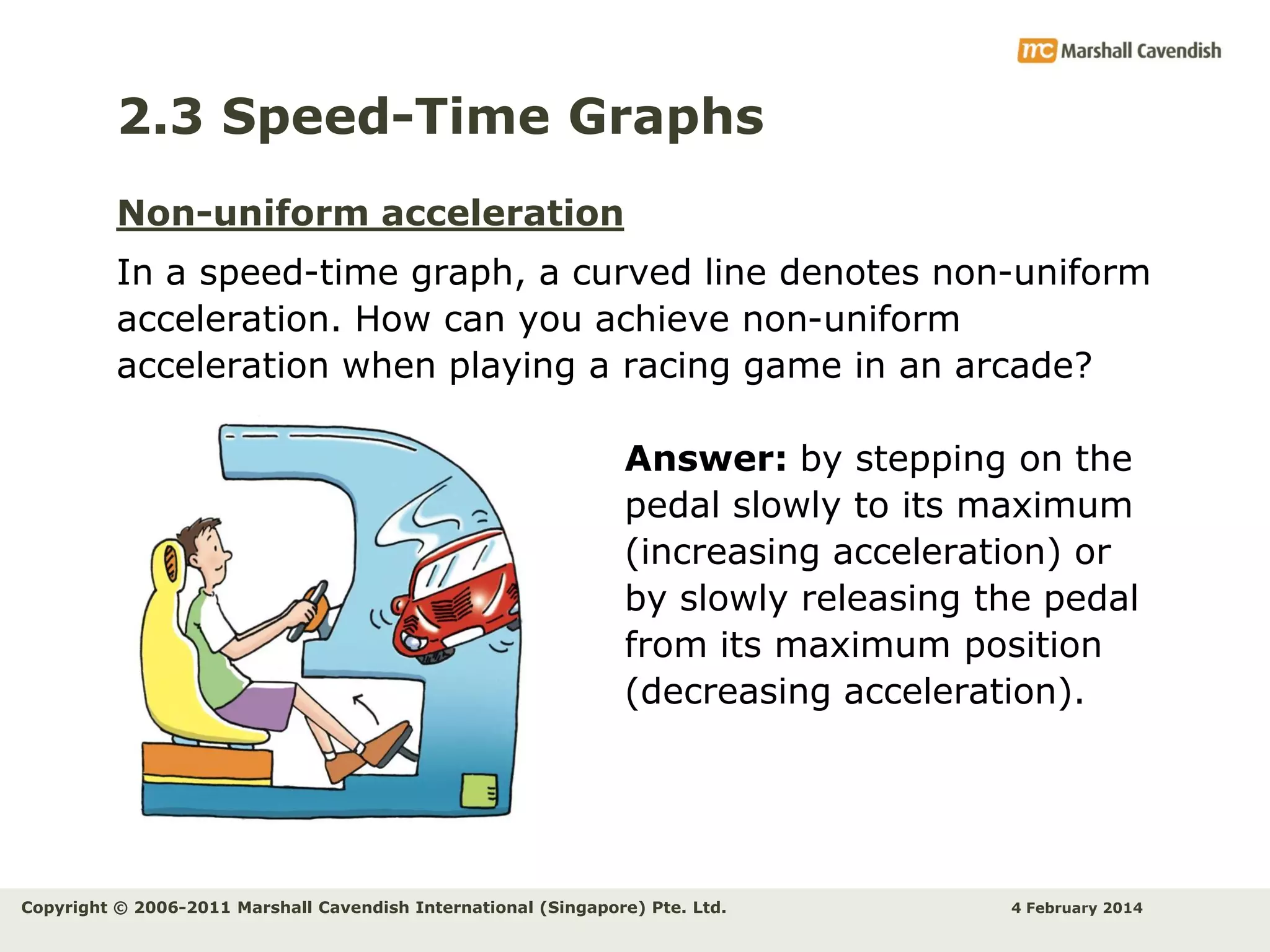
Non-uniform acceleration
In a speed-time graph, a curved line denotes non-uniform
acceleration. How can you achieve non-uniform
acceleration when playing a racing game in an arcade?
Answer: by stepping on the
pedal slowly to its maximum
(increasing acceleration) or
by slowly releasing the pedal
from its maximum position
(decreasing acceleration).

Copyright © 2006-2011 Marshall Cavendish International (Singapore) Pte. Ltd.

4 February 2014
2.3 Speed-Time Graphs
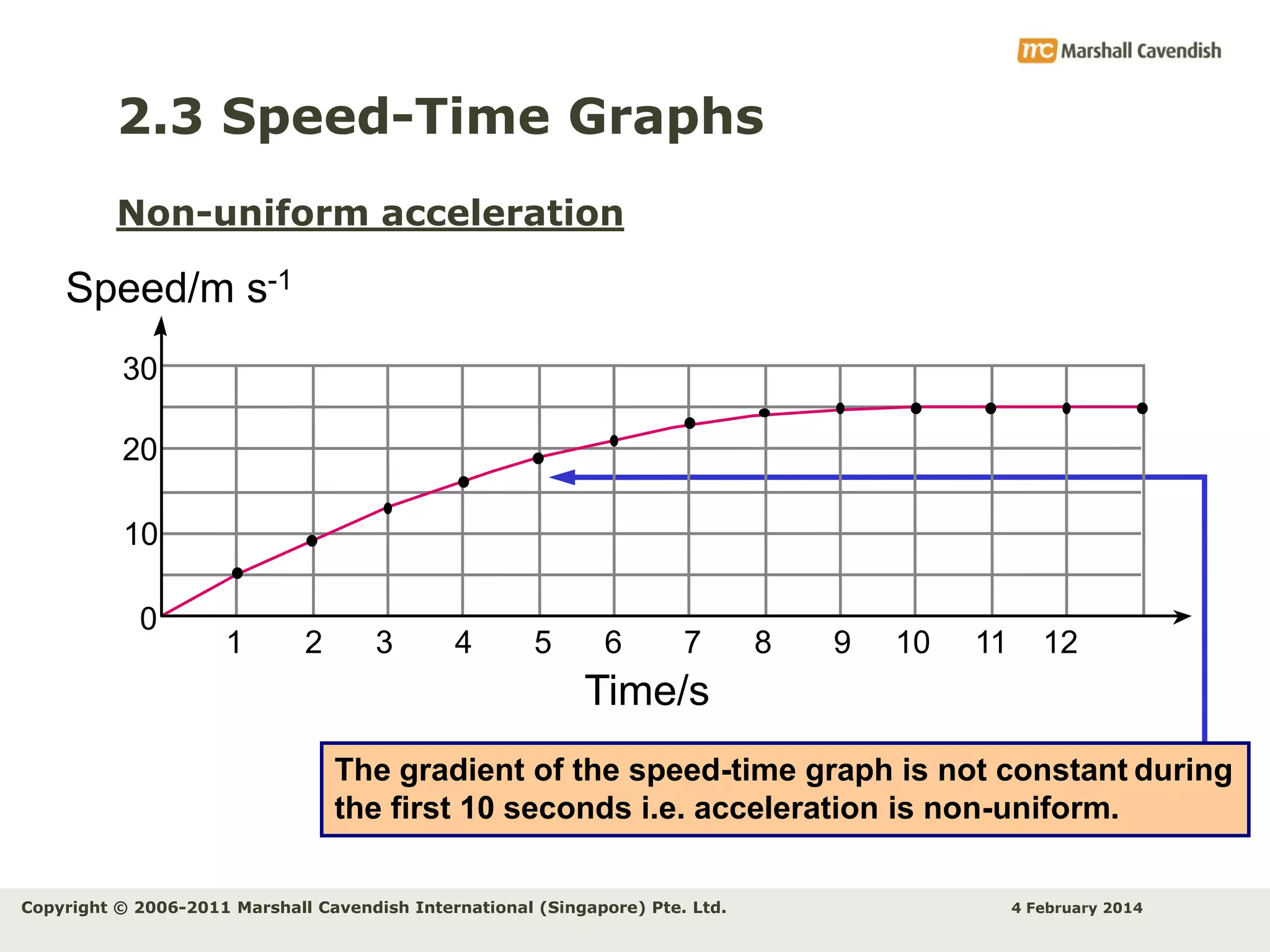
Non-uniform acceleration

Speed/m s-1
30
20

10
0

1

2

3

4

5

6

7

8

9

10

11

12

Time/s
The gradient of the speed-time graph is not constant during
the first 10 seconds i.e. acceleration is non-uniform.
Copyright © 2006-2011 Marshall Cavendish International (Singapore) Pte. Ltd.

4 February 2014
2.3 Speed-Time Graphs
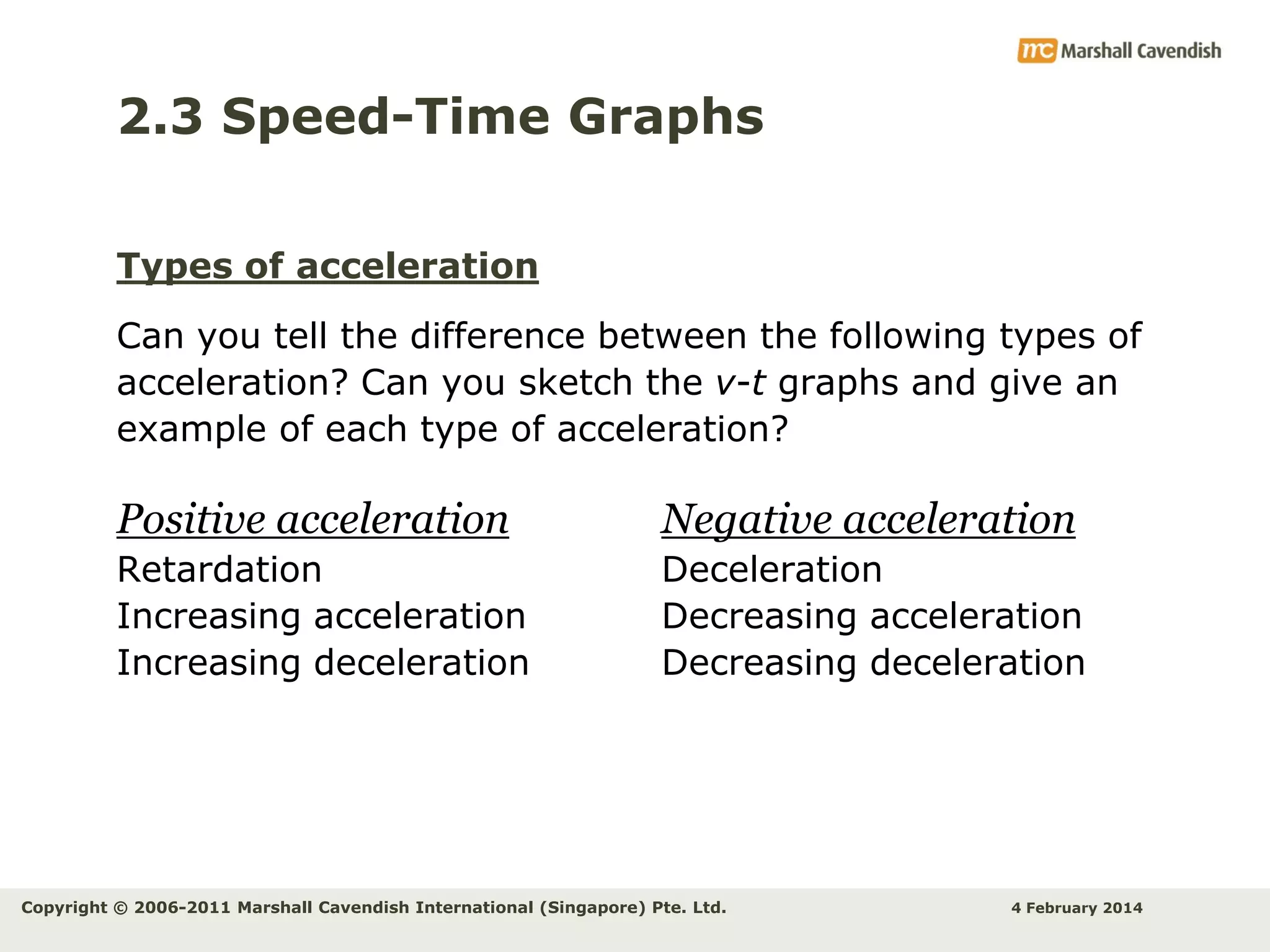
Types of acceleration
Can you tell the difference between the following types of
acceleration? Can you sketch the v-t graphs and give an
example of each type of acceleration?

Positive acceleration

Negative acceleration

Retardation
Increasing acceleration
Increasing deceleration

Deceleration
Decreasing acceleration
Decreasing deceleration

Copyright © 2006-2011 Marshall Cavendish International (Singapore) Pte. Ltd.

4 February 2014
2.3 Speed-Time Graphs
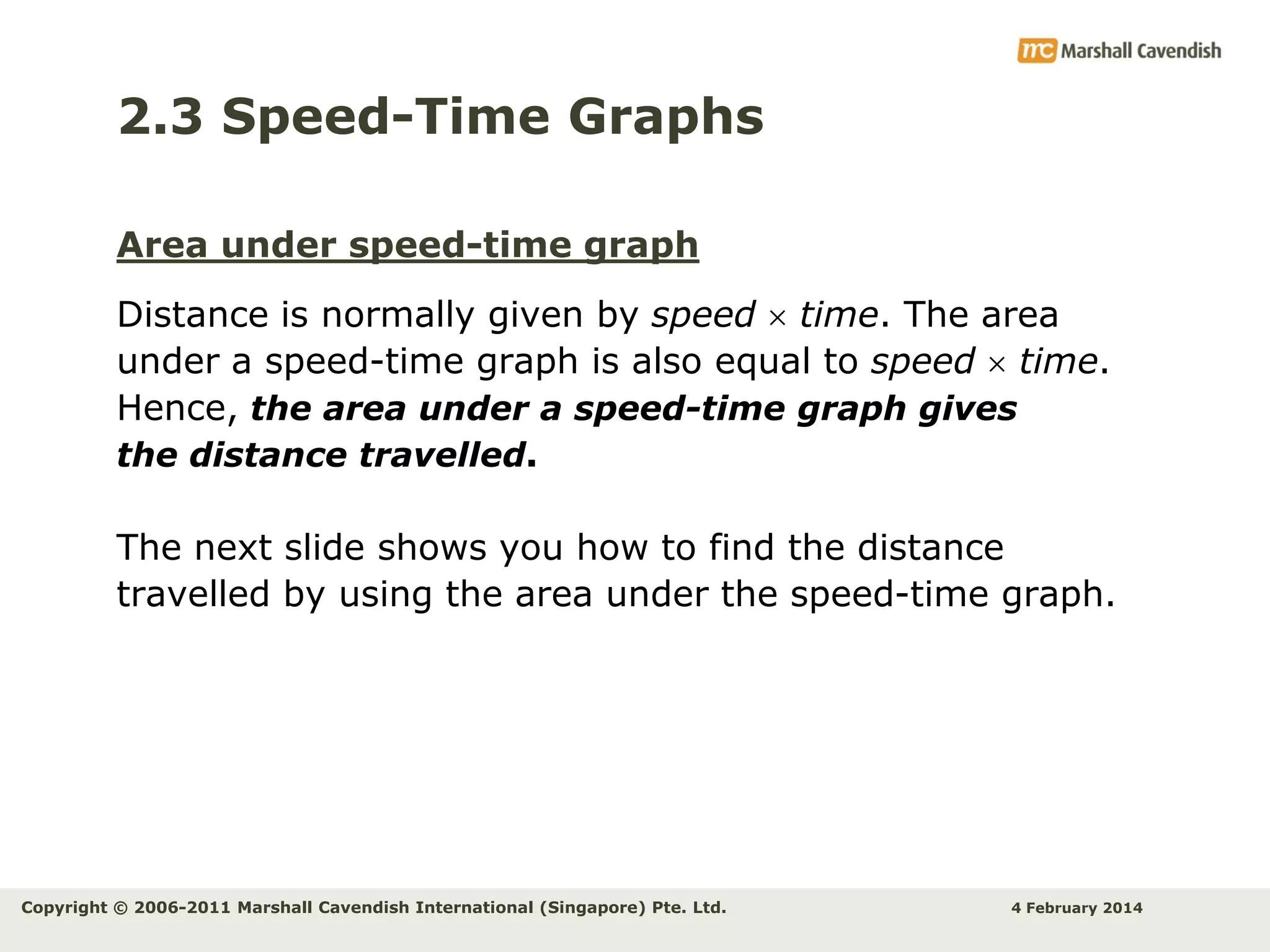
Area under speed-time graph

Distance is normally given by speed  time. The area
under a speed-time graph is also equal to speed  time.
Hence, the area under a speed-time graph gives
the distance travelled.
The next slide shows you how to find the distance
travelled by using the area under the speed-time graph.

Copyright © 2006-2011 Marshall Cavendish International (Singapore) Pte. Ltd.

4 February 2014
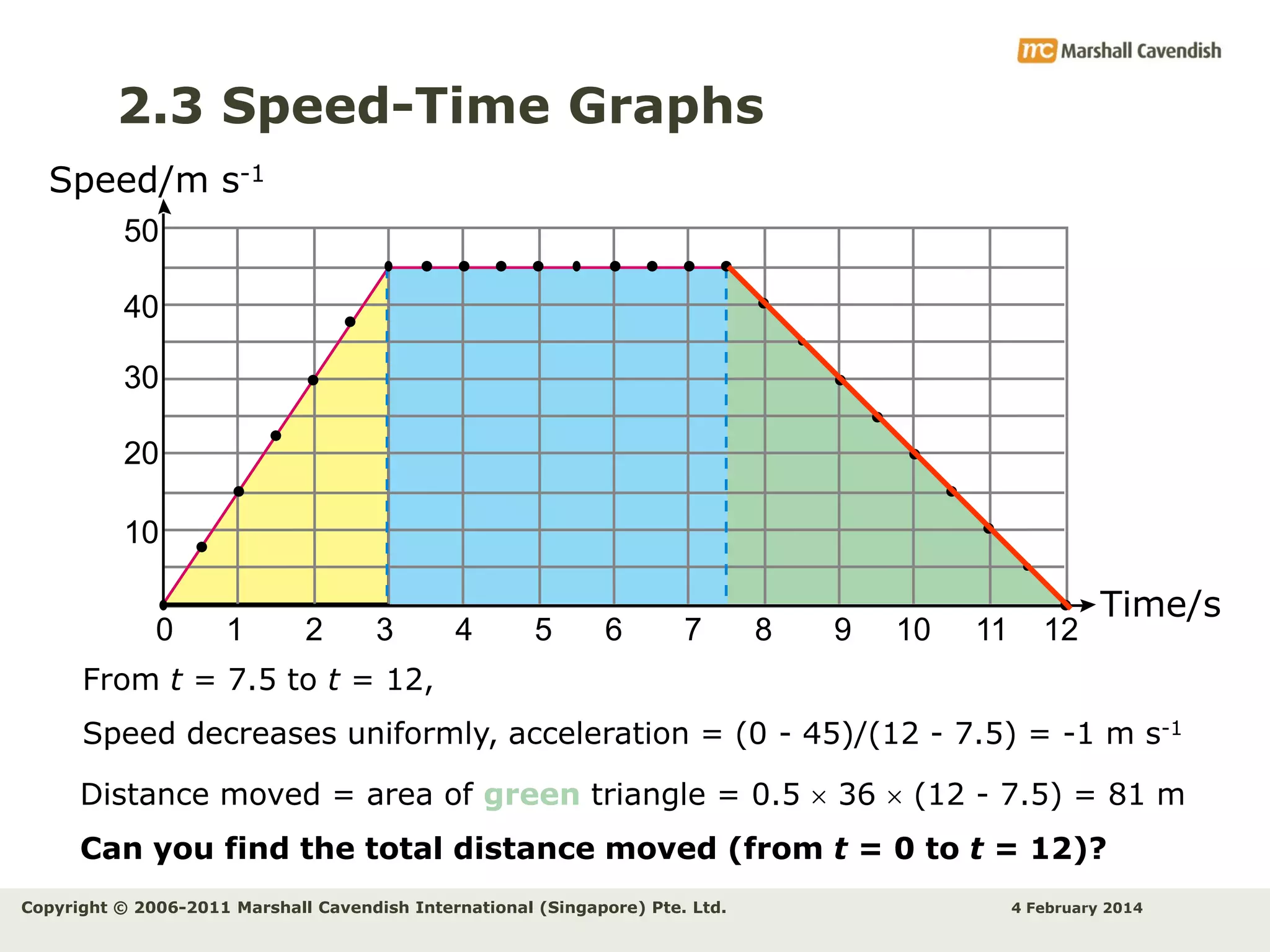
2.3 Speed-Time Graphs
Speed/m s-1
50
40
30
20
10
0

1

2

3

4

5

6

7

8

9

10

11

12

Time/s

From t = 7.5 to t = 12,
Speed decreases uniformly, acceleration = (0 - 45)/(12 - 7.5) = -1 m s-1
Distance moved = area of green triangle = 0.5  36  (12 - 7.5) = 81 m

Can you find the total distance moved (from t = 0 to t = 12)?
Copyright © 2006-2011 Marshall Cavendish International (Singapore) Pte. Ltd.

4 February 2014
2.3 Speed-Time Graphs
Key Ideas
• A speed-time graph shows how speed changes with
time.
• The gradient of the tangent at a point on the
speed-time graph gives the instantaneous
acceleration.
• The area under the speed-time graph is the total
distance travelled.

Copyright © 2006-2011 Marshall Cavendish International (Singapore) Pte. Ltd.

4 February 2014
2.3 Speed-Time Graphs
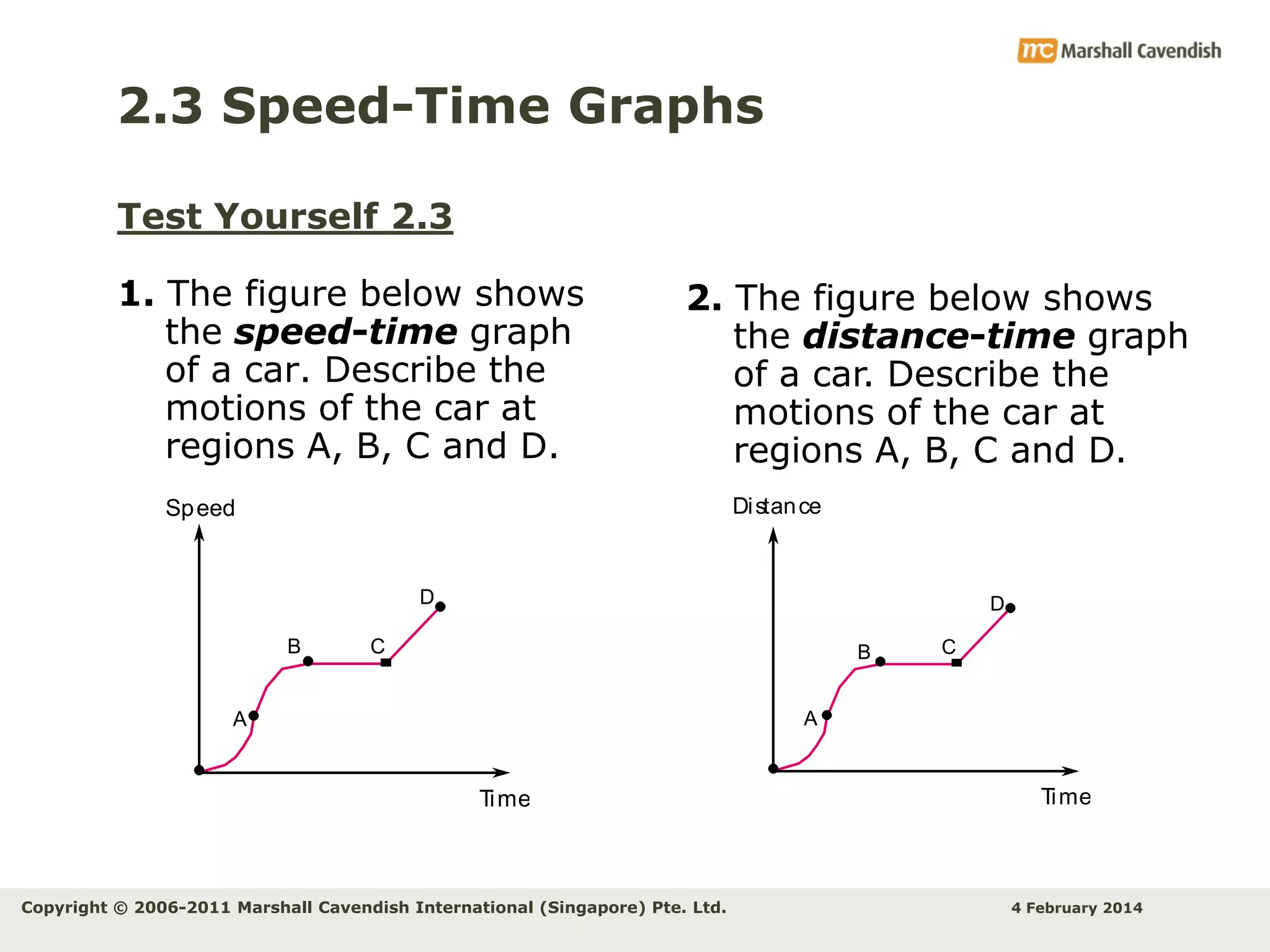
Test Yourself 2.3
1. The figure below shows
the speed-time graph
of a car. Describe the
motions of the car at
regions A, B, C and D.

2. The figure below shows
the distance-time graph
of a car. Describe the
motions of the car at
regions A, B, C and D.
Di stan ce

Sp eed

D
B

D

C

B

C

A

A

Ti me

Copyright © 2006-2011 Marshall Cavendish International (Singapore) Pte. Ltd.

Ti me

4 February 2014
2.4 Acceleration of Free Fall
In this section, you’ll be able to:
• state that the acceleration of free fall near to Earth is
approximately 10 m s-2
• describe motion of bodies in free fall with and without
air resistance
• understand what terminal velocity is

Copyright © 2006-2011 Marshall Cavendish International (Singapore) Pte. Ltd.

4 February 2014
2.4 Acceleration of Free Fall
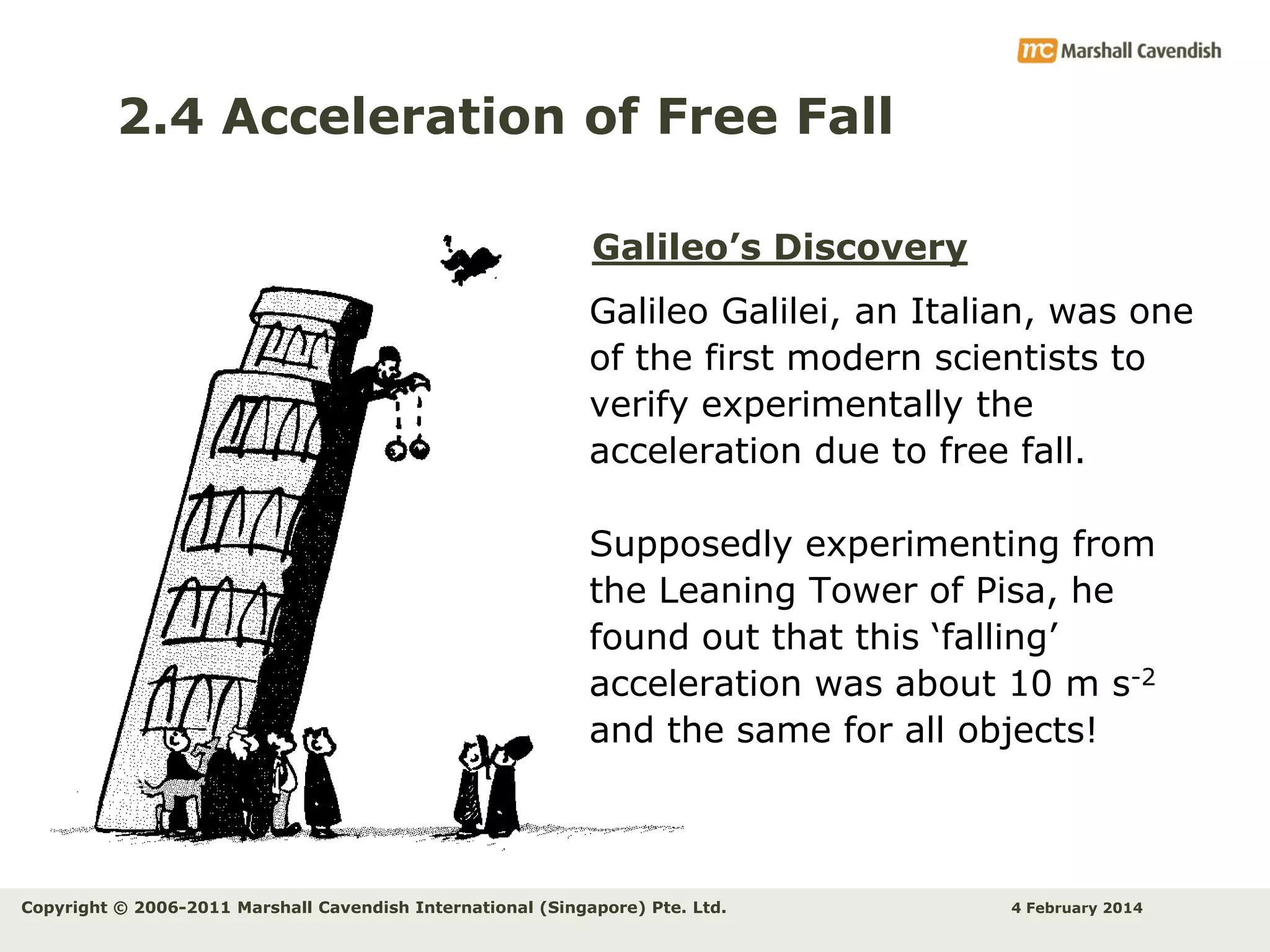
Galileo’s Discovery
Galileo Galilei, an Italian, was one
of the first modern scientists to
verify experimentally the
acceleration due to free fall.
Supposedly experimenting from
the Leaning Tower of Pisa, he
found out that this ‘falling’
acceleration was about 10 m s-2
and the same for all objects!

Copyright © 2006-2011 Marshall Cavendish International (Singapore) Pte. Ltd.

4 February 2014
2.4 Acceleration of Free Fall
Falling without air resistance
Take a coin from your wallet and hold it
in one hand. Hold your wallet in the other
hand and stand on your chair. Drop both
items from the same height at the same
time. What happens?
a) The light coin hits the ground first
b) The heavy wallet hits the ground first
c) Both hit the ground at the same time

Copyright © 2006-2011 Marshall Cavendish International (Singapore) Pte. Ltd.

4 February 2014
2.4 Acceleration of Free Fall
Falling with air resistance

Objects falling without (or with negligible) air
resistance fall with 10 m s-2. If air resistance is
present, objects will fall with a constant speed.
Air resistance:
1.
2.
3.
4.

Opposes the motion of moving objects
Increases with the speed of the object
Increases with surface area
Increases with density of air

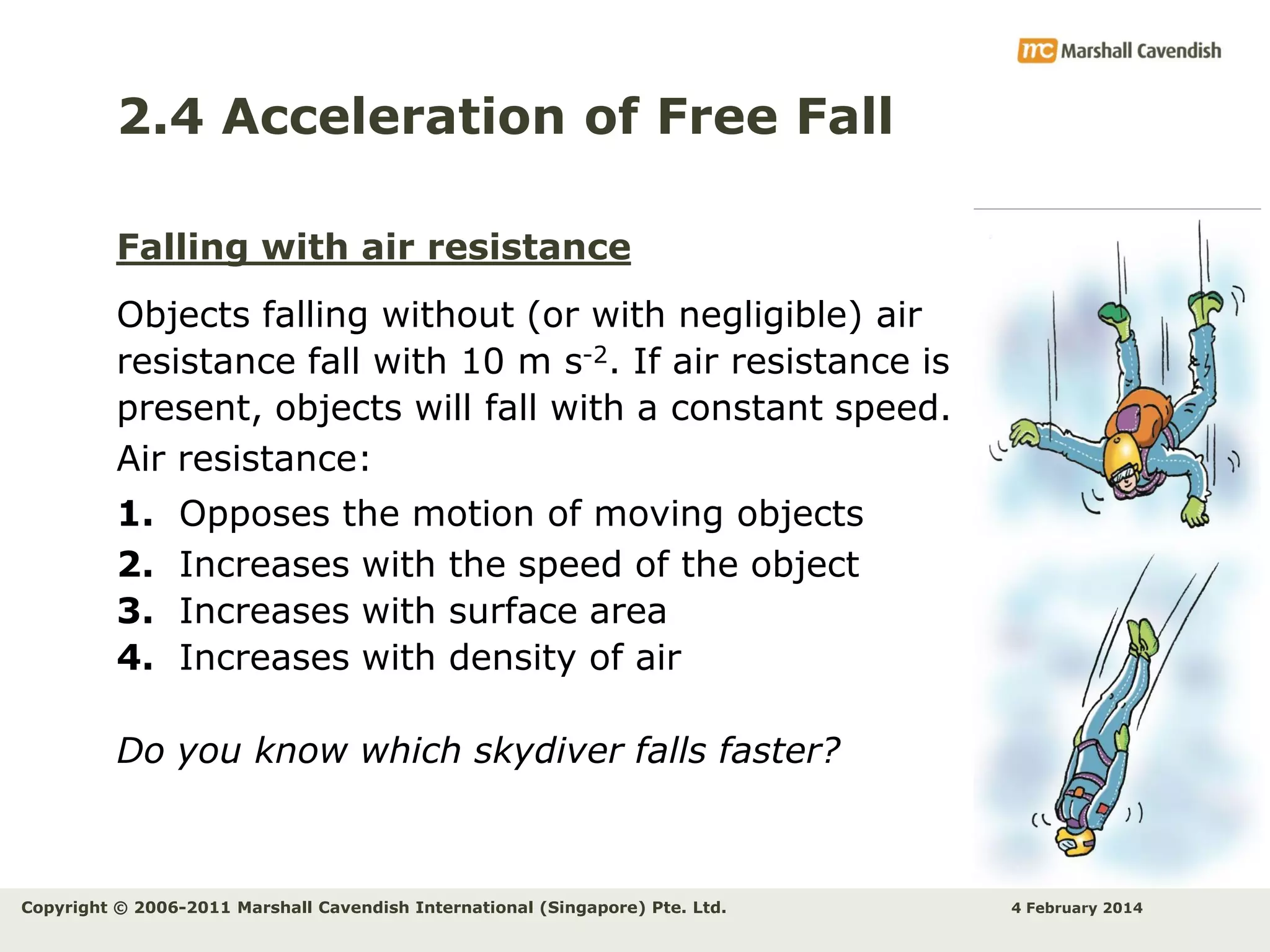
Do you know which skydiver falls faster?

Copyright © 2006-2011 Marshall Cavendish International (Singapore) Pte. Ltd.

4 February 2014
2.4 Acceleration of Free Fall
Key Ideas

• When air resistance is absent, all objects fall under
gravity with constant acceleration, g, the acceleration
of free fall (about 10 m s-2)
• When air resistance is present, all objects falling under
gravity experience decreasing acceleration until
terminal velocity is reached. (At this point, air
resistance equals the weight of the object.)

Copyright © 2006-2011 Marshall Cavendish International (Singapore) Pte. Ltd.

4 February 2014
2.4 Acceleration of Free Fall
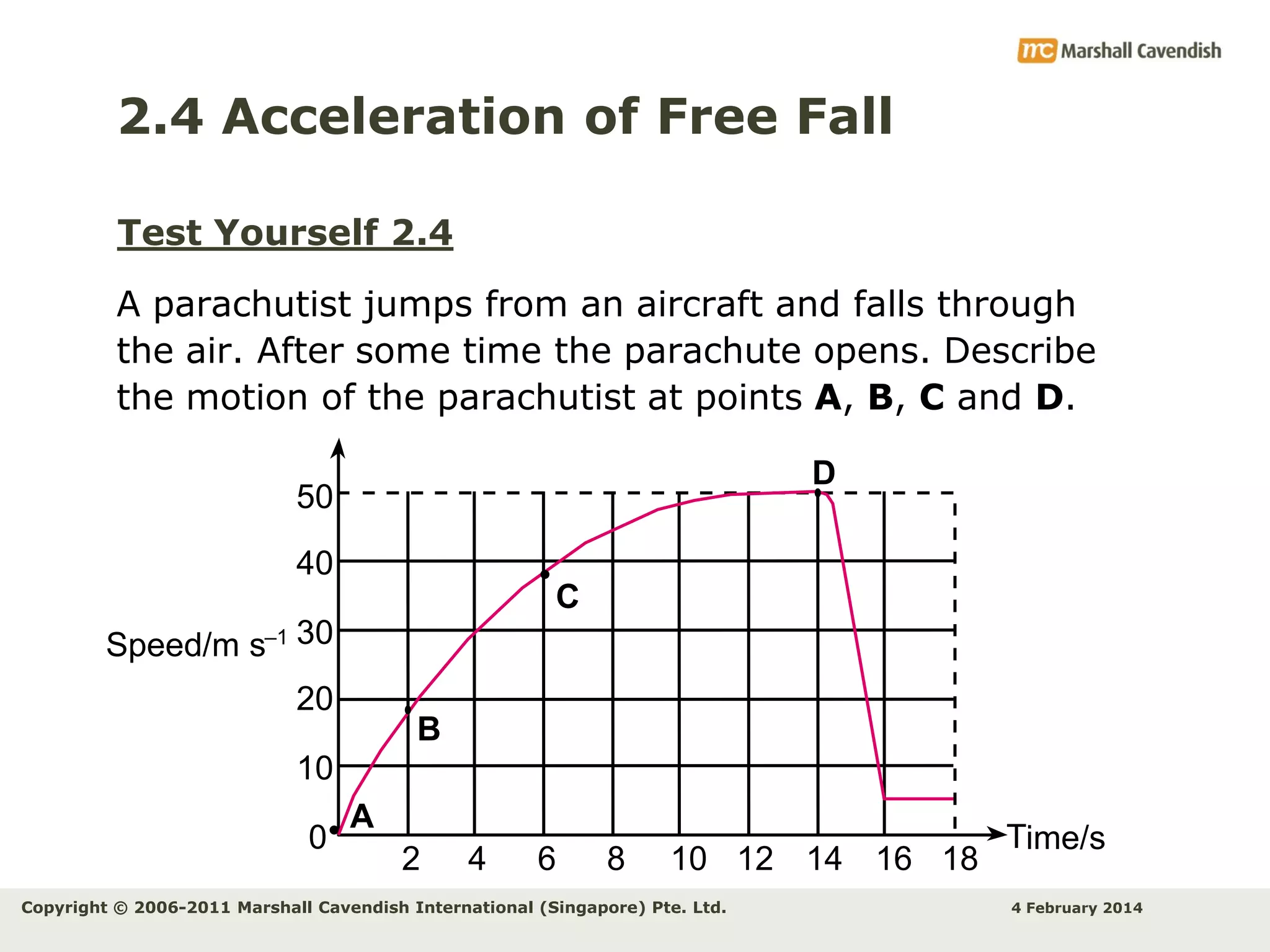
Test Yourself 2.4
A parachutist jumps from an aircraft and falls through
the air. After some time the parachute opens. Describe
the motion of the parachutist at points A, B, C and D.
D

50
40
C
Speed/m s–1 30
20

B

10
0

A
2

4

6

8

10 12 14 16 18

Copyright © 2006-2011 Marshall Cavendish International (Singapore) Pte. Ltd.

Time/s
4 February 2014

Unit 2

  • 1.
    PHYSICS Matters forGCE ‘O’ Level Unit 2: Kinematics
  • 2.
    2.1 Distance, Timeand Speed In this section, you’ll be able to: • state what speed is • calculate average speed • plot and interpret a distance-time graph Copyright © 2006-2011 Marshall Cavendish International (Singapore) Pte. Ltd. 4 February 2014
  • 3.
    2.1 Distance, Timeand Speed What is Speed? Speed is the distance moved per unit time i.e. Speed = In symbols, v = where distance moved time taken d t d = distance moved (m) t = time taken (s) v = speed (m s-1) Copyright © 2006-2011 Marshall Cavendish International (Singapore) Pte. Ltd. 4 February 2014
  • 4.
    2.1 Distance, Timeand Speed The ‘Triangle’ Method To find the value of a quantity, cover up the symbol to give the related formula: • d=vt • v= d t • t= d v Copyright © 2006-2011 Marshall Cavendish International (Singapore) Pte. Ltd. 4 February 2014
  • 5.
    2.1 Distance, Timeand Speed What is Average Speed? Can you calculate the speed of each athlete in the table below? Athlete Event Time Speed/m s–1 Atlanta, 1996 Bailey, Canada 100 m 9.84 s 10.2 Atlanta, 1996 Johnson, USA 200 m 19.32 s 10.4 Atlanta, 1996 Johnson, USA 400 m 43.49 s 9.2 Atlanta, 1996 Rodal, Norway 800 m 1:42.59 min 7.8 Location, year Copyright © 2006-2011 Marshall Cavendish International (Singapore) Pte. Ltd. 4 February 2014
  • 6.
    2.1 Distance, Timeand Speed What is Average Speed? • The speed that you have calculated for each athlete is actually the average speed. • Each athlete did not run at the same speed throughout the race. • In short, average speed assumes that the object travels at the same speed throughout the entire distance. Copyright © 2006-2011 Marshall Cavendish International (Singapore) Pte. Ltd. 4 February 2014
  • 7.
    2.1 Distance, Timeand Speed What is 1 m s-1 in km h-1? 1 m s-1 means that the object moves 1 m in 1 s. In 1 h, there are 60 × 60 = 3600 s. Hence, the distance traveled in 3600 s is 3600 m = 3.6 km. Therefore, 1 m s-1 = 3.6 km h-1. Or you can use conversion of units as follows: 1 m  1 km  60 s  60 min = 3.6 km = 3.6 km h-1 1 s 1000 m 1 min 1h 1h Copyright © 2006-2011 Marshall Cavendish International (Singapore) Pte. Ltd. 4 February 2014
  • 8.
    2.1 Distance, Timeand Speed Distance-time graphs For an object moving with constant or uniform speed, the distance-time graph is a straight line. What is the speed of this object? Distance/m 100 80 60 40 20 0 2 4 6 8 10 12 The total distance moved after 10 s is 80 m. Therefore, the speed is: 80 v= = 8 m s-1 10 Time/s Copyright © 2006-2011 Marshall Cavendish International (Singapore) Pte. Ltd. 4 February 2014
  • 9.
    2.1 Distance, Timeand Speed Distance-time graphs for increasing speed After 10 s, distance moved is 20 m. Average speed after 10 s is : 20 v= = 2 m s–1 10 100 80 60 40 20 0 2 4 6 8 10 12 14 16 Time/s Copyright © 2006-2011 Marshall Cavendish International (Singapore) Pte. Ltd. 18 20 After 20 s, distance moved is 80 m. The average speed after 20 s is: 80 v= = 4 m s–1 20 4 February 2014
  • 10.
    2.1 Distance, Timeand Speed Distance-time graphs for decreasing speed During the first 18 s, the speed of the object decreases. 100 80 60 40 20 0 2 4 6 8 10 12 14 Time/s 16 18 Copyright © 2006-2011 Marshall Cavendish International (Singapore) Pte. Ltd. After 18 s, distance moved remains 100 m. There is no change in the distance from 10 s to 15 s. Therefore, the 20 speed is zero. The object is stationary or at rest. 4 February 2014
  • 11.
    2.1 Distance, Timeand Speed Instantaneous Speed The instantaneous speed of an object is the speed at a particular instant. It can be found from the gradient of the tangent at a point on the distance-time graph. At t = 5 s, the instantaneous speed is s 90 v= = 14 = 6.4 m s-1 t 100 80 60 40 s 20 0 t 2 4 6 8 10 12 14 Copyright © 2006-2011 Marshall Cavendish International (Singapore) Pte. Ltd. 16 18 20 Time/s 4 February 2014
  • 12.
    2.1 Distance, Timeand Speed Key Ideas • Speed is the change in distance per unit time, v = s t Its SI unit is m s-1. • Average speed is the total distance travelled, divided by the total time taken. • A distance-time graph shows how distance changes with time. (a) If speed is uniform, the graph is a straight line. (b) If speed is non-uniform, the graph is a curve. • The gradient of the tangent at a point on the s-t graph gives the instantaneous speed. Copyright © 2006-2011 Marshall Cavendish International (Singapore) Pte. Ltd. 4 February 2014
  • 13.
    2.1 Distance, Timeand Speed Test Yourself 2.1 At the start of a journey, the odometer (a meter which clocks the total distance of a car has travelled) has an initial reading of 50780 km. At the end of the journey, the odometer reading was 50924 km. The journey took two hours. What was the average speed of the journey in (a) km h-1 ? (b) m s-1 ? Speedometer Odometer Copyright © 2006-2011 Marshall Cavendish International (Singapore) Pte. Ltd. 4 February 2014
  • 14.
    2.2 Speed, Velocityand Acceleration In this section, you’ll be able to: • state what velocity and uniform acceleration are change in velocity • calculate acceleration using Time taken • interpret given examples of non-uniform acceleration Copyright © 2006-2011 Marshall Cavendish International (Singapore) Pte. Ltd. 4 February 2014
  • 15.
    2.2 Speed, Velocityand Acceleration Speed and Velocity Velocity is the change in distance in a specified direction (i.e. displacement) per unit time. It can be positive or negative. For example, when you perform a 200 m sprint, your distance is 200 m, whereas your displacement is generally Distance less, as shown in the figure below. What would your speed and velocity be when you run the 200 metres in Displacement 50 m 25 seconds? Copyright © 2006-2011 Marshall Cavendish International (Singapore) Pte. Ltd. travelled 200 m 4 February 2014
  • 16.
    2.2 Speed, Velocityand Acceleration Acceleration Acceleration is the change in velocity with time. In symbols: a =  v (in m s-2) t 3 seconds after take off, a shuttle has a speed of 45 m s-1. What is its acceleration? Copyright © 2006-2011 Marshall Cavendish International (Singapore) Pte. Ltd. 4 February 2014
  • 17.
    2.2 Speed, Velocityand Acceleration Key Ideas • Velocity is the change in displacement per unit time. It is speed in a specified direction. Its SI unit is m s-1, which is the same for speed. • Acceleration is the change in velocity per unit time. Its SI unit is m s-2. Copyright © 2006-2011 Marshall Cavendish International (Singapore) Pte. Ltd. 4 February 2014
  • 18.
    2.2 Speed, Velocityand Acceleration Test Yourself: Inside Scoop Ever heard of the Vertical Marathon? Since 1987, this race takes place annually at the tallest hotel in Southeast Asia: the 226 metres high Stamford hotel in Singapore. Balvinder Singh set the record in 1989 by climbing the 1336 steps in 6 minutes and 55 seconds. Calculate his velocity in steps and in kilometres per hour. Is his velocity positive or negative? Copyright © 2006-2011 Marshall Cavendish International (Singapore) Pte. Ltd. 4 February 2014
  • 19.
    2.3 Speed-Time Graphs Inthis section, you’ll be able to: • plot and interpret speed-time graphs • determine the distance travelled by calculating the area under the speed-time graph Copyright © 2006-2011 Marshall Cavendish International (Singapore) Pte. Ltd. 4 February 2014
  • 20.
    2.3 Speed-Time Graphs Uniformacceleration In a speed-time graph, a straight line denotes uniform acceleration. How can you achieve uniform acceleration when playing a racing game in an arcade? Answer: by stepping on the pedal all the way! On the next slide we can see the corresponding speed-time graph. Copyright © 2006-2011 Marshall Cavendish International (Singapore) Pte. Ltd. 4 February 2014
  • 21.
    2.3 Speed-Time Graphs Uniformacceleration Speed/m s-1 35 30 25 20 15 10 5 0 0 2 4 6 8 10 12 13 14 Time/s The gradient of the line is 2 m s-2 Or: a = (u – v)/t = (20 – 10)/(10 – 0) = 2 m s-2 Copyright © 2006-2011 Marshall Cavendish International (Singapore) Pte. Ltd. 4 February 2014
  • 22.
    2.3 Speed-Time Graphs Non-uniformacceleration In a speed-time graph, a curved line denotes non-uniform acceleration. How can you achieve non-uniform acceleration when playing a racing game in an arcade? Answer: by stepping on the pedal slowly to its maximum (increasing acceleration) or by slowly releasing the pedal from its maximum position (decreasing acceleration). Copyright © 2006-2011 Marshall Cavendish International (Singapore) Pte. Ltd. 4 February 2014
  • 23.
    2.3 Speed-Time Graphs Non-uniformacceleration Speed/m s-1 30 20 10 0 1 2 3 4 5 6 7 8 9 10 11 12 Time/s The gradient of the speed-time graph is not constant during the first 10 seconds i.e. acceleration is non-uniform. Copyright © 2006-2011 Marshall Cavendish International (Singapore) Pte. Ltd. 4 February 2014
  • 24.
    2.3 Speed-Time Graphs Typesof acceleration Can you tell the difference between the following types of acceleration? Can you sketch the v-t graphs and give an example of each type of acceleration? Positive acceleration Negative acceleration Retardation Increasing acceleration Increasing deceleration Deceleration Decreasing acceleration Decreasing deceleration Copyright © 2006-2011 Marshall Cavendish International (Singapore) Pte. Ltd. 4 February 2014
  • 25.
    2.3 Speed-Time Graphs Areaunder speed-time graph Distance is normally given by speed  time. The area under a speed-time graph is also equal to speed  time. Hence, the area under a speed-time graph gives the distance travelled. The next slide shows you how to find the distance travelled by using the area under the speed-time graph. Copyright © 2006-2011 Marshall Cavendish International (Singapore) Pte. Ltd. 4 February 2014
  • 26.
    2.3 Speed-Time Graphs Speed/ms-1 50 40 30 20 10 0 1 2 3 4 5 6 7 8 9 10 11 12 Time/s From t = 7.5 to t = 12, Speed decreases uniformly, acceleration = (0 - 45)/(12 - 7.5) = -1 m s-1 Distance moved = area of green triangle = 0.5  36  (12 - 7.5) = 81 m Can you find the total distance moved (from t = 0 to t = 12)? Copyright © 2006-2011 Marshall Cavendish International (Singapore) Pte. Ltd. 4 February 2014
  • 27.
    2.3 Speed-Time Graphs KeyIdeas • A speed-time graph shows how speed changes with time. • The gradient of the tangent at a point on the speed-time graph gives the instantaneous acceleration. • The area under the speed-time graph is the total distance travelled. Copyright © 2006-2011 Marshall Cavendish International (Singapore) Pte. Ltd. 4 February 2014
  • 28.
    2.3 Speed-Time Graphs TestYourself 2.3 1. The figure below shows the speed-time graph of a car. Describe the motions of the car at regions A, B, C and D. 2. The figure below shows the distance-time graph of a car. Describe the motions of the car at regions A, B, C and D. Di stan ce Sp eed D B D C B C A A Ti me Copyright © 2006-2011 Marshall Cavendish International (Singapore) Pte. Ltd. Ti me 4 February 2014
  • 29.
    2.4 Acceleration ofFree Fall In this section, you’ll be able to: • state that the acceleration of free fall near to Earth is approximately 10 m s-2 • describe motion of bodies in free fall with and without air resistance • understand what terminal velocity is Copyright © 2006-2011 Marshall Cavendish International (Singapore) Pte. Ltd. 4 February 2014
  • 30.
    2.4 Acceleration ofFree Fall Galileo’s Discovery Galileo Galilei, an Italian, was one of the first modern scientists to verify experimentally the acceleration due to free fall. Supposedly experimenting from the Leaning Tower of Pisa, he found out that this ‘falling’ acceleration was about 10 m s-2 and the same for all objects! Copyright © 2006-2011 Marshall Cavendish International (Singapore) Pte. Ltd. 4 February 2014
  • 31.
    2.4 Acceleration ofFree Fall Falling without air resistance Take a coin from your wallet and hold it in one hand. Hold your wallet in the other hand and stand on your chair. Drop both items from the same height at the same time. What happens? a) The light coin hits the ground first b) The heavy wallet hits the ground first c) Both hit the ground at the same time Copyright © 2006-2011 Marshall Cavendish International (Singapore) Pte. Ltd. 4 February 2014
  • 32.
    2.4 Acceleration ofFree Fall Falling with air resistance Objects falling without (or with negligible) air resistance fall with 10 m s-2. If air resistance is present, objects will fall with a constant speed. Air resistance: 1. 2. 3. 4. Opposes the motion of moving objects Increases with the speed of the object Increases with surface area Increases with density of air Do you know which skydiver falls faster? Copyright © 2006-2011 Marshall Cavendish International (Singapore) Pte. Ltd. 4 February 2014
  • 33.
    2.4 Acceleration ofFree Fall Key Ideas • When air resistance is absent, all objects fall under gravity with constant acceleration, g, the acceleration of free fall (about 10 m s-2) • When air resistance is present, all objects falling under gravity experience decreasing acceleration until terminal velocity is reached. (At this point, air resistance equals the weight of the object.) Copyright © 2006-2011 Marshall Cavendish International (Singapore) Pte. Ltd. 4 February 2014
  • 34.
    2.4 Acceleration ofFree Fall Test Yourself 2.4 A parachutist jumps from an aircraft and falls through the air. After some time the parachute opens. Describe the motion of the parachutist at points A, B, C and D. D 50 40 C Speed/m s–1 30 20 B 10 0 A 2 4 6 8 10 12 14 16 18 Copyright © 2006-2011 Marshall Cavendish International (Singapore) Pte. Ltd. Time/s 4 February 2014